REVIEW 4 major objections 5 minor 3 cited by
Noisereduce: Domain General Noise Reduction for Time Series Signals
T0 review · 4 major / 5 minor · reviewed 2026-08-11 · deepseek-v4-flash
Pith's one-line read The paper claims Noisereduce, a spectral gating algorithm that requires no training data, outperforms other conventional noise reduction algorithms on speech, birdsong, simulated neural spikes, and seismic waveforms, making it a fast…
desk verdict Honest validation of a widely used spectral gating tool with a genuinely useful benchmark; the bioacoustics comparison hands Noisereduce a matched noise clip the baselines never see, and that asymmetry should drive the revision. read the letter →
The pith
A machine-rendered reading of the paper's core claim, the machinery that carries it, and where it could break.
The reading
What carries the argument
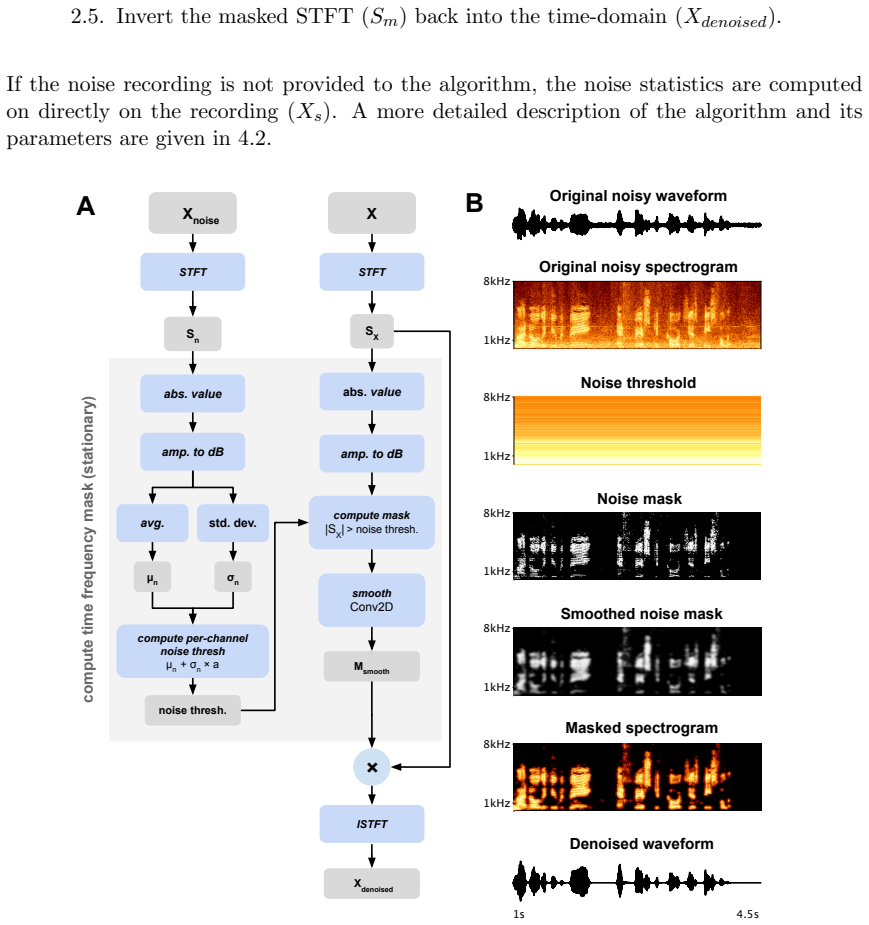
The load-bearing object is the per-frequency noise threshold $\mathrm{thresh}_n(f)=\mu_n(f)+k\sigma_n(f)$ computed from the decibel spectrogram of a noise estimate, which turns into a binary spectral mask $M(f,t)$. The mask is the whole algorithm: it decides, independently for each time-frequency cell, whether the energy is signal (keep) or noise (zero it), with an optional triangular smoothing kernel over frequency and time to reduce artifacts. Everything else, including the STFT, the inverse STFT, and the sliding-window statistics in the non-stationary variant, exists to feed this threshold. The argument stands or falls on whether such an amplitude threshold, set from noise statistics, separates signal from noise across domains.
What would settle it
Rerun the paper's NOIZEUS comparison with babble noise at a signal-to-noise ratio of 0 dB and measure STOI or PESQ; if Noisereduce does not exceed every conventional baseline listed (Wiener, iterative Wiener, subspace, spectral subtraction, Savitzky-Golay), the paper's main speech superiority claim is false. A similar test on non-stationary noise with abrupt amplitude changes would probe whether the sliding-window variant truly adapts faster than the stationary version.
Extended reading notes
Core claim
Noisereduce's central claim is that a simple per-frequency amplitude threshold cleanly separates signal from noise in a wide range of time-series recordings. The algorithm computes the short-time Fourier transform of a noise clip, converts magnitudes to decibels, and for each frequency $f$ sets $\mathrm{thresh}_n(f) = \mu_n(f) + k\sigma_n(f)$, where $\mu_n$ and $\sigma_n$ are the mean and standard deviation of the noise spectrogram across time and $k$ is a sensitivity hyperparameter. It then forms a binary mask $M(f,t)=1$ when the signal spectrogram exceeds the threshold and $0$ otherwise, optionally smooths the mask in time and frequency, multiplies the signal STFT by the mask, and inverts back to the time domain. The non-stationary variant computes the same statistics over a sliding window on the signal itself, so the threshold adapts as the noise floor changes. The paper argues that this training-free mask is fast, requires minimal computational resources, and outperforms other conventional algorithms in all four tested domains, while remaining competitive with deep-learning models at a fraction of the cost.
Load-bearing premise
The method assumes that the noise measured in a quiet clip, or in short windows around the signal, is the same noise that corrupts the signal, and that in each frequency band the signal's loudness is higher than the noise's average loudness plus a few fluctuations; when the noise shifts or the signal is faint, the mask erases signal or leaves noise.
Editorial extensions
If this is right
- In speech, Noisereduce can be adopted as the conventional baseline for comparing new machine-learning enhancers, since it beats Wiener, iterative Wiener, subspace, spectral subtraction, and Savitzky-Golay at 0, 5, 10, and 15 dB SNR on NOIZEUS.
- In bioacoustics, the new Birdsong NOIZEUS benchmark gives researchers a standard dataset, and Noisereduce provides a strong first-pass denoiser for recordings where no labeled training data exist.
- In electrophysiology, Noisereduce improves automated spike detection (ROC AUC 0.97 versus 0.91 unfiltered, 0.94 Wiener, and 0.96 Savitzky-Golay) and can be used as a preprocessing step before spike sorting, though not for clustering because it alters spike shapes.
- In seismology, Noisereduce reduces STA/LTA onset-detection error more than Wiener or Savitzky-Golay at low SNR for both white and pink noise, and comes closer to DeepDenoiser's performance than other conventional methods.
- GPU-accelerated Noisereduce runs fast enough for real-time or near-real-time use, making the algorithm practical on large datasets and resource-limited systems where deep denoisers are too slow.
Reading between the lines
- Editorial inference: The paper's domain-generality claim implies Noisereduce should transfer to other time-series domains with spectro-temporal structure, such as ECG artifact removal or sonar, as long as a noise-only clip or a slowly drifting noise floor is available; this transfer is not tested in the paper.
- Editorial inference: Because the mask is binary and amplitude-based, the non-stationary variant will lag abrupt noise-floor changes and will erase low-amplitude signal that overlaps the noise distribution; an adaptive or soft mask, which the paper mentions as future work, is the natural next test.
- Editorial inference: The authors' caveat that Noisereduce should be used only for spike detection, not clustering, suggests that any reconstruction-based downstream use, such as seismic waveform inversion or acoustic feature extraction, should validate that the mask does not distort the features of interest.
- Editorial inference: The Birdsong NOIZEUS dataset could become a reusable benchmark for bioacoustic denoising, enabling future machine-learning methods to be compared fairly across studies; the authors created it but do not make this claim explicitly.
Signed reviews
Editorial analysis
A structured set of objections, weighed in public.
Referee Report
Summary. The paper introduces Noisereduce, an open-source spectral gating algorithm for time-series noise reduction, and evaluates it on four domains: speech, bioacoustics, electrophysiology, and seismology. The algorithm computes a per-frequency threshold from noise statistics, builds a binary time-frequency mask, optionally smooths it, and applies it to the signal STFT; a non-stationary variant computes the threshold from sliding windows on the signal itself. The authors compare Noisereduce against several conventional algorithms (Wiener, Iterative Wiener, Savitzky-Golay, Spectral Subtraction, Subspace) and, in speech and seismology, against deep-learning baselines. They report that Noisereduce outperforms the conventional algorithms on the tested metrics and runs faster than the deep-learning baselines, supporting its proposed role as a domain-general tool and a baseline for machine-learning methods.
Significance. If the claims hold, the paper provides a useful validation of a widely used open-source tool, with concrete benefits: the algorithm requires no training data, has few parameters, supports GPU acceleration, and the authors release the benchmark data and reproduction scripts. The head-to-head comparisons with Denoiser and DeepDenoiser are informative for practitioners choosing between conventional and learned methods. However, the strength of the central claim depends on the correctness of the algorithm description and on the fairness of the comparisons; both currently have load-bearing issues that require correction before the reported results can be taken as supporting the advertised conclusions.
major comments (4)
- [4.2.1, Eq. (14)] Eq. (14) defines the masked STFT as Sm = conv2d(SX, SF), where SF is the smoothing filter, but the accompanying text says the mask Msmooth is applied to SX. As written, the mask M never enters the output and the operation would only smooth the spectrogram, not perform noise gating. This contradicts Step 2.4 in Section 1.1 and the block diagram in Fig. 1, where the smoothed mask is multiplied elementwise with the signal STFT. Please correct Eq. (14) to an elementwise multiplication of Msmooth with SX, and adjust Eqs. (9)–(13) so that they describe smoothing of the mask rather than of the signal spectrogram.
- [2.2 / 4.3, Bioacoustics comparison] The bioacoustics comparison appears to give Noisereduce an information advantage over the baselines. Section 4.3 states that for each song/noise pair the Birdsong NOIZEUS dataset includes a one-second noise clip at the same SNR, and Section 2.2 does not report whether the other algorithms received this clip. If Noisereduce was given the matched noise-only clip while Wiener and Savitzky-Golay had to estimate noise from the corrupted signal, then the large improvements in Tables 5 and 6 reflect asymmetric input information rather than algorithmic superiority. Please state explicitly which inputs each method received, and either provide the noise clip to all methods or evaluate Noisereduce without it; otherwise the claim that Noisereduce outperforms conventional algorithms in bioacoustics is not supported.
- [4.2.2 / Table 9] The parameter prop_decrease is described as a core control for how much below-threshold noise is removed, but it is absent from the formal algorithm in Section 4.2.1. Eq. (8) defines a binary mask and Eq. (14) does not include prop_decrease at all, so a reader cannot reproduce the behavior of the published package from the equations. Please add the missing equation (e.g., a soft scaling of the mask by prop_decrease) or remove the parameter from the algorithm description and state the default mask is binary.
- [2.2–2.4, Tables 5–8 and Fig. 5] The comparative claims rest on mean differences without inferential statistics. In several rows the reported SEMs overlap (e.g., Table 7, SNR 15: Noisereduce 0.069 ± 0.019 vs Wiener 0.080 ± 0.024; Table 5, SNR 15: Savitzky-Golay 11.91 ± 2.47), and Section 2.3 reports AUC differences from a single simulated recording with no uncertainty estimate. Please report sample sizes and appropriate significance tests or paired comparisons, or temper the wording from “outperforms” to “tends to improve” where the evidence is not conclusive.
minor comments (5)
- [2.1, speech experiments] It is not stated whether Noisereduce was provided with a noise-only clip in the NOIZEUS speech evaluation. This is important because the algorithm's stationary variant either uses a supplied noise clip or falls back to the signal itself; please specify which protocol was used for Tables 1–4.
- [4.2.1, Eq. (13)] The symbol W(f,t) in Eq. (13) is not defined; presumably W = Lf ⊗ Lt, but this should be stated explicitly.
- [4.2.2 / Table 9] The parameter names are inconsistent: the text refers to “n_std_thresh_stationary” while Table 9 lists “n_std_thresh”, and Eq. (5) uses k. Please unify the notation, and verify the default of 1 ms for “noise_window_size_nonstationary_ms”, which seems extremely short for most signals.
- [2.4, Tables 7–8] The statement that Noisereduce outperforms the baselines “across all SNR levels” is stronger than the data support at high SNR, where differences are small and confidence intervals overlap; consider adding statistical tests or softening the claim.
- [Fig. 5 caption] There is a typo in the caption: “Reciever Operator Characteristic” should be “Receiver Operating Characteristic.”
Circularity Check
No significant circularity: empirical benchmarking with external ground truth; matched-noise-clip asymmetry is a methodological concern, not a circular reduction.
full rationale
The paper is an empirical evaluation rather than a derivation chain. Noisereduce is a spectral-gating algorithm whose mask threshold is computed from noise statistics (Eqs. 3-5), and the benchmark comparisons use external ground truth signals (NOIZEUS speech, simulated MEArec electrophysiology, ObsPy seismic waveforms, and the author-released Birdsong NOIZEUS dataset). No parameter is fitted to a subset of the benchmark and then reported as a prediction, and no uniqueness theorem or prior-work ansatz is invoked to forbid alternative noise-reduction choices. The author-created Birdsong NOIZEUS dataset and the self-citations (e.g., [43,45,46]) are real evidence but not load-bearing: the current experiments stand on their own comparisons against standard algorithms and external metrics. One methodological caveat is that the bioacoustics evaluation provides Noisereduce with a matched 1-second noise clip drawn from the same soundscape at the same SNR (Sec. 4.3), while Wiener and Savitzky-Golay must estimate noise from the signal itself; this asymmetry weakens the strength of the reported "outperforms" claim in Sec. 2.2, but it is an experimental-design concern, not a circular equivalence between the method's output and its input by construction.
Assumptions & free parameters
free parameters (6)
- n_std_thresh =
1.5 (default)
- prop_decrease =
1.0 (default)
- freq_mask_smooth_hz =
500 Hz (default)
- time_mask_smooth_ms =
50 ms (default)
- noise_window_size_nonstationary_ms =
1 ms (default)
- n_fft, win_length, hop_length =
1024, None, None (defaults)
assumptions (4)
- domain assumption The observed signal is a sum of a clean signal and additive noise, and the noise statistics can be estimated from a representative noise clip or from the signal itself.
- domain assumption Signal and noise are separable by a per-frequency amplitude threshold in the STFT magnitude domain.
- domain assumption The noise is approximately stationary within the noise clip (stationary version) or within the sliding window (non-stationary version).
- domain assumption The mask smoothing kernel (triangular in frequency and time) preserves signal structure while removing isolated noise peaks.
Cite this review
Pith. "Pith review of Noisereduce: Domain General Noise Reduction for Time Series Signals." pith.science (2026). https://pith.science/paper/YQA4HQES
@misc{pith2026241217851,
  author       = {Pith},
  title        = {Pith review of: Noisereduce: Domain General Noise Reduction for Time Series Signals},
  year         = {2026},
  howpublished = {\url{https://pith.science/paper/YQA4HQES}},
  note         = {Machine review of arXiv:2412.17851}
}
read the original abstract
Extracting signals from noisy backgrounds is a fundamental problem in signal processing across a variety of domains. In this paper, we introduce Noisereduce, an algorithm for minimizing noise across a variety of domains, including speech, bioacoustics, neurophysiology, and seismology. Noisereduce uses spectral gating to estimate a frequency-domain mask that effectively separates signals from noise. It is fast, lightweight, requires no training data, and handles both stationary and non-stationary noise, making it both a versatile tool and a convenient baseline for comparison with domain-specific applications. We provide a detailed overview of Noisereduce and evaluate its performance on a variety of time-domain signals.
Figures


Figures from the paper (5 more)


Forward citations
Cited by 3 Pith papers
-
Training Set Synthesis for Bioacoustic Denoising: A Case Study With Mice
A U-Net trained on ridge-synthesized pseudo-clean mouse USVs, with a ridge-weighted loss, improves SI-SDR, ridge tracking, and classification accuracy on noisy bioacoustic recordings.
-
SyncBreaker:Stage-Aware Multimodal Adversarial Attacks on Audio-Driven Talking Head Generation
SyncBreaker jointly attacks image and audio streams with Multi-Interval Sampling and Cross-Attention Fooling to degrade speech-driven talking head generation more than single-modality baselines.
-
Improving Out-of-Domain Robustness with Targeted Augmentation in Frequency and Pixel Spaces
Combining amplitude-spectrum interpolation with pixel-space blending during fine-tuning improves out-of-domain accuracy by 3 to 9 points across vision, medical, audio, and astronomical benchmarks.
Reference graph
Works this paper leans on
-
[1]
R. V. Allen. Automatic earthquake recognition and timing from single traces. Bulletin of the Seismological Society of America, 68(5):1521–1532, 10 1978. ISSN 0037-1106. doi: 10.1785/BSSA0680051521. URL https://doi.org/10.1785/BSSA0680051521
-
[2]
Z. Arneodo, T. Sainburg, J. Jeanne, and T. Gentner. An acoustically isolated european starling song library, 2019. 15
work page 2019
-
[3]
M. Beyreuther, R. Barsch, L. Krischer, T. Megies, Y. Behr, and J. Wassermann. ObsPy: A Python Toolbox for Seismology. Seismological Research Letters, 81(3): 530–533, 05 2010. ISSN 0895-0695. doi: 10.1785/gssrl.81.3.530. URL https://doi. org/10.1785/gssrl.81.3.530
- [4]
-
[5]
S. Boll. Suppression of acoustic noise in speech using spectral subtraction. IEEE Transactions on acoustics, speech, and signal processing, 27(2):113–120, 1979
work page 1979
-
[6]
S. F. Boll. Suppression of acoustic noise in speech using spectral subtraction. IEEE Transactions on Acoustics, Speech, and Signal Processing, 27(2):113–120, 1979. doi: 10.1109/TASSP.1979.1163209
arXiv 1979
-
[7]
A. P. Buccino and G. T. Einevoll. Mearec: a fast and customizable testbench simulator for ground-truth extracellular spiking activity. Neuroinformatics, 19(1):185–204, 2021
work page 2021
-
[8]
A. P. Buccino, C. L. Hurwitz, S. Garcia, J. Magland, J. H. Siegle, R. Hurwitz, and M. H. Hennig. Spikeinterface, a unified framework for spike sorting. Elife, 9:e61834, 2020
work page 2020
Show all 62 references
-
[9]
X. Chen, R. Wang, A. Khalilian-Gourtani, L. Yu, P. Dugan, D. Friedman, W. Doyle, O. Devinsky, Y. Wang, and A. Flinker. A neural speech decoding framework leveraging deep learning and speech synthesis. Nature Machine Intelligence, pages 1–14, 2024
2024
-
[10]
Defossez, G
A. Defossez, G. Synnaeve, and Y. Adi. Real time speech enhancement in the waveform domain, 2020. URL https://arxiv.org/abs/2006.12847
2020 arXiv
-
[11]
P. S. Earle and P. M. Shearer. Characterization of global seismograms using an automatic-picking algorithm. Bulletin of the Seismological Society of America, 84(2): 366–376, 04 1994. ISSN 0037-1106. doi: 10.1785/BSSA0840020366. URL https: //doi.org/10.1785/BSSA0840020366
1994 doi
-
[12]
Ephraim and H
Y. Ephraim and H. Van Trees. A signal subspace approach for speech enhancement. IEEE Transactions on Speech and Audio Processing, 3(4):251–266, 1995. doi: 10. 1109/89.397090
1995
-
[13]
Fleishman, D
E. Fleishman, D. Cholewiak, D. Gillespie, T. Helble, H. Klinck, E.-M. Nosal, and M. A. Roch. Ecological inferences about marine mammals from passive acoustic data. Biological Reviews, 98(5):1633–1647, 2023. 16
2023
-
[14]
X. Hao, X. Su, Z. Wang, H. Zhang, and Batushiren. Unetgan: A robust speech en- hancement approach in time domain for extremely low signal-to-noise ratio condition. In Interspeech 2019. ISCA, Sept. 2019. doi: 10.21437/interspeech.2019-1567. URL http://dx.doi.org/10.21437/Inters...
2019 doi
-
[15]
X. Hao, X. Su, R. Horaud, and X. Li. Fullsubnet: A full-band and sub-band fu- sion model for real-time single-channel speech enhancement. In ICASSP 2021 - 2021 IEEE International Conference on Acoustics, Speech and Signal Processing (ICASSP). IEEE, June 2021. doi: 10.1109/icas...
2021
-
[16]
Hu and P
Y. Hu and P. C. Loizou. A subspace approach for enhancing speech corrupted by colored noise. In 2002 IEEE International Conference on Acoustics, Speech, and Signal Processing, volume 1, pages I–573–I–576, 2002. doi: 10.1109/ICASSP.2002.5743782
2002
-
[17]
Hu and P
Y. Hu and P. C. Loizou. Evaluation of Objective Quality Measures for Speech En- hancement. IEEE Transactions on Audio, Speech, and Language Processing, 16 (1):229–238, Jan. 2008. ISSN 1558-7924. doi: 10.1109/TASL.2007.911054. URL https://ieeexplore.ieee.org/document/4389058/
2008
-
[18]
A. S. Injaian, E. D. Lane, and H. Klinck. Aircraft events correspond with vocal behavior in a passerine. Scientific Reports, 11(1):1197, 2021
2021
-
[19]
P.56:Objective measurement of active speech level, 1993
International Telecommunication Union. P.56:Objective measurement of active speech level, 1993. URL https://www.itu.int/rec/T-REC-P.56
1993
-
[20]
D.-H. Jung, N. Y. Kim, S. H. Moon, C. Jhin, H.-J. Kim, J.-S. Yang, H. S. Kim, T. S. Lee, J. Y. Lee, and S. H. Park. Deep learning-based cattle vocal classification model and real-time livestock monitoring system with noise filtering. Animals, 11(2):357, 2021
2021
-
[21]
Lee, S.-H
Y.-E. Lee, S.-H. Kim, S.-H. Lee, J.-S. Lee, S. Kim, and S.-W. Lee. Speech synthesis from brain signals based on generative model. In 2023 11th International Winter Conference on Brain-Computer Interface (BCI), pages 1–4. IEEE, 2023
2023
-
[22]
Lee, S.-H
Y.-E. Lee, S.-H. Lee, S.-H. Kim, and S.-W. Lee. Towards voice reconstruction from eeg during imagined speech. In Proceedings of the AAAI Conference on Artificial Intelligence, volume 37, pages 6030–6038, 2023
2023
-
[23]
Li, P.-W
J.-H. Li, P.-W. Yu, H.-C. Wang, C.-Y. Lin, Y.-C. Lin, C.-P. Liu, C.-Y. Hsieh, and C.- T. Chan. Multi-sensor fusion approach to drinking activity identification for improving fluid intake monitoring. Applied Sciences, 14(11):4480, 2024. 17
2024
-
[24]
W. Li, J. Xue, R. Tan, C. Wang, Z. Deng, S. Li, G. Guo, and D. Cao. Global-local- feature-fused driver speech emotion detection for intelligent cockpit in automated driving. IEEE Transactions on Intelligent Vehicles, 8(4):2684–2697, 2023
2023
-
[25]
Lim and A
J. Lim and A. Oppenheim. All-pole modeling of degraded speech. IEEE Transactions on Acoustics, Speech, and Signal Processing, 26(3):197–210, 1978. doi: 10.1109/ TASSP.1978.1163086
1978
-
[26]
J. S. Lim. Two-Dimensional Signal and Image Processing. Prentice Hall, Englewood Cliffs, NJ, 1990
1990
-
[27]
Z. Liu, L. Proctor, P. Collier, D. Casenhiser, E. J. Paek, S. O. Yoon, and X. Zhao. Ma- chine learning of transcripts and audio recordings of spontaneous speech for diagnosis of alzheimer’s disease. Alzheimer’s & Dementia, 17:e057556, 2021
2021
-
[28]
P. Loizou. Speech Enhancement: Theory and Practice, Second Edition. Taylor & Francis, 2013. ISBN 9781466504219. URL https://books.google.co.il/books? id=ntXLfZkuGTwC
2013
-
[29]
P. C. Loizou. NOIZEUS: Noisy speech corpus - Univ. Texas-Dallas, 2007. URL https://ecs.utdallas.edu/loizou/speech/noizeus/
2007
-
[30]
Lostanlen, J
V. Lostanlen, J. Salamon, M. Cartwright, B. McFee, A. Farnsworth, S. Kelling, and J. P. Bello. Per-channel energy normalization: Why and how. IEEE Signal Processing Letters, 26(1):39–43, 2018
2018
-
[31]
Macartney and T
C. Macartney and T. Weyde. Improved speech enhancement with the wave-u-net,
-
[32]
Magland, J
J. Magland, J. J. Jun, E. Lovero, A. J. Morley, C. L. Hurwitz, A. P. Buccino, S. Garcia, and A. H. Barnett. Spikeforest, reproducible web-facing ground-truth validation of automated neural spike sorters. Elife, 9:e55167, 2020
2020
-
[33]
S. P. Maher, P. B. Dawson, A. J. Hotovec-Ellis, W. A. Thelen, and R. S. Matoza. Automated detection of volcanic seismicity using network covariance and image pro- cessing. Seismological Research Letters, 95(5):2580–2594, 2024
2024
-
[34]
Mandala, S
S. Mandala, S. S. Amini, A. R. Syaifullah, M. Pramudyo, S. Nurmaini, A. H. Abdullah, et al. Enhanced myocardial infarction identification in phonocardiogram signals using segmented feature extraction and transfer learning-based classification. IEEE Access, 11:136654–136665, 2023
2023
-
[35]
Mazzocconi, B
C. Mazzocconi, B. O’Brien, and T. Chaminade. How do you laugh in an fmri scanner? laughter distribution, mimicry and acoustic analysis. In Disfluency in Spontaneous Speech (DiSS) Workshop 2023, 2023. 18
2023
-
[36]
McEwen, K
B. McEwen, K. Soltero, S. Gutschmidt, A. Bainbridge-Smith, J. Atlas, and R. Green. Automatic noise reduction of extremely sparse vocalisations for bioacoustic monitor- ing. Ecological Informatics, 77:102280, 2023
2023
-
[37]
McGinn, S
K. McGinn, S. Kahl, M. Z. Peery, H. Klinck, and C. M. Wood. Feature embeddings from the birdnet algorithm provide insights into avian ecology. Ecological Informatics, 74:101995, 2023
2023
-
[38]
Megela Simmons, J
A. Megela Simmons, J. A. Simmons, and M. E. Bates. Analyzing acoustic interactions in natural bullfrog (rana catesbeiana) choruses. Journal of Comparative Psychology, 122(3):274, 2008
2008
-
[39]
Mehrish, N
A. Mehrish, N. Majumder, R. Bharadwaj, R. Mihalcea, and S. Poria. A review of deep learning techniques for speech processing. Information Fusion, 99:101869, 2023
2023
-
[40]
Michaud, J
F. Michaud, J. Sueur, M. Le Cesne, and S. Haupert. Unsupervised classification to improve the quality of a bird song recording dataset. Ecological Informatics, 74: 101952, 2023
2023
-
[41]
Pascual, A
S. Pascual, A. Bonafonte, and J. Serr` a. Segan: Speech enhancement generative ad- versarial network, 2017. URL https://arxiv.org/abs/1703.09452
2017 arXiv
-
[42]
A. Rix, J. Beerends, M. Hollier, and A. Hekstra. Perceptual evaluation of speech quality (pesq)-a new method for speech quality assessment of telephone networks and codecs. In 2001 IEEE International Conference on Acoustics, Speech, and Signal Processing. Proceedings (Cat. No....
2001
-
[43]
Sainburg and T
T. Sainburg and T. Q. Gentner. Toward a computational neuroethology of vocal communication: from bioacoustics to neurophysiology, emerging tools and future di- rections. Frontiers in Behavioral Neuroscience, 15:811737, 2021
2021
-
[44]
Sainburg and A
T. Sainburg and A. Zorea. Birdsong NOIZEUS: Bioacoustics noise reduction bench- mark dataset, Oct. 2024. URL https://doi.org/10.5281/zenodo.13947444
2024 doi
-
[45]
Sainburg, B
T. Sainburg, B. Theilman, M. Thielk, and T. Q. Gentner. Parallels in the sequential organization of birdsong and human speech. Nature communications, 10(1):3636, 2019
2019
-
[46]
Sainburg, M
T. Sainburg, M. Thielk, and T. Q. Gentner. Finding, visualizing, and quantifying latent structure across diverse animal vocal repertoires. PLoS computational biology, 16(10):e1008228, 2020. 19
2020
-
[47]
Savitzky and M
A. Savitzky and M. J. E. Golay. Smoothing and differentiation of data by simplified least squares procedures. Analytical Chemistry, 36(8):1627–1639, 1964. doi: 10.1021/ ac60214a047
1964
-
[48]
M. H. Soni, N. Shah, and H. A. Patil. Time-frequency masking-based speech enhance- ment using generative adversarial network. In 2018 IEEE international conference on acoustics, speech and signal processing (ICASSP), pages 5039–5043. IEEE, 2018
2018
-
[49]
Spiller, N
M. Spiller, N. Esmaeili, T. S¨ uhn, A. Boese, S. Turial, A. A. Gumbs, R. Croner, M. Friebe, and A. Illanes. Enhancing veress needle entry with proximal vibroacoustic sensing for automatic identification of peritoneum puncture.Diagnostics, 14(15), 2024
2024
-
[50]
C. J. Steinmetz and J. Reiss. pyloudnorm: A simple yet flexible loudness meter in python. In Audio Engineering Society Convention 150. Audio Engineering Society, 2021
2021
-
[51]
C. H. Taal, R. C. Hendriks, R. Heusdens, and J. Jensen. A short-time objec- tive intelligibility measure for time-frequency weighted noisy speech. In 2010 IEEE International Conference on Acoustics, Speech and Signal Processing, pages 4214– 4217, Mar. 2010. doi: 10.1109/ICASSP...
2010
-
[52]
T. M. Taha, A. Adeel, and A. Hussain. A survey on techniques for enhancing speech. International Journal of Computer Applications, 179(17):1–14, 2018
2018
-
[53]
Trnkoczy
A. Trnkoczy. Understanding and parameter setting of sta/lta trigger algorithm. In P. Bormann, editor, New Manual of Seismological Observatory Practice 2 (NMSOP-2). Deutsches GeoForschungsZentrum GFZ, 2009. doi: 10.2312/GFZ.NMSOP-2 IS 8.1
2009 doi
-
[54]
Vellinga
W. Vellinga. Xeno-canto - soundscapes from around the world. https://doi.org/ 10.15468/9u3zaq, 2024. Occurrence dataset accessed via GBIF.org on 2024-10-17
2024 doi
-
[55]
Weber and J
M. Weber and J. P. Davis. Evidence of a laterally variable lower mantle structure from P- and S-waves. Geophysical Journal International, 102(1):231–255, 07 1990. ISSN 0956-540X. doi: 10.1111/j.1365-246X.1990.tb00544.x. URL https://doi.org/ 10.1111/j.1365-246X.1990.tb00544.x
1990 doi
-
[56]
J. Xie, J. G. Colonna, and J. Zhang. Bioacoustic signal denoising: a review. Artificial Intelligence Review, 54:3575–3597, 2021
2021
-
[57]
Yi Hu and P. Loizou. Subjective Comparison of Speech Enhancement Algorithms. In 2006 IEEE International Conference on Acoustics Speed and Signal Processing Proceedings, volume 1, pages I–153–I–156, Toulouse, France, 2006. IEEE. ISBN 20 9781424404698. doi: 10.1109/ICASSP.2006.1...
2006 arXiv
-
[58]
Zheng and X.-L
N. Zheng and X.-L. Zhang. Phase-aware speech enhancement based on deep neural networks. IEEE/ACM Transactions on Audio, Speech, and Language Processing, 27 (1):63–76, 2019. doi: 10.1109/TASLP.2018.2870742
2019
-
[59]
W. Zhu, S. M. Mousavi, and G. C. Beroza. Seismic signal denoising and decomposition using deep neural networks. IEEE Transactions on Geoscience and Remote Sensing, 57(11):9476–9488, 2019. doi: 10.1109/TGRS.2019.2926772
2019
-
[60]
W. Zhu, S. M. Mousavi, and G. C. Beroza. Seismic signal denoising and decomposition using deep neural networks. IEEE Transactions on Geoscience and Remote Sensing, 57(11):9476–9488, 2019
2019
-
[61]
Y. Zhu, A. Smith, and K. Hauser. Automated heart and lung auscultation in robotic physical examinations. IEEE Robotics and Automation Letters, 7(2):4204–4211, 2022. 4 Supplementary Information 4.1 Code Availability The implementation of the Noisereduce algorithm is available a...
2022
-
[2018]
URL https://arxiv.org/abs/1811.11307
Reviewed August 11, 2026 · model on record in the stance chip above.
Discussion (0). Continue with ORCID to comment.