REVIEW 4 major objections 5 minor 52 references
Unsupervised Learning Approach for Beamforming in Cell-Free Integrated Sensing and Communication
T0 review · 4 major / 5 minor · reviewed 2026-08-11 · deepseek-v4-flash
Pith's one-line read An unsupervised, distributed teacher–student deep learning scheme designs cell-free ISAC beamformers whose quality is close to the convex-optimization baseline while cutting computation by at least three orders of magnitude.
desk verdict Plausible distributed-DL scheme for cell-free ISAC, but the local-CSI approximation is unquantified and the evaluation lacks statistical rigor; still deserves a serious referee. read the letter →
The pith
A machine-rendered reading of the paper's core claim, the machinery that carries it, and where it could break.
The reading
What carries the argument
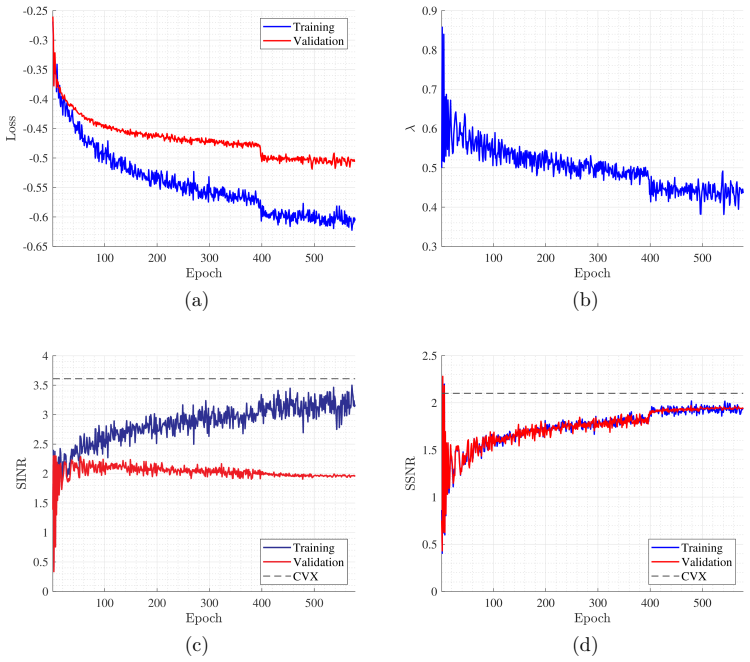
The load-bearing mechanism is the distributed teacher–student training unit. Two ensembles of per-AP DNNs are first trained with the teacher loss $L_t^{(\beta)} = -[(1-\beta)g_1 + \beta g_2]$, one with $\beta=0$ (sensing-only) and one with $\beta=1$ (communication-only); their mean scores over the training set supply the reference maxima $\hat{g}_1^{(\max)}$ and $\hat{g}_2^{(\max)}$. A third identical ensemble is trained with the student loss $L_s^{(\lambda)} = -\left[(1-\lambda)\frac{g_1}{\hat{g}_1^{(\max)}} + \lambda\frac{g_2}{\hat{g}_2^{(\max)}}\right]$, where $\lambda$ is updated each mini-batch from the normalized gaps $G_1$ and $G_2$, so the sensing–communication balance is steered automatically rather than set by a fixed hyperparameter. Each DNN outputs its AP's beam set from that AP's local CSI, and the outputs are normalized to the AP power budget before SSNR and SINR are evaluated.
What would settle it
Run the identical teacher–student procedure with more access points (for example $L=4$ and $L=8$): if the student's minimum-SINR gap to the centralized convex baseline grows steadily as $L$ increases, the claim that local-CSI-based distributed networks match the centralized solution is falsified.
Extended reading notes
Core claim
The central claim is that a teacher–student unsupervised training procedure can produce per-access-point beamformers for cell-free ISAC that are near the quality of a centralized joint SSNR/SINR optimization, while requiring each AP to use only its local CSI at deployment. The method's contribution is that it makes the problem unsupervised and distributed: no labeled beamformer dataset is needed, the DNNs cooperate only through the loss during offline training, and after training each AP can generate its own beams independently. Reported results show the student model matching or approaching the convex baseline's average SINR at two and five users, with a slight shortfall at eight users, and an inference time around a thousandth of the baseline's.
Load-bearing premise
The load-bearing premise is that each AP's neural network can produce near-optimal beamformers using only that AP's local channel information, even though the SINR expression couples every AP's channels and beams through each user's receiver.
Editorial extensions
If this is right
- After offline training, each AP can compute its own beamformers from local CSI alone, so real-time deployment no longer requires the CPU to solve the optimization or send beam vectors over fronthaul for each channel realization.
- Because training is unsupervised, generating a dataset does not require repeatedly solving the non-convex optimization to create labels; only channel samples and the SSNR/SINR formulas are needed.
- The adaptive $\lambda$ rule removes the need for a costly grid search over the tradeoff parameter, and the teacher-provided maxima give an architecture-specific upper bound on what the student can achieve.
- In the reported line-of-sight settings the U-net student stayed close to the convex baseline as the user count varied, and the measured inference time was roughly three orders of magnitude shorter than the two-step bisection plus SDP baseline.
Reading between the lines
- Editorial inference: the strongest untested premise is that local CSI at each AP is enough; since the SINR of every user couples all APs, the interesting stress test is to increase the number of APs and observe whether the student-to-baseline gap widens.
- Editorial inference: because the teacher scores bound what the student can reach, the method's ceiling is set by architecture capacity; the F5-with-80k-points experiment already hints that bigger filters and more data are the levers, and one could map the ceiling as a function of model size.
- Editorial inference: the evaluation is restricted to line-of-sight channels and fixed AP/user position distributions; transferring to multipath or moving targets would likely require retraining or an input representation that is less geometry-specific.
- Editorial inference: the 'at least three orders of magnitude' claim is an implementation-level runtime comparison on a specific CPU/GPU pairing, not an asymptotic statement, so sharper evidence would come from profiling on the actual edge hardware where the AP DNNs would run.
Editorial analysis
A structured set of objections, weighed in public.
Referee Report
Summary. The paper proposes an unsupervised, distributed, teacher-student deep learning method for joint communication and sensing beamforming in cell-free ISAC systems. It trains one DNN per AP, where the l-th DNN maps only the l-th AP's local CSI to that AP's beamforming vectors, and trains two biased teacher models (SSNR-only and SINR-only) whose average scores are then used to normalize the student loss. The student is deployed per AP at inference time. Experiments with 1D-CNN, CAE, and U-net architectures compare average SSNR/SINR curves against a CVX-based benchmark from [28] and report a runtime comparison claiming at least three orders of magnitude speedup.
Significance. If the central claim holds, the work is practically significant: it offers a path to real-time, decentralized beamforming for cell-free ISAC without relying on a central processor or heavy fronthaul signaling. The unsupervised training avoids generating expensive labeled datasets, and the distributed inference structure is a genuine architectural contribution. The paper also tests multiple CNN architectures and includes a runtime comparison against a conventional solver, which is a strength. However, the significance is conditional because the evaluation does not yet support the headline quantitative claims: there is no independent test set, no statistical variability reporting, and the core distributed-CSI premise is not validated against a centralized baseline or worst-case metrics.
major comments (4)
- [Section 5.1, Eqs. (13)-(14) and Eq. (2)] The distributed architecture uses the l-th DNN input as only the l-th AP's local CSI (Eqs. (13)-(14)), while the SINR objective in Eq. (2) couples all APs through the stacked channels h_n and beamformers w_lq. In general, the optimal beamformer at one AP depends on the channels and beamformers of all other APs, so a function of local CSI alone cannot reproduce the centralized optimum. The paper does not quantify the resulting gap: it never compares against a centralized DNN that receives full CSI, and it reports only average SSNR/SINR curves over 200 benchmark points without per-sample or worst-case results. Since the distributed deployment and fronthaul-load reduction claims rest on this approximation, the authors should add a focused numerical study of the local-CSI gap, including per-sample SINR distributions and, ideally, a centralized-DNN baseline.
- [Section 8, especially Figs. 7-10, 13-16] The evaluation protocol is not sufficient to support the close-to-CVX performance claim. The CVX benchmark is averaged over only 200 randomly selected points with no variance indicated, and all DL training/validation curves appear to be single runs without error bars or multiple seeds. Moreover, the final reported student performance is selected post hoc from the validation curves using a 94% SINR threshold (Section 8.3), and no separate test set is held out. This makes the reported numbers vulnerable to optimistic selection bias and prevents an assessment of statistical significance. The authors should add error bars over multiple training runs, report performance on an independent test set, and state the model-selection rule before evaluation.
- [Section 4, Eq. (11) and Section 5.2] The student loss in Eq. (11) is claimed to be bounded in [-1,0] because the denominators are said to be the 'maximum possible' scores g1(max) and g2(max). However, these values are implemented as sample means of the teacher scores over the training set, not true maxima. A student can exceed the teacher's mean, in which case g1/E[g1(max)] > 1 and the loss can fall below -1. The interpretation of the teacher models as providing strict upper bounds on student performance is therefore not mathematically valid as stated. Either the denominators should be actual maxima (with appropriate robustness handling) or the boundedness and 'maximum attainable' claims should be revised.
- [Section 8.4 and Fig. 16b] The abstract's headline 'at least three orders of magnitude' speedup is based on a runtime comparison shown in Fig. 16b, but the figure reports average runtime without confidence intervals, and the text does not specify the number of repeated trials or the variance across runs. A strong quantitative claim of this type needs a more careful timing methodology, including warm-up effects, per-sample runtime distributions, and hardware/software version details. The fairness of comparing distributed DL inference (single AP's DNN) against a centralized solver should also be discussed explicitly, although the maximum-of-two-APs choice in the paper is a reasonable start.
minor comments (5)
- [Section 8.3] The sentence beginning 'To address the results shown by Figure 15, we the notation, F n' is missing a verb ('introduce'), and later in the same section 'ahchieved' is a typo for 'achieved'.
- [Notation and Section 2] The notation block defines I_N as 'the identity vector of a size N x N', which should be 'identity matrix'.
- [Section 8.1 and Fig. 8b] The discussion of CAE overfitting is clear, but the figures would benefit from explicit markers or legends distinguishing training and validation curves, since several curves are close together and hard to read in grayscale.
- [Section 5.2 and Eq. (12)] The lambda update rule in Eq. (12) has no convergence analysis or theoretical justification; a brief explanation of why this update should balance the two gaps would improve the presentation, even if the empirical behavior is the main evidence.
- [References] Some cited works are arXiv preprints rather than peer-reviewed publications; the authors should update references where stable versions exist, and should double-check the novelty statement in the Introduction in light of the recent cell-free ISAC literature.
Circularity Check
No circularity: the teacher-score normalization in Eq. (11) is a fixed training constant, and the close-to-CVX performance claim is benchmarked against the external solution of [28].
full rationale
The derivation is self-contained against an external baseline. The student loss (Eq. 11) divides g1 and g2 by teacher-derived sample means, but those means are fixed constants computed once before student training; they do not enter the evaluation and do not force the reported SINR/SSNR values. The central performance claim is checked against the CVX-based solution of [28] on 200 points (Section 8), and runtime is measured directly (Fig. 16b). The only self-citation is [18], used as background in the introduction and not load-bearing for any technical step. The local-CSI restriction in Section 5.1 (Eqs. 13-14) is an architectural assumption whose gap to the centralized optimum is not quantified; that is an unquantified approximation and a robustness/correctness concern, not a circular reduction, because none of the paper's equations is defined in terms of the result it is used to predict.
Assumptions & free parameters
free parameters (5)
- Teacher normalization constants g1_max and g2_max =
Sample means of teacher scores over training set, values not reported numerically
- Student normalization parameter lambda(0) =
0.5
- Adaptation step size epsilon =
0.01
- Communication power ratio rho =
0.5
- Model selection SINR threshold =
94%
assumptions (6)
- domain assumption Per-AP beamformers can be well approximated as functions of only local CSI at that AP
- domain assumption The SSNR expression in Eq. (6) is the right sensing performance metric
- domain assumption Line-of-sight channel model with steering vectors in Eq. (4) is sufficient
- domain assumption The CVX-based solution of [28] is a valid near-optimal state-of-the-art baseline
- ad hoc to paper Teacher sample-mean scores bound student performance for the same architecture
- ad hoc to paper Lambda adaptation in Eq. (12) converges to a desirable balance
Cite this review
Pith. "Pith review of Unsupervised Learning Approach for Beamforming in Cell-Free Integrated Sensing and Communication." pith.science (2026). https://pith.science/paper/GNGE7BGS
@misc{pith2026241218162,
  author       = {Pith},
  title        = {Pith review of: Unsupervised Learning Approach for Beamforming in Cell-Free Integrated Sensing and Communication},
  year         = {2026},
  howpublished = {\url{https://pith.science/paper/GNGE7BGS}},
  note         = {Machine review of arXiv:2412.18162}
}
read the original abstract
Cell-free massive multiple input multiple output (MIMO) systems can provide reliable connectivity and increase user throughput and spectral efficiency of integrated sensing and communication (ISAC) systems. This can only be achieved through intelligent beamforming design. While many works have proposed optimization methods to design beamformers for cell-free systems, the underlying algorithms are computationally complex and potentially increase fronthaul link loads. To address this concern, we propose an unsupervised learning algorithm to jointly design the communication and sensing beamformers for cell-free ISAC system. Specifically, we adopt a teacher-student training model to guarantee a balanced maximization of sensing signal to noise ratio (SSNR) and signal to interference plus noise ratio (SINR), which represent the sensing and communication metrics, respectively. The proposed scheme is decentralized, which can reduce the load on the central processing unit (CPU) and the required fronthaul links. To avoid the tradeoff problem between sensing and communication counterparts of the cell-free system, we first train two identical models (teacher models) each biased towards one of the two tasks. A third identical model (a student model) is trained based on the maximum sensing and communication performance information obtained by the teacher models. While the results show that our proposed unsupervised DL approach yields a performance close to the state-of-the-art solution, the proposed approach is more computationally efficient than the state of the art by at least three orders of magnitude.
Figures


Figures from the paper (13 more)




Reference graph
Works this paper leans on
-
[28]
U. Demirhan, A. Alkhateeb, Cell-free isac MIMO systems: Joint sens- ing and communication beamforming, arXiv preprint arXiv:2301.11328 (2023)
arXiv 2023
-
[1]
S. K. Dehkordi, G. Caire, Active sensing schemes for beam-space MIMO radar in ISAC applications, in: 2023 IEEE Wireless Communications and Networking Conference (WCNC), IEEE, 2023, pp. 1–6
work page 2023
-
[2]
P. Gao, L. Lian, J. Yu, Cooperative ISAC with direct localization and rate-splitting multiple access communication: A pareto optimization framework, IEEE Journal on Selected Areas in Communications 41 (5) (2023) 1496–1515
work page 2023
-
[3]
C. Liu, X. Liu, S. Li, W. Yuan, D. W. K. Ng, Deep CLSTM for pre- dictive beamforming in integrated sensing and communication-enabled vehicular networks, Journal of Communications and Information Net- works 7 (3) (2022) 269–277
work page 2022
-
[4]
W. Yuan, Z. Wei, S. Li, J. Yuan, D. W. K. Ng, Integrated sensing and communication-assisted orthogonal time frequency space transmission for vehicular networks, IEEE Journal of Selected Topics in Signal Pro- cessing 15 (6) (2021) 1515–1528
work page 2021
- [5]
-
[6]
K. Meng, Q. Wu, J. Xu, W. Chen, Z. Feng, R. Schober, A. L. Swindle- hurst, UA V-enabled integrated sensing and communication: Opportu- nities and challenges, IEEE Wireless Communications (2023)
work page 2023
-
[7]
F. Dong, F. Liu, Y. Cui, W. Wang, K. Han, Z. Wang, Sensing as a ser- vice in 6G perceptive networks: A unified framework for ISAC resource allocation, IEEE Transactions on Wireless Communications (2022)
work page 2022
Show all 52 references
-
[8]
F. Dong, F. Liu, Localization as a service in perceptive networks: An ISAC resource allocation framework, in: 2022 IEEE International Con- ference on Communications Workshops (ICC Workshops), IEEE, 2022, pp. 848–853
2022
-
[9]
F. Zeng, J. Yu, J. Li, F. Liu, D. Wang, X. You, Integrated sensing and communication for network-assisted full-duplex cell-free distributed massive MIMO systems, arXiv preprint arXiv:2311.05101 (2023). 29
2023 arXiv
-
[10]
D. Xu, X. Yu, D. W. K. Ng, A. Schmeink, R. Schober, Robust and secure resource allocation for ISAC systems: A novel optimization framework for variable-length snapshots, IEEE Transactions on Communications 70 (12) (2022) 8196–8214
2022
-
[11]
Z. He, W. Xu, H. Shen, D. W. K. Ng, Y. C. Eldar, X. You, Full-duplex communication for ISAC: Joint beamforming and power optimization, IEEE Journal on Selected Areas in Communications (2023)
2023
-
[12]
H. Hua, J. Xu, T. X. Han, Transmit beamforming optimization for in- tegrated sensing and communication, in: 2021 IEEE Global Communi- cations Conference (GLOBECOM), IEEE, 2021, pp. 01–06
2021
-
[13]
Z. Yu, X. Hu, C. Liu, M. Peng, C. Zhong, Location sensing and beam- forming design for irs-enabled multi-user isac systems, IEEE Transac- tions on Signal Processing 70 (2022) 5178–5193
2022
-
[14]
R. Liu, M. Li, A. L. Swindlehurst, Joint beamforming and reflection design for ris-assisted isac systems, in: 2022 30th European Signal Pro- cessing Conference (EUSIPCO), IEEE, 2022, pp. 997–1001
2022
-
[15]
Z. Yu, H. Ren, C. Pan, G. Zhou, B. Wang, M. Dong, J. Wang, Active ris aided isac systems: Beamforming design and performance analysis, IEEE Transactions on Communications (2023)
2023
-
[16]
Zhong, J
K. Zhong, J. Hu, C. Pan, M. Deng, J. Fang, Joint waveform and beam- forming design for ris-aided isac systems, IEEE Signal Processing Letters 30 (2023) 165–169
2023
-
[17]
Demirhan, A
U. Demirhan, A. Alkhateeb, Integrated sensing and communication for 6G: Ten key machine learning roles, IEEE Communications Magazine (2023)
2023
-
[18]
Salem, M
H. Salem, M. Quamar, A. Mansoor, M. Elrashidy, N. Saeed, M. Masood, Data-driven integrated sensing and communication: Recent advances, challenges, and future prospects, arXiv preprint arXiv:2308.09090 (2023)
2023 arXiv
-
[19]
Y. Liu, I. Al-Nahhal, O. A. Dobre, F. Wang, Deep-learning-based chan- nel estimation for IRS-assisted isac system, in: GLOBECOM 2022-2022 IEEE Global Communications Conference, IEEE, 2022, pp. 4220–4225. 30
2022
-
[20]
C. Liu, W. Yuan, S. Li, X. Liu, H. Li, D. W. K. Ng, Y. Li, Learning-based predictive beamforming for integrated sensing and communication in vehicular networks, IEEE Journal on Selected Areas in Communications 40 (8) (2022) 2317–2334
2022
-
[21]
J. Mu, Y. Gong, F. Zhang, Y. Cui, F. Zheng, X. Jing, Integrated sensing and communication-enabled predictive beamforming with deep learning in vehicular networks, IEEE Communications Letters 25 (10) (2021) 3301–3304
2021
-
[22]
X. Liu, H. Zhang, K. Long, A. Nallanathan, V. C. Leung, Distributed unsupervised learning for interference management in integrated sensing and communication systems, IEEE Transactions on Wireless Commu- nications (2023)
2023
-
[23]
Elhoushy, M
S. Elhoushy, M. Ibrahim, W. Hamouda, Cell-free massive mimo: A sur- vey, IEEE Communications Surveys & Tutorials 24 (1) (2021) 492–523
2021
-
[24]
Nayebi, A
E. Nayebi, A. Ashikhmin, T. L. Marzetta, H. Yang, B. D. Rao, Precod- ing and power optimization in cell-free massive MIMO systems, IEEE Transactions on Wireless Communications 16 (7) (2017) 4445–4459
2017
-
[25]
Bj¨ ornson, L
E. Bj¨ ornson, L. Sanguinetti, Making cell-free massive MIMO compet- itive with MMSE processing and centralized implementation, IEEE Transactions on Wireless Communications 19 (1) (2019) 77–90
2019
-
[26]
H. Q. Ngo, A. Ashikhmin, H. Yang, E. G. Larsson, T. L. Marzetta, Cell- free massive MIMO versus small cells, IEEE Transactions on Wireless Communications 16 (3) (2017) 1834–1850
2017
-
[27]
H. Q. Ngo, A. Ashikhmin, H. Yang, E. G. Larsson, T. L. Marzetta, Correction to” Cell-free massive MIMO versus small cells”., IEEE Trans. Wirel. Commun. 19 (5) (2020) 3623–3624
2020
-
[29]
S. Liu, M. Li, Q. Liu, Joint BS mode selection and beamforming design for cooperative cell-free ISAC networks, arXiv preprint arXiv:2305.10800 (2023). 31
2023 arXiv
-
[30]
Behdad, ¨O
Z. Behdad, ¨O. T. Demir, K. W. Sung, E. Bj¨ ornson, C. Cavdar, Multi-static target detection and power allocation for integrated sens- ing and communication in cell-free massive MIMO, arXiv preprint arXiv:2305.12523 (2023)
2023 arXiv
-
[31]
W. Mao, Y. Lu, C.-Y. Chi, B. Ai, Z. Zhong, Z. Ding, Communication- sensing region for cell-free massive MIMO isac systems, arXiv preprint arXiv:2307.16259 (2023)
2023 arXiv
-
[32]
Elfiatoure, M
M. Elfiatoure, M. Mohammadi, H. Q. Ngo, M. Matthaiou, Cell-free massive MIMO for ISAC: Access point operation mode selection and power control, arXiv preprint arXiv:2310.09032 (2023)
2023 arXiv
-
[33]
Cao, Q.-Y
Y. Cao, Q.-Y. Yu, Joint resource allocation for user-centric cell-free integrated sensing and communication systems, IEEE Communications Letters (2023)
2023
-
[34]
L. A. Iliadis, Z. D. Zaharis, S. Sotiroudis, P. Sarigiannidis, G. K. Kara- giannidis, S. K. Goudos, The road to 6G: a comprehensive survey of deep learning applications in cell-free massive MIMO communications systems, EURASIP Journal on Wireless Communications and Network- in...
2022
-
[35]
Zhao, Power allocation in cell-free massive MIMO: Using deep learn- ing methods, Ph.D
Y. Zhao, Power allocation in cell-free massive MIMO: Using deep learn- ing methods, Ph.D. thesis, Ph. D. dissertation (2022)
2022
-
[36]
Zaher, ¨O
M. Zaher, ¨O. T. Demir, E. Bj¨ ornson, M. Petrova, Learning-based down- link power allocation in cell-free massive MIMO systems, IEEE Trans- actions on Wireless Communications 22 (1) (2022) 174–188
2022
-
[37]
Nikbakht, A
R. Nikbakht, A. Jonsson, A. Lozano, Unsupervised-learning power con- trol for cell-free wireless systems, in: 2019 IEEE 30th Annual Interna- tional Symposium on Personal, Indoor and Mobile Radio Communica- tions (PIMRC), IEEE, 2019, pp. 1–5
2019
-
[38]
Hojatian, J
H. Hojatian, J. Nadal, J.-F. Frigon, F. Leduc-Primeau, Decentralized beamforming for cell-free massive MIMO with unsupervised learning, IEEE Communications Letters 26 (5) (2022) 1042–1046. 32
2022
-
[39]
Zhang, J
Y. Zhang, J. Zhang, S. Buzzi, H. Xiao, B. Ai, Unsupervised deep learning for power control of cell-free massive MIMO systems, IEEE Transactions on Vehicular Technology (2023)
2023
-
[40]
Rajapaksha, K
N. Rajapaksha, K. S. Manosha, N. Rajatheva, M. Latva-aho, Unsu- pervised learning-based joint power control and fronthaul capacity al- location in cell-free massive MIMO with hardware impairments, IEEE Wireless Communications Letters (2023)
2023
-
[41]
Rajapaksha, K
N. Rajapaksha, K. S. Manosha, N. Rajatheva, M. Latva-Aho, Deep learning-based power control for cell-free massive MIMO networks, in: ICC 2021-IEEE International Conference on Communications, IEEE, 2021, pp. 1–7
2021
-
[42]
Zhang, J
Y. Zhang, J. Zhang, Y. Jin, S. Buzzi, B. Ai, Deep learning-based power control for uplink cell-free massive MIMO systems, in: 2021 IEEE Global Communications Conference (GLOBECOM), IEEE, 2021, pp. 1–6
2021
-
[43]
L. Luo, J. Zhang, S. Chen, X. Zhang, B. Ai, D. W. K. Ng, Downlink power control for cell-free massive MIMO with deep reinforcement learn- ing, IEEE Transactions on Vehicular Technology 71 (6) (2022) 6772– 6777
2022
-
[44]
Liu, C.-Y
Y.-C. Liu, C.-Y. Ma, Z. He, C.-W. Kuo, K. Chen, P. Zhang, B. Wu, Z. Kira, P. Vajda, Unbiased teacher for semi-supervised object detection, arXiv preprint arXiv:2102.09480 (2021)
2021 arXiv
-
[45]
Vandeghen, A
R. Vandeghen, A. Cioppa, M. Van Droogenbroeck, Semi-supervised training to improve player and ball detection in soccer, in: Proceed- ings of the IEEE/CVF Conference on Computer Vision and Pattern Recognition, 2022, pp. 3481–3490
2022
-
[46]
J. Xu, X. Wang, P. Zhu, X. You, Privacy-preserving channel estima- tion in cell-free hybrid massive MIMO systems, IEEE Transactions on Wireless Communications 20 (6) (2021) 3815–3830
2021
-
[47]
H. Song, T. Goldstein, X. You, C. Zhang, O. Tirkkonen, C. Studer, Joint channel estimation and data detection in cell-free massive MU-MIMO systems, IEEE Transactions on Wireless Communications 21 (6) (2021) 4068–4084. 33
2021
-
[48]
Amadid, M
J. Amadid, M. Boulouird, A. Belhabib, A. Zeroual, On channel esti- mation for rician fading with the phase-shift in cell-free massive mimo system, Wireless Personal Communications (2022) 1–21
2022
-
[49]
Ronneberger, P
O. Ronneberger, P. Fischer, T. Brox, U-net: Convolutional networks for biomedical image segmentation, in: Medical Image Computing and Computer-Assisted Intervention–MICCAI 2015: 18th International Conference, Munich, Germany, October 5-9, 2015, Proceedings, Part III 18, Spring...
2015
-
[50]
C. Qi, W. Ci, J. Zhang, X. You, Hybrid beamforming for millimeter wave MIMO integrated sensing and communications, IEEE Communications Letters 26 (5) (2022) 1136–1140
2022
-
[51]
Y. Zhuo, Z. Wang, Performance analysis of ISAC system under corre- lated communication-sensing channel, IEEE Transactions on Vehicular Technology (2023)
2023
-
[52]
H. Wang, J. Yang, FBUNet: Full convolutional network based on fu- sion block architecture for biomedical image segmentation, Journal of Medical and Biological Engineering 41 (2021) 185–202. 34
2021
Reviewed August 11, 2026 · model on record in the stance chip above.
Discussion (0). Continue with ORCID to comment.