REVIEW 4 major objections 6 minor 1 references
Alleviating the trade-off between coincidence time resolution and sensitivity using scalable TOF-DOI detectors
T0 review · 4 major / 6 minor · reviewed 2026-08-11 · deepseek-v4-flash
Pith's one-line read Thin stacked crystals restore PET sensitivity without slowing timing.
desk verdict The xDetector is a genuinely new stacking geometry that deserves a referee, but the central 'without compromising sensitivity' claim is asserted, not measured. read the letter →
The pith
A machine-rendered reading of the paper's core claim, the machinery that carries it, and where it could break.
The reading
What carries the argument
The central object is the xDetector: a module in which two detector groups are stacked orthogonally, with each group's one-dimensional array of LSO crystals coupled one-to-one to SiPMs and left bare on one longitudinal side so the two bare sides face each other through air. The air coupling lets a controllable fraction of scintillation photons cross into the facing layer, so the same readout yields both the interaction channel and a light-sharing signal used to estimate position along the crystal's longitudinal axis. The argument also leans on an analytic CTR expression, $CTR_{\mathrm{analytic}} = 3.33 \cdot \sqrt{\tau_{\mathrm{diff}} \cdot (1.57 \cdot \tau_r + 1.33 \cdot \sigma_{\mathrm{SPTR+PTS}})} / (PDE \cdot LTE \cdot ILY)$, which is used to correct the measured 20 mm CTR for batch-to-batch scintillator differences and to justify that shorter crystals improve timing by reducing photon transit time spread.
What would settle it
Directly measure the coincidence time resolution of the same 20 mm LSO crystal used in the study (or a crystal with the same decay time and light yield) under the same electronics and reference detector, with no length-based correction, and compare it with the xDetector's 175 ps result; if the uncorrected 20 mm CTR is already close to or better than the xDetector's, the claimed timing advantage disappears.
Extended reading notes
Core claim
The central claim is that the timing-versus-sensitivity trade-off in TOF-PET can be relaxed by stacking two orthogonally oriented one-dimensional detector groups instead of using one thick crystal. Each scintillator is read by its own SiPM, with four sides reflective and one longitudinal side left bare; the bare sides of the two groups face each other across an air gap. Most scintillation light stays in the crystal that interacted with the gamma ray, but a small fraction leaks to the facing layer, which both gives depth-of-interaction information and reduces the number of photons seen by the primary channel. Measured CTRs for the 3 mm and 4 mm prototypes were 175.3 +/- 1.3 ps and 187.4 +/- 1.7 ps FWHM, comparable to single crystals of the same length and, after a 1.35 correction factor based on decay-time and light-yield differences, better than a 20 mm single crystal. The paper argues that with state-of-the-art scintillators, SiPMs, and fast readout, this geometry makes 100 ps FWHM CTR with high DOI resolution a practical target.
Load-bearing premise
The load-bearing assumption is that the 1.35 correction factor applied to the measured 20 mm CTR is accurate; that factor depends on an estimated light-yield ratio taken from a literature curve rather than a direct measurement, and the paper admits the correction is uncertain to some extent.
Editorial extensions
If this is right
- PET detectors can use roughly 13 mm long crystals instead of 20 mm, reducing the photon transit time spread that limits CTR, while stacking recovers the lost sensitivity.
- DOI information comes from the same readout, so no extra detector layer or end readout is needed to correct parallax errors.
- Detector performance is expected to stay independent of the number of stacked layers, letting users choose the stack depth for their sensitivity target.
- With faster scintillators, higher-PDE SiPMs, and high-frequency readout, the same geometry is claimed to be a practical route to 100 ps CTR.
- The light-sharing that gives DOI also improves pulse-height linearity by lowering the photon count seen by each channel.
Reading between the lines
- Editorial inference: If the 1.35 correction factor is optimistic, the headline advantage over a 20 mm detector shrinks; a direct same-crystal comparison would settle the margin.
- Editorial inference: The same stacking idea might extend beyond PET to any scintillator-based gamma detector where timing and stopping power compete, such as Compton cameras or dual-readout detectors.
- Editorial inference: The longitudinal position signal could be used to correct event-by-event timing biases caused by different interaction depths, which the paper mentions as future work; that correction may be needed before the 100 ps target is reached.
- Editorial inference: Since the xDetector needs about 1.5 times more SiPMs than a conventional one-to-one detector, the practical benefit depends on whether the timing gain outweighs the added cost and the small packing-fraction loss.
Editorial analysis
A structured set of objections, weighed in public.
Referee Report
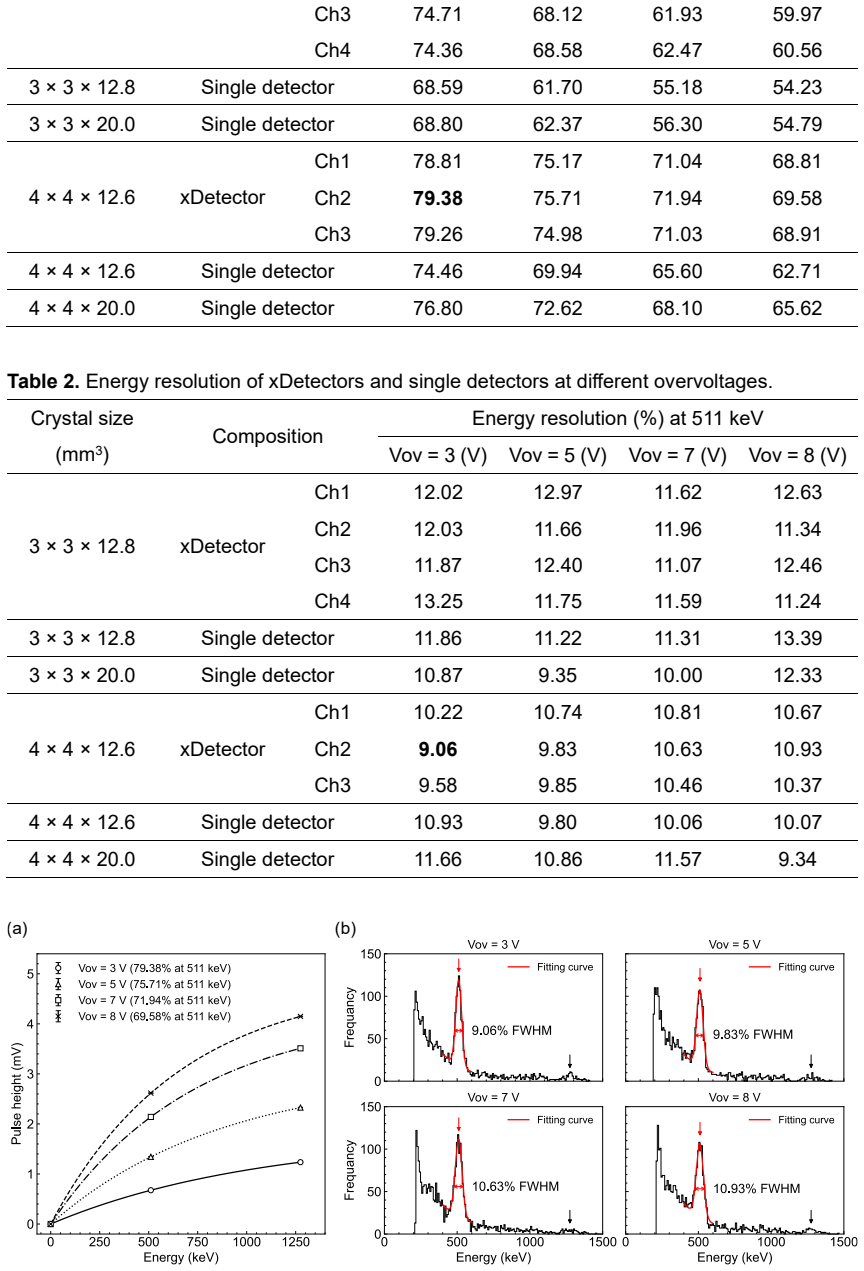
Summary. The manuscript proposes a PET detector geometry called the xDetector, in which two one-dimensional detector groups are orthogonally stacked with their bare longitudinal sides facing each other through air coupling. The design is intended to allow the scintillator length to be reduced to approximately 13 mm while preserving sensitivity by stacking layers along the depth-of-interaction axis, and to provide DOI information from the same readout. The authors report a coincidence time resolution of 175.3 ps FWHM, an energy resolution of 11.1% FWHM, and a longitudinal spatial resolution of 3.96 mm FWHM for a 3x3x12.8 mm3 LSO crystal prototype with MPPC readout. They also compare the CTR with 20 mm single detectors after applying a correction factor of 1.35 derived from an analytic CTR expression.
Significance. If the central claim were fully demonstrated, the xDetector would offer an interesting route toward simultaneous TOF and DOI capability with thinner crystals, potentially easing the path to sub-100 ps CTR in a practical scanner. The paper has notable strengths: the CTR measurements are performed over a range of overvoltages, the energy and linearity characterization is detailed, and the authors explicitly acknowledge the uncertainty in the 20 mm CTR correction. The concept of stacking detectors along the DOI axis is clearly presented, and the longitudinal position readout using pulse-height ratios is demonstrated with waveforms. However, the main trade-off claim is not yet experimentally verified, because no sensitivity or detection efficiency measurement is presented, and the CTR comparison against 20 mm detectors relies on a correction whose components are only partially measured. These issues are load-bearing for the abstract's assertion that the xDetector 'effectively resolves the trade-off between TOF capability and sensitivity.'
major comments (4)
- [Section 3.1 and Figure 1] The central claim that the xDetector preserves sensitivity despite thinner crystals is not experimentally supported. The CTR measurement in Section 3.1 irradiates the longitudinal side of the upper scintillator, giving a gamma-ray path of only 3 mm in the 3x3x12.8 mm3 crystal, not the path along the DOI axis that would correspond to clinical incidence. If the DOI axis is the long axis (12.8 mm), the measured CTR is optimistic because photon transit time spread increases with path length; if the DOI axis is the short axis (3 mm), the two-layer stack provides only about 6 mm of material, far below the 20 mm reference. No photopeak efficiency or coincidence detection efficiency measurement is provided to substantiate the claim of comparable sensitivity. The authors should either measure the detection efficiency along the DOI axis or clearly state the orientation and provide a quantitative sensitivity comparison.
- [Section 4.1 and Eq. (6)] The claimed timing advantage of the thin-crystal xDetector over conventional 20 mm detectors rests entirely on a correction factor of 1.35 applied to the measured 20 mm CTR. This factor combines a measured decay-time ratio (46.6/37.1 ns) with an estimated intrinsic light yield ratio of 1.45 taken from a literature relation between light transfer efficiency and crystal length. The authors admit in the Discussion that rise time and sigma were not fully considered and that the correction is 'uncertain to some extent.' Because the corrected 20 mm CTR is the benchmark for the trade-off argument, the uncertainty must be quantified. A direct measurement with a 20 mm crystal from the same manufacturing batch, or a sensitivity analysis over the unknown parameters, would be necessary to establish the claimed improvement.
- [Section 3.1 and Figure 4] The reported 175.3 ps FWHM is the width of the time-difference histogram between the xDetector and the reference detector, whose single timing resolution is 111.2 ps FWHM. Without quadrature subtraction, this value does not represent the xDetector's own CTR and can be misleading when compared with literature values. The authors should report the deconvolved single-detector CTR for the xDetector (which would be approximately 135 ps if Gaussian quadrature is assumed) or explicitly state that the reported value is the pair CTR including the reference contribution. This is particularly important because the abstract highlights 175 ps as the achieved CTR.
- [Section 4.1 and Table 1] The comparison between the 20 mm crystal and the 12.8/12.6 mm crystals is confounded by the stated difference in manufacturing date, which produced different decay times and light yields. The authors correct for the decay-time difference using Eq. (6), but the correction is itself uncertain, as acknowledged in the Discussion. This leaves a systematic, unquantified bias in the comparison. The authors should either replace the 20 mm measurement with a same-batch crystal or provide a quantitative bound on the residual bias. Without this, the conclusion that the xDetector 'significantly outperformed' the 20 mm detectors is not robust.
minor comments (6)
- [Abstract and Section 1] Please use the standard notation mm^3 instead of mm3 throughout the manuscript.
- [Section 3.3 and Eq. (5)] The definition of N in Eq. (5) is not entirely clear; specify that 2N is the total number of readout columns (6 or 8) and clarify why the sum starts at i=4 or 5.
- [Section 3.3] The text notes that the longitudinal spatial resolution measured here corresponds to the x- or y-axis resolution, not the conventional DOI resolution. This distinction is important and should also be stated in the abstract or conclusions to avoid misinterpretation.
- [Figure 4] The error bars on the plotted CTR values are not shown in the figure; consider adding them or stating in the caption that they are comparable to the text-reported uncertainties.
- [Discussion] The statement that the corrected CTR suggests a 35% improvement 'simply by replacing the LSO with an optimal one' is an extrapolation based on the uncertain correction; it should be phrased as a hypothesis rather than a quantitative prediction.
- [General] The text has occasional awkward phrasing (e.g., 'the xDetector requires more SiPMs than the conventional 1-to-1 coupled detector') and a few grammatical errors; a careful language edit is recommended.
Circularity Check
No significant circularity: the central CTR and DOI measurements are direct, and the 20 mm comparison correction relies on external analytic models and independently measured decay times rather than on the paper's own fitted outputs.
full rationale
The paper's central claims are backed by direct experimental measurements: a CTR of 175.3 ps FWHM, an energy resolution of 11.07% FWHM, and a longitudinal spatial resolution of 3.96 mm FWHM are all reported as measured values for the xDetector prototype. The only potentially constructed comparison is the correction applied to the 20 mm single-detector CTR in Section 4.1, but this correction is not circular: it is computed from an external analytic expression (Gundacker et al 2020, Eq. 6) using measured decay times (37.1 and 46.6 ns) and a light-yield ratio estimated from a published LTE-versus-length relation (Cates and Levin 2018). The corrected 20 mm value is not fitted to the xDetector's CTR, and the authors explicitly note the correction is simplified and uncertain. The paper does not present the 35% improvement as a measured result but as a potential extrapolation, so it is not a fitted input renamed as a prediction. Self-citations (Ota 2021; Ota and Ote 2024; Onishi et al 2024) appear as hardware references or contextual prior work, not as load-bearing uniqueness arguments or as the source of the main result. The sensitivity-preservation claim is a geometric design argument based on stacking along the DOI axis, not a derivation that reduces to its own conclusion. No equation in the paper is equivalent to its inputs by construction. Concerns about missing sensitivity verification or the accuracy of the 20 mm correction are correctness risks, not circularity.
Assumptions & free parameters
free parameters (3)
- 20 mm crystal CTR correction factor =
1.35
- Light yield ratio ILY20/ILY12.8 =
1.45
- Linearity function parameters A and B =
not reported
assumptions (4)
- domain assumption The analytic CTR expression (Eq. 6) from Gundacker et al. (2020) accurately describes the dependence of CTR on crystal properties and can be used to correct the 20 mm measurement.
- domain assumption The relationship between light transfer efficiency and crystal length from Cates and Levin (2018) applies to the LSO crystals used here.
- domain assumption Stacking detector groups along the DOI axis recovers the sensitivity of a 20 mm crystal without degrading timing.
- domain assumption The timing performance of a detector group is independent of the number of stacked layers (scalability).
Cite this review
Pith. "Pith review of Alleviating the trade-off between coincidence time resolution and sensitivity using scalable TOF-DOI detectors." pith.science (2026). https://pith.science/paper/RABGSAVN
@misc{pith2026241218211,
  author       = {Pith},
  title        = {Pith review of: Alleviating the trade-off between coincidence time resolution and sensitivity using scalable TOF-DOI detectors},
  year         = {2026},
  howpublished = {\url{https://pith.science/paper/RABGSAVN}},
  note         = {Machine review of arXiv:2412.18211}
}
read the original abstract
Coincidence time resolution (CTR) in time-of-flight positron emission tomography (TOF-PET) has significantly improved with advancements in scintillators, photodetectors, and readout electronics. Achieving a CTR of 100 ps remains challenging due to the need for sufficiently thick scintillators-typically 20 mm-to ensure adequate sensitivity because the photon transit time spread within these thick scintillators impedes achieving 100 ps CTR. Therefore, thinner scintillators are preferable for CTR better than 100 ps. To address the trade-off between TOF capability and sensitivity, we propose a readout scheme of PET detectors. The proposed scheme utilizes two orthogonally stacked one-dimensional PET detectors, enabling the thickness of the scintillators to be reduced to approximately 13 mm without compromising sensitivity. This is achieved by stacking the detectors along the depth-of-interaction (DOI) axis of a PET scanner. We refer to this design as the cross-stacked detector, or xDetector. Furthermore, the xDetector inherently provides DOI information using the same readout scheme. Experimental evaluations demonstrated that the xDetector achieved a CTR of 175 ps FWHM and an energy resolution of 11% FWHM at 511 keV with 3 x 3 x 12.8 mm3 lutetium oxyorthosilicate crystals, each coupled one-to-one with silicon photomultipliers. In terms of xy-spatial resolution, the xDetector exhibited an asymmetric resolution due to its readout scheme: one resolution was defined by the 3.2 mm readout pitch, while the other was calculated using the center-of-gravity method. The xDetector effectively resolves the trade-off between TOF capability and sensitivity while offering scalability and DOI capability. By integrating state-of-the-art scintillators, photodetectors, and readout electronics with the xDetector scheme, achieving a CTR of 100 ps FWHM alongside high DOI resolution becomes a practical possibility.
Figures


Figures from the paper (3 more)


Reference graph
Works this paper leans on
-
[1]
Akamatsu G, Takahashi M, Tashima H, Iwao Y, Yoshida E, Wakizaka H, Kumagai M, Yamashita T and Yamaya T 2022 Performance evaluation of VRAIN: a brain -dedicated PET with a hemispherical detector arrangement Phys. Med. Biol. 67 225001 Anger H O 1964 Scintillation camera with multichannel collimators J. Nucl. Med. 5 515–31 Cates J W, Gundacker S, Auffray E, ...
work page 2022
Reviewed August 11, 2026 · model on record in the stance chip above.
Discussion (0). Continue with ORCID to comment.