REVIEW 2 major objections 5 minor 48 references
Ejecta Wakes from Companion Interaction in Type Ia Supernova Remnants
T0 review · 2 major / 5 minor · reviewed 2026-08-11 · deepseek-v4-flash
Pith's one-line read The reverse shock races down the low-density wake carved by a surviving companion, converges off-center, and pulls interstellar gas into the remnant's core, leaving an X-ray asymmetry that lasts thousands of years.
desk verdict Solid 3D study of companion wakes in Ia remnants, but the flashiest claim—ISM drawn to the center—rests on an untested density floor and a questionable wake extrapolation to r=0. read the letter →
The pith
A machine-rendered reading of the paper's core claim, the machinery that carries it, and where it could break.
The reading
What carries the argument
The central object is the companion-interaction wake: the cone of low-density, higher-velocity ejecta left behind after the supernova blast collides with the surviving donor star. Its underdensity is the mechanism that lets the reverse shock travel quickly into the remnant, converge off-center, and entrain interstellar gas toward the center. A second mechanism, transverse flow of shocked ejecta driven by pressure gradients, refills the wake on roughly a sound-crossing time and restores sphericity to the forward shock without erasing the asymmetry in the core. The numerical machinery is a two-stage calculation: Athena++ for the ejecta-companion collision, followed by the uniformly expanding-grid code Sprout for the 3-D remnant evolution to 3000 years.
What would settle it
High-resolution X-ray spectroscopy of the central few parsecs of a young type Ia remnant, such as SNR 0509-67.5, should detect ISM line emission if the claim holds; if no interstellar material is found at the center and the reverse-shock ring is centered on the explosion point instead of offset, the claim would be ruled out.
Extended reading notes
Core claim
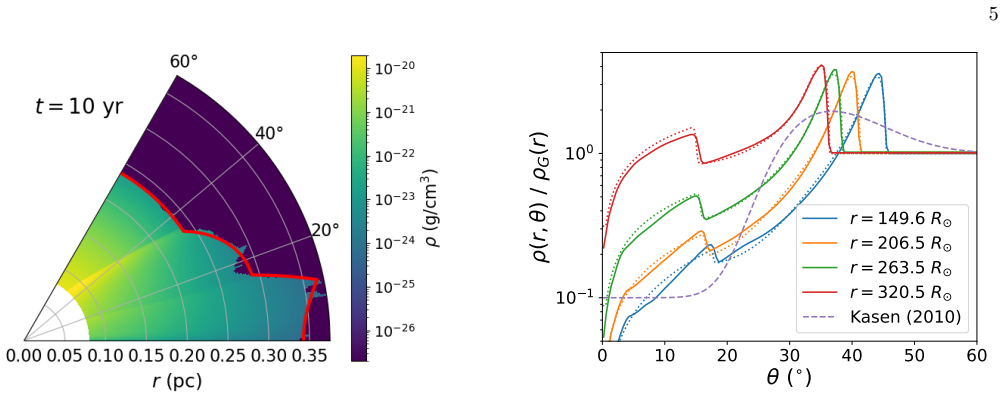
The paper's central discovery is that the companion-interaction wake, not the forward shock, determines the long-lived asymmetry of a type Ia supernova remnant. In both the double-degenerate model simulated with Athena++ and the single-degenerate model built from the Kasen (2010) wake fit, the wake is a cone of low-density, shock-heated, slightly accelerated ejecta. Because it is underdense, the reverse shock traverses the wake sooner than elsewhere, converges off-center (colliding with the reverse shock from the other side roughly 2 pc from the explosion), rebounds, and drives high-velocity gas back up the wake. A passive tracer shows interstellar gas is pulled through the wake and reaches the center of the remnant in both models. The forward shock becomes spherical by about a thousand years because transverse pressure gradients push shocked ejecta into the wake, but the reverse shock, the ejecta distribution, and the X-ray emission remain asymmetric.
Load-bearing premise
The load-bearing assumption is that the fitted wake density never falls below 1% of the unperturbed ejecta density in the double-degenerate model (and 10% in the single-degenerate model); if a real wake is denser than that floor, the reverse shock would slow down and interstellar gas might not reach the remnant's center.
Editorial extensions
If this is right
- Thermal X-ray maps of type Ia remnants can remain measurably asymmetric for more than a thousand years, so the absence of an early spherical remnant does not by itself require a merger.
- Interstellar gas can be transported to the center of a young type Ia remnant through the wake, so central X-ray spectra may show ISM-like abundances mixed with ejecta.
- A forward shock that is spherical at late times does not imply the underlying ejecta are spherically distributed; the contact discontinuity and reverse shock stay off-center.
- The X-ray asymmetry is strongest when the remnant is viewed perpendicular to the wake, but it is still visible from other angles, so viewing geometry must be folded into any comparison with observations.
- Wider binaries with smaller donor solid angles produce increasingly spherical X-ray morphologies, meaning a symmetric remnant does not rule out a surviving companion.
Reading between the lines
- If interstellar gas really reaches the center through the wake, then spatially resolved X-ray line-ratio maps of the cores of nearby type Ia remnants could directly test the surviving-companion scenario, because a merger remnant should lack this inward ISM channel.
- The finding that the reverse shock converges off-center predicts a central hot region offset from the explosion point; high-resolution Doppler mapping of X-ray lines could locate the companion's original direction.
- A natural numerical extension is to repeat the remnant evolution with the density floor in the wake fit raised or lowered, since the ISM-to-center result depends on how empty the wake is allowed to become.
- Analogous wake dynamics may appear in other transients with a surviving companion, although the different ejecta structure would change the timing of reverse-shock convergence.
Signed reviews
Editorial analysis
A structured set of objections, weighed in public.
Referee Report
Summary. The paper studies the late-time evolution of Type Ia supernova remnants that contain a low-density wake carved by the interaction of the supernova ejecta with a surviving binary companion. The authors first run Athena++ simulations of the ejecta-companion collision for a double-degenerate (double-detonation) model, construct analytic fits to the resulting density structure, and compare with the Kasen (2010) single-degenerate fit. These structures are mapped into the expanding-grid code Sprout and evolved from 10 yr to 3000 yr. The reported results are that the forward shock becomes spherical by roughly 1000 yr owing to transverse flow, the reverse shock crosses the low-density wake, converges off-center, and draws interstellar medium into the remnant center, and that Rayleigh-Taylor plumes at the wake edge create a toroidal ejecta structure with observable thermal X-ray asymmetries persisting for thousands of years.
Significance. If the central claims hold, the paper provides a concrete observational discriminant between remnants of Type Ia supernovae with a surviving companion and remnants from mergers, at ages of order 10^3 yr, tied to off-center reverse-shock convergence and deep ISM ingress. The work is a forward simulation rather than a fit to observed remnants, uses standard publicly available codes, and is transparent about its free parameters and numerical choices; the code forks are made available for reproduction. The main value is the falsifiable prediction of a long-lived X-ray asymmetry and its viewing-angle dependence. The strength of the claim is currently limited by the sensitivity of the initial wake structure to unverified assumptions, as detailed below.
major comments (2)
- [Appendix A, §5.3] The ad hoc density floor and the extrapolation of the fitted low-density cone to r = 0 are load-bearing for the central claim of §5.3 that the reverse shock traverses the wake and draws ISM to the remnant center. Physically, the wake is carved downstream of the donor at a = 0.269 R_sun and should not extend interior to the homologously expanded donor radius (about 0.002 pc at 10 yr and 0.2 pc at 1000 yr); in that interior region, unperturbed ejecta is roughly 100 times denser than the imposed floor. Because the reverse-shock speed and the advection of ISM into the center are controlled by this axial density contrast, the center-reaching behavior is not robust until at least one sensitivity test is provided: for example, a higher floor, a wake truncated at the donor radius, or a direct mapping of the Athena++ profile instead of the fitted form.
- [§2, §4] No resolution study is presented for either code. The Athena++ collision run uses only 10 azimuthal cells, and the Sprout remnant runs use a single 512x512x1024 grid. The claims of large Rayleigh-Taylor plumes around the wake edge and a toroidal ejecta structure (§5.3 and Figs. 6, 7, 11) are morphological results that could depend on resolution and on the suppression of non-axisymmetric modes. Please add a resolution test (for example, at least one coarser and one finer Sprout run, and ideally a check of the Athena++ azimuthal resolution) or otherwise bound the numerical uncertainty of these features.
minor comments (5)
- [Title] The title contains a stray space: 'Ejecta W akes' should be 'Ejecta Wakes'.
- [§4] The sentence defining 'unperturbed' appears to have reversed wording: it says the term refers to the portion of the ejecta altered by the companion interaction, but the subsequent usage refers to ejecta unaffected by the companion.
- [§5.3] The text contains a typo, 'morpohology', which should be 'morphology'.
- [§2, Eq. (6)] Equation (6) is followed by an empty equation number (7); the numbering should be checked.
- [§5.4] The statement that the semi-analytic model gives the correct reverse-shock convergence time 'only due to our choice of aRS' is an important limitation and should be flagged more prominently in the discussion, since Figure 10 could otherwise be read as independent validation.
Circularity Check
No significant circularity: the central remnant-phase claims are emergent outputs of a forward simulation, not fits to those claims.
full rationale
The derivation chain is a forward calculation: Athena++ simulations of the ejecta-companion collision produce the wake structure; Appendix A fits map that structure into the Sprout initial condition; Sprout evolves the remnant to 3000 yr; X-ray maps are line integrals of rho^2. The claims that the reverse shock traverses the wake, converges off-center, and draws ISM to the center are outputs of this evolution, not parameters fitted to those outputs. The paper explicitly flags its semi-analytic free parameters: 'The semi-analytic model still gives the correct convergence time, but only due to our choice of ˜aRS' (Sec 5.4), so no fitted prediction is disguised as a result. The Appendix A floor 'We also enforce ρ(r, θ) ≥ 0.01ρG(r) so that the density does not drop too low at θ = 0' is an imposed initial-condition regularization whose sensitivity is not studied; that is a modeling-robustness limitation, not a circular step, because the floor is not tuned to the predicted ISM-to-center outcome. The Gaussian ejecta profile is taken from Wong et al. (2024), a same-group citation (Bildsten is a coauthor), but this profile is not the source of the wake asymmetry—the wake is simulated here—and the citation is not used to forbid alternatives or to import a uniqueness theorem. The paper also checks against independent prior simulations (García-Senz et al. 2012; Gray et al. 2016; Ferrand et al. 2022), supporting the external content of the result.
Assumptions & free parameters
free parameters (5)
- wake density floor =
0.01 rho_G (relative to unperturbed ejecta density)
- SD wake filling factor fh =
0.1
- lED (lead factor) =
1.1
- phiED (pressure ratio) =
0.5
- aRS (reverse shock acceleration) =
-0.12 Eej Mej^(-4/3) rho_ISM^(1/3)
assumptions (6)
- domain assumption The SNIa ejecta is well-described by the Gaussian velocity profile of Wong et al. (2024) with Mej=0.9 Msun and Eej=0.97e51 erg.
- domain assumption The companion can be modeled as a rigid, reflective sphere that survives the explosion.
- domain assumption At t=1000 s the ejecta is homologous and can be extrapolated ballistically to t=10 yr.
- domain assumption The ISM is uniform with density 6.31e-25 g/cm3 (n ~ 0.38 cm^-3), matched to SNR 0509-67.5.
- standard math The Euler equations with ideal gas plus radiation pressure closure are an adequate description.
- ad hoc to paper Post-shock RT instabilities and mixing are adequately captured at the chosen resolution and without the low-Mach correction.
Cite this review
Pith. "Pith review of Ejecta Wakes from Companion Interaction in Type Ia Supernova Remnants." pith.science (2026). https://pith.science/paper/PBAANJ2D
@misc{pith2026241218226,
  author       = {Pith},
  title        = {Pith review of: Ejecta Wakes from Companion Interaction in Type Ia Supernova Remnants},
  year         = {2026},
  howpublished = {\url{https://pith.science/paper/PBAANJ2D}},
  note         = {Machine review of arXiv:2412.18226}
}
read the original abstract
Type Ia supernovae are triggered by accretion onto a white dwarf from a companion which is most likely Roche lobe-filling at the time of the explosion. The collision between the ejecta and a surviving companion carves out a conical wake, which could manifest as an asymmetry when the ejecta reaches the remnant phase. We simulate the companion interaction using the Athena++ hydrodynamics solver to determine the ejecta structure for a double-degenerate type Ia supernova. Ejecta in the wake is of lower density and higher velocity than the unperturbed ejecta. We then evolve the ejecta for several thousand years using the expanding-grid code Sprout. The forward shock within the wake is initially indented, but becomes spherical after roughly a thousand years due to transverse motion of shocked ejecta that fills the wake. The reverse shock travels quickly within the wake, leading to an off-center convergence of the reverse shock and leaving the remnant with an asymmetrical core. This also draws material from the interstellar medium deep into the remnant, eventually reaching the center. Large Rayleigh-Taylor plumes are found around the edge of the wake, creating a toroidal structure composed primarily of ejecta. Estimates of the thermal X-ray emission show that such remnants exhibit observable asymmetries for thousands of years.
Figures


Figures from the paper (9 more)


Reference graph
Works this paper leans on
-
[1]
, " * write output.state after.block = add.period write newline
ENTRY address archivePrefix author booktitle chapter doi edition editor eprint howpublished institution journal key month number organization pages publisher school series title misctitle type volume year version url label extra.label sort.label short.list INTEGERS output.state before.all mid.sentence after.sentence after.block FUNCTION init.state.consts ...
-
[2]
write newline
" write newline "" before.all 'output.state := FUNCTION format.url url empty "" new.block "" url * "" * if FUNCTION format.eprint eprint empty "" archivePrefix empty "" archivePrefix "arXiv" = new.block " " eprint * " " * new.block " " eprint * " " * if if if FUNCTION format.doi doi empty "" " " doi * " " * if FUNCTION format.pid doi empty eprint empty ur...
-
[3]
thebibliography [1] 20pt to REFERENCES 6pt =0pt -12pt 10pt plus 3pt =0pt =0pt =1pt plus 1pt =0pt =0pt -12pt =13pt plus 1pt =20pt =13pt plus 1pt \@M =10000 =-1.0em =0pt =0pt 0pt =0pt =1.0em @enumiv\@empty 10000 10000 `\.\@m \@noitemerr \@latex@warning Empty `thebibliography' environment \@ifnextchar \@reference \@latexerr Missing key on reference command E...
arXiv 2021
-
[4]
Arunachalam , P., Hughes , J. P., Hovey , L., & Eriksen , K. 2022, , 938, 121, 10.3847/1538-4357/ac927c
-
[5]
Bauer , E. B., White , C. J., & Bildsten , L. 2019, , 887, 68, 10.3847/1538-4357/ab4ea4
-
[6]
2017, , 465, 2060, 10.1093/mnras/stw2737
Boehner , P., Plewa , T., & Langer , N. 2017, , 465, 2060, 10.1093/mnras/stw2737
-
[7]
Boerner, T. J., Deems, S., Furlani, T. R., Knuth, S. L., & Towns, J. 2023, in Practice and Experience in Advanced Research Computing, PEARC '23 (New York, NY, USA: Association for Computing Machinery), 173–176, 10.1145/3569951.3597559
arXiv 2023
-
[8]
Boos , S. J., Townsley , D. M., & Shen , K. J. 2024, arXiv e-prints, arXiv:2401.08011, 10.48550/arXiv.2401.08011
Show all 48 references
-
[9]
Duffell , P. C. 2016, , 821, 76, 10.3847/0004-637X/821/2/76
2016 doi
-
[10]
J., Chandra , V., et al
El-Badry , K., Shen , K. J., Chandra , V., et al. 2023, The Open Journal of Astrophysics, 6, 28, 10.21105/astro.2306.03914
2023 arXiv
-
[11]
C., et al
Ferrand , G., Tanikawa , A., Warren , D. C., et al. 2022, , 930, 92, 10.3847/1538-4357/ac5c58
2022 doi
-
[12]
Fleischmann , N., Adami , S., & Adams , N. A. 2020, Journal of Computational Physics, 423, 109762, 10.1016/j.jcp.2020.109762
2020
-
[13]
2012, , 745, 75, 10.1088/0004-637X/745/1/75
Garc \' a-Senz , D., Badenes , C., & Serichol , N. 2012, , 745, 75, 10.1088/0004-637X/745/1/75
2012 doi
-
[14]
2023, , 680, A80, 10.1051/0004-6361/202346954
Godinaud , L., Acero , F., Decourchelle , A., & Ballet , J. 2023, , 680, A80, 10.1051/0004-6361/202346954
2023 doi
-
[15]
J., Raskin , C., & Owen , J
Gray , W. J., Raskin , C., & Owen , J. M. 2016, , 833, 62, 10.3847/1538-4357/833/1/62
2016 doi
-
[16]
R., Millman, K
Harris, C. R., Millman, K. J., van der Walt, S. J., et al. 2020, Nature, 585, 357, 10.1038/s41586-020-2649-2
2020 doi
-
[17]
2018, , 864, 119, 10.3847/1538-4357/aad6a0
Hirai , R., Podsiadlowski , P., & Yamada , S. 2018, , 864, 119, 10.3847/1538-4357/aad6a0
2018 doi
-
[18]
Hunter, J. D. 2007, Computing in Science & Engineering, 9, 90, 10.1109/MCSE.2007.55
2007 doi
-
[19]
2010, , 708, 1025, 10.1088/0004-637X/708/2/1025
Kasen , D. 2010, , 708, 1025, 10.1088/0004-637X/708/2/1025
2010 doi
-
[20]
K., & Han , Z
Liu , Z.-W., R \"o pke , F. K., & Han , Z. 2023, Research in Astronomy and Astrophysics, 23, 082001, 10.1088/1674-4527/acd89e
2023 doi
-
[21]
M., R \"o pke , F
Liu , Z.-W., Tauris , T. M., R \"o pke , F. K., et al. 2015, , 584, A11, 10.1051/0004-6361/201526757
2015 doi
-
[22]
A., Ramirez-Ruiz , E., Huppenkothen , D., Badenes , C., & Pooley , D
Lopez , L. A., Ramirez-Ruiz , E., Huppenkothen , D., Badenes , C., & Pooley , D. A. 2011, , 732, 114, 10.1088/0004-637X/732/2/114
2011 doi
-
[23]
Mandal , S., & Duffell , P. C. 2023, , 269, 30, 10.3847/1538-4365/acfc19
2023 doi
-
[24]
C., Polin , A., & Milisavljevic , D
Mandal , S., Duffell , P. C., Polin , A., & Milisavljevic , D. 2023, , 956, 130, 10.3847/1538-4357/acf9fb
2023 doi
- [25]
-
[26]
2000, , 128, 615, 10.1086/313392
Marietta , E., Burrows , A., & Fryxell , B. 2000, , 128, 615, 10.1086/313392
2000 doi
-
[27]
2014, Journal of Computational Physics, 270, 784, 10.1016/j.jcp.2014.04.001
Mignone , A. 2014, Journal of Computational Physics, 270, 784, 10.1016/j.jcp.2014.04.001
2014 doi
-
[28]
Mihalas , D., & Mihalas , B. W. 1984, Foundations of radiation hydrodynamics
1984
-
[29]
Q., Moon , D.-S., Drout , M
Ni , Y. Q., Moon , D.-S., Drout , M. R., et al. 2023, , 959, 132, 10.3847/1538-4357/ad0640
2023 doi
-
[30]
P., Mushotzky , R., Shaya , E
Olling , R. P., Mushotzky , R., Shaya , E. J., et al. 2015, , 521, 332, 10.1038/nature14455
2015 doi
-
[31]
2015, , 449, 942, 10.1093/mnras/stv337
Papish , O., Soker , N., Garc \' a-Berro , E., & Aznar-Sigu \'a n , G. 2015, , 449, 942, 10.1093/mnras/stv337
2015 doi
-
[32]
Picquenot , A., Holland-Ashford , T., & Williams , B. J. 2024, , 687, A28, 10.1051/0004-6361/202449155
2024 doi
-
[33]
R., Ghavamian , P., Laming , J
Seitenzahl , I. R., Ghavamian , P., Laming , J. M., & Vogt , F. P. A. 2019, , 123, 041101, 10.1103/PhysRevLett.123.041101
2019 doi
-
[34]
J., Kasen , D., Miles , B
Shen , K. J., Kasen , D., Miles , B. J., & Townsley , D. M. 2018 a , , 854, 52, 10.3847/1538-4357/aaa8de
2018 doi
-
[35]
J., Boubert , D., G \"a nsicke , B
Shen , K. J., Boubert , D., G \"a nsicke , B. T., et al. 2018 b , , 865, 15, 10.3847/1538-4357/aad55b
2018 doi
-
[36]
V., Arunachalam , P., Kerzendorf , W., et al
Shields , J. V., Arunachalam , P., Kerzendorf , W., et al. 2023, , 950, L10, 10.3847/2041-8213/acd6a0
2023 doi
-
[37]
M., Tomida, K., White, C
Stone, J. M., Tomida, K., White, C. J., & Felker, K. G. 2020, The Astrophysical Journal Supplement Series, 249, 4, 10.3847/1538-4365/ab929b
2020 doi
-
[38]
2018, , 868, 90, 10.3847/1538-4357/aae9ee
Tanikawa , A., Nomoto , K., & Nakasato , N. 2018, , 868, 90, 10.3847/1538-4357/aae9ee
2018 doi
-
[39]
2019, , 885, 103, 10.3847/1538-4357/ab46b6
Tanikawa , A., Nomoto , K., Nakasato , N., & Maeda , K. 2019, , 885, 103, 10.3847/1538-4357/ab46b6
2019 doi
-
[40]
1950, Proceedings of the Royal Society of London Series A, 201, 159, 10.1098/rspa.1950.0049
Taylor , G. 1950, Proceedings of the Royal Society of London Series A, 201, 159, 10.1098/rspa.1950.0049
1950
-
[41]
2002, , 385, 337, 10.1051/0004-6361:20011817
Teyssier , R. 2002, , 385, 337, 10.1051/0004-6361:20011817
2002 doi
-
[42]
F., Spruce , M., & Speares , W
Toro , E. F., Spruce , M., & Speares , W. 1994, Shock Waves, 4, 25, 10.1007/BF01414629
1994 doi
- [43]
-
[44]
2012, , 20, 49, 10.1007/s00159-011-0049-1
Vink , J. 2012, , 20, 49, 10.1007/s00159-011-0049-1
2012 doi
-
[45]
E., et al
Virtanen, P., Gommers, R., Oliphant, T. E., et al. 2020, Nature Methods, 17, 261, 10.1038/s41592-019-0686-2
2020 doi
-
[46]
J., Chomiuk , L., Hewitt , J
Williams , B. J., Chomiuk , L., Hewitt , J. W., et al. 2016, , 823, L32, 10.3847/2041-8205/823/2/L32
2016 doi
-
[47]
Wong , T. L. S., White , C., & Bildsten , L. 2024, arXiv e-prints, arXiv:2408.00125. 2408.00125
2024 arXiv
- [48]
Reviewed August 11, 2026 · model on record in the stance chip above.
Discussion (0). Continue with ORCID to comment.