REVIEW 3 major objections 4 minor 2 cited by
Calabi-Yau pairs of complexity two
T0 review · 3 major / 4 minor · reviewed 2026-08-11 · deepseek-v4-flash
Pith's one-line read For Calabi-Yau pairs of complexity two, cluster type is decided by three fiber conditions: a node, irreducible restrictions, and volume at least 5.
desk verdict A clean criterion for cluster type in complexity two, with a classification payoff for Gorenstein del Pezzo surfaces, but its reduction to surface fibrations rests on an unproved preprint theorem by the first author. read the letter →
The pith
A machine-rendered reading of the paper's core claim, the machinery that carries it, and where it could break.
The reading
What carries the argument
The machinery is built from the complexity invariant $c(X,B)=\dim X+\dim_{\mathbb{Q}}\mathrm{Cl}_{\mathbb{Q}}(X)-|B|$, which measures how far a log Calabi-Yau pair is from being toric: complexity zero pairs are toric and complexity one pairs are already cluster type. Theorem 1.4 decomposes a Fano type pair of index one and complexity two into either a finite cover of degree at most two that is cluster type or a crepant tower of strict conic fibrations (conic fibrations whose two boundary components are horizontal and disjoint) ending in a surface fibration over a toric Calabi-Yau pair. Theorem 1.6 normalizes that fibration into a standard model, and Theorems 1.7 and 1.8 translate cluster type into fiber data. The coregularity invariance of Theorem 1.9 supplies the missing obstruction: over a toric base the coregularity of general fibers equals that of the total space, so the absence of a node on the general fiber is a genuine obstruction rather than an artifact of a bad model. The volume threshold 5 enters because blowing up a node subtracts 4 from the self-intersection of the fiber boundary, so the strict transform is positive exactly when $\operatorname{vol}(F)\geq 5$.
What would settle it
Take a standard model of relative Picard rank one over a toric base whose general fiber has a nodal boundary, irreducible component restrictions, and $\operatorname{vol}(F)=4$; Theorem 1.8 predicts it is not cluster type, so exhibiting a crepant birational map from $(\mathbb{P}^3,\Sigma_3)$ would disprove the theorem. Concretely, one can search for an anti-canonical boundary on $X(4A_2)$ or $X(2A_1+2A_3)$ whose complement is covered by algebraic tori; the paper says no such boundary exists.
Extended reading notes
Core claim
The central claim is Theorem 1.8: if $f:(X,B)\to(T,B_T)$ is a standard model of relative dimension two and relative Picard rank one over a toric Calabi-Yau pair, then $(X,B)$ is of cluster type if and only if the general fiber boundary $B_F$ has a nodal point, each irreducible component of $B$ restricts to an irreducible component of $B_F$, and $\operatorname{vol}(F)\geq 5$. A companion theorem, Theorem 1.7, handles relative Picard rank two with the volume bound replaced by positivity of self-intersection of some boundary component. Applied to surfaces, Theorem 1.3 states that a Gorenstein del Pezzo surface of Picard rank one is cluster type exactly when it has only A-type singularities and either $\operatorname{vol}(X)>1$ or $|X^{\mathrm{sing}}|\leq 3$; the only A-type surfaces with volume one and four singular points, $X(4A_2)$ and $X(2A_1+2A_3)$, are not cluster type. Here 'cluster type' means the open variety $X\setminus B$ is covered by algebraic tori up to codimension two, so the theorem says precisely which singular surfaces admit such a torus-rich logarithmic structure.
Load-bearing premise
The proof leans on an external structural claim, not proved here, that every such pair can be birationally decomposed without changing its Calabi-Yau structure into conic fibrations ending in a surface fibration over a toric variety; if that claim is false or incomplete, the whole reduction collapses.
Editorial extensions
If this is right
- Theorem 1.3 identifies the fourteen cluster-type Gorenstein del Pezzo surfaces of Picard rank one; the only A-type non-cluster cases are $X(4A_2)$ and $X(2A_1+2A_3)$.
- For higher-dimensional complexity-two pairs, cluster type is decided at the level of surface fibrations over toric bases, so the three fiber tests can be applied fibration by fibration.
- Strict conic fibrations preserve cluster type in both directions (Theorem 1.5), so inserting or contracting such fibrations does not change the answer.
- Complexity-two pairs can fail to be rational while having index one, coregularity zero, and complexity two (Example 7.1), so the criterion does not secretly measure rationality.
- Coregularity is constant on general fibers of crepant fibrations to toric Calabi-Yau pairs (Theorem 1.9), giving a ready-made invariant for families.
Reading between the lines
- The three conditions are decidable in practice: once a standard model is exhibited, checking a node, component irreducibility, and volume is finite computation; the paper supplies the reduction but does not advertise it as an algorithm.
- The threshold $\operatorname{vol}(F)\geq 5$ coincides with the classical boundary where del Pezzo fibrations over $\mathbb{P}^1$ tend to be rational, suggesting cluster type may be the logarithmic version of that rationality threshold; this connection is not made in the paper.
- The two exceptional surfaces sit at the simultaneous extreme of volume one and four singular points; a natural test is whether every anti-canonical boundary on them fails the node condition, or whether some non-general boundary choice could still be cluster type.
- For relative Picard rank one, the node condition and volume condition appear independent; one could try replacing volume $\geq 5$ by self-intersection $\geq 1$ in higher relative dimension, a reformulation left implicit.
Signed reviews
Editorial analysis
A structured set of objections, weighed in public.
Referee Report
Summary. This paper develops criteria for deciding when a Calabi-Yau pair of index one and complexity two is of cluster type. The main structural theorem (Theorem 1.4) asserts that, up to a crepant birational map extracting only log canonical places, such a pair is either finitely crepant-covered of degree at most two by a cluster-type pair, or admits a surface fibration over a toric Calabi-Yau pair after a composition of strict conic fibrations. The paper then restricts to standard models over toric bases and proves two precise criteria (Theorems 1.7 and 1.8) for cluster type in terms of the general fiber: existence of a node, component-wise restriction, and either a positive-self-intersection component (relative Picard rank two) or volume at least five (relative Picard rank one). These criteria are applied to Gorenstein del Pezzo surfaces of Picard rank one, yielding Theorem 1.3: cluster type holds if and only if the surface has only A-type singularities and either vol(X)>1 or |X^sing|≤3, with X(4A2) and X(2A1+2A3) as the only non-cluster A-type exceptions. The paper closes with worked examples and two open questions.
Significance. If the claimed results are correct, this is a substantial advance: it gives an actionable, numerical characterization of cluster type for a natural class of log Calabi-Yau pairs and settles the rank-one Gorenstein del Pezzo case. The proof strategy is transparent and largely verifiable: the reduction to standard models, the coregularity invariance theorem, and the del Pezzo analysis are written out in detail, with no fitted parameters. The main caveat is that the proof of Theorem 1.4 imports the central tower-of-Mori-fiber-spaces statement [20, Theorem 5.6] from an unpublished preprint, and the converse direction of Theorem 1.7 imports [5, Theorem 3.4]; these dependencies must be resolved before the characterization can be regarded as self-contained.
major comments (3)
- [§3, proof of Theorem 1.4] The dichotomy (i)/(ii) is the foundation of the paper, but its proof is not self-contained: it invokes [20, Theorem 5.6] (an unpublished 2024 preprint by the first author) which supplies the tower of Mori fiber spaces with at least n-2 strict conic fibrations. No statement, proof, or verification of the hypotheses of that theorem is given. Since Theorems 1.7 and 1.8 apply only to standard models obtained after this reduction, any unstated hypothesis in [20, Theorem 5.6] would invalidate the claim that the criteria govern all Fano-type index-one complexity-two pairs. Please either include a proof of the tower theorem in an appendix or state it explicitly and confirm that it applies to the pairs considered here.
- [§5, proof of Theorem 1.7 (converse)] The only-if direction of condition (2) (the 'monodromy reasons' argument) is delegated to [5, Theorem 3.4], another preprint. This is load-bearing for the equivalence: if that statement is not available, Theorem 1.7 gives only a sufficient condition. The paper should state the imported theorem and either prove it or give a peer-reviewed reference.
- [§6, proof of Theorem 1.3] The proof passes from the Miyanishi-Zhang classification [18] to the table of eleven singularity types with the sentence 'we are left with checking the following classes,' but the completeness of this reduction is not demonstrated. Since Theorem 1.3's 'if and only if' and the count of fourteen cluster-type classes depend on this completeness, the table should be accompanied by the precise correspondence to [18] (for instance, the relevant rows of Figures 1 and 1' or the enumeration of the 31 families).
minor comments (4)
- [§3, proof of Theorem 1.4, Case 2] In the final step, 'By Lemma 2.13, we conclude that (Y0,BY0) is of cluster type' should cite Lemma 3.2; Lemma 2.13 only gives coregularity, index, and complexity inequalities.
- [§2.4, Definition 2.9] There is a typo: 'the infimum among of c(X,B;Σ)' should read 'the infimum of c(X,B;Σ)'.
- [Abstract and §6, Theorem 6.1] There are small typos: 'F urthermore' in the abstract and 'Asume' in Theorem 6.1 should be corrected.
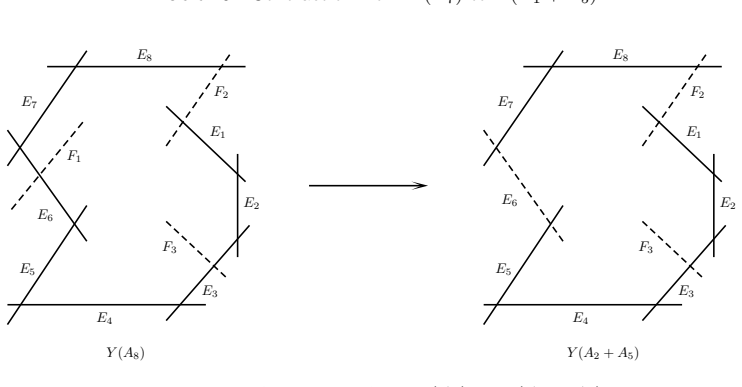
- [§5, Figures 1-8] The proofs of Theorems 1.7 and 1.8 depend on Figures 1-8; the figures should be checked for legibility and label consistency, and color-coded components should be annotated so that the arguments are reproducible in grayscale.
Circularity Check
Theorem 1.4's reduction to surface fibrations over toric bases is imported from the first author's [20, Thm 5.6] rather than proved; the title-level dichotomy rests on a same-author preprint, though the fiber criteria themselves are not definitionally circular.
-
self citation load bearing
[Section 3, proof of Theorem 1.4]
"By [20, Theorem 5.6], there exists a crepant birational map (X_0,B_0) ⇢ (X,B), only extracting log canonical places of (X,B), and a tower of Mori fiber spaces (X_0,B_0) → (X_1,B_1) → ... → (X_k,B_k) → Spec(K), of which at least n−2 of the f_i's are strict conic fibrations. ... Indeed, by [20, Theorem 1.5], the pair (X_{j+1},B_{j+1}) is a toric Calabi–Yau pair."
Theorem 1.4 is the paper's advertised reduction to surface fibrations over toric bases, but its dichotomy (i)/(ii) is not derived in the paper: the entire tower of Mori fiber spaces with n−2 strict conic fibrations, and the toricity of the remaining base, are taken verbatim from [20, Thm 5.6] and [20, Thm 1.5], a preprint by the first author that is not proved, sketched, or machine-checked here. If [20] is not accepted, the universal quantifier in Theorems 1.7–1.8 over 'complexity two' is unsupported; the derivation reduces to a same-author citation chain rather than to a self-contained proof. This is load-bearing self-citation, not a fitted parameter or a definitional equivalence, so it does not make the criteria themselves circular.
full rationale
The paper contains no fitted parameters and no condition that is defined in terms of the conclusion; the criteria in Theorems 1.7 and 1.8 are proved via complexity computations, Proposition 5.1, Theorem 1.9, and the MMP, and the del Pezzo classification in Theorem 1.3 is checked against Miyanishi–Zhang's list with explicit boundary constructions. So the central classification has independent content. The circularity burden comes from the structural layer: the proof of Theorem 1.4 delegates its main dichotomy to [20, Thm 5.6] and [20, Thm 1.5] (first author), while the complexity-one base case is imported from [8] (second author and collaborators) and the 'cluster type over the base' converse step from [5] (first author and collaborators). Those are real theorems in their own preprints, but none is machine-checked or code-reproduced here, and [20] in particular is the step that makes the reduction to surface fibrations over toric varieties cover arbitrary complexity-two pairs. This raises the score to 4; it is not a 6+ because the fiber-wise criteria and the surface classification are not forced by construction.
Assumptions & free parameters
assumptions (7)
- domain assumption The base field is an algebraically closed field of characteristic zero.
- standard math Fano type varieties are relative Mori dream spaces.
- standard math The dual complex of a Calabi-Yau pair is equidimensional.
- domain assumption Every Fano type Calabi-Yau pair of complexity two admits a crepant birational tower of Mori fiber spaces with at least n-2 strict conic fibrations.
- domain assumption Calabi-Yau pairs of index one and complexity one are cluster type.
- standard math The 31 families of Gorenstein del Pezzo surfaces of Picard rank one are classified by their singularities.
- standard math Finite covers of P1 ramified only over {0} and {infinity} are isomorphic to P1 with the same boundary.
Cite this review
Pith. "Pith review of Calabi-Yau pairs of complexity two." pith.science (2026). https://pith.science/paper/MXMGPHXT
@misc{pith2026241218830,
  author       = {Pith},
  title        = {Pith review of: Calabi-Yau pairs of complexity two},
  year         = {2026},
  howpublished = {\url{https://pith.science/paper/MXMGPHXT}},
  note         = {Machine review of arXiv:2412.18830}
}
abstract
A Calabi-Yau pair of index one and complexity zero is toric. Furthermore, a Calabi-Yau pair of index one and complexity one is of cluster type. In this article, we study Calabi-Yau pairs of index one and complexity two. We develop machinery to decide whether a Calabi-Yau of complexity two is of cluster type. This approach reduces the problem to studying del Pezzo fibrations over toric varieties. We apply this to the setting of Gorenstein del Pezzo surfaces of Picard rank one. We prove that such a surface $X$ is cluster type if and only if $X$ has only $A$-type singularities and either $\mathrm{vol}(X)>1$ or $|X^{\rm sing}|\leq 3$.
Figures


Figures from the paper (10 more)




Forward citations
Cited by 2 Pith papers
-
Bott-Chern complexity of K\"ahler pairs
The Bott-Chern complexity of a non-projective Calabi-Yau Kähler pair is at least 3, and this bound is attained by singular non-projective K3 surfaces with Picard rank zero.
-
Complexity one varieties are cluster type
A log Calabi-Yau pair of index one and complexity at most one is a cluster type variety, and varieties of absolute complexity one admit a finite cluster type cover of degree at most two.
Reference graph
Works this paper leans on
-
[18]
M. Miyanishi and D.-Q. Zhang. Gorenstein log del Pezzo s urfaces of rank one. J. Algebra , 118(1):63–84, 1988. doi:10.1016/0021-8693(88)90048-8
-
[1]
A. Avilov, K. Loginov, and V. Przyjalkowski. Coregulari ty of smooth Fano threefolds. Commun. Number Theory Phys. , 18(3):509–577, 2024. doi:10.4310/cntp.240904010922
-
[2]
L. Braun, S. Filipazzi, J. Moraga, and R. Svaldi. The Jord an property for local fundamental groups. Geom. Topol. , 26(1):283–319, 2022. doi:10.2140/gt.2022.26.283
-
[3]
M. V. Brown, J. McKernan, R. Svaldi, and H. R. Zong. A geome tric characterization of toric varieties. Duke Math. J. , 167(5):923–968, 2018. doi:10.1215/00127094-2017-0047
-
[4]
D. A. Cox, J. B. Little, and H. K. Schenck. Toric varieties , volume 124 of Graduate Studies in Mathematics . American Mathematical Society, Providence, RI, 2011. doi:10.1090/gsm/124
doi:10.1090/gsm/124 2011
-
[5]
E. A. da Silva, F. Figueroa, and J. Moraga. Algebraic tori in the complement of quartic surfaces, 2024, arXiv:2411.03506
work page Pith review arXiv 2024
-
[6]
Log Calabi--Yau pairs of complexity zero and arbitrary index
J. Enwright and F. Figueroa. Log Calabi-Yau pairs of comp lexity zero and arbitrary index, 2024, arXiv:2411.05343
work page Pith review arXiv 2024
-
[7]
Log Calabi-Yau pairs of birational complexity zero
J. Enwright, F. Figueroa, and J. Moraga. Log Calabi-Yau p airs of birational complexity zero, 2024, arXiv:2404.05878
work page Pith review arXiv 2024
Show all 25 references
-
[8]
Enwright, J
J. Enwright, J. Li, and J. I. Y´ a˜ nez. Complexity one vari eties are cluster type, 2025, arXiv:2504.17369
2025 arXiv
-
[9]
Esser, L
L. Esser, L. Ji, and J. Moraga. Symmetries of fano varieti es. Journal f¨ ur die reine und angewandte Mathematik (Crelles Journal), 2024. doi:doi:10.1515/crelle-2024-0077
2024 doi
-
[10]
Filipazzi, M
S. Filipazzi, M. Mauri, and J. Moraga. Index of coregula rity zero log Calabi-Yau pairs. Algebra Number Theory, 19(2):383– 413, 2025. doi:10.2140/ant.2025.19.383
2025 doi
-
[11]
Filipazzi and R
S. Filipazzi and R. Svaldi. On the connectedness princi ple and dual complexes for generalized pairs. Forum Math. Sigma , 11:Paper No. e33, 2023. doi:10.1017/fms.2023.25
2023 doi
-
[12]
Gachet, Z
C. Gachet, Z. Liu, and J. Moraga. Fundamental groups of l og Calabi-Yau surfaces, 2023, arXiv:2312.03981
2023 arXiv
-
[13]
M. Gross. Toric degenerations and Batyrev-Borisov dua lity. Math. Ann. , 333(3):645–688, 2005. doi:10.1007/s00208-005-0686-7
2005 doi
-
[14]
Gross, P
M. Gross, P. Hacking, and S. Keel. Mirror symmetry for lo g Calabi-Yau surfaces I. Publ. Math. Inst. Hautes ´Etudes Sci. , 122:65–168, 2015. doi:10.1007/s10240-015-0073-1
2015 doi
-
[15]
Ji and J
L. Ji and J. Moraga. Toricity in families of Fano varieti es, 2024, arXiv:2409.03564
2024
-
[16]
C.-J. Lai. Varieties fibered by good minimal models. Math. Ann. , 350(3):533–547, 2011. doi:10.1007/s00208-010-0574-7
2011 doi
-
[17]
Mauri and J
M. Mauri and J. Moraga. Birational complexity and dual c omplexes. Proc. Lond. Math. Soc. (3) , 131(2):Paper No. e70073,
-
[19]
J. Moraga. Kawamata log terminal singularities of full rank, 2021, arXiv:2007.10322
2021 arXiv
-
[20]
J. Moraga. Birational complexity and conic fibrations, 2024, arXiv:2403.17251
2024
-
[21]
J. Moraga. Birational complexity of log Calabi-Yau 3-f olds, 2024, arXiv:2405.18516
2024 arXiv
-
[22]
J. Moraga. Termination of pseudo-effective 4-fold flips . Math. Z. , 310(4):Paper No. 73, 32, 2025. doi:10.1007/s00209-025-03766-y
2025 doi
-
[23]
Moraga and R
J. Moraga and R. Svaldi. A geometric characterization o f toric singularities. Journal de Math´ ematiques Pures et Appliqu´ ees, page 103620, 2024. doi:https://doi.org/10.1016/j.matpur.2024.103620
2024
-
[24]
Y. G. Prokhorov. The rationality problem for conic bund les. Uspekhi Mat. Nauk , 73(3(441)):3–88, 2018. doi:10.4213/rm9811. UCLA Mathematics Department, Box 951555, Los Angeles, CA 9009 5-1555, USA Email address : jmoraga@math.ucla.edu UCLA Mathematics Department, Box 951555, ...
2018 doi
-
[2025]
doi:10.1112/plms.70073
Reviewed August 11, 2026 · model on record in the stance chip above.
Discussion (0). Continue with ORCID to comment.