REVIEW 3 major objections 6 minor 65 references
Optimization-based model order reduction of fluid-structure interaction problems
T0 review · 3 major / 6 minor · reviewed 2026-08-11 · deepseek-v4-flash
Pith's one-line read Fluid-structure interaction can be recast as an optimization problem with the interface flux as control, allowing separate reduced models for fluid and solid.
desk verdict A credible optimization-based partitioned FSI/MOR formulation with honest FOM tests, but unreported δ and in-sample ROM results keep it from being fully convincing. read the letter →
The pith
A machine-rendered reading of the paper's core claim, the machinery that carries it, and where it could break.
The reading
What carries the argument
The load-bearing object is the optimization problem (25), whose objective punishes the mismatch between the fluid velocity on the interface and the time-discrete solid velocity, plus $\frac{\delta}{2}$ times the $H^1(\tilde{\Gamma})$ seminorm of the control $g$; the constraints are the discrete residuals of the fluid and solid. The control $g$ represents the normal flux at the interface. For the reduced-order model the same structure is kept, with POD spaces for fluid state, solid state, and control; enrichment modes are added to the state spaces and the fluid ROM uses least-squares Petrov-Galerkin projection so the coupled problem stays stable.
What would settle it
Solve the exact-solution test of Section 5.1 with the regularization parameter $\delta$ set to several values from large to tiny, and compute the error against the exact solution; if the error does not decrease toward the reported second-order convergence as $\delta\to 0$, the full-order solution used throughout is not the fluid-structure solution but a nearby regularized one.
Extended reading notes
Core claim
The central claim is that the discrete fluid-structure system (24) is equivalent, in the limit of vanishing regularization, to the constrained optimization problem (25), with the interface flux $g$ as control; the objective is the squared mismatch between the fluid velocity on the interface and the Newmark time-discrete solid velocity, plus a $\delta$-weighted $H^1(\tilde{\Gamma})$ control penalty. Since $g$ enters linearly in both residuals, static condensation turns each SQP subproblem into a least-squares problem for $g$, so fluid and solid subproblems can be solved independently and then coupled through the control. The paper argues this removes the need for compatibility conditions between fluid and solid reduced spaces, and demonstrates the setup on three two-dimensional problems: an exact-solution test showing second-order convergence, an elastic-beam configuration where SQP needs far fewer iterations than Dirichlet-Neumann, and the benchmark case where LSPG-plus-enrichment ROMs and a ROM-FOM hybrid reproduce the high-fidelity results.
Load-bearing premise
The method's reference solution comes from a regularized optimization problem; the paper assumes this problem converges to the real fluid-structure system as the penalty term shrinks, citing earlier work but giving no check or penalty values for its own moving-mesh tests.
Editorial extensions
If this is right
- The full-order partitioned solver is second-order accurate in space and time when BDF2 and Newmark are used, based on the exact-solution test.
- SQP with the inexact Jacobian is faster than Dirichlet-Neumann iteration in the elastic-beam tests, with about a ten-fold speedup on the coarse mesh.
- Fluid and solid reduced spaces can be built independently with POD, and the optimization enforces interface coupling without compatibility conditions.
- Enrichment of the state spaces and LSPG for the fluid are both needed: Galerkin-only or no-enrichment ROMs become unstable or inaccurate in the benchmark test.
- A hybrid configuration with a reduced-order solid and full-order fluid remains accurate over a longer integration window in the benchmark test, although the paper reports spurious force oscillations can appear on the finer mesh.
Reading between the lines
- The same optimization coupling could be applied to non-conforming fluid and solid meshes; the paper says compatibility is not required but only tests conforming meshes.
- Because the cost of forming the sensitivity matrices grows with the control dimension, reducing the control space by POD or adaptive selection of interface degrees is a natural next step toward larger or three-dimensional problems.
- The reported ROM errors are measured against the regularized reference solution, so their practical meaning depends on the unverified $\delta\to 0$ limit; a $\delta$-convergence study would settle this.
- The enrichment strategy that stabilizes the ROM could double as an indicator of where the reduced fluid space is deficient, since it is built from the interface control response.
Editorial analysis
A structured set of objections, weighed in public.
Referee Report
Summary. The paper proposes an optimization-based partitioned formulation for fluid-structure interaction (FSI) in an arbitrary Lagrangian-Eulerian (ALE) framework. The interface flux is introduced as a control variable, and the implicitly coupled fluid-solid system is reformulated as the constrained optimization problem (25), solved by sequential quadratic programming (SQP). Reduced-order models are then built separately for the fluid state, the solid state, and the control using proper orthogonal decomposition (POD), with Galerkin projection for the solid and least-squares Petrov-Galerkin (LSPG) projection for the fluid, together with an enrichment strategy. Numerical experiments include a manufactured-solution convergence study, an elastic-beam test, the Turek-Hron benchmark, and ROM and hybrid ROM-FOM reconstructions. The paper's central claim is that this optimization-based coupling enables seamless coupling of independent full-order and reduced-order subproblems without compatibility conditions.
Significance. If the formulation is sound, it provides a practically relevant alternative to Dirichlet-to-Neumann and monolithic coupling for partitioned FSI solvers, especially in the model-reduction setting where the fluid and solid reduced spaces can be constructed independently. The SQP-vs-DtN comparison in Table 2 and the agreement with the Turek benchmark in Section 5.3 are useful and credible. The manufactured-solution convergence rates in Table 1 are also encouraging. The main weaknesses are that the convergence of the regularized problem (25) to the original coupled system (24) as delta tends to zero is asserted but not verified for the present ALE formulation, that the regularization parameter delta is not reported in any experiment, and that the fully discrete stability analysis is deferred. Because every FOM and ROM error is measured against a solution of (25), the missing delta documentation is a load-bearing reproducibility and correctness gap.
major comments (3)
- [Section 3.4, Eq. (25)] The statement that solutions of (25) converge to solutions of (24) as delta approaches 0 is cited to [33,34,35] but is not verified for the present ALE formulation with a time-dependent fluid domain and a nonlinear hyperelastic solid. Moreover, the regularizer in (25) is the H1(eGamma) seminorm, which is not coercive on the control space G because constant interface tractions are not penalized. No delta values are reported anywhere in Section 5, so the FOM reference used in Tables 1-4 and Figures 4-6 and 10-17 is a solution of (25) for an unspecified delta. This is load-bearing because every ROM error is measured against that reference rather than against a solution of (24). Please provide a delta-convergence study (e.g., delta = 10^-2, 10^-4, 10^-6) or prove the convergence under the paper's assumptions, and report the delta used in each numerical experiment.
- [Section 5.1, Table 1] The convergence study in Table 1 refines h and Delta t simultaneously while delta is held fixed (and unreported). If delta is fixed positive, the error to the exact solution of (2) includes a regularization error that does not vanish with h and Delta t unless the exact control happens to lie in the kernel of the regularizer. The observed second-order rates are therefore not by themselves a complete convergence statement for the coupled system (24). The authors should either report the value of delta used, demonstrate that the rates are independent of delta, or include a study in which delta is sent to zero along with the discretization parameters.
- [Section 4.1 and Section 6] The paper states that the enrichment strategy 'ensures algebraic stability of the coupled problem' (Section 6) and that enrichment and Petrov-Galerkin projection are 'key to ensure ... stability' (Section 5.2), but the fully discrete stability analysis is explicitly deferred in Section 3.3. The numerical evidence in Figures 14 and 17 shows that stability is not universal: the Galerkin ROM and the LSPG ROM without enrichment are unstable from early times, and the hybrid ROM on mesh1 develops oscillations after about 7 seconds. The stability claim should be restricted to the enriched LSPG configuration and, ideally, supported by a discrete energy estimate or a precise numerical stability criterion rather than presented as a general property of the enrichment strategy.
minor comments (6)
- [Eq. (31) vs Section 3.4] The POD control inner product in (31) is the full H1(eGamma) inner product, while the regularizer in (25) uses only the H1(eGamma) seminorm. The relation between these two choices should be clarified, since the POD inner product is a norm but the regularizer is not.
- [Appendix B] The dimensions of the control matrix eEs are stated as RNu x NGamma, but the definition (eEs)_{j,l} = integral over eGamma of phi^f_{i_f_l} * phi^s_j (with j as a solid index) suggests the dimension should be RNs x NGamma. Please correct the typo.
- [Section 5.2, Figure 13 context] The text says 'The results of the ROM are in good agreement with the HF results for all tolerances considered' and then immediately notes that tolpod = 10^-4 leads to an unstable ROM. Since Figure 13 shows only tolpod = 10^-5, 10^-6, 10^-7, either include the 10^-4 case in the figure or rephrase the sentence to avoid an apparent contradiction.
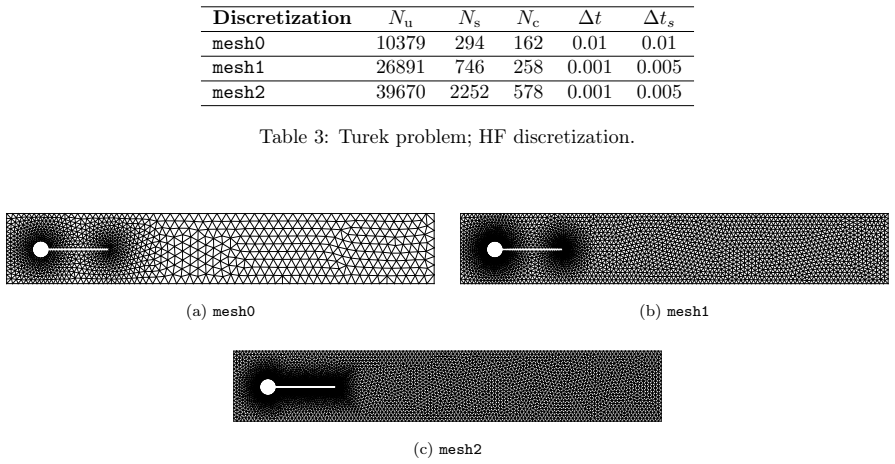
- [Section 2.1 and Section 5] The pseudo-elastic parameters mu_m and lambda_m for the ALE mesh deformation are said to be discussed in Section 5, but no values are reported. These parameters affect the mesh motion and hence the FOM solution; please report them for each test case.
- [Section 5.3.1] The statement 'we divide the equations by rho_f' is not reflected in the governing equations or in the reported parameter values; please specify the nondimensionalization so that the numerical setup is reproducible.
- [Global] The manuscript does not state whether the implementation or data are available. Given the number of algorithmic parameters (tolsqp, tolen, tolpod, delta, mesh parameters), a code/data availability statement would substantially improve reproducibility.
Circularity Check
No significant circularity: the FOM is anchored to external exact/benchmark solutions, and the ROM evaluation is explicitly an in-sample 'solution reproduction' exercise rather than a disguised prediction.
full rationale
The paper's derivation chain is largely self-contained. The full-order formulation (23)-(25) is derived directly from the FE discretization of the ALE fluid and Lagrangian solid equations; the claim that solutions of the regularized problem (25) converge to those of the coupled system (24) as δ→0 is cited to independent prior work [33,34,35] (Kuberry and Lee), not to the present authors, so this is not a self-citation loop. The FOM is validated against an exact manufactured solution (Section 5.1, Table 1) and against the independent Turek benchmark (Section 5.3, Table 4, Figure 10), providing external anchors. The ROM part is explicitly framed as a 'solution reproduction problem': Section 4 states 'we focus on the solution reproduction problem' and 'The problem is of little practical interest; however, it represents the first step towards the development of a predictive MOR framework.' Using the same trajectory to build POD spaces and then to measure reconstruction error is therefore an in-sample consistency check, not a fitted parameter renamed as a prediction. The enrichment and LSPG choices are supported by within-paper ablation studies (Figures 6 and 14). The reported weaknesses—long-time ROM instabilities, slow POD eigenvalue decay, and the unreported δ values with unverified hypotheses for the δ→0 limit in the ALE/nonlinear-solid setting—are correctness or support gaps, not circular reductions: they do not make the central formulation equivalent to its inputs by construction. Hence no specific circular step is identified.
Assumptions & free parameters
free parameters (5)
- Regularization weight delta =
not reported
- POD tolerance tolpod =
1e-4 to 1e-8
- Enrichment tolerance tolen =
0.1
- Pseudo-elastic ALE parameters mu_m, lambda_m =
not reported
- Characteristic velocity u_inf =
1 (beam), 3 (Turek)
assumptions (5)
- domain assumption The coupled ALE FSI problem is well-posed and regular enough for the FE error analysis and energy estimates.
- ad hoc to paper The solution of the regularized problem (25) converges to the solution of (24) as delta goes to 0.
- ad hoc to paper POD plus enrichment yields full-rank sensitivity matrices and algebraic stability of the coupled ROM.
- standard math Taylor-Hood P2-P1 elements for the fluid and P2 elements for the solid satisfy the needed inf-sup and approximation properties on moving meshes.
- domain assumption The pseudo-elastic extension (5) gives a bijective ALE map for all time steps.
invented entities (1)
-
Interface flux control g on eGamma
Cite this review
Pith. "Pith review of Optimization-based model order reduction of fluid-structure interaction problems." pith.science (2026). https://pith.science/paper/NVZ33PXC
@misc{pith2026241218916,
  author       = {Pith},
  title        = {Pith review of: Optimization-based model order reduction of fluid-structure interaction problems},
  year         = {2026},
  howpublished = {\url{https://pith.science/paper/NVZ33PXC}},
  note         = {Machine review of arXiv:2412.18916}
}
read the original abstract
We introduce optimization-based full-order and reduced-order formulations of fluid structure interaction problems. We study the flow of an incompressible Newtonian fluid which interacts with an elastic body: we consider an arbitrary Lagrangian Eulerian formulation of the fluid problem and a fully Lagrangian formulation of the solid problem; we rely on a finite element discretization of both fluid and solid equations. The distinctive feature of our approach is an implicit coupling of fluid and structural problems that relies on the solution to a constrained optimization problem with equality constraints. We discuss the application of projection-based model reduction to both fluid and solid subproblems: we rely on Galerkin projection for the solid equations and on least-square Petrov-Galerkin projection for the fluid equations. Numerical results for three model problems illustrate the many features of the formulation.
Figures


Figures from the paper (14 more)




Reference graph
Works this paper leans on
-
[1]
E. B. Agamloh, A. K. Wallace, and A. Von Jouanne. Application of fluid–structure interaction simulation of an ocean wave energy extraction device.Renewable Energy, 33(4):748–757, Apr. 2008
work page 2008
-
[2]
M. Astorino and C. Grandmont. Convergence analysis of a projection semi-implicit coupling scheme for fluid–structure interaction problems.Numerische Mathematik, 116(4):721–767, 2010
work page 2010
-
[3]
F. Ballarin, G. Rozza, and Y. Maday. Reduced-order semi-implicit schemes for fluid-structure interac- tion problems. In P. Benner, M. Ohlberger, A. Patera, G. Rozza, K. Urban (eds) Model Reduction of Parametrized Systems. MS&A, vol 17. Springer, Cham., 2017
work page 2017
-
[4]
A. T. Barker and X.-C. Cai. Scalable parallel methods for monolithic coupling in fluid–structure interaction with application to blood flow modeling.Journal of Computational Physics, 229(3):642–659, 2010
work page 2010
-
[5]
M. Bergmann, A. Fondanèche, and A. Iollo. An Eulerian finite-volume approach of fluid-structure interac- tion problems on quadtree meshes.Journal of Computational Physics, 471:111647, 2022
work page 2022
-
[6]
J.-F. Bonnans, J. C. Gilbert, C. Lemaréchal, and C. A. Sagastizábal.Numerical optimization: theoretical and practical aspects. Springer Science & Business Media, 2006. 22
work page 2006
-
[7]
K. Carlberg, C. Farhat, J. Cortial, and D. Amsallem. The GNAT method for nonlinear model reduction: effective implementation and application to computational fluid dynamics and turbulent flows.Journal of Computational Physics, 242:623–647, 2013
work page 2013
-
[8]
P. Causin, J.-F. Gerbeau, and F. Nobile. Added-mass effect in the design of partitioned algorithms for fluid–structure problems.Computer methods in applied mechanics and engineering, 194(42-44):4506–4527, 2005
work page 2005
Show all 65 references
-
[9]
Chabannes, G
V. Chabannes, G. Pena, and C. Prud’Homme. High-order fluid–structure interaction in 2D and 3D appli- cation to blood flow in arteries.Journal of Computational and Applied Mathematics, 246:1–9, 2013
2013
-
[10]
Cinquegrana and P
D. Cinquegrana and P. L. Vitagliano. Validation of a new fluid—structure interaction framework for non-linear instabilities of 3D aerodynamic configurations.Journal of Fluids and Structures, 103:103264, 2021
2021
-
[11]
Cottet, E
G.-H. Cottet, E. Maitre, and T. Milcent. Eulerian formulation and level set models for incompressible fluid-structure interaction.ESAIM: Mathematical Modelling and Numerical Analysis, 42(3):471–492, 2008
2008
-
[12]
Cremonesi, A
M. Cremonesi, A. Franci, S. Idelsohn, and E. Oñate. A state of the art review of the particle finite element method (PFEM). Archives of Computational Methods in Engineering, 27(5):1709–1735, 2020
2020
-
[13]
Deparis, M
S. Deparis, M. Discacciati, G. Fourestey, and A. Quarteroni. Fluid–structure algorithms based on Steklov–Poincaré operators. Computer Methods in Applied Mechanics and Engineering, 195:5797–5812, 2006
2006
-
[14]
Deparis, D
S. Deparis, D. Forti, G. Grandperrin, and A. Quarteroni. FaCSI: A block parallel preconditioner for fluid–structure interaction in hemodynamics.Journal of Computational Physics, 327:700–718, 2016
2016
-
[15]
Deparis and A
S. Deparis and A. E. Løvgren. Stabilized reduced basis approximation of incompressible three-dimensional Navier-Stokes equations in parametrized deformed domains.Journal of Scientific Computing, 50(1):198– 212, 2012
2012
-
[16]
Donea, A
J. Donea, A. Huerta, J.-P. Ponthot, and A. Rodríguez-Ferran. Arbitrary Lagrangian Eulerian methods. Encyclopedia of computational mechanics, 2004
2004
-
[17]
D’Elia and P
M. D’Elia and P. B. Bochev. Optimization–based coupling of nonlocal and local diffusion models.MRS Online Proceedings Library (OPL), 1753:mrsf14–1753, 2015
2015
-
[18]
Farhat and P
C. Farhat and P. Geuzaine. Design and analysis of robust ALE time-integrators for the solution of unsteady flow problems on moving grids. Computer Methods in Applied Mechanics and Engineering, 193(39):4073–4095, 2004
2004
-
[19]
Farhat and V
C. Farhat and V. K. Lakshminarayan. An ALE formulation of embedded boundary methods for tracking boundary layers in turbulent fluid–structure interaction problems. Journal of Computational Physics, 263:53–70, 2014
2014
-
[20]
Farhat, M
C. Farhat, M. Lesoinne, and P. Le Tallec. Load and motion transfer algorithms for fluid/structure in- teraction problems with non-matching discrete interfaces: Momentum and energy conservation, optimal discretization and application to aeroelasticity.Computer methods in applie...
1998
-
[21]
Farhat, K
C. Farhat, K. G. Van der Zee, and P. Geuzaine. Provably second-order time-accurate loosely-coupled solution algorithms for transient nonlinear computational aeroelasticity. Computer methods in applied mechanics and engineering, 195(17-18):1973–2001, 2006
1973
-
[22]
M. A. Fernández. Coupling schemes for incompressible fluid-structure interaction: implicit, semi-implicit and explicit. SeMA Journal, 55(1):59–108, 2011
2011
-
[23]
M. A. Fernández and M. Moubachir. A Newton method using exact jacobians for solving fluid–structure coupling. Computers & Structures, 83(2-3):127–142, 2005
2005
-
[24]
Formaggia, A
L. Formaggia, A. Quarteroni, and A. Veneziani.Cardiovascular Mathematics: Modeling and simulation of the circulatory system, volume 1. Springer Science & Business Media, 2010
2010
-
[25]
Froehle and P.-O
B. Froehle and P.-O. Persson. Nonlinear elasticity for mesh deformation with high-order discontinuous galerkin methods for the Navier-Stokes equations on deforming domains. InSpectral and High Order Meth- ods for Partial Differential Equations ICOSAHOM 2014: Selected papers fr...
2014
-
[26]
M. D. Gunzburger and H. K. Lee. An optimization-based domain decomposition method for the Navier- Stokes equations. SIAM Journal on Numerical Analysis, 37(5):1455–1480, Jan 2000
2000
-
[27]
M. D. Gunzburger, J. S. Peterson, and H. Kwon. An optimization based domain decomposition method for partial differential equations.Computers & Mathematics with Applications, 37(10):77–93, 1999
1999
-
[28]
Habchi, S
C. Habchi, S. Russeil, D. Bougeard, J.-L. Harion, T. Lemenand, A. Ghanem, D. D. Valle, and H. Peerhos- saini. Partitioned solver for strongly coupled fluid–structure interaction.Computers & Fluids, 71:306–319, 2013
2013
-
[29]
Hoang, Y
C. Hoang, Y. Choi, and K. Carlberg. Domain-decomposition least-squares Petrov–Galerkin (DD-LSPG) nonlinear model reduction.Computer methods in applied mechanics and engineering, 384:113997, 2021
2021
-
[30]
Iollo, G
A. Iollo, G. Sambataro, and T. Taddei. A one-shot overlapping Schwarz method for component-based model reduction: application to nonlinear elasticity.Computer Methods in Applied Mechanics and Engineering, 404:115786, 2023
2023
-
[31]
Kalashnikova, M
I. Kalashnikova, M. Barone, and M. Brake. A stable Galerkin reduced order model for coupled fluid– structure interaction problems. International Journal for Numerical Methods in Engineering, 95(2):121– 144, 2013
2013
-
[32]
Kim and H
W. Kim and H. Choi. Immersed boundary methods for fluid-structure interaction: A review.International Journal of Heat and Fluid Flow, 75:301–309, 2019
2019
-
[33]
Kuberry and H
P. Kuberry and H. Lee. A decoupling algorithm for fluid-structure interaction problems based on optimiza- tion. Computer Methods in Applied Mechanics and Engineering, 267:594–605, 2013
2013
-
[34]
Kuberry and H
P. Kuberry and H. Lee. Analysis of a fluid-structure interaction problem recast in an optimal control setting. SIAM Journal on Numerical Analysis, 53(3):1464–1487, 2015
2015
-
[35]
Kuberry and H
P. Kuberry and H. Lee. Convergence of a fluid–structure interaction problem decoupled by a Neumann control over a single time step.Journal of Mathematical Analysis and Applications, 437(1):645–667, 2016
2016
-
[36]
Küttler and W
U. Küttler and W. A. Wall. Fixed-point fluid–structure interaction solvers with dynamic relaxation.Com- putational Mechanics, 43:61–72, 2008
2008
-
[37]
T. Lieu, C. Farhat, and M. Lesoinne. Reduced-order fluid/structure modeling of a complete aircraft configuration. Computer methods in applied mechanics and engineering, 195(41-43):5730–5742, 2006
2006
-
[38]
Lombardi, N
M. Lombardi, N. Parolini, A. Quarteroni, and G. Rozza. Numerical simulation of sailing boats: dynamics, FSI, and shape optimization. In G. Buttazzo and A. Frediani, editors,Variational Analysis and Aerospace Engineering: Mathematical Challenges for Aerospace Design, page 339–3...
2012
-
[39]
A. E. Løvgren, Y. Maday, and E. M. Rønquist. A reduced basis element method for the steady Stokes problem. ESAIM: Mathematical Modelling and Numerical Analysis, 40(3):529–552, 2006
2006
-
[40]
F. Nobile. Numerical approximation of fluid-structure interaction problems with application to haemody- namics. PhD thesis, EPFL, 2001
2001
-
[41]
Nonino, F
M. Nonino, F. Ballarin, G. Rozza, and Y. Maday. Projection based semi-implicit partitioned reduced basis method for fluid-structure interaction problems.Journal of Scientific Computing, 94(1):4, 2023
2023
-
[42]
Prusak, M
I. Prusak, M. Nonino, D. Torlo, F. Ballarin, and G. Rozza. An optimisation–based domain–decomposition reduced order model for the incompressible Navier-Stokes equations. Computers & Mathematics with Applications, 151:172–189, 2023
2023
-
[43]
Prusak, D
I. Prusak, D. Torlo, M. Nonino, and G. Rozza. An optimisation–based domain–decomposition reduced order model for parameter–dependent non–stationary fluid dynamics problems.Computers & Mathematics with Applications, 166:253–268, 2024
2024
-
[44]
S. S. Rao.The finite element method in engineering. Elsevier, 2010
2010
-
[45]
T. Richter. A fully Eulerian formulation for fluid–structure-interaction problems.Journal of Computational Physics, 233:227–240, 2013
2013
-
[46]
L. A. Sangalli and A. L. Braun. A fluid-structure interaction model for numerical simulation of bridge flutter using sectional models with active control devices. Preliminary results.Journal of Sound and Vibration, 477:115338, 2020. 24
2020
-
[47]
Schott, C
B. Schott, C. Ager, and W. A. Wall. Monolithic cut finite element–based approaches for fluid-structure interaction. International Journal for Numerical Methods in Engineering, 119(8):757–796, 2019
2019
-
[48]
Shamanskiy and B
A. Shamanskiy and B. Simeon. Mesh moving techniques in fluid-structure interaction: robustness, accu- mulated distortion and computational efficiency.Computational Mechanics, 67(2):583–600, Feb. 2021
2021
-
[49]
Sirovich
L. Sirovich. Turbulence and the dynamics of coherent structures. I. Coherent structures.Quarterly of applied mathematics, 45(3):561–571, 1987
1987
-
[50]
Sugiyama, S
K. Sugiyama, S. Ii, S. Takeuchi, S. Takagi, and Y. Matsumoto. A full Eulerian finite difference approach for solving fluid–structure coupling problems.Journal of Computational Physics, 230(3):596–627, 2011
2011
-
[51]
T. Taddei. A registration method for model order reduction: data compression and geometry reduction. SIAM Journal on Scientific Computing, 42(2):A997–A1027, 2020
2020
-
[52]
Taddei, X
T. Taddei, X. Xu, and L. Zhang. A non-overlapping optimization-based domain decomposition approach to component-based model reduction of incompressible flows.Journal of Computational Physics, 509:113038, 2024
2024
-
[53]
Taddei and L
T. Taddei and L. Zhang. A discretize-then-map approach for the treatment of parameterized geometries in model order reduction.Computer Methods in Applied Mechanics and Engineering, 384:113956, 2021
2021
-
[54]
Taddei and L
T. Taddei and L. Zhang. Space-time registration-based model reduction of parameterized one-dimensional hyperbolic PDEs. ESAIM: Mathematical Modelling and Numerical Analysis, 55(1):99–130, 2021
2021
-
[55]
T. E. Tezduyar, M. Behr, S. Mittal, and J. Liou. A new strategy for finite element computations involving moving boundaries and interfaces—the deforming-spatial-domain/space-time procedure: I. The concept and preliminary tests.Computer methods in applied mechanics and engineer...
1992
-
[56]
T. E. Tezduyar, M. Behr, S. Mittal, and J. Liou. A new strategy for finite element computations involving moving boundaries and interfaces—the deforming-spatial-domain/space-time procedure: II. Computation of free-surface flows, two-liquid flows, and flows with drifting cylind...
1992
-
[57]
Turek and J
S. Turek and J. Hron. Proposal for numerical benchmarking of fluid-structure interaction between an elastic object and laminar incompressible flow. InLecture Notes in Computational Science and Engineering, volume 53, pages 371–385. Springer Berlin Heidelberg, 2006
2006
-
[58]
Valkov, C
B. Valkov, C. H. Rycroft, and K. Kamrin. Eulerian method for multiphase interactions of soft solid bodies in fluids. Journal of Applied Mechanics, 82(4):041011, 2015
2015
-
[59]
Van Loon, P
R. Van Loon, P. D. Anderson, J. De Hart, and F. P. Baaijens. A combined fictitious domain/adaptive meshingmethodforfluid–structureinteractioninheartvalves. International Journal for Numerical Methods in Fluids, 46(5):533–544, 2004
2004
-
[60]
Modelreductionusingproperorthogonaldecomposition
S.Volkwein. Modelreductionusingproperorthogonaldecomposition. Lecture Notes, Institute of Mathemat- ics and Scientific Computing, University of Graz. see http://www. uni-graz. at/imawww/volkwein/POD. pdf, 1025, 2011
2011
-
[61]
C. R. Wentland, F. Rizzi, J. Barnett, and I. Tezaur. The role of interface boundary conditions and sampling strategies for Schwarz-based coupling of projection-based reduced order models.arXiv preprint arXiv:2410.04668, 2024
2024 arXiv
-
[62]
T. Wick. Fluid-structure interactions using different mesh motion techniques.Computers & Structures, 89(13–14):1456–1467, July 2011
2011
-
[63]
Wu and X.-C
Y. Wu and X.-C. Cai. A fully implicit domain decomposition based ALE framework for three-dimensional fluid–structure interaction with application in blood flow computation.Journal of Computational Physics, 258:524–537, 2014
2014
-
[64]
D. Xiao, P. Yang, F. Fang, J. Xiang, C. C. Pain, and I. M. Navon. Non-intrusive reduced order modelling of fluid–structure interactions.Computer Methods in Applied Mechanics and Engineering, 303:35–54, 2016
2016
-
[65]
M. Yano. A space-time Petrov–Galerkin certified reduced basis method: Application to the Boussinesq equations. SIAM Journal on Scientific Computing, 36(1):A232–A266, 2014. 25
2014
Reviewed August 11, 2026 · model on record in the stance chip above.
Discussion (0). Continue with ORCID to comment.