REVIEW 3 major objections 4 minor 34 references
A Novel Algorithm for Periodic Conformal Flattening of Genus-one and Multiply Connected Genus-zero Surfaces
T0 review · 3 major / 4 minor · reviewed 2026-08-11 · deepseek-v4-flash
Pith's one-line read Periodic conformal flattening maps tori and holed spheres to the plane with maps that do not depend on the cut path and are bijective on intrinsic Delaunay meshes.
desk verdict Genuinely new periodic conformal flattening for genus-one and annulus; the multiply-connected extension overclaims conformality because its final Laplace-Beltrami step is only harmonic. read the letter →
The pith
A machine-rendered reading of the paper's core claim, the machinery that carries it, and where it could break.
The reading
What carries the argument
The central object is the cutting Laplacian matrix $\tilde{L}_D$ built on the mesh after it is cut along loops, together with the matrix $P$ that encodes the translation-identical conditions pairing each seam side with its translate. Assembling the unknown coordinates as $g=[f,h,t]$ with $\tilde{f}=Pg$ turns the discrete conformal energy $E_C(\tilde{f})=\frac{1}{2}\operatorname{trace}(\tilde{f}^T\tilde{L}_D\tilde{f})-\text{area}$ into a quadratic form in $g$, and setting its gradient to zero produces the sparse linear systems solved by DPCF and SPCF. The positivity of the cotangent edge weights on intrinsic Delaunay meshes makes the flattened map a convex combination map, which is what lets the bijectivity argument borrow the discrete maximum principle and the one-to-one piecewise-linear mapping criterion. For annuli, the explicit map $\Pi(x,y)=e^{-2\pi l^{-1}y}(\cos(2\pi l^{-1}x),\sin(2\pi l^{-1}x))$ is the bridge from the periodic band to a circular annulus.
What would settle it
Run SPCF on a multiply connected mesh with at least three boundaries and compare the Beltrami coefficient $|\mu|$ face-by-face immediately after the annulus iteration and again after the final circle-fixing correction. If $|\mu|$ rises by more than rounding error in any region where interior vertices were moved, the composite map is not conformal there, directly contradicting the claim that the correction step keeps the map conformal. A complementary check is to compare angles near a corrected hole against the original mesh angles; a systematic angle error localized around the hole would also falsify the conformality claim.
Extended reading notes
Core claim
For a genus-one mesh, cutting along a handle loop and a tunnel loop and asking that the two copies of each cut differ by fixed lattice vectors reduces conformal flattening to minimizing a quadratic functional; the Euler-Lagrange equations become two sparse linear systems whose unknowns are the interior vertex coordinates and one lattice vector $h$ (with the other vector $t$ normalized). For a doubly connected genus-zero surface, the analogous single-periodic construction with Dirichlet boundary conditions on the two boundary loops yields a periodic band, which an explicit exponential map then sends to a genuine circular annulus. The central theoretical claims are that the resulting maps are independent of the cut path selection, that the lattice vectors depend only on the homology class of the cut loops, and that on intrinsic Delaunay meshes the maps are bijective; the bijectivity proof runs through the convex-combination structure of the flattened coordinates and an established one-to-one piecewise-linear mapping criterion. The multiply connected genus-zero pipeline iterates these annulus maps boundary by boundary and finishes with a Laplace–Beltrami step that forces all boundary holes to be perfect circles, which the paper asserts leaves the composition conformal.
Load-bearing premise
The weakest assumption is that the last step of the multiply connected pipeline—forcing every boundary hole to a perfect circle and then repositioning all interior points by solving the standard flat-smoothing equation—still preserves exact angle preservation; that equation preserves smoothness, not angles, and the paper gives no proof that it is conformal here.
Editorial extensions
If this is right
- A user can choose any cut path on a torus-like mesh; the computed conformal map and its conformal error distribution do not change, so expensive path-optimization preprocessing is unnecessary.
- The lattice vectors $(h,t)$ are tied to the homology basis of the cut loops; changing loops by an integer basis change transforms $(h,t)$ by the same integer matrix up to scale and rotation, giving a stability guarantee for the output domain.
- On intrinsic Delaunay meshes the flattened maps are bijective, so textures and meshes generated in the flattened domain do not fold; the paper's edge-flip preprocessing removes all observed folding triangles on low-quality meshes.
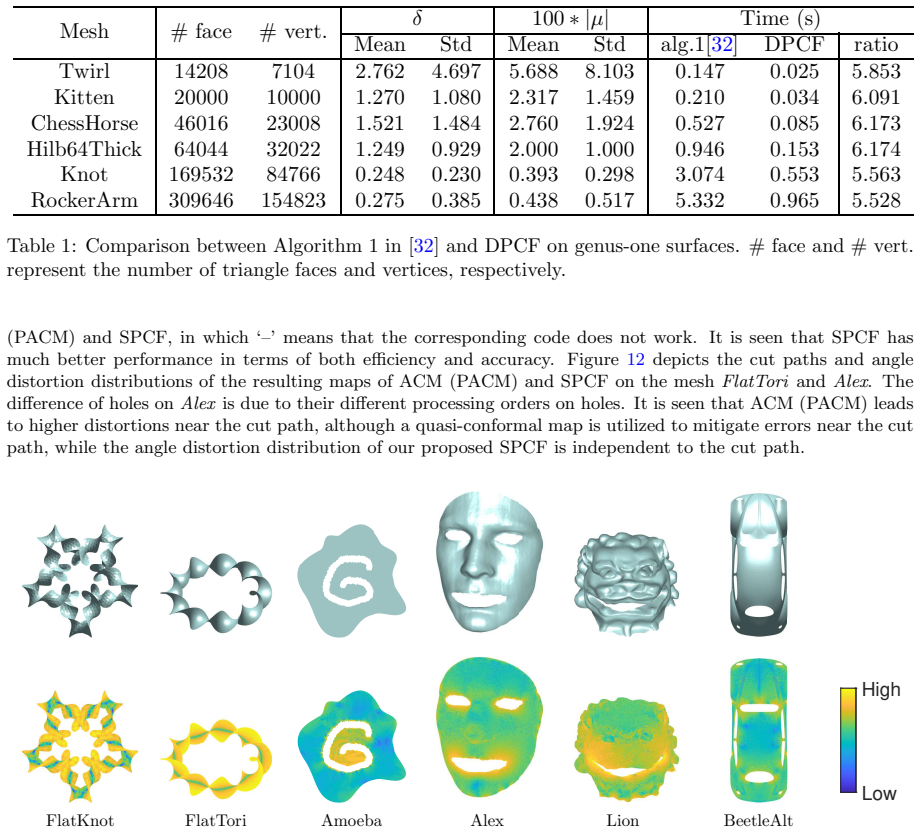
- Because DPCF and SPCF each reduce to solving two sparse linear systems, the reported runtimes are roughly 4–5 times shorter (and up to about 3 times shorter for multiply connected surfaces) than the compared state-of-the-art algorithms.
- Texture mapping can treat the seams as invisible: translation-identical seam sides glue back without extra angular distortion, and the accompanying experiments show chessboard textures remaining orthogonal across cut paths.
Reading between the lines
- Editorial extension: the conformality of the multiply connected pipeline rests on the unproved premise that the final Laplace–Beltrami correction, which moves interior vertices after every boundary is fixed to a circle, is itself conformal; a direct measurement of the Beltrami coefficient before and after that step would test whether the composite map is truly conformal or only approximately so.
- Editorial extension: cut-path independence suggests $(h,t)$ can be read as a numerical invariant of the surface's conformal structure; comparing lattices across different homology bases, or across progressively refined meshes, could serve as a convergence test for the uniformization.
- Editorial extension: the same periodic energy formulation may adapt to higher-genus surfaces by cutting along a full homology basis and imposing translation conditions on every paired side, although the present paper explicitly restricts itself to fundamental domains of genus-one and multiply connected genus-zero surfaces.
Editorial analysis
A structured set of objections, weighed in public.
Referee Report
Summary. This paper introduces periodic conformal flattening for discrete genus-one and multiply connected genus-zero surfaces. For a genus-one mesh, the authors cut along handle and tunnel loops, impose translation-identified cut seams, and minimize the discrete conformal energy, obtaining two sparse linear systems (DPCF, Algorithm 1). For doubly connected surfaces, a single periodic domain is computed and mapped to an annulus by the explicit exponential map (SPCF, Algorithm 2). For multiply connected surfaces, Algorithm 3 iterates annulus flattenings and then corrects the boundaries to circles by a Laplace-Beltrami solve. The paper claims cut-path independence, no seam distortion, bijectivity on intrinsic Delaunay triangulations, and reports large speedups and low distortion in numerical experiments.
Significance. If the claims hold, the DPCF and annulus SPCF formulations are significant: they reduce conformal flattening to two sparse linear solves, avoid seam distortion, and provide a bijectivity guarantee under a standard Delaunay condition. The experiments support the efficiency advantages for these cases, and the comparison with the cohomology and quasi-conformal benchmarks is informative. However, the multiply connected extension, which is a headline contribution, rests on an unsupported conformality assertion for the final Laplace-Beltrami correction. Because that assertion is load-bearing and no theorem covers Algorithm 3, the paper cannot be accepted in its current form.
major comments (3)
- [Section 4.2, Algorithm 3 Step 7] The sentence 'all the maps are conformal maps, so the composite map f := h ∘ f_{N-1} ∘ ... ∘ f_1 is also conformal' is not justified. Step 7 of Algorithm 3 defines h by solving the Laplace-Beltrami equation [L_D]_II f_I = -[L_D]_IB f_B after restricting the boundaries to circles. This is a harmonic map with Dirichlet boundary data, and a harmonic map is not conformal in general: conformality is equivalent to a vanishing Beltrami coefficient, while harmonicity only gives Δu = 0. Circular boundary data does not imply that the interior solve is the trace of a holomorphic map. Theorem 6 covers Algorithm 2 only, so the conformality of the poly-annulus pipeline is unsupported. The authors must either prove that h is conformal (or at least give a rigorous bound on its Beltrami coefficient), replace Step 7 with a conformal correction, or explicitly withdraw the conformal claim for multiply connected surfaces.
- [Lemma 3, Section 5.2] The proof of local bijectivity is not complete as written. The proof states 'For simplicity, here we omit the details' and then invokes an iterative cutting-and-gluing procedure ('If not satisfying ..., we can repeat finding cutting and gluing the sub-mesh until satisfying') without specifying a termination condition or proving that the modified map ~f' still satisfies the convex combination equations (58). Since Theorem 5 relies directly on Lemma 3, the bijectivity guarantee for DPCF is not established by the present argument. This is a load-bearing point for one of the paper's main advertised advantages.
- [Theorem 3, Section 5.1] The cut-path independence for SPCF is stated without proof, with only 'similar to Theorem 2' as justification. The SPCF setting differs materially from DPCF: there is a single periodic seam, the outer and inner boundaries carry fixed Dirichlet values, and the area term is given by the more involved formula (30)-(32). A proof or a precise reduction to Lemma 1 is needed before the cut-path independence claim for SPCF can be accepted.
minor comments (4)
- [Abstract and Conclusion] The abstract states a '4-5 times improvement' in efficiency, while the conclusion states 'at least 5 times and 3 times'; the measured ratios in Tables 1 and 2 are approximately 5.5-6.2 for DPCF and 3.4-4.5 for SPCF. Please make the stated speedup consistent with the reported numbers.
- [Section 6.1, Table 1] The text says that the conformal accuracy of DPCF and Algorithm 1 of [32] is 'mostly identical' with at most 0.2% relative error, but no comparison table is provided. Please report the actual relative errors or state explicitly where these data can be found.
- [Equation (24a)] The expression for ~f mixes n×2 matrix blocks with 1×2 row vectors in one displayed row-vector form. Please clarify the intended dimensions, for example by writing all blocks consistently as row blocks or indicating block sizes.
- [Throughout] There are several language and typographical errors, e.g., 'fo r' in the abstract, 'bijectivity guaranteeing' as a noun phrase, and 'is a intrinsic Delaunay' in Section 5.2. A careful proofreading pass is recommended.
Circularity Check
No circularity: DPCF/SPCF solve a standard conformal-energy minimization; cut independence and bijectivity are established from the paper's linear systems and the independent theorem of Floater [11], while [32]/[4] appear only as benchmarks.
full rationale
I walked the derivation chain and found no step where a claimed result is equivalent by construction to its inputs or to a self-citation. In Section 3 the unknown map f and lattice vectors h,t are the minimizers of the discrete conformal energy (Eqs. (16)-(23)); fixing t=(1,0) is a gauge choice, not a fit, and the comparison with Algorithm 1 of [32] in Table 1 is a measured benchmark, not an input. Cut-path independence (Theorem 2 and its SPCF analogue Theorem 3) is proved by showing that a perturbed cut path satisfies the same linear system (Lemma 1), not by invoking a fitted value. Bijectivity (Theorems 5 and 6) rests on Floater's one-to-one piecewise-linear mapping theorem [11] and the paper's own convex-combination argument (Lemma 3); this is independent external support. The self-citations [14,17,21,32,33] supply standard energy formulas and benchmarks, and none carries a load-bearing uniqueness assertion. I do flag one non-circular correctness gap: Section 4.2/Algorithm 3 Step 7 states 'In these processes, all the maps are conformal maps, so the composite map f := h ∘ f_{N-1} ∘ ... ∘ f_1 is also a conformal map,' but h is obtained by solving the Laplace-Beltrami equation [LD]_II f_I = -[LD]_IB f_B; harmonicity alone does not imply conformality, and no theorem is proved for this step. This is an unsupported internal assumption rather than a circular reduction, so it does not raise the circularity score.
Assumptions & free parameters
free parameters (2)
- Lattice vector t normalization =
(1,0)
- Annulus boundary placement =
outer y=0, inner y=1
assumptions (6)
- standard math Poincare-Klein-Koebe uniformization: every genus-one surface is conformally equivalent to a quotient C/G by a lattice.
- domain assumption The discrete conformal energy EC(f)=1/2 trace(f^T L_D f) - |f(M)| is an accurate discrete surrogate for continuous conformal energy.
- ad hoc to paper Floater's one-to-one piecewise linear mapping theorem applies to the periodic fundamental domains produced by DPCF and SPCF.
- domain assumption Intrinsic Delaunay triangulation implies positive cotangent weights and an M-matrix reduced Laplacian.
- ad hoc to paper The final Laplace-Beltrami correction in the poly-annulus pipeline is conformal or nearly conformal.
- domain assumption The linear systems (23) and (40) have unique solutions after fixing O and t.
Cite this review
Pith. "Pith review of A Novel Algorithm for Periodic Conformal Flattening of Genus-one and Multiply Connected Genus-zero Surfaces." pith.science (2026). https://pith.science/paper/ESEXK6TW
@misc{pith2026241219052,
  author       = {Pith},
  title        = {Pith review of: A Novel Algorithm for Periodic Conformal Flattening of Genus-one and Multiply Connected Genus-zero Surfaces},
  year         = {2026},
  howpublished = {\url{https://pith.science/paper/ESEXK6TW}},
  note         = {Machine review of arXiv:2412.19052}
}
read the original abstract
In this paper, we propose a novel parameterization method for genus-one and multiply connected genus-zero surfaces, called periodic conformal flattening. The conformal energy minimization technique is utilized to compute the desired conformal map, which is characterised as an easily solvable quadratic functional minimization problem, yielding a sparse linear system. The advantages of the proposed algorithms DPCF and SPCF are a) independence from the cut path selection, which introduces no additional conformal distortion near the cut seams; b) bijectivity guaranteeing for intrinsic Delaunay triangulations. The numerical experiments illustrate that DPCF and SPCF express high accuracy and a 4-5 times improvement in terms of efficiency compared with state-of-the-art algorithms.Based on the theoretical proof of the bijectivity guaranteeing, a simple strategy is applied for to guarantee the bijectivity of the resulting maps for non-Delaunay triangulations. The application on texture mapping illustrates the practicality of our developed algorithms.
Figures


Figures from the paper (10 more)




Reference graph
Works this paper leans on
-
[32]
A new efficient algorithm for volume- preserving parameterizations of genus-one 3-manifolds
Mei-Heng Yueh, Tiexiang Li, Wen-Wei Lin, and Shing-Tun g Yau. A new efficient algorithm for volume- preserving parameterizations of genus-one 3-manifolds. SIAM Journal on Imaging Sciences , 13(3):1536–1564, 2020
work page 2020
-
[11]
Michael S. Floater. One-to-one piecewise linear mappi ngs over triangulations. Mathematics of Computation , 72(242):685–696, 2002
work page 2002
-
[1]
Noam Aigerman, Roi Poranne, and Yaron Lipman. Seamless s urface mappings. ACM Transactions on Graphics, 34(4), 2015
work page 2015
-
[2]
Alexander I. Bobenko and Boris A. Springborn. A discrete laplace–beltrami operator for simplicial surfaces. Discrete & Computational Geometry , 38(4):740–756, 2007
work page 2007
-
[3]
Robust surface remeshing based on confo rmal welding
Wei Chen, Siquan Sun, Yue Wang, Na Lei, Chander Sadasivan , Apostolos Tassiopoulos, Shikui Chen, Hang Si, and Xianfeng Gu. Robust surface remeshing based on confo rmal welding. In Proceedings of the 2024 International Meshing Roundtable (IMR) , pages 0–0, 2024
work page 2024
-
[4]
Gary P. T. Choi. Efficient conformal parameterization of m ultiply-connected surfaces using quasi-conformal theory. Journal of Scientific Computing , 87(3), 2021
work page 2021
-
[5]
A linear formulation for disk conformal parameterization of simply- connected open surfaces
Gary Pui-Tung Choi and Lok Ming Lui. A linear formulation for disk conformal parameterization of simply- connected open surfaces. Advances in Computational Mathematics , 44(1):87–114, 2018
work page 2018
-
[6]
Flash: Fast la ndmark aligned spherical harmonic parameterization for genus-0 closed brain surfaces
Pui Tung Choi, Ka Chun Lam, and Lok Ming Lui. Flash: Fast la ndmark aligned spherical harmonic parameterization for genus-0 closed brain surfaces. SIAM Journal on Imaging Sciences , 8(1):67–94, 2015
work page 2015
Show all 34 references
-
[7]
Fast disk conformal parame terization of simply-connected open surfaces
Pui Tung Choi and Lok Ming Lui. Fast disk conformal parame terization of simply-connected open surfaces. Journal of Scientific Computing , 65(3):1065–1090, 2015
2015
-
[8]
Intrins ic parameterizations of surface meshes
Mathieu Desbrun, Mark Meyer, and Pierre Alliez. Intrins ic parameterizations of surface meshes. Computer Graphics Forum, 21(3):209–218, 2002
2002
-
[9]
Dey, Fengtao Fan, and Yusu Wang
Tamal K. Dey, Fengtao Fan, and Yusu Wang. An efficient compu tation of handle and tunnel loops via reeb graphs. ACM Transactions on Graphics , 32(4), 2013
2013
-
[10]
Computing sparse cones with bounded distortion for conformal parameterizations
Qing Fang, Wenqing Ouyang, Mo Li, Ligang Liu, and Xiao-M ing Fu. Computing sparse cones with bounded distortion for conformal parameterizations. ACM Transactions on Graphics , 40(6), 2021
2021
-
[12]
Garanzha, L.N
V.A. Garanzha, L.N. Kudryavtseva, and S.V. Utyuzhniko v. Variational method for untangling and optimiza- tion of spatial meshes. Journal of Computational and Applied Mathematics , 269:24–41, 2014
2014
-
[13]
Di screte conformal equivalence of polyhedral surfaces
Mark Gillespie, Boris Springborn, and Keenan Crane. Di screte conformal equivalence of polyhedral surfaces. ACM Transactions on Graphics , 40(4):1–20, 2021. 17
2021
-
[14]
Computational Conformal Geometry , volume 3 of Advanced Lectures in Mathematics
Xianfeng Gu and Shing-Tung Yau. Computational Conformal Geometry , volume 3 of Advanced Lectures in Mathematics. International Press and Higher Education Press, 2007
2007
-
[15]
Conformal surface parameterization for texture mapping
Steven Haker, Sigurd Angenent, Allen Tannenbaum, Ron K ikinis, Guillermo Sapiro, and Michael Halle. Conformal surface parameterization for texture mapping. IEEE Transactions on Visualization and Computer Graphics, 6(2):181–189, 2000
2000
-
[16]
MIPS: An efficient glob al parametrization method
Kai Hormann and G¨ unther Greiner. MIPS: An efficient glob al parametrization method. Curve and Surface Design: Saint-Malo 1999 , pages 153–162, 2000
1999
-
[17]
A novel symmetric skew- Hamiltonian isotropic lanczos algorithm for spectral conf ormal parameterizations
Wei-Qiang Huang, Xianfeng David Gu, Wen-Wei Lin, and Sh ing-Tung Yau. A novel symmetric skew- Hamiltonian isotropic lanczos algorithm for spectral conf ormal parameterizations. Journal of Scientific Computing, 61(3):558–583, 2014
2014
-
[18]
Hutchinson
John E. Hutchinson. Computing conformal maps and minim al surfaces. In Theoretical and Numerical Aspects of Geometric Variational Problems , volume 26, pages 140–161. 1991
1991
-
[19]
Discrete surface Ricci flow
Miao Jin, Junho Kim, Feng Luo, and Xianfeng Gu. Discrete surface Ricci flow. IEEE Transactions on Visualization and Computer Graphics , 14(5):1030–1043, 2008
2008
-
[20]
Discrete conformal mappings via circle patterns
Liliya Kharevych, Boris Springborn, and Peter Schroed er. Discrete conformal mappings via circle patterns. ACM Transactions on Graphics , 25(2):412–438, 2006
2006
-
[21]
Convergent conformal energy mini- mization for the computation of disk parameterizations
Yueh-Cheng Kuo, Wen-Wei Lin, Mei-Heng Yueh, and Shing- Tung Yau. Convergent conformal energy mini- mization for the computation of disk parameterizations. SIAM Journal on Imaging Sciences , 14(4):1790–1815, 2021
2021
-
[22]
Labsik, K
U. Labsik, K. Hormann, and G. Greiner. Using most isomet ric parameterizations for remeshing polygonal surfaces. In Proceedings Geometric Modeling and Processing 2000. Theor y and Applications , pages 220–228, 2000
2000
-
[23]
Least squares conformal maps for automatic texture atlas generation
Bruno L´ evy, Sylvain Petitjean, Nicolas Ray, and J´ erome Maillot. Least squares conformal maps for automatic texture atlas generation. ACM Transactions on Graphics , 21(3):362–371, 2002
2002
-
[24]
Spectral conformal parameterization
Patrick Mullen, Yiying Tong, Pierre Alliez, and Mathie u Desbrun. Spectral conformal parameterization. Computer Graphics Forum , 27(5):1487–1494, 2008
2008
-
[25]
Boundary first flattenin g
Rohan Sawhney and Keenan Crane. Boundary first flattenin g. ACM Transactions on Graphics , 37(1):5:1– 5:14, 2017
2017
-
[26]
Parameterization of fa ceted surfaces for meshing using angle-based flattening
Alla Sheffer and Eric de Sturler. Parameterization of fa ceted surfaces for meshing using angle-based flattening. Engineering with Computers , 17(3):326–337, 2001
2001
-
[27]
ABF++: Fast and robust angle based flattening
Alla Sheffer, Bruno L´ evy, Maxim Mogilnitsky, and Alexa nder Bogomyakov. ABF++: Fast and robust angle based flattening. ACM Transactions on Graphics , 24(2):311–330, 2005
2005
-
[28]
Opti mal cone singularities for conformal flattening
Yousuf Soliman, Dejan Slepˇ cev, and Keenan Crane. Opti mal cone singularities for conformal flattening. ACM Transactions on Graphics , 37(4), 2018
2018
-
[29]
Efficient bijective parameterizations
Jian-Ping Su, Chunyang Ye, Ligang Liu, and Xiao-Ming Fu . Efficient bijective parameterizations. ACM Transactions on Graphics , 39(4), 2020
2020
-
[30]
Practical construction of globally injective parameterizations with positional con straints
Qi Wang, Wen-Xiang Zhang, Yuan-Yuan Cheng, Ligang Liu, and Xiao-Ming Fu. Practical construction of globally injective parameterizations with positional con straints. Computational Visual Media , 9(2):265–277, 2023
2023
-
[31]
Generalized discrete Ricci flow
Yong-Liang Yang, Ren Guo, Feng Luo, Shi-Min Hu, and Xian feng Gu. Generalized discrete Ricci flow. Computer Graphics Forum , 28(7):2005–2014, 2009
2005
-
[33]
An efficient energy minimization for conformal parameterizations
Mei-Heng Yueh, Wen-Wei Lin, Chin-Tien Wu, and Shing-Tu ng Yau. An efficient energy minimization for conformal parameterizations. Journal of Scientific Computing , 73(1):203–227, 2017
2017
-
[34]
Thingi10K: A dataset of 10,000 3D-printing models
Qingnan Zhou and Alec Jacobson. Thingi10K: A dataset of 10,000 3D-printing models. arXiv preprint arXiv:1605.04797, 2016. 18
2016 arXiv
Reviewed August 11, 2026 · model on record in the stance chip above.
Discussion (0). Continue with ORCID to comment.