REVIEW 4 major objections 6 minor 17 references
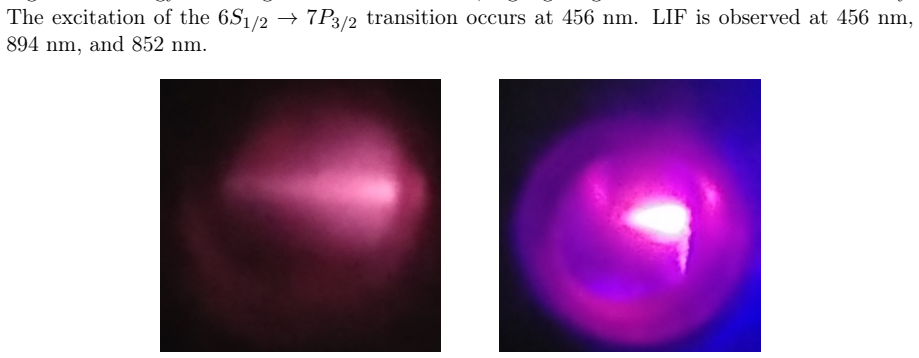
Blue laser induced bright red fluorescence in hot cesium vapor
T0 review · 4 major / 6 minor · reviewed 2026-08-11 · deepseek-v4-flash
Pith's one-line read A single 456 nm laser in hot cesium vapor yields bright 852 nm fluorescence with about 1 percent conversion efficiency.
desk verdict A plausible and useful Cs vapor cell demonstration, but the ~1% down-conversion efficiency claim rests on an unstated solid-angle assumption and needs a geometry-stated measurement to be load-bearing. read the letter →
The pith
A machine-rendered reading of the paper's core claim, the machinery that carries it, and where it could break.
The reading
What carries the argument
The mechanism is an ionization–recombination cascade in cesium. The 456 nm laser is resonant with the 6S1/2 to 7P3/2 transition; a second 456 nm photon ionizes the excited atom, and recombination followed by cascade spontaneous emission predominantly populates the 6P3/2 level, whose decay to 6S1/2 emits the 852 nm line. The 'self-conversion' double peak in the Doppler-broadened spectrum is explained by Beer–Lambert self-absorption of that 852 nm light as it travels through the vapor column: center-of-line photons are re-absorbed, leaving two peaks on either side. The T-shaped all-sapphire cell is what allows the high vapor temperatures without darkening.
What would settle it
Place the heated cell inside an integrating sphere, send in a known 456 nm power, and measure the total 852 nm power leaving the cell; if the ratio is much below 1 percent, the isotropic full-solid-angle recalculation overestimates the down-conversion efficiency.
Extended reading notes
Core claim
The central discovery is that resonant 456 nm excitation of the 6S1/2 to 7P3/2 transition in hot cesium vapor generates bright fluorescence at 852 nm, the D2 line from 6P3/2 to 6S1/2, through a cascade: atoms excited to 7P3/2 absorb further 456 nm photons and become ionized, and recombination followed by cascade spontaneous emission predominantly populates 6P3/2, which radiates at 852 nm. In a T-shaped all-sapphire cell with a 1 cm vapor column, the 852 nm fluorescence peaks at 130 degrees Celsius and falls off at 300 degrees Celsius, and its power grows nearly linearly with blue laser intensity up to 100 mW. Recalculating the measured side fluorescence to total solid angle, the authors claim a conversion efficiency of about 1 percent. At 130 degrees Celsius, the Doppler-broadened 852 nm spectrum shows a central dip that splits the line into two peaks, explained as self-conversion: fluorescence is re-absorbed by ground-state cesium while traversing the vapor column, with the Beer–Lambert optical depth about 400, a value the authors note might be an order of magnitude smaller because many atoms are excited. The cell blocks 456 nm light at the detector, so it acts as both a 456 nm to 852 nm down-converter and an optical filter.
Load-bearing premise
The 1 percent efficiency figure assumes the 852 nm fluorescence radiates equally in all directions, so the power measured in one direction can be multiplied by the full solid angle to obtain the total emitted power.
Editorial extensions
If this is right
- A single 456 nm laser, without any second pump beam, produces bright 852 nm fluorescence from cesium vapor.
- At the detector, residual 456 nm light is completely suppressed, so the cell functions as an optical filter as well as a down-converter.
- The 852 nm power rises nearly linearly with 456 nm laser intensity up to 100 mW, so in this range more blue power yields proportionally more red power.
- The optimum cell temperature is about 130 degrees Celsius, and heating above 300 degrees Celsius reduces the fluorescence sharply.
- Because the photodiode is about seven times more sensitive at 852 nm than at 456 nm, the converted signal is easier to detect than the blue light would be.
Reading between the lines
- Beyond the paper, if the 1 percent efficiency holds under integrating-sphere measurement, the cell could serve as the receiver stage for underwater blue-light links, because seawater transmits 456 nm well and silicon detectors respond more strongly at 852 nm.
- Beyond the paper, the two-peak self-conversion spectrum hints at a passive frequency discriminator: the relative depth and separation of the peaks track laser detuning, so the cell could help lock a laser to the cesium D2 line.
- Beyond the paper, because the mechanism relies on ionization and recombination, the linear growth with blue power should saturate once most atoms are ionized; the paper's data stop at 100 mW, so the saturation point is a testable prediction.
- Beyond the paper, analogous single-laser down-conversion should occur in other alkali vapors with a resonant blue transition, such as rubidium's 420 nm line to 780 nm fluorescence.
Editorial analysis
A structured set of objections, weighed in public.
Referee Report
Summary. The manuscript reports an experimental study of laser-induced fluorescence in a hot cesium vapor cell excited by a single 456 nm diode laser resonant with the 6S1/2–7P3/2 transition. Bright red fluorescence and an 852 nm line (6P3/2–6S1/2) are observed, with the 852 nm power measured as a function of cell temperature and laser intensity. A maximum is reported at 130 °C, and at this temperature the Doppler-broadened 852 nm spectrum shows a central dip attributed to self-absorption. The authors estimate a ~1% conversion efficiency of 456 nm to 852 nm radiation and propose the cell as an optical filter and down-converter.
Significance. The qualitative observations are valuable and likely correct: the disappearance of red LIF at 300 MHz detuning, the temperature and intensity trends, and the possibility of a single-laser blue-to-red converter are of practical interest for underwater-communication receivers. The paper's strengths are the simple setup, the direct measurements, and the demonstration that an all-sapphire cell withstands high temperatures without darkening. However, the headline quantitative claim—~1% down-conversion efficiency—rests on an unspecified solid-angle extrapolation and is not yet demonstrated. If confirmed by a direct total-power measurement or a well-characterized angular scan, the result would provide a simple, practical frequency down-conversion scheme.
major comments (4)
- [Section 2, Results] The sentence 'Recalculating the total 852 nm power emitted into 4π steradians... indicates a conversion efficiency of the 456 nm radiation power of ~1%' is the paper's central quantitative claim, but no collection geometry is reported. The detector (FD-24K), its active area, distance from the cell, collection solid angle, and calibration are not given, and no angular scan of the 852 nm emission is described. At N ≈ 8 × 10^13 cm^-3 the 852 nm transition is optically thick, so radiation trapping can make the emission anisotropic and path-dependent; a 4π extrapolation from a single side port is not justified. Please supply a direct total-power measurement (integrating sphere or calibrated angular integration) or restate the claim as a directional fluorescence measurement.
- [Section 2, Fig. 4] The temperature and intensity dependences are presented without error bars, fit curves, or any statement of measurement repeatability. Because the 'nearly linear' dependence and the maximum at 130 °C are used to support the practical down-converter claim, the raw data and uncertainties should be shown, ideally with a fit to the intensity dependence.
- [Section 2, self-conversion paragraph] The central dip in Fig. 5(iii) is attributed to self-absorption with σNL ≈ 400, but the text immediately concedes that this value 'might be smaller by an order of magnitude' because many atoms are excited. No quantitative line-shape model is compared with the measured two-peak spectrum, and at such large optical depth simple Beer-Lambert propagation would predict essentially complete absorption across most of the Doppler profile. Please fit the measured spectrum with a self-absorption model, and clarify why L = 0.5 cm appears in σNL when the cell length is stated as 1 cm.
- [Section 2 and Conclusion] The text states both '~8% LIF efficiency is observed for 456 nm radiation' and a 'down-conversion efficiency of 456 nm → 852 nm of ~1%.' These two numbers are never reconciled; if one is total LIF and the other is the 852 nm component, both definitions and their measurement bases should be given explicitly.
minor comments (6)
- [Fig. 4(b)] The horizontal axis is labeled in mW cm^-2, while the text quotes laser power in mW; please state the beam area or change the axis to mW.
- [Fig. 5] The labels '3/s8594 2 '3/s8594 3 '3/s8594 4 ' appear corrupted; the intended hyperfine transitions Fg = 3 → Fe = 2, 3, 4 should be typeset correctly.
- [Section 2] The term 'self-conversion' is unusual; 'self-absorption' or 'radiation trapping' would be more standard for the mechanism described.
- [Section 2] The sentence 'Notably, blue fluorescence at 456 nm is also observed' should clarify whether this is resonant fluorescence from 7P3/2 → 6S1/2 or residual scattered laser light.
- [References] Reference [6] is incomplete: the title does not name the transition being measured; please supply the full title.
- [Fig. 3] Adding a scale bar and a note on camera exposure settings would make the visual resonance criterion easier to reproduce.
Circularity Check
No significant circularity: the paper is an experimental report whose quantitative claims rest on direct power measurements and literature cross-sections, not on fitting or on self-citations that determine the conclusions.
full rationale
The paper's central claims are empirical observations: 456 nm excitation of Cs vapor produces 852 nm fluorescence, the fluorescence power peaks at 130 °C, and the spectrum develops two peaks at higher density. The 1% conversion efficiency is presented as a recalculation from measured LIF power: "Recalculating the total 852 nm power emitted into 4π steradians ... indicates a conversion efficiency of the 456 nm radiation power of ~1%." This is a derived estimate from a power measurement, not a parameter fitted to force agreement with a target output. The self-absorption explanation for the two-peak spectrum uses the standard Beer-Lambert expression exp(−σNL) with σ = 10^-11 cm^2 and density N from the stated temperature; the authors even concede the resulting σNL~400 "might be smaller by an order of magnitude, as many Cs atoms are in excited states," which is a caveat, not a circular justification. The cited prior work is used for context and for reference spectra (e.g., the nanocell sub-Doppler spectrum used as a frequency marker), and the Cs all-sapphire cell reference concerns cell technology, not the fluorescence mechanism. No equation in the paper defines a predicted quantity in terms of the measured outcome, no fitted parameter is relabeled as a prediction, and no load-bearing conclusion is supported solely by a self-citation. The lack of detector geometry and angular calibration affects the accuracy of the 4π efficiency estimate, but that is an experimental-support limitation, not a circularity. Therefore the appropriate circularity score is 0.
Assumptions & free parameters
assumptions (5)
- domain assumption Cs atomic level structure and transition wavelengths are standard and taken from references.
- domain assumption The ionization/recombination cascade mechanism populates 6P3/2 from 7P3/2.
- domain assumption Spontaneous 852 nm emission is isotropic for the 4 pi solid-angle recalculation.
- domain assumption The central fluorescence dip follows Beer-Lambert self-absorption with sigma = 10^-11 cm^2.
- domain assumption Cs vapor densities correspond to the stated cell reservoir temperatures.
Cite this review
Pith. "Pith review of Blue laser induced bright red fluorescence in hot cesium vapor." pith.science (2026). https://pith.science/paper/WWZVNLQU
@misc{pith2026241219081,
  author       = {Pith},
  title        = {Pith review of: Blue laser induced bright red fluorescence in hot cesium vapor},
  year         = {2026},
  howpublished = {\url{https://pith.science/paper/WWZVNLQU}},
  note         = {Machine review of arXiv:2412.19081}
}
read the original abstract
We have observed laser-induced fluorescence using 456 nm laser radiation, resonant with the 6S1/2-7P3/2 transition in Cs atoms. It includes red emission lines in the range of 580-730 nm and a prominent line at 852 nm corresponding to the 6P3/2-6S1/2 transition. A T-shaped all-sapphire cell with a length of 1 cm, containing Cs atomic vapor and capable of being heated up to 500 oC, was used. The laser-induced fluorescence (LIF) power at 852 nm was investigated as a function of the cell temperature. The maximum LIF power was achieved at 130 oC, while a significant decrease was observed around 300 oC. At 130 oC, the Doppler-broadened LIF spectrum at 852 nm exhibited self-conversion, resulting in the formation of two distinct peaks within the spectrum. The LIF power at 852 nm was also studied as a function of the 456 nm radiation power. The Cs cell demonstrated potential as an efficient optical filter and down-converter, effectively transforming 456 nm radiation into 852 nm radiation.
Figures


Figures from the paper (2 more)


Reference graph
Works this paper leans on
-
[1]
Towardsquantumcommunicationsinfree-spaceseawater,
L.Ji,J.Gao,A.-L.Yang, et al.,“Towardsquantumcommunicationsinfree-spaceseawater,” Optics Express, vol. 25, p. 19795, 2017
work page 2017
-
[2]
B. Wozniak and J. Dera,Light Absorption in Sea Water . Springer Science Business Media, LLC, 2007
work page 2007
-
[3]
J. Huennekens, Z. Wu, and T. Walker, “Ionization. excitation of high-lying atomic states and molecular fluorescence in cs vapor excited at 455.7 and 459.4 nm,” Phys. Rev. A , vol. 31, p. 196, 1985
work page 1985
-
[4]
A. Urvoy, Diploma thesis, 2011. [Online]. Available: http://pi5.uni-stuttgart.de
work page 2011
-
[5]
Cascade coherence transfer and magneto-optical resonances at 455 nm excitation of cesium,
M. Auzinsh, R. Ferber, F. Gahbauer, A. Jarmola, L. Kalvans, and A. Atvars, “Cascade coherence transfer and magneto-optical resonances at 455 nm excitation of cesium,”Optics Communications, vol. 284, p. 2863, 2011
work page 2011
-
[6]
Measurement of the radial matrix elements for the transitions in cesium,
A. Damitz, G. Toh, E. Putney, C. Tanner, and D. Elliott, “Measurement of the radial matrix elements for the transitions in cesium,”Phys. Rev. A , vol. 99, p. 062510, 2019
work page 2019
-
[7]
Spectroscopic study of the 7p1/2 and 7p3/2 states in cesium-133,
W. Williams, M. Herd, and W. Hawkins, “Spectroscopic study of the 7p1/2 and 7p3/2 states in cesium-133,”Laser Physics Letters, vol. 15, p. 095702, 2018. 6
work page 2018
-
[8]
E. Klinger, A. Mursa, C. Rivera-Aguilar, R. Vicarini, and N. Boudot, “Sub-doppler spec- troscopy of the cs atom 6s1/2–7p1/2 transition at 459 nm in a microfabricated vapor cell,” Optics Letters, vol. 49, p. 1953, 2024
work page 1953
Show all 17 references
-
[9]
Realization of population inversion be- tween 7s1/2 and 6p3/2 levels of cesium for four-level active optical clock,
W. YanFei, W. DongYing, Z. TongGang, et al., “Realization of population inversion be- tween 7s1/2 and 6p3/2 levels of cesium for four-level active optical clock,”Science China, Physics Mechanics & Astronomy , vol. 56, p. 1107, 2013
2013
-
[10]
Optical cascade pumping of the 7p3/2 level in cesium atoms,
S. Kargapol’tsev, V. Velichansky, A. Yarovitsky, A. Taichenachev, and V. Yudin, “Optical cascade pumping of the 7p3/2 level in cesium atoms,”Quantum Electronics, vol. 35, p. 591, 2005
2005
-
[11]
Generation of coherent blue light via bichromatic pumping in cesium vapor,
G. Ge, T. Li, Z. Guoqing,et al., “Generation of coherent blue light via bichromatic pumping in cesium vapor,”Frontiers of Physics, vol. 18, p. 42302, 2023
2023
-
[12]
Polychromatic and collimated lights generated by nondegenerate four-wave mixing in cesium vapor,
B. Yang, J. Fan, J. Xu, L. Zheng, W. Huang, and H. Zhou, “Polychromatic and collimated lights generated by nondegenerate four-wave mixing in cesium vapor,” Optics Express , vol. 32, p. 3492, 2024
2024
-
[13]
Frequency characteristics of collimated blue light generated by four-wave mixing in cesium vapor,
B. Yang, J. Xu, J. Fan, and H. Zhou, “Frequency characteristics of collimated blue light generated by four-wave mixing in cesium vapor,”Optics Letters, vol. 49, p. 3846, 2024
2024
-
[14]
Efficient cw sodium dimer raman laser operation in a high-temperature sapphire cell,
D. Sarkisyan, U. Hinze, L. Meyer, and B. Wellegehausen, “Efficient cw sodium dimer raman laser operation in a high-temperature sapphire cell,”Applied Physics B , vol. 70, pp. 351– 354, 2000
2000
-
[15]
Cooperative lamb shift in an atomic vapor layer of nanometer thickness,
J. Keaveney, A. Sargsyan, U. Krohn, D. Sarkisyan, I. Hughes, and C. Adams, “Cooperative lamb shift in an atomic vapor layer of nanometer thickness,”Phys. Rev. Lett. , vol. 108, p. 173601, 2012
2012
-
[16]
Formation of strongly shifted eit resonances using
A. Sargsyan, A. Tonoyan, R. Momier, C. Leroy, and D. Sarkisyan, “Formation of strongly shifted eit resonances using "forbidden" transitions of cesium,”J. Quant. Spectrosc. Radiat. Transf., vol. 272, p. 107780, 2023
2023
-
[17]
Demtroder, Laser Spectroscopy: Basic Concepts and Instrumentation
W. Demtroder, Laser Spectroscopy: Basic Concepts and Instrumentation . Springer Science & Business Media, 2002. 7
2002
Reviewed August 11, 2026 · model on record in the stance chip above.
Discussion (0). Continue with ORCID to comment.