REVIEW 4 major objections 6 minor 23 references
Parameter Efficient Fine-Tuning for Deep Learning-Based Full-Waveform Inversion
T0 review · 4 major / 6 minor · reviewed 2026-08-11 · deepseek-v4-flash
Pith's one-line read A pretrained seismic inversion model, adapted by low-rank updates to just 1.1 million of its 24.4 million parameters, matches full fine-tuning on familiar geological data and beats it on unseen geological styles.
desk verdict Useful PEFT-for-FWI recipe undermined by overclaimed superiority and data errors in the tables; fixable, worth a conditional review. read the letter →
The pith
A machine-rendered reading of the paper's core claim, the machinery that carries it, and where it could break.
The reading
What carries the argument
The load-bearing object is the Low-Rank Adaptation (LoRA) module: for each convolutional and transposed-convolutional weight matrix $W_0$, the update is $W = W_0 + \alpha B A$, with trainable low-rank matrices $A$ and $B$, a common rank $r=16$, and scaling $\alpha=16$, while the pretrained weights stay frozen. These low-rank updates are inserted into the InversionNet U-shaped encoder-decoder, giving roughly 1.1 million trainable parameters out of 24.4 million. The pretrained base model supplies general geological features, and the small adapters supply task-specific adjustments, which is why the authors can swap adapters across tasks instead of storing full copies of the model. This design is what carries the paper's efficiency and generalization claims.
What would settle it
Run the same LoRA-PFM versus full-fine-tuning comparison on real or realistic field-seismic data with different acquisition geometries, noise levels, and missing traces; if LoRA-PFM's out-of-distribution advantage does not appear there, or if the two methods tie within measurement noise, the central out-of-distribution claim fails. A cheaper check is to repeat the out-of-distribution evaluation across all 12 OpenFWI dataset families as train-test pairs and verify that LoRA-PFM beats full fine-tuning on the majority of pairs rather than only on the four reported here.
Extended reading notes
Core claim
On the paper's own terms, the discovery is that a foundation-model strategy transfers to a geophysical imaging task: pretraining InversionNet on a mixture of six OpenFWI datasets produces a feature set that improves downstream velocity recovery over training from scratch, and the cheapest way to exploit it is LoRA rather than full fine-tuning. With rank 16 and alpha 16, LoRA-PFM updates only 1.1 million parameters, yet its test metrics stay within a small margin of full fine-tuning on the four target datasets (for example, MAE 0.031 versus 0.030 on FlatVel B and 0.139 versus 0.139 on CurveFault B). When models trained on one dataset are tested on other dataset families with different geological structure, LoRA-PFM consistently beats full fine-tuning in MAE, RMSE, and SSIM, and the margin grows when only 10 to 25 percent of the training data is available. The authors interpret this as evidence that freezing the pretrained weights and nudging them with low-rank residuals preserves general seismic features while preventing the overfitting that full fine-tuning suffers on scarce or shifted data.
Load-bearing premise
The paper's load-bearing premise is that the distribution shifts among the OpenFWI dataset families stand in for real geological change, and the authors explicitly note that their own experiments are confined to synthetic simulations.
Editorial extensions
If this is right
- Pretraining one InversionNet-style model on multiple geological families, then fully fine-tuning it, is a stronger recipe than training a task-specific model from scratch on the same target dataset.
- LoRA adaptation of the pretrained model gives near-identical in-distribution accuracy while training only 1.1 million of 24.4 million parameters, so adaptation is cheaper in memory and storage.
- On held-out geological families, LoRA-PFM improves MAE, RMSE, and SSIM relative to full fine-tuning, so adapter-based fine-tuning is the recommended route for out-of-distribution deployment.
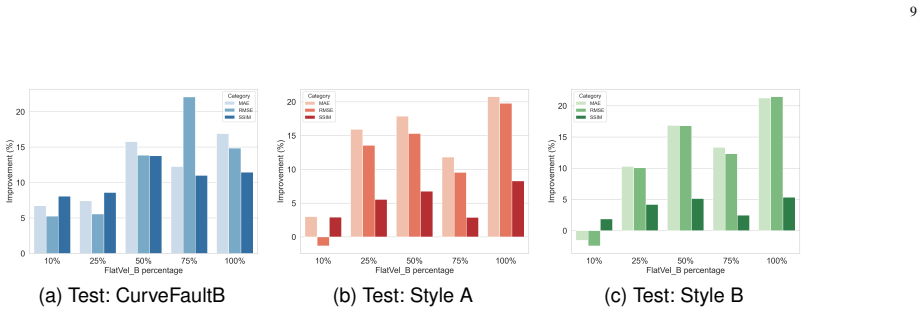
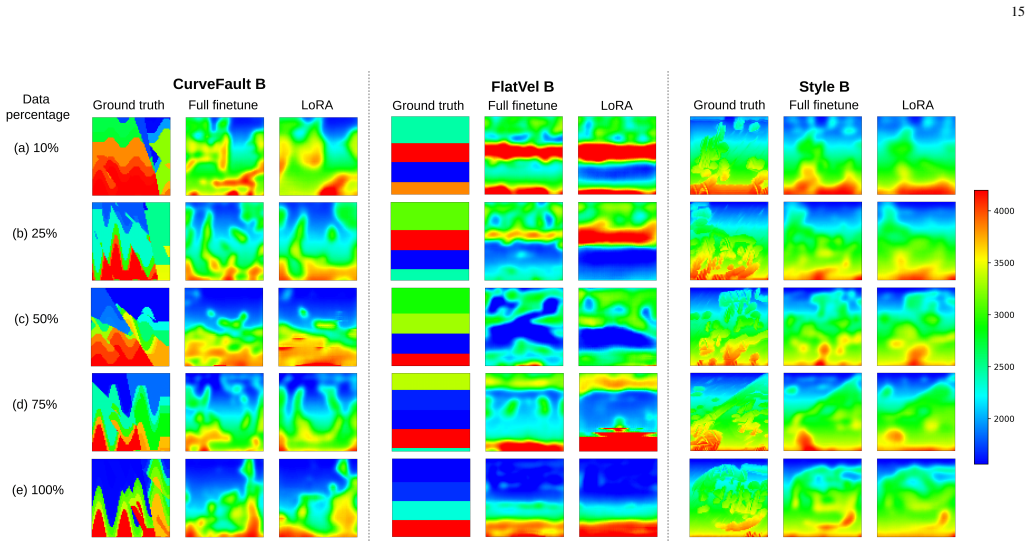
- The LoRA advantage persists when the fine-tuning set is cut to 10 percent of the training data, meaning the approach is suited to low-data adaptation.
- Because the frozen base model stays intact, one pretrained model can serve many tasks by swapping small adapters rather than storing a full model copy per task.
Reading between the lines
- If the LoRA advantage generalizes to field data, a practical consequence is that a seismic contractor could maintain one frozen subsurface model and ship tiny per-survey adapters, making multi-client model storage and transfer far cheaper.
- The same recipe, pretrain broadly and add LoRA adapters, could be tested on other geophysical inverse problems such as electrical resistivity tomography or ground-penetrating radar inversion, where task-specific networks show similar out-of-distribution failures.
- Comparing LoRA against adapter or prompt-tuning variants on the same pretrained FWI model would separate the benefit of low-rank updates from the benefit of parameter efficiency in general.
- An ablation that trains LoRA on an untrained random-weight InversionNet and compares it with LoRA on the pretrained base would quantify how much of the out-of-distribution gain comes from pretraining rather than from low-rank adaptation itself.
Editorial analysis
A structured set of objections, weighed in public.
Referee Report
Summary. The paper proposes a pretrained foundational model (PFM) for seismic full-waveform inversion (FWI), built by supervised pretraining an InversionNet backbone on six 2D OpenFWI datasets. It then compares two adaptation strategies on four downstream FWI tasks: full fine-tuning of all 24.4M parameters (FFT-PFM) and low-rank adaptation (LoRA-PFM) that updates only 1.1M parameters. The authors claim that FFT-PFM outperforms task-specific baselines, that LoRA-PFM achieves comparable in-distribution performance to FFT-PFM while reducing memory, and that LoRA-PFM outperforms both FFT-PFM and baselines on out-of-distribution (OOD) tasks and in low-data regimes. The paper also reports memory-efficiency and storage benefits of LoRA adapters.
Significance. If substantiated, the result would be practically valuable: it would show that parameter-efficient fine-tuning is sufficient to adapt a pretrained FWI model to new geological scenarios, reducing per-task storage and compute. The paper has clear strengths: it uses the public OpenFWI benchmark, releases code, reports parameter counts, and includes a systematic low-data study. However, the central OOD-superiority claim is currently not supported by the paper's own numbers, and several tables contain internal inconsistencies. The contribution is incremental (LoRA applied to InversionNet) but the study could be useful if the claims are corrected and the evidence is strengthened with statistical rigor.
major comments (4)
- [Section IV-D, Table III] The text states that 'LoRA-PFM performs better than FFT-PFM in all the tested datasets,' but Table III shows the opposite for three of the four datasets: on FVB, FFT-PFM has MAE 0.030 vs LoRA-PFM 0.031, RMSE 0.080 vs 0.084, and SSIM 0.952 vs 0.943; on STA, FFT-PFM has better MAE, RMSE, and SSIM; on STB, FFT-PFM again has better metrics. Only on CFB do the MAE values tie (0.139). This direct contradiction must be resolved, either by correcting the claim or by presenting additional evidence that the differences are not meaningful.
- [Section IV-E, Table IV] The section claims that 'LoRA-PFM performs better than the Baseline and FFT-PFM' across OOD datasets and later concludes that 'for OOD samples, LoRA-PFM performs better than FFT-PFM across all datasets.' Table IV contains multiple counterexamples: when trained on Style B and tested on CurveFault B, FFT-PFM achieves MAE 0.255 vs LoRA-PFM 0.276, RMSE 0.339 vs 0.391, and SSIM 0.452 vs 0.410; when trained on Style A and tested on Style B, FFT-PFM has MAE 0.085 vs 0.088 and SSIM 0.680 vs 0.667. The text itself acknowledges that 'FFT-PFM slightly outperforms LoRA-PFM on FlatVel B and CurveFault B' in the Style-B-trained row, which is inconsistent with the universal conclusion. The OOD claim needs to be restricted to the datasets where it actually holds, or supported by a statistical test that accounts for these exceptions.
- [Section IV-E and Section IV-A] No error bars, random seeds, or significance tests are reported for any of the ID or OOD comparisons, and the fine-tuning hyperparameters (number of epochs, learning rate, batch size, early stopping criteria) are not specified separately for FFT-PFM and LoRA-PFM. The supplementary gives pretraining details (e.g., 120 epochs, AdamW, WarmupMultiStepLR) but does not state whether the two fine-tuning methods were given identical training budgets or how convergence was determined. Without this information, the reported OOD advantages of LoRA-PFM over FFT-PFM could be an artifact of undertrained FFT-PFM or of a single favorable seed. The paper should report multi-seed means and standard deviations and explicitly state the compute budget allocated to each method.
- [Supplementary Table VI] Supplementary Table VI contains an impossible entry: for test CurveFault B at 75% training data, FFT-PFM reports RMSE 0.178 with MAE 0.312, which violates the mathematical relationship RMSE ≥ MAE. The same table also shows identical rows for 10% and 25% training data (FFT-PFM 0.277/0.372/0.465 and LoRA-PFM 0.259/0.353/0.504), suggesting a tabulation or copy error. These issues undermine confidence in the low-data quantitative results and require the tables to be regenerated and rechecked.
minor comments (6)
- [Section IV-G] The text says that LoRA-PFM uses 1.1 million parameters, 'which is a reduction of 4.5%.' This is numerically incorrect: 1.1M is approximately 4.5% of 24.4M, so the statement should say 'a reduction of 95.5%' or 'using only 4.5% of the parameters.'
- [Section IV-E] The sentence 'highlighting its robustness as a preferred technique for diverse applications' contains a typo: 'ODD datasets' should be 'OOD datasets.'
- [Abstract and Section III-B] The model is described as 'task-agnostic,' but it is pretrained via supervised learning on six FWI datasets to predict velocity maps. Consider replacing 'task-agnostic' with 'multi-task pretrained' or clarifying the intended meaning, since the pretraining task is not agnostic to the FWI objective.
- [Supplementary Section VII] The hyperparameter description is ambiguous: it states 'convergence was achieved after 90 epochs' and later 'the models undergo training for 120 epochs.' Please clarify which of these applies to pretraining and which, if any, applies to fine-tuning, and provide fine-tuning-specific hyperparameters for both FFT-PFM and LoRA-PFM.
- [Figure 6 caption] The caption says the model was tested with 'FlatVel B (blue), and Style A (red),' but panel (c) shows Style B. The caption should list all three test sets (FlatVel B, Style A, Style B) as shown in the figure.
- [Table IV] In the row for train=FVB, test=STA, the method entry reads 'FFT-PFM M'; the stray 'M' should be removed.
Circularity Check
No circular derivation: the paper is an empirical transfer-learning study whose claims are measured comparisons, not consequences of fitted inputs or self-cited uniqueness theorems.
full rationale
The paper's central chain is empirical: pretrain an InversionNet backbone on OpenFWI subsets, then compare full fine-tuning (FFT-PFM) against LoRA adaptation (LoRA-PFM) on held-out in-distribution and out-of-distribution tasks. No claim is derived from an equation that contains its own conclusion. The LoRA update W + DeltaW = W0 + alpha*B*A is the standard definition from Hu et al. and is not used to force any measured outcome. The rank and alpha hyperparameters are selected by exhaustive search (Section IV-D, Table II), but the reported comparisons (Tables III and IV) are then evaluated on separate test splits, so this is ordinary model selection rather than a fitted quantity being relabeled as a prediction. The OOD protocol trains on one of the four target datasets and tests on the other three, so the reported OOD metrics are genuinely out-of-sample with respect to the fine-tuning data. The paper does cite prior work, including its own architectural starting point (InversionNet), but nothing load-bearing reduces to a self-citation chain; the transfer claim is tested against OpenFWI baselines rather than assumed from a citation. There are internal inconsistencies in the text and tables (e.g., Section IV-D says LoRA-PFM beats FFT-PFM in all datasets while Table III shows FFT-PFM with lower MAE on FVB and STA; Table VI contains an impossible RMSE lower than MAE at 75% data; Section IV-E acknowledges FFT-PFM slightly outperforms LoRA-PFM on FlatVel B and CurveFault B after claiming universal LoRA superiority). These are correctness, reporting, and statistical-support problems, not circularity: they do not show that any result is equivalent to its input by definition. The acknowledged limitation that experiments are confined to OpenFWI simulations (Conclusion) is an external-validity caveat, not a circular step. Therefore the appropriate circularity score is 0.
Assumptions & free parameters
free parameters (2)
- LoRA rank r =
16
- LoRA alpha =
16
assumptions (3)
- domain assumption OpenFWI dataset families are representative of real geological scenarios
- domain assumption InversionNet architecture is a sufficient backbone for a foundational FWI model
- domain assumption L1 loss and the specified input normalization are appropriate for FWI reconstruction
Cite this review
Pith. "Pith review of Parameter Efficient Fine-Tuning for Deep Learning-Based Full-Waveform Inversion." pith.science (2026). https://pith.science/paper/HXG2AZEG
@misc{pith2026241219510,
  author       = {Pith},
  title        = {Pith review of: Parameter Efficient Fine-Tuning for Deep Learning-Based Full-Waveform Inversion},
  year         = {2026},
  howpublished = {\url{https://pith.science/paper/HXG2AZEG}},
  note         = {Machine review of arXiv:2412.19510}
}
read the original abstract
Seismic full waveform inversion (FWI) has seen promising advancements through deep learning. Existing approaches typically focus on task-specific models trained and evaluated in isolation that lead to limited generalization across different geological scenarios. In this work we introduce a task-agnostic foundational model for FWI that captures general features across tasks. We first demonstrate that full fine-tuning of this foundational model outperforms task-specific models built from scratch by delivering superior performance across multiple benchmarks. Building upon this we employ parameter-efficient fine-tuning (PEFT) to further reduce computational overhead. By fine-tuning only a small fraction of the model parameters PEFT achieves comparable results to full fine-tuning while significantly lowering memory and computational requirements. Additionally, PEFT excels in out-of-distribution tasks where it outperforms both full fine-tuning and task-specific models. These findings establish the value of foundational modeling for FWI and highlight PEFT as an effective strategy for efficient and scalable adaptation across diverse tasks.
Figures


Figures from the paper (12 more)





Reference graph
Works this paper leans on
-
[1]
An overview of full-waveform inversion in exploration geophysics,
J. Virieux and S. Operto, “An overview of full-waveform inversion in exploration geophysics,” Geophysics, vol. 74, no. 6, pp. WCC1–WCC26, 2009
2009
-
[2]
An introduction to full waveform inversion,
J. Virieux, A. Asnaashari, R. Brossier, L. M ´etivier, A. Ribodetti, and W. Zhou, “An introduction to full waveform inversion,” in Encyclopedia of exploration geophysics. Society of Exploration Geophysicists, 2017, pp. R1–1
work page 2017
-
[3]
Openfwi: Large-scale multi-structural benchmark datasets for full waveform inversion,
C. Deng, S. Feng, H. Wang, X. Zhang, P. Jin, Y . Feng, Q. Zeng, Y . Chen, and Y . Lin, “Openfwi: Large-scale multi-structural benchmark datasets for full waveform inversion,” Advances in Neural Information Processing Systems, vol. 35, pp. 6007–6020, 2022
work page 2022
-
[4]
Deep-learning tomography,
M. Araya-Polo, J. Jennings, A. Adler, and T. Dahlke, “Deep-learning tomography,” The Leading Edge , vol. 37, no. 1, pp. 58–66, 2018
2018
-
[5]
Inversionnet: An efficient and accurate data-driven full waveform inversion,
Y . Wu and Y . Lin, “Inversionnet: An efficient and accurate data-driven full waveform inversion,”IEEE Transactions on Computational Imaging, vol. 6, pp. 419–433, 2019
work page 2019
-
[6]
A theory- guided deep-learning formulation and optimization of seismic waveform inversion,
J. Sun, Z. Niu, K. A. Innanen, J. Li, and D. O. Trad, “A theory- guided deep-learning formulation and optimization of seismic waveform inversion,” Geophysics, vol. 85, no. 2, pp. R87–R99, 2020
work page 2020
-
[7]
Physics-guided deep learning for seismic inversion with hybrid training and uncertainty analysis,
J. Sun, K. A. Innanen, and C. Huang, “Physics-guided deep learning for seismic inversion with hybrid training and uncertainty analysis,” Geophysics, vol. 86, no. 3, pp. R303–R317, 2021
2021
-
[8]
Data-driven seismic waveform inversion: A study on the robustness and generalization,
Z. Zhang and Y . Lin, “Data-driven seismic waveform inversion: A study on the robustness and generalization,” IEEE Transactions on Geoscience and Remote sensing , vol. 58, no. 10, pp. 6900–6913, 2020
2020
Show all 23 references
-
[9]
Generalization capability of data- driven deep learning models for seismic full-waveform inversion: An example using the openfwi dataset,
A. Abdullin and U. Bin Waheed, “Generalization capability of data- driven deep learning models for seismic full-waveform inversion: An example using the openfwi dataset,” in Third International Meeting for Applied Geoscience & Energy . Society of Exploration Geophysicists and ...
2023
-
[10]
Learned full waveform inversion incorporating task information for ultrasound computed tomography,
L. Lozenski, H. Wang, F. Li, M. Anastasio, B. Wohlberg, Y . Lin, and U. Villa, “Learned full waveform inversion incorporating task information for ultrasound computed tomography,” IEEE Transactions on Computational Imaging , 2024
2024
-
[11]
Improving the generalization of segmentation foundation model under distribution shift via weakly supervised adaptation,
H. Zhang, Y . Su, X. Xu, and K. Jia, “Improving the generalization of segmentation foundation model under distribution shift via weakly supervised adaptation,” in Proceedings of the IEEE/CVF Conference on Computer Vision and Pattern Recognition , 2024, pp. 23 385–23 395
2024
-
[12]
A deep dive into single-cell rna sequencing foundation models,
R. Boiarsky, N. Singh, A. Buendia, G. Getz, and D. Sontag, “A deep dive into single-cell rna sequencing foundation models,” bioRxiv, pp. 2023–10, 2023
2023
-
[13]
Seismic foundation model (sfm): a new generation deep learning model in geophysics,
H. Sheng, X. Wu, X. Si, J. Li, S. Zhang, and X. Duan, “Seismic foundation model (sfm): a new generation deep learning model in geophysics,” arXiv preprint arXiv:2309.02791 , 2023
2023 arXiv
-
[14]
Parameter-efficient fine-tuning of large- scale pre-trained language models,
N. Ding, Y . Qin, G. Yang, F. Wei, Z. Yang, Y . Su, S. Hu, Y . Chen, C.-M. Chan, W. Chen et al. , “Parameter-efficient fine-tuning of large- scale pre-trained language models,” Nature Machine Intelligence, vol. 5, no. 3, pp. 220–235, 2023
2023
-
[15]
Lora: Low-rank adaptation of large language models,
E. J. Hu, Y . Shen, P. Wallis, Z. Allen-Zhu, Y . Li, S. Wang, L. Wang, and W. Chen, “Lora: Low-rank adaptation of large language models,” arXiv preprint arXiv:2106.09685 , 2021
2021 arXiv
-
[16]
Parameter-efficient fine- tuning for large models: A comprehensive survey,
Z. Han, C. Gao, J. Liu, S. Q. Zhang et al. , “Parameter-efficient fine- tuning for large models: A comprehensive survey,” arXiv preprint arXiv:2403.14608, 2024
2024 arXiv
-
[17]
On the opportunities and risks of foundation models,
R. Bommasani, D. A. Hudson, E. Adeli, R. Altman, S. Arora, S. von Arx, M. S. Bernstein, J. Bohg, A. Bosselut, E. Brunskill et al. , “On the opportunities and risks of foundation models,” arXiv preprint arXiv:2108.07258, 2021
2021 arXiv
-
[18]
Scaling instruction-finetuned language models,
H. W. Chung, L. Hou, S. Longpre, B. Zoph, Y . Tay, W. Fedus, Y . Li, X. Wang, M. Dehghani, S. Brahma et al., “Scaling instruction-finetuned language models,” Journal of Machine Learning Research , vol. 25, no. 70, pp. 1–53, 2024
2024
-
[19]
Image complexity and spatial information,
H. Yu and S. Winkler, “Image complexity and spatial information,” in 2013 Fifth International Workshop on Quality of Multimedia Experience (QoMEX). IEEE, 2013, pp. 12–17
2013
-
[20]
Prilora: Pruned and rank-increasing low-rank adaptation,
N. Benedek and L. Wolf, “Prilora: Pruned and rank-increasing low-rank adaptation,” arXiv preprint arXiv:2401.11316 , 2024
2024 arXiv
-
[21]
The impact of initialization on lora finetuning dynamics,
S. Hayou, N. Ghosh, and B. Yu, “The impact of initialization on lora finetuning dynamics,” arXiv preprint arXiv:2406.08447 , 2024
2024 arXiv
-
[22]
Platypus: Quick, cheap, and powerful refinement of llms,
A. N. Lee, C. J. Hunter, and N. Ruiz, “Platypus: Quick, cheap, and powerful refinement of llms,” arXiv preprint arXiv:2308.07317 , 2023. 11
2023 arXiv
-
[23]
Fourier-deeponet: Fourier- enhanced deep operator networks for full waveform inversion with improved accuracy, generalizability, and robustness,
M. Zhu, S. Feng, Y . Lin, and L. Lu, “Fourier-deeponet: Fourier- enhanced deep operator networks for full waveform inversion with improved accuracy, generalizability, and robustness,”Computer Methods in Applied Mechanics and Engineering , vol. 416, p. 116300, 2023. (Supplement...
2023
Reviewed August 11, 2026 · model on record in the stance chip above.
Discussion (0). Continue with ORCID to comment.