REVIEW 3 major objections 4 minor 59 references
Forecasts of effects of beam systematics and deprojection on the third-generation ground-based cosmic microwave background experiment
T0 review · 3 major / 4 minor · reviewed 2026-08-10 · deepseek-v4-flash
Pith's one-line read Deprojection removes the beam-mismatch leakage that would otherwise bias next-generation CMB polarization measurements.
desk verdict A careful, internally consistent forecast that deprojection clears beam-mismatch leakage for S3, but noise-free fits make the residual estimate optimistic and the margin unquantified. read the letter →
The pith
A machine-rendered reading of the paper's core claim, the machinery that carries it, and where it could break.
The reading
What carries the argument
The load-bearing object is the set of six leakage templates derived from the beam-smoothed temperature map $\tilde{T}$ and its first and second spatial derivatives: $\delta g\,\tilde{T}$, $\delta\sigma(\nabla_x^2+\nabla_y^2)\tilde{T}$, $\delta x\,\nabla_x\tilde{T}$, $\delta y\,\nabla_y\tilde{T}$, $\delta p(\nabla_x^2-\nabla_y^2)\tilde{T}$, and $\delta c\,2\nabla_x\nabla_y\tilde{T}$. Because map-making is linear, the total T-to-P leakage from small beam mismatches is a linear combination of these templates, so deprojection fits the six coefficients in time-ordered data and subtracts the fitted leakage. The fitted coefficients are then averaged over time chunks per detector pair and the maps are passed through NILC for T and E modes and cILC for B-mode foreground cleaning, with the residual evaluated by comparing systematics-added versus systematics-free maps.
What would settle it
Run the same deprojection and foreground-cleaning pipeline while adding white noise (and, where possible, 1/f noise) to the time-ordered data during the template fit, then compare the residual BB power and the inferred r bias against the systematics-free case. If the residual beam-systematic power rises above the noise floor or shifts r by more than the reported uncertainty, the paper's "negligible residual" conclusion fails.
Extended reading notes
Core claim
The central claim is that deprojection makes beam-mismatch systematics negligible for a third-generation ground-based CMB experiment. The authors model the differential beam of each detector pair with six parameters (gain, two pointing shifts, beamwidth, plus-ellipticity, and cross-ellipticity), generate mock S3 time-ordered data with those mismatches, and fit the six corresponding leakage templates to remove the T-to-P leakage before map-making. After propagating the deprojected maps through the full analysis chain, the residual contamination is shown to be far below the noise uncertainty for TT, EE, TE, and BB power spectra, and the reconstructed lensing potential and r constraints agree with the systematics-free case, giving a 95% upper limit r < 0.043 in both cases. This establishes deprojection as sufficient to prevent beam mismatch from biasing the science goals of S3.
Load-bearing premise
The deprojection coefficients are fitted to mock time-ordered data with no detector noise, so the recovered per-detector beam parameters are optimistic; if realistic noise degrades the template fit, the residual T-to-P leakage after deprojection would be larger than reported.
Editorial extensions
If this is right
- S3 experiments can adopt deprojection in their map-making pipeline and ignore residual beam-mismatch leakage in later analysis.
- Residual systematics after deprojection do not bias NILC- and cILC-cleaned TT, EE, TE, or BB band powers at S3 sensitivity.
- CMB lensing reconstruction from polarization retains essentially the same signal-to-noise ratio (about 4.2) as the systematics-free case.
- The tensor-to-scalar ratio posterior is unchanged by beam systematics after deprojection, with a 95% upper limit of r < 0.043.
Reading between the lines
- If detector noise is added to the time-ordered data during the template fit, the recovered per-detector deprojection coefficients will scatter more, and whether the residual stays negligible will likely depend on how the noise is filtered before fitting.
- The paper only treats T-to-P leakage; polarization-angle miscalibration (E-to-B leakage) and far sidelobes are explicitly left out, so the benign conclusion should not be read as covering all beam-related systematics.
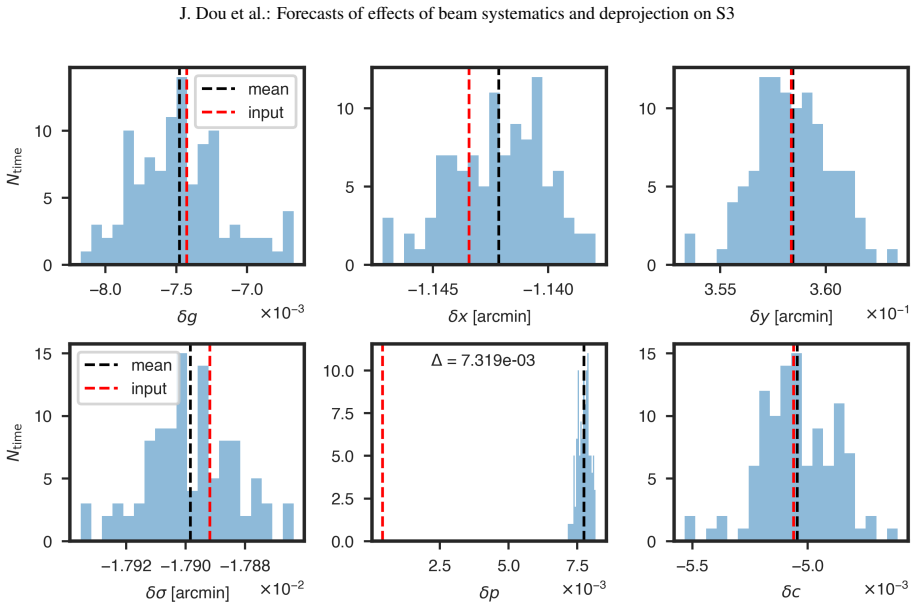
- The recovered bias on plus-ellipticity, about $7.3\times 10^{-3}$, comes from the cosmological TE correlation; real data would likely need a systematics-free simulation set to calibrate this bias before science analysis.
- A natural extension would be to test deprojection robustness with anisotropic or sidelobe-dominated beams rather than the elliptical-Gaussian differential beam model.
Signed reviews
Editorial analysis
A structured set of objections, weighed in public.
Referee Report
Summary. The paper presents an end-to-end forecast of beam-mismatch deprojection for a third-generation ground-based CMB experiment (S3). It simulates 300 realizations with 7,000 polarized detectors at 95/150 GHz, adds stochastic beam mismatches (gain, beam width, pointing, and plus/cross ellipticity) to the time-ordered data, and applies the deprojection technique by fitting six leakage templates derived from Planck 100/143 GHz maps. The residual maps and power spectra are then propagated through NILC and cILC foreground cleaning, lensing reconstruction, and an MCMC estimate of the tensor-to-scalar ratio r. The authors find that the residual beam-systematic leakage after deprojection is negligible: the lensing signal-to-noise ratio is about 4.2 and the 95% upper limit on r is <0.043, nearly identical with and without beam systematics. They conclude that the residual leakage can be ignored in the S3 data analysis pipeline.
Significance. The paper is a detailed and careful forecast that exercises a full mock-observation and analysis pipeline, including scan strategy, pair differencing, component separation with NILC and cILC, lensing reconstruction, and r estimation. Its strengths are the explicit internal consistency checks: recovered beam parameters correlate strongly with inputs (Appendix A), the residual BB spectrum after deprojection is 2-3 orders of magnitude below the input spectrum (Section 4.2), and the r posterior is essentially unchanged by systematics (Section 4.5). If the deprojection implementation survives a realistic treatment of detector noise, the paper would provide a useful validation of a standard mitigation technique for S3-era experiments. At present, however, the central 'negligible residual' claim rests on a deprojection fit performed on noiseless TOD and on a self-consistent six-parameter mismatch model, so the headline result should be regarded as conditional on those choices.
major comments (3)
- [Sect. 2 ('Noise is not involved...') and Appendix A] The deprojection coefficients are fitted to noiseless TOD, and Appendix A concedes that the resulting scatter is 'too optimistic since the noise was not added to the data.' This is load-bearing for the central claim that the residual beam-systematic leakage can be ignored. In a least-squares fit of the six leakage templates to a pair-difference TOD containing additive detector noise, the fitted coefficients acquire a noise-induced variance proportional to (A^T A)^{-1} σ^2 even when the noise is uncorrelated with the templates; subtracting the fitted templates then leaves a residual term proportional to the template amplitude times the coefficient error. The paper does not quantify this coefficient noise or show how it averages down when the per-chunk fits are coadded in the map-making step of Section 4.1. Because the headline comparisons are made against S3 sensitivity (lensing S/N about 4.2, r upper limit 0.043), the conclusion that the residual leakage can be ignored is not yet demonstrated for realistic TOD noise. I request either simulations that include noise in the deprojection fit or an analytic estimate of the resulting residual B-mode power.
- [Sect. 4.1, Fig. 1 and Appendix A] The correction for the differential plus-ellipticity bias uses the mean recovered value, ⟨δp_recov⟩=7.2×10^{-3}, estimated from the paper's own systematics-free and noise-free simulations. If detector noise is added to the TOD, the distribution of fitted δp broadens, and any bias-correction scheme must be recomputed with matching noise so that the correction is unbiased for the actual analysis. The current comparison is self-consistent, but the specific numerical value of the correction and the resulting E-mode filtering residual may not transfer to a noise-realistic analysis. The revision should either re-derive the bias correction in the presence of detector noise or argue analytically why the noise-free value remains applicable.
- [Sect. 2, Table 1, and Sect. 5] The injected beam mismatches are drawn from exactly the six-parameter family whose derivatives are used as deprojection templates, so the simulation demonstrates that the deprojection can remove contaminants of the same functional form; it does not independently validate the template basis against more general beam errors. Real beams can contain higher-order aberrations, frequency-dependent structure, or near-sidelobe features not representable by the six templates. The final sentence of Section 5 ("the residual leakage can be ignored in the following data analysis pipeline") is broader than what the simulation tests. I recommend qualifying the conclusion to the modeled six-parameter family, or adding at least one out-of-family mismatch (for example, a higher-order Hermite-Gauss mode or an asymmetric sidelobe) to test robustness.
minor comments (4)
- [Sect. 2] The text groups gain, bandpass, pointing, beam-width, and ellipticity differences under the term 'beam mismatch,' but only the spatial beam parameters in Table 1 are actually simulated and deprojected. Please clarify which of the enumerated error types are included in the mock and which are left for future work.
- [Sect. 4.4] The text refers to '301 simulation sets mentioned above,' while Section 2 states that the mock dataset consists of 300 simulated sky maps. Please clarify the consistency between these numbers.
- [Fig. 6 caption] The caption states that the power spectra are shown with ℓmax = 1500, whereas the text in Sections 3.1 and 3.2 describes analysis with ℓmax = 2000. Please clarify whether the plotted spectra are truncated for display or whether the analysis was actually performed to a lower maximum multipole.
- [Sect. 4.2, Fig. 3] The deprojection residual is described as '2~3 orders of magnitude lower' than the input CMB-plus-foreground spectrum. Because this comparison is made for a single realization, quoting a one-realization estimate would be clearer; a small ensemble-averaged residual spectrum would better support the claim.
Circularity Check
Injected beam mismatches share the exact deprojection template basis, making the 'negligible residual' a self-consistency check; the δp bias is self-calibrated from the paper's own no-systematics simulations.
-
self definitional
[Section 2, Table 1 and deprojection procedure (around Eq. 2)]
"Under the assumption that the mismatch is small, except the third and higher orders, all the templates are the beam-smoothed map of T( ˆn) and its first and second spatial derivatives (see Table 1) (Hu et al. 2003). The map-making procedure is a linear operation, meaning that the total leakage is the linear combination of the leakage templates of these differential modes. Therefore, we filtered the leakage out by fitting these templates to our data and then subtracting them."
The beam mismatches injected into the mock TOD are generated from the same six-parameter differential-beam model (Table 1), whose leakage templates are exactly the six T-derivative functions that deprojection fits and subtracts. The systematic is therefore, by construction, a linear combination of the cleaning basis, so the post-subtraction residual is zero up to coefficient-estimation error. The conclusion that the residual leakage is negligible is thus a self-consistency test of the six-parameter fit and does not validate deprojection against beam mismatches outside this template family (e.g., higher-order beam distortions or sidelobes).
-
other
[Section 4.1 (deprojection results, bias correction)]
"We corrected for the bias using the averaged deprojection coefficient estimated from systematics-free simulations, which is ⟨δprecov⟩ = 7.2×10⁻³."
The δp bias correction is calibrated from the paper's own systematics-free simulations and then applied to the systematics-added case. This centers the residual comparison by construction (for the mean), so the reported E-mode filtering bias in the deprojected maps is removed with a value measured from the same simulation suite used to evaluate the residuals. The paper states the bias affects B modes negligibly, so this self-calibration is secondary to the r constraint, but it is nevertheless a fitted input rather than an independent prediction.
full rationale
The deprojection study is largely self-contained: the S3 TOD, scan strategy, foregrounds, and noise simulations are generated from external inputs (Planck Sky Model, FFP10, Planck bands, S3-like noise), and the NILC/cILC, lensing, and r-estimation pipelines are standard methods. The main circularity concern is structural: the injected beam mismatch uses exactly the six-parameter model whose leakage templates are the deprojection basis, so the headline 'residual can be ignored' is a self-consistency check of the fit rather than a test against an independent systematic model. The δp bias correction is a second self-calibration step, using the mean recovered coefficient from the paper's own systematics-free simulations. The noise-free deprojection assumption (Section 2 and Appendix A) is an acknowledged limitation that affects realism but is not itself a circular step; the comparison to Han et al. (2023b) for lensing S/N is a same-author benchmark, but the lensing reconstruction is computed here from the paper's own simulations, so no load-bearing self-citation chain is present. Overall, partial circularity in the injection/cleaning basis, with substantial independent pipeline content, warrants a moderate score.
Assumptions & free parameters
free parameters (3)
- Beam mismatch input distributions for six modes at 95/150 GHz =
Table 1, e.g., delta_g mean 3.9e-4, std 3e-3 at 95 GHz
- Differential plus-ellipticity bias correction =
7.2e-3
- cILC foreground SED parameters =
T_dust=19.6 K, beta_dust=1.59, beta_sync=-3
assumptions (7)
- domain assumption The differential beam is modeled as the difference of two elliptical Gaussian beams parameterized by six modes: gain, pointing x/y, beamwidth, plus and cross ellipticity.
- ad hoc to paper Deprojection can be performed on time-ordered data without detector noise because noise is assumed uncorrelated with the Planck-derived templates.
- domain assumption Planck 100 and 143 GHz simulations provide accurate leakage templates, with their noise subdominant to the temperature signal.
- domain assumption Detector noise is white after pair differencing and polynomial filtering, with realistic 1/f noise significantly removed.
- domain assumption The adopted S3 configuration (7000 detectors, NET 350 microK sqrt(s), FWHM 19 arcmin at 95 GHz and 11 arcmin at 150 GHz, 17% sky in the northern hemisphere) represents a third-generation ground-based CMB experiment.
- domain assumption Far sidelobe contamination is excluded from the analysis.
- domain assumption The input CMB realizations are generated with tensor-to-scalar ratio r = 0 and six LambdaCDM parameters drawn within 1 sigma of Planck 2018 constraints.
Cite this review
Pith. "Pith review of Forecasts of effects of beam systematics and deprojection on the third-generation ground-based cosmic microwave background experiment." pith.science (2026). https://pith.science/paper/6NNEBBX3
@misc{pith2026241220415,
  author       = {Pith},
  title        = {Pith review of: Forecasts of effects of beam systematics and deprojection on the third-generation ground-based cosmic microwave background experiment},
  year         = {2026},
  howpublished = {\url{https://pith.science/paper/6NNEBBX3}},
  note         = {Machine review of arXiv:2412.20415}
}
abstract
The ground-based cosmic microwave background (CMB) experiments are susceptible to various instrumental errors, especially for $B$-mode measurements. The difference between the response of two polarized detectors, referred to as the beam mismatch, would induce a $T\rightarrow P$ leakage when the detector pair is differenced to cancel the unpolarized signal. We applied the deprojection technique on the time-ordered mock data to mitigate the systematic contamination caused by beam mismatches by assuming the third-generation ground-based CMB experiment (S3). Our results show that the deprojection effectively recovered the input power spectra. We adopted the Needlet ILC (NILC) and constrained ILC (cILC) methods to reconstruct the foreground-cleaned $TEB$ maps, and we evaluated the level of residual systematic errors after the foreground cleaning pipeline by comparing the power spectra between the systematics-added data after deprojection and the systematics-free data. The results show that the residual beam systematics cleaned by deprojection do not bias the CMB measurements of the $T$, $E$, and $B$ modes nor the CMB lensing reconstruction or the estimation of the tensor-to-scalar ratio under the S3 sensitivity.
Figures


Figures from the paper (5 more)


Reference graph
Works this paper leans on
-
[1]
, " * write output.state after.block = add.period write newline
ENTRY address archiveprefix author booktitle chapter edition editor howpublished institution eprint journal key month note number organization pages publisher school series title type volume year label extra.label sort.label short.list INTEGERS output.state before.all mid.sentence after.sentence after.block FUNCTION init.state.consts #0 'before.all := #1 ...
-
[2]
write newline
" write newline "" before.all 'output.state := FUNCTION n.dashify 't := "" t empty not t #1 #1 substring "-" = t #1 #2 substring "--" = not "--" * t #2 global.max substring 't := t #1 #1 substring "-" = "-" * t #2 global.max substring 't := while if t #1 #1 substring * t #2 global.max substring 't := if while FUNCTION word.in bbl.in " " * FUNCTION format....
- [3]
-
[4]
N., Adshead, P., Ahmed, Z., et al
Abazajian, K. N., Adshead, P., Ahmed, Z., et al. 2016, ArXiv e-prints [ [arXiv] 1610.02743 ]
arXiv 2016
- [5]
- [6]
- [7]
-
[8]
L., Larson, D., Weiland, J
Bennett, C. L., Larson, D., Weiland, J. L., et al. 2013, ApJS, 208, 20
2013
Show all 59 references
-
[9]
2014, ApJ, 792, 62
BICEP2 Collaboration , Ade, P., Aikin, R., Amiri, M., et al. 2014, ApJ, 792, 62
2014
-
[10]
BICEP2 Collaboration , Ade, P. A. R., Aikin, R. W., et al. 2015, ApJ, 814, 110
2015
-
[11]
BICEP2/Keck Collaboration , Ade, P. A. R., Aikin, R. W., et al. 2015, ApJ, 806, 206
2015
-
[12]
BICEP/Keck Collaboration , Ade, P. A. R., Ahmed, Z., et al. 2021, PRL, 127, 151301
2021
-
[13]
BICEP/Keck Collaboration , Ade, P. A. R., Ahmed, Z., et al. 2023, ApJ, 949, 43
2023
-
[14]
& Schneider , J
Blanchard , A. & Schneider , J. 1987, A&A, 184, 1
1987
-
[15]
& Lewis, A
Carron, J. & Lewis, A. 2017, PRD, 96, 063510
2017
-
[16]
E., et al
CMB-S4 Collaboration , Abazajian, K., Addison, G. E., et al. 2022, ApJ, 926, 54
2022
-
[17]
2013, A&A, 553, A96
Delabrouille, J., Betoule, M., Melin, J.-B., et al. 2013, A&A, 553, A96
2013
-
[18]
L., et al
Delabrouille, J., Cardoso, J.-F., Jeune, M. L., et al. 2009, A&A, 493, 835
2009
-
[19]
2024, JCAP, 05, 006
Dou, J., Ghosh, S., Santos, L., & Zhao, W. 2024, JCAP, 05, 006
2024
-
[20]
2014, in Millimeter, Submillimeter, and Far-Infrared Detectors and Instrumentation for Astronomy VII, ed
Essinger-Hileman, T., Ali, A., Amiri, M., et al. 2014, in Millimeter, Submillimeter, and Far-Infrared Detectors and Instrumentation for Astronomy VII, ed. W. S. Holland & J. Zmuidzinas, Vol. 9153, International Society for Optics and Photonics (SPIE), 91531I
2014
-
[21]
W., Lang, D., & Goodman, J
Foreman-Mackey , D., Hogg, D. W., Lang, D., & Goodman, J. 2013, Publ. Astron. Soc. Pac., 125, 306
2013
-
[22]
A., Cothard, N
Gallardo, P. A., Cothard, N. F., Puddu, R., et al. 2018, in Millimeter, Submillimeter, and Far-Infrared Detectors and Instrumentation for Astronomy IX, ed. J. Zmuidzinas & J.-R. Gao, Vol. 10708, International Society for Optics and Photonics (SPIE), 107082L
2018
-
[23]
2021, JCAP, 2021, 036
Ghosh, S., Delabrouille, J., Zhao, W., & Santos, L. 2021, JCAP, 2021, 036
2021
-
[24]
2022, JCAP, 10, 063
Ghosh, S., Liu, Y., Zhang, L., et al. 2022, JCAP, 10, 063
2022
-
[25]
M., Hivon, E., Banday, A
Gorski, K. M., Hivon, E., Banday, A. J., et al. 2005, ApJ, 622, 759
2005
-
[26]
2023 a , Sci
Han, J., Cao, Y., & Hu, B. 2023 a , Sci. Sin. Phys. Mech. & Astron., 53
2023
-
[27]
2023 b , JCAP, 04, 063
Han, J., Hu, B., Ghosh, S., et al. 2023 b , JCAP, 04, 063
2023
-
[28]
2016, in Millimeter, Submillimeter, and Far-Infrared Detectors and Instrumentation for Astronomy VIII, ed
Harrington, K., Marriage, T., Ali, A., et al. 2016, in Millimeter, Submillimeter, and Far-Infrared Detectors and Instrumentation for Astronomy VIII, ed. W. S. Holland & J. Zmuidzinas, Vol. 9914, International Society for Optics and Photonics (SPIE), 99141K
2016
-
[29]
Hazumi, M., Ade, P. A. R., Akiba, Y., et al. 2019, J. Low Temp. Phys., 194, 443
2019
-
[30]
2001, ApJL, 557, L79
Hu, W. 2001, ApJL, 557, L79
2001
-
[31]
M., & Zaldarriaga, M
Hu, W., Hedman, M. M., & Zaldarriaga, M. 2003, PRD, 67
2003
-
[32]
& Okamoto, T
Hu, W. & Okamoto, T. 2002, ApJ, 574, 566
2002
-
[33]
2003, PRD, 67, 123507
Kesden, M., Cooray, A., & Kamionkowski, M. 2003, PRD, 67, 123507
2003
-
[34]
2000, ApJ, 538, 473
Lewis, A., Challinor, A., & Lasenby, A. 2000, ApJ, 538, 473
2000
-
[35]
2018, Nat
Li, H., Li, S.-Y., Liu, Y., Li, Y.-P., & Zhang, X. 2018, Nat. Astron., 2, 104
2018
-
[36]
Li, H. et al. 2019, Natl. Sci. Rev., 6, 145
2019
-
[37]
2019 a , JCAP, 2019, 046
Liu, H., Creswell, J., & Dachlythra, K. 2019 a , JCAP, 2019, 046
2019
-
[38]
2019 b , PRD, 100, 023538
Liu, H., Creswell, J., von Hausegger , S., & Naselsky, P. 2019 b , PRD, 100, 023538
2019
-
[39]
2022 a , Sci
Liu, J., Han, J., & Hu, B. 2022 a , Sci. Sin. Phys. Mech. & Astron., 52
2022
-
[40]
2022 b , Sci
Liu, J., Sun, Z., Han, J., et al. 2022 b , Sci. China Phys. Mech. Astron., 65, 109511
2022
-
[41]
2017, JCAP, 06, 031
Louis, T., Grace, E., Hasselfield, M., et al. 2017, JCAP, 06, 031
2017
-
[42]
S., Ali-Ha\" moud, Y., Carron, J., Lewis, A., & Madhavacheril, M
Maniyar, A. S., Ali-Ha\" moud, Y., Carron, J., Lewis, A., & Madhavacheril, M. S. 2021, PRD, 103, 083524
2021
-
[43]
2019, Universe, 5, 42
Mennella, A., Ade, P., Amico, G., et al. 2019, Universe, 5, 42
2019
-
[44]
Okamoto, T. & Hu, W. 2003, PRD, 67, 083002
2003
-
[45]
2020 a , A&A, 641, A8
Planck Collaboration , Aghanim, N., Akrami, Y., et al. 2020 a , A&A, 641, A8
2020
-
[46]
2020 b , A&A, 641, A6
Planck Collaboration , Aghanim, N., Akrami, Y., Ashdown, M., et al. 2020 b , A&A, 641, A6
2020
-
[47]
2016, A&A, 596, A109
Planck Collaboration , Aghanim, N., Ashdown, M., et al. 2016, A&A, 596, A109
2016
-
[48]
J., et al
Planck Collaboration , Akrami, Y., Andersen, K. J., et al. 2020 c , A&A, 643, A42
2020
-
[49]
2020 d , A&A, 641, A4
Planck Collaboration , Akrami, Y., Ashdown, M., et al. 2020 d , A&A, 641, A4
2020
-
[50]
2023, A&A, 678, A165
Reinecke, M., Belkner, S., & Carron, J. 2023, A&A, 678, A165
2023
-
[51]
2011, MNRAS, 410, 2481
Remazeilles, M., Delabrouille, J., & Cardoso, J.-F. 2011, MNRAS, 410, 2481
2011
-
[52]
2021, MNRAS, 503, 2478
Remazeilles, M., Rotti, A., & Chluba, J. 2021, MNRAS, 503, 2478
2021
-
[53]
T., Reichardt, C
Sayre, J. T., Reichardt, C. L., Henning, J. W., et al. 2020, PRD, 101, 122003
2020
-
[54]
2019, ArXiv e-prints [ [arXiv] 1911.03547 ]
Sheehy, C. 2019, ArXiv e-prints [ [arXiv] 1911.03547 ]
2019 arXiv
-
[55]
2019, JCAP, 2019, 056
Simons Observatory Collaboration , Ade, P., Aguirre, J., et al. 2019, JCAP, 2019, 056
2019
-
[56]
J., G \'o rski, K
Tristram, M., Banday, A. J., G \'o rski, K. M., et al. 2022, PRD, 105, 083524
2022
-
[57]
& Seljak, U
Zaldarriaga, M. & Seljak, U. 1998, PRD, 58, 023003
1998
-
[58]
& Baskaran, D
Zhao, W. & Baskaran, D. 2010, PRD, 82, 023001
2010
-
[59]
2019, JOSS, 4, 1298
Zonca, A., Singer, L., Lenz, D., et al. 2019, JOSS, 4, 1298
2019
Reviewed August 10, 2026 · model on record in the stance chip above.
Discussion (0). Continue with ORCID to comment.