REVIEW 4 major objections 4 minor 45 references
SatFlow: Scalable Network Planning for LEO Mega-Constellations
T0 review · 4 major / 4 minor · reviewed 2026-08-10 · deepseek-v4-flash
Pith's one-line read A hierarchical planner cuts LEO mega-constellation flow violations by up to 21 percent and total costs by up to 89.4 percent in simulations.
desk verdict A useful two-tier planning framework whose headline cost savings are computed at infeasible operating points; needs proof or feasibility-matched reporting before the numbers can be trusted. read the letter →
The pith
A machine-rendered reading of the paper's core claim, the machinery that carries it, and where it could break.
The reading
What carries the argument
The machinery is a two-tier decomposition with two algorithms. The upper level is a homogeneous multi-agent deep-Q network: each agent manages a group of satellites in the same orbit, picks a common index offset for linking to the eastern neighboring orbit, and receives a shared reward combining normalized energy consumption and ISL switching cost; its state comes from temporally weighted edge features compressed by LINE embeddings and passed through a two-layer GCN. The lower level reformulates the traffic-and-power subproblem as extended monotropic optimization with a linkage matrix, then solves it by the distributed alternating step method, where each satellite minimizes a local Lagrangian with projected sub-gradient steps, updates multipliers, and exchanges variables with one- and two-hop neighbors. A group-based asynchronous ISL re-establishment scheme, in which groups rotate through re-establishment windows, keeps some links connected at all times. Together these pieces give SatFlow its claimed O(nt) lower-level time complexity and scalability with constellation size.
What would settle it
Run SatFlow-L on a small constellation for which a centralized convex solver or exhaustive search gives the exact optimal energy cost; if the distributed algorithm's converged allocation has a flow violation ratio above zero and its reported energy is below the feasible optimum, or if the feasible optimum's energy is lower than SatFlow's reported cost, the optimality claim is refuted. The paper's own Table II already shows nonzero flow violation ratios at termination, making this a directly checkable gap.
Extended reading notes
Core claim
The central claim is that network planning for LEO mega-constellations—choosing the ISL topology, splitting traffic over it, and tuning per-ISL laser power—can be decomposed hierarchically without losing the coupling that matters. Given a topology, the traffic and power allocation form a subproblem the paper treats as a constrained convex optimization, solved by a distributed alternating step method based on extended monotropic programming; the paper asserts this method converges to the optimal solution, needs only local neighbor exchange, and runs in O(nt) time for nt traffic flows. The upper level treats ISL re-establishment as a multi-agent reinforcement learning problem, where agents choose inter-plane index offsets, a group-based mechanism resolves conflicts, and a graph convolutional network over temporally weighted features supplies state. On three simulated constellation shells, SatFlow is reported to reduce the flow violation ratio by up to 21.0 percent and total normalized costs by up to 89.4 percent against benchmarks, with throughput gains of roughly 8 to 10 percent. The key architectural bet is that a fast, distributed lower-level optimizer can supply accurate energy costs to a slower topology-learning upper level, making the joint problem tractable at mega-constellation scale.
Load-bearing premise
The load-bearing premise is that the distributed lower-level algorithm truly converges to the optimal traffic-and-power allocation for a fixed topology, so the energy costs it feeds upward are true minimums; the paper states convexity and convergence but omits the proofs, and the reported 4.1 to 6.3 percent flow violation ratios show the stopping point is outside the feasible region. If that premise gives way, the energy-cost comparisons against the benchmarks are not apples-to-apples.
Editorial extensions
If this is right
- If SatFlow's claims hold, mega-constellation operators can plan topology, routing, and power in one framework instead of optimizing theoretical metrics like average link capacity or hop count alone.
- The lower-level algorithm's linear-in-flows time complexity and one- and two-hop communication mean that traffic and power allocation can be run at constellation scale without a central solver.
- Fine-grained laser power control becomes a first-class planning variable, so energy cost can be lowered by not running every ISL terminal at maximum power.
- Because the upper level learns from traffic distributions, the re-establishment plan can adapt to biased, shifting real-world demand rather than assuming uniform traffic.
- The reported reductions in flow violation ratio suggest that explicitly optimizing traffic allocation and power together can make the constellation carry more of its requested load under the same link budget.
Reading between the lines
- Editorial inference: the same slow-topology/fast-allocation decomposition could apply to terrestrial networks with reconfigurable optical switches, where topology changes are costly but traffic allocation happens frequently.
- Editorial inference: since the paper's own Table II shows flow violation ratios of 4.1 to 6.3 percent at termination, the lower-level solver is stopping before true feasibility; adding a projection or feasibility-repair step might make its reported energy costs directly comparable to feasible baselines, at some added runtime.
- Editorial inference: the action design restricts each agent's satellites to one common index offset; allowing per-satellite offsets would enlarge the search space and might reduce switching cost further, at the price of more conflict resolution.
- Editorial inference: the traffic model is anchored to a mobile streaming dataset; rerunning the planner with other demand patterns would test how much of the gain comes from matching the specific geography and timing of that dataset.
Editorial analysis
A structured set of objections, weighed in public.
Referee Report
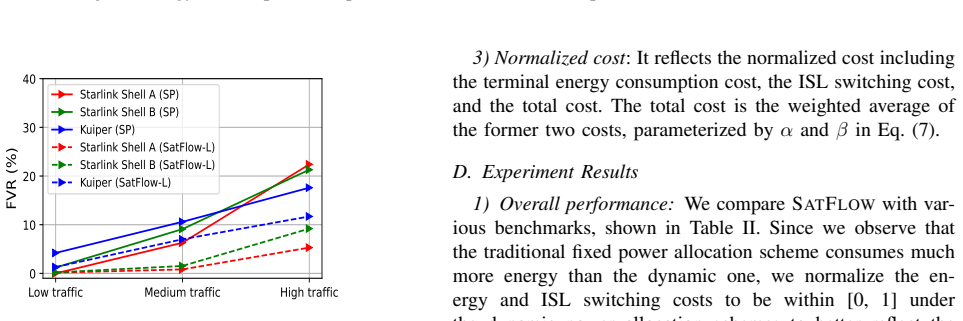
Summary. The paper proposes SatFlow, a two-tier hierarchical framework for planning ISL topology, traffic allocation, and laser terminal power in LEO mega-constellations. The upper-level module uses a multi-agent deep-Q network to re-establish inter-plane ISLs over long time scales, while the lower-level module applies a distributed alternating step method, based on extended monotropic programming, to allocate splittable flows and power under a fixed topology. The authors claim the original problem is NP-hard and that their decomposition yields scalability. Simulations on three constellation shells report reductions in flow violation ratio of up to 21.0% and reductions in total normalized cost of up to 89.4% relative to fixed-power shortest-path baselines. The paper also includes ablations of the lower- and upper-level modules separately.
Significance. If the algorithmic claims and evaluation were fully supported, SatFlow would be a useful contribution to network planning for large LEO constellations, combining RL-based topology control with distributed optimization for traffic and power. The problem formulation is realistic and the hierarchical decomposition is sensible. The paper also provides a thorough ablation separating the contributions of the lower- and upper-level modules. However, the current significance is tempered by two issues: the main convergence theorem for the lower-level module is stated without proof, and the headline experimental numbers are produced at points that violate the flow-conservation constraints, as evidenced by the reported FVR values. The cost comparisons therefore do not currently establish the claimed advantage over the feasible regime described by the theory.
major comments (4)
- [Section IV-A, Theorem 1 and Algorithm 1] The proof of Theorem 1 is omitted, and the stopping criterion in Algorithm 1 (line 11) is a fixed-point test on Y, not a feasibility test for constraint (9). With rho set to 1e-10 in Eq. (17), the penalty for flow-conservation violation is negligible, and Table II reports FVR values of 4.1/3.8, 5.5/5.0, and 6.3/5.4 percent for SatFlow. These FVR values show that the lower-level module terminates at points that do not satisfy the hard constraints of Sub-problem (12). The ablation in Sec. V-D2 explicitly runs SatFlow-L until FVR is below 1 permille, confirming that the headline Table II results were not obtained at feasible termination. Consequently, the cost reductions reported in Table II are evaluated at infeasible operating points and do not support the claim that SatFlow-L converges to the optimum of Sub-problem (12). The authors should either re-evaluate all benchmarks at a common feasible termination criterion or present a trade-off analysis that separates the effects of infeasibility from planning quality.
- [Section IV-A, Eq. (17) and penalty parameter rho] The paper sets the penalty coefficient rho to 1e-10, yet describes this as prioritizing flow conservation. As written, Eq. (17) then has essentially no penalty for violating the flow-conservation constraint, which is consistent with the sizable FVR in Table II but is in tension with the stated objective of enforcing constraint (9). The authors should explain how a negligible penalty coefficient can enforce flow conservation, or justify a different mechanism that yields feasible solutions. This issue is not merely notational; it is load-bearing for the optimality claim of the lower-level module.
- [Section IV-A, Theorems 2 and 3] The paper claims in Theorem 3 that SatFlow-L has O(nt) time complexity independent of the constellation size, which is central to the scalability contribution. The proof is omitted. The same holds for Theorem 2 on the communication locality. While the statements are plausible, the omitted proofs leave the scalability claims unsupported. Given that the central message of the paper is scalability, these theorems should be proved or at least accompanied by a detailed derivation in an appendix.
- [Section V-D1, Table II and cost normalization] The comparison in Table II mixes different FVR levels across algorithms and does not isolate planning quality from the early-termination behavior of the lower-level module. In particular, SP-D is reported to have much higher FVR (roughly 12-26%) while SatFlow has 4-6% FVR, and the cost reductions of up to 89.4% are computed after normalizing costs under dynamic power allocation schemes. The authors should either compare costs at matched FVR levels or explicitly separate the trade-offs between cost and feasibility. As it stands, a reader cannot determine how much of the cost reduction is due to better topology/traffic planning and how much is an artifact of where each algorithm is stopped.
minor comments (4)
- [Section III-A, orbital period] The text says the analyzed period of 7200 s is "close to the orbiting period" of the selected shells, but satellites at 560 km altitude have an orbital period of roughly 5760 s; please verify the period or clarify why 7200 s was chosen.
- [Section IV-A, Eq. (17) notation] Equation (17) is dense and the definitions of q_l and the indexing in the penalty term are not fully explained. A brief notational table or a more explicit expansion would improve readability.
- [Section IV-B, training termination] Algorithm 2 does not specify the criterion for stopping an episode or for deciding that the coordinator has reached convergence; the paper states that "an episode stops once the coordinator finds it reaching convergence," but no definition is given. This makes the training procedure difficult to reproduce.
- [Table II, formatting] The columns for "ISL Switch." and "Tot. Cost" are not clearly separated, and several rows use slash-separated pairs that are ambiguous. Reformatting the table with explicit subcolumns would help readers interpret the results.
Circularity Check
No circular derivation: SatFlow's reported gains are measured against external benchmarks, and no equation reduces its outputs to fitted inputs.
full rationale
SatFlow's derivation chain is self-contained in the relevant sense. The top-level objective (7) is a weighted sum of terminal energy computed from Eq. (3) and ISL switching cost from Eq. (5); the lower-level module solves sub-problem (12) with constraints (8)-(10), and the upper-level DQN optimizes reward (21), which is a normalized version of the same objective. No term in these equations is defined in terms of the reported outputs. FVR is a separately defined residual metric (Eq. 23), not the optimization objective, so reporting lower FVR is an independent evaluation quantity. The 89.4% total-cost reduction is computed against fixed-power heuristics such as SP-F and SP-D, not against a parameter that encodes the answer. The only overlapping-author citation ([5]) is used as a satellite edge-computing timing/testbed reference and is not load-bearing. The omitted proofs in Sec. IV-A, including the proof of Theorem 1, are a rigor and completeness concern; they rely on external convergence results [12] and do not constitute a circular step. Training and evaluating the RL policy in the same simulator is a standard limitation of this genre, but it does not make the cost comparison definitional. Therefore no specific step in the claimed derivation reduces by construction to its own inputs.
Assumptions & free parameters
free parameters (7)
- α, β objective weights =
α=2/3, β=1/3; α=1/3, β=2/3
- ρ penalty coefficient =
1e-10
- σ update step size =
1.9
- kmax, ksg iteration caps =
kmax=300, ksg=20
- NG satellite groups per orbit =
4 for Starlink shells, 2 for Kuiper
- η ISL switch window =
NG * t_theta_max
- De and Di time intervals =
De=30 s, Di=1200 s
assumptions (4)
- domain assumption The lower-level subproblem (12) is convex and the alternating step method converges to its optimum
- domain assumption ISL switching cost is proportional to total laser-terminal rotation angle
- domain assumption Flow meta-information for the next Di period is known in advance and accurate
- standard math Eckstein's alternating step method [12] applies unchanged with Armijo line search and projected sub-gradient inner steps
Cite this review
Pith. "Pith review of SatFlow: Scalable Network Planning for LEO Mega-Constellations." pith.science (2026). https://pith.science/paper/ZLWAWWV6
@misc{pith2026241220475,
  author       = {Pith},
  title        = {Pith review of: SatFlow: Scalable Network Planning for LEO Mega-Constellations},
  year         = {2026},
  howpublished = {\url{https://pith.science/paper/ZLWAWWV6}},
  note         = {Machine review of arXiv:2412.20475}
}
read the original abstract
Low-earth-orbit (LEO) satellite communication networks have evolved into mega-constellations with hundreds to thousands of satellites inter-connecting with inter-satellite links (ISLs). Network planning, which plans for network resources and architecture to improve the network performance and save operational costs, is crucial for satellite network management. However, due to the large scale of mega-constellations, high dynamics of satellites, and complex distribution of real-world traffic, it is extremely challenging to conduct scalable network planning on mega-constellations with high performance. In this paper, we propose SatFlow, a distributed and hierarchical network planning framework to plan for the network topology, traffic allocation, and fine-grained ISL terminal power allocation for mega-constellations. To tackle the hardness of the original problem, we decompose the grand problem into two hierarchical sub-problems, tackled by two-tier modules. A multi-agent reinforcement learning approach is proposed for the upper-level module so that the overall laser energy consumption and ISL operational costs can be minimized; A distributed alternating step algorithm is proposed for the lower-level module so that the laser energy consumption could be minimized with low time complexity for a given topology. Extensive simulations on various mega-constellations validate SatFlow's scalability on the constellation size, reducing the flow violation ratio by up to 21.0% and reducing the total costs by up to 89.4%, compared with various state-of-the-art benchmarks.
Figures


Figures from the paper (4 more)



Reference graph
Works this paper leans on
-
[4]
Y . Li, J. Luo, Y . Ran, and J. Pi, “Deepisl: Joint optimization of LEO inter-satellite link planning and power allocation via parameterized deep reinforcement learning,” in Proc. IEEE GLOBECOM, Kuala Lumpur, Malaysia, December, 2023, pp. 3977–3982
work page 2023
- [1]
-
[2]
Available: https://www.aboutamazon.com/what-we- do/devices-services/project-kuiper
“Kuiper.” [Online]. Available: https://www.aboutamazon.com/what-we- do/devices-services/project-kuiper
- [3]
-
[5]
Collaborative hyperspectral image processing using satellite edge computing,
B. Zhu, S. Lin, Y . Zhu, and X. Wang, “Collaborative hyperspectral image processing using satellite edge computing,” IEEE Trans. Mob. Comput., vol. 23, no. 3, pp. 2241–2253, 2024
work page 2024
-
[6]
Orbital edge computing: Nanosatellite constel- lations as a new class of computer system,
B. Denby and B. Lucia, “Orbital edge computing: Nanosatellite constel- lations as a new class of computer system,” in Proc. ACM ASPLOS, Lau- sanne, Switzerland, March, 2020 , J. R. Larus, L. Ceze, and K. Strauss, Eds., 2020, pp. 939–954
work page 2020
-
[7]
Multipath cooperative routing with efficient acknowledgement for LEO satellite networks,
F. Tang, H. Zhang, and L. T. Yang, “Multipath cooperative routing with efficient acknowledgement for LEO satellite networks,” IEEE Trans. Mob. Comput., vol. 18, no. 1, pp. 179–192, 2019
work page 2019
-
[8]
“Where is internet traffic?” [Online]. Available: https://ceo- na.com/business/where-is-internet-traffic/
Show all 45 references
-
[9]
In the united states, what day of the week has the most social media traffic?
“In the united states, what day of the week has the most social media traffic?” [Online]. Available: https://www.quora.com/In-the- United-States-what-day-of-the-week-has-the-most-social-media-traffic/
-
[10]
Topological design, routing and handover in satellite networks,
A. Ferreira, J. Galtier, , and P. Penna, “Topological design, routing and handover in satellite networks,” Handbook of wireless networks and mobile computing, vol. 473, 2002
2002
-
[11]
Network planning with deep reinforcement learning,
H. Zhu, V . Gupta, S. S. Ahuja, Y . Tian, Y . Zhang, and X. Jin, “Network planning with deep reinforcement learning,” in Proc. ACM SIGCOMM USA, August, 2021, pp. 258–271
2021
-
[12]
The alternating step method for monotropic programming on the connection machine cm-2,
J. Eckstein, “The alternating step method for monotropic programming on the connection machine cm-2,” ORSA J. Comp. , vol. 5, no. 1, 1993
1993
-
[13]
Falcon: Towards fast and scalable data delivery for emerging earth observation constellations,
M. Lyu, Q. Wu, Z. Lai, H. Li, Y . Li, and J. Liu, “Falcon: Towards fast and scalable data delivery for emerging earth observation constellations,” in IEEE INFOCOM, New York City, NY, USA, May , 2023, pp. 1–10
2023
-
[14]
Satcp: Link-layer informed TCP adaptation for highly dynamic LEO satellite networks,
X. Cao and X. Zhang, “Satcp: Link-layer informed TCP adaptation for highly dynamic LEO satellite networks,” in IEEE INFOCOM, New York City, NY, USA, May , 2023, pp. 1–10
2023
-
[15]
Delay is not an option: Low latency routing in space,
M. Handley, “Delay is not an option: Low latency routing in space,” in Proc. ACM HotNets, Redmond, WA, USA, November , 2018, pp. 85–91
2018
-
[16]
All-encompassing guide on video bitrate
“All-encompassing guide on video bitrate.” [Online]. Available: https://www.gumlet.com/learn/what-is-video-bitrate/
-
[17]
Continuous-time link prediction via temporal dependent graph neural network,
L. Qu, H. Zhu, Q. Duan, and Y . Shi, “Continuous-time link prediction via temporal dependent graph neural network,” in Proc. ACM WWW, Taipei, Taiwan, April, 2020, pp. 3026–3032
2020
-
[18]
Capacity-efficient and uncertainty- resilient backbone network planning with hose,
S. S. Ahuja, V . Gupta, V . Dangui, S. Bali, A. Gopalan, H. Zhong, P. Lapukhov, Y . Xia, and Y . Zhang, “Capacity-efficient and uncertainty- resilient backbone network planning with hose,” in Proc. ACM SIG- COMM, USA, August , 2021, pp. 547–559
2021
-
[19]
Cooperatively constructing cost-effective content distribution networks upon emerging low earth orbit satellites and clouds,
Z. Lai, H. Li, Q. Zhang, Q. Wu, and J. Wu, “Cooperatively constructing cost-effective content distribution networks upon emerging low earth orbit satellites and clouds,” in Proc. IEEE ICNP, Dallas, TX, USA, November, 2021, pp. 1–12
2021
-
[20]
Spacertc: Unleashing the low-latency potential of mega-constellations for real-time commu- nications,
Z. Lai, W. Liu, Q. Wu, H. Li, J. Xu, and J. Wu, “Spacertc: Unleashing the low-latency potential of mega-constellations for real-time commu- nications,” in Proc. IEEE INFOCOM, London, United Kingdom, May , 2022, pp. 1339–1348
2022
-
[21]
Laser communication in space
“Laser communication in space.” [Online]. Available: https://mynaric.com/products/space/
-
[22]
Dynamic planning of inter-plane inter-satellite links in LEO satellite networks,
J. Pi, Y . Ran, H. Wang, Y . Zhao, R. Zhao, and J. Luo, “Dynamic planning of inter-plane inter-satellite links in LEO satellite networks,” in Proc. IEEE ICC, Seoul, Korea, May , 2022, pp. 3070–3075
2022
-
[23]
Extended monotropic programming and duality,
D. Bertsekas, “Extended monotropic programming and duality,” J Optim Theory Appl, vol. 139, no. 2, pp. 209–225, 2008
2008
-
[24]
Efficient placement of edge computing devices for vehicular applications in smart cities,
G. Premsankar, B. Ghaddar, M. D. Francesco, and R. Verago, “Efficient placement of edge computing devices for vehicular applications in smart cities,” in Proc. IEEE/IFIP NOMS , Taipei, Taiwan, April, 2018, pp. 1–9
2018
-
[25]
Achieving resilient and performance-guaranteed routing in space- terrestrial integrated networks,
Z. Lai, H. Li, Y . Wang, Q. Wu, Y . Deng, J. Liu, Y . Li, and J. Wu, “Achieving resilient and performance-guaranteed routing in space- terrestrial integrated networks,” in Proc. IEEE INFOCOM, New York City, NY, USA, May , 2023, pp. 1–10
2023
-
[26]
Youtube dataset on mobile streaming for internet traffic modeling and streaming analysis,
F. Loh, F. Wamser, F. Poign ´ee, S. Geißler, and T. Hoßfeld, “Youtube dataset on mobile streaming for internet traffic modeling and streaming analysis,” Sci Data, vol. 9, no. 293, 2022
2022
-
[27]
Minimization of functions having lipschitz continuous first partial derivatives,
A. Larry, “Minimization of functions having lipschitz continuous first partial derivatives,” Pacific J. Math, vol. 16, no. 1, pp. 1–3, 1966
1966
-
[28]
Low-latency live video streaming over a low-earth- orbit satellite network with DASH,
J. Zhao and J. Pan, “Low-latency live video streaming over a low-earth- orbit satellite network with DASH,” in Pro. ACM MMSys, Bari, Italy, April, 2024, pp. 109–120
2024
-
[29]
Qos topology control in ad hoc wireless networks,
X. Jia, D. Li, and D. Du, “Qos topology control in ad hoc wireless networks,” in Proc. IEEE INFOCOM, Hong Kong, China, March, 2004, pp. 1264–1272
2004
-
[30]
A performance study of splittable and unsplittable traffic allocation in wireless sensor networks,
S. Tai, R. Benkoczi, H. S. Hassanein, and S. G. Akl, “A performance study of splittable and unsplittable traffic allocation in wireless sensor networks,” in Proc. IEEE ICC, Istanbul, Turkey, June , 2006, pp. 3432– 3437
2006
-
[31]
The trusted source for ip address data
“The trusted source for ip address data.” [Online]. Available: https://ipinfo.io/
-
[32]
Locations of google data centers
“Locations of google data centers.” [Online]. Available: https://www.google.com/about/datacenters/locations/
-
[33]
Cell planning for het- erogeneous networks: An approximation algorithm,
W. Zhao, S. Wang, C. Wang, and X. Wu, “Cell planning for het- erogeneous networks: An approximation algorithm,” in Proc. IEEE INFOCOM, Toronto, Canada, April , 2014, pp. 1087–1095
2014
-
[34]
Aggregation points planning for software- defined network based smart grid communications,
S. Wang and X. Huang, “Aggregation points planning for software- defined network based smart grid communications,” in Proc. IEEE INFOCOM, San Francisco, CA, USA, April , 2016, pp. 1–9
2016
-
[35]
Inter-networking and function optimization for mega-constellations,
Z. Lin, H. Li, J. Liu, Z. Lai, and G. Fan, “Inter-networking and function optimization for mega-constellations,” in Proc. IEEE/IFIP Networking, Catania, Italy, June, 2022, pp. 1–9
2022
-
[36]
LINE: large- scale information network embedding,
J. Tang, M. Qu, M. Wang, M. Zhang, J. Yan, and Q. Mei, “LINE: large- scale information network embedding,” in Proc. ACM WWW, Florence, Italy, May, 2015, pp. 1067–1077
2015
-
[37]
A distributed routing algorithm for datagram traffic in leo satellite networks,
E. Ekici, I. Akyildiz, and M. Bender, “A distributed routing algorithm for datagram traffic in leo satellite networks,” IEEE/ACM Trans. Netw., vol. 9, no. 2, pp. 137–147, 2001
2001
-
[38]
Inter-plane inter-satellite connectivity in dense LEO constellations,
I. L. Mayorga, B. Soret, and P. Popovski, “Inter-plane inter-satellite connectivity in dense LEO constellations,” IEEE Trans. Wirel. Commun., vol. 20, no. 6, pp. 3430–3443, 2021
2021
-
[39]
Connectivity analysis of mega-constellation satellite networks with optical intersatellite links,
Y . Lee and J. P. Choi, “Connectivity analysis of mega-constellation satellite networks with optical intersatellite links,” IEEE Trans. Aerosp. Electron. Syst., vol. 57, no. 6, pp. 4213–4226, 2021
2021
-
[40]
Free space path loss: details & calculator
“Free space path loss: details & calculator.” [On- line]. Available: https://www.electronics-notes.com/articles/antennas- propagation/propagation-overview/free-space-path-loss.php/
-
[41]
Pyephem
“Pyephem.” [Online]. Available: https://pypi.org/project/pyephem/
-
[42]
Analysis of a flow problem with fixed charges,
D. S. Hochbaum and A. Segev, “Analysis of a flow problem with fixed charges,” Networks, vol. 19, no. 3, pp. 291–312, 1989
1989
-
[43]
Space network users’ guide (snug) revision 10,
“Space network users’ guide (snug) revision 10,” Goddard Space Flight Center, National Aeronautics and Space Administration , 2012
2012
-
[44]
K-band frequency: Advantages and applications
“K-band frequency: Advantages and applications.” [Online]. Avail- able: https://resources.pcb.cadence.com/blog/2022-k-band-frequency- advantages-and-applications
2022
-
[45]
Environmental conditions for space flight hard- ware – a survey,
J. Plante and B. Lee, “Environmental conditions for space flight hard- ware – a survey,” Dynamic Range Corporation , 2004
2004
Reviewed August 10, 2026 · model on record in the stance chip above.
Discussion (0). Continue with ORCID to comment.