REVIEW 3 major objections 5 minor 61 references
Adaptive Heuristics for Scheduling DNN Inferencing on Edge and Cloud for Personalized UAV Fleets
T0 review · 3 major / 5 minor · reviewed 2026-08-10 · deepseek-v4-flash
Pith's one-line read A deadline-aware edge-cloud scheduler for drone DNN tasks lifts on-time completion to 88% and QoS utility up to 2.7x over baselines.
desk verdict Solid QoS scheduling study; the QoE gains are currently supported only by sleep-based simulations, so the headline needs a caveat. read the letter →
The pith
A machine-rendered reading of the paper's core claim, the machinery that carries it, and where it could break.
The reading
What carries the argument
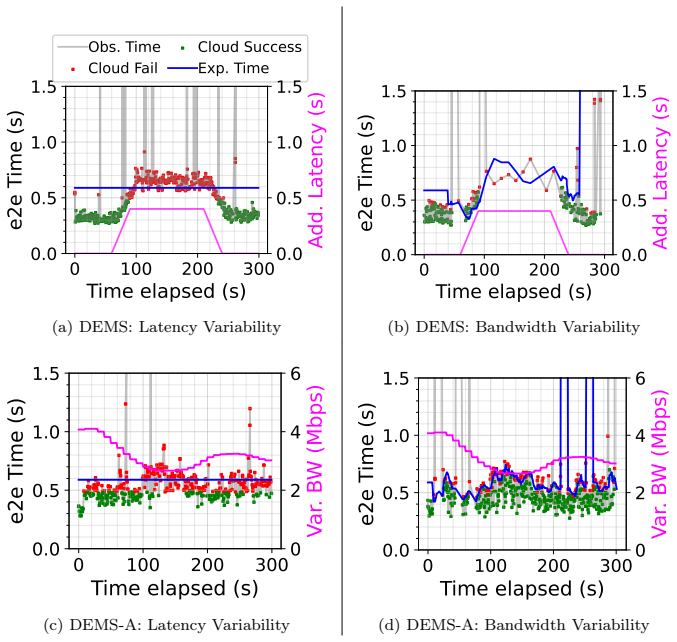
The machinery is a set of composable deadline-feasibility heuristics in DEMS, the deadline-driven edge-cloud scheduler with migration and work stealing. On the edge, tasks are ordered by earliest deadline, and every insertion tests whether the sum of expected execution times of higher-priority tasks plus the new task's expected time $t_i$ would exceed its deadline $t'_j + \delta_i$. The migration score $S^j_i$ decides who goes to the cloud: it is the edge-minus-cloud utility difference when the cloud would succeed with positive utility, otherwise just the edge utility. Slack $\sigma^j = (t'_j+\delta_i)-(t''+t_i)$ at the head of the edge queue triggers work stealing, with stolen tasks ranked by $(\gamma^E_i-\gamma^C_i)/t_i$ and with negative-cloud-utility tasks prioritized. The adaptive variant replaces the static cloud estimate $\hat{t}_i$ with a sliding-window average of observed end-to-end latencies, with a cooling period to recover from dead-ends. GEMS closes the loop by tracking the incremental completion rate $\hat{\alpha}^x_i = \hat{\lambda}^x_i / \lambda^x_i$ per model per tumbling window and pushing pending edge tasks of a lagging model to the cloud when it can still meet their deadlines.
What would settle it
Run the six DNN workloads on real edge and cloud hardware but feed the scheduler full latency distributions instead of the 95th/99th-percentile point estimates, or count how often actual completion exceeds those percentile bounds; if the completion and utility advantages of DEMS, DEMS-A, and GEMS over the E+C baseline shrink toward zero whenever the true tail is heavier than the benchmark tail, the central claim is refuted.
Extended reading notes
Core claim
The core discovery is that the tension between maximizing on-time task completion and maximizing utility — where utility is benefit minus execution cost — can be resolved by a greedy, deadline-driven scheduler that treats the edge as the preferred resource and the cloud as a safety valve, and that this resolution survives when the cloud is slow and variable. DEMS, DEMS-A, and GEMS are not approximations of an optimal schedule; they are explicit heuristics evaluated against seven baselines, including cloud-only, edge-only, EDF and SJF hybrids, and two state-of-the-art schedulers adapted from the literature. The paper's claim is that on realistic workloads, these heuristics dominate the baselines on the two-objective frontier of task completion and QoS utility, and that GEMS additionally hits user-specified completion-rate targets in tumbling windows, which is what a VIP-facing application needs to keep navigation smooth. The real-flight result extends the claim to the full cyber-physical loop: GEMS completes up to 87% of tasks, edge-only scheduling stalls at 30 FPS, and GEMS produces the smoothest trajectory by jerk and yaw error.
Load-bearing premise
The scheduler's deadline checks depend on benchmarked 95th/99th-percentile latency estimates being treated as fixed expected durations, so if real edge or cloud latency is much more variable than those percentiles, or if the percentiles don't transfer from emulated containers to a real Jetson-class edge, the decisions and the reported gains can break.
Editorial extensions
If this is right
- A fleet of dozens of drones can be served by one scheduler per edge: weak-scaling emulations hold task completion near 83% from 21 to 84 drones.
- Network variability on the path to the cloud does not have to be fatal: adapting the expected cloud latency with a sliding window recovers 16–27% utility under shaped latency and bandwidth swings while keeping task completion near the non-adaptive version.
- Applications with user-tunable reliability targets can express them as completion-rate thresholds per time window, and the scheduler can enforce them without waiting for the window to fail: GEMS gains up to 75% in QoE utility by rescheduling pending tasks of lagging models.
- The same scheduler that maximizes QoS also improves the physical outcome: a real drone following a VIP with GEMS completes more tasks, finishes its flight where edge-only scheduling stalls, and reports lower jerk and yaw error.
Reading between the lines
- An implication the authors leave implicit: their deadline/benefit abstraction is model-agnostic, so the same scheduler should transfer to other latency-sensitive drone workloads such as traffic monitoring or emergency response, as long as each app supplies a deadline, a benefit, and a window completion rate.
- A testable extension: replace the fixed 95th/99th-percentile point estimates with online quantile estimates or full latency distributions; the adaptation logic suggests this would help most exactly when tails are heavy, but the magnitude is untested.
- A neighboring question: the utility-maximizing edge-cloud split depends on the edge being cheaper than the cloud; if public edge services are priced like the cloud, the migration and stealing rules would need different scoring, a regime the paper itself flags as outside its sweet spot.
- A corollary for practice: the QoE window mechanism turns a user's reliability preference into an enforceable SLA, which could be connected to automated negotiation of deadlines and benefits, a direction the conclusion names as future work.
Signed reviews
Editorial analysis
A structured set of objections, weighed in public.
Referee Report
Summary. The paper addresses deadline-driven scheduling of DNN inference tasks generated by drone fleets assisting visually impaired persons. It defines a QoS utility (Eq. 1) with task benefits, edge/cloud costs, and a QoE utility (Eq. 2) that rewards models whose task completion rate in a tumbling window reaches a threshold α. The proposed heuristics are: DEMS, combining EDF ordering, edge-to-cloud migration via a score function, and cloud-to-edge work stealing; DEMS-A, which adapts the expected cloud latency using a sliding-window average; and GEMS, which migrates pending edge tasks to the cloud whenever the incremental window completion rate falls below α. Evaluation uses container-emulated Jetson Nano edges, real pre-recorded drone video, six real DNNs, and AWS Lambda, plus a field test with a Tello drone and Orin Nano. The paper reports up to 88% task completion, up to 2.7x QoS utility over baselines, 16% additional utility with DEMS-A, 75% higher QoE utility with GEMS, and better drone-trajectory smoothness in the field trial.
Significance. If the claims hold, the paper is a useful engineering contribution: it combines realistic workloads (six contemporary DNNs on actual drone footage), an open-source scheduler, a credible container and FaaS evaluation harness, and a real drone validation. The migration/work-stealing heuristics are clearly specified and the relative comparison to several baselines is internally consistent. The main reservations are that the QoE headline is not tested under real DNN execution or network variability, the deadline-feasibility logic relies on percentile estimates used as deterministic bounds, and the empirical evaluation rests on single runs per condition. These issues are fixable with additional experiments and more cautious claims; in its present form the paper overstates the strength of the QoE result.
major comments (3)
- [§8.7, Eq. (2)] The 'up to 75% higher QoE utility' claim in the abstract is supported only by the sleep-based workloads in §8.7. The text says, 'we account for the performance of these alternate edge and cloud resources by replacing the DNN execution with just a sleep function for the relevant execution duration of the tasks.' This makes the expected execution times exact and removes the execution-time and network variability that DEMS-A and GEMS are designed to handle. In the real-DNN emulation (§8.3–8.6) QoE utility is not reported, and in the real-world flight (§8.8) the authors set α=1.0 and state the setup 'does not accrue the full QoE utility due to the strict 1.0 completion rate.' The QoE component of the central claim is therefore untested under realistic conditions; I recommend either adding a real-DNN QoE evaluation with network variability or explicitly limiting the QoE claim to the sleep-based emulation.
- [Appendix A; §5.1, §5.3, §5.4; Algorithm 1] The scheduler treats percentile-based expected execution times as deterministic bounds. Appendix A sets the edge time t from the average 99th percentile and the cloud time t_hat from the average 95th percentile. These values are used in JIT feasibility checks, cloud trigger times, work-stealing slack, and GEMS migration (Algorithm 1 line 11). A 95th-percentile cloud estimate means 5% of invocations exceed t_hat; a task migrated on the condition x + t_hat_i ≤ deadline can miss by construction. DEMS-A (§5.4) adapts to sustained latency shifts but not to single-task tail events, and the cooling-period reset to the static default can resurrect stale estimates. Please report the empirical distribution of observed-minus-expected times, test sensitivity to the quantile choice, and confirm that the reported gains survive. Without this, the feasibility logic is not robust to heavy tails or to transferring t_hat from container-emulated Nano edges to the real Orin Nano setup of §8.8.
- [§8.3–§8.8] Each workload and condition is evaluated with a single 300-second run (or a single flight); the reported whiskers are min-max across edge containers on one host, not across independent runs. Since cloud latency, Lambda cold starts, and network shaping are stochastic (Fig. 2), single-run comparisons cannot establish the 'up to' percentages in the abstract or distinguish the heuristics from noise. I recommend several independent runs per condition with median and spread, or a clear disclaimer that the quantitative gains are from single trials.
minor comments (5)
- [Algorithm 1, line 7] The expression bα_i = cλ_i/λ_i uses cλ_i, which is not defined in the algorithm; it should refer to the successful-count variable bλ_i updated on lines 4–6.
- [§8.7, Table 2] The sentence 'MD and CD have different configurations for the two workloads, as shown in Table 1' should refer to Table 2, since Table 2 is the one listing the WL1/WL2 configurations.
- [§8.2, Fig. 8] The baseline description says CLD 'should achieve 100% task completion on-time,' but the results in Fig. 8 show lower completion for intensive workloads due to network timeouts; the text should reconcile these statements.
- [§8.4] The sentence '≈23% of the successful tasks in 4D-P are stolen from the cloud queue, and are all BP, forming 100% of all successfully stolen tasks for 4D-P' is confusing; it should say that all stolen tasks are BP and these constitute about 23% of successful tasks.
- [§5.3, Fig. 12] The discussion around Fig. 12 refers to changes in the 'expected deadline'; the quantity being adapted is the expected execution time, not the deadline.
Circularity Check
GEMS QoE utility gains are forced by a sleep-based evaluation whose realized latencies equal the scheduler's own expected latencies.
-
self definitional
[Section 8.7 (GEMS QoE evaluation), Table 2 vs. Algorithm 1 line 11]
"For simplicity, in these experiments, we account for the performance of these alternate edge and cloud resources by replacing the DNN execution with just a sleep function for the relevant execution duration of the tasks. ... if (γC i > 0) && ( x + ˆti ≤ t′ j + δi) then Send τ j i from edge queue to the cloud queue"
GEMS's cloud-migration test uses the expected cloud duration `t_i`, and the §8.7 workload realizes cloud execution by sleeping for exactly that same 'relevant execution duration.' Thus every migrated task satisfying line 11 completes within its deadline by construction, independent of the execution-time and network variability (Fig. 2) that motivates DEMS-A and GEMS. The reported 24–75% QoE-utility advantage over DEMS in Fig. 14 is a logical consequence of the feasibility predicate with ground-truth latencies set equal to the predicate's own inputs, rather than an empirical result under realistic variability. The experiment re-exhibits the definition of the feasibility check instead of testing whether `t_i` is a reliable bound.
full rationale
The QoS claims for DEMS and DEMS-A are not circular: they are evaluated with real DNN models on Jetson Nano containers and AWS Lambda, against baselines using the same utility definitions, and the completion/utility numbers depend on actual execution and network behavior rather than on the scheduler's expected times. The self-citations ([22], [2]) are provenance for the DEMS heuristic and the Ocularone application, not load-bearing evidence for the scheduling results, and the code is public. The one self-confirming element is the GEMS QoE evaluation in §8.7: the sleep duration is set to the scheduler's expected execution duration, so the migration check is guaranteed to succeed, making the QoE utility gain an artifact of the experimental construction rather than a demonstration under realistic variance. The real-flight validation (§8.8) does not report QoE utility, noting that the strict α=1.0 setup 'does not accrue the full QoE utility,' which leaves the headline QoE improvement without independent real-execution support. Overall, the QoS contribution is substantially independent, but the headline QoE component partially reduces to its own feasibility predicate.
Assumptions & free parameters
free parameters (5)
- DEMS-A adaptation parameters (w, epsilon, tcp) =
w=10, epsilon=10 ms, tcp=10 s
- QoS workload parameters (benefits, deadlines) for six DNNs in Table 1 =
beta 40-250, delta 650-1000 ms, edge/cloud costs K=1-6, Khat=15-210
- Expected edge/cloud execution times in Table 1 =
t: 142-739 ms, t_hat: 398-878 ms
- QoE workload parameters for WL1 and WL2 in Table 2 =
bar-beta 360-600, delta 400-1000 ms, t 100-750 ms, t_hat 200-950 ms
- QoE window settings alpha and omega =
alpha = 0.9 or 1.0, omega = 20 s
assumptions (6)
- domain assumption Inference tasks are independent, have fixed deadlines and benefits, and may be executed on edge or cloud or dropped.
- domain assumption Expected execution durations are treated as deterministic bounds for JIT feasibility and work-stealing decisions, with edge 99th percentile and cloud 95th percentile.
- domain assumption Cloud execution time can be tracked by a sliding-window average and reset after a cooling period.
- ad hoc to paper User value is captured by the QoE utility that pays bar-beta only if the completion rate in a tumbling window reaches alpha.
- domain assumption A container with 4 vCPUs and 4 GB RAM emulates a Jetson Nano edge, and drone containers emulate Tello WiFi video streams.
- domain assumption The workload generation rate of 1-second segments and one task per registered model per segment is representative of the VIP application.
Cite this review
Pith. "Pith review of Adaptive Heuristics for Scheduling DNN Inferencing on Edge and Cloud for Personalized UAV Fleets." pith.science (2026). https://pith.science/paper/BD23KCAY
@misc{pith2026241220860,
  author       = {Pith},
  title        = {Pith review of: Adaptive Heuristics for Scheduling DNN Inferencing on Edge and Cloud for Personalized UAV Fleets},
  year         = {2026},
  howpublished = {\url{https://pith.science/paper/BD23KCAY}},
  note         = {Machine review of arXiv:2412.20860}
}
read the original abstract
Drone fleets with onboard cameras coupled with computer vision and DNN inferencing models can support diverse applications. One such novel domain is for one or more buddy drones to assist Visually Impaired People (VIPs) lead an active lifestyle. Video inferencing tasks from such drones can help both navigate the drone and provide situation awareness to the VIP, and hence have strict execution deadlines. We propose a deadline-driven heuristic, DEMS-A, to schedule diverse DNN tasks generated continuously to perform inferencing over video segments generated by multiple drones linked to an edge, with the option to execute on the cloud. We use strategies like task dropping, work stealing and migration, and dynamic adaptation to cloud variability, to guarantee a Quality of Service (QoS), i.e. maximize the utility and the number of tasks completed. We also introduce an additional Quality of Experience (QoE) metric useful to the assistive drone domain, which values the frequency of success for task types to ensure the responsiveness and reliability of the VIP application. We extend our DEMS solution to GEMS to solve this. We evaluate these strategies, using (i) an emulated setup of a fleet of over 80 drones supporting over 25 VIPs, with real DNN models executing on pre-recorded drone video streams, using Jetson Nano edges and AWS Lambda cloud functions, and (ii) a real-world setup of a Tello drone and a Jetson Orin Nano edge generating drone commands to follow a VIP in real-time. Our strategies present a task completion rate of up to 88%, up to 2.7x higher QoS utility compared to the baselines, a further 16% higher QoS utility while adapting to network variability, and up to 75% higher QoE utility. Our practical validation exhibits task completion of up to 87% for GEMS and 33% higher total utility of GEMS compared to edge-only.
Figures


Figures from the paper (25 more)




Reference graph
Works this paper leans on
-
[1]
World Health Organization, Blindness and visual impairment fact sheets (August 2023)
work page 2023
-
[2]
S. Raj, S. Padhi, Y. Simmhan, Ocularone: Exploring drones-based assistive technologies for the visually impaired, in: Extended Abstracts of the CHI Conference on Human Factors in Computing Systems, 2023. 39
work page 2023
-
[3]
of Federal Regulations, General Operating and Flight Rules (14 CFR Part 91), Tech
C. of Federal Regulations, General Operating and Flight Rules (14 CFR Part 91), Tech. rep., Federal Aviation Administration (2024)
work page 2024
-
[4]
E. U. A. S. Agency, Easy Access Rules for Unmanned Aircraft Systems (Regulations (EU) 2019/947 and 2019/945), Tech. rep. (2022)
work page 2022
-
[5]
of Civil Aviation, Accessibility Standards and Guidelines for Civil Avi- ation, Tech
M. of Civil Aviation, Accessibility Standards and Guidelines for Civil Avi- ation, Tech. rep., India (2023)
work page 2023
-
[6]
C. Christodoulou, P. Kolios, Optimized tour planning for drone-based ur- ban traffic monitoring, in: IEEE 91st VTC2020-Spring, 2020
work page 2020
-
[7]
T. Benarbia, K. Kyamakya, A literature review of drone-based package de- livery logistics systems and their implementation feasibility, Sustainability 14 (1) (2021) 360
work page 2021
-
[8]
A. Kumar, et al., A drone-based networked system and methods for com- bating coronavirus disease (covid-19) pandemic, Future Generation Com- puter Systems 115 (2021)
work page 2021
Show all 61 references
-
[9]
Hiebert, E
B. Hiebert, E. Nouvet, V. Jeyabalan, L. Donelle, The application of drones in healthcare and health-related services in north america: A scoping re- view, Drones 4 (3) (2020) 30
2020
-
[10]
Avila, M
M. Avila, M. Funk, N. Henze, Dronenavigator: Using drones for navigating visually impaired persons, in: ACM SIGACCESS, ASSETS, 2015
2015
-
[11]
Avila Soto, M
M. Avila Soto, M. Funk, M. Hoppe, R. Boldt, K. Wolf, N. Henze, Drone- navigator: Using leashed and free-floating quadcopters to navigate visually impaired travelers, in: ACM SIGACCESS, ASSETS, 2017
2017
-
[12]
rep., NVIDIA Corporation (2024)
NVIDIA, Jetson Orin Nano Developer Kit Carrier Board Specification, Tech. rep., NVIDIA Corporation (2024)
2024
-
[13]
Kuriakose, R
B. Kuriakose, R. Shrestha, F. E. Sandnes, Tools and technologies for blind and visually impaired navigation support: a review, IETE Technical Re- view 39 (1) (2022) 3–18
2022
-
[14]
Al Zayer, S
M. Al Zayer, S. Tregillus, J. Bhandari, D. Feil-Seifer, E. Folmer, Exploring the use of a drone to guide blind runners, in: ACM SIGACCESS, ASSETS, 2016
2016
-
[15]
Momont, Ambulance Drone at TU Delft, Tech
A. Momont, Ambulance Drone at TU Delft, Tech. rep., TUDelft (2014)
2014
-
[16]
J. Zeng, L. T. Yang, M. Lin, H. Ning, J. Ma, A survey: Cyber-physical- social systems and their system-level design methodology, FGCS 105 (2020)
2020
-
[17]
ACM Meas
S.K.Prashanthi, S.A.Kesanapalli, Y.Simmhan, Characterizingtheperfor- mance of accelerated jetson edge devices for training deep learning models, Proc. ACM Meas. Anal. Comput. Syst. (2022). 40
2022
-
[18]
Yamaguchi, Y
A. Yamaguchi, Y. Nakamoto, K. Sato, Y. Watanabe, H. Takada, Edf- pstream: Earliest deadline first scheduling of preemptable data streams – issues related to automotive applications, in: IEEE Intl. Conf. on Em- bedded and Real-Time Computing Syst. & Applications, 2015
2015
-
[19]
J. Wang, Z. Feng, Z. Chen, S. A. George, M. Bala, P. Pillai, S.-W. Yang, M. Satyanarayanan, Edge-based live video analytics for drones, IEEE In- ternet Computing (2019)
2019
-
[20]
H. Guo, J. Liu, Uav-enhanced intelligent offloading for internet of things at the edge, IEEE Transactions on Industrial Informatics (2020)
2020
-
[21]
Khochare, F
A. Khochare, F. B. Sorbelli, Y. Simmhan, S. K. Das, Improved algo- rithms for co-scheduling of edge analytics and routes for uav fleet missions, IEEE/ACM Transactions on Networking 32 (1) (2024)
2024
-
[22]
S. Raj, H. Gupta, Y. Simmhan, Scheduling dnn inferencing on edge and cloud for personalized uav fleets, in: IEEE/ACM 23rd CCGrid, 2023
2023
-
[23]
Mahmud, S
R. Mahmud, S. N. Srirama, K. Ramamohanarao, R. Buyya, Quality of experience (qoe)-aware placement of applications in fog computing envi- ronments, Journal of Parallel and Distributed Computing 132 (2019)
2019
-
[24]
Y. Mao, et al., Differentiate quality of experience scheduling for deep learn- ing inferences with docker containers in the cloud, IEEE Transactions on Cloud Computing 11 (2) (2023) 1667–1677
2023
-
[25]
M. M. Islam, M. Sheikh Sadi, K. Z. Zamli, M. M. Ahmed, Developing walking assistants for visually impaired people: A review, IEEE Sensors Journal (2019)
2019
-
[26]
WeWALK Limited UK, WeWalk: Enhancing the mobility of visually im- paired people (August 2020)
2020
-
[27]
Brown, Researchers design an AI-powered backpack for the visually impaired (2021)
D. Brown, Researchers design an AI-powered backpack for the visually impaired (2021)
2021
-
[28]
J. Bai, S. Lian, Z. Liu, K. Wang, D. Liu, Smart guiding glasses for visually impaired people in indoor environment, IEEE Transactions on Consumer Electronics (2017)
2017
-
[29]
Al-Heeti, Google expands lookout app for people who are blind or vision- impaired, Tech
A. Al-Heeti, Google expands lookout app for people who are blind or vision- impaired, Tech. rep., CNet (Aug. 2020)
2020
-
[30]
M. M. Nasralla, I. U. Rehman, D. Sobnath, S. Paiva, Computer vision and deep learning-enabled uavs: Proposed use cases for visually impaired people in a smart city, in: Computer Analysis of Images and Patterns, Springer International Publishing, 2019
2019
-
[31]
Tianfield, Towards edge-cloud computing, in: IEEE International Con- ference on Big Data (Big Data), 2018
H. Tianfield, Towards edge-cloud computing, in: IEEE International Con- ference on Big Data (Big Data), 2018. 41
2018
-
[32]
Varshney, Y
P. Varshney, Y. Simmhan, Characterizing application scheduling on edge, fog, and cloud computing resources, Software: Practice and Experience 50 (5) (2020) 558–595
2020
-
[33]
H. Dai, X. Zeng, Z. Yu, T. Wang, A scheduling algorithm for autonomous driving tasks on mobile edge computing servers, J. of Systems Arch. (2019)
2019
-
[34]
R. O. Aburukba, M. Alikarrar, T. Landolsi, K. El-Fakih, Scheduling inter- net of things requests to minimize latency in hybrid fog–cloud computing, Future Generation Computer Systems 111 (2020) 539–551
2020
-
[35]
J. Meng, H. Tan, X.-Y. Li, Z. Han, B. Li, Online deadline-aware task dis- patching and scheduling in edge computing, IEEE Transactions on Parallel and Distributed Systems 31 (6) (2020) 1270–1286
2020
-
[36]
K. Rao, G. Coviello, W.-P. Hsiung, S. Chakradhar, Eco: Edge-cloud opti- mization of 5g applications, in: IEEE/ACM International Symposium on Cluster, Cloud and Internet Computing (CCGrid), 2021
2021
-
[37]
Zhang, B
Y. Zhang, B. Tang, J. Luo, J. Zhang, Deadline-aware dynamic task schedul- ing in edge–cloud collaborative computing, Electronics (2022)
2022
-
[38]
W. Chen, B. Liu, H. Huang, S. Guo, Z. Zheng, When uav swarm meets edge-cloud computing: The qos perspective, IEEE Network 33 (2019)
2019
-
[39]
Postoaca, C
A.-V. Postoaca, C. Negru, F. Pop, Deadline-aware scheduling in cloud-fog- edge systems, in: IEEE/ACM International Symposium on Cluster, Cloud and Internet Computing (CCGRID), 2020
2020
-
[40]
Z. Fu, J. Ren, D. Zhang, Y. Zhou, Y. Zhang, Kalmia: A heterogeneous qos-aware scheduling framework for dnn tasks on edge servers, in: IEEE Conference on Computer Communications (INFOCOM), 2022
2022
-
[41]
X. Chen, J. Zhang, B. Lin, Z. Chen, K. Wolter, G. Min, Energy-efficient offloading for dnn-based smart iot systems in cloud-edge environments, IEEE Transactions on Parallel and Distributed Systems (2022)
2022
-
[42]
S. Shen, Y. Ren, Y. Ju, X. Wang, W. Wang, V. C. M. Leung, Edgema- trix: A resource-redefined scheduling framework for sla-guaranteed multi- tier edge-cloud computing systems, IEEE Jour. on Sel. Areas in Comm. (2023)
2023
-
[43]
P. Lai, Q. He, G. Cui, X. Xia, M. Abdelrazek, F. Chen, J. Hosking, J. Grundy, Y. Yang, Qoe-aware user allocation in edge computing systems with dynamic qos, Future Generation Computer Systems 112 (2020)
2020
-
[44]
C. Li, J. Bai, J. Tang, Joint optimization of data placement and scheduling for improving user experience in edge computing, Journal of Parallel and Distributed Computing 125 (2019) 93–105. 42
2019
-
[45]
Minovski, C
D. Minovski, C. Åhlund, K. Mitra, Modeling quality of iot experience in autonomous vehicles, IEEE Internet of Things Journal 7 (5) (2020)
2020
-
[46]
L. A. b. Burhanuddin, X. Liu, Y. Deng, U. Challita, A. Zahemszky, Qoe optimization for live video streaming in uav-to-uav communications via deep reinforcement learning, IEEE Transactions on Vehicular Technology 71 (5) (2022) 5358–5370
2022
-
[47]
Vahidinia, B
P. Vahidinia, B. Farahani, F. S. Aliee, Cold start in serverless computing: Current trends and mitigation strategies, in: International Conference on Omni-layer Intelligent Systems (COINS), 2020
2020
-
[48]
Z. Han, H. Tan, X.-Y. Li, S. H.-C. Jiang, Y. Li, F. C. M. Lau, Ondisc: Online latency-sensitive job dispatching and scheduling in heterogeneous edge-clouds, IEEE/ACM Transactions on Networking (2019)
2019
-
[49]
Jocher, A
G. Jocher, A. Chaurasia, J. Qiu, Ultralytics YOLOv8 (2023)
2023
-
[50]
Nagrath, Control systems engineering, New Age International, 2006
I. Nagrath, Control systems engineering, New Age International, 2006
2006
-
[51]
NVIDIA AI IOT, Hand Pose Estimation And Classification (2021)
2021
-
[52]
Vapnik, The nature of statistical learning theory, Springer science & business media, 1999
V. Vapnik, The nature of statistical learning theory, Springer science & business media, 1999
1999
-
[53]
Niantic, Monodepth2: Monocular depth estimation from a single image (2019)
I. Niantic, Monodepth2: Monocular depth estimation from a single image (2019)
2019
-
[54]
AIZOOTech, Detect faces and determine whether people are wearing mask (2020)
2020
-
[55]
S. Raj, B. A. Madhabhavi, K. Astu, A. A. Rajesh, P. M, Y. Simmhan, Ocularone-bench: Benchmarking dnn models on gpus to assist the visually impaired (2025). arXiv:2504.03709. URL https://arxiv.org/abs/2504.03709
2025 arXiv
-
[56]
S. Raj, B. A. Madhabhavi, M. Kumar, P. Gupta, Y. Simmhan, Distance estimation to support assistive drones for the visually impaired using robust calibration (2025). arXiv:2504.01988. URL https://arxiv.org/abs/2504.01988
2025
-
[57]
Badiger, S
S. Badiger, S. Baheti, Y. Simmhan, Violet: A large-scale virtual environ- ment for internet of things, in: Euro-Par: Parallel Processing, 2018
2018
-
[58]
I. Gog, S. Kalra, P. Schafhalter, J. E. Gonzalez, I. Stoica, D3: a dynamic deadline-drivenapproachforbuildingautonomousvehicles, in: Proceedings of 17th European Conference on Computer Systems, EuroSys, 2022
2022
-
[59]
Shupeng, L
L. Shupeng, L. Menglu, B. M. Chen, Safe corridor based task interface for quadrotors, in: International Micro-Air Vehicles Conference, 2018. 43
2018
-
[60]
I. Bae, J. Moon, J. Jhung, H. Suk, T. Kim, H. Park, J. Cha, J. Kim, D. Kim, S. Kim, Self-driving like a human driver instead of a robocar: Personalized comfortable drivingexperience for autonomousvehicles, arXiv preprint arXiv:2001.03908 (2020)
2020 arXiv
-
[61]
Union, General Data Protection Regulation (GDPR) Summary (2018)
E. Union, General Data Protection Regulation (GDPR) Summary (2018). 44 HV DEV BP DEO CD MD 0.00 0.25 0.50 0.75 1.00e2e Time (s) Deadline Expected execution time (a) 1 drone per edge HV DEV BP DEO CD MD 0.00 0.25 0.50 0.75 1.00e2e Time (s) Deadline Expected execution time (b) 3...
2018
Reviewed August 10, 2026 · model on record in the stance chip above.
Discussion (0). Continue with ORCID to comment.