REVIEW 2 major objections 5 minor 1 cited by
Chirality encoding in resonant metasurfaces governed by lattice symmetries
T0 review · 2 major / 5 minor · reviewed 2026-08-10 · deepseek-v4-flash
Pith's one-line read The chiral response of a metasurface vanishes at angles set by lattice and meta-atom mirror symmetries.
desk verdict A clean symmetry rule for achiral anchor angles in resonant metasurfaces, verified in simulation and partly in experiment; the C3v/square data leave one reproducibility gap that a referee should probe. read the letter →
The pith
A machine-rendered reading of the paper's core claim, the machinery that carries it, and where it could break.
The reading
What carries the argument
The machinery is the mirror-axis matching condition plus a counting identity. In a Bravais lattice with $m$ in-plane mirror lines and a $C_{nv}$ meta-atom with $n$ mirror lines, the symmetry axes are spaced by $\pi/m$ and $\pi/n$. Rotating the meta-atom through $\beta$ brings some axis $i\pi/m$ into coincidence with some axis $j\pi/n$; the smallest such rotation is $\min_{i,j}|i\pi/m - j\pi/n| = \pi/\mathrm{lcm}(m,n)$ by B\'ezout's identity. When such a coincidence occurs, the whole pattern has a mirror plane and all chiral optical observables vanish. The derivation is purely geometric and makes no reference to the resonant mode structure, which is why the zeros are robust.
What would settle it
Enumerate all symmetry operations of the periodic pattern, including glide reflections, for a representative combination such as a $C_{3v}$ spinner on a square lattice; if an achiral angle appears that is not of the form $s\pi/\mathrm{lcm}(3,4)=s\pi/12$, the anchor set is incomplete. A normal-incidence CD measurement at a predicted anchor angle that returns a nonzero value would likewise disprove the rule.
Extended reading notes
Core claim
The central claim is that for a periodic array of achiral $C_{nv}$ meta-atoms on a substrate that breaks out-of-plane mirror symmetry, the metasurface becomes achiral exactly when one of the meta-atom's $n$ mirror planes coincides with one of the lattice's $m$ mirror planes. The angular spacing between such coincidences is $\Delta\beta = \pi/\mathrm{lcm}(m,n)$, so the chiral response, quantified by total circular dichroism $CD_{tot}=(T_R-T_L)/(T_R+T_L)$, must vanish at $\beta = s\pi/\mathrm{lcm}(m,n)$. The paper proves this by minimizing the angular distance between the two mirror-axis sets and invoking B\'ezout's identity, and it confirms the zeros in full-wave simulations for square and hexagonal lattices with $C_{2v}$ bars and $C_{3v}$ spinners. Experimentally, gradient metasurfaces that sweep $\beta$ along the chip show robust CD zeros at the predicted angles, with the maxima between anchors reaching |CD| values above 0.8. The same design principle is then used to encode two independent images in one metasurface, one in unpolarized transmission and one in CD.
Load-bearing premise
The rule assumes that a mirror-line match between lattice and meta-atom is the only way the periodic pattern can become achiral, so it does not consider glide reflections or other improper symmetries that lack a pure mirror line.
Editorial extensions
If this is right
- Designers of chiral metasurfaces can choose any combination of a $C_{nv}$ resonator and one of the five Bravais lattices and know in advance the set of rotation angles that give exactly zero chirality.
- Because the CD curve is anti-symmetric about each anchor angle, a structure whose maximum chirality reaches $|CD|=1$ can access the full $[-1,1]$ range simply by varying $\beta$.
- A continuous gradient of $\beta$ across a chip maps the entire chirality-versus-angle curve into a single sample, so one fabrication run characterizes the full symmetry pair.
- The amplitude-encoding scheme uses individual unit cells as pixels, allowing images to be written into transmission and CD simultaneously without polarization optics for readout.
- Lower-symmetry lattices give larger CD maxima but a narrower transmission encoding range, while hexagonal lattices balance the two channels, making the lattice choice a design trade-off.
Reading between the lines
- A testable extension: the same anchor-angle formula should hold for reflection CD and for co-polarized CD, since those observables are also odd under the mirror operation; comparing zero sets across observables would isolate extrinsic-chirality contributions.
- One consequence left implicit: if a glide-reflection symmetry can make a two-dimensional pattern achiral without aligning any mirror lines, the formula would undercount the zeros; enumerating the full diperiodic group for one-motif unit cells would either close this gap or reveal additional anchors.
- The rule should transfer to plasmonic metasurfaces and to other resonant platforms, because it depends only on symmetry and not on material; measuring the same anchor angles with metal resonators would test that transfer.
- Near a symmetry anchor, CD should grow linearly with detuning $\delta\beta$, offering a simple analog control knob for chirality and setting the practical resolution of the encoding scheme.
Editorial analysis
A structured set of objections, weighed in public.
Referee Report
Summary. The manuscript proposes a universal, parameter-free selection rule for the chiral optical response of planar metasurfaces made of C_nv-symmetric meta-atoms on a substrate. For a Bravais lattice with m in-plane mirror lines and a meta-atom with n mirror lines, it predicts that the total circular dichroism vanishes at relative rotation angles β = sπ/lcm(m,n) (Eq. 1, Table 1), and that these 'anchor' angles are independent of the resonant modes of the metasurface. The authors validate the rule with CST simulations and mid-IR experiments on Ge-on-CaF2 gradient metasurfaces for C2v and C3v resonators in square and hexagonal lattices, and in the supplementary for rectangular and monoclinic lattices. They further demonstrate simultaneous image encoding in transmission and circular dichroism, using the symmetry-protected zeros to expand the dynamic range of the chiral signal.
Significance. If fully validated, this is a useful and elegant contribution: it reduces the design of a resonant chiral metasurface to a single geometric parameter β, with a closed-form expression for the chirality-canceling angles that does not require numerical optimization. The derivation is elementary (Bézout's identity) and the anchor-zero predictions are confirmed by simulations and, for most tested combinations, by experiments; the gradient-metasurface platform and the dual-channel image encoding are convincing applications. The only fitted quantity is the imaginary part of the Ge permittivity, which affects CD amplitudes but not the locations of the zeros, so the zeros themselves are independent predictions. The main limitations are the missing necessity proof for the selection rule (the converse of mirror-line matching) and an incomplete quantitative explanation of the mode-dependent C3v/square experimental nodes.
major comments (2)
- [Supplementary S1, Eq. (1), Table 1] The derivation in Supplementary S1 establishes the angular positions at which a lattice mirror line coincides with a meta-atom mirror line, and this condition is sufficient for achirality. It does not prove, however, that these are the only achiral orientations: the text does not rule out other improper isometries such as glide reflections. Because Table 1 labels all non-anchor angles as chiral and Eq. (1) is presented as a complete selection rule, this necessity step is load-bearing. I expect it can be closed by noting that, for one C_nv motif per primitive cell centered at a lattice point, any improper isometry of the combined pattern must have a reflection direction that is simultaneously a lattice automorphism direction and a motif mirror direction; the authors should add this argument explicitly.
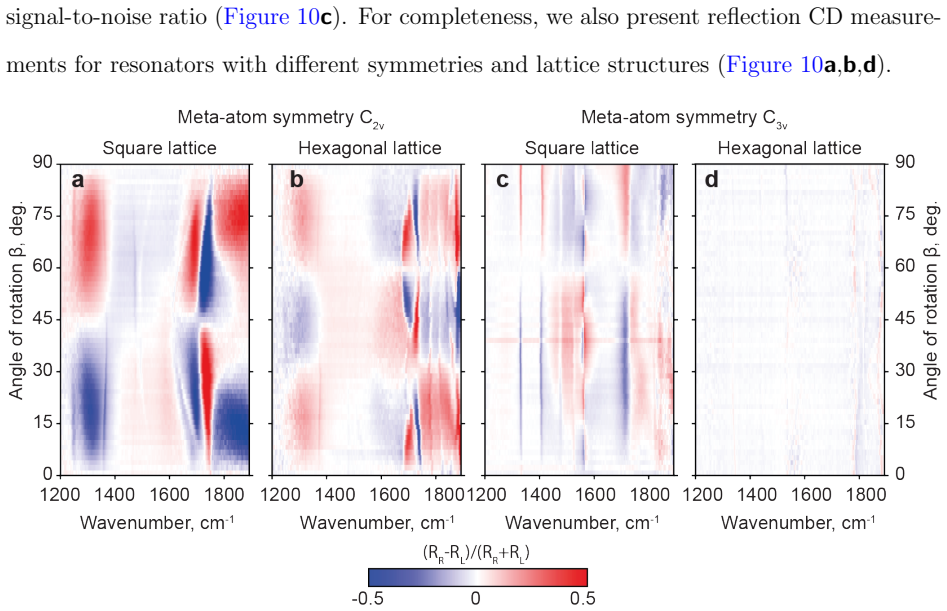
- [§4, Fig. 4c; Supplementary S4] The experimental C3v/square map shows the predicted Δβ=15° zeros only for the mode near 1570 cm−1; for the modes at 1320 and 1400 cm−1 the measured nodes are spaced by Δβ=60° instead. The manuscript attributes this to oblique incidence and extrinsic chirality, but Supplementary S4 demonstrates the oblique-incidence effect only for C2v/square at a polar angle of 5° and does not reproduce the C3v/square maps at the relevant frequencies. Because the central claim is that the zeros are robust and independent of the resonant modes, this mode-dependent discrepancy is a load-bearing experimental gap. The authors should provide quantitative evidence, for example oblique-incidence simulations for C3v/square, that the intermediate 15° nodes are filled by extrinsic chirality while the 60° nodes survive, or they should qualify the claim.
minor comments (5)
- [Supplementary S1, after Eq. (6)] The text states that the number of zeros in the interval [0, π/2] is N = lcm(m,n)/2; for lcm(4,3)=12 this gives 6, but the set of zeros {0, 15°, 30°, 45°, 60°, 75°, 90°} contains 7 angles. The formula counts intervals rather than zeros, or the interval endpoints should be excluded; please correct this.
- [Main text, §2] The sentence 'The later one is the showcase of our choice in this work.' is a duplicated fragment of the preceding sentence and should be removed.
- [Eq. (1), Table 1] Equation (1) is not defined for the monoclinic case m=0; the table handles this case qualitatively, but a brief parenthetical noting that Eq. (1) applies for m,n>0 would avoid confusion.
- [Supplementary S1 and S2] There are typos in the supplementary text: 'Assumming' in S1 and 'afformentioned' in S2; please correct them.
- [Fig. 4c and Supplementary S5] The transmission-CD data for the C3v/square sample are noisy because of low transmission; a direct overlay of the reflection-CD map from Supplementary S5 with the transmission-CD map in the main text would make the claimed node spacing easier to assess.
Circularity Check
No significant circularity: the selection-rule zeros are derived from Bezout’s identity and verified against independent simulations and measurements; the only fitted quantity affects CD amplitudes, not zero angles.
full rationale
The central claim, Eq. (1), Δβ = π/lcm(m,n), is derived in Supplementary Section S1 as a self-contained geometric calculation: the minimum angle between two sets of mirror axes is obtained by minimizing |in−jm| and invoking Bézout’s identity. The inputs are the definition of chirality as absence of a mirror plane and the assumed C_nv/mirror-line taxonomy of meta-atom and lattice; no parameter is fitted to the CD data to produce the zero angles. The predicted zero angles are then tested against full-wave CST simulations and FTIR measurements of chiral gradient metasurfaces, and the agreement is external to the derivation. The only fitted quantity explicitly mentioned is the imaginary part of the germanium permittivity, chosen to match spectral shapes and resonance positions; this affects CD amplitudes but not the symmetry-determined zero locations. The supplementary use of Ref. [41], whose authors overlap with the present paper, to state that cross-polarized transmission is prohibited for C_n with n≥3 is not load-bearing for the central selection rule: the same zeros are exhibited in the paper’s own simulations and measured maps, and the C2v cases in Supplementary Figure 7 directly compute the cross-polarization difference instead of relying on that citation. The unproved necessity of a mirror-line match, including the absence of an explicit treatment of possible glide symmetries, is an incompleteness or correctness risk rather than a circular reduction; it does not make the prediction equivalent to its inputs. The experimental discrepancy for the C3v/square sample at 1320 and 1400 cm−1, where nodes are spaced by 60° instead of 15°, is presented as a limitation and attributed to oblique-incidence extrinsic chirality; this is a validation gap, not evidence that the prediction was obtained from the data. Overall, the derivation chain is self-contained and the predictions are not forced by fitting or by self-citation.
Assumptions & free parameters
free parameters (1)
- Imaginary part of Ge permittivity (loss level) =
εGe = 17.45 + i0.1668
assumptions (4)
- standard math Bezout's identity: for coprime m', n' there exist integers i, j with |i n' - j m'| = 1
- domain assumption A 2D periodic pattern of identical C_nv meta-atoms (one per unit cell) is achiral iff at least one meta-atom mirror line coincides with a lattice mirror line.
- domain assumption The CaF2 substrate breaks the out-of-plane mirror symmetry, so the structures can possess 3D chirality.
- domain assumption Total CD (TR - TL)/(TR + TL) is a valid measure of chirality, and its zeros coincide with the symmetry-protected anchors.
Cite this review
Pith. "Pith review of Chirality encoding in resonant metasurfaces governed by lattice symmetries." pith.science (2026). https://pith.science/paper/ME6LEV7P
@misc{pith2026241220955,
  author       = {Pith},
  title        = {Pith review of: Chirality encoding in resonant metasurfaces governed by lattice symmetries},
  year         = {2026},
  howpublished = {\url{https://pith.science/paper/ME6LEV7P}},
  note         = {Machine review of arXiv:2412.20955}
}
read the original abstract
Chiral metasurfaces provide invaluable tools capable of controlling structured light required for biosensing, photochemistry, holography, and quantum photonics. Here we suggest and realize a universal strategy for controlling the chiral response of resonant metasurfaces via the interplay of meta-atom geometry and lattice arrangements within all five possible planar Bravais symmetries. By introducing chiral gradient metasurfaces, we illustrate how our approach allows producing a predictable chiral response tunable by simple parameter variations. We highlight that symmetry-controlled chiral response provides an additional degree of freedom in optical signal processing, and showcase this with simultaneous mid-IR image encoding in two fundamental quantities, transmission and circular dichroism. Our proposed concept represents a universal toolkit for on-demand design and control of chiral metastructures that has potential for numerous applications in life sciences, quantum optics and more.
Figures


Figures from the paper (11 more)




Forward citations
Cited by 1 Pith paper
-
Maximal optical chirality via mode coupling in bilayer metasurfaces
Bilayer membrane metasurfaces with rotated C4-symmetric holes achieve near-maximal circular dichroism through two distinct mode-coupling scenarios combined with engineered loss.
Reference graph
Works this paper leans on
-
[1]
Kelvin, W. T. The molecular tactics of a crystal ; Clarendon Press, 1894; p 27
-
[2]
Electromagnetic Chirality, Part 1: The Microscopic Perspective [Electromagnetic Perspectives]
Caloz, C.; Sihvola, A. Electromagnetic Chirality, Part 1: The Microscopic Perspective [Electromagnetic Perspectives]. IEEE Antennas Propag. Mag. 2020, 62, 58–71
work page 2020
-
[3]
Electromagnetic Chirality, Part 2: The Macroscopic Perspective [Electromagnetic Perspectives]
Caloz, C.; Sihvola, A. Electromagnetic Chirality, Part 2: The Macroscopic Perspective [Electromagnetic Perspectives]. IEEE Antennas Propag. Mag. 2020, 62, 82–98
work page 2020
-
[4]
Barron, L. D. From Cosmic Chirality to Protein Structure: Lord Kelvin’s Legacy. Chi- rality 2012, 24, 879–893
work page 2012
-
[5]
Smith, S. W. Chiral Toxicology: It’s the Same Thing. . . Only Different. Toxicological Sciences 2009, 110, 4–30
work page 2009
-
[6]
Kobayashi, N.; Muranaka, A. Circular Dichroism and Magnetic Circular Dichroism Spec- troscopy for Organic Chemists ; Royal Society of Chemistry, 2011
work page 2011
-
[7]
Fasman, G. D. Circular dichroism and the conformational analysis of biomolecules ; Springer Science & Business Media, 2013. 33
work page 2013
-
[8]
Aiello, C. D.; Abendroth, J. M.; Abbas, M.; Afanasev, A.; Agarwal, S.; Banerjee, A. S.; Beratan, D. N.; Belling, J. N.; Berche, B.; Botana, A.; Caram, J. R.; Celardo, G. L.; Cuniberti, G.; Garcia-Etxarri, A.; Dianat, A.; Diez-Perez, I.; Guo, Y.; Gutierrez, R.; Herrmann, C.; Hihath, J.; Kale, S.; Kurian, P.; Lai, Y.-C.; Liu, T.; Lopez, A.; Med- ina, E.; Mu...
work page 2022
Show all 80 references
-
[9]
A.; Johnson, W
Baase, W. A.; Johnson, W. C. Circular dichroism and DNA secondary structure. Nucleic Acids Res. 1979, 6, 797–814
1979
-
[11]
A.; He, H.; Pham-Huy, C
Nguyen, L. A.; He, H.; Pham-Huy, C. Chiral Drugs: An Overview. International Journal of Biomedical Science : IJBS 2006, 2, 85
2006
-
[12]
Emergent quantum confinement at topological insulator surfaces
Bahramy, M.; King, P.; de la Torre, A.; Chang, J.; Shi, M.; Patthey, L.; Balakrishnan, G.; Hofmann, P.; Arita, R.; Nagaosa, N.; Baumberger, F. Emergent quantum confinement at topological insulator surfaces. Nature Communications 2012, 3
2012
-
[13]
Chiral quantum optics
Lodahl, P.; Mahmoodian, S.; Stobbe, S.; Rauschenbeutel, A.; Schneeweiss, P.; Volz, J.; Pichler, H.; Zoller, P. Chiral quantum optics. Nature 2017, 541, 473–480
2017
-
[14]
Multiplexed Anticounterfeiting Meta-image Displays with Single-Sized Nanostructures
Deng, J.; Deng, L.; Guan, Z.; Tao, J.; Li, G.; Li, Z.; Li, Z.; Yu, S.; Zheng, G. Multiplexed Anticounterfeiting Meta-image Displays with Single-Sized Nanostructures. Nano Letters 2020, 20, 1830–1838
2020
-
[15]
Singh, S.; Bhardwaj, S.; Choudhary, N.; Patgiri, R.; Teramoto, Y.; Maji, P. K. Stimuli- Responsive Chiral Cellulose Nanocrystals Based Self-Assemblies for Security Measures 34 to Prevent Counterfeiting: A Review. ACS Applied Materials & Interfaces 2024, 16, 41743–41765
2024
-
[16]
Metalenses: Versatile multifunctional photonic com- ponents
Khorasaninejad, M.; Capasso, F. Metalenses: Versatile multifunctional photonic com- ponents. Science 2017, 358
2017
-
[17]
Advances in optical metalenses
Arbabi, A.; Faraon, A. Advances in optical metalenses. Nat. Photonics 2023, 17, 16–25
2023
-
[18]
L.; Zeng, S.; Bi, R.; Tai, K.; Dholakia, K.; Olivo, M
Zhang, S.; Wong, C. L.; Zeng, S.; Bi, R.; Tai, K.; Dholakia, K.; Olivo, M. Metasurfaces for biomedical applications: imaging and sensing from a nanophotonics perspective. Nanophotonics 2021, 10, 259–293
2021
-
[19]
N.; Kivshar, Y
Tittl, A.; Leitis, A.; Liu, M.; Yesilkoy, F.; Choi, D.-Y.; Neshev, D. N.; Kivshar, Y. S.; Altug, H. Imaging-based molecular barcoding with pixelated dielectric metasurfaces. Science 2018, 360, 1105–1109
2018
-
[20]
Nonlinear metasurfaces: a paradigm shift in nonlinear optics
Krasnok, A.; Tymchenko, M.; Al` u, A. Nonlinear metasurfaces: a paradigm shift in nonlinear optics. Materials Today 2018, 21, 8–21
2018
-
[21]
U.; Tseng, M
Jangid, P.; Richter, F. U.; Tseng, M. L.; Sinev, I.; Kruk, S.; Altug, H.; Kivshar, Y. Spectral Tuning of High-Harmonic Generation with Resonance-Gradient Metasurfaces. Advanced Materials 2023, 36
2023
-
[22]
Optical computing metasur- faces: applications and advances
Zhou, H.; Zhao, C.; He, C.; Huang, L.; Man, T.; Wan, Y. Optical computing metasur- faces: applications and advances. Nanophotonics 2024, 13, 419–441
2024
-
[23]
Hwang, Y.; Davis, T. J. Optical metasurfaces for subwavelength difference operations. Applied Physics Letters 2016, 109, 181101
2016
-
[24]
C.; Edwards, B.; Engheta, N.; Ozcan, A
Hu, J.; Mengu, D.; Tzarouchis, D. C.; Edwards, B.; Engheta, N.; Ozcan, A. Diffractive optical computing in free space. Nat. Commun. 2024, 15, 1–21. 35
2024
-
[25]
Generalized Pancharatnam-Berry Phase in Rotationally Symmetric Meta-Atoms
Xie, X.; Pu, M.; Jin, J.; Xu, M.; Guo, Y.; Li, X.; Gao, P.; Ma, X.; Luo, X. Generalized Pancharatnam-Berry Phase in Rotationally Symmetric Meta-Atoms. Phys. Rev. Lett. 2021, 126, 183902
2021
-
[26]
Photonics Insights, Vol
Guo, Y.; Pu, M.; Zhang, F.; Xu, M.; Li, X.; Ma, X.; Luo, X. Photonics Insights, Vol. 1, Issue 1 ; SPIE, 2022; Vol. 1; p R03
2022
-
[27]
S.; Kim, Y.; Kim, I.; Badloe, T.; Zubair, M.; Mehmood, M
Kim, J.; Rana, A. S.; Kim, Y.; Kim, I.; Badloe, T.; Zubair, M.; Mehmood, M. Q.; Rho, J. Chiroptical Metasurfaces: Principles, Classification, and Applications. Sensors 2021, 21, 4381
2021
-
[28]
P.; Rubin, N
Balthasar Mueller, J. P.; Rubin, N. A.; Devlin, R. C.; Groever, B.; Capasso, F. Meta- surface Polarization Optics: Independent Phase Control of Arbitrary Orthogonal States of Polarization. Phys. Rev. Lett. 2017, 118, 113901
2017
-
[29]
L.; Cheung, S
Zhu, H. L.; Cheung, S. W.; Chung, K. L.; Yuk, T. I. Linear-to-Circular Polarization Conversion Using Metasurface. IEEE Trans. Antennas Propag. 2013, 61, 4615–4623
2013
-
[30]
Conversion between polarization states based on a metasurface
Teng, S.; Zhang, Q.; Wang, H.; Liu, L.; Lv, H. Conversion between polarization states based on a metasurface. Photonics Res. 2019, 7, 246–250
2019
-
[31]
D.; Dada, A
Shah, Y. D.; Dada, A. C.; Grant, J. P.; Cumming, D. R. S.; Altuzarra, C.; Nowack, T. S.; Lyons, A.; Clerici, M.; Faccio, D. An All-Dielectric Metasurface Polarimeter. ACS Pho- tonics 2022, 9, 3245–3252
2022
-
[32]
Ding, F.; Chen, Y.; Bozhevolnyi, S. I. Metasurface-Based Polarimeters. Appl. Sci. 2018, 8, 594
2018
-
[33]
M.; Arbabi, A.; Faraon, A
Arbabi, E.; Kamali, S. M.; Arbabi, A.; Faraon, A. Full-Stokes Imaging Polarimetry Using Dielectric Metasurfaces. ACS Photonics 2018, 5, 3132–3140
2018
-
[34]
Tang, Y.; Cohen, A. E. Enhanced Enantioselectivity in Excitation of Chiral Molecules by Superchiral Light. Science 2011, 332, 333–336. 36
2011
-
[35]
L.; Askarpour, A
Mohammadi, E.; Tsakmakidis, K. L.; Askarpour, A. N.; Dehkhoda, P.; Tavakoli, A.; Altug, H. Nanophotonic Platforms for Enhanced Chiral Sensing. ACS Photonics 2018, 5, 2669–2675
2018
-
[36]
L.; Tittl, A.; Altug, H
Mohammadi, E.; Tavakoli, A.; Dehkhoda, P.; Jahani, Y.; Tsakmakidis, K. L.; Tittl, A.; Altug, H. Accessible Superchiral Near-Fields Driven by Tailored Electric and Magnetic Resonances in All-Dielectric Nanostructures. ACS Photonics 2019, 6, 1939–1946
2019
-
[37]
Toward Maximally Elec- tromagnetically Chiral Scatterers at Optical Frequencies
Garcia-Santiago, X.; Hammerschmidt, M.; Sachs, J.; Burger, S.; Kwon, H.; Kn¨ oller, M.; Arens, T.; Fischer, P.; Fernandez-Corbaton, I.; Rockstuhl, C. Toward Maximally Elec- tromagnetically Chiral Scatterers at Optical Frequencies. ACS Photonics 2022, 9, 1954– 1964
2022
-
[38]
S.; Nauman, A.; Lee, J.; Kim, H
Khaliq, H. S.; Nauman, A.; Lee, J.; Kim, H. Recent Progress on Plasmonic and Dielectric Chiral Metasurfaces: Fundamentals, Design Strategies, and Implementation. Advanced Optical Materials 2023, 11
2023
-
[39]
Advances on broadband and resonant chiral metasurfaces
Deng, Q.-M.; Li, X.; Hu, M.-X.; Li, F.-J.; Li, X.; Deng, Z.-L. Advances on broadband and resonant chiral metasurfaces. npj Nanophoton. 2024, 1, 1–22
2024
-
[40]
A.; Zheludev, N
Plum, E.; Fedotov, V. A.; Zheludev, N. I. Planar metamaterial with transmission and reflection that depend on the direction of incidence. Appl. Phys. Lett. 2009, 94, 131901
2009
-
[41]
Scattering Matrix for Chiral Harmonic Generation and Frequency Mixing in Nonlinear Metasurfaces
Koshelev, K.; Toftul, I.; Hwang, Y.; Kivshar, Y. Scattering Matrix for Chiral Harmonic Generation and Frequency Mixing in Nonlinear Metasurfaces. J. Opt. 2024, 26, 055003
2024
-
[42]
M.; Canillas, A.; Bosch, S.; Markovich, G.; Kahr, B
Arteaga, O.; Sancho-Parramon, J.; Nichols, S.; Maoz, B. M.; Canillas, A.; Bosch, S.; Markovich, G.; Kahr, B. Relation between 2D/3D chirality and the appearance of chi- roptical effects in real nanostructures. Opt. Express 2016, 24, 2242–2252
2016
-
[43]
Goerlitzer, E. S. A.; Mohammadi, R.; Nechayev, S.; Volk, K.; Rey, M.; Banzer, P.; Karg, M.; Vogel, N. Chiral Surface Lattice Resonances. Adv. Mater. 2020, 32, 2001330. 37
2020
-
[44]
V.; Antonov, A
Gorkunov, M. V.; Antonov, A. A.; Kivshar, Y. S. Metasurfaces with Maximum Chirality Empowered by Bound States in the Continuum. Phys. Rev. Lett. 2020, 125, 093903
2020
-
[45]
Chiral Bilayer All-Dielectric Metasurfaces
Tanaka, K.; Arslan, D.; Fasold, S.; Steinert, M.; Sautter, J.; Falkner, M.; Pertsch, T.; Decker, M.; Staude, I. Chiral Bilayer All-Dielectric Metasurfaces. ACS Nano 2020, 14, 15926–15935
2020
-
[46]
Core–Shell Plasmonic Nanohelices
Kosters, D.; de Hoogh, A.; Zeijlemaker, H.; Acar, H.; Rotenberg, N.; Kuipers, L. Core–Shell Plasmonic Nanohelices. ACS Photonics 2017, 4, 1858–1863
2017
-
[47]
D.; Sanvitto, D.; Passaseo, A
Esposito, M.; Tasco, V.; Cuscun` a, M.; Todisco, F.; Benedetti, A.; Tarantini, I.; Giorgi, M. D.; Sanvitto, D.; Passaseo, A. Nanoscale 3D Chiral Plasmonic Helices with Circular Dichroism at Visible Frequencies. ACS Photonics 2015, 2, 105–114
2015
-
[48]
A Helical Metamaterial for Broadband Circular Polarization Conversion
Kaschke, J.; Blume, L.; Wu, L.; Thiel, M.; Bade, K.; Yang, Z.; Wegener, M. A Helical Metamaterial for Broadband Circular Polarization Conversion. Adv. Opt. Mater. 2015, 3, 1411–1417
2015
-
[49]
S.; Li, X
Shi, T.; Deng, Z.-L.; Geng, G.; Zeng, X.; Zeng, Y.; Hu, G.; Overvig, A.; Li, J.; Qiu, C.- W.; Al` u, A.; Kivshar, Y. S.; Li, X. Planar chiral metasurfaces with maximal and tunable chiroptical response driven by bound states in the continuum. Nat. Commun. 2022, 13, 1–8
2022
-
[50]
Simultaneous broadband and high circular dichroism with two-dimensional all-dielectric chiral metasurface
Wang, R.; Wang, C.; Sun, T.; Hu, X.; Wang, C. Simultaneous broadband and high circular dichroism with two-dimensional all-dielectric chiral metasurface. Nanophotonics 2023, 12, 4043–4053
2023
-
[51]
I.; Li, G.; Kivshar, Y
Koshelev, K.; Tang, Y.; Hu, Z.; Kravchenko, I. I.; Li, G.; Kivshar, Y. Resonant Chiral Effects in Nonlinear Dielectric Metasurfaces. ACS Photonics 2023, 10, 298–306
2023
-
[52]
Nonlinear Chiral Metasurfaces Based on Structured van der Waals Materials
Tonkaev, P.; Toftul, I.; Lu, Z.; Qin, H.; Qiu, S.; Yang, W.; Koshelev, K.; Lu, Y.; 38 Kivshar, Y. Nonlinear Chiral Metasurfaces Based on Structured van der Waals Materials. Nano Lett. 2024, 24, 10577–10582
2024
-
[53]
Chiral Dichroism in Resonant Metasurfaces with Monoclinic Lattices
Toftul, I.; Tonkaev, P.; Koshelev, K.; Lai, F.; Song, Q.; Gorkunov, M.; Kivshar, Y. Chiral Dichroism in Resonant Metasurfaces with Monoclinic Lattices. Phys. Rev. Lett. 2024, 133, 216901
2024
-
[54]
Manipulating the Chirality of Moir´ e Metasurface by Symmetry Breaking
Lyu, B.; Li, Y.; Jia, Q.; Li, H.; Yang, G.; Cao, F.; Kou, S.; Liu, D.; Cao, T.; Li, G.; Shi, J. Manipulating the Chirality of Moir´ e Metasurface by Symmetry Breaking. Laser Photonics Rev. 2023, 17, 2201004
2023
-
[55]
H.; Zheng, Y
Wu, Z.; Liu, Y.; Hill, E. H.; Zheng, Y. Chiral metamaterials via Moir´ e stacking. Nanoscale 2018, 10, 18096–18112
2018
-
[56]
Recent Advances in Ultrathin Chiral Metasurfaces by Twisted Stacking
Han, Z.; Wang, F.; Sun, J.; Wang, X.; Tang, Z. Recent Advances in Ultrathin Chiral Metasurfaces by Twisted Stacking. Adv. Mater. 2023, 35, 2206141
2023
-
[57]
S.; D ´ ıaz-Rubio, A.; Tretyakov, S
Asadchy, V. S.; D ´ ıaz-Rubio, A.; Tretyakov, S. A. Bianisotropic metasurfaces: physics and applications. Nanophotonics 2018, 7, 1069–1094
2018
-
[58]
Dual-band strong extrinsic 2D chirality in a highly symmetric metal-dielectric-metal achiral metasurface
Cao, T.; wei Wei, C.; Li, Y. Dual-band strong extrinsic 2D chirality in a highly symmetric metal-dielectric-metal achiral metasurface. Opt. Mater. Express 2016, 6, 303–311
2016
-
[59]
J.; Lin, J.; Yuan, X.-C
Hwang, Y.; Hopkins, B.; Wang, D.; Mitchell, A.; Davis, T. J.; Lin, J.; Yuan, X.-C. Optical Chirality from Dark-Field Illumination of Planar Plasmonic Nanostructures. Laser & Photonics Reviews 2017, 11, 1700216
2017
-
[60]
M.; Amboli, J.; Zhang, L.; Demesy, G.; Bonod, N.; Bouj- day, S.; Kildemo, M.; Gallas, B
Nicolas, M.; Walmsness, P. M.; Amboli, J.; Zhang, L.; Demesy, G.; Bonod, N.; Bouj- day, S.; Kildemo, M.; Gallas, B. True Circular Dichroism in Optically Active Achiral Metasurfaces and Its Relation to Chiral Near-Fields. ACS Applied Optical Materials 2023, 1, 1360–1366. 39
2023
-
[61]
Achiral, Helicity Preserving, and Resonant Structures for Enhanced Sensing of Chiral Molecules
Graf, F.; Feis, J.; Garcia-Santiago, X.; Wegener, M.; Rockstuhl, C.; Fernandez- Corbaton, I. Achiral, Helicity Preserving, and Resonant Structures for Enhanced Sensing of Chiral Molecules. ACS Photonics 2019, 6, 482–491
2019
-
[62]
S.; Barron, L
Gilroy, C.; Hashiyada, S.; Endo, K.; Karimullah, A. S.; Barron, L. D.; Okamoto, H.; Togawa, Y.; Kadodwala, M. Roles of Superchirality and Interference in Chiral Plasmonic Biodetection. J. Phys. Chem. C 2019, 123, 15195–15203
2019
-
[63]
A.; Giessen, H.; Weiss, T
Both, S.; Sch¨ aferling, M.; Sterl, F.; Muljarov, E. A.; Giessen, H.; Weiss, T. Nanophotonic Chiral Sensing: How Does It Actually Work? ACS Nano 2022, 16, 2822–2832
2022
-
[64]
N.; Dolgaleva, K.; Boyd, R
Volkov, S. N.; Dolgaleva, K.; Boyd, R. W.; Jefimovs, K.; Turunen, J.; Svirko, Y.; Can- field, B. K.; Kauranen, M. Optical activity in diffraction from a planar array of achiral nanoparticles. Phys. Rev. A 2009, 79, 043819
2009
-
[65]
Angle-selective chiral absorption induced by diffractive coupling in metasurfaces
Meng, J.; Zhang, Z.; Liu, W.; Li, Y.; Sun, Y.; Lai, Z.; Yu, T. Angle-selective chiral absorption induced by diffractive coupling in metasurfaces. Opt. Lett. 2022, 47, 5385– 5388
2022
-
[66]
V.; Kong, X.-T.; Wang, Z.; Govorov, A
Movsesyan, A.; Besteiro, L. V.; Kong, X.-T.; Wang, Z.; Govorov, A. O. Engineering Strongly Chiral Plasmonic Lattices with Achiral Unit Cells for Sensing and Photodetec- tion. Adv. Opt. Mater. 2022, 10, 2101943
2022
-
[67]
Y.; Movsesyan, A.; Kong, X.-T.; Yu, P.; Besteiro, L
´Avalos Ovando, O.; Santiago, E. Y.; Movsesyan, A.; Kong, X.-T.; Yu, P.; Besteiro, L. V.; Khorashad, L. K.; Okamoto, H.; Slocik, J. M.; Correa-Duarte, M. A.; Comesa˜ na- Hermo, M.; Liedl, T.; Wang, Z.; Markovich, G.; Burger, S.; Govorov, A. O. Chiral Bioinspired Plasmonics: A ...
2022
-
[68]
J.; Aigner, A.; G¨ olz, T.; Tittl, A.; de S
Gryb, D.; Wendisch, F. J.; Aigner, A.; G¨ olz, T.; Tittl, A.; de S. Menezes, L.; Maier, S. A. Two-Dimensional Chiral Metasurfaces Obtained by Geometrically Simple Meta-atom Rotations. Nano Lett. 2023, 23, 8891–8897. 40
2023
-
[69]
V.; Antonov, A
Gorkunov, M. V.; Antonov, A. A.; Mamonova, A. V.; Muljarov, E. A.; Kivshar, Y. Substrate-Induced Maximum Optical Chirality of Planar Dielectric Structures.Adv. Opt. Mater. 2024, n/a, 2402133
2024
-
[70]
Substrate-Induced Chirality in an Indi- vidual Nanostructure
Nechayev, S.; Barczyk, R.; Mick, U.; Banzer, P. Substrate-Induced Chirality in an Indi- vidual Nanostructure. ACS Photonics 2019, 6, 1876–1881
2019
-
[71]
Introduction to Solid State Physics , 8th ed.; Wiley: Hoboken, NJ, 2005
Kittel, C. Introduction to Solid State Physics , 8th ed.; Wiley: Hoboken, NJ, 2005
2005
-
[72]
Anisotropic Dissymmetry Factor, g: Theoretical Investigation on Single Molecule Chi- roptical Spectroscopy
Wakabayashi, M.; Yokojima, S.; Fukaminato, T.; Shiino, K.; Irie, M.; Nakamura, S. Anisotropic Dissymmetry Factor, g: Theoretical Investigation on Single Molecule Chi- roptical Spectroscopy. J. Phys. Chem. A 2014, 118, 5046–5057
2014
-
[73]
D.; Pescitelli, G
Berova, N.; Bari, L. D.; Pescitelli, G. Application of electronic circular dichroism in configurational and conformational analysis of organic compounds. Chem. Soc. Rev. 2007, 36, 914–931
2007
-
[74]
S.; Valero, A
Shalin, A. S.; Valero, A. C.; Miroshnichenko, A. All-Dielectric Nanophotonics ; Elsevier: San Diego, 2023
2023
-
[75]
V.; Gorkunov, M
Kondratov, A. V.; Gorkunov, M. V.; Darinskii, A. N.; Gainutdinov, R. V.; Rogov, O. Y.; Ezhov, A. A.; Artemov, V. V. Extreme optical chirality of plasmonic nanohole arrays due to chiral Fano resonance. Phys. Rev. B 2016, 93, 195418
2016
-
[76]
H.; Gu, M
Leitis, A.; Tittl, A.; Liu, M.; Lee, B. H.; Gu, M. B.; Kivshar, Y. S.; Altug, H. Angle- multiplexed all-dielectric metasurfaces for broadband molecular fingerprint retrieval.Sci. Adv. 2019, 5, eaaw2871
2019
-
[77]
U.; Sinev, I.; Zhou, S.; Leitis, A.; Oh, S.-H.; Tseng, M
Richter, F. U.; Sinev, I.; Zhou, S.; Leitis, A.; Oh, S.-H.; Tseng, M. L.; Kivshar, Y.; Altug, H. Gradient High-Q Dielectric Metasurfaces for Broadband Sensing and Control of Vibrational Light-Matter Coupling. Adv. Mater. 2024, 36, 2314279. 41
2024
-
[78]
J.; Lee, H
Gromyko, D.; An, S.; Gorelik, S.; Xu, J.; Lim, L. J.; Lee, H. Y. L.; Tjiptoharsono, F.; Tan, Z.-K.; Qiu, C.-W.; Dong, Z.; Wu, L. Unidirectional Chiral Emission via Twisted Bi-layer Metasurfaces. Nat. Commun. 2024, 15, 1–10
2024
-
[79]
S.; Feng, J.; Qiu, C.-W.; Wu, L
Gromyko, D.; Loh, J. S.; Feng, J.; Qiu, C.-W.; Wu, L. Enabling all-to-circular polar- ization upconversion by nonlinear chiral metasurfaces with rotational symmetry. arXiv 2024,
2024
-
[80]
J.; Lu, Y.; Agrawal, A.; Xu, T
Fan, Q.; Liu, M.; Zhang, C.; Zhu, W.; Wang, Y.; Lin, P.; Yan, F.; Chen, L.; Lezec, H. J.; Lu, Y.; Agrawal, A.; Xu, T. Independent Amplitude Control of Arbitrary Orthogonal States of Polarization via Dielectric Metasurfaces. Phys. Rev. Lett. 2020, 125, 267402
2020
-
[81]
Near-infrared chirality of plasmonic metasurfaces with gold rectangular holes
Wu, B.; Wang, M.; Sun, Y.; Wu, F.; Shi, Z.; Wu, X. Near-infrared chirality of plasmonic metasurfaces with gold rectangular holes. Advanced Composites and Hybrid Materials 2022, 5, 2527–2535. 42
2022
Reviewed August 10, 2026 · model on record in the stance chip above.
Discussion (0). Continue with ORCID to comment.