REVIEW 5 major objections 6 minor 30 references
Quivers with potentials for Grassmannian cluster algebras
T0 review · 5 major / 6 minor · reviewed 2026-08-14 · deepseek-v4-flash
Pith's one-line read For a Grassmannian cluster algebra, the quiver alone determines the potential, and this uniqueness identifies the symmetry groups of its category and cluster algebra.
desk verdict Useful and partly new uniqueness result for Grassmannian cluster algebra QPs, but the proof of the key theorem has a strict-vs-equality inequality gap that must be fixed. read the letter →
The pith
A machine-rendered reading of the paper's core claim, the machinery that carries it, and where it could break.
The reading
What carries the argument
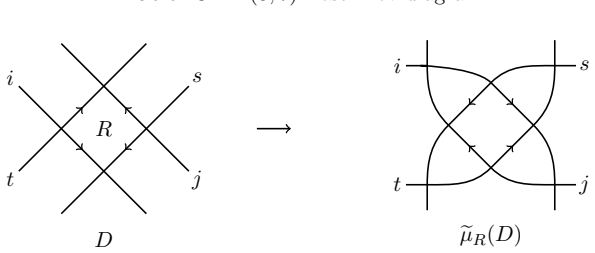
The load-bearing object is the Postnikov diagram $D$ together with its dual quiver $Q(D)$: vertices are the alternating oriented regions into which the strands cut the disk, and arrows record crossings of strands. The potential $W(D)$ is the signed sum of the fundamental cycles of $Q(D)$, one for each oriented region, taken clockwise with positive sign and anticlockwise with negative sign; the iced version adds frozen boundary arrows. The decisive mechanism is the compatibility theorem: applying the quiver-with-potential mutation at the vertex corresponding to an alternating quadrilateral cell $R$ gives, after reduction and up to right-equivalence, exactly the quiver with potential of the geometrically exchanged diagram $\mu_R(D)$. Uniqueness is then produced by the general uniqueness criterion from [17], which says a QP satisfying a finiteness condition, a Jacobian-ideal condition on long cycles, and a perturbation condition is the unique non-degenerate QP on its quiver; this criterion is checked directly on the initial diagram $D_{\mathrm{ini}}$.
What would settle it
Exhibit two reduced $(k,n)$-Postnikov diagrams for the same pair $(k,n)$ that are not connected by geometric exchanges, which would make the QP in Definition 2.5 ill-defined. Alternatively, find a quiver $Q$ in the Grassmannian mutation class and a non-degenerate potential $W'$ on $Q$ that is not right-equivalent to $W$ or $W^{\mathrm{op}}$; even a single 2-cycle appearing after an iterated mutation of $(Q,W)$ would disprove rigidity.
Extended reading notes
Core claim
The central claim is that the Grassmannian cluster algebra $\mathbb{C}[\mathrm{Gr}(k,n)]$ has a canonical quiver with potential $(Q,W)$, well-defined up to mutation and right-equivalence, and that $(Q,W)$ is rigid, Jacobi-finite, and unique: every non-degenerate potential on the same quiver $Q$ is right-equivalent to $W$, and every non-degenerate potential on the opposite quiver $Q^{\mathrm{op}}$ is right-equivalent to $W^{\mathrm{op}}$. The proof constructs $W(D)$ from a Postnikov diagram as the signed sum of fundamental cycles, proves mutation compatibility with geometric exchange, and then applies a uniqueness criterion provided in [17] to the initial diagram. The consequence the authors draw is that, within the mutation class of a Grassmannian cluster algebra, the quiver determines the potential, so the cluster automorphism group of the algebra coincides with the auto-equivalence group of its generalized cluster category.
Load-bearing premise
Everything rests on the assumption that any two reduced $(k,n)$-Postnikov diagrams are connected by geometric exchanges, so the mutation class of the quiver with potential does not depend on which diagram one starts from; the proof of the local compatibility theorem also presents one configuration in detail and asserts the remaining configurations are similar.
Editorial extensions
If this is right
- For any two reduced Postnikov diagrams representing the same $(k,n)$, the associated quivers with potentials are mutation-equivalent, so the QP of a Grassmannian cluster algebra is a well-defined invariant rather than an artifact of a diagram choice.
- The QP $(Q,W)$ is rigid and non-degenerate: no iterated mutation produces a 2-cycle, and the Jacobian algebra $P(Q,W)$ is finite-dimensional.
- If $Q'$ is a quiver in the mutation class and $Q'\cong Q$, then any QP $(Q',W')$ over $Q'$ is right-equivalent to $(Q,W)$; if $Q'\cong Q^{\mathrm{op}}$, it is right-equivalent to $(Q^{\mathrm{op}},W^{\mathrm{op}})$.
- The generalized cluster category $\mathcal{C}_{(Q,W)}$ has the same symmetry group as the cluster algebra: $\mathrm{Aut}_T(\mathcal{C}_{(Q,W)}) \cong \mathrm{Aut}(\mathcal{A}_{(Q,W)})$ for trivial coefficients.
- The authors conjecture the same quiver-determines-potential principle for all mutation classes of non-degenerate QPs, which would give the category-algebra isomorphism for every generalized cluster category; this paper establishes that case for Grassmannians.
Reading between the lines
- The same uniqueness route should work for any cluster algebra whose quivers arise from dimer models with a signed fundamental-cycle potential, including the dimer-model, unipotent-group, and double-Bruhat-cell settings the authors list, so quiver-determines-potential may hold for a broad class of Jacobian-finite QPs beyond Grassmannians.
- Because the iced QP is neither rigid nor Jacobi-finite, the frozen-vertex version cannot carry the same uniqueness theorem; a separate theory would be needed to decide whether iced quivers also determine their potentials.
- A practical test of the uniqueness theorem: take the initial quiver $Q_{\mathrm{ini}}$ for a small pair like $(k,n)=(3,7)$, enumerate non-degenerate potentials on $Q_{\mathrm{ini}}$ by computer, and check right-equivalence to $W_{\mathrm{ini}}$; the criterion predicts that every sufficiently long-cycle perturbation is absorbed by a right-equivalence.
- The category-algebra isomorphism suggests that cluster automorphism groups of Grassmannian cluster algebras can be computed by classifying auto-equivalences of the generalized cluster category, a problem where tilting theory supplies tools that are not available on the algebra side.
Signed reviews
Editorial analysis
A structured set of objections, weighed in public.
Referee Report
Summary. The paper associates to each Postnikov diagram D a quiver with potential (Q(D),W(D)) and an iced version (Q(D),F(D),W(D)), and claims that mutations of these QPs are compatible with geometric exchanges of Postnikov diagrams (Theorem 0.1/2.4). This compatibility is used to define 'a QP of C[Gr(k,n)]' up to mutation-equivalence (Definition 2.5). The authors then prove rigidity and Jacobi-finiteness of these QPs (Theorems 2.7, 2.10) and, via a criterion of Geiß-Labardini-Schröer, uniqueness of the non-degenerate (hence rigid) QP on a Grassmannian cluster algebra quiver up to right-equivalence (Theorem 2.14). From uniqueness they derive Corollary 0.3 and, in Section 3, an isomorphism between the auto-equivalence group of the generalized cluster category and the cluster automorphism group of the associated cluster algebra (Theorem 3.5).
Significance. If the main results hold, this is a substantial contribution: it gives an explicit quiver-with-potential model for Grassmannian cluster algebras, proves rigidity and uniqueness of the potential, and extends the known isomorphism between cluster automorphisms and categorical auto-equivalences to the Grassmannian case. The paper also demonstrates a useful method: reducing a two-dimensional combinatorial problem to checking a list of local configurations and then invoking a general criterion. The authors are careful to distinguish the new results from existing rigidity proofs by Buan-Iyama-Reiten-Smith and Kulkarni. However, the central uniqueness theorem rests on a verification of a stated inequality that is not actually established, and other load-bearing steps are either only sketched or depend on unstated assumptions. The manuscript is therefore not yet ready for publication in its current form.
major comments (5)
- [§2.3, proof of Theorem 2.14, Step I] The proof of condition (2) of Proposition 2.13 is not correct as written. The paper states that paths in η_α have length 4m−3 and paths in ∂_α W_ini have length 3, so short(η_α)+short(∂_α W_ini)=4m. But condition (2) of Proposition 2.13 (quoted from [17, Theorem 8.20]) requires this sum to be strictly greater than length(l)=length(ω^m)=4m. The displayed computation gives equality, not strict inequality. The same issue occurs in Step II, where the additional term p q ∂_α W_ini has degree exactly length(l). Thus the verification does not satisfy the stated hypothesis of Proposition 2.13. This is load-bearing because Theorem 2.14, and consequently Corollary 0.3 and Theorem 3.5, depend on it. The authors must either prove the strict inequality, replace the quoted criterion by the correct version from [17] (if the correct version uses a non-strict inequality), or supply an alternative argument.
- [§2.3, proof of Theorem 2.14, condition (3)] The verification of condition (3) of Proposition 2.13 is too compressed to be valid as written. The proof says condition (3) 'follows immediately' from Proposition 2.12 and from the fact that every non-fundamental cycle has length greater than 4. These observations alone do not show that an arbitrary non-degenerate potential on Q_ini is right-equivalent to W_ini plus terms of degree greater than long(W_ini). One still needs to show that the degree-4 part of any non-degenerate potential is cyclically equivalent to the signed sum of fundamental cycles that defines W_ini, including control of coefficients and signs. This is a nontrivial step and must be spelled out.
- [Definition 2.5] The definition of a QP of C[Gr(k,n)] as a QP mutation-equivalent to (Q(D),W(D)) depends on the class being independent of the choice of Postnikov diagram D. The paper does not state or prove that the graph of reduced Postnikov diagrams connected by geometric exchanges is connected for each (k,n). Since the compatibility result Theorem 2.4 is local, it cannot by itself establish well-definedness without this global connectivity assertion. The authors should either prove the connectivity or give a precise reference and explain how it follows.
- [§2.1, proof of Theorem 2.4] The proof of Theorem 2.4 explicitly treats only one of the three local configurations shown in Figure 8 and says the others 'can be proved similarly.' Because Theorem 2.4 is the basis for the definition of the QP and IQP for Grassmannian cluster algebras, the omitted cases are load-bearing. The authors should at least state the structure of the remaining computations or give a clear symmetry/rotation argument that reduces all cases to the displayed one.
- [§2.2, proof of Theorem 2.7, Step 2] Step 2 of the proof of Theorem 2.7 asserts that any fundamental cycle ω_2 can be connected to the bottom-left fundamental cycle ω_1 by repeatedly applying Lemma 2.8, but no proof is given that the dual graph of fundamental cycles sharing an arrow is connected. Since Lemma 2.8 only propagates rigidity from one fundamental cycle to another sharing an arrow, the argument requires this connectivity as an explicit premise. The authors should either prove the connectivity or cite a result that implies it.
minor comments (6)
- [Abstract] There is a typo in the abstract: 'Postnilov Diagram' should be 'Postnikov Diagram'.
- [Remark 1.1 and text after Definition 2.1] Several cross-references appear as 'Remarks ??, 2.9 and 2.11' or 'Remarks ??' with unresolved placeholders; these should be fixed.
- [Introduction, paragraph after Theorem 0.1] The name 'Buar-King-Marsh' is a typo for 'Baur-King-Marsh'.
- [§2.1, proof of Theorem 2.4] In the displayed potential after the pre-mutation, the term '−ξt' is used; it would help to define the path t explicitly at that point, since t appears both as a path and as a target map in the quiver conventions.
- [§2.2, Lemma 2.6] The construction in Step 1 says 'we repeat above construction until a is never a vertex on a cycle l′', but the termination of this process is asserted rather than proved. A short termination argument using the finiteness of the quiver and monotonicity of the relevant coordinate would improve clarity.
- [§2.3, Theorem 2.14] The phrase 'unique rigid QP' in Theorem 2.14 is stronger than what is proved unless rigidity coincides with non-degeneracy for the QPs in question; the paper notes rigid implies non-degenerate, but the converse is not established. The statement should be phrased carefully as 'unique rigid among QPs on Q up to right-equivalence' only if the proof covers it, or a reference should be given.
Circularity Check
No significant circularity: the main claims are derived from explicit combinatorial data and an external uniqueness criterion, not from self-referential definitions or fitted parameters.
full rationale
The paper's central derivation is self-contained in the relevant sense. The quiver with potential (Q(D), W(D)) is defined explicitly as a signed sum of fundamental cycles associated to a Postnikov diagram, and the compatibility of mutations with geometric exchanges is verified by direct local computations with reductions and right-equivalences. Rigidity is proved by explicit manipulation of cycles in the initial quiver, using Lemmas 2.6 and 2.8 and the mutation-invariance of rigidity. The uniqueness claim rests on Proposition 2.13, quoted from Geiß-Labardini-Schröer [17], which is an external general criterion; the paper then attempts to verify its hypotheses for the initial QP. No parameter is fitted to a subset of data and then renamed as a prediction, and no equation is shown to be equivalent to its own input by construction. The authors' own earlier works are cited only in background or application contexts and are not load-bearing for the main derivation. Two possible concerns are noted but are not circularity: Definition 2.5 depends on the unstated connectedness of the geometric exchange graph of reduced Postnikov diagrams, and the proof of Theorem 2.14 appears to verify a non-strict inequality where the quoted criterion asks for a strict one. These are correctness or well-definedness issues, not instances of a conclusion being imported through self-citation or definitional equivalence. Accordingly, the circularity score is 0.
Assumptions & free parameters
assumptions (5)
- standard math Mutation theory of quivers with potentials, including reduction and right-equivalence, as developed in [12] and [27].
- domain assumption Scott's theorem that C[Gr(k,n)] has a cluster algebra structure via Postnikov diagrams [28].
- standard math The uniqueness criterion for non-degenerate QPs, Proposition 2.13 and related results from [17].
- standard math Labardini-Fragoso's planar graph result [25, Section 10], used in Lemma 2.3 to realize sign changes by right-equivalences.
- domain assumption Reduced Postnikov diagrams for fixed (k,n) are connected by geometric exchanges, so the mutation class in Definition 2.5 is independent of the diagram.
Cite this review
Pith. "Pith review of Quivers with potentials for Grassmannian cluster algebras." pith.science (2026). https://pith.science/paper/24A2SPAW
@misc{pith2026190810103,
  author       = {Pith},
  title        = {Pith review of: Quivers with potentials for Grassmannian cluster algebras},
  year         = {2026},
  howpublished = {\url{https://pith.science/paper/24A2SPAW}},
  note         = {Machine review of arXiv:1908.10103}
}
abstract
We consider (iced) quiver with potential $(\bar{Q}(D), F(D), \bar{W}(D))$ associated to a Postnilov Diagram $D$ and prove the mutation of the quiver with potential $(\bare{Q}(D), F(D), \bar{W}(D))$ is compatible with the geometric exchange of the Postnikov diagram $D$. This ensures we may define a quiver with potential for a Grassmannian cluster algebra. We show such quiver with potential is always rigid (thus non-degenerate) and Jacobian-finite. And in fact, it is the unique non-degenerate (thus unique rigid) quiver with potential associated to the Grassmannian cluster algebra up to right-equivalence, by using a general result of Gei\ss-Labardini-Schr\"oer. As an application, we verify that the auto-equivalence group of the generalized cluster category ${\mathcal{C}}_{(Q, W)}$ is isomorphic to the cluster automorphism group of the associated Grassmannian cluster algebra ${{\mathcal{A}}_{(Q, W)}}$ with trivial coefficients.
Figures


Figures from the paper (11 more)


Reference graph
Works this paper leans on
-
[17]
C. Geiß, D. Labardini-Fragoso, J. Schr¨ oer, The representation type of Jacobian algebras, Adv. Math. 290 (2016), 364-452. 1, 4, 19, 23
work page 2016
-
[1]
Amiot, Cluster categories for algebras of global dimension 2 and quivers with potential
C. Amiot, Cluster categories for algebras of global dimension 2 and quivers with potential. Ann. Inst. Fourier (Grenoble) 59 (2009), no. 6, 2525-2590. 21, 22, 23
work page 2009
-
[2]
Amiot, On generalized cluster categories, Representations of algebras and related topics, EMS Ser
C. Amiot, On generalized cluster categories, Representations of algebras and related topics, EMS Ser. Congr.Rep., Eur. Math. Soc., Z¨ urich, 2011, pp. 1-53 22
work page 2011
- [3]
- [4]
- [5]
-
[6]
K. Baur, A. King, R. Marsh, Dimer models and cluster categories of Grassmannians, Proc. Lond. Math. Soc. (3) 113 (2016), no. 2, 213-260. 2, 10, 11, 21
work page 2016
-
[7]
A. B. Buan, O. Iyama, I. Reiten, J. Scott, Cluster structures for 2-Calabi-Yau categories and unipotent groups. Compos. Math. 145 (2009), no. 4, 1035-1079. 3, 21, 23
work page 2009
Show all 30 references
-
[8]
A. B. Buan, O. Iyama, I. Reiten, D. Smith, Mutation of cluster-tilting objects and potentials, Amer. J. Math. 133 (2011), no. 4, 835-887. 2, 3, 4, 22
2011
-
[9]
Broomhead Dimer models and Calabi-Yau algebras, Mem
N. Broomhead Dimer models and Calabi-Yau algebras, Mem. Amer. Math. Soc. 215 (2012), no. 1011, viii+86 pp. ISBN: 978-0-8218-5308-5. 3
2012
-
[10]
Chang, B
W. Chang, B. Zhu, Cluster automorphism groups of cluster algebras with coefficients, Sci. China Math. 59 (2016), no. 10, 1919-1936. 22
2016
-
[11]
Chang, B
W. Chang, B. Zhu, Cluster automorphism groups of cluster algebras of finite type, J. Algebra 447 (2016), 490-515. 22
2016
-
[12]
Derksen, J
H. Derksen, J. Weyman, A. Zelevinsky, Quivers with potentials and their representations I: Muta- tions, Selecta Math. 14 (2008), no. 1, 59-119. 2, 4, 6
2008
-
[13]
Fomin, A
S. Fomin, A. Zelevinsky, Cluster algebras. I. Foundations, Journal of the American Mathematical Society, 2002, 15(2), 497-529. 1
2002
-
[14]
Fomin, A
S. Fomin, A. Zelevinsky, Cluster algebras. II. Finite type classification, Invent. Math. 154(1), 63-121,
-
[15]
Fomin, A
S. Fomin, A. Zelevinsky, Cluster algebras IV: Coefficients, Compositio Mathematica, 2007, 143:112-
2007
-
[16]
C. Fu, B. Keller, On cluster algebras with coefficients and 2-Calabi-Yau categories, Trans. Amer. Math. Soc. 362 (2010), no. 2, 859-895. 21
2010
-
[18]
C. Geiß, B. Leclerc, J. Schr¨ oer, Partial flag varieties and preprojective algebras, Ann. Inst. Fourier 58 (2008) 825-876. 10, 21
2008
-
[19]
Hanany, Y
A. Hanany, Y. He, V. Jejjala, J. Pasukonis, S. Ramgoolam, D. Rodriguez-Gomez, Invariants of toric Seiberg duality, Internat. J. Modern Phys. A 27 (2012), no. 1, 1250002, 38 pp. 2
2012
-
[20]
Jensen, A
B. Jensen, A. King, X. Su, A categorification of Grassmannian Cluster Algebras, Proc. Lond. Math. Soc. (3) 113 (2016), no. 2, 185-212 10, 21
2016
-
[21]
Kulkarni, Dimer models on cylinders over Dynkin diagrams and cluster algebras, Proc
M. Kulkarni, Dimer models on cylinders over Dynkin diagrams and cluster algebras, Proc. Amer. Math. Soc. 147 (2019), no. 3, 921-932. 3
2019
-
[22]
Keller, I
B. Keller, I. Reiten, Acyclic Calabi-Yau categories. With an appendix by Michel Van den Bergh. Compos. Math. 144 (2008), no. 5, 1332-1348. 22
2008
-
[23]
Keller, D
B. Keller, D. Yang, Derived equivalences from mutations of quivers with potential. Adv. Math. 226 (2011), no. 3, 2118-2168. 23
2011
-
[24]
Labardini-Fragoso Quivers with potentials associated to triangulated surfaces, Proc
D. Labardini-Fragoso Quivers with potentials associated to triangulated surfaces, Proc. Lond. Math. Soc. (3) 98 (2009), no. 3, 797-839. 3
2009
-
[25]
Labardini-Fragoso Quivers with potentials associated to triangulated surfaces, part IV: Removing boundary assumptions, Selecta Math
D. Labardini-Fragoso Quivers with potentials associated to triangulated surfaces, part IV: Removing boundary assumptions, Selecta Math. (N.S.) 22 (2016), no. 1, 145-189. 3, 11
2016
-
[26]
Postnikov, Total positivity, Grassmannians, and networks, arXiv:math/0609764v1
A. Postnikov, Total positivity, Grassmannians, and networks, arXiv:math/0609764v1. 7
-
[27]
Pressland, Mutation of frozen Jacobian algebras, J
M. Pressland, Mutation of frozen Jacobian algebras, J. Algebra 546 (2020), 236-273. 2, 4, 6, 11, 18
2020
-
[28]
Scott, Grassmannians and cluster algebras, Proc
J. Scott, Grassmannians and cluster algebras, Proc. London Math. Soc. (3) 92 (2006), no. 2, 345-380. 2, 7, 9, 14, 23
2006
-
[29]
Yang, The interplay between 2-and-3-Calabi–Yau triangulated categories, arXiv:1811.07553
D. Yang, The interplay between 2-and-3-Calabi–Yau triangulated categories, arXiv:1811.07553. 22
-
[30]
Vit´ oria, Mutations vs
J. Vit´ oria, Mutations vs. Seiberg duality, J. Algebra 321 (2009), no. 3, 816-828. 2 School of Mathematics and Statistics, Shaanxi Normal University, Xi’an 710062, China. Email address : changwen161@163.com School of Mathematics and Statistics, Beijing institute of technology...
2009
Reviewed August 14, 2026 · model on record in the stance chip above.
Discussion (0). Continue with ORCID to comment.