REVIEW 3 major objections 4 minor 14 references
Visualizing the Support of Kostant's Weight Multiplicity Formula for the Rank Two Lie Algebras
T0 review · 3 major / 4 minor · reviewed 2026-08-14 · deepseek-v4-flash
Pith's one-line read The paper completely determines the Weyl alternation sets $A(\lambda,\mu)$ for the four rank-two Lie algebras $\mathfrak{so}_5(\mathbb{C})$, $\mathfrak{sp}_4(\mathbb{C})$, $\mathfrak{so}_4(\mathbb{C})$, and $\mathfrak{g}_2$: each Weyl…
desk verdict Theorem 3.1 is false as stated: the {1,s1} case omits the shared condition J2, and a concrete counterexample shows the paper's central case lists cannot be trusted without recomputation. read the letter →
The pith
A machine-rendered reading of the paper's core claim, the machinery that carries it, and where it could break.
The reading
What carries the argument
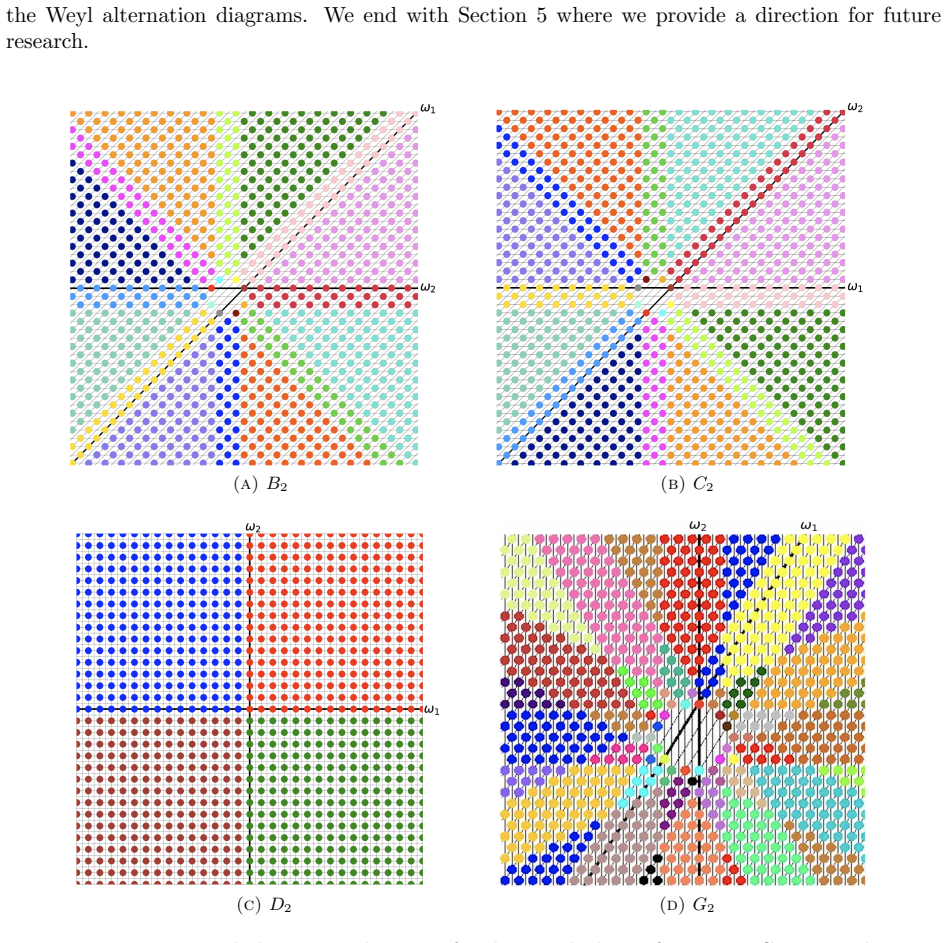
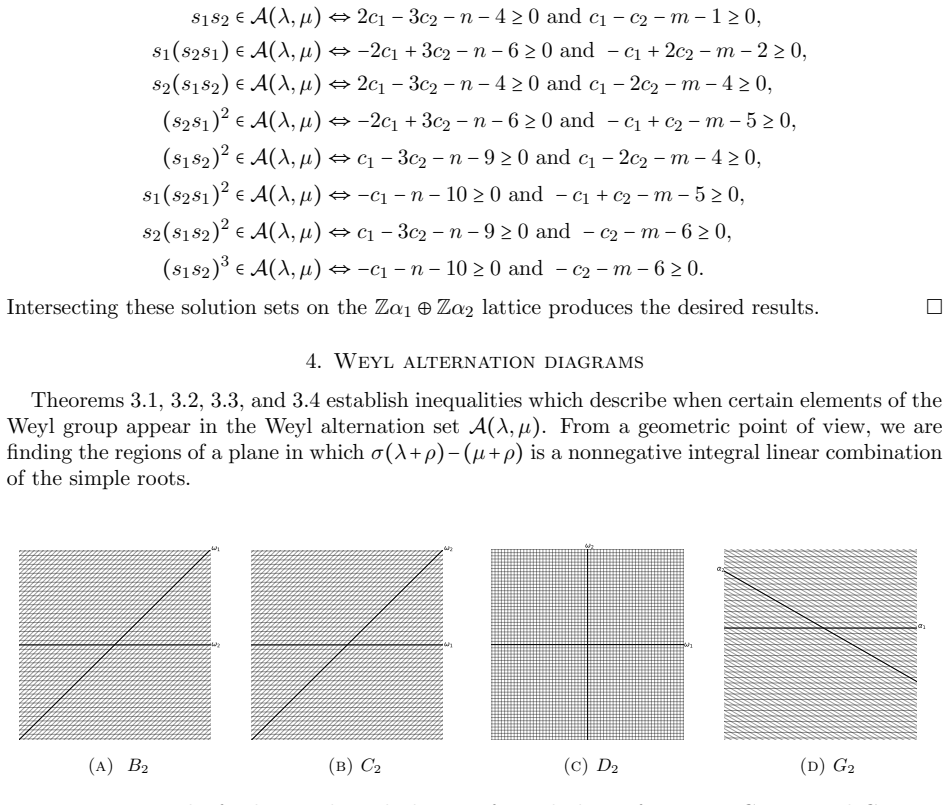
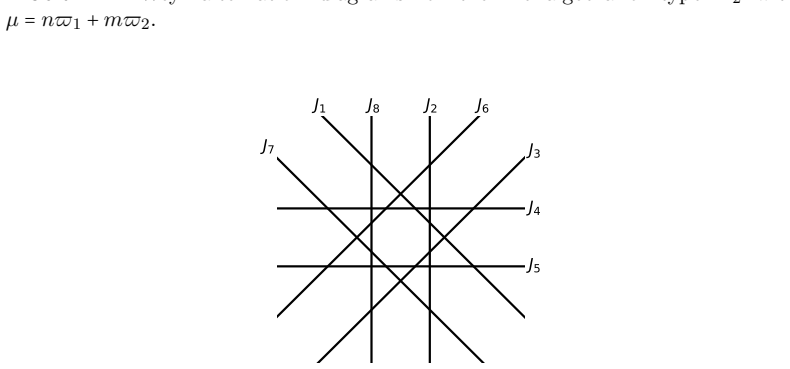
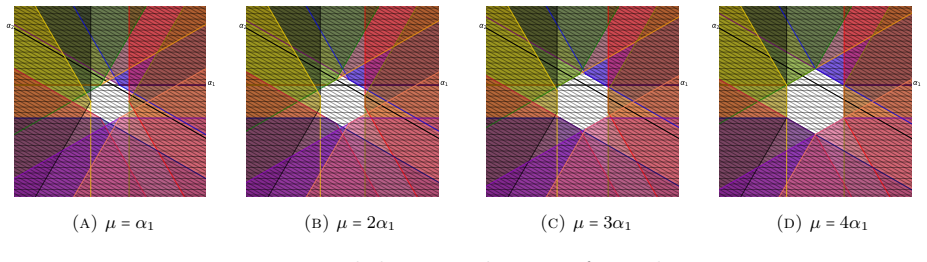
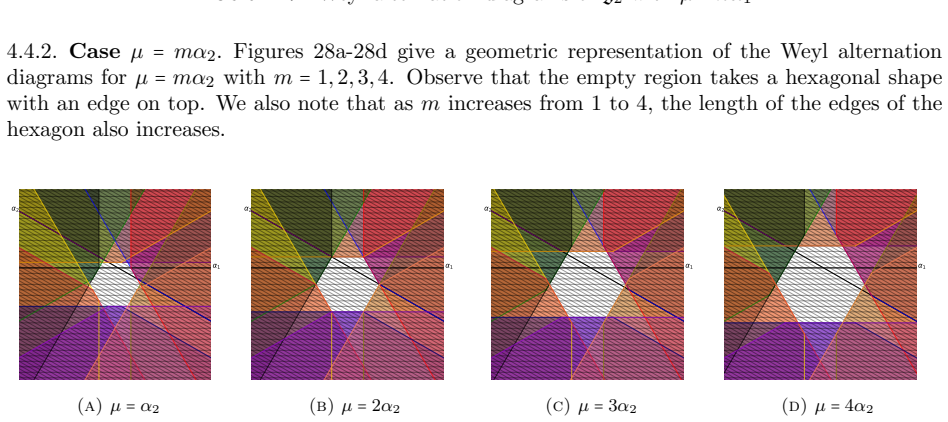
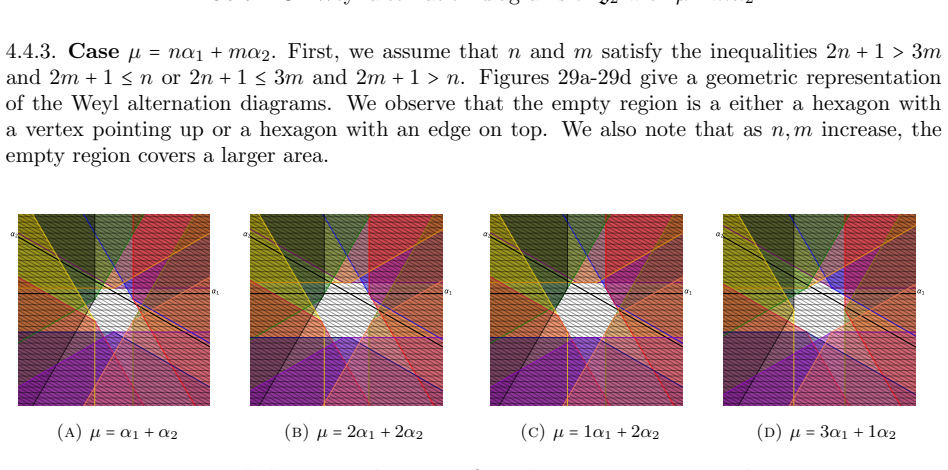
The load-bearing object is the Weyl alternation set $A(\lambda,\mu) = \{\sigma \in W : \wp(\sigma(\lambda+\rho)-(\mu+\rho)) > 0\}$, where $\wp$ is Kostant's partition function, counting the number of ways a weight can be written as a nonnegative integral combination of positive roots. The mechanism that carries the argument is rewriting $\sigma(\lambda+\rho)-(\mu+\rho)$ in the simple-root basis $\alpha_1, \alpha_2$ for each Weyl group element, so that membership reduces to a pair of linear inequalities in the coordinates $c_1, c_2$ of $\lambda$ and $n, m$ of $\mu$; divisibility lemmas restrict the relevant lattice, and intersecting the resulting half-plane solutions yields the finite case lists. Plotting the boundary lines of these inequalities on the fundamental weight lattice produces the Weyl alternation diagrams whose empty regions the paper classifies geometrically.
What would settle it
Take $\mathfrak{so}_5(\mathbb{C})$, choose an integral $\lambda$ with $c_2$ even and a dominant integral $\mu$ with $m$ even, compute the two coefficients of $\sigma(\lambda+\rho)-(\mu+\rho)$ for all eight Weyl group elements, and compare the resulting set of contributing $\sigma$ with the subset predicted by Theorem 3.1; any pair whose true alternation set is not among the twenty-five listed cases, or appears in two of them, would refute the claimed completeness, and a random sweep over a large box of such pairs would settle the issue.
Extended reading notes
Core claim
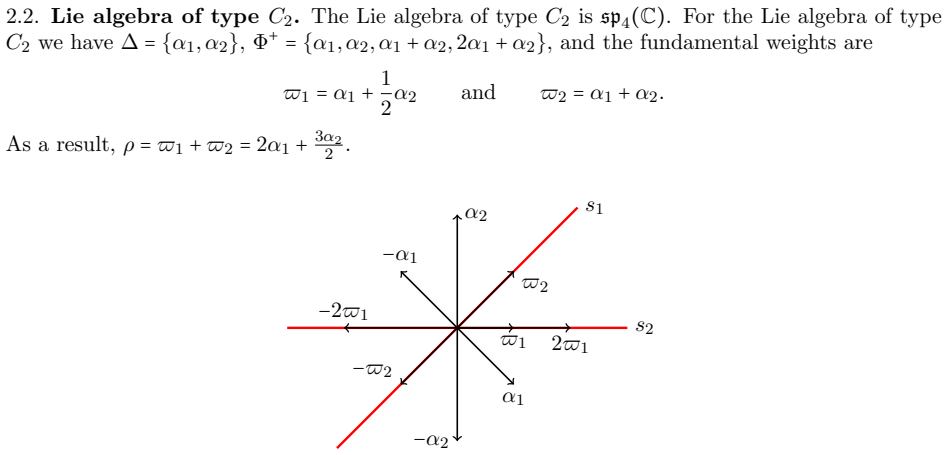
For each of the Lie algebras $\mathfrak{so}_5(\mathbb{C})$ (type $B_2$), $\mathfrak{sp}_4(\mathbb{C})$ (type $C_2$), $\mathfrak{so}_4(\mathbb{C})$ (type $D_2$), and $\mathfrak{g}_2$ (type $G_2$), the paper establishes a complete, explicit description of the Weyl alternation set $A(\lambda,\mu)$. For every Weyl group element $\sigma$ it computes $\sigma(\lambda+\rho)-(\mu+\rho)$ in the simple-root basis, obtaining a pair of affine linear forms in the coordinates of $\lambda$ and $\mu$; $\sigma$ lies in $A(\lambda,\mu)$ exactly when both coordinates are nonnegative, which is the condition that Kostant's partition function counts at least one expression for that weight difference. Intersecting these membership conditions on the relevant lattice—with parity conditions on $c_2$ for $B_2$, on $c_1$ for $C_2$, on both for $D_2$, and none for $G_2$—produces the case lists of Theorems 3.1, 3.2, 3.3, and 3.4, each stating that $A(\lambda,\mu)$ is one of a finite collection of subsets of the Weyl group, the empty set included. The accompanying diagrams shade these regions on the fundamental weight lattice, giving a complete visual census of the support of Kostant's partition function in these four algebras.
Load-bearing premise
The classification rests on an enumeration step that is asserted but not shown in detail: that intersecting the individual membership conditions over all Weyl group elements produces exactly the listed alternation sets, with every valid combination of inequalities accounted for exactly once; if that enumeration is incomplete or overlapping, the complete descriptions of $A(\lambda,\mu)$ would be wrong even though the per-element conditions are correct.
Editorial extensions
If this is right
- Weight-multiplicity computations for $\mathfrak{so}_5(\mathbb{C})$, $\mathfrak{sp}_4(\mathbb{C})$, $\mathfrak{so}_4(\mathbb{C})$, and $\mathfrak{g}_2$ can skip every Weyl group element excluded by the relevant linear inequalities, leaving only the terms that actually contribute to Kostant's formula.
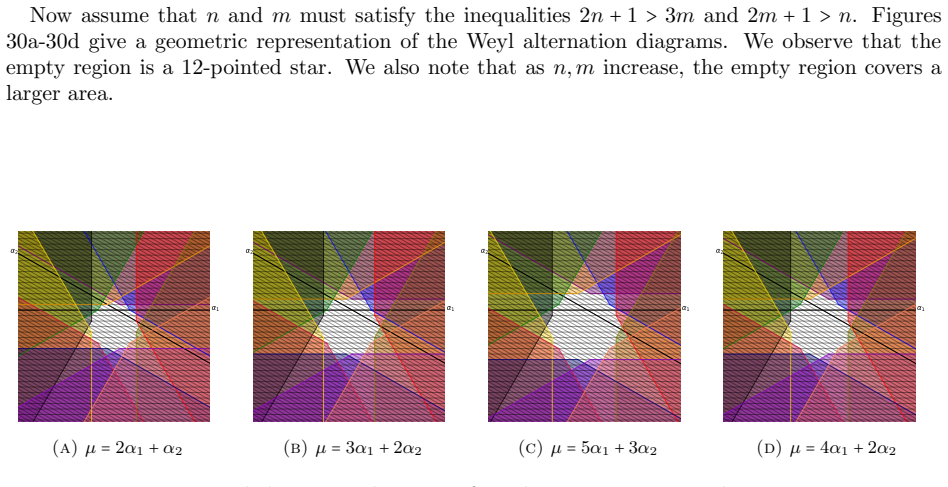
- The Weyl alternation diagrams give an at-a-glance census of which weight regions have an empty alternation set, with empty regions shaped like squares, stars, hexagons, or crosses whose size grows as $\mu$ grows.
- The theorems extend the earlier $\mathfrak{sl}_3(\mathbb{C})$ lattice-pattern description to all four rank-two Lie algebras, covering arbitrary dominant $\mu$ rather than only the previously treated $\mu=0$ case.
- The case lists provide the base pattern for the rank-three question posed in the paper, such as the Weyl alternation diagrams for $\mathfrak{sl}_4(\mathbb{C})$, where the same inequality-intersection method could be applied.
Reading between the lines
- If the enumeration is complete, then the empty regions in the diagrams are precisely the sets of weights $\lambda$ where all per-element inequality pairs conflict on the admissible lattice, and their square, star, and hexagon shapes are explained by which pairs of boundary lines intersect first—a structure the paper observes but does not fully formalize.
- A natural testable extension is to implement the case lists and audit them computationally by brute-force evaluation of Kostant's partition function on random lattice points, which would settle the exhaustiveness question directly in rank two.
- The same coordinate-expansion scheme should transfer to other rank-two root-system data, with the number of cases growing with the Weyl group order, and the rank-three question the paper poses for $\mathfrak{sl}_4(\mathbb{C})$ would reveal whether the method scales beyond dihedral Weyl groups.
Signed reviews
Editorial analysis
A structured set of objections, weighed in public.
Referee Report
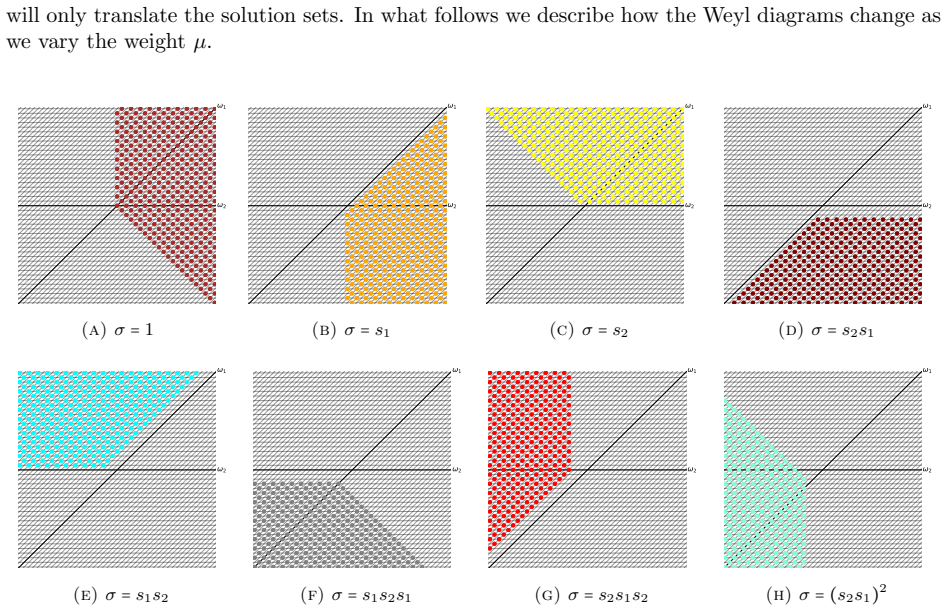
Summary. The paper aims to give complete case-by-case descriptions of the Weyl alternation set A(λ,μ) for the rank two Lie algebras so4(C), so5(C), sp4(C), and g2, for every integral λ and dominant integral μ. Theorems 3.1–3.4 list subsets of the Weyl group according to which of a set of linear inequalities in the coordinates of λ and μ hold, with the proofs computing for each Weyl group element the two inequalities equivalent to membership in A(λ,μ) and then asserting that intersecting these solution sets yields the tables. Section 4 uses these lists to draw Weyl alternation diagrams for various μ and claims precise shapes (square, hexagon, star, strip, cross) for the empty region. The paper is not correct as written: the row {1,s1} in Theorem 3.1 omits the inequality J2 that the proof itself shows is necessary for both 1 and s1 to lie in A(λ,μ), and an explicit counterexample satisfies all stated row conditions while A(λ,μ)=∅.
Significance. If correct, the paper would reduce the computation of the support of Kostant's partition function to checking linear inequalities for the four rank two algebras, and it would provide a visual census of the empty and nonempty regions extending earlier work on sl3(C). The paper has real strengths: the individual membership computations for each Weyl group element are explicit and checkable, the parity conditions for the root lattice are organized cleanly, and the geometric presentation of the inequalities is useful. However, the central claim, namely the correctness and completeness of the case lists in Theorems 3.1–3.4, is false. Since the Weyl alternation diagrams in Section 4 are colored according to exactly those case lists, the main contribution cannot be accepted as stated.
major comments (3)
- [§3.1, Theorem 3.1] The row {1,s1} lists the conditions J1, J3, ¬J4, and ¬J5, but omits J2, which the proof itself shows is necessary for both 1 and s1 to belong to A(λ,μ). For λ=6ϖ2 and μ=ϖ1+6ϖ2, i.e., (c1,c2)=(0,6) and (n,m)=(1,6), the parity assumptions are satisfied and the stated row conditions hold: J1=2≥0, J3=1≥0, J4=−8<0, and J5=−10<0. However, J2=c1+c2−n−m=−1<0, so neither 1 nor s1 satisfies the membership inequalities derived in the proof. In fact, all eight coefficient pairs are negative in this example, so A(λ,μ)=∅, not {1,s1}. This is a direct numerical counterexample to Theorem 3.1 and therefore to the paper's central claim.
- [§3.1–§3.4, proofs of Theorems 3.1–3.4] The error is not an isolated typo but a systematic failure of the asserted intersection step. In Theorem 3.1, row {1,s2} lists J2,J4,¬J3,¬J6 but omits J1, which is necessary for both 1 and s2; row {s1,s2s1} lists J2,J5,¬J1,¬J7 but omits J3, which is necessary for both s1 and s2s1; and row {1,s1,s2s1} lists J3,J4,¬J5,¬J6 even though the proof shows s2s1∈A(λ,μ) only if J5 holds, so the stated conditions actually force s2s1 to be absent. Each proof in Theorems 3.1–3.4 closes with the sentence 'intersecting these solution sets produces the desired results' without performing the intersection analysis, and the counterexample above shows the omitted analysis is not merely unproven but incorrect. Since the diagrams in Section 4 are colored from these same case lists, the diagrams inherit the error.
- [§4, especially §4.1.3 and Figures 13a–13c] The 'if and only if' statements describing when the empty region is a square with an edge on top, a square with a vertex up, or an 8-pointed star are asserted from the diagrams rather than derived from the inequalities and the lattice parity conditions. This is a secondary gap in the exposition, but it matters because the diagrams are constructed from the incorrect case lists; after Theorem 3.1 is corrected, the shape classifications must be re-examined. The claim that changing μ only translates the solution sets also requires care because the parity of n and m changes which sublattice is plotted.
minor comments (4)
- [§3.3, proof of Theorem 3.3] The displayed equivalence for 1∈A(λ,μ) contains 'c1−m/2 ≥0' where the second inequality should be 'c2−m/2 ≥0', and the same substitution is needed in the displayed equivalence for s1∈A(λ,μ).
- [§4.1–§4.2] The text in Section 4.1 says 'we plot the conditions in Table 1' and Section 4.2 says 'Table 2'; these should refer to the condition tables (Table 5 and Table 6, respectively) rather than the Weyl group action tables.
- [§3.3] The statement of Theorem 3.3 fixes n,m∈2N, but the proof begins with 'n,m∈N'; the parity assumptions should be stated consistently throughout.
- [§3.4] Theorem 3.4 is typeset as a long sequence of separate display equations, which makes it difficult to verify exhaustiveness and disjointness; a single aligned case environment would improve readability.
Circularity Check
No significant circularity: the Weyl alternation set computations are direct expansions of the defining partition-function positivity condition, with no fitted parameters, no prediction-from-fit, and no load-bearing self-citation.
full rationale
The paper's central claims are the case lists in Theorems 3.1-3.4, which describe A(lambda, mu) for the rank-two algebras. The derivation chain is fully self-contained: the proofs expand sigma(lambda+rho)-(mu+rho) in the simple-root basis for each Weyl group element, then invoke Definition 2.1, which defines A(lambda, mu) as the set of sigma with both coefficients nonnegative. The displayed formulas in each proof, e.g. in Theorem 3.1, directly give the equivalence between membership and the inequalities J1-J8. The closing sentence 'intersecting these solution sets ... produces the desired results' is a computational step on the already-derived inequalities, not an appeal to an external or imported conclusion. There are no fitted parameters, no subset of data used to predict a closely related quantity, and no uniqueness theorem imported from prior work to force a choice. The citations to [4] and [8] are used only for definitions, diagrams, and background on Weyl alternation diagrams, not as evidence for the membership computations. Any issue with the claimed case lists would be a mathematical correctness problem, not a circularity problem; indeed the reviewer's own counterexample concerns the truth of the intersection, not the derivation depending on its conclusion. The paper is therefore self-contained against external definitions and merits a circularity score of 0.
Assumptions & free parameters
assumptions (4)
- standard math Kostant's weight multiplicity formula, equation (1.1), gives multiplicities as an alternating sum over the Weyl group involving Kostant's partition function.
- standard math The root system and Weyl group action data for B2, C2, D2, and G2 are as listed in Section 2 and Tables 1 through 4.
- domain assumption For rank two, positivity of Kostant's partition function is equivalent to the argument having nonnegative integer coefficients in the simple-root basis.
- domain assumption Type D2, so4(C), is treated in the same framework even though the introduction calls the Lie algebras simple and so4(C) is semisimple rather than simple.
Cite this review
Pith. "Pith review of Visualizing the Support of Kostant's Weight Multiplicity Formula for the Rank Two Lie Algebras." pith.science (2026). https://pith.science/paper/24LTWSWO
@misc{pith2026190808405,
  author       = {Pith},
  title        = {Pith review of: Visualizing the Support of Kostant's Weight Multiplicity Formula for the Rank Two Lie Algebras},
  year         = {2026},
  howpublished = {\url{https://pith.science/paper/24LTWSWO}},
  note         = {Machine review of arXiv:1908.08405}
}
read the original abstract
The multiplicity of a weight in a finite-dimensional irreducible representation of a simple Lie algebra g can be computed via Kostant's weight multiplicity formula. This formula consists of an alternating sum over the Weyl group (a finite group) and involves a partition function known as Kostant's partition function. Motivated by the observation that, in practice, most terms in the sum are zero, our main results describe the elements of the Weyl alternation sets. The Weyl alternation sets are subsets of the Weyl group which contributes nontrivially to the multiplicity of a weight in a highest weight representation of the Lie algebras so_4(C), so_5(C), sp_4(C), and the exceptional Lie algebra g_2. By taking a geometric approach, we extend the work of Harris, Lescinsky, and Mabie on sl_3(C), to provide visualizations of these Weyl alternation sets for all pairs of integral weights \lambda and \mu of the Lie algebras considered.
Figures


Figures from the paper (29 more)








Reference graph
Works this paper leans on
-
[1]
A. Bjorner and F. Brenti (2005). Combinatorics of Coxeter groups. Springer-Verlag
work page 2005
-
[2]
R. Goodman, and N. R. Wallach, Symmetry, Representations and Invariants, Springer, New York, 2009
work page 2009
-
[3]
P. E. Harris, Combinatorial problems related to Kostant's weight multiplicity formula. Ph.D. Dissertation, University of Wisconsin Milwaukee (2012)
work page 2012
-
[4]
P. E. Harris. Computing weight multiplicities. To appear in book Foundations for Undergraduate Research in Mathematics, Springer
-
[5]
P. E. Harris. On the adjoint representation of sl _n and the Fibonacci numbers . C. R. Math. Acad. Sci. Paris 349 (2011) pp. 935-937
work page 2011
-
[6]
P. E. Harris, E. Insko, L. K. Williams. The adjoint representation of a classical Lie algebra and the support of Kostant's weight multiplicity formula. Journal of Combinatorics Volume 7 (2016) Number 1 pp. 75-116
work page 2016
-
[7]
Kostant, A formula for the multiplicity of a weight, Proc
B. Kostant, A formula for the multiplicity of a weight, Proc. Natl. Acad. Sci, USA 44 (1958), 588-589
work page 1958
-
[8]
V. S. Varadarajan, Lie Groups, Lie Algebras, and Their Representations, Springer (1984),
work page 1984
Show all 14 references
-
[9]
Chang, P
K. Chang, P. E. Harris, and E. Insko. Kostant’s Weight Multiplicity Formula and the Fibonacci and Lucas Numbers. To appear in Journal of Combinatorics
-
[10]
Goodman, and N
R. Goodman, and N. R. Wallach. Symmetry, Representations and Invariants, Springer, New York, 2009
2009
-
[11]
P. E. Harris. Computing weight multiplicities. In: Wootton A., Peterson V., Lee C. (eds) A Primer for Undergraduate Research. Foundations for Undergraduate Research in Mathematics. Birkhauser, Cham (2017) 193-222
2017
-
[12]
P. E. Harris, H. Lescinsky, and G. Mabie. Lattice patterns for the support of Kostant's weight multiplicity formula on sl _3( ) . Minnesota Journal of Undergraduate Mathematics, [S.l.], v. 4, n. 1, June 2018
2018
-
[13]
P. E. Harris, M. Rahmoeller, L. Schneider, and A. Simpson. When is the q -multiplicity of a weight equal to a power of q ? https://arxiv.org/pdf/1905.10319.pdf . Preprint
1905 arXiv
-
[14]
V. S. Varadarajan, Lie Groups, Lie Algebras, and Their Representations, Springer (1984)
1984
Reviewed August 14, 2026 · model on record in the stance chip above.
Discussion (0). Continue with ORCID to comment.