REVIEW 2 major objections 5 minor 24 references
Optimization-based Posture Generation for Whole-body Contact Motion by Contact Point Search on the Body Surface
T0 review · 2 major / 5 minor · reviewed 2026-08-07 · deepseek-v4-flash
Pith's one-line read This paper claims that whole-body contact postures can be generated by one gradient-based optimization that simultaneously solves for joint angles and contact points on the robot's body surface.
desk verdict A practical contact-point parameterization for whole-body posture optimization, with real-robot demos; the edge-crossing gradient is approximate but the empirical support is decent. read the letter →
The pith
A machine-rendered reading of the paper's core claim, the machinery that carries it, and where it could break.
The reading
What carries the argument
The load-bearing object is the local contact configuration $u=(u_1,u_2)$ with the map of eqs. (19)--(22): move on the tangent plane spanned by $\zeta,\eta$, then project onto the body's convex surface. Its Jacobian supplies the gradient of the position part of the contact task, and the smoothed normal $\hat{\xi}(p)$ of eq. (26), a normalized weighted average of the face normal and adjacent-face normals with the smooth weight of eq. (28), supplies a differentiable normal direction. Together they let a standard SQP solver search over the body surface without converting the mesh to a smooth analytic shape.
What would settle it
Run the single-body contact-point search of Fig. 7 on a box or tetrahedron from many random starting points with the target on the far side of an edge and count how often the optimization crosses the edge. If the smoothed normal does not consistently cross more often than the raw normal, or if convergence fails once the set of adjacent faces changes discretely, the central claim is falsified.
Extended reading notes
Core claim
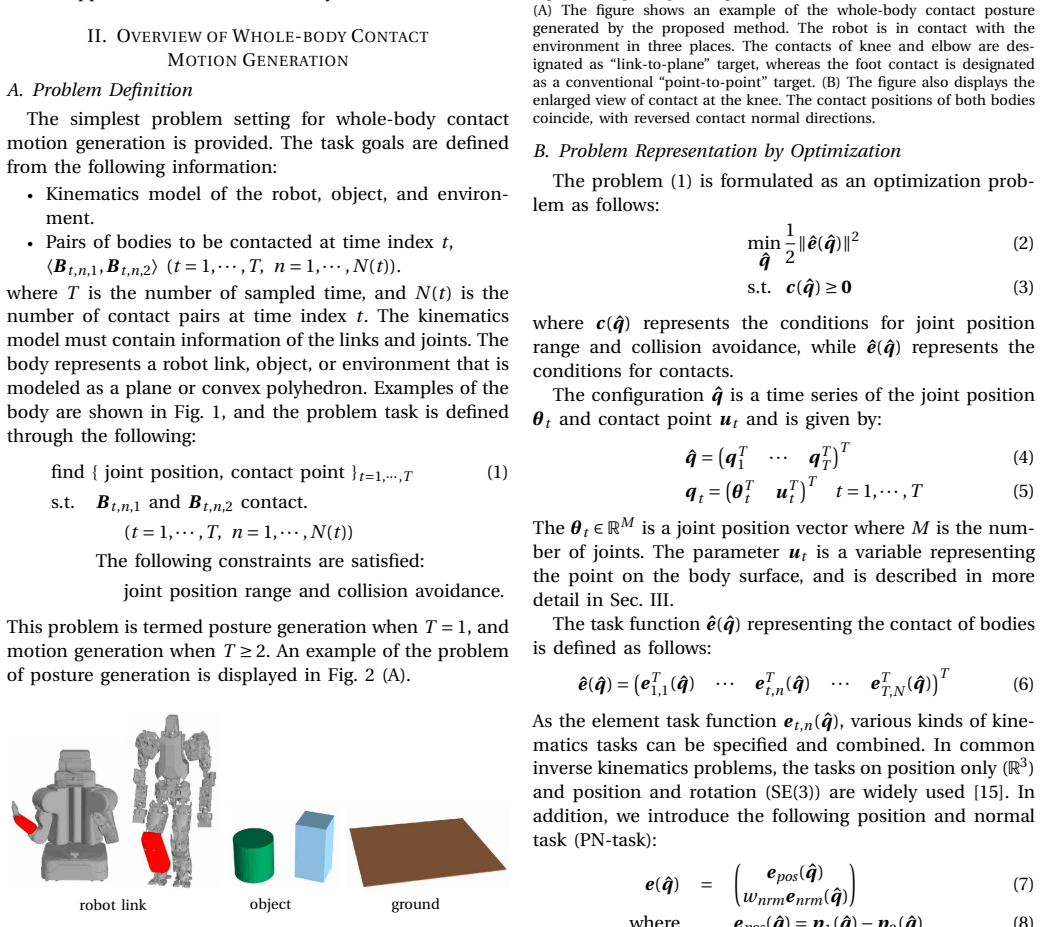
At the center of the paper is the PN-task, a contact task whose error is zero exactly when the two contact positions coincide and their surface normals point in opposite directions. The configuration variable $\hat{q}$ stacks joint positions $\theta$ and contact configurations $u$, and the nonlinear program minimizes $\frac{1}{2}\|\hat{e}(\hat{q})\|^2$ subject to joint limits and collision constraints. Each contact configuration $u\in\mathbb{R}^2$ is local: in every SQP iteration the optimizer moves a point on the tangent plane and projects it onto the convex mesh, so the contact point itself is re-anchored each iteration rather than carried as a global coordinate. The smoothed normal of eq. (26) makes the normal and tangent directions differentiable across mesh edges, and the position Jacobian is simply the tangent axes while the normal Jacobian is evaluated by finite differences. The paper demonstrates that this formulation solves single-body contact-point searches, inverse kinematics with a shaped tip body, and whole-body motions executed on real robots.
Load-bearing premise
The load-bearing premise is that the smoothed normal of eq. (26), with derivatives approximated by finite differences, gives the SQP optimizer accurate enough gradient information to keep stepping across mesh edges instead of stalling at a face boundary.
Editorial extensions
If this is right
- Contact points no longer need to be fixed or hand-picked; the optimizer places them automatically on any link, object, or environment surface modeled as a plane or convex polyhedron.
- The same gradient machinery extends inverse kinematics to body-to-body contact tasks, so conventional point-to-point IK becomes a special case.
- Because the contact configuration is re-anchored each iteration, the contact point can travel across a link during a multi-posture sequence, enabling motions such as the knee-push in which the knee contact slides on the link.
- With the contact-wrench formulation, the method extends to statics-aware whole-body tasks, so balance and pushing forces can be considered while the knee contact point is optimized.
- The per-iteration cost is a few milliseconds in a scripting-language implementation, so a compiled implementation is expected to be fast enough for practical motion generation.
Reading between the lines
- A natural extension would be to embed this local contact-parameterization inside a trajectory optimizer, treating each contact as an implicit surface parameter that can be re-anchored as the robot moves.
- The smoothed-normal gradient is a generic geometric primitive, so it could be reused for collision-distance gradients or for online tactile-feedback controllers beyond posture generation.
- One testable extension is to replace the finite-difference normal Jacobian with an analytic derivative of eq. (26) and measure whether convergence across face boundaries improves or degrades when the set of adjacent faces changes discretely.
Editorial analysis
A structured set of objections, weighed in public.
Referee Report
Summary. The paper proposes an optimization-based method for generating robot postures and motions that use whole-body contact. Contact points on the robot's body surface are represented by local two-dimensional configuration variables, and a sequential quadratic programming (SQP) formulation is used to simultaneously optimize joint positions and contact points. To apply gradient-based optimization to convex polyhedral meshes, the paper introduces a smoothed normal direction computed from a weighted average of adjacent face normals, with derivatives obtained by finite differences. The method is evaluated in numerical experiments on contact-point searching and inverse kinematics with surface contact, and in three real-robot whole-body contact tasks: dual-arm object holding with a PR2, knee pushing with an HRP-2, and non-prehensile board tilting with an RHP4B.
Significance. If the central claims are correct, this is a practically valuable extension of inverse kinematics to whole-body contact: it avoids explicit mesh conversion or sampling-based contact search, works directly on the raw convex mesh, and is demonstrated on physical robots in three substantially different contact tasks. The paper's strength is that the core optimization formulation is self-contained, the normal-smoothing idea is simple and plausible, and the experiments show real-world feasibility. I also credit the paper for being explicit that the global contact configuration is not carried across SQP iterations, which is an important detail for reproducibility. However, the load-bearing gradient approximation at mesh edges is only weakly validated, and the paper does not provide enough evidence that the finite-difference Jacobian is reliable when contact points cross face boundaries, which is precisely the feature that distinguishes the method from fixed-contact IK.
major comments (2)
- [Sec. III.B, Eq. (24)] Equation (24) states that ∂p1/∂u = [ζ η], but p^{[k+1]}(u) is defined in Eq. (22) as a projection onto the body surface. This derivative is exact only when the tangent-plane step stays within the interior of the same face; when the optimal step crosses a face boundary, the closest-point projection clamps or slides along an edge, so the true derivative differs from [ζ η] and the QP linearization in Eq. (11) may over- or under-estimate the effect of the contact configuration update. The paper does not bound this error, nor does it report how often edge-crossing steps occur or compare the finite-difference Jacobian against a high-resolution or analytic reference. Since the method's claimed advantage is precisely the ability to move contact points across mesh edges, this approximation needs either a derivation of a correction/error bound or a systematic numerical study (e.g., repeated trials with varied initial conditions, counts of edge-crossing steps, and convergence rates) to be considered load-bearing evidence.
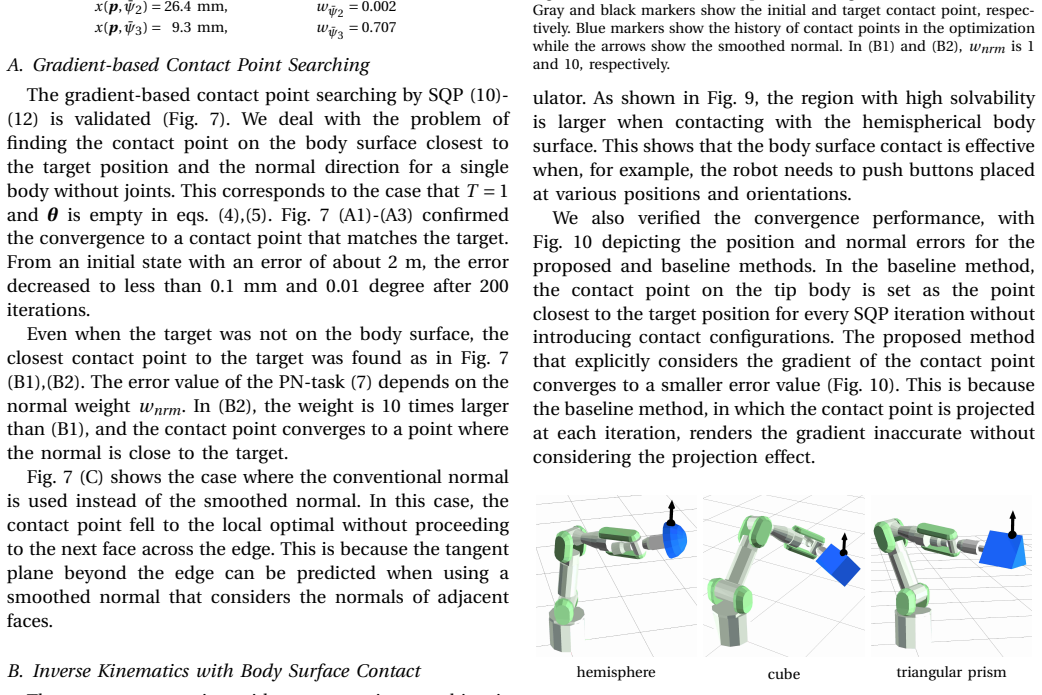
- [Sec. III.C, Eq. (25)-(28)] The smoothed normal of Eq. (26) is defined by a weighted sum over the set of adjacent faces Ψ(ψ), and the text acknowledges in Sec. III.C that this face set changes discretely. Nevertheless, the paper claims the smoothed normal is differentiable and computes its derivative by finite differences in Eq. (25) without analyzing the effect of the discrete face-set change. The finite-difference step ε and the smoothing range R are free parameters, and their influence on convergence is not investigated. The evidence provided—Fig. 7(C) showing failure without smoothing and Figs. 7(A)-(B), 11-15 showing success with smoothing—is limited to a small number of qualitative trajectories; no convergence statistics, sensitivity analyses, or failure counts are reported. I request either a continuity/differentiability analysis that covers the face-set boundary or a more extensive experimental study (varying R, ε, ulim, and initial contact points) to support the claim that the finite-difference Jacobian is adequate across edges.
minor comments (5)
- [Sec. III.C, Eq. (27)] The distance x(p, ψ̄) is described only as "the distance on the body surface from point p to the adjacent face"; please specify whether this is Euclidean distance to the face, shortest path along the surface, or another geodesic-like measure, since the formula and its implementation affect reproducibility.
- [Sec. IV.A] The text states that with a target not on the body surface, the closest contact point is found, but no error metric or quantitative result is reported for that case; please add a numerical value or a convergence plot.
- [Table I] The percentage breakdown in Table I is confusing: "calculate matrices in QP (11)" is listed as 82% and 87% of total time, while its subrows (∂e/∂θ, ∂e/∂u, c(q), solve QP) sum to only about 87-99% of the total; please clarify the hierarchy of the timing categories so the percentages sum consistently.
- [Sec. V.A] The assertion that a 3 kg object is difficult to grasp with just the gripper tips due to insufficient friction is not supported by a quantitative friction or force-closure analysis; a brief justification or citation would help.
- [General] There are minor typographical issues, including "Mechano-Infomatics" in the author affiliation and inconsistent spacing in equations; a careful proofread is recommended.
Circularity Check
Central contact-point-search derivation is self-contained; self-citations are not load-bearing.
full rationale
The paper's central claim is that a gradient-based optimization can simultaneously search joint positions and contact points parameterized by local two-dimensional coordinates on a convex mesh. The derivation chain is self-contained: Eqs. (19)-(22) define the local tangent-plane motion and closest-point projection, Eqs. (23)-(25) build the PN-task Jacobian from that same map, and Eq. (26) defines the smoothed normal used for differentiability. The numerical validation in Sec. IV-A compares the optimizer against externally specified target points and normals, not against quantities derived from the method's own parameters, so no fitted input is being renamed as a prediction. The weights w_nrm and smoothing range R are user-chosen constants, not data-fit parameters. The only self-citations, [1] and [21], appear in the related-work discussion and in the extension to an inverse-kinematics-and-statics framework for the knee-pushing application; neither supplies or justifies the paper's distinguishing contribution (contact point search on the body surface by gradient-based optimization), and neither is invoked as a uniqueness theorem or as an external constraint that forces the formulation. The approximation in Eq. (24) and the finite-difference Jacobian in Eq. (25) are numerical accuracy concerns, not circularities, because they are not equivalent to the paper's conclusions by construction. Overall, no significant circularity is present.
Assumptions & free parameters
free parameters (3)
- smoothing range R =
400 mm (Fig. 4), 30 mm (Fig. 6)
- normal weight wnrm =
1 and 10 (Fig. 7 B1, B2)
- contact configuration limit ulim =
10-20 mm for life-sized robots
assumptions (3)
- domain assumption Robot links, objects, and environments are modeled as convex polyhedra or primitive shapes.
- ad hoc to paper The smoothed normal in eq. (26) is differentiable enough for gradient-based optimization, with derivatives computed by finite differences in eq. (25).
- standard math The closest-point projection onto a convex body is well-defined and locally well-behaved; the tangent-plane linearization of eqs. (19)-(22) is a valid local parameterization within the ulim bound.
Cite this review
Pith. "Pith review of Optimization-based Posture Generation for Whole-body Contact Motion by Contact Point Search on the Body Surface." pith.science (2026). https://pith.science/paper/24NFCALR
@misc{pith2026250523501,
  author       = {Pith},
  title        = {Pith review of: Optimization-based Posture Generation for Whole-body Contact Motion by Contact Point Search on the Body Surface},
  year         = {2026},
  howpublished = {\url{https://pith.science/paper/24NFCALR}},
  note         = {Machine review of arXiv:2505.23501}
}
read the original abstract
Whole-body contact is an effective strategy for improving the stability and efficiency of the motion of robots. For robots to automatically perform such motions, we propose a posture generation method that employs all available surfaces of the robot links. By representing the contact point on the body surface by two-dimensional configuration variables, the joint positions and contact points are simultaneously determined through a gradient-based optimization. By generating motions with the proposed method, we present experiments in which robots manipulate objects effectively utilizing whole-body contact.
Figures


Figures from the paper (10 more)




Reference graph
Works this paper leans on
-
[1]
M. Murooka, S. Nozawa, Y. Kakiuchi, K. Okada, and M. Inaba. Whole- body pushing manipulation with contact posture planning of large and heavy object for humanoid robot. InProceedings of The 2015 IEEE International Conference on Robotics and Automation, pp. 5682–5689, May 2015
work page 2015
-
[2]
F . Kanehiro, K. Kaneko, K. Fujiwara, K. Harada, S. Kajita, K. Yokoi, H. Hirukawa, K. Akachi, and T . Isozumi. The first humanoid robot that has the same size as a human and that can lie down and get up. InProceedings of The 2003 IEEE International Conference on Robotics and Automation, Vol. 2, pp. 1633–1639, Sep. 2003
work page 2003
-
[3]
P . Mittendorfer, E. Yoshida, and G. Cheng. Realizing whole-body tactile interactions with a self-organizing, multi-modal artificial skin on a humanoid robot.Advanced Robotics, Vol. 29, No. 1, pp. 51–67, 2015
work page 2015
-
[4]
Y. Kakiuchi, M. Kamon, N. Shimomura, S. Yukizaki, N. Takasugi, S. Nozawa, K. Okada, and M. Inaba. Development of life-sized humanoid robot platform with robustness for falling down, long time working and error occurrence. InProceedings of the 2017 IEEE/RSJ International Conference on Intelligent Robots and Systems, pp. 689– 696, Sept 2017
work page 2017
-
[5]
K. Bouyarmane, S. Caron, A. Escande, and A. Kheddar.Humanoid Robotics: A Reference, chapter Multi-contact Motion Planning and Control, pp. 1763–1804. Springer, January 2018
work page 2018
- [6]
-
[7]
K. Salisbury, W . Townsend, B. Ebrman, and D. DiPietro. Preliminary design of a whole-arm manipulation system (wams). InProceedings of The 1988 IEEE International Conference on Robotics and Automation, Vol. 1, pp. 254–260, April 1988
work page 1988
-
[8]
A. Miller and P . K. Allen. Graspit!: A Versatile Simulator for Robotic Grasping.IEEE Robotics and Automation Magazine, Vol. 11, No. 4, pp. 110–122, 2004
work page 2004
Show all 24 references
-
[9]
M. A. Roa, M. J. Argus, D. Leidner, C. Borst, and G. Hirzinger. Power grasp planning for anthropomorphic robot hands. InProceedings of The 2012 IEEE International Conference on Robotics and Automation, pp. 563–569, May 2012
2012
-
[10]
H. Dai, A. Valenzuela, and R. Tedrake. Whole-body motion planning with centroidal dynamics and full kinematics. InProceedings of the 2014 IEEE-RAS International Conference on Humanoid Robots, pp. 295–302, Nov 2014
2014
-
[11]
Escande, N
A. Escande, N. Mansard, and P . B. Wieber. Hierarchical quadratic programming: Fast online humanoid-robot motion generation.The International Journal of Robotics Research, Vol. 33, No. 7, pp. 1006– 1028, 2014
2014
-
[12]
Brossette, A
S. Brossette, A. Escande, and A. Kheddar. Multicontact postures computation on manifolds.IEEE Transactions on Robotics, Vol. 34, No. 5, pp. 1252–1265, Oct 2018
2018
-
[13]
Escande, S
A. Escande, S. Miossec, M. Benallegue, and A. Kheddar. A strictly convex hull for computing proximity distances with continuous gradients.IEEE Transactions on Robotics, Vol. 30, No. 3, pp. 666–678, June 2014
2014
-
[14]
Escande, S
A. Escande, S. Brossette, and A. Kheddar. Parametrization of catmull- clark subdivision surfaces for posture generation. InProceedings of The 2016 IEEE International Conference on Robotics and Automation, pp. 1608–1614, May 2016
2016
-
[15]
D. E. Whitney. Resolved motion rate control of manipulators and human prostheses.IEEE Transactions on man-machine systems, Vol. 10, No. 2, pp. 47–53, 1969
1969
-
[16]
Nocedal and S
J. Nocedal and S. Wright. Numerical optimization.Springer, 1999
1999
-
[17]
EusLisp.http://github.com/euslisp
-
[18]
H. J. Ferreau, C. Kirches, A. Potschka, H. G. Bock, and M. Diehl. qpOASES: A parametric active-set algorithm for quadratic program- ming.Mathematical Programming Computation, Vol. 6, No. 4, pp. 327–363, 2014
2014
-
[19]
Coumanns
E. Coumanns. Bullet physics library.www.bulletphysics.org, 2012
2012
-
[20]
Bouyarmane and A
K. Bouyarmane and A. Kheddar. Humanoid robot locomotion and manipulation step planning.Advanced Robotics, Vol. 26, No. 10, pp. 1099–1126, 2012
2012
-
[21]
Shigematsu, M
R. Shigematsu, M. Murooka, Y. Kakiuchi, K. Okada, and M. Inaba. Generating a key pose sequence based on kinematics and statics optimization for manipulating a heavy object by a humanoid robot. InProceedings of the 2019 IEEE/RSJ International Conference on Intelligent Robots an...
2019
-
[22]
Kajita, M
S. Kajita, M. Morisawa, K. Miura, S. Nakaoka, K. Harada, K. Kaneko, F . Kanehiro, and K. Yokoi. Biped walking stabilization based on linear inverted pendulum tracking. InProceedings of the 2010 IEEE/RSJ International Conference on Intelligent Robots and Systems, pp. 4489– 4496...
2010
-
[23]
Nozawa, et al
S. Nozawa, et al. Multi-layered real-time controllers for humanoid’ s manipulation and locomotion tasks with emergency stop. InPro- ceedings of the 2015 IEEE-RAS International Conference on Humanoid Robots, pp. 381–388, Nov 2015
2015
-
[24]
M. T . Mason. Progress in nonprehensile manipulation.The Interna- tional Journal of Robotics Research, Vol. 18, No. 11, pp. 1129–1141, 1999
1999
Reviewed August 7, 2026 · model on record in the stance chip above.
Discussion (0). Sign in to comment.