Modified Axelrod Model Showing Opinion Convergence And Polarization In Realistic Scale-Free Networks
Pith reviewed 2026-05-23 06:43 UTC · model grok-4.3
The pith
A modified Axelrod model on scale-free networks with continuous opinions produces polarization that empathetic agents fail to curb, while altering highly connected agents succeeds better.
A machine-rendered reading of the paper's core claim, the machinery that carries it, and where it could break.
Core claim
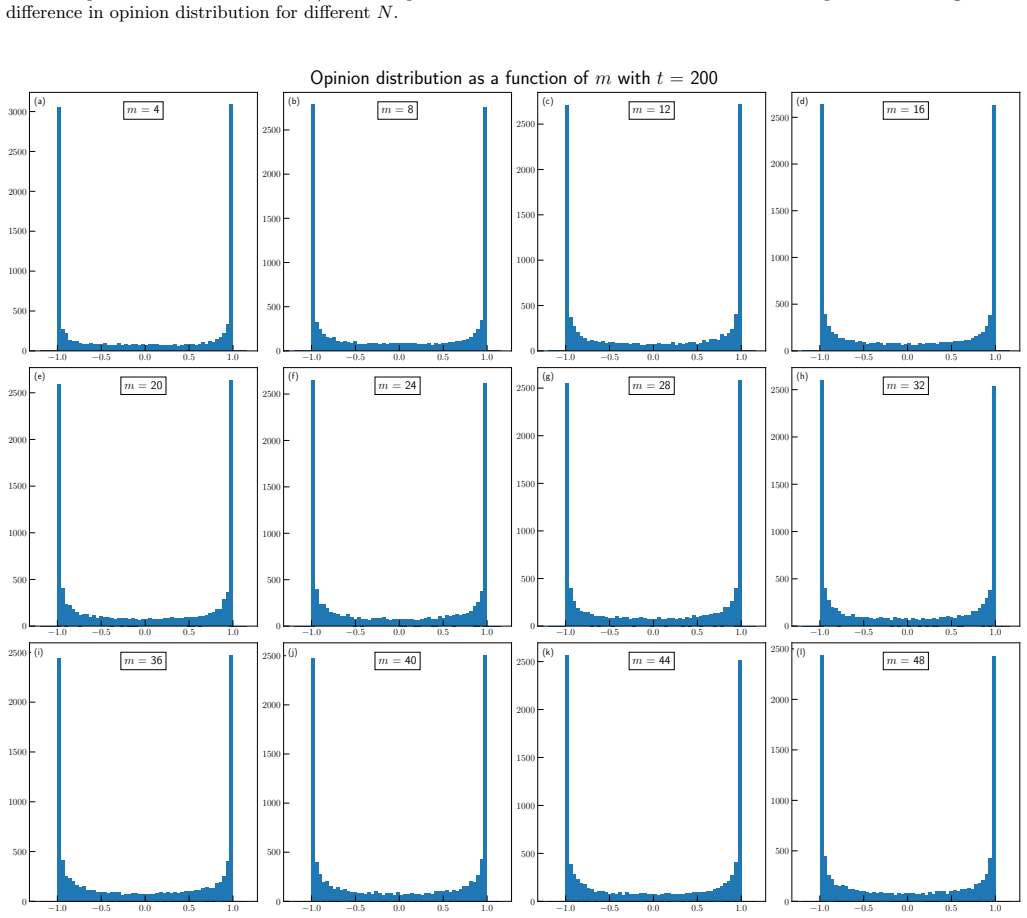
Computer simulations of the modified model exhibit scaling behavior and a notable trend in opinion polarization on all features across the majority of reasonable parameters. Empathetic agents introduced to reduce differences achieve only limited success. The most effective intervention is to change the behavior of a significant portion of highly connected agents.
What carries the argument
Interaction rules on a scale-free network that allow both convergence and divergence of continuous opinions measured by Euclidean distance in [-1,1].
If this is right
- Opinion polarization emerges on every feature under most tested parameters.
- Scaling relations appear in the polarization measures.
- Empathetic agents produce only marginal reductions in polarization.
- Altering interactions among a large fraction of high-degree nodes yields stronger mitigation than empathy rules.
Where Pith is reading between the lines
- Real social-media platforms might reduce polarization more by changing how highly followed accounts interact than by adding empathy prompts to users.
- The findings imply that network topology itself, rather than agent-level traits alone, drives the observed polarization.
- Empirical tests could replace the generated scale-free graphs with actual social-contact networks to check whether the hub-intervention effect persists.
Load-bearing premise
The chosen scale-free network, continuous opinion values in [-1,1], and rules permitting divergence are sufficient to represent real opinion dynamics without external media or other individual differences.
What would settle it
Running the same parameter sweeps on a non-scale-free network and finding no polarization trend or no advantage for hub-targeted changes would undermine the reported scaling and mitigation results.
Figures




read the original abstract
Axelrod model is an opinion dynamics model such that each agent on a square lattice has a finite number of possible nominal opinions on a finite number of issues that are usually called features in the field. Moreover, its dynamics between two agents is assimilative in the sense that the number of agreeing features between them never decreases upon interaction. Here we modify this model to study opinion convergence, polarization and more importantly to find ways to reduce opinion polarization in an already polarized population. We do so by changing or adding several elements from complex network and continuous opinion dynamics research. First, we put agents in a scale-free network. Second, we adopt the bounded confidence model by representing our agent's opinions by numbers in $[-1,1]$ those distances follow the standard Euclidean metric. Third, our rules allow both convergence and divergence of their resultant opinions after a pair of agents interacts. As a result, our modified model offers a more comprehensive exploration of opinion dynamics. Computer simulation results of our model show scaling behavior and a notable trend in opinion polarization on all features in the majority of reasonable simulation parameters. To mitigate this polarization, we introduce empathetic agents that work actively to reduce opinion differences. However, our findings indicate limited success in the approach for the most effective way is to change the behavior of a significant portion of highly connected agents. This research contributes to the understanding of opinion dynamics within society and highlights the nuanced complexities that arise when considering factors such as network structure and continuous opinion values. Our results prompt further exploration and open avenues for future investigations into effective methods of reducing opinion polarization.
Editorial analysis
A structured set of objections, weighed in public.
Referee Report
Summary. The paper modifies the classic Axelrod model by embedding agents in scale-free networks, representing opinions as continuous values in [-1,1] with Euclidean distance, and permitting interaction rules that allow both convergence and divergence. Computer simulations are reported to exhibit scaling behavior together with a notable polarization trend across features for the majority of reasonable parameters; empathetic agents are introduced as a mitigation strategy but found to have limited success, with the most effective intervention being alteration of the behavior of a significant fraction of high-degree nodes.
Significance. If the reported scaling and polarization trends prove robust, the work extends opinion-dynamics modeling to continuous opinions on heterogeneous networks and supplies a concrete, if preliminary, comparison of mitigation tactics. The emphasis on hub-node interventions is potentially actionable for network-based studies, though the absence of statistical controls in the abstract reduces immediate impact.
major comments (2)
- [Abstract] Abstract: the central claim that polarization occurs 'in the majority of reasonable simulation parameters' is load-bearing for the scaling and polarization results, yet the abstract supplies no information on how 'reasonable' parameters were chosen independently of the observed outcome, on error bars, or on any statistical test; this prevents verification that the trend is not an artifact of parameter selection.
- [Abstract] Abstract: the mitigation conclusion that 'the most effective way is to change the behavior of a significant portion of highly connected agents' is presented without quantitative metrics, baseline comparisons, or definition of 'significant portion,' rendering the relative efficacy of empathetic agents versus hub intervention impossible to assess from the given text.
minor comments (2)
- The abstract refers to 'empathetic agents' and 'changing the behavior' of hubs without defining the precise update rules or the fraction of nodes involved; these definitions belong in the methods section.
- No references are supplied in the abstract to prior continuous-opinion or scale-free-network studies (e.g., bounded-confidence models or network Axelrod variants); adding them would clarify the incremental contribution.
Simulated Author's Rebuttal
We thank the referee for the constructive comments on the abstract. We address each point below and will revise the abstract to incorporate additional details on parameter selection, statistical reporting, and quantitative metrics for the mitigation strategies.
read point-by-point responses
-
Referee: [Abstract] Abstract: the central claim that polarization occurs 'in the majority of reasonable simulation parameters' is load-bearing for the scaling and polarization results, yet the abstract supplies no information on how 'reasonable' parameters were chosen independently of the observed outcome, on error bars, or on any statistical test; this prevents verification that the trend is not an artifact of parameter selection.
Authors: We agree that the abstract should clarify the basis for 'reasonable' parameters and include statistical information. The full manuscript explores a range of network sizes, feature counts, and interaction thresholds drawn from standard values in the opinion dynamics literature, with results averaged over multiple independent runs and variability shown in the figures. We will revise the abstract to note the parameter ranges explored and the consistency of polarization trends across those runs. revision: yes
-
Referee: [Abstract] Abstract: the mitigation conclusion that 'the most effective way is to change the behavior of a significant portion of highly connected agents' is presented without quantitative metrics, baseline comparisons, or definition of 'significant portion,' rendering the relative efficacy of empathetic agents versus hub intervention impossible to assess from the given text.
Authors: We acknowledge the abstract lacks quantitative detail on the hub intervention. The manuscript compares empathetic agents against targeted changes to high-degree nodes, reporting the fraction of hubs modified and the resulting reduction in polarization metrics relative to baselines. We will revise the abstract to include a brief quantitative statement on the fraction of hubs and the comparative outcomes. revision: yes
Circularity Check
No significant circularity; simulation results are direct model outputs
full rationale
The paper defines a modified Axelrod model (scale-free network, continuous opinions in [-1,1], rules allowing convergence/divergence) and reports simulation outcomes on polarization and scaling under stated parameters. No derivation chain, equations, or predictions are presented that reduce by construction to fitted inputs or self-citations. Results are framed as observations from the explicitly defined model, with no load-bearing self-citation or ansatz smuggling. This is the standard case of a self-contained computational study.
Axiom & Free-Parameter Ledger
free parameters (2)
- scale-free network parameters (degree distribution, size)
- number of features and opinion bounds [-1,1]
axioms (2)
- domain assumption Opinions are continuous real numbers in [-1,1] whose distances follow Euclidean metric
- ad hoc to paper Interaction rules allow both convergence and divergence of opinions
invented entities (1)
-
empathetic agents
no independent evidence
Reference graph
Works this paper leans on
-
[1]
In each time step, an agent ( i, j) is randomly picked
-
[2]
One of the nearest neighbors of ( i, j) is randomly chosen
-
[3]
And denote the features that the two agents are different by Fdiff
Denote the number of features that this pair of agents have in common by Fcomm. And denote the features that the two agents are different by Fdiff
-
[4]
similar”. Otherwise, they are “dissim- ilar
With probability P (interaction) = Fcomm/F , we randomly pick a feature in Fdiff and the agent (i, j) FIG. 1. Typical time evolution of 100 agents on a 10 × 10 lattice with F = 5 and q = 10 according to the Axelrod model [6]. Adjacent agents are connected by different line styles according to their cultural similarities Fcomm/F (solid for Fcomm/F ≤ 20%, d...
work page 1953
-
[5]
[Scale-free network generation] A B-A network with N vertices is generated with each newly added ver- 4 tex connecting to m existing nodes using their stan- dard preferential attachment mechanism [25]. Each vertex of the network represents an agent and only those agents joined by an edge in the network can communicate directly with each other
-
[6]
[Opinion initialization] Each agent is character- ized by the same finite set of F features F = {f1, · · · , fF }. The opinion of agent X on feature f ∈ F , denoted by Xf is randomly and indepen- dently drawn from Nh(¯x, σ) = Nh(0, 0.5), namely, the normal distribution with mean 0 and standard deviation 0 .5 in the hyperbolic distance metric. More precise...
-
[7]
Then, a neighbor of X, say Y , is randomly selected
[Opinion evolution] An agent X is randomly picked. Then, a neighbor of X, say Y , is randomly selected. A feature f is randomly selected from F. (a) [The case of similar agents] If the two agents are similar, namely, the hyperbolic distances between at least κ = 1/2 of their opinions are less than the agreement threshold a, then Xf, the opinion of feature...
work page 2000
- [8]
-
[9]
K. Sznajd-Weron and J. Sznajd, Int. J. Mod. Phys. C 11, 1157 (2000), https://doi.org/10.1142/S0129183100000936
-
[10]
Sznajd model and its applications
K. Sznajd-Weron, Sznajd model and its applications (2005), arXiv:physics/0503239 [physics.soc-ph]
work page internal anchor Pith review Pith/arXiv arXiv 2005
-
[11]
R. Hegselmann and U. Krause, J. Artifi- cal Societies and Social Simulation 5 (2002), https://www.jasss.org/5/3/2.html. 12
work page 2002
- [12]
- [13]
-
[14]
G. Deffuant, D. Neau, F. Amblard, and G. Weisbuch, Adv. Complex Sys. 3, 87 (2000)
work page 2000
-
[15]
G. Weisbuch, G. Deffuant, F. Amblard, and J.-P. Nadal, Complexity 7, 55 (2002)
work page 2002
-
[16]
A. Sˆ ırbu, V. Loreto, V. D. P. Servedio, and F. Tria, Opin- ion dynamics: Models, extensions and external effects, in Participatory Sensing, Opinions and Collective Aware- ness, edited by V. Loreto, M. Haklay, A. Hotho, V. D. Servedio, G. Stumme, J. Theunis, and F. Tria (Springer International Publishing, Cham, 2017) pp. 363–401
work page 2017
- [17]
-
[18]
J. Liu, J. He, Z. Qiu, and S. He, Front. Phys. 10, 10.3389/fphy.2022.1042900 (2022)
-
[19]
L. Helfmann, N. Djurdjevac Conrad, P. Lorenz-Spreen, and C. Sch¨ utte, Sci. Repts.13, 19375 (2023)
work page 2023
-
[20]
H. Chau, C. Wong, F. Chow, and C.-H. F. Fung, Physica A 415, 133 (2014)
work page 2014
- [21]
-
[22]
P. Dandekar, A. Goel, and D. T. Lee, Proc. Nat. Acad. Sci. (USA) 110, 5791 (2013), https://www.pnas.org/doi/pdf/10.1073/pnas.1217220110
-
[23]
N. Koudenburg and Y. Kashima, Pers. Soc. Psychol. Bull. 48, 1068 (2022)
work page 2022
- [24]
-
[25]
O. Devauchelle, P. Szymczak, and P. Nowakowski, Phys. Rev. E 109, 044106 (2024)
work page 2024
- [26]
-
[27]
P. MacCarron, P. J. Maher, S. Fennell, K. Burke, J. P. Gleeson, K. Durrheim, and M. Quayle, PLOS ONE 15, 1 (2020)
work page 2020
-
[28]
F. Battiston, V. Nicosia, V. Latora, and M. S. Miguel, Sci. Rept. 7, 1809 (2017)
work page 2017
-
[29]
C. S. Amorim, Bourdieu dynamics of fields from a modi- fied axelrod model (2014), arXiv:1407.3479 [physics.soc- ph]
work page internal anchor Pith review Pith/arXiv arXiv 2014
-
[30]
Data Analysis And Modeling In Physics
X. Zou, Opinion Dynamics: Go Beyond Axelrod Model and the Application on Voting Dynamics , Project report of the course “Data Analysis And Modeling In Physics” (Univ. of Hong Kong, 2023)
work page 2023
-
[31]
Barab´ asi, Science 325, 412 (2009), https://www.science.org/doi/pdf/10.1126/science.1173299
A.-L. Barab´ asi, Science 325, 412 (2009), https://www.science.org/doi/pdf/10.1126/science.1173299
- [32]
-
[33]
C. I. Hovland, I. L. Janis, and H. H. Kelley, Communica- tion And Persuasion; Psychological Studies Of Opinion Change (Yale U Press, 1953)
work page 1953
- [34]
- [35]
-
[36]
U. K. H. Ecker, S. Lewandowsky, J. Cook, P. Schmid, L. K. Fazio, N. Brashier, P. Kendeou, E. K. Vraga, and M. A. Amazeen, Nature Reviews Psychology 1, 13 (2022)
work page 2022
discussion (0)
Sign in with ORCID, Apple, or X to comment. Anyone can read and Pith papers without signing in.