REVIEW 4 major objections 3 minor 26 references
Combinatorics of infinite rank module categories over finite dimensional $\mathfrak{sl}_3$-modules in Lie-algebraic context
T0 review · 4 major / 3 minor · reviewed 2026-08-10 · deepseek-v4-flash
Pith's one-line read Every simple sl3-module yields one of eight infinite graphs for the category generated by tensoring with finite-dimensional modules.
desk verdict Solid sl3 model-case combinatorics with a real gap in the universal reduction: Theorem 20 needs the (2/3,2/3)+Λ case and a peer-reviewed Kostant reference. read the letter →
The pith
A machine-rendered reading of the paper's core claim, the machinery that carries it, and where it could break.
The reading
What carries the argument
The central object is the locally finitary category $\operatorname{add}(\mathcal C\cdot L)$, whose indecomposable objects carry a nonnegative integer action matrix $[F]$ for the natural module $F=L((1,0))$; the graph $\Gamma_F$ is the directed multigraph encoding this matrix. The proof machinery is a two-part transfer. First, the algebra $\mathcal L(L,L)$ of endomorphisms of $L$ on which the adjoint action is locally finite, a Harish-Chandra bimodule, is shown to be the algebra-object proxy for $\operatorname{add}(\mathcal C\cdot L)$. Second, $\mathcal L(L,L)$ is identified with $\mathcal L(L(\lambda),L(\lambda))$ for a suitable highest weight module $L(\lambda)$, or with the corresponding Whittaker bimodule in the exceptional coset, so the classification reduces to the model cases computed in Sections 4--6. Perron-Frobenius theory enters through the fact that the positive eigenvector for the eigenvalue $3$ is unique and its coefficients are representation-theoretic quantities such as dimension, growth data, or Verma flag length.
What would settle it
Take any simple $\mathfrak{sl}_3$-module with an integral central character, list the indecomposable projective functors for that character, and compute the multiplicities of each simple summand in the adjoint action on its locally finite endomorphism ring; any deviation from the multiplicities of $U(\mathfrak{g})/\operatorname{Ann}(L)$ or, in the exceptional coset, from the Whittaker bimodule would disprove the reduction in Section 7.3 and could produce a graph outside the eight-graph list.
Extended reading notes
Core claim
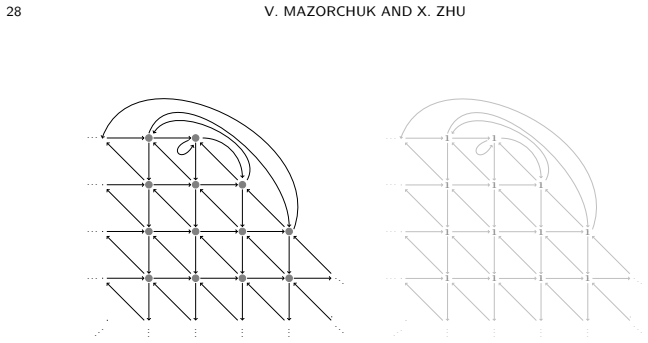
The main theorem, Theorem 20, states: let $L$ be any simple $\mathfrak{sl}_3$-module and $N$ a transitive subquotient of $\operatorname{add}(\mathcal C\cdot L)$. Then the graph $\Gamma_F$ recording the action of the natural three-dimensional module $F = L((1,0))$ is isomorphic to the graph in one of Figures 3, 5, 6, 7, 8, 9, 10, 11, 12, 13, 14, or 15, up to the isomorphisms that identify some of them; the distinct list contains exactly eight graphs, collected in Figure 16. Because the monoidal category of finite-dimensional $\mathfrak{sl}_3$-modules is generated by $F$, this graph determines the full combinatorial shadow of the action. The proof obtains seven graphs from simple highest weight modules in category O, the category of finitely generated weight modules with locally finite nilpotent action, and one further graph from non-degenerate Whittaker modules. Arbitrary simple modules are reduced to these models through Harish-Chandra bimodules: the locally finite part of the endomorphism algebra of $L$ is compared with the corresponding bimodule for a highest weight or Whittaker module, using equality of annihilators and a spanning result for locally finite endomorphism rings.
Load-bearing premise
The load-bearing premise is an unpublished claim that every simple $\mathfrak{sl}_3$-module of integral type has its locally finite endomorphism ring equal to the enveloping-algebra quotient, and if that premise fails the reduction to the model cases breaks.
Editorial extensions
If this is right
- Every transitive subquotient of $\operatorname{add}(\mathcal C\cdot L)$, for any simple $\mathfrak{sl}_3$-module $L$, has one of eight graphs; the list is finite even though each graph is infinite.
- The Perron-Frobenius eigenvector with eigenvalue $3$ encodes dimensions in the regular case, growth-related quantities in the middle cases, and Verma flag lengths in the bottom case, so the combinatorics determines numerical invariants of the modules.
- The eight graphs are the $\mathfrak{sl}_3$-analogues of the infinite Dynkin diagrams that classify the $\mathfrak{sl}_2$ case, placing the result in the same framework as the earlier $\mathfrak{sl}_2$ classification.
- For the four graphs without multiple oriented edges, the underlying simple transitive module category is semi-simple, so the classification reaches beyond combinatorics to a structural uniqueness statement.
- Categories generated by regular upper or lower middle weights decompose as an extension of the corresponding singular-piece graph by the regular module-category graph, giving a compositional description of the full category.
Reading between the lines
- If the theorem is right, the eight graphs form a complete obstruction: any simple transitive module category over the finite-dimensional $\mathfrak{sl}_3$ monoidal category not on the list cannot arise from tensoring with a simple module; whether such categories exist as abstract constructions is a separate question left open by the paper.
- The eigenvalue $3$ is the dimension of the natural module, just as the eigenvalue was $2$ for $\mathfrak{sl}_2$; by analogy, an $\mathfrak{sl}_n$ version should have eigenvalue $n$ and probably a finite list, though the exceptional cosets and Whittaker branch suggest the list will grow with $n$ in a non-obvious way.
- One can try to read the eight graphs purely combinatorially: classify strongly connected locally finite multigraphs with a positive eigenvector of eigenvalue $3$ and the local branching rules visible in the figures. A matching classification would make the Lie-algebraic reduction unnecessary.
- Proposition 21 settles semi-simplicity for the four graphs without double edges; applying the same argument to the four remaining graphs would decide whether the simple transitive category itself, not only its graph, is uniquely determined.
Editorial analysis
A structured set of objections, weighed in public.
Referee Report
Summary. The paper studies the module categories add(C·L) attached to a simple sl3-module L, where C is the monoidal category of finite-dimensional sl3-modules. The authors compute, for the action of the natural module F, the oriented graph Γ_F of a transitive subquotient N of add(C·L). Theorem 20 asserts that Γ_F is always one of eight infinite graphs, collected in Figure 16. For each graph the paper provides an explicit positive eigenvector for the Perron-Frobenius eigenvalue 3, with entries coming from dimensions, Gelfand-Kirillov dimensions, Bernstein numbers, or Verma flag lengths depending on the case. The proof is organized through model cases: the regular module category, BGG category O (upper middle, lower middle, bottom, partially integral, and generic weights), Whittaker modules, and a reduction of arbitrary simple L via Harish-Chandra bimodules. Several auxiliary results, such as Theorem 1, establish rigidity properties of the regular module category.
Significance. If correct, the classification is a substantial extension of the sl2 results in [MZ24] and gives a finite list of infinite combinatorial shadows for finite-dimensional sl3 actions. A genuine strength is that the Perron-Frobenius eigenvectors are derived from intrinsic invariants rather than fitted to the graphs; the paper also connects the combinatorics to dimensions, GK dimension, Bernstein numbers, and Verma flag lengths. The rigidity statement for the regular module category (Theorem 1) is an additional contribution. However, the reduction in §7.3 that underpins Theorem 20 currently rests on an unpublished preprint and appears to skip the non-integral exceptional case λ∈(2/3,2/3)+Λ, so the significance is conditional on completing that argument.
major comments (4)
- [§7.3, case λ ∉ (1/3,1/3)+Λ] The dichotomy in §7.3 is incomplete. By Proposition 18(e), both (1/3,1/3)+Λ and (2/3,2/3)+Λ have the exceptional property (W·λ)∩(λ+Λ) = {λ, sr·λ, rs·λ}, and Proposition 19(a) treats both as exceptional in the Whittaker setting. But §7.3 only separates (1/3,1/3)+Λ, and then claims that for all remaining λ the relevant part of Oχ is indecomposable. For λ∈(2/3,2/3)+Λ this claim is false: such a weight is generic in the sense of §5.7, and Proposition 17 shows that the corresponding block of category O is semi-simple. Thus the reduction of an arbitrary simple module L to the model categories is not proved for λ∈(2/3,2/3)+Λ; a separate argument (presumably parallel to the two subcases used for (1/3,1/3)+Λ) or an explicit invocation of Proposition 19(a) is needed.
- [§7.3, first displayed isomorphism] The isomorphism L(L(λ),L(λ)) ≅ L(L,L) ≅ U(g)/Ann(L) for λ∉(1/3,1/3)+Λ is asserted to follow from the positive solution of Kostant's problem for simple sl2- and sl3-modules with integral central characters, with [Ma23] cited for details. This step is load-bearing for Theorem 20, but [Ma23] is an unpublished preprint by the first author, and the stated hypothesis 'integral central characters' does not by its own wording cover the non-integral weights in (2/3,2/3)+Λ that occur in the same case. Please either give a complete proof in the paper or replace the reference by a peer-reviewed source covering all central characters actually used in the argument.
- [Propositions 5, 6, 9, 13, 14, 15, 16] These propositions are needed for the completeness of the eight-graph classification in Theorem 20, yet each is dispatched with 'Mutatis mutandis the proof of ...'. In at least one instance the paper itself emphasizes that the two situations are not symmetric: after Proposition 5 it notes that N1 and N2 are not equivalent and have different combinatorics. For a journal-level proof, the reader needs at least a precise statement of which case analyses are replaced and why the resulting local pictures are the ones claimed; otherwise the completeness of the list is not independently verifiable from the text.
- [§7.2–§7.3, proof of Theorem 20] Theorem 20 is stated for an arbitrary transitive subquotient N of add(C·L), but the proof establishes an equivalence for the whole category add(C·L) via L(L,L)-modules and then stops. The propositions in Sections 4–6 compute graphs for specific simple transitive module categories (N1, N2, N3, M_i^a, K, etc.) and for some quotients; they do not compute or bound the graphs of arbitrary transitive subquotients of non-simple model categories such as add(C·L(λ)) for a regular upper middle weight λ (cf. Proposition 4). If 'transitive subquotient' is intended to mean 'simple transitive subquotient' (as suggested by §1.2), the theorem should say so; otherwise a further argument showing that every transitive subquotient has the graph of one of the listed simple transitive categories is missing.
minor comments (3)
- [§5.6, Proposition 16(a)] Proposition 16(a) says 'For λ ∈ X4 such that λ1+λ2 = −1', but the statement concerns the category M_6^a and should read λ∈X6; X4 is defined earlier for the (a,0)+Λ case in Proposition 14.
- [§5.7 and §6.3] The term 'generic' is used in two incompatible ways: §5.7 calls all weights that are neither integral nor partially integral generic, which includes (1/3,1/3)+Λ and (2/3,2/3)+Λ, while §6.3 and Proposition 18(e) treat these two cosets as exceptional. Introducing separate terminology would avoid confusion.
- [§5.3, proof of Proposition 4(b)] The sentence claiming that the combinatorics of tensoring with L((1,0)) between regular simples within one connected shaded component is the same as the combinatorics in C_C is not fully justified in the text beyond the assertion that a Weyl group element transforms the component; a sentence explaining why multiplicities are preserved would help the reader.
Circularity Check
Theorem 20's reduction of arbitrary simple modules to the model cases rests on the first author's unpublished [Ma23] positive-solution theorem; the eight graphs themselves are independently computed, so circularity is partial.
-
self citation load bearing
[Section 7.3, proof of Theorem 20 (paragraph beginning 'Consider first the case λ ∉ (1/3,1/3)+Λ')]
"We claim that, in this case, the following holds: L(L(λ),L (λ)) ∼= L(L,L ) ∼=U (g)/ AnnU(g)(L). All this can be found in the literature, see [MS08, MMM23, Ma2 3]. ... Therefore the isomorphisms above just reflect the fact that Kostant’s problem has positive solution for all simple sl2 and sl3-modules with integral central characters, see [Ma23] for details."
The proof of Theorem 20 for an arbitrary simple module L is reduced to the highest-weight/Whittaker model cases exactly by the chain L(L,L) ≅ L(L(λ),L(λ)) ≅ U(g)/Ann(L). For every λ outside (1/3,1/3)+Λ this chain is not proved here but is delegated to [Ma23], an unpublished preprint by the first author; the sentence specifically names [Ma23] as the source for the positive solution of Kostant's problem that underlies the isomorphism. This is load-bearing: without it, the classification for arbitrary L is not connected to Sections 4-6. The citation is therefore an author-overlapping black box used to justify the central reduction, rather than an independently verified theorem. The paper's own case analyses remain self-contained, so the circularity is partial.
full rationale
The eight graphs and their Perron-Frobenius eigenvectors are genuinely computed from the module categories in Sections 4-6 (from dimensions, GK dimensions, Bernstein numbers, or Verma flag lengths), not fitted or assumed, so the combinatorial heart of the paper is not circular. The classification claimed in Theorem 20, however, extends to arbitrary simple sl3-modules only through the Section 7.3 reduction of L(L,L) to a highest-weight or Whittaker bimodule. The non-exceptional branch of that reduction is asserted via the chain L(L(λ),L(λ)) ≅ L(L,L) ≅ U(g)/Ann(L), with the key fact attributed to the first author's preprint [Ma23] ('Kostant's problem has positive solution for all simple sl2 and sl3-modules with integral central characters'). This is an author-overlapping, unpublished citation doing load-bearing work. Moreover, the dichotomy in §7.3 routes λ∈(2/3,2/3)+Λ through the first case, even though Proposition 18(e) groups that coset with (1/3,1/3)+Λ as a three-element exceptional case, and the quoted [Ma23] statement is worded only for integral central characters, so the on-paper coverage is not fully documented. These issues affect the generality of the main theorem but not the correctness of the computed graphs for the model cases; hence a moderate circularity score of 4 is appropriate.
Assumptions & free parameters
assumptions (7)
- domain assumption Classification of indecomposable projective functors on sl3 (Bernstein-Gelfand [BG80]).
- domain assumption Duflo's theorem that every primitive ideal of U(sl3) is the annihilator of a simple highest weight module [Du77].
- domain assumption Positive solution of Kostant's problem for simple sl2 and sl3-modules with integral central characters [Ma23].
- domain assumption Milicic-Soergel description of composition series of Whittaker-induced modules [MiSo97].
- domain assumption Finite dimensionality of endomorphism algebras of V⊗L and local finitariness of add(C·L) [MMM23].
- domain assumption Standard properties of category O, including translation functors, Verma flags, and projective-injective modules [BGG76, Hu08].
- standard math Infinite analogue of the Perron-Frobenius theorem for strongly connected locally finite graphs with positive eigenvector.
Cite this review
Pith. "Pith review of Combinatorics of infinite rank module categories over finite dimensional $\mathfrak{sl}_3$-modules in Lie-algebraic context." pith.science (2026). https://pith.science/paper/XTJM57FK
@misc{pith2026250100291,
  author       = {Pith},
  title        = {Pith review of: Combinatorics of infinite rank module categories over finite dimensional $\mathfraksl_3$-modules in Lie-algebraic context},
  year         = {2026},
  howpublished = {\url{https://pith.science/paper/XTJM57FK}},
  note         = {Machine review of arXiv:2501.00291}
}
abstract
We determine the combinatorics of transitive module categories over the monoidal category of finite dimensional $\mathfrak{sl}_3$-modules which arise when acting by the latter monoidal category on arbitrary simple $\mathfrak{sl}_3$-modules. This gives us a family of eight graphs which can be viewed as $\mathfrak{sl}_3$-generalizations of the classical infinite Dynkin diagrams.
Figures


Figures from the paper (15 more)




Reference graph
Works this paper leans on
-
[1]
On selfadjoint functors satisfying polynomial relations
Agerholm, T.; Mazorchuk, V. On selfadjoint functors satisfying polynomial relations. J. Algebra 330 (2011), 448--467
2011
-
[2]
Andersen, H. H.; Stroppel, C. Twisting functors on O . Represent. Theory 7 (2003), 681--699
work page 2003
-
[3]
Tensor products of finite- and infinite-dimensional representations of semisimple Lie algebras
Bernstein, J.; Gelfand, S. Tensor products of finite- and infinite-dimensional representations of semisimple Lie algebras. Compositio Math. 41 (1980), no.2, 245--285
1980
-
[4]
A certain category of g -modules
Bernstein, I.; Gelfand, I.; Gelfand, S. A certain category of g -modules. Funkcional. Anal. i Prilozen. 10 (1976), no. 2, 1--8
1976
-
[5]
Dixmier, J. Enveloping algebras. Grad. Stud. Math. 11 , American Mathematical Society, Providence, RI, 1996, xx+379 pp
work page 1996
-
[6]
Duflo, M. Sur la classification des id \'e aux primitifs dans l'alg \`e bre enveloppante d'une alg \`e bre de Lie semi-simple. Ann. of Math. (2) 105 (1977), no. 1, 107--120
work page 1977
-
[7]
Tensor categories
Etingof, P.; Gelaki, S.; Nikshych, D.; Ostrik, V. Tensor categories. Math. Surveys Monogr., 205 American Mathematical Society, Providence, RI, 2015, xvi+343 pp
2015
-
[8]
Representations in abelian categories
Freyd, P. Representations in abelian categories. Springer-Verlag New York, Inc., New York, 1966, pp. 95--120
work page 1966
Show all 26 references
-
[9]
Happel, D.; Preiser, U.; Ringel, C. M. Binary polyhedral groups and Euclidean diagrams. Manuscripta Math. 31 (1980), no. 1-3, 317--329
1980
-
[10]
Happel, D.; Preiser, U.; Ringel, C. M. Vinberg's characterization of Dynkin diagrams using subadditive functions with application to DTr-periodic modules. Lecture Notes in Math., 832 , Springer, Berlin, 1980, pp. 280--294
1980
-
[11]
Representations of semisimple Lie algebras in the BGG category O
Humphreys, J. Representations of semisimple Lie algebras in the BGG category O . Grad. Stud. Math., 94 American Mathematical Society, Providence, RI, 2008, xvi+289 pp
2008
-
[12]
Jantzen, J. C. Einh \"u llende Algebren halbeinfacher Lie-Algebren. Ergebnisse der Mathematik und ihrer Grenzgebiete (3), 3 . Springer-Verlag, Berlin, 1983. ii+298 pp
1983
-
[13]
On Arkhipov's and Enright's functors
Khomenko, O.; Mazorchuk, V. On Arkhipov's and Enright's functors. Math. Z. 249 (2005), no.2, 357--386
2005
-
[14]
On Whittaker vectors and representation theory
Kostant, B. On Whittaker vectors and representation theory. Invent. Math. 48 (1978), no. 2, 101--184
1978
-
[15]
Growth of algebras and Gelfand-Kirillov dimension
Krause, G.; Lenagan, T. Growth of algebras and Gelfand-Kirillov dimension. Grad. Stud. Math., 22 American Mathematical Society, Providence, RI, 2000, x+212 pp
2000
-
[16]
Applying projective functors to arbitrary holonomic simple modules
Mackaay, M.; Mazorchuk, V.; Miemietz, V. Applying projective functors to arbitrary holonomic simple modules. J. Lond. Math. Soc. (2) 110 (2024), no. 2, Paper No. e12965
2024
-
[17]
Trihedral Soergel bimodules
Mackaay, M.; Mazorchuk, V.; Miemietz, V.; Tubbenhauer, D. Trihedral Soergel bimodules. Fund. Math. 248 (2020), no.3, 219--300
2020
-
[18]
Extension of the 2-representation theory of finitary 2-categories to locally (graded) finitary 2-categories
Macpherson, J. Extension of the 2-representation theory of finitary 2-categories to locally (graded) finitary 2-categories. Ark. Mat. 60 (2022), no. 1, 125--172
2022
-
[19]
2-representations and associated coalgebra 1-morphisms for locally wide finitary 2-categories
Macpherson, J. 2-representations and associated coalgebra 1-morphisms for locally wide finitary 2-categories. J. Pure Appl. Algebra 226 (2022), no. 11, Paper No. 107081, 27 pp
2022
-
[20]
The tale of Kostant's problem
Mazorchuk, V. The tale of Kostant's problem. Preprint arXiv:2308.02839
-
[21]
Cell 2 -representations of finitary 2 -categories
Mazorchuk, V.; Miemietz, V. Cell 2 -representations of finitary 2 -categories. Compos. Math. 147 (2011), no. 5, 1519--1545
2011
-
[22]
Transitive 2-representations of finitary 2-categories
Mazorchuk, V.; Miemietz, V. Transitive 2-representations of finitary 2-categories. Trans. Amer. Math. Soc. 368 (2016), no. 11, 7623--7644
2016
-
[23]
Categorification of (induced) cell modules and the rough structure of generalised Verma modules
Mazorchuk, V.; Stroppel, C. Categorification of (induced) cell modules and the rough structure of generalised Verma modules. Adv. Math. 219 (2008), no.4, 1363---1426
2008
-
[24]
Infinite rank module categories over finite dimensional sl _2 -mo\-du\-les in Lie-algebraic context
Mazorchuk, V.; Zhu, X. Infinite rank module categories over finite dimensional sl _2 -mo\-du\-les in Lie-algebraic context. Preprint arXiv:2405.19894
-
[25]
The composition series of modules induced from Whittaker modules
Mili c i \'c , D.; Soergel, W. The composition series of modules induced from Whittaker modules. Comment. Math. Helv. 72 (1997), no. 4, 503--520
1997
-
[26]
Sloane, N. J. A. The Online Encyclopedia of Integer Sequences. Founded in 1964
1964
Reviewed August 10, 2026 · model on record in the stance chip above.
Discussion (0). Continue with ORCID to comment.