REVIEW 2 major objections 4 minor 17 references
Momentum-based minimization of the Ginzburg-Landau functional on Euclidean spaces and graphs
T0 review · 2 major / 4 minor · reviewed 2026-08-10 · deepseek-v4-flash
Pith's one-line read The paper's central claim is that the momentum-based accelerated Allen-Cahn equation has a sharp-interface limit given by the hyperbolic law $\partial_t v = (1-v^2)(h-\alpha v)$, so interfaces move at bounded speed, form corners instead…
desk verdict The paper's headline formal singular limit is not derived as written: Lemma A.2 proves the opposite sign of the corrector equation, so the O(1/ε) cancellation in §3.2.2 fails; the rigorous parts and numerical comparisons are decent but the central claim needs a fix. read the letter →
The pith
A machine-rendered reading of the paper's core claim, the machinery that carries it, and where it could break.
The reading
What carries the argument
The central object is the refined traveling-wave/corrector ansatz for the accelerated Allen-Cahn equation: $u \approx \varphi(r/\varepsilon) + \varepsilon\, v\,\partial_t\omega\, \psi(r/\varepsilon)$ with $r=(1-v^2)^{-1/2}\operatorname{sdist}$. The optimal profile $\varphi$ satisfies $\varphi'' = W'(\varphi)$, the corrector $\psi$ satisfies $\psi'' - W''(\varphi)\psi = \varphi' + 2x\varphi''$, and $\omega=(1-v^2)^{-1/2}$ is the Lorentz factor. Inserting this ansatz and discarding off-interface terms turns the PDE into an averaged interface equation whose solvability condition is exactly $\partial_t v=(1-v^2)(h-\alpha v)$; the corrector sets the exchange ratio between the two leading-order terms. On the discrete side, the key machinery is a convex-concave splitting whose convex part is quadratic, making each implicit step a linear solve; this yields CINEMA, which is unconditionally energy-stable but does not accelerate, and FISTA, which accelerates for intermediate-to-large step sizes at negligible extra cost.
What would settle it
Simulate the accelerated Allen-Cahn equation at several small values of $\varepsilon$ for a non-circular well-prepared initial curve, extract the zero-level-set normal velocity $v$ and curvature $h$, and compare them with an independent numerical solution of $\partial_t v=(1-v^2)(h-\alpha v)$; if the deviation does not shrink at the expected $O(\varepsilon)$ rate, or if the width of a moving interface does not scale like $\varepsilon(1-v^2)^{-1/2}$, the formal limit is wrong.
Extended reading notes
Core claim
The authors derive that the accelerated Allen-Cahn equation, the momentum version of the $L^2$ gradient flow of the Ginzburg-Landau energy, has a sharp-interface limit described by $\partial_t v = (1-v^2)(h-\alpha v)$. The derivation uses the refined traveling-wave ansatz $u = \varphi(r/\varepsilon) + \varepsilon\, v\,\partial_t\omega\, \psi(r/\varepsilon)$ with $r = (1-v^2)^{-1/2}\operatorname{sdist}$, where $\varphi$ is the optimal interface profile, $\psi$ solves the corrector equation $\psi'' - W''(\varphi)\psi = \varphi' + 2x\varphi''$, and $(1-v^2)^{-1/2}$ acts as a Lorentz factor for the signed distance. The corrector is needed because a moving interface changes both its width and its shape, and it fixes the balance between the $\varphi'$ and $x\varphi''$ terms that would otherwise not match. The resulting geometric law is hyperbolic: finite speed of propagation, no parabolic smoothing of corners, and an interface width contracted by $(1-v^2)^{-1/2}$. Numerical experiments on shrinking circles match the law, while large-time-step FISTA discretizations on planar curves, triply periodic minimal surfaces, and graph label propagation show that momentum can accelerate minimization outside the regime where the PDE analysis applies.
Load-bearing premise
The derivation of the limiting law assumes that the solution remains in the refined traveling-wave form $u=\varphi(r/\varepsilon)+\varepsilon\, v\,\partial_t\omega\, \psi(r/\varepsilon)$ with $r=(1-v^2)^{-1/2}\operatorname{sdist}$, that the initial data are well prepared, and that all off-interface terms of order $\operatorname{sdist}$ can be discarded; no rigorous error estimate or stability proof for this ansatz is given.
Editorial extensions
If this is right
- If the singular limit is correct, the sharp-interface limit of momentum-based diffuse perimeter minimization is a hyperbolic geometric flow with speed bound $|v|\le 1$, so interfaces can form corners and a shrinking circle can collapse and then re-expand.
- Because a moving interface is thinner by the factor $(1-v^2)^{-1/2}$, fast-moving interfaces require a finer spatial resolution than the Allen-Cahn equation would need at the same $\varepsilon$.
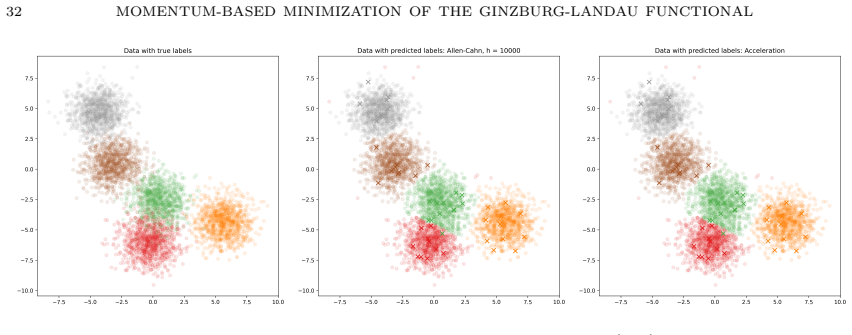
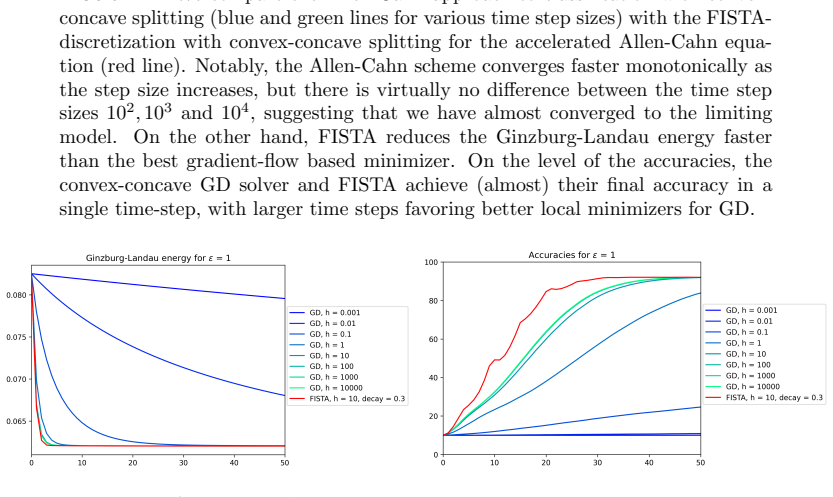
- In the large-time-step FISTA regime, momentum can reduce the number of iterations several-fold compared with convex-concave splitting gradient descent, for example reaching a triply periodic minimal surface in about 93 steps versus 471 for gradient descent, and it can speed up label propagation in graph-based semi-supervised learning.
- CINEMA decreases the total energy in every step for any time-step size and is therefore a stable momentum scheme, but it does not provide acceleration; where the concave gradient is evaluated decides whether momentum helps.
- The conditional convergence result implies that any long-time limit of the accelerated Allen-Cahn flow is a critical point of the Ginzburg-Landau energy, so the method is a legitimate minimization tool despite its non-monotone energy landscape.
Reading between the lines
- The appearance of the Lorentz factor suggests that other phase-field gradient flows, when inertial terms are added, may acquire similar velocity-dependent width corrections; a direct check would be to measure the width of a fast planar interface and compare it with $\varepsilon(1-v^2)^{-1/2}$.
- Since no tangential derivative of $v$ enters the limiting law, the flow is purely local along the interface; this raises the possibility of analysing corner formation and defining continuation past singularities by characteristic methods, as in hyperbolic conservation laws.
- The FISTA acceleration occurs precisely in the large-step regime where the continuous PDE limit does not apply, so the mathematically honest explanation of the acceleration may be an $\varepsilon$-fixed, large-time-step discrete limit rather than the singular limit (3).
- On graphs, finite speed of propagation would mean label information cannot cross more than about one graph edge per unit of hyperbolic time, and momentum's inertia may be what lets FISTA escape poor local minima that stall plain gradient descent.
Editorial analysis
A structured set of objections, weighed in public.
Referee Report
Summary. This paper studies the momentum-based (damped hyperbolic) Allen-Cahn equation, ∂_tt u + α∂_t u = Δu − W′(u)/ε², as a tool for minimizing the Ginzburg-Landau functional. The authors prove three elementary properties: monotone decay of a total energy (Theorem 3.1), conditional subsequential convergence to critical points (Theorem 3.2), and finite speed of propagation (Theorem 3.3). The main analytic contribution is a formal singular-limit derivation, Eq. (3), asserting that interfaces evolve by ∂_t v = (1−v²)(h − αv) with v the normal velocity and h the mean curvature. The paper also proposes two time discretizations, CINEMA and a FISTA-type convex-concave splitting scheme, proves stability of CINEMA, and provides numerical experiments for curves, surfaces, and graph-based semi-supervised learning.
Significance. The proposed singular limit, if valid, is a novel hyperbolic geometric flow: it has finite propagation speed, a velocity-dependent interface width with Lorentz-like factor (1−v²)^{−1/2}, permits corner formation in analogy to hyperbolic conservation laws, and is not the gradient flow of the limiting perimeter functional. The rigorous results Theorems 3.1–3.3 and 4.1–4.2 are correct and useful, and the numerical experiments (circle validation, curve evolution, Schwarz P and Gyroid surfaces, MNIST) are extensive and clearly presented. The authors are also explicit that the singular limit is formal and that large-time-step FISTA behavior is not captured by the PDE analysis. However, the central formal derivation is currently undermined by a sign inconsistency in the corrector lemma (Lemma A.2), so the paper's main new analytic claim needs repair before the results can be relied upon.
major comments (2)
- [Appendix A, Lemma A.2; Section 3.2.2] Lemma A.2 states the corrector equation as ψ′′ − W′′(ϕ)ψ = ϕ′ + 2xϕ′′ (Eq. (10)), but the variational proof in Step 3 derives the Euler-Lagrange equation −ψ′′ + W′′(ϕ)ψ = ϕ′ + 2xϕ′′, which is the opposite sign. Step 4's numerical construction, which solves the homogeneous problem ψc′′ = W′′(ϕ)ψc and combines with ϕ′, likewise corresponds to the Euler-Lagrange sign. Section 3.2.2 uses exactly Eq. (10) to cancel the O(1/ε) terms in the refined ansatz, so the stated lemma does not support the cancellation. If the corrector satisfies the sign derived in the proof, the ϕ′ and 2xϕ′′ terms in the interface equation would add rather than cancel, and Eq. (3) would not follow even formally. This is a load-bearing error: the singular limit is the paper's central analytic claim, and the proof of the corrector lemma must be reconciled with the statement (or the ansatz and derivation adjusted accordingly) and the formal calculation re-verified.
- [Section 3.2.2] The formal singular-limit derivation discards all terms of order sdist ('we discard the terms in the equation which retain sdist') and supplements this with the assumption of 'well-prepared initial data', which is never defined. No error estimates or compactness arguments are supplied, so Eq. (3) is not a proven asymptotic statement about solutions of the accelerated Allen-Cahn equation. The numerical confirmation in Section 3.2.3 only treats circles, for which v and ω are spatially constant, all tangential gradients vanish, and the corrector-sensitive cancellation is trivial; it therefore cannot validate the refined ansatz in the general case. The authors are transparent about the formal nature of the derivation, but as the central claim of the paper, this limitation should be stated more prominently and, ideally, the well-prepared condition should be made precise.
minor comments (4)
- [Throughout] The manuscript contains several typos, e.g., 'minization' in the header, 'Eudlidean' in Section 1, and 'are not be observed' in the abstract.
- [Section 3.2.2] The displayed algebraic lines following the refined ansatz are difficult to parse because of ambiguous parentheses in the typeset expressions; please clarify the grouping of the terms involving −(v∂tω)ψ′′ and W′′(ϕ)ψ/ε.
- [Lemma A.2, Step 3] In the computation of the cross term in F(ξ), the identity ∫(ψ̂′ϕ′′ + W′′ϕ′ψ̂) = 2∫ϕ′′ψ̂′ is not correct; the left-hand side equals 0 by integration by parts (since ∫W′′ϕ′ψ̂ = ∫ϕ′′′ψ̂ = −∫ϕ′′ψ̂′). The conclusion that the cross term vanishes is unaffected, but the displayed identity should be corrected.
- [Section 3.2.3] The sentence 'We can find the perimeter of (a phase field approximation to) an evolving disk in two ways' switches between 'we' and passive constructions; please streamline for readability.
Circularity Check
No significant circularity: the singular-limit derivation is self-contained and parameter-free; the Lemma A.2 sign discrepancy is a correctness issue, not a circular dependency.
full rationale
The central claim, Eq. (3), is derived by formal matched asymptotics from the accelerated Allen-Cahn equation. The ansatz u = phi(r/epsilon) + epsilon (v d_t omega) psi(r/epsilon) with r = (1-v^2)^(-1/2) sdist and the corrector equation (10) are internal to the derivation; the Lorentz factor omega is solved from the leading-order condition omega^2(1-v^2)=1, and alpha is a model friction parameter, not a fitted constant. The numerical validation in Section 3.2.3 solves the derived ODE (6) for the radius and compares it to the PDE simulation without tuning parameters; the 'velocity-adjusted perimeter' is computed from the same ansatz, so the comparison is consistency rather than curve-fitting. The self-citations to [DOSW25] concern convex-concave splitting behavior (epsilon^2-slow interface movement, smoothed potentials with quadratic convex part) and are not inputs to the singular-limit expansion; the relevant empirical claims are also supported by the paper's own numerics, e.g., Table 1 and Figure 4. One substantive non-circularity concern remains: Lemma A.2 states Eq. (10) as psi'' - W''(phi)psi = phi' + 2x phi'', but the variational proof's Euler-Lagrange equation is written with the opposite sign, -psi'' + W''(phi)psi = phi' + 2x phi''. This is an internal inconsistency that would break the O(1/epsilon) cancellation in Section 3.2.2 if uncorrected, but it is a mathematical error, not a circular definition of the target law. Hence no circularity is present; the score of 1 reflects only the presence of minor non-load-bearing self-citations.
Assumptions & free parameters
free parameters (4)
- friction coefficient α =
chosen by hand: α=3 in Section 5.1.1, α=1.4 in Section 5.1.2, α=0.1 in Figure 8
- time step τ =
τ=10^-5 in the PDE regime, τ=1 in Figure 8, τ=0.4 in Section 5.1.2
- interface width ε =
ε=0.01, 0.015, 0.03, and 1
- smoothing parameter R in the double-well potential =
R=2 in Section 4.4
assumptions (4)
- domain assumption The double-well potential W is even, C^2, with W''(±1) > 0 and a quadratic convex part.
- domain assumption The graph is finite, undirected, and uses the unnormalized symmetric graph Laplacian with Gaussian edge weights or thresholded edges.
- ad hoc to paper Well-prepared initial data and the two-term traveling-wave ansatz u = φ(r/ε) + ε(v ∂_t ω) ψ(r/ε) remain valid, with O(sdist) terms discarded.
- standard math Standard phase-field background results: Γ-convergence of Per_ε to perimeter and existence and stability of the one-dimensional optimal profile.
Cite this review
Pith. "Pith review of Momentum-based minimization of the Ginzburg-Landau functional on Euclidean spaces and graphs." pith.science (2026). https://pith.science/paper/G44RITHU
@misc{pith2026250100389,
  author       = {Pith},
  title        = {Pith review of: Momentum-based minimization of the Ginzburg-Landau functional on Euclidean spaces and graphs},
  year         = {2026},
  howpublished = {\url{https://pith.science/paper/G44RITHU}},
  note         = {Machine review of arXiv:2501.00389}
}
read the original abstract
We study the momentum-based minimization of a diffuse perimeter functional on Euclidean spaces and on graphs with applications to semi-supervised classification tasks in machine learning. While the gradient flow in the task at hand is a parabolic partial differential equation, the momentum method corresponds to a damped hyperbolic PDE, leading to qualitatively and quantitatively different trajectories. Using a convex-concave splitting-based FISTA-type time discretization, we demonstrate empirically that momentum can lead to faster convergence if the time step size is large but not too large. With large time steps, the PDE analysis offers only limited insight into the geometric behavior of solutions and typical hyperbolic phenomena like loss of regularity are not be observed in sample simulations. We obtain the singular limit of the evolution equations as the length parameter of the phase fields tends to zero by formal expansions and numerically confirm its validity for circles in two dimensions. Our analysis is complemented by numerical experiments for planar curves, surfaces in three-dimensional space, and semi-supervised learning tasks on graphs.
Figures


Figures from the paper (11 more)




Reference graph
Works this paper leans on
-
[12]
[HADR24] J Hermant, J-F Aujol, C Dossal, and A Rondepierre. Study of the behaviour of nesterov accelerated gradient in a non convex setting: the strongly quasar convex case. arXiv preprint arXiv:2405.19809 ,
-
[17]
[VMBC] Publius Vergilius Maro. Aeneis. Translated by Rolfe Humphries 1951: https://www.gutenberg.org/cache/epub/61596/pg61596.txt, 19 BC. Oluwatosin Akande, Industrial and Systems Engineering, Lehigh University, 200 West Packer A venue, Bethlehem, PA 18015, USA Email address : oaa323@lehigh.edu Patrick Dondl, Abteilung f¨ur Angewandte Mathematik, Albert-L...
work page 1951
-
[1977]
Provable non-accelerations of the heavy-ball method
[GTD23] Baptiste Goujaud, Adrien Taylor, and Aymeric Dieuleveut. Provable non-accelerations of the heavy-ball method. arXiv preprint arXiv:2307.11291 ,
-
[1984]
Nesterov acceleration in benignly non-convex landscapes
48 MOMENTUM-BASED MINIMIZATION OF THE GINZBURG-LANDAU FUNCTIONAL [GW24] Kanan Gupta and Stephan Wojtowytsch. Nesterov acceleration in benignly non-convex landscapes. arXiv preprint arXiv:2410.08395,
-
[1986]
[GM10] Maria del Mar Gonzalez and Regis Monneau. Slow motion of particle systems as a limit of a reaction- diffusion equation with half-laplacian in dimension one. arXiv preprint arXiv:1007.0740 ,
-
[1992]
Node classification for signed social networks using diffuse interface methods
[MBS20] Pedro Mercado, Jessica Bosch, and Martin Stoll. Node classification for signed social networks using diffuse interface methods. In Machine Learning and Knowledge Discovery in Databases: European Con- ference, ECML PKDD 2019, W¨ urzburg, Germany, September 16–20, 2019, Proceedings, Part I, pages 524–540. Springer,
work page 2019
-
[1993]
Metastable dynamics for hyperbolic variations of the Allen-Cahn equation
[FLM16] Raffaele Folino, Corrado Lattanzio, and Corrado Mascia. Metastable dynamics for hyperbolic variations of the allen-cahn equation. arXiv preprint arXiv:1607.06796 ,
-
[2004]
[SW23] Jonathan W Siegel and Stephan Wojtowytsch. A qualitative difference between gradient flows of convex functions in finite-and infinite-dimensional Hilbert spaces. arXiv preprint arXiv:2310.17610 ,
Show all 17 references
-
[2007]
Models for information propagation on graphs
[DEK22] Oliver RA Dunbar, Charles M Elliott, and Lisa Maria Kreusser. Models for information propagation on graphs. arXiv preprint arXiv:2201.07577 ,
-
[2010]
Convex-concave splitting for the allen-cahn equation leads to ε2-slow movement of interfaces
[DOSW25] Patrick Dondl, Akwum Onwunta, Ludwig Striet, and Stephan Wojtowytsch. Convex-concave splitting for the allen-cahn equation leads to ε2-slow movement of interfaces. arXiv:2506.18869 [math.NA],
-
[2011]
[Ros92] Marty Ross
Accessed: 2024-10-07. [Ros92] Marty Ross. Schwarz’ p and d surfaces are stable. Differential Geometry and its Applications , 2(2):179– 195,
2024
-
[2016]
A variational perspective on the dissipative hamiltonian structure of the vlasov-fokker- planck equation
[Par24] Sangmin Park. A variational perspective on the dissipative hamiltonian structure of the vlasov-fokker- planck equation. arXiv preprint arXiv:2406.13682 ,
-
[2020]
Second-order flows for approach- ing stationary points of a class of non-convex energies via convex-splitting schemes
[CDI+24] Haifan Chen, Guozhi Dong, Jos´ e A Iglesias, Wei Liu, and Ziqing Xie. Second-order flows for approach- ing stationary points of a class of non-convex energies via convex-splitting schemes. arXiv preprint arXiv:2402.12173,
-
[2021]
Convergence of stochastic gradient descent schemes for lojasiewicz-landscapes
[DK21] Steffen Dereich and Sebastian Kassing. Convergence of stochastic gradient descent schemes for lojasiewicz-landscapes. arXiv preprint arXiv:2102.09385 ,
-
[2022]
Bdf schemes for accelerated gradient flows in projection-free approximation of nonconvex constrained variational minimization
[DGXY24] Guozhi Dong, Zikang Gong, Ziqing Xie, and Shuo Yang. Bdf schemes for accelerated gradient flows in projection-free approximation of nonconvex constrained variational minimization. arXiv preprint arXiv:2409.14670,
-
[2023]
Finite element methods for the stretching and bending of thin structures with folding
[BGM24] Andrea Bonito, Diane Guignard, and Angelique Morvant. Finite element methods for the stretching and bending of thin structures with folding. Numerische Mathematik , 156(6):2031–2068,
-
[2024]
Accelerated gradient flows for large bending deformations of nonlinear plates
[DGY24] Guozhi Dong, Hailong Guo, and Shuo Yang. Accelerated gradient flows for large bending deformations of nonlinear plates. arXiv preprint arXiv:2402.12152 ,
Reviewed August 10, 2026 · model on record in the stance chip above.
Discussion (0). Continue with ORCID to comment.