REVIEW 4 major objections 5 minor 33 references
Amplifier scheme: driven by direct-drive under 10 MJ laser toward inertial fusion energy
T0 review · 4 major / 5 minor · reviewed 2026-08-11 · deepseek-v4-flash
Pith's one-line read A direct-drive capsule with an extremely dense shell can extend burn through a primary explosion, a fireball, and a secondary explosion, reaching target gain 77 and burn fraction 38.5% in 1D simulations.
desk verdict A genuinely new target concept with a plausible 1D path to G=77, but the load-bearing cold-shell stability and a minor yield/burn inconsistency leave the quantitative claims unverified. read the letter →
The pith
A machine-rendered reading of the paper's core claim, the machinery that carries it, and where it could break.
The reading
What carries the argument
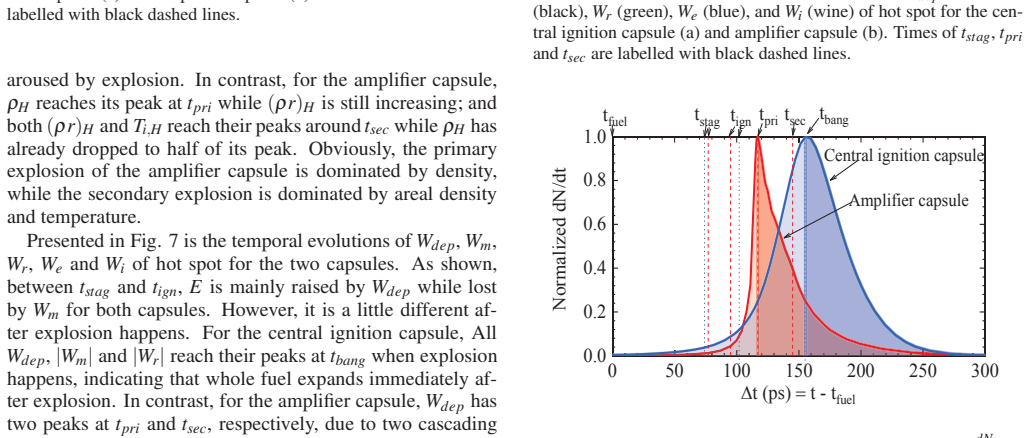
The central object is the self-amplifying capsule: a spherical cryogenic DT layer inside a CH ablator, driven so that at stagnation the cold shell is extremely compressed relative to the hot spot ($\rho_c/\rho_h \sim 28$, cold-shell areal density $\sim 1.6\ \mathrm{g/cm^2}$). The mechanism is a four-stage cascade: central hot-spot ignition acts as a spark plug; density-dominated ignition moves the fusion peak into the shell; the primary explosion in the shell pushes the inner fuel into a converging fireball; and the fireball's convergence at the center produces the secondary explosion. The paper proposes two trigger criteria for the first explosion: the density ratio $\rho_c/\rho_h$ and $\xi = a(\rho R)_c / T_{i,c}^{3/4}$, with the amplifier capsule at $\xi = 3.6$ versus $0.93$ for central ignition. Simulations are carried out with the 1D multi-group radiation-hydrodynamic code RDMG.
What would settle it
Run a 3D radiation-hydrodynamics simulation or experiment with realistic drive nonuniformity and target surface roughness on the amplifier capsule. If the cold shell breaks up before the primary explosion, the fusion rate will not show the second peak and the yield after bang time will not exceed the yield before it by a large factor, contradicting the 4.8x claim.
Extended reading notes
Core claim
On the paper's own terms, the discovery is that the burn stage of an ignited inertial-fusion capsule can be extended by exploiting density rather than temperature. If stagnation produces a shell with density ratio $\rho_c/\rho_h = 28$ and cold-shell areal density $1.6\ \mathrm{g/cm^2}$, the fusion-rate peak moves out of the hot spot into the shell; the resulting primary explosion splits the fuel, drives the inner part to converge into a fireball, and the convergence at the center produces a secondary explosion. The simulations show the yield after the first explosion is 4.8 times the yield before it, compared with 1.25 for the central-ignition capsule, giving total yield 729 MJ, target gain 77, and burn fraction 38.5% at a convergence ratio of 18.6.
Load-bearing premise
The design assumes the extremely compressed cold shell, with density ratio about 28 and areal density 1.6 g/cm2 at stagnation, remains intact during the burn phase; in three dimensions, shell breakup would suppress the primary explosion, fireball convergence, and secondary explosion.
Editorial extensions
If this is right
- If the 1D result carries over, a single 9.46 MJ direct-drive capsule would burn 38.5% of its DT fuel and release 729 MJ, a target gain of 77.
- Because the scheme operates at convergence ratio 18.6 rather than the roughly 35 needed for conventional high-gain central ignition, the Rayleigh-Taylor hot-spot condition is relaxed.
- Density-dominated ignition moves the fusion peak into the shell, which is what allows the primary explosion to split the fuel and drive the inner part inward.
- The same amplifier physics is expected to work in indirect drive, with the indirect-drive design reported separately by the authors.
Reading between the lines
- The two-explosion structure suggests a new target-design axis: instead of maximizing hot-spot temperature alone, one can design for shell areal density and use the shell itself as the amplifier; systematic scans over fuel mass and pulse shape could reveal whether the 1.6 g/cm2 areal-density requirement is truly necessary.
- If the fireball is as hot and dense as reported, it may serve as a laboratory source for warm dense matter, nuclear astrophysics, or neutron diagnostics, independent of energy production.
- The trigger criterion $\xi = a(\rho R)_c / T_{i,c}^{3/4}$ implies a threshold relation that could be tested by changing the ablator material or the fuel layer thickness to see whether the threshold shifts predictably.
- The authors state they will optimize the design at lower laser energy, so a concrete testable extension is whether a smaller capsule with the same $\xi$ and $\rho_c/\rho_h$ values still produces the secondary explosion at comparable burn fraction.
Editorial analysis
A structured set of objections, weighed in public.
Referee Report
Summary. The paper proposes an "amplifier scheme" for inertial confinement fusion, in which an extremely dense cold shell at stagnation causes a primary explosion inside the shell, driving an inward converging fireball that produces a secondary explosion. From single 1D simulations with the RDMG code, the authors claim a direct-drive capsule containing 6.33 mg of DT and driven by a 9.46 MJ laser produces a nuclear yield of 729 MJ (target gain G=77), a burn fraction of 38.5%, and a yield after bang time that is 4.8 times the yield before bang time. These results are compared with a 1.6 MJ central-ignition capsule (0.842 mg DT, Yid=35.5 MJ, G=22, burn fraction 16.2%). The central quantitative claims are the high gain, the 4.8x post-bang yield ratio, and the extreme fireball conditions (330 g/cm3, 350 keV, 54 Tbar at the secondary explosion). All results rest on two unverified 1D runs, and the paper explicitly recognizes that the required cold-shell/hot-spot density ratio may lead to a hydrodynamically unstable design.
Significance. If correct, the amplifier scheme would offer a new route to high-gain inertial fusion energy with a lower convergence ratio than central ignition, and the predicted fireball would be a qualitatively new regime. The paper also proposes a quantitative trigger criterion, xi = a(rhoR)c/T_i,c^(3/4), which is falsifiable and testable. The strengths of the work are the clear physical description of the proposed cascade mechanism and the use of an established radiation-hydrodynamics code. However, the significance is strongly conditional: the claimed gain and burn enhancement depend on the survival of a cold shell with rho_c/rho_h=28-42 under conditions where the Atwood number is near unity, and no multi-dimensional stability analysis is provided. The reported Yid and Phi values are also mutually inconsistent for both capsules, so the headline numbers cannot be taken at face value.
major comments (4)
- [Table I and §6] The reported yield Yid=729 MJ is inconsistent with the stated burn fraction Phi=38.5% and DT fuel mass 6.33 mg. For equimolar DT, complete burn of 1 mg releases about 340 MJ; 38.5% of 6.33 mg gives 828 MJ, not 729 MJ. Conversely, Yid=729 MJ implies Phi=33.9%. The same discrepancy appears for the central ignition capsule: 0.842 mg at Phi=16.2% would give 46 MJ, while Yid=35.5 MJ implies Phi=12.4%. Because the target gain G is derived directly from Yid and the burn fraction is a stated central output, this numerical inconsistency must be resolved before the quantitative claims can be accepted.
- [§5 and Fig. 4] The entire scheme relies on the existence and survival of a cold shell with rho_c/rho_h=28 at stagnation and rho_c/rho_h=42 at tign, with the shell density reaching 1430 g/cm3 (Table I and Fig. 4). Such density ratios correspond to Atwood numbers close to 0.95; with the quoted implosion velocity of 3.75e7 cm/s and the stagnation-to-burn timescale of tens of picoseconds, the deceleration-phase Rayleigh-Taylor growth factors for modes l=10-100 are very large. The manuscript presents only 1D results and provides no perturbation-growth, 2D, or 3D simulations, and the final paragraph concedes that the high density ratio "may be challenging and lead to a hydrodynamic unstable design." Without a quantitative stability assessment, the claimed G=77 and the 4.8x post-bang yield ratio are not established for a physically realizable target. A concrete test would be to seed surface roughness or laser imprint in 2D/3D simulations, or at minimum to provide standard RT growth-factor estimates for the shell at stagnation and during burn.
- [Summary comparison] The comparison between the amplifier capsule (9.46 MJ, 6.33 mg DT) and the central ignition capsule (1.6 MJ, 0.842 mg DT) is not controlled: the laser energy differs by a factor of 5.9 and the fuel mass by a factor of 7.5. The claim that the post-bang/pre-bang yield ratio (4.8 vs 1.25) demonstrates the advantage of the amplifier scheme is therefore not supported by this comparison. To substantiate the claimed advantage, the authors would need to compare designs with matched fuel mass and driver energy, or to show a normalized scaling that accounts for these differences. As written, the 4.8x ratio is a property of a single 1D run, not a controlled comparison.
- [§6 and summary] The trigger criterion xi = a(rhoR)c/T_i,c^(3/4) with a=1 is introduced after the simulations, and the summary states that "we are doing the parameter scan to identify them by simulations." Thus the criterion is currently a curve-fit assertion rather than a validated design rule. If the paper wishes to present xi as a predictive criterion, at least a small parameter scan, or a derivation from the condition Wdep/We>1, is needed; otherwise its status should be clearly labeled as a conjecture, not a result.
minor comments (5)
- [Fig. 11 caption] The caption contains the typo "spacial" instead of "spatial."
- [Fig. 6 and Table I] The notation for the ion temperature of the hot spot is inconsistent: the text and Table I use Ti,h, while Fig. 6 uses Ti,H. Please unify the notation.
- [Table I] The table uses "tsecondary" while the text and Fig. 6 use "tsec"; please use a single symbol throughout.
- [§2 equation] The energy equation dE/dt = Wdep + Wm + Wr + Wi + We is given without an equation number and the terms are described only in prose; adding a numbered equation and explicit definitions of all subscripts would improve clarity.
- [Figs. 3 and 4] In several axis labels and captions, "0.1r" appears where the intended quantity is clearly 0.1 times the mass density; the typesetting should be corrected (e.g., "0.1ρ" or "rho" expanded) to avoid confusion with radius.
Circularity Check
No significant circularity: the reported gain, burn fraction, and post-bang yield ratio are direct outputs of 1D RDMG simulations, not values manufactured from a fitted constant or from a self-citation chain.
full rationale
The central claims of the paper, including G=77, Phi=38.5%, Yid=729 MJ, and the 4.8x yield after bangtime, are presented as results of the RDMG 1D radiation-hydrodynamics simulations for the amplifier capsule and the comparison central-ignition capsule. These are simulation outputs, not parameters fitted to the quantities they are used to predict. The proposed trigger criterion xi = a(rhoR)c/T_i,c^(3/4) with a=1 is introduced after the simulations as an interpretive metric; the paper explicitly states 'we are doing the parameter scan to identify them by simulations,' so it is not used to generate the reported yields. The self-citations to the 10-MJ driver concept [Matter Radiat. Extremes 9, 043002 (2024)] and to the separate indirect-drive paper [26] provide motivation or pointers but do not carry the derivation of the central result; the gain calculation is self-contained in the RDMG runs. The closing admission that the high density ratio 'may be challenging and lead to a hydrodynamic unstable design' is a stability caveat, not a circular step. No equation in the paper reduces to its own input, and no fitted parameter is renamed as a prediction. The paper's results may be limited by the absence of 3D stability analysis or by internal consistency questions about Yid versus burn fraction, but those are correctness concerns, not circularity.
Assumptions & free parameters
free parameters (1)
- a in xi trigger criterion =
1 (assigned by hand)
assumptions (4)
- domain assumption Spherical symmetry and 1D hydrodynamics are sufficient to describe the amplifier scheme and its yields.
- domain assumption RDMG's physics models (multi-group radiation transport, inverse bremsstrahlung absorption, ray tracing) are adequate for the burn-phase predictions.
- ad hoc to paper The comparison capsule is a representative central ignition design.
- standard math The relation between DT fuel mass, burn fraction, and yield follows the standard fusion energy content.
Cite this review
Pith. "Pith review of Amplifier scheme: driven by direct-drive under 10 MJ laser toward inertial fusion energy." pith.science (2026). https://pith.science/paper/4W6VNYTO
@misc{pith2026250101314,
  author       = {Pith},
  title        = {Pith review of: Amplifier scheme: driven by direct-drive under 10 MJ laser toward inertial fusion energy},
  year         = {2026},
  howpublished = {\url{https://pith.science/paper/4W6VNYTO}},
  note         = {Machine review of arXiv:2501.01314}
}
read the original abstract
The National Ignition Facility successfully achieved target gain 2.4 thus marginally entering into burn stage.Meanwhile, a recent conceptual design on 10 MJ laser driver [Matter Radiat. Extremes 9, 043002 (2024)] provides a new room for exploring novel target designs and interesting phenomena in a burning plasma after ignition. In this paper, we propose an amplifier scheme with extended burn stage, which includes secondary implosion, generates extremely hot and dense fusion fireball, and produces additional gain. The amplifier scheme can be realized either by direct-drive or by indirect-drive. Here, we present a direct-drive amplifier design. The amplifier scheme can be realized at a low convergence ratio, so it can greatly relax the \r{ho} RT hot spot condition and the stringent requirements on engineering issues by a high gain fusion. Especially, the fireball lasts for 30 ps, reaching 330 g/cc, 350 keV, 54 Tbar at center when the secondary explosion happens, which leaves an important room for novel target designs towards clean fusion energy.
Figures


Figures from the paper (7 more)




Reference graph
Works this paper leans on
-
[1]
Report of the Fusion Energy Sciences Workshop on Inertial Fusion En- ergy
S. Atzeni and J. Meyer-ter-V ehn, The Physics of Inertial Fusion: Beam Plasma Interaction, Hydrodynamics, Dense Plasma Physics (Clarendon Press, Oxford, 2004); “Report of the Fusion Energy Sciences Workshop on Inertial Fusion En- ergy”, U. S. Department of Energy, (2023)
work page 2023
-
[2]
https://science.osti.gov/-/media/fes/pdf/worksho p- reports/2023/IFE-Basic-Research-Needs-Final-Report.pdf
work page 2023
-
[3]
Achievement of Target Gain Larger than Unity in an Inertial Fusion Experiment
H. Abu-Shawareb, R. Acree, P . Adams, J. Adams, B. Addis, R . Aden, P . Adrian, B. B. Afeyan, M. Aggleton, L. Aghaian et al., “Achievement of Target Gain Larger than Unity in an Inertial Fusion Experiment”, Phys. Rev. Lett. 132, 065102 (2024)
work page 2024
-
[4]
Energy Principles of Scientific Breakeven in an Inertial Fusion Experiment
O. A. Hurricane, D. A. Callahan, D. T. Casey, A. R. Christo - pherson, A. L. Kritcher, O. L. Landen, S. A. Maclaren, R. Nora , P . K. Patel, J. Ralph et al. , “Energy Principles of Scientific Breakeven in an Inertial Fusion Experiment”, Phys. Rev. Lett. 132, 065103 (2024)
work page 2024
-
[5]
Hohlraum Reheating from Burning NIF Implosions
M. S. Rubery, M. D. Rosen, N. Aybar, O. L. Landen, L. Divol, C. V . Y oung, C. Weber, J. Hammer, J. D. Moody, A. S. Moore et al. , “Hohlraum Reheating from Burning NIF Implosions”, Phys. Rev. Lett. 132, 065104 (2024)
work page 2024
-
[6]
A. Pak, A. B. Zylstra, K. L. Baker, D. T. Casey, E. Dewald, L . Divol, M. Hohenberger, A. S. Moore, J. E. Ralph, D. J. Schloss- berg et al., “Observations and properties of the first laboratory fusion experiment to exceed a target gain of unity,” Phys. Rev. E 109, 025203 (2024)
work page 2024
-
[7]
Design of the first fusion experiment to achieve target energy gain G > 1,
A. L. Kritcher, A. B. Zylstra, R. Weber, O. A. Hurricane, D . A. Callahan, D. S. Clark, L. Divol, D. E. Hinkel, K. Humbird, O. Jones et al. , “Design of the first fusion experiment to achieve target energy gain G > 1,” Phys. Rev. E 109, 025204 (2024)
work page 2024
-
[8]
See https://www.energy.gov/cfo/articles/fy-2025-b udget- justification for more information about the new fusion yiel d record of 5.2 MJ on the NIF
work page 2025
Show all 33 references
-
[9]
High flux sym- metry of the spherical hohlraum with octahedral 6LEHs at the hohlraumto-capsule radius ratio of 5.14
K. Lan, J. Liu, D. Lai, W. Zheng, and X. He, “High flux sym- metry of the spherical hohlraum with octahedral 6LEHs at the hohlraumto-capsule radius ratio of 5.14”, Phys. Plasmas 21, 010704 (2014)
2014
-
[10]
Symmetry contro l of an indirectly driven high-density-carbon implosion at hig h con- vergence and high velocity,
L. Divol, A. Pak, L. F. Berzak Hopkins, “Symmetry contro l of an indirectly driven high-density-carbon implosion at hig h con- vergence and high velocity,” Phys. Plasmas 24, 056309 (2017)
2017
-
[11]
A new beam configuration to support both sph er- ical hohlraums and symmetric direct drive
S. Craxton, “A new beam configuration to support both sph er- ical hohlraums and symmetric direct drive”. The 62nd Annual Meeting of the American Physical Society Division of Plasma Physics, November 9-13, 2020 in U.S.A
2020
-
[12]
First inertial confinement fusion implosion experiment in octahedral spherical hohlraum,
K. Lan, Y . Dong, J. Wu, Z. Li, Y . Chen, H. Cao, L. Hao, S. Li, G. Ren, W. Jiang et al. , “First inertial confinement fusion implosion experiment in octahedral spherical hohlraum,” Phys. Rev. Lett. 127, 245001(2021)
2021
-
[13]
Dream fusion in octahedral spherical hohlraum ,
K. Lan, “Dream fusion in octahedral spherical hohlraum ,” Mat- ter Radiat. Extremes 7, 055701 (2022)
2022
-
[14]
The impact of low-mode symmetry on in- ertial fusion energy output in the burning plasma state,
J. E. Ralph, J. S. Ross, A. B. Zylstra, A. L. Kritcher, H. F . Robey, C. V . Y oung, O. A. Hurricane, A. Pak, D. A.Callahan, K. L. Baker et al., “The impact of low-mode symmetry on in- ertial fusion energy output in the burning plasma state,” Nature Communications 15, 2975 (2024)
2024
-
[15]
Interplay of Laser-Plasma Interactions and In ertial Fusion Hydrodynamics,
D. J. Strozzi, D. S. Bailey, P . Michel, L. Divol, S. M. Sep ke, G. D. Kerbel, C. A. Thomas, J. E. Ralph, J. D. Moody, and M. B. Schneider, “Interplay of Laser-Plasma Interactions and In ertial Fusion Hydrodynamics,” Phys. Rev. Lett. 118, 025002 (2017)
2017
-
[16]
V . T. Tikhonchuk, T. Gong, N. Jourdain, O. Renner, F. P . C on- damine, K. Q. Pan, W. Nazarov, L. Hudec, J. Limpouch, R. Liska et al. Studies of laser-plasma interaction physics with low-density targets for direct-drive inertial confinement fusion on the Shenguang III prototyp...
2021
-
[17]
Sup- pression of stimulated Raman scattering by angularly incoh er- ent light, towards a laser system of incoherence in all dimen - sions of time, space, and angle,
Y . Guo, X. Zhang, D. Xu, X. Guo, B. Shen, and K. Lan, “Sup- pression of stimulated Raman scattering by angularly incoh er- ent light, towards a laser system of incoherence in all dimen - sions of time, space, and angle,” Matter Radiat. Extremes 8, 035902 (2023)
2023
-
[18]
A model of laser imprinting,
V . N. Goncharov, S. Skupsky, T. R. Boehly, J. P . Knauer, P . McKenty, V . A. Smalyuk, R. P . J. Town, O. V . Gotchev, R. Betti, and D. D. Meyerhofer, “A model of laser imprinting,” Phys. Plasmas 7, 2062 (2000)
2000
-
[19]
Capsule physics comparison of National Ig- nition Facility implosion designs using plastic, high density car- bon, and beryllium ablators,
D. S. Clark, A. L. Kritcher, S. A. Yi, A. B. Zylstra, S. W. H aan, and C. R. Weber, “Capsule physics comparison of National Ig- nition Facility implosion designs using plastic, high density car- bon, and beryllium ablators,” Phys. Plasmas 25, 032703 (2018)
2018
-
[20]
Novel Target Designs to Mitigate Hyd ro- dynamic Instabilities Growth in Inertial Confinement Fusio n,
X. Qiao and K. Lan, “Novel Target Designs to Mitigate Hyd ro- dynamic Instabilities Growth in Inertial Confinement Fusio n,” Phys. Rev. Lett. 126, 185001(2021)
2021
-
[21]
Direct measurement of ice-ablator interface motion for in sta- bility mitigation in indirect drive ICF implosions,
A. Do, C. R. Weber, E. L. Dewald, D. T. Casey, D. S. Clark, S. F. Khan, O. L. Landen, A. G. MacPhee, and V . A. Smalyuk, “Direct measurement of ice-ablator interface motion for in sta- bility mitigation in indirect drive ICF implosions,” Phys. Rev. Lett. 129, 215003 (2022)
2022
-
[22]
Sui and K
Z. Sui and K. Lan, “Driver at 10MJ and 1 shot/30 min for in- ertial confinement fusion at high gain: Efficient, compact, l ow- cost, low laser-plasma instabilities, beam color selectab le from 2 ω /3ω /4ω , applicable to multiple laser fusion schemes,” Mat- ter Radiat. Extremes ...
2024
-
[23]
La ser compression of matter to super-high densities: Thermonucl ear (CTR) applications,
J. Nuckolls, L. Wood, A. Thiessen, and G. Zimmerman, “La ser compression of matter to super-high densities: Thermonucl ear (CTR) applications,” Nature 239, 139 (1972)
1972
-
[24]
Laser-direct-drive program: Promise, challenge, and path forward,
E. M. Campbell, V . N. Goncharov, T. C. Sangster, S. P . Reg an, P . B. Radha, R. Betti, J.F. Myatt, D.H. Froula, M.J. Rosen- berg, I.V . Igumenshchev et al. , “Laser-direct-drive program: Promise, challenge, and path forward,” Matter Radiat. Ex- tremes 2, 37 (2017)
2017
-
[25]
Tripled yield in direct-drive laser fusion through statistical modelling,
V . Gopalaswamy, R. Betti, J. P . Knauer, N. Luciani, D. Pa tel, K. M. Woo, A. Bose, I. V . Igumenshchev, E. M. Campbell, K. S. Anderson et al. , “Tripled yield in direct-drive laser fusion through statistical modelling,” Nature 565, 581 (2019)
2019
-
[26]
Am- plifier scheme: increasing burn efficiency via cascading exp lo- 10 sions for inertial confinement fusion,
Y . Li, K. Lan, H. Cao, Y .-H. Chen, X. Zhao, and Z. Sui, “Am- plifier scheme: increasing burn efficiency via cascading exp lo- 10 sions for inertial confinement fusion,” to be published in Phys. Plasmas
-
[27]
Progress toward a self-consistent set of 1D ignit ion capsule metrics in ICF,
J. Lindl, S. W. Haan, O. L. Landen, A. R. Christopherson, and R. Betti, “Progress toward a self-consistent set of 1D ignit ion capsule metrics in ICF,” Phys. Plasmas 25, 122704 (2018)
2018
-
[28]
An artificial-scattering ite ration method for calculating multi-group radiation transfer pro blem,
T. Feng, D. Lai, and Y . Xu, “An artificial-scattering ite ration method for calculating multi-group radiation transfer pro blem,” Chin. J. Comput. Phys. 16, 199 (1999)
1999
-
[29]
Study on laser-irradiated Au plasmas by detailed configura tion accounting atomic physics,
K. Lan, X. Qiao, P . Song, W. Zheng, B. Qing, and J. Zhang, “Study on laser-irradiated Au plasmas by detailed configura tion accounting atomic physics,” Phys. Plasmas 24,102706 (2017)
2017
-
[30]
Study of high-Z coated ignition targ et by DCA atomic physics for direct-drive ICF,
X. Qiao and K. Lan, “Study of high-Z coated ignition targ et by DCA atomic physics for direct-drive ICF,” Plasma Phys. Con- trol. Fusion 61, 014006 (2019)
2019
-
[31]
Non- equilibrium between ions and electrons inside hot spots fro m National Ignition Facility experiments,
Z. Fan, Y . Liu, B. Liu, C. Y u, K. Lan, and J. Liu, “Non- equilibrium between ions and electrons inside hot spots fro m National Ignition Facility experiments,” Matter Radiat. Ex- tremes 2,3 (2017)
2017
-
[32]
Escape of α -particle from hot-spot for in- ertial confinement fusion,
K. Li, and K. Lan, “Escape of α -particle from hot-spot for in- ertial confinement fusion,” Phys. Plasmas 26, 122701 (2019)
2019
-
[33]
Shock Ignition of Thermonu- clear Fuel with High Areal Density,
R. Betti, C. D. Zhou, K. S. Anderson, L. J. Perkins, W. Theobald, and A. A. Solodov, “Shock Ignition of Thermonu- clear Fuel with High Areal Density,” Phys. Rev. Lett. 98, 155001 (2007)
2007
Reviewed August 11, 2026 · model on record in the stance chip above.
Discussion (0). Continue with ORCID to comment.