REVIEW 4 major objections 6 minor 24 references
Interruption Handling for Conversational Robots
T0 review · 4 major / 6 minor · reviewed 2026-08-10 · deepseek-v4-flash
Pith's one-line read A robot that classifies the intent behind user interruptions handles 93.69% of them in live tasks.
desk verdict A genuinely novel integrated system for real-time interruption handling, but the headline 93.69% success number does not isolate the intent-classifier contribution and the always-yield comparison is not a measured baseline. read the letter →
The pith
A machine-rendered reading of the paper's core claim, the machinery that carries it, and where it could break.
The reading
What carries the argument
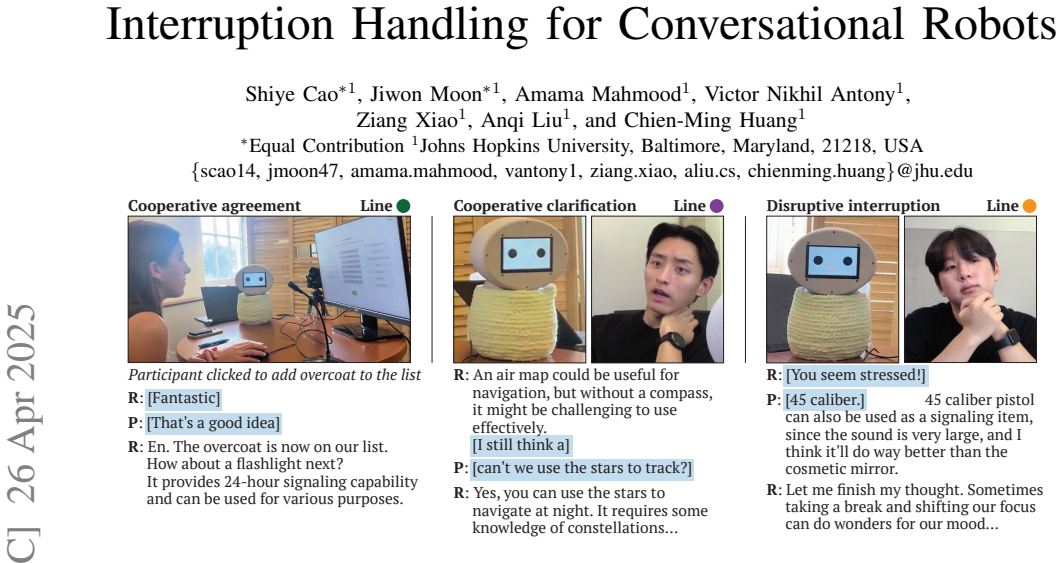
The load-bearing mechanism is a three-module pipeline. Interruption detection monitors for overlapping speech and treats speech as a non-interruption if less than two seconds of planned robot speech remains. Intent classification uses a prompt-engineered large language model that receives the conversational history and the elapsed time since the robot's turn began and returns one of four intents. Strategy selection then follows interaction patterns coded from human-human videos: acknowledge-and-continue for agreement and assistance, answer-and-continue for clarification, and either hold the floor or yield for disruptive interruptions depending on how early in the turn they occur. A wakeword or the word "stop" bypasses the classifier and triggers immediate yielding. The design also separates one-to-two-word backchannels from longer cooperative agreements and treats disruptive interruptions within five seconds of the robot's turn start as aggressive, triggering a floor-holding response.
What would settle it
Record the same 21-participant interactions and re-classify each of the 111 interruptions from transcript plus elapsed time, then compare against prosodic and visual features; if adding pitch, volume, and gaze information changes the classification of more than a few of the 11 misclassified cases, the text-only premise is testably incomplete. More directly, run the system with participants instructed to interrupt using only non-lexical sounds such as sighs or laughter, and measure whether the pipeline can handle those cases at all.
Extended reading notes
Core claim
The paper claims a first for robotic systems: interruption handling driven by intention classification rather than a fixed reaction to overlapping speech. Its central empirical claim is that a system which classifies interruptions into four categories—cooperative agreement, cooperative assistance, cooperative clarification, and disruptive interruption—and selects among strategies such as continue, acknowledge-and-continue, clarify-and-continue, yield immediately, and acknowledge-and-wrap-up achieves 93.69% successful handling in live interaction. The paper also reports that the intent classifier was correct on 88.78% of handled interruptions, that 76.03% of interruption attempts were disruptive, and that both ignoring interruptions and always yielding perform worse on the same data (27.03% and 84.68% successful, respectively). In the paper's own words, no existing robotic system has integrated intention classification into its interruption-handling framework.
Load-bearing premise
The whole handling strategy rests on the language model being able to infer the user's true intent from a text transcript plus elapsed turn time, without hearing tone of voice or seeing the user's face; if text alone cannot reliably separate cooperation from disruption, the strategy selection has no solid foundation.
Editorial extensions
If this is right
- A robot that ignores interruptions would have handled only 27.03% of the interruptions observed in this study, because it would miss 73 disruptive and 8 clarification attempts.
- A robot that always yields would handle 84.68%, failing on cooperative agreement and cooperative assistance, so intent-based handling adds roughly nine percentage points of successful handling.
- Unsuccessful interruption handling correlates with lower perceived inclusion ($\rho = -0.43$, $p = .005$) and lower discussion satisfaction ($\rho = -0.35$, $p = .021$), so handling errors carry social cost.
- Speech recognition errors, not the language model itself, caused most intent misclassifications, so improving automatic speech recognition robustness is the next lever for the approach.
- Users' habits from commercial voice assistants, such as saying the wakeword before every query, can make interactions rigid even when the system supports natural interruption.
Reading between the lines
- Beyond the paper, the text-only classifier's success may not transfer to languages or dialects where agreement and disagreement are carried by prosody rather than words; adding pitch, energy, and speaking-rate features and comparing accuracy on the same recorded interruptions is a direct test.
- Beyond the paper, the five-second aggression rule and the one-to-two-word backchannel rule are thresholds fitted to this study's data, and the optimal cutoffs likely shift with task context and culture.
- Beyond the paper, the finding that participants viewed the robot as an assistive tool and expected it to yield immediately suggests interruption handling can be used to signal robot role: holding the floor may cast the robot as more authoritative, which could help or harm depending on the application.
- Beyond the paper, the dyadic evaluation leaves multi-party interruptions unaddressed; extending the system would require deciding whose interruption to honor when several users speak at once.
Editorial analysis
A structured set of objections, weighed in public.
Referee Report
Summary. This paper presents a real-time interruption-handling system for conversational robots. The system detects user-initiated interruptions via overlapping speech, classifies the interrupter's intent into four categories (cooperative agreement, cooperative assistance, cooperative clarification, disruptive interruption) using an LLM (GPT-4o-mini) with text transcripts and elapsed time, and selects handling strategies derived from interaction patterns observed in human-human YouTube conversations. The authors integrate the system into an LLM-powered social robot and evaluate it in a timed decision-making task and a contentious discussion task with 21 participants. They report that 104 of 111 handled interruptions (93.69%) were successfully handled, that intent classification was correct in 88.78% of cases, and that the system is, to the best of their knowledge, the first robotic system to integrate intention classification into its interruption-handling framework.
Significance. The work addresses an important gap in human-robot interaction: moving beyond always-yield or ignore policies toward context- and intent-aware interruption handling. The paper provides a complete system implementation with open-source code and supplementary materials, a user study with 206 minutes of interaction data, and a two-coder annotation process with high inter-coder reliability (Cohen's Kappa = 0.92). The interaction-pattern analysis from human-human data is a useful design resource for the community. However, the current evaluation does not isolate the contribution of the novel intent-classification module, and the abstract's headline success rate omits important exclusions and lacks a measured baseline. If these evaluation issues are addressed, the work could be a solid empirical contribution to real-time conversational robot design.
major comments (4)
- [Abstract; §VI-B–VI-C] The headline claim 'successfully handled 93.69% (n=104/111) of user-initiated interruptions' does not isolate the paper's intended contribution. Of the 111 handled interruptions, 43 were resolved by wakeword-triggered immediate yield and 13 were 'finish-up' cases with less than two seconds of planned robot speech remaining; both paths bypass the intent classifier entirely (Section VI-B, Fig. 3). Only 55 interruptions passed through the classifier, with 80.00% accuracy (44/55). The Discussion's comparison against 'always yield' (84.68%) and 'ignore' (27.03%) is a post hoc relabeling of the same data, not a measured control condition. Consequently, the aggregate success rate is consistent with a system that mostly yields politely, and it does not by itself demonstrate that real-time intention classification improves interruption handling. The authors should report success separately for classifier-based vs. bypass paths and add a measured baseline condition (e.g., always-yield or wakeword-only) to support the causal claim.
- [§V-E; §VI-C] The success criterion is subjective and lacks an experimental baseline. Coders assessed whether the robot 'effectively responded to the interrupter without causing a conversation breakdown,' but no operational definition of 'conversation breakdown' is given, and the coding was performed by the authors on their own system. In addition, several misclassifications were counted as successful handling (e.g., disruptive interruptions misclassified as clarification, Section VI-D), which makes the metric lenient. Without a baseline condition under the same tasks and participant pool, the 93.69% figure cannot be interpreted as evidence that intention-based handling outperforms simpler policies. I recommend adding a between-subjects baseline (always-yield, ignore, or wakeword-only) or, at minimum, reporting per-path success rates and a more objective outcome measure such as task completion or interrupter goal attainment.
- [§IV-B; §VI-B] The intent classifier relies solely on text transcripts and elapsed time, without prosodic or visual cues, and its accuracy is only 80.00% (44/55) on the classifier-passing subset (95% confidence interval for 44/55 is roughly 67–89%). Because the system's strategy selection is predicated on this classification, the paper should provide a confusion matrix, per-type accuracy (especially for cooperative vs. disruptive), and a discussion of how text-only input biases the classification (e.g., short utterances like 'no' are ambiguous without prosody). The current reporting of aggregate 'intent correctly classified' (88.78%) mixes bypass paths with classifier output and is not sufficient to establish the reliability of the novel component.
- [Abstract; §VI-B] The abstract reports 93.69% (n=104/111) without disclosing that 10 of the 121 observed interruptions were excluded from analysis: five triggered pre-programmed events that bypass the system, and five occurred during a network-related speech-to-text delay (Section VI-B). These exclusions are disclosed in the body, but the abstract's 'user-initiated interruptions' phrase is inaccurate because it omits these cases. The abstract should either use a qualified phrasing (e.g., 'of the 111 interruptions handled by the system') or report the overall rate including all 121 interruptions.
minor comments (6)
- [Fig. 3] The metro-map diagram is visually dense, and the text references 'Line <color>' without ensuring that colors are distinguishable in grayscale or accessible to color-blind readers; please add line labels or numbers.
- [Table II] The table formatting is difficult to parse; the columns and counts for the 'LLM error handling' row and the footnote markers are unclear. Please reformat with explicit column headers and align counts with rows.
- [§VI-A] The sentence 'The timed decision-making task (n=86) had more than twice as many user-initiated interruptions as the contentious discussion task (n=35)' is ambiguous about whether these are per-participant or total counts; please clarify.
- [§V-E] The inter-coder reliability (Cohen's Kappa = 0.92) is reported for the full coding including interruption type and success; please also report reliability separately for the 'successfully handled' judgment, since this is the key outcome variable.
- [§I] The novelty claim 'no existing robotic system has integrated intention classification into its interruption-handling framework' is strong; a systematic survey of prior work in spoken dialogue systems and voice assistants would strengthen it, or the claim should be softened.
- [§VI-D] In the example, the robot says 'I suggested a parachute' after previously discussing a flashlight; the inconsistency between the example text and the item under discussion is confusing and should be corrected.
Circularity Check
No significant circularity: the paper is an empirical system evaluation with no fitted-parameter or self-citation derivation chain.
full rationale
The paper's central claims are empirical: the system detects user-initiated interruptions, classifies their intent via an LLM, selects a handling strategy, and the outcome is measured by coder-judged success. No quantity is derived from another by construction, and no fitted parameter is subsequently relabeled as a prediction. The interaction patterns that motivate the handling strategies are hand-coded from YouTube videos and used as design inputs, not as outputs of the system. The intent taxonomy is imported from prior literature, but not through a self-citation that is load-bearing; the authors' own prior work cited in the paper (gaze aversion, voice-assistant error studies, trust repair) is peripheral to the interruption-handling claim. The 93.69% success figure aggregates cases that bypass the intent classifier (wakeword-triggered yields and finish-up cases) and uses an author-defined success criterion, but this is an evaluation-design and attribution concern, not circularity: the reported outcome is not forced by an equation, by a definitional equivalence, or by the system's own inputs. For these reasons, the paper does not exhibit circular reasoning.
Assumptions & free parameters
free parameters (3)
- planned_speech_threshold =
2 seconds
- aggressive_disruptive_window =
5 seconds
- backchannel_word_limit =
1-2 words
assumptions (3)
- domain assumption LLM text-based classification from transcript and elapsed time suffices to infer interruption intent.
- domain assumption Interruption handling patterns observed in human-human YouTube conversations generalize to human-robot interaction.
- domain assumption The four-category interruption taxonomy (agreement, assistance, clarification, disruptive) is exhaustive for user-initiated interruptions.
Cite this review
Pith. "Pith review of Interruption Handling for Conversational Robots." pith.science (2026). https://pith.science/paper/OUJZUIRX
@misc{pith2026250101568,
  author       = {Pith},
  title        = {Pith review of: Interruption Handling for Conversational Robots},
  year         = {2026},
  howpublished = {\url{https://pith.science/paper/OUJZUIRX}},
  note         = {Machine review of arXiv:2501.01568}
}
read the original abstract
Interruptions, a fundamental component of human communication, can enhance the dynamism and effectiveness of conversations, but only when effectively managed by all parties involved. Despite advancements in robotic systems, state-of-the-art systems still have limited capabilities in handling user-initiated interruptions in real-time. Prior research has primarily focused on post hoc analysis of interruptions. To address this gap, we present a system that detects user-initiated interruptions and manages them in real-time based on the interrupter's intent (i.e., cooperative agreement, cooperative assistance, cooperative clarification, or disruptive interruption). The system was designed based on interaction patterns identified from human-human interaction data. We integrated our system into an LLM-powered social robot and validated its effectiveness through a timed decision-making task and a contentious discussion task with 21 participants. Our system successfully handled 93.69% (n=104/111) of user-initiated interruptions. We discuss our learnings and their implications for designing interruption-handling behaviors in conversational robots.
Figures


Figures from the paper (1 more)

Reference graph
Works this paper leans on
-
[1]
A Robust System for Natural Spoken Dialogue
James F Allen, Bradford W Miller, Eric K Ringger, and Teresa Sikorski. A robust system for natural spoken dialogue. arXiv preprint cmp-lg/9606023 , 1996
work page Pith review arXiv 1996
-
[2]
Conversational gaze aversion for humanlike robots
Sean Andrist, Xiang Zhi Tan, Michael Gleicher, and Bilge Mutlu. Conversational gaze aversion for humanlike robots. In Proceedings of the 2014 ACM/IEEE inter- national conference on Human-robot interaction , pages 25–32, 2014
work page 2014
-
[3]
Geoffrey W Beattie. Interruption in conversational in- teraction, and its relation to the sex and status of the interactants. Linguistics, 1981
work page 1981
-
[4]
More than just a pretty face: affordances of embodiment
Justine Cassell, Timothy Bickmore, Hannes Vilhj´almsson, and Hao Yan. More than just a pretty face: affordances of embodiment. In Proceedings of the 5th international conference on Intelligent user interfaces, pages 52–59, 2000
work page 2000
-
[5]
What Makes a Good Conversation?: Challenges in Designing Truly Conversational Agents
Leigh Clark, Nadia Pantidi, Orla Cooney, Philip Doyle, Diego Garaialde, Justin Edwards, Brendan Spillane, Emer Gilmartin, Christine Murad, Cosmin Munteanu, et al. What Makes a Good Conversation?: Challenges in Designing Truly Conversational Agents. In Proceed- ings of the 2019 CHI conference on human factors in computing systems, pages 1–12, 2019
work page 2019
-
[6]
Multimodal conver- sational interaction with a humanoid robot
Adam Csapo, Emer Gilmartin, Jonathan Grizou, Jing- Guang Han, Raveesh Meena, Dimitra Anastasiou, Kris- tiina Jokinen, and Graham Wilcock. Multimodal conver- sational interaction with a humanoid robot. In 2012 IEEE 3rd International Conference on Cognitive Infocommu- nications (CogInfoCom), pages 667–672. IEEE, 2012
work page 2012
-
[7]
Designing the Impres- sion of Social Agents’ Real-time Interruption Handling
Patrick Gebhard, Tanja Schneeberger, Gregor Mehlmann, Tobias Baur, and Elisabeth Andr´e. Designing the Impres- sion of Social Agents’ Real-time Interruption Handling. In Proceedings of the 19th ACM International Confer- ence on Intelligent Virtual Agents , pages 19–21, 2019
work page 2019
-
[8]
Felix Gervits and Matthias Scheutz. Pardon the interrup- tion: Managing turn-taking through overlap resolution in embodied artificial agents. In Proceedings of the 19th annual SIGdial meeting on discourse and dialogue, pages 99–109, 2018
work page 2018
Show all 24 references
-
[9]
Interrupting the discourse on interrup- tions: An analysis in terms of relationally neutral, power- and rapport-oriented acts
Julia A Goldberg. Interrupting the discourse on interrup- tions: An analysis in terms of relationally neutral, power- and rapport-oriented acts. Journal of Pragmatics , 14(6): 883–903, 1990
1990
-
[10]
What Does an Interruption Sound Like? Stanford University, 2018
Katherine Hilton. What Does an Interruption Sound Like? Stanford University, 2018
2018
-
[11]
Modeling and Evaluating Narrative Gestures for Humanlike Robots
Chien-Ming Huang and Bilge Mutlu. Modeling and Evaluating Narrative Gestures for Humanlike Robots. In Robotics: Science and Systems, volume 2. Citeseer, 2013
2013
-
[12]
What If It Is Wrong
Ulas Berk Karli, Shiye Cao, and Chien-Ming Huang. “What If It Is Wrong”: Effects of Power Dynamics and Trust Repair Strategy on Trust and Compliance in HRI. In Proceedings of the 2023 ACM/IEEE International Conference on Human-Robot Interaction , pages 271– 280, 2023
2023
-
[13]
Interruptions and nonverbal gender differences
Carol W Kennedy and Carl Camden. Interruptions and nonverbal gender differences. Journal of Nonverbal Behavior, 8:91–108, 1983
1983
-
[14]
Sex and power in interaction: Conversational privileges and duties
Peter Kollock, Philip Blumstein, and Pepper Schwartz. Sex and power in interaction: Conversational privileges and duties. American sociological review , pages 34–46, 1985
1985
-
[15]
Situated Understanding of Errors in Older Adults’ Interactions with V oice Assistants: A Month- Long, In-Home Study
Amama Mahmood, Junxiang Wang, and Chien-Ming Huang. Situated Understanding of Errors in Older Adults’ Interactions with V oice Assistants: A Month- Long, In-Home Study. arXiv preprint arXiv:2403.02421, 2024
2024 arXiv
-
[16]
Patterns for how users overcome obstacles in voice user interfaces
Bryan A Myers, Anam Furqan, Jennifer Nebolsky, Kevin Caro, and Junia Zhu. Patterns for how users overcome obstacles in voice user interfaces. In Proceedings of the 2018 CHI Conference on Human Factors in Computing Systems, pages 1–7, 2018
2018
-
[17]
The Benefits of a Jeffersonian Transcript
Song Hee Park and Alexa Hepburn. The Benefits of a Jeffersonian Transcript. Frontiers in Communication, 7: 779434, 2022
2022
-
[18]
On Backchannels in English Conversa- tion
V ojtˇech Pipek. On Backchannels in English Conversa- tion. PhD thesis, Masarykova univerzita, Pedagogick ´a fakulta, 2007
2007
-
[19]
Continuous interac- tion with a virtual human
Dennis Reidsma, Iwan de Kok, Daniel Neiberg, Sathish Chandra Pammi, Bart van Straalen, Khiet Truong, and Herwin van Welbergen. Continuous interac- tion with a virtual human. Journal on Multimodal User Interfaces, 4:97–118, 2011
2011
-
[20]
A survey on dialogue man- agement in human-robot interaction
Merle M Reimann, Florian A Kunneman, Catharine Oertel, and Koen V Hindriks. A survey on dialogue man- agement in human-robot interaction. ACM Transactions on Human-Robot Interaction , 2024
2024
-
[21]
Remote conversations: The effects of mediating talk with technology
Abigail J Sellen. Remote conversations: The effects of mediating talk with technology. Human-computer interaction, 10(4):401–444, 1995
1995
-
[22]
Fresh start: Encouraging politeness in wakeword-driven human-robot interaction
Ruchen Wen, Alyssa Hanson, Zhao Han, and Tom Williams. Fresh start: Encouraging politeness in wakeword-driven human-robot interaction. In Proceed- ings of the 2023 ACM/IEEE International Conference on Human-Robot Interaction, pages 112–121, 2023
2023
-
[23]
What If I Interrupt You
Liu Yang. What If I Interrupt You. In Proceedings of the 2021 International Conference on Multimodal Interaction, pages 827–831, 2021
2021
-
[24]
Multimodal classification of interruptions in humans’ interaction
Liu Yang, Catherine Achard, and Catherine Pelachaud. Multimodal classification of interruptions in humans’ interaction. In Proceedings of the 2022 International Conference on Multimodal Interaction , pages 597–604, 2022
2022
Reviewed August 10, 2026 · model on record in the stance chip above.
Discussion (0). Continue with ORCID to comment.