REVIEW 4 major objections 5 minor 1 cited by
Optimizing Sequence Alignment with Scored NFAs
T0 review · 4 major / 5 minor · reviewed 2026-08-10 · deepseek-v4-flash
Pith's one-line read NAPOLY+ adds per-state score registers to an automata accelerator, letting it report the highest-scoring sequence alignment rather than just the first match.
desk verdict A plausible but unvalidated scored-NFA extension of NAPOLY: the score-update rule is never defined and no functional test is reported, so the central claim of optimal alignment is unsupported. read the letter →
The pith
A machine-rendered reading of the paper's core claim, the machinery that carries it, and where it could break.
The reading
What carries the argument
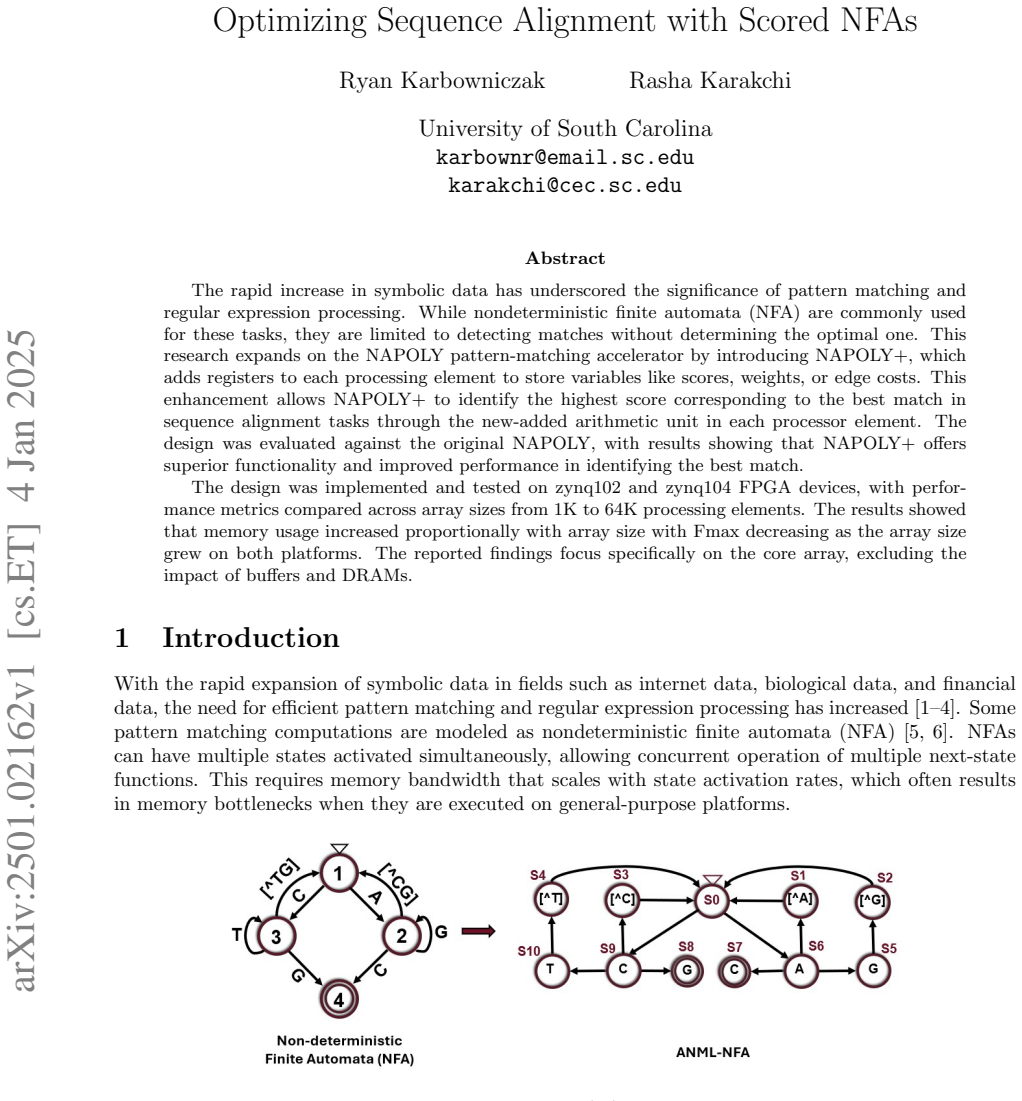
The carrying mechanism is the scored state-transition element: each element holds a symbol-matching state bit, a score register, a configured edge-cost register, and an arithmetic unit that accumulates the incoming predecessor score with the edge cost. The start element stays active for all input symbols and new symbols inject zero scores so fresh paths can begin; accepting elements, which are not connected to the start element, emit the accumulated score when activated. This makes the overlay a hardware implementation of a weighted automaton that evaluates many alternative start-to-accept paths in parallel.
What would settle it
Feed NAPOLY+ a weighted automaton in which two start-to-accept paths with different total scores converge at a common intermediate state, then compare the reported score with the true maximum computed by dynamic programming; a reported score below that maximum would refute the optimality claim.
Extended reading notes
Core claim
The central claim is that NAPOLY+, by adding score tracking to the NAPOLY state-transition elements, can identify the highest score corresponding to the best sequence-alignment match. The paper reports that the enhanced array keeps NAPOLY's activation logic while computing an outgoing score as the incoming score plus a configured edge score, and that accepting elements report the final score once activated. In the reported experiments, the design runs on two FPGA boards across array sizes from 1K to 64K processing elements, uses 90–95% of logic cells on one board and under 85% on the other, keeps distributed-memory use comparable to the original NAPOLY, and shows maximum clock frequency decreasing as array size grows.
Load-bearing premise
The design assumes that keeping a single score per processing element, reset to zero at the start of each new input symbol, is enough to maintain the best accumulated path score when several active paths reach the same element at the same time.
Editorial extensions
If this is right
- If the design is correct, sequence alignment on the overlay returns the optimal score, not merely a first match, which is the quantity needed for DNA similarity scoring.
- The added arithmetic and registers raise logic-cell utilization by a few percentage points while leaving distributed-memory use close to NAPOLY's, so the capability is affordable at array sizes up to 64K.
- Maximum clock frequency falls as the array grows on both tested FPGAs, with the larger board staying roughly 50–100 MHz faster, so the achievable throughput depends on array scale.
- Because the score mechanism is generic over configured edge costs, the same arithmetic unit can encode different scoring rules for matches, mismatches, and gaps without changing the fabric.
Reading between the lines
- If one score register per element is truly enough, then NAPOLY+ is computing the maximum path score in the Viterbi sense, so the design could be reused for shortest-path problems or probabilistic model scoring by reinterpreting the edge weights.
- The paper's evaluation measures hardware metrics, not alignment accuracy against a known-optimal software result; a direct comparison of reported scores to dynamic-programming optimal scores on benchmark sequences would settle the functional claim.
- The unresolved point of how multiple incoming scores to the same element in the same cycle are combined means the architecture likely assumes one dominant predecessor per cycle; testing with converging paths would reveal whether the reported score is an upper or lower bound.
- The reported resource figures exclude buffers and DRAMs, so end-to-end system scaling with the memory hierarchy may differ from the core-array trends shown here.
Editorial analysis
A structured set of objections, weighed in public.
Referee Report
Summary. This manuscript describes NAPOLY+, a modification of the NAPOLY FPGA-based nondeterministic finite automaton overlay. Each state-transition element is extended with a register for a score/weight and an arithmetic unit, with the stated goal of making the accelerator report the highest-scoring match, e.g., the optimal score in DNA sequence alignment. Section 3 gives a high-level description of the STE+ and the array, and Section 4 reports FPGA resource utilization, distributed-memory usage, fan-out, Fmax, and throughput for array sizes from 1K to 64K on ZCU102 and ZCU104 boards, compared against the original NAPOLY. No functional or simulation results for alignment scores are reported.
Significance. The intended contribution is potentially useful: scoring an NFA overlay in a max-plus sense would extend automata processors beyond Boolean match detection and could benefit sequence alignment and related applications. The paper also provides resource-scaling data at nontrivial array sizes. However, the manuscript does not define the score-update rule essential to correct computation, does not provide functional verification, and leaves citation placeholders and unclear relations to prior work. Because none of the reported measurements concerns correctness of the computed scores, the central claim is currently unsupported. No machine-checked proofs, source code, or test vectors are shipped.
major comments (4)
- [Section 3, STE+ arithmetic and score update] The paper never defines the rule by which an STE+ combines multiple incoming scores. After stating that each STE+ 'combines activation signals from all f predecessors,' it says only that the outgoing score is calculated 'based on the incoming score from its predecessor and its edge score' (singular). For weighted automata, optimal alignment requires the max-plus recurrence S_q(t) = max_{p in pred(q)} (S_p(t-1) + w(p,q)). The text does not state whether the arithmetic unit implements this maximum, a sum, or first-arrival selection. The sentence 'we initialize the incoming scores to zero for every new symbol' is also ambiguous: if all scores are reset on every symbol, accumulated path scores cannot propagate across multiple symbols; if only new-start paths are reset, that exception needs to be part of an explicit update equation. Without this definition, the claimed computation of highest alignment scores is not established.
- [Section 4, functional validation] All experimental results in Section 4 are resource and timing metrics: LUT utilization, distributed memory, fan-out, Fmax, and throughput. There is no simulation trace, no known-answer test, no comparison of NAPOLY+ scores against a reference alignment algorithm such as Needleman-Wunsch or against the authors' earlier scored-NFA implementation, and no demonstration that accepting STEs report the same score as a software baseline. The abstract's statement that 'results showing that NAPOLY+ offers superior functionality' is therefore not supported by the data presented.
- [Section 3, start-state and accepting-state connections] The special connections for the start STE+ are described only informally: 'we designed all (STE+)s to be connected to the start STE+' but accepting STEs 'have no connection with the start state.' This raises questions about how a match that begins at the start state and ends at an accepting state is scored when the accepting state can only be reached through non-start predecessors, and how gap penalties on multi-symbol paths are applied when the start state is continuously active. A precise description of the interconnection topology and the handling of new-start path scores is needed to evaluate the design.
- [Section 3 and References, completeness] The manuscript contains two unresolved citation placeholders ('[?]') in Section 3 and cites the authors' previous arXiv preprint [12] without explaining the incremental contribution of NAPOLY+ over that work. This prevents a reviewer from verifying novelty and reproducibility. The text as submitted is not complete enough for publication.
minor comments (5)
- [Abstract and throughout] The spacing in 'NF A' is inconsistent (e.g., Abstract and Section 2.1); use 'NFA' consistently throughout the manuscript.
- [Section 4, device names and units] The text mixes 'zynq102'/'zynq104' with 'ZCU102'/'ZCU104', and states '6.2 Mb Mb of distributed memory' with a duplicated unit; these should be standardized and corrected.
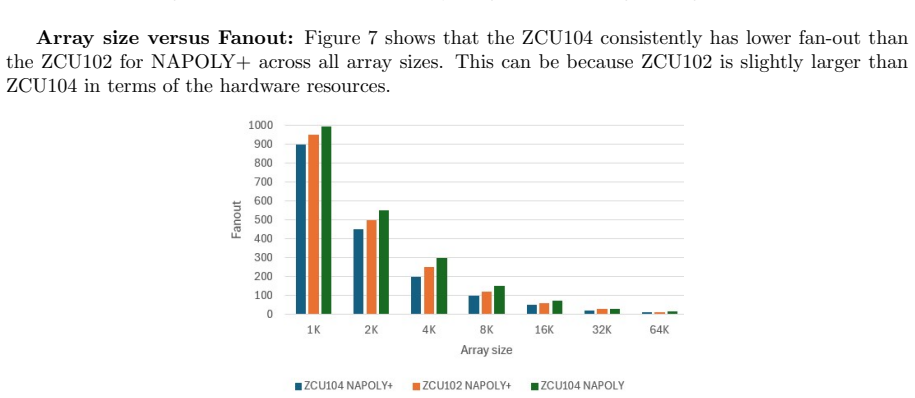
- [Figures 5-8] The figures referenced in Section 4 are not included in the submitted text; each figure needs axis labels, units, and clear descriptions of what is plotted (e.g., point markers versus lines) so the resource data can be interpreted.
- [Section 3, score representation] The description of the score registers and arithmetic unit should specify the bit width and signed representation, since the motivating example uses negative scores for mismatches and gaps.
- [Section 2.2, weighted automata versus ANML] The weighted automaton definition in Section 2.2 assigns weights to transitions, while NAPOLY uses ANML with labels on states; the mapping between these two representations and the resulting edge-score register in STE+ should be stated explicitly.
Circularity Check
No significant circularity: NAPOLY+ extends the authors' earlier NAPOLY with scored STEs, but the claimed best-match scoring is not derived by construction from its inputs.
full rationale
The paper's contribution is an engineering extension rather than a derivation that reduces to its own inputs. NAPOLY+ adds per-STE score registers and an arithmetic unit to the previously published NAPOLY overlay; the abstract's 'highest score' claim is a design goal, and the reported evaluation is resource utilization and Fmax, not a statistical fit followed by a prediction. The score-update rule is under-specified (no equation defines how multiple predecessor scores combine), and no functional simulation validates the alignment result; these are correctness and evidence gaps, not circularity. Citations to the authors' own NAPOLY papers and to a prior scored-NFA preprint supply background and design context, but no load-bearing step is forced by a self-citation chain, and no parameter is fitted then renamed as a prediction. The central claim is therefore unverified rather than equivalent to an input by definition, so the circularity score is 0.
Assumptions & free parameters
assumptions (3)
- domain assumption The start state remains active at all times, and a new match can begin at every input symbol.
- domain assumption Additive transition scores (match, mismatch, gap) with maximization yield the biologically optimal alignment.
- ad hoc to paper A single score register per STE+ can represent the best score for that state at each point in time.
invented entities (1)
-
STE+ (scored State Transition Element)
Cite this review
Pith. "Pith review of Optimizing Sequence Alignment with Scored NFAs." pith.science (2026). https://pith.science/paper/6X5U7TM2
@misc{pith2026250102162,
  author       = {Pith},
  title        = {Pith review of: Optimizing Sequence Alignment with Scored NFAs},
  year         = {2026},
  howpublished = {\url{https://pith.science/paper/6X5U7TM2}},
  note         = {Machine review of arXiv:2501.02162}
}
read the original abstract
The rapid increase in symbolic data has underscored the significance of pattern matching and regular expression processing. While nondeterministic finite automata (NFA) are commonly used for these tasks, they are limited to detecting matches without determining the optimal one. This research expands on the NAPOLY pattern-matching accelerator by introducing NAPOLY+, which adds registers to each processing element to store variables like scores, weights, or edge costs. This enhancement allows NAPOLY+ to identify the highest score corresponding to the best match in sequence alignment tasks through the new-added arithmetic unit in each processor element. The design was evaluated against the original NAPOLY, with results showing that NAPOLY+ offers superior functionality and improved performance in identifying the best match. The design was implemented and tested on zynq102 and zynq104 FPGA devices, with performance metrics compared across array sizes from 1K to 64K processing elements. The results showed that memory usage increased proportionally with array size with Fmax decreasing as the array size grew on both platforms. The reported findings focus specifically on the core array, excluding the impact of buffers and DRAMs.
Figures


Figures from the paper (5 more)



Forward citations
Cited by 1 Pith paper
-
ML-Based Automata Simplification for Symbolic Accelerators
AutoSlim prunes NFA transitions with a Random Forest that simply learns a score threshold, reporting hardware savings but no evidence that matching semantics are preserved.
Reference graph
Works this paper leans on
-
[12]
A scored non-deterministic finite automata processor for sequence alignment, 2024
Ryan Karbowniczak and Rasha Karakchi. A scored non-deterministic finite automata processor for sequence alignment, 2024. arXiv preprint arXiv:2410.19758
arXiv 2024
-
[1]
Bradshaw, Rasha Karakchi, and Jason D
Jordan A. Bradshaw, Rasha Karakchi, and Jason D. Bakos. Two-hit filter synthesis for genomic database search. In 2016 IEEE 24th Annual International Symposium on Field-Programmable Cus- tom Computing Machines (FCCM) , volume 52–55, pages 165–172, 2016. 6
work page 2016
-
[2]
Rasha Karakchi, Jordan A. Bradshaw, and Jason D. Bakos. High-level synthesis of a genomic database search engine. In 2016 International Conference on ReConFigurable Computing and FP- GAs (ReConFig), pages 1–6, 2016
work page 2016
-
[3]
Rasha Karakchi and Jason D. Bakos. Napoly: A non-deterministic automata processor overlay. ACM Transactions on Reconfigurable Technology and Systems, 16:1–25, 2023
2023
-
[4]
Robotomata: A framework for approximate pattern matching of big data on an automata processor
Xiaodong Yu, Kaixi Hou, Hao Wang, and Wu chun Feng. Robotomata: A framework for approximate pattern matching of big data on an automata processor. In 2017 IEEE International Conference on Big Data (Big Data) , pages 283–292, 2017
work page 2017
-
[5]
Rasha Karakchi, Lothrop O. Richards, and Jason D. Bakos. A dynamically reconfigurable automata processor overlay. In 2017 International Conference on ReConFigurable Computing and FPGAs (ReConFig), pages 1–8, 2017
work page 2017
-
[6]
An overlay architecture for pattern matching
Rasha Karakchi, Charles Daniels, and Jason Bakos. An overlay architecture for pattern matching. In 2019 IEEE 30th International Conference on Application-specific Systems, Architectures and Processors (ASAP), volume 2160–052X, pages 165–172, 2019
work page 2019
-
[7]
Finding motifs in biological sequences using the micron automata processor
Indranil Roy and Srinivas Aluru. Finding motifs in biological sequences using the micron automata processor. In 2014 IEEE 28th International Parallel and Distributed Processing Symposium , pages 415–424, 2014
work page 2014
Show all 20 references
-
[8]
K. Wang, K. Angstadt, C. Bo, N. Brunelle, E. Sadredini, T. Tracy, J. Wadden, M. Stan, and K. Skadron. An overview of micron’s automata processor. In Proceedings of the 11th IEEE/ACM/IFIP International Conference on Hardware/Software Codesign and System Synthe- sis, 2017
2017
-
[9]
Weighted automaton, 2024
Wikipedia Contributors. Weighted automaton, 2024. Accessed: 2024-12-29
2024
-
[10]
Weighted automata algorithms
Mehryar Mohri. Weighted automata algorithms. In Handbook of weighted automata, pages 213–254. Springer, 2009
2009
-
[11]
Handbook of Weighted Automata
Bakh Khoussainov and Wei Li, editors. Handbook of Weighted Automata . Springer, 2020
2020
-
[13]
Weighted automata algorithms
Mehryar Mohri. Weighted automata algorithms. IEEE Transactions on Neural Networks and Learning Systems, 23(1):17–28, 2012
2012
-
[14]
Bakos and Rasha Karakchi
Jason D. Bakos and Rasha Karakchi. nfatool, 2023. https://github.com/HeRCLab/nfatool
2023
-
[15]
An efficient and scalable semiconductor architecture for parallel automata processing
Paul Dlugosch, Dave Brown, Paul Glendenning, Michael Leventhal, and Harold Noyes. An efficient and scalable semiconductor architecture for parallel automata processing. IEEE Transactions on Parallel and Distributed Systems , 25(12):3088–3098, 2014
2014
-
[16]
Approximating proba- bilistic models as weighted finite automata
Ananda Theertha Suresh, Brian Roark, Michael Riley, and Vlad Schogol. Approximating proba- bilistic models as weighted finite automata. 2021
2021
-
[17]
Quasi-distances and weighted finite automata
Timothy Ng, David Rappaport, and Kai Salomaa. Quasi-distances and weighted finite automata. In International Workshop on Descriptional Complexity of Formal Systems , pages 209–219. Springer, 2015
2015
-
[18]
Zcu104 evaluation board user guide, 2019
Xilinx Inc. Zcu104 evaluation board user guide, 2019. Retrieved from https://www.mouser.com/datasheet/2/903/ug1267-zcu104-eval-bd-1596428.pdf
2019
-
[19]
Zcu102 evaluation board user guide, 2019
Xilinx Inc. Zcu102 evaluation board user guide, 2019. Retrieved from https://www.mouser.com/pdfDocs/ug1182-zcu102-eval-bd.pdf
2019
-
[20]
A scratchpad spiking neural network accelerator
Rasha Karakchi. A scratchpad spiking neural network accelerator. In 2024 IEEE 3rd International Conference on Computing and Machine Intelligence (ICMI) , pages 1–5. IEEE, 2024. 7
2024
Reviewed August 10, 2026 · model on record in the stance chip above.
Discussion (0). Continue with ORCID to comment.