REVIEW 3 major objections 5 minor 39 references
Colour symmetry and altermagnetic-like spin textures in noncollinear antiferromagnets
T0 review · 3 major / 5 minor · reviewed 2026-08-10 · deepseek-v4-flash
Pith's one-line read Non-collinear antiferromagnets carry a spin-texture component that survives without spin-orbit coupling, and colour symmetry groups determine exactly what that component is.
desk verdict Colour-group tensors cleanly extract SOC-free spin textures in the tested isomorphic CG/SG cases, but the general claim overreaches into an unproven supergroup regime. read the letter →
The pith
A machine-rendered reading of the paper's core claim, the machinery that carries it, and where it could break.
The reading
What carries the argument
The central object is the colour point group (CPG): a group of point-group operations composed with colour permutations, where each colour labels a real-space spin direction and each anti-colour labels its time-reversed opposite. The paper uses the notation $\{G|H'|H\}$, with $G$ the parent point group, $H'$ the subgroup leaving one colour invariant, and $H$ the subgroup leaving all colours invariant. From a generic symmetric tensor one projects tensors symmetrised by the CPG, multiplies each coloured tensor by the axial unit vector of its assigned spin direction, and sums to obtain the altermagnetic-like spin texture. Because the magnetic point group is a subgroup of the CPG, the resulting tensor is automatically a special case of the full MPG tensor, which provides the decomposition into SOC-free and SOC-dependent contributions.
What would settle it
Perform a spin-resolved DFT calculation without spin-orbit coupling on a non-collinear antiferromagnet whose magnetic structure breaks crystal symmetry, and decompose the Fermi-surface spin texture into the tensor basis of its colour point group; any non-zero texture component forbidden by that colour group would show that the colour group does not capture the full SOC-free texture.
Extended reading notes
Core claim
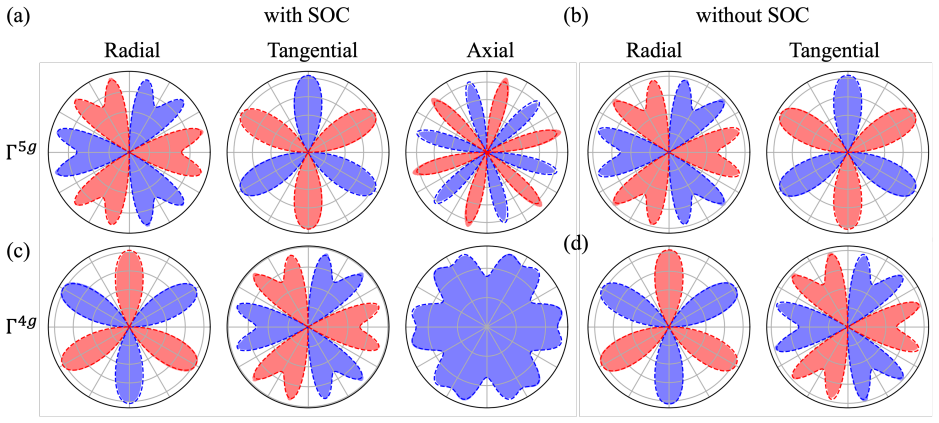
The central claim is that for non-collinear antiferromagnets one can extract, from the textures allowed by the magnetic point group, a component that is invariant under arbitrary global rotations in spin space and can exist in the absence of spin-orbit coupling, exactly as in collinear altermagnets. This component is generated by a tensor built from the colour point group of the ordered moments; the full magnetic-point-group tensor contains it as a special case, so the MPG/CPG pair separates the texture into an SOC-free altermagnetic-like part and a residual SOC-dependent part. For Mn3GaN the special-case condition is $\Lambda_2=\Lambda_3=0$. Spin-resolved DFT without SOC reproduces the CPG texture, and switching on SOC adds an axial $(111)$ component that is zero on average for $\Gamma_{5g}$ but yields weak ferromagnetism for $\Gamma_{4g}$.
Load-bearing premise
The load-bearing premise is that the symmetry of the static arrangement of atomic spins completely determines the symmetry of the SOC-free electronic spin texture; if electron-correlation or Fermi-surface effects broke that correspondence, the colour-group decomposition would misassign the SOC-free part.
Editorial extensions
If this is right
- For any non-collinear antiferromagnet, the SOC-free spin texture is fixed by the colour group of the ordered moments alone, so it can be predicted without DFT or adjustable parameters.
- The MPG/CPG pair decomposes every texture into an altermagnetic-like, rotation-invariant part and a residual SOC-dependent part; the residual part is what changes when spin-orbit coupling is turned on.
- For Mn3Ir(Ge,Si) and Pb2MnO4, where magnetic order does not break crystallographic symmetry, the CPG texture coincides with the full MPG texture, meaning their lowest-order spin textures are entirely SOC-free.
- For Mn3GaN, the $\Gamma_{5g}$ and $\Gamma_{4g}$ textures are orthogonal and related by a 90-degree spin-space rotation; without SOC the axial $(111)$ component is absent, while with SOC it appears and is net-polarised only in $\Gamma_{4g}$.
- Tensorial fits show CPG expansions of the no-SOC DFT textures and MPG expansions of the SOC textures agree with the Fermi-surface calculations to high tensor rank.
Reading between the lines
- Editorial extension: because the colour-group input is just the ordered magnetic structure, the method could be used as a high-throughput screen to identify non-collinear magnets with large SOC-free spin textures before performing expensive electronic-structure calculations.
- Editorial extension: the paper's closing remark suggests the same colour-symmetry idea, with the axial colour vectors replaced by bond-based cross products of the two site spins, could cover k/-k-antisymmetric magnets such as p-wave and triangular-lattice systems; if that adaptation succeeds, the colour-group framework would unify the symmetry description of both texture classes.
- Editorial extension: the invariance property implies that any two magnetic phases of one material related by a global spin rotation should have identical SOC-free textures up to that rotation; the $\Gamma_{5g}$/$\Gamma_{4g}$ pair is one check of this, and other multi-phase materials could test it more broadly.
Editorial analysis
A structured set of objections, weighed in public.
Referee Report
Summary. The paper introduces a colour point group (CPG) formalism to extract, from the momentum-space spin texture of non-collinear antiferromagnets, a component that is invariant under global spin-space rotations and can exist without spin-orbit coupling, in analogy with collinear altermagnets. The construction starts from a generic symmetric tensor, projects it onto the CPG of the ordered moments, and combines the resulting coloured tensors with the real-space spin directions to form an 'altermagnetic-like' tensor. The authors show by explicit examples (Mn3Ir(Ge,Si), Pb2MnO4, and the Gamma-5g and Gamma-4g phases of Mn3GaN) that the CPG tensor is a special case of the full magnetic-point-group tensor, and they validate the prediction for Mn3GaN with spin-resolved DFT calculations with and without spin-orbit coupling, including a tensorial decomposition of the DFT textures.
Significance. If the central claim holds in full generality, the paper provides a systematic, parameter-free symmetry method for computing the SOC-independent component of spin textures in non-collinear magnets and for predicting which materials can display altermagnetic-like textures. The tensorial projection is clean, involves no fitted symmetry parameters, and the construction of CPG tensors as special cases of MPG tensors follows by group inclusion. The DFT check on Mn3GaN is a genuine, direct test: the no-SOC calculation lacks the axial component predicted to be absent, and the SOC calculation acquires it, which is a strong point in the paper's favour. The principal limitation is that the identification of CPG symmetry with the symmetry of the SOC-free electronic texture is explicitly acknowledged to fail in general for inequivalent-magnitude orbits, and that regime is not tested by any of the worked examples.
major comments (3)
- [III B and VIII] The general claim that the CPG-projected tensor is the SOC-free component of the spin texture is not established for the case explicitly acknowledged in Sec. III B, where spins connected by colour operations do not have the same magnitude. In that case the CPG is a proper supergroup of the spin group, so the extra colour-permutation operations are not symmetries of the magnetic Hamiltonian and there is no symmetry reason for the electronic texture to obey them. All three materials analysed in the main text, including the DFT-tested Mn3GaN, have isomorphic CG and SG, so the presented validation does not test this regime. The authors should either prove that the 'hidden symmetries' nevertheless constrain the SOC-free texture, provide a non-isomorphic test case, or explicitly restrict the central claim to the isomorphic case.
- [VI] The sentence after Eq. (14), 'It can also be shown that more general four-colour models based on the same CPG produce an altermagnetic-like tensor that is identical to T_MPG', is presented without proof. This assertion matters because it is used to argue that the CPG building blocks can reconstruct not only the special Lambda14-only texture but the full MPG tensor for Pb2MnO4-like systems. Please supply the derivation in the text or an appendix, or clearly label the statement as a conjecture for future work.
- [VII C] The DFT validation of the CPG/MPG decomposition is presented through one graphical example (Fig. 7) with fit parameters deferred to Supplementary Tables S1 and S2, and no goodness-of-fit statistic is reported in the main text. Since the consistency between DFT and the symmetry tensors is a central load-bearing result, the revision should report fit residuals or a similar quantitative measure for all four bands and both phases, so the reader can assess the claimed 'very good agreement' rather than relying on visual inspection.
minor comments (5)
- [III and Ref. 18] Typographical errors: 'Shubkikov' in Sec. III and 'Kozev' in Ref. 18 should be corrected to 'Shubnikov' and 'Kotzev', respectively.
- [VI, Eq. (11)] The definition 'B = (ee + f)/2' appears to contain a typo; it should presumably read 'B = (e + f)/2'.
- [V A, Eq. (8)] The spin vectors in Eq. (8) are not normalized whereas those in Eqs. (15) and (16) are; the authors should state that only the directions matter or normalize the vectors consistently.
- [V A] The main text refers to 'Eq. 16' when re-assigning colours to spin-texture directions, but the colour assignments appear in Eq. (3) of the present version; the cross-reference should be corrected.
- [Ref. 6] Reference 6 is dated '(2040)', which is likely a typo; the year should be corrected.
Circularity Check
No significant circularity: the CPG tensors are obtained by explicit projection and validated against independent DFT; the same-author MPG tables are used only as comparison, not as input.
full rationale
The paper's central construction is self-contained: the coloured tensors are produced by explicit projection from a generic symmetric tensor under the colour point group, with no fitted parameters, and the spin texture is then assembled from these tensors and the real-space moment directions. The claimed rotational invariance (Eq. 2) follows by construction from the colour assignment and is not an input renamed as a prediction. The comparison with MPG tensors from Ref. 3 (a prior paper by one of the authors) is a benchmark, not a load-bearing premise: the CPG tensors are displayed explicitly so the relation T_CPG = special case of T_MPG can be checked directly, and the MPG tensors themselves are standard symmetry-allowed forms. The DFT calculation for Mn3GaN provides an independent external test, especially the absence of the axial spin-texture component without SOC, which is not fitted. The admitted case where the colour group is a proper supergroup of the spin group (Sec. III B) is a stated limitation of the general claim rather than a circular reduction; none of the three worked examples relies on that regime, and the Mn3GaN validation is restricted to the isomorphic CG/SG case. No equation in the paper reduces to its own input, and no fitted quantity is presented as a prediction. The self-citation to Ref. 3 does not make the argument circular because the cited MPG tensor tables are independent of the CPG construction and are used only for comparison.
Assumptions & free parameters
free parameters (1)
- Tensorial expansion coefficients fitted to DFT spin textures (radial, tangential, axial components for each band) =
not given in main text; tabulated in SI Tables S1-S2
assumptions (4)
- standard math Colour symmetry group classifications (Harker 1981; Kotzev and Alexandrova 1988) are correct and applicable to magnetic structures.
- domain assumption The magnetic point group tensor tables from Radaelli, PRB 110, 214428 (2024), Ref. 3, are correct and complete for the MPG classes used.
- domain assumption The symmetry of the SOC-free electronic spin texture is given by the colour group of the static magnetic structure, so that spin textures are covariant under global spin rotations (Eq. 2) and fully captured by CPG-projected tensors.
- domain assumption Spin textures can be represented as polynomial tensors in k to arbitrary rank (Eq. 1) and the leading low-rank terms describe the Fermi-surface texture.
Cite this review
Pith. "Pith review of Colour symmetry and altermagnetic-like spin textures in noncollinear antiferromagnets." pith.science (2026). https://pith.science/paper/XUNA4AOU
@misc{pith2026250102947,
  author       = {Pith},
  title        = {Pith review of: Colour symmetry and altermagnetic-like spin textures in noncollinear antiferromagnets},
  year         = {2026},
  howpublished = {\url{https://pith.science/paper/XUNA4AOU}},
  note         = {Machine review of arXiv:2501.02947}
}
abstract
We present a formalism based on colour symmetry to analyse the momentum-space spin textures of non-collinear antiferromagnets. We show that, out of the spin textures allowed by the magnetic point group, \textcolor{\altcolor} {one can extract a component that is invariant by general rotations in spin space, and can exist in the absence of spin-orbit coupling, in complete analogy to spin textures in altermagnets}. We demonstrate this approach in the case of three complex, non-collinear magnets, Mn$_3$Ir(Ge,Si), Pb$_2$MnO$_4$ and Mn$_3$GaN. For Mn$_3$GaN, we also show that the predictions of colour-symmetry analysis are consistent with density functional theory calculations performed on the same system both with and without spin-orbit coupling.
Figures


Figures from the paper (4 more)


Reference graph
Works this paper leans on
-
[1]
author author L. S mejkal , author J. Sinova , \ and\ author T. Jungwirth ,\ 10.1103/PHYSREVX.12.031042/FIGURES/4/MEDIUM journal journal Physical Review X \ volume 12 ,\ pages 031042 ( year 2022 a ) NoStop
work page doi:10.1103/physrevx.12.031042/figures/4/medium 2022
-
[2]
author author L. S mejkal , author J. Sinova , \ and\ author T. Jungwirth ,\ 10.1103/PHYSREVX.12.040501/FIGURES/14/MEDIUM journal journal Physical Review X \ volume 12 ,\ pages 040501 ( year 2022 b ) ,\ http://arxiv.org/abs/2204.10844 arXiv:2204.10844 NoStop
arXiv 2022
-
[3]
author author P. G. \ Radaelli ,\ 10.1103/PhysRevB.110.214428 journal journal Physical Review B \ volume 110 ,\ pages 214428 ( year 2024 ) NoStop
-
[4]
author author S. W. \ Cheong \ and\ author F. T. \ Huang ,\ 10.1038/s41535-024-00626-6 journal journal npj Quantum Materials 2024 9:1 \ volume 9 ,\ pages 1 ( year 2024 ) NoStop
-
[5]
author author A. B. \ Hellenes , author T. Jungwirth , author R. Jaeschke-Ubiergo , author A. Chakraborty , author J. Sinova , \ and\ author L. S mejkal ,\ https://arxiv.org/abs/2309.01607v3 \ ( year 2023 ) ,\ http://arxiv.org/abs/2309.01607 arXiv:2309.01607 NoStop
arXiv 2023
-
[6]
author author S. Hayami , author Y. Yanagi , \ and\ author H. Kusunose ,\ 10.1103/PhysRevB.101.220403 journal journal Physical Review B \ volume 101 ,\ pages 220403 ( year 2040 ) NoStop
-
[7]
note ` k /- k symmetric / anti-symmetric ' means that the spin texture, defined as s _ n k = _ n k | | _ n k (see below) is the same/changes sign by exchanging k and - k . `Time-reversal odd/even' means that the spin texture in the time-reversed magnetic domain (i.e., the domain obtained by flipping all the magnetic moments) is opposite/the same for a giv...
-
[8]
author author G. Dresselhaus ,\ 10.1103/PhysRev.100.580 journal journal Physical Review \ volume 100 ,\ pages 580 ( year 1955 ) NoStop
Show all 39 references
-
[9]
author author E. I. \ Rashba \ and\ author V. Sheka ,\ @noop journal journal Fiz. Tverd. Tela: Collected Papers \ volume 2 ,\ pages 62 ( year 1959 ) NoStop
1959
-
[10]
Z elezn \' y , author Y
author author J. Z elezn \' y , author Y. Zhang , author C. Felser , \ and\ author B. Yan ,\ 10.1103/PHYSREVLETT.119.187204/FIGURES/3/MEDIUM journal journal Physical Review Letters \ volume 119 ,\ pages 187204 ( year 2017 ) ,\ http://arxiv.org/abs/1702.00295 arXiv:1702.00295 NoStop
2017 arXiv
-
[11]
o ck , \ and\ author J. K \
author author J. Sticht , author K. H. \ H \" o ck , \ and\ author J. K \" u bler ,\ 10.1088/0953-8984/1/43/016 journal journal Journal of Physics: Condensed Matter \ volume 1 ,\ pages 8155 ( year 1989 ) NoStop
1989 doi
-
[12]
For this reason, we will exclude k /- k -antisymmetric magnets from our treatment
note As explained in the remainder, the CG approach can be employed to describe the magnetic structures of k /- k -antisymmetric magnets, but coloured tensors as defined here would require some modifications. For this reason, we will exclude k /- k -antisymmetric magnets from ...
-
[13]
Brekke , author P
author author B. Brekke , author P. Sukhachov , author H. G. \ Giil , author A. Brataas , \ and\ author J. Linder ,\ https://arxiv.org/abs/2405.15823v1 \ ( year 2024 ) ,\ http://arxiv.org/abs/2405.15823 arXiv:2405.15823 NoStop
2024 arXiv
-
[14]
Harker ,\ 10.1107/S0567739481000697 journal journal Acta Crystallographica Section A \ volume 37 ,\ pages 286 ( year 1981 ) NoStop
author author D. Harker ,\ 10.1107/S0567739481000697 journal journal Acta Crystallographica Section A \ volume 37 ,\ pages 286 ( year 1981 ) NoStop
1981 doi
-
[15]
Sivardi \` e re ,\ 10.1107/S0108767384001197 journal journal Acta Crystallographica Section A \ volume 40 ,\ pages 573 ( year 1984 ) NoStop
author author J. Sivardi \` e re ,\ 10.1107/S0108767384001197 journal journal Acta Crystallographica Section A \ volume 40 ,\ pages 573 ( year 1984 ) NoStop
1984 doi
-
[16]
author author R. L. \ Roth ,\ 10.1107/S0108767385001039 journal journal Acta Crystallographica Section A \ volume 41 ,\ pages 484 ( year 1985 ) NoStop
1985 doi
-
[17]
Sivardi \` e re ,\ 10.1107/S0108767388005549 journal journal Acta Crystallographica \ volume 44 ,\ pages 735 ( year 1988 ) NoStop
author author J. Sivardi \` e re ,\ 10.1107/S0108767388005549 journal journal Acta Crystallographica \ volume 44 ,\ pages 735 ( year 1988 ) NoStop
1988 doi
-
[18]
author author J. N. \ Kotzev \ and\ author D. A. \ Alexandrova ,\ 10.1107/S0108767388008335 journal journal Acta Crystallographica Section A \ volume 44 ,\ pages 1082 ( year 1988 ) NoStop
1988 doi
-
[19]
author author D. B. \ Litvin , author J. N. \ Kotzev , \ and\ author J. L. \ Birman ,\ 10.1103/PhysRevB.26.6947 journal journal Physical Review B \ volume 26 ,\ pages 6947 ( year 1982 ) NoStop
1982 doi
-
[20]
Jir \' a k ,\ 10.1103/PhysRevB.46.8725 journal journal Physical Review B \ volume 46 ,\ pages 8725 ( year 1992 ) NoStop
author author Z. Jir \' a k ,\ 10.1103/PhysRevB.46.8725 journal journal Physical Review B \ volume 46 ,\ pages 8725 ( year 1992 ) NoStop
1992 doi
-
[21]
author author E. F. \ Bertaut ,\ 10.1107/S0567739468000306 journal journal Acta Crystallographica Section A \ volume 24 ,\ pages 217 ( year 1968 ) NoStop
1968 doi
-
[22]
author author Y. A. \ Izyumov ,\ 10.1016/0304-8853(80)91147-6 journal journal Journal of Magnetism and Magnetic Materials \ volume 15-18 ,\ pages 497 ( year 1980 ) NoStop
1980 doi
-
[23]
author author D. B. \ Litvin ,\ 10.1107/S0567739477000709 journal journal Acta Crystallographica Section A \ volume 33 ,\ pages 279 ( year 1977 ) NoStop
1977 doi
-
[24]
Eriksson , author L
author author T. Eriksson , author L. Bergqvist , author P. Nordblad , author O. Eriksson , \ and\ author Y. Andersson ,\ 10.1016/J.JSSC.2004.07.001 journal journal Journal of Solid State Chemistry \ volume 177 ,\ pages 4058 ( year 2004 a ) NoStop
2004 doi
-
[25]
Eriksson , author R
author author T. Eriksson , author R. Liz \' a rraga , author S. Felton , author L. Bergqvist , author Y. Andersson , author P. Nordblad , \ and\ author O. Eriksson ,\ 10.1103/PhysRevB.69.054422 journal journal Physical Review B \ volume 69 ,\ pages 054422 ( year 2004 b ) NoStop
-
[26]
Hu , author O
author author M. Hu , author O. Janson , author C. Felser , author P. McClarty , author J. van den Brink , \ and\ author M. G. \ Vergniory ,\ https://arxiv.org/abs/2410.17993v2 \ ( year 2024 ) ,\ http://arxiv.org/abs/2410.17993 arXiv:2410.17993 NoStop
2024
-
[27]
author author S. A. \ Kimber \ and\ author J. P. \ Attfield ,\ 10.1039/B704361A journal journal Journal of Materials Chemistry \ volume 17 ,\ pages 4885 ( year 2007 ) NoStop
2007 doi
-
[28]
author author D. C. \ Kakarla , author H. C. \ Wu , author D. J. \ Hsieh , author P. J. \ Sun , author G. J. \ Dai , author J. Y. \ Lin , author J. L. \ Her , author Y. H. \ Matsuda , author L. Z. \ Deng , author M. Gooch , author C. W. \ Chu , \ and\ author H. D. \ Yang ,\ 10...
-
[29]
\ Cheong \ and\ author F.-T
author author S.-W. \ Cheong \ and\ author F.-T. \ Huang ,\ https://arxiv.org/abs/2503.16277v1 \ ( year 2025 ) ,\ http://arxiv.org/abs/2503.16277 arXiv:2503.16277 NoStop
2025 arXiv
-
[30]
author author E. F. \ Bertaut , author D. Fruchart , author J. P. \ Bouchaud , \ and\ author R. Fruchart ,\ 10.1016/0038-1098(68)90098-7 journal journal Solid State Communications \ volume 6 ,\ pages 251 ( year 1968 ) NoStop
1968 doi
-
[31]
Shi , author Y
author author K. Shi , author Y. Sun , author J. Yan , author S. Deng , author L. Wang , author H. Wu , author P. Hu , author H. Lu , author M. I. \ Malik , author Q. Huang , \ and\ author C. Wang ,\ 10.1002/ADMA.201600310 journal journal Advanced materials (Deerfield Beach, F...
-
[32]
Nan , author C
author author T. Nan , author C. X. \ Quintela , author J. Irwin , author G. Gurung , author D. F. \ Shao , author J. Gibbons , author N. Campbell , author K. Song , author S. Y. \ Choi , author L. Guo , author R. D. \ Johnson , author P. Manuel , author R. V. \ Chopdekar , au...
-
[33]
author author H. K. \ Singh , author I. Samathrakis , author N. M. \ Fortunato , author J. Zemen , author C. Shen , author O. Gutfleisch , \ and\ author H. Zhang ,\ 10.1038/s41524-021-00566-w journal journal npj Computational Materials 2021 7:1 \ volume 7 ,\ pages 1 ( year 202...
-
[34]
@citealpnum Zelezny2017
note Note that the ^ 4g magnetic structure is the same as for the compound Mn _3 Ir reported in ref. @citealpnum Zelezny2017 . The schematic spin texture reported in their Fig. 3 is very similar to the one we calculate here. Stop
-
[35]
Giannozzi , author O
author author P. Giannozzi , author O. Andreussi , author T. Brumme , author O. Bunau , author M. Buongiorno Nardelli , author M. Calandra , author R. Car , author C. Cavazzoni , author D. Ceresoli , author M. Cococcioni , author N. Colonna , author I. Carnimeo , author A. Dal...
-
[36]
author author J. P. \ Perdew , author K. Burke , \ and\ author M. Ernzerhof ,\ 10.1103/PhysRevLett.77.3865 journal journal Phys. Rev. Lett. \ volume 77 ,\ pages 3865 ( year 1996 ) NoStop
1996 doi
-
[37]
@noop note See Supplemental Material. Stop
-
[38]
note Note that the net magnetization in the absence of SOC is identically zero for collinear altermagnets and also for non-collinear magnets where each colour has a corresponding anti-colour, since the magnetisation of anti-coloured sublattices cancels. Stop
-
[39]
This approach will be fully described in a future paper
note Very briefly, magnets with k /- k anti-symmetric splitting are characterised by bond-type multipolar ordering, Hayami2020b and the staggered magnetisation (in the collinear case) or the one-colour axial unit vectors (non-collinear case) need to be replaced in the tensoria...
Reviewed August 10, 2026 · model on record in the stance chip above.
Discussion (0). Continue with ORCID to comment.