REVIEW 2 major objections 5 minor 2 cited by
Stellar Tidal Disruptions by Newborn Neutron Stars or Black Holes: A Mechanism for Hydrogen-poor (Super)luminous Supernovae and Fast Blue Optical Transients
T0 review · 2 major / 5 minor · reviewed 2026-08-10 · deepseek-v4-flash
Pith's one-line read A newborn neutron star or black hole kicked into its main-sequence companion can tidally disrupt it, and the resulting super-Eddington accretion wind can power the roughly $10^{44}$ erg s$^{-1}$ transients seen as luminous Type Ibc…
desk verdict A credible new engine for some SLSNe-Ibc and FBOTs, but the peak luminosity rests on an unvalidated disk-radius assumption. read the letter →
The pith
A machine-rendered reading of the paper's core claim, the machinery that carries it, and where it could break.
The reading
What carries the argument
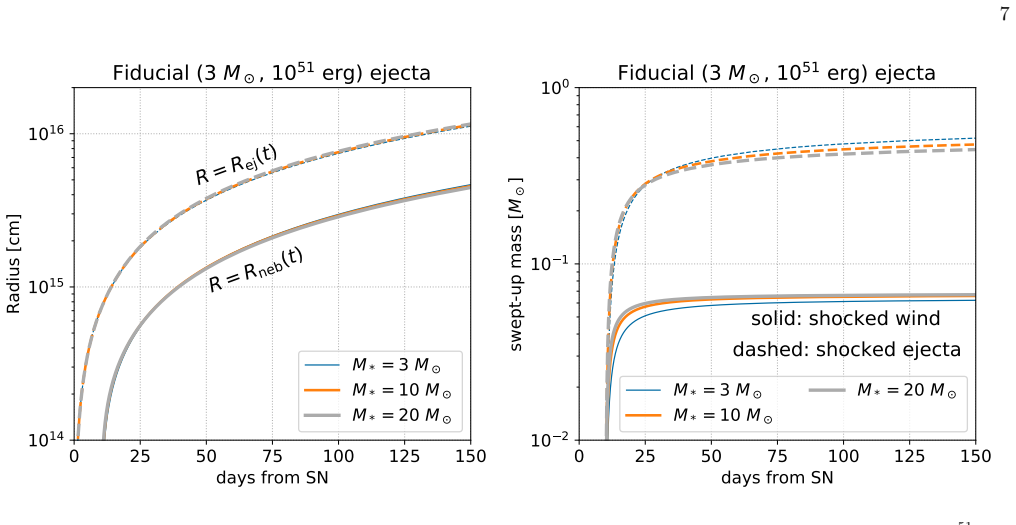
The engine is a super-Eddington accretion disk around a newborn neutron star or black hole, fed by the tidally disrupted companion. The load-bearing identities are the disk-wind kinetic luminosity $L_{\rm kin}(t) \approx \frac{p}{2(1-p)} \frac{G M_{\rm NS}|\dot M_{\rm disk}|}{R_{\rm NS}} (R_{\rm NS}/r_{\rm disk})^p$ and the initial disk parameters $M_{\rm disk,0}=M_{\rm NS}$, $r_{\rm disk,0}=(2M_{\rm NS}/M_*)R_*$, which set the total wind energy budget of $\sim10^{50}$ erg. The wind collides with the supernova ejecta in a thin-shell wind nebula, whose expansion is evolved with the same equations used for magnetar-wind nebulae, and the efficiency $\epsilon_{\rm rad}$ with which shocked-wind energy becomes radiation is computed from free-free and inverse-Compton cooling. A Monte-Carlo calculation of post-supernova orbits, using a natal-kick distribution, converts the geometric condition that the closest approach lies inside the stellar radius into a predicted event rate.
What would settle it
Run a 3D hydrodynamic simulation of a $1.4\,M_\odot$ neutron star colliding with a $2$--$10\,M_\odot$ main-sequence star at pericenter inside the stellar radius: if the bound debris mass comes out well below one neutron-star mass, or the disk circularizes at a radius much smaller than $(2M_{\rm NS}/M_*)R_*$, then the wind energy in equations (15)--(16) and the predicted $\sim10^{44}$ erg s$^{-1}$ peaks do not follow.
Extended reading notes
Core claim
The central claim is that the tidal disruption of a main-sequence companion by a newborn compact remnant is a viable central engine for the brightest hydrogen-poor supernovae and fast blue optical transients. For companions heavier than the remnant, the conventional tidal radius lies inside the star, so the paper adopts an initial disk of about one neutron-star mass at a radius set by the Bondi scale, $r_{\rm disk,0} = (2M_{\rm NS}/M_*)R_*$, and follows its viscous evolution with a one-zone disk model that sheds mass through a wind. The wind kinetic luminosity, roughly $L_{\rm kin,0} \sim 3\times10^{45}$ erg s$^{-1}$ with total energy $E_{\rm kin,0}\sim4\times10^{50}$ erg for a $10\,M_\odot$ companion, is injected into a homologously expanding supernova ejecta through a shocked wind nebula, with a semi-analytic radiative efficiency computed from free-free and inverse-Compton cooling. The output peaks near $10^{44}$ erg s$^{-1}$ for days to months and populates the same peak-magnitude versus rise-time region as luminous Type Ibc supernovae, while low-ejecta-mass progenitors reproduce the fast evolution, X-ray reprocessing time, and late hydrogen lines of AT2018cow-like FBOTs; a $5\,M_\odot$ black-hole remnant brightens the peak by roughly a magnitude, reaching the brightest superluminous supernovae.
Load-bearing premise
The calculation assumes that a disrupted companion leaves an accretion disk holding about one neutron star's worth of mass starting at a radius guessed from a simple scaling argument, rather than measured from a self-consistent simulation; if the real disk is lighter or more compact, the wind energy and the predicted brightness drop.
Editorial extensions
If this is right
- Luminous Type Ibc supernovae and AT2018cow-like fast blue optical transients can be powered by super-Eddington accretion after a companion is disrupted, in roughly $0.1$--$1\%$ of stripped-envelope supernovae.
- Late-time hydrogen emission at roughly 100--400 days after explosion, with $L_{H\alpha}/L_{\rm rad}\sim1\%$, is a direct prediction, matching the delayed appearance of hydrogen lines in a subset of superluminous supernovae and fast blue optical transients.
- Multiple partial disruptions before the final one produce delayed, repeated energy injection, naturally yielding bumpy light curves and pre-peak excesses in superluminous supernovae.
- A $5\,M_\odot$ black-hole remnant raises the peak brightness by about one magnitude, extending the model to the brightest superluminous supernovae at $-21$ to $-22$ mag.
- Low-mass helium-star progenitors with ejecta mass $\lesssim1\,M_\odot$ reproduce the fast rise, low nickel mass, and the roughly 20-day X-ray to optical transition observed in AT2018cow.
Reading between the lines
- If the model is right, radio and X-ray follow-up of nearby luminous fast blue optical transients should reveal non-thermal emission from the collisionless wind-ejecta shock, a signature the paper leaves to future work.
- The multiple-encounter branch predicts that some superluminous supernovae should show quasi-periodic modulation on the orbital timescale before the final disruption; a systematic search in high-cadence light curves could test this directly.
- The rate estimate inherits the assumed neutron-star kick distribution, so better constraints on black-hole kick magnitudes from Galactic binaries or gravitational-wave observations would sharpen the predicted fraction and could be compared with observed superluminous supernova and fast blue optical transient rates.
- Late-time hydrogen-line surveys offer a clean discriminant between this engine and magnetar spin-down: the model predicts H$\alpha$ tracks the bolometric luminosity at roughly a fixed 1\% ratio, whereas magnetar-powered ejecta should be hydrogen-free.
Editorial analysis
A structured set of objections, weighed in public.
Referee Report
Summary. This paper proposes that a newborn neutron star or black hole, kicked into its main-sequence companion after a stripped-envelope supernova, can tidally disrupt the companion and accrete it at highly super-Eddington rates. The resulting disk wind shocks the SN ejecta and powers a transient with peak luminosity ~1e44 erg/s, optical peaks of -19 to -21 mag, and durations of days to months. The authors build a one-zone disk evolution model with wind injection into a homologously expanding ejecta, compute the radiative efficiency of the shocked wind semi-analytically, and compare the resulting light curves to luminous Type Ibc SNe, superluminous SNe, and the FBOT AT2018cow. They also perform a Monte-Carlo estimate of the fraction of Type Ibc SNe leading to such disruptions (0.1-2%) and discuss late-time Halpha emission, X-ray reprocessing, circumstellar medium signatures, and multiple encounters.
Significance. If the mechanism operates, it is a genuinely new route to hydrogen-poor luminous transients and FBOTs, with natural explanations for late-time Halpha emission, bumpy light curves, and low 56Ni yields that are awkward for the standard magnetar model. The paper is clearly written, the light-curve code is public, and the authors are appropriately cautious about many uncertainties. The Monte-Carlo rate calculation uses independently measured kick distributions and an independently simulated disruption criterion, which is a strength. However, the central quantitative claims depend on initial disk parameters and a disruption criterion that are extrapolated beyond the regime of existing SPH simulations; until those are validated or bracketed, the model should be regarded as promising but not fully established.
major comments (2)
- [Section 2.1, Eqs. (5)-(6), (15)-(16)] The initial disk mass and radius, Mdisk,0 = MNS and rdisk,0 = (2MNS/M*)R*, are scaling assumptions rather than results of hydrodynamics for the relevant mass ratio M*/MNS ~ 2-7. Since Lkin,0 is proportional to Mdisk,0/rdisk,0^2, a factor of about 2 increase in rdisk,0 (e.g., toward the ~2R* disk radius found in Kremer et al. 2022a for M*/MBH = 1-2) or a factor of about 3 decrease in Mdisk,0 reduces the wind energy budget in Eq. (16) by an order of magnitude, pushing the predicted peak below the claimed ~1e44 erg/s. The paper notes this limitation but does not quantify its effect on the light curves; Figure 2 shows the disk evolution for Mdisk,0/MNS = 0.1 but not the resulting peak luminosity. The authors should either validate the initial disk parameters with hydrodynamics at M*/MNS > 2, or present the peak magnitude and rise time as functions of Mdisk,0 and rdisk,0 and delineate the parameter region that actually matches luminous Ibc SNe and FBOTs.
- [Section 4.1, Figure 9] The disruption fraction is computed using the criterion rcl < R*, which is calibrated by Kremer et al. (2022a) for full disruptions with 1 <= M*/MBH <= 2. For a 1.4 Msun neutron star and M* = 7-10 Msun, the tidal radius rT = (MNS/M*)^(1/3) R* lies well inside the star, so an encounter with rcl ~ R* may lead only to partial stripping or a grazing collision rather than full tidal disruption. The resulting 0.1-2% rate estimate is therefore likely an upper limit, and the claimed compatibility with the rates of luminous Ibc SNe and FBOTs is not yet established. Please use a mass-ratio-dependent disruption criterion or explicitly quantify how much the rate changes under the extrapolation.
minor comments (5)
- [Section 2.3, Eq. (28)] The bolometric light curves are extended into the regime tau_ej < 1 where the diffusion approximation and the thermalization factor (1 - exp(-tau_ej)) become invalid; the authors flag this issue for the r-band magnitude but should also mark or truncate the bolometric curves in the nebular phase.
- [Section 4.1, Eqs. (38)-(45)] The black-hole kick distribution is assumed to be log-uniform between 10 and 2000 km/s; the rate estimate would benefit from a clear statement of how sensitive the disruption fraction is to this assumed prior, especially given the large spread in the literature.
- [Section 4.2, Eq. (50)] The Halpha luminosity is estimated under the ionization-bounded assumption with a single epsilon_ion = 30 eV; the transition to a density-bounded regime for low-ejecta-mass systems is discussed only qualitatively, and a quantitative boundary or a brief parameter scan would strengthen the claimed spectral diversity.
- [Throughout] The title and Table 1 contain spacing artifacts ('F ast', 'T ransients', 'T able'), and the caption of Figure 2 uses 'Mdisk/MNS = 0.1 and Mdisk/MNS = 1' while the y-axis label uses X/X0, which is slightly confusing; please harmonize the notation.
- [Section 5 / Code availability] The public code link is a positive feature, but a versioned release or a persistent DOI would make the reproducibility claim more robust.
Circularity Check
No circular derivation: disk parameters are explicit assumptions, not fitted outputs, and the only author-overlapping citation supplies independent SPH evidence.
full rationale
All load-bearing inputs are either independent empirical constraints (kick distribution from Hobbs et al. 2005; binary and ejecta parameters from Zapartas et al. 2017 and Gomez et al.) or explicit model assumptions (Mdisk,0 = MNS, rdisk,0 = (2MNS/M*)R*, alpha, H/R, p = 0.5). These assumptions are not fitted to the target light curves: the predicted Lrad(t) follows from integrating equations 27-31 with the stated initial conditions, and the model is then compared to data over a range of parameters. The only author-overlapping citation is Kremer et al. (2022a), which supplies the disruption criterion and bound fraction via externally falsifiable, code-based SPH simulations whose assumptions do not include the present radiative model, so it is independent support rather than a circular premise. The appendix's epsilon_rad is a semi-analytic cooling calculation, not a restatement of the output luminosity. The H-alpha luminosity in eq. (50) follows from ionization balance and is checked against observed line strengths rather than used to define them. Therefore no derivation step reduces by construction to its own input; the strong sensitivity of eq. (15) to the assumed disk mass and radius is a parameter-uncertainty issue, not a circularity.
Assumptions & free parameters
free parameters (9)
- tTDE =
2, 10, 30 days (varied)
- alpha(H/R)^2 =
3e-3, 1e-2, 3e-2 (fiducial 1e-2)
- M* =
3, 10, 20 M_sun (varied)
- p =
0.5 (fixed)
- Mdisk,0 =
1.4 M_sun (M_NS)
- rdisk,0 =
(2 M_NS / M*) R*
- MBH (BH model) =
5 M_sun
- epsilon_ion =
30 eV
- xi =
0.5
assumptions (7)
- domain assumption Main-sequence mass-radius relation R* = R_sun (M*/M_sun)^0.6
- domain assumption Full disruption occurs when pericenter rp <= R*
- domain assumption SN ejecta is homologous with power-law density profile rho proportional to r^-1
- domain assumption Disk wind mass inflow rate follows Mdot(r) proportional to r^p with p=0.5
- domain assumption NS natal kicks follow Maxwell-Boltzmann distribution with sigma=265 km/s
- domain assumption BH natal kicks are log-uniform from 10 to 2000 km/s
- domain assumption Opacities kappa = 0.07 cm^2/g and kappa_gamma = 0.03 cm^2/g
Cite this review
Pith. "Pith review of Stellar Tidal Disruptions by Newborn Neutron Stars or Black Holes: A Mechanism for Hydrogen-poor (Super)luminous Supernovae and Fast Blue Optical Transients." pith.science (2026). https://pith.science/paper/3AU4R7PI
@misc{pith2026250103316,
  author       = {Pith},
  title        = {Pith review of: Stellar Tidal Disruptions by Newborn Neutron Stars or Black Holes: A Mechanism for Hydrogen-poor (Super)luminous Supernovae and Fast Blue Optical Transients},
  year         = {2026},
  howpublished = {\url{https://pith.science/paper/3AU4R7PI}},
  note         = {Machine review of arXiv:2501.03316}
}
abstract
Hydrogen-poor supernovae (SNe) of Type Ibc are explosions of massive stars that lost their hydrogen envelopes, typically due to interactions with a binary companion. We consider the case where the natal kick imparted to the neutron star (NS) or black hole (BH) remnant brings the compact object to a collision with a main-sequence companion, eventually leading to full tidal disruption of the companion. Subsequently, super-Eddington accretion onto the NS/BH launches a powerful, fast wind which collides with the SN ejecta and efficiently converts the kinetic energy of the wind into radiation. The radiation is reprocessed by the surrounding ejecta into a luminous ($\sim 10^{44}$ erg s$^{-1}$ at peak), days to months-long transient with optical peaks from $-19$ to $-21$ mag, comparable to (super)luminous Type Ibc SNe and fast blue optical transients (FBOTs) like AT2018cow. From a Monte-Carlo analysis we estimate the fraction of tidal disruptions following SNe in binaries to be $\sim 0.1$--$1$\%, roughly compatible with the event rates of these luminous SNe. At the broad-brush level, our model reproduces the multi-wavelength and spectral observations of FBOTs, and has the potential to explain peculiar features seen in some (super)luminous SNe which are difficult to reproduce by the conventional magnetar spindown mechanism, such as late-time hydrogen lines, bumpy light curves, and pre-peak excess.
Figures


Figures from the paper (6 more)


Forward citations
Cited by 2 Pith papers
-
AT2019ijn: a fast-rising, slow-decaying blue optical transient with exceptionally bright radio emission
AT2019ijn combines LFBOT-like fast optical rise and blue color with slow decay and radio luminosity peaking late at 2e31 erg/s/Hz, best fit as an off-axis jetted IMBH TDE.
-
Implications of the UV/optical Plateau of AT2018cow
A wind-and-irradiation disk model fits the AT2018cow UV plateau with accretor masses from 1.4 to ~100 solar masses, removing the need for a >200 solar-mass black hole.
Reference graph
Works this paper leans on
-
[1]
2020, ApJ, 901, 53, doi: 10.3847/1538-4357/abad35 —
Akashi, M., & Soker, N. 2020, ApJ, 901, 53, doi: 10.3847/1538-4357/abad35 —. 2021, MNRAS, 501, 4053, doi: 10.1093/mnras/staa3897
-
[2]
Arcavi, I., Howell, D. A., Kasen, D., et al. 2017, Nature, 551, 210, doi: 10.1038/nature24030
-
[3]
Arnett, W. D. 1980, ApJ, 237, 541, doi: 10.1086/157898 —. 1982, ApJ, 253, 785, doi: 10.1086/159681
doi:10.1086/157898 1980
-
[4]
Atri, P., Miller-Jones, J. C. A., Bahramian, A., et al. 2019, MNRAS, 489, 3116, doi: 10.1093/mnras/stz2335
-
[6]
1995, MNRAS, 274, 461, doi: 10.1093/mnras/274.2.461
Brandt, N., & Podsiadlowski, P. 1995, MNRAS, 274, 461, doi: 10.1093/mnras/274.2.461
-
[7]
S., Margutti, R., Matthews, D., et al
Bright, J. S., Margutti, R., Matthews, D., et al. 2022, ApJ, 926, 112, doi: 10.3847/1538-4357/ac4506
-
[8]
2023, ApJ, 957, 68, doi: 10.3847/1538-4357/acfc1c
Burrows, A., Vartanyan, D., & Wang, T. 2023, ApJ, 957, 68, doi: 10.3847/1538-4357/acfc1c
-
[9]
2024, arXiv e-prints, arXiv:2412.07831, doi: 10.48550/arXiv.2412.07831
Burrows, A., Wang, T., & Vartanyan, D. 2024, arXiv e-prints, arXiv:2412.07831, doi: 10.48550/arXiv.2412.07831
Show all 135 references
-
[10]
2024, Nature, 625, 253, doi: 10.1038/s41586-023-06787-x
Chen, P., Gal-Yam, A., Sollerman, J., et al. 2024, Nature, 625, 253, doi: 10.1038/s41586-023-06787-x
2024 doi
-
[11]
R., Piro, A
Chen, Y., Drout, M. R., Piro, A. L., et al. 2023, ApJ, 955, 43, doi: 10.3847/1538-4357/ace964
2023 doi
-
[12]
A., & Irwin, C
Chevalier, R. A., & Irwin, C. M. 2011, ApJL, 729, L6, doi: 10.1088/2041-8205/729/1/L6
2011 doi
- [13]
-
[14]
2024, ApJ, 977, 200, doi: 10.3847/1538-4357/ad9561
Natarajan, P. 2024, ApJ, 977, 200, doi: 10.3847/1538-4357/ad9561
2024 doi
-
[15]
L., Margutti, R., Terreran, G., et al
Coppejans, D. L., Margutti, R., Terreran, G., et al. 2020, ApJL, 895, L23, doi: 10.3847/2041-8213/ab8cc7
2020 doi
-
[16]
2019, MNRAS, 485, 5105, doi: 10.1093/mnras/stz232
Crumley, P., Caprioli, D., Markoff, S., & Spitkovsky, A. 2019, MNRAS, 485, 5105, doi: 10.1093/mnras/stz232
2019 doi
-
[17]
B., Benz, W., & Hills, J
Davies, M. B., Benz, W., & Hills, J. G. 1992, ApJ, 401, 246, doi: 10.1086/172056 De Cia, A., Gal-Yam, A., Rubin, A., et al. 2018, ApJ, 860, 100, doi: 10.3847/1538-4357/aab9b6 de Mink, S. E., Cottaar, M., & Pols, O. R. 2008, in American Institute of Physics Conference Series, V...
1992 doi
-
[18]
2013, ApJ, 764, 166, doi: 10.1088/0004-637X/764/2/166
Koter, A. 2013, ApJ, 764, 166, doi: 10.1088/0004-637X/764/2/166
2013 doi
-
[19]
Janka, H. T. 2021, A&A, 656, A61, doi: 10.1051/0004-6361/202141927
2021 doi
-
[20]
C., & Prieto, J
Dessart, L., Leonard, D. C., & Prieto, J. L. 2020, A&A, 638, A80, doi: 10.1051/0004-6361/202037854
2020 doi
-
[21]
2013, ApJ, 772, 30, doi: 10.1088/0004-637X/772/1/30
Dexter, J., & Kasen, D. 2013, ApJ, 772, 30, doi: 10.1088/0004-637X/772/1/30
2013 doi
-
[22]
R., Soderberg, A
Drout, M. R., Soderberg, A. M., Gal-Yam, A., et al. 2011, ApJ, 741, 97, doi: 10.1088/0004-637X/741/2/97
2011 doi
-
[23]
2019, ApJL, 876, L10, doi: 10.3847/2041-8213/ab18a5
Eftekhari, T., Berger, E., Margalit, B., et al. 2019, ApJL, 876, L10, doi: 10.3847/2041-8213/ab18a5
2019 doi
-
[24]
Eggleton, P. P. 1983, ApJ, 268, 368, doi: 10.1086/160960
1983 doi
-
[25]
Crockett, R. M. 2013, MNRAS, 436, 774, doi: 10.1093/mnras/stt1612
2013 doi
-
[26]
J., Izzard, R
Eldridge, J. J., Izzard, R. G., & Tout, C. A. 2008, MNRAS, 384, 1109, doi: 10.1111/j.1365-2966.2007.12738.x
2008
- [27]
-
[28]
E., Sukhbold, T., & Janka, H
Ertl, T., Woosley, S. E., Sukhbold, T., & Janka, H. T. 2020, ApJ, 890, 51, doi: 10.3847/1538-4357/ab6458
2020 doi
-
[29]
W., Hutchinson-Smith, T., Vigna-G´ omez, A., & Ramirez-Ruiz, E
Everson, R. W., Hutchinson-Smith, T., Vigna-G´ omez, A., & Ramirez-Ruiz, E. 2024, ApJ, 971, 132, doi: 10.3847/1538-4357/ad595e
2024 doi
-
[30]
R., Vincenzi, M., et al
Frohmaier, C., Angus, C. R., Vincenzi, M., et al. 2021, MNRAS, 500, 5142, doi: 10.1093/mnras/staa3607
2021 doi
-
[31]
2022, MNRAS, 511, 3951, doi: 10.1093/mnras/stac317
Fuller, J., & Lu, W. 2022, MNRAS, 511, 3951, doi: 10.1093/mnras/stac317
2022 doi
-
[32]
2019, ARA&A, 57, 305, doi: 10.1146/annurev-astro-081817-051819
Gal-Yam, A. 2019, ARA&A, 57, 305, doi: 10.1146/annurev-astro-081817-051819
2019 doi
-
[33]
2022, ApJ, 941, 107, doi: 10.3847/1538-4357/ac9842
Hosseinzadeh, G. 2022, ApJ, 941, 107, doi: 10.3847/1538-4357/ac9842
2022 doi
-
[34]
2024, MNRAS, 535, 471, doi: 10.1093/mnras/stae2270
Gomez, S., Nicholl, M., Berger, E., et al. 2024, MNRAS, 535, 471, doi: 10.1093/mnras/stae2270
2024 doi
-
[35]
Gottlieb, O., & Metzger, B. D. 2024, ApJL, 974, L9, doi: 10.3847/2041-8213/ad7d82
2024 doi
-
[36]
M., Quataert, E., & Kim, C.-G
Guo, M., Stone, J. M., Quataert, E., & Kim, C.-G. 2024, ApJ, 973, 141, doi: 10.3847/1538-4357/ad5fe7 Guti´ errez, C. P., Mattila, S., Lundqvist, P., et al. 2024, ApJ, 977, 162, doi: 10.3847/1538-4357/ad89a5
2024 doi
-
[37]
2022, MNRAS, 517, 4544, doi: 10.1093/mnras/stac3007
Hirai, R., & Podsiadlowski, P. 2022, MNRAS, 517, 4544, doi: 10.1093/mnras/stac3007
2022 doi
-
[38]
2018, ApJ, 864, 119, doi: 10.3847/1538-4357/aad6a0
Hirai, R., Podsiadlowski, P., & Yamada, S. 2018, ApJ, 864, 119, doi: 10.3847/1538-4357/aad6a0
2018 doi
-
[39]
Ho, A. Y. Q., Phinney, E. S., Ravi, V., et al. 2019, ApJ, 871, 73, doi: 10.3847/1538-4357/aaf473
2019 doi
-
[40]
Ho, A. Y. Q., Perley, D. A., Kulkarni, S. R., et al. 2020, ApJ, 895, 49, doi: 10.3847/1538-4357/ab8bcf
2020 doi
-
[41]
Ho, A. Y. Q., Perley, D. A., Gal-Yam, A., et al. 2023, ApJ, 949, 120, doi: 10.3847/1538-4357/acc533
2023 doi
-
[42]
R., Lyne, A
Hobbs, G., Lorimer, D. R., Lyne, A. G., & Kramer, M. 2005, MNRAS, 360, 974, doi: 10.1111/j.1365-2966.2005.09087.x
2005
-
[43]
2022, MNRAS, 516, 1846, doi: 10.1093/mnras/stac2373
Hober, O., Bear, E., & Soker, N. 2022, MNRAS, 516, 1846, doi: 10.1093/mnras/stac2373
2022 doi
-
[44]
D., et al
Hosseinzadeh, G., Berger, E., Metzger, B. D., et al. 2022, ApJ, 933, 14, doi: 10.3847/1538-4357/ac67dd
2022 doi
-
[45]
W., Twum, A
Hutchinson-Smith, T., Everson, R. W., Twum, A. A., et al. 2024, ApJ, 977, 196, doi: 10.3847/1538-4357/ad88f3
2024 doi
-
[46]
W., et al
Inserra, C., Nicholl, M., Chen, T. W., et al. 2017, MNRAS, 468, 4642, doi: 10.1093/mnras/stx834
2017 doi
-
[47]
2023, A&A, 678, A87, doi: 10.1051/0004-6361/202245231
Karamehmetoglu, E., Sollerman, J., Taddia, F., et al. 2023, A&A, 678, A87, doi: 10.1051/0004-6361/202245231
2023 doi
-
[48]
2010, ApJ, 717, 245, doi: 10.1088/0004-637X/717/1/245
Kasen, D., & Bildsten, L. 2010, ApJ, 717, 245, doi: 10.1088/0004-637X/717/1/245
2010 doi
-
[49]
D., & Bildsten, L
Kasen, D., Metzger, B. D., & Bildsten, L. 2016, ApJ, 821, 36, doi: 10.3847/0004-637X/821/1/36
2016 doi
-
[50]
2016, ApJ, 818, 94, doi: 10.3847/0004-637X/818/1/94
Margutti, R. 2016, ApJ, 818, 94, doi: 10.3847/0004-637X/818/1/94
2016 doi
-
[51]
N., & Takabe, H
Kato, T. N., & Takabe, H. 2010, ApJ, 721, 828, doi: 10.1088/0004-637X/721/1/828
2010 doi
-
[52]
2024, MNRAS, 532, 3926, doi: 10.1093/mnras/stae1681
Kinugawa, T., Horiuchi, S., Takiwaki, T., & Kotake, K. 2024, MNRAS, 532, 3926, doi: 10.1093/mnras/stae1681
2024 doi
-
[53]
2013, Stellar Structure and Evolution, doi: 10.1007/978-3-642-30304-3 Kıro˘ glu, F., Kremer, K., Biscoveanu, S., Gonz´ alez Prieto, E., & Rasio, F
Kippenhahn, R., Weigert, A., & Weiss, A. 2013, Stellar Structure and Evolution, doi: 10.1007/978-3-642-30304-3 Kıro˘ glu, F., Kremer, K., Biscoveanu, S., Gonz´ alez Prieto, E., & Rasio, F. A. 2025a, ApJ, 979, 237, doi: 10.3847/1538-4357/ada26b Kıro˘ glu, F., Lombardi, Jr., J. ...
-
[54]
G., & Pols, O
Klencki, J., Nelemans, G., Istrate, A. G., & Pols, O. 2020, A&A, 638, A55, doi: 10.1051/0004-6361/202037694
2020 doi
-
[55]
2024, ApJ, 973, 5, doi: 10.3847/1538-4357/ad5feb
Koshimoto, N., Kawanaka, N., & Tsuna, D. 2024, ApJ, 973, 5, doi: 10.3847/1538-4357/ad5feb
2024 doi
-
[56]
C., Lu, W., Piro, A
Kremer, K., Lombardi, J. C., Lu, W., Piro, A. L., & Rasio, F. A. 2022a, ApJ, 933, 203, doi: 10.3847/1538-4357/ac714f
-
[57]
L., et al
Kremer, K., Lu, W., Piro, A. L., et al. 2021, ApJ, 911, 104, doi: 10.3847/1538-4357/abeb14
2021 doi
-
[58]
L., Lachat, M., & Rasio, F
Kremer, K., Lu, W., Rodriguez, C. L., Lachat, M., & Rasio, F. A. 2019, ApJ, 881, 75, doi: 10.3847/1538-4357/ab2e0c
2019 doi
-
[59]
L., & Lombardi, J
Kremer, K., Mockler, B., Piro, A. L., & Lombardi, J. C. 2023, MNRAS, 524, 6358, doi: 10.1093/mnras/stad2239
2023 doi
-
[60]
S., Kıro˘ glu, F., et al
Kremer, K., Ye, C. S., Kıro˘ glu, F., et al. 2022b, ApJL, 934, L1, doi: 10.3847/2041-8213/ac7ec4
-
[61]
2020, ApJ, 903, 66, doi: 10.3847/1538-4357/abba33
Leung, S.-C., Blinnikov, S., Nomoto, K., et al. 2020, ApJ, 903, 66, doi: 10.3847/1538-4357/abba33
2020 doi
- [62]
-
[63]
C., J., Proulx, Z
Lombardi, J. C., J., Proulx, Z. F., Dooley, K. L., et al. 2006, ApJ, 640, 441, doi: 10.1086/499938
2006 doi
-
[64]
2023, MNRAS, 519, 1409, doi: 10.1093/mnras/stac3621
Lu, W., Fuller, J., Quataert, E., & Bonnerot, C. 2023, MNRAS, 519, 1409, doi: 10.1093/mnras/stac3621
2023 doi
-
[65]
D., Bersier, D., James, P
Lyman, J. D., Bersier, D., James, P. A., et al. 2016, MNRAS, 457, 328, doi: 10.1093/mnras/stv2983
2016 doi
-
[66]
G., & Lorimer, D
Lyne, A. G., & Lorimer, D. R. 1994, Nature, 369, 127, doi: 10.1038/369127a0
1994 doi
-
[67]
2019, MNRAS, 487, 5618, doi: 10.1093/mnras/stz1640
Lyutikov, M., & Toonen, S. 2019, MNRAS, 487, 5618, doi: 10.1093/mnras/stz1640
2019 doi
-
[68]
2016, MNRAS, 456, 578, doi: 10.1093/mnras/stv2733
Mandel, I. 2016, MNRAS, 456, 578, doi: 10.1093/mnras/stv2733
2016 doi
-
[69]
Marchant, P., Pappas, K. M. W., Gallegos-Garcia, M., et al. 2021, A&A, 650, A107, doi: 10.1051/0004-6361/202039992 24
2021 doi
-
[70]
D., Chornock, R., et al
Margutti, R., Metzger, B. D., Chornock, R., et al. 2019, ApJ, 872, 18, doi: 10.3847/1538-4357/aafa01
2019 doi
-
[71]
S., Matthews, D
Margutti, R., Bright, J. S., Matthews, D. J., et al. 2023, ApJL, 954, L45, doi: 10.3847/2041-8213/acf1fd
2023 doi
-
[72]
D., & Goldberg, J
Matsumoto, T., Metzger, B. D., & Goldberg, J. A. 2025, ApJ, 978, 56, doi: 10.3847/1538-4357/ad93a9
2025 doi
-
[73]
Metzger, B. D. 2022, ApJ, 932, 84, doi: 10.3847/1538-4357/ac6d59
2022 doi
-
[74]
D., Margalit, B., Kasen, D., & Quataert, E
Metzger, B. D., Margalit, B., Kasen, D., & Quataert, E. 2015, MNRAS, 454, 3311, doi: 10.1093/mnras/stv2224
2015 doi
-
[75]
D., et al
Migliori, G., Margutti, R., Metzger, B. D., et al. 2024, ApJL, 963, L24, doi: 10.3847/2041-8213/ad2764
2024 doi
-
[76]
J., Nicholl, M., et al
Moore, T., Smartt, S. J., Nicholl, M., et al. 2023, ApJL, 956, L31, doi: 10.3847/2041-8213/acfc25
2023 doi
-
[77]
J., Liu, Z.-W., & Izzard, R
Moriya, T. J., Liu, Z.-W., & Izzard, R. G. 2015, MNRAS, 450, 3264, doi: 10.1093/mnras/stv934
2015 doi
-
[78]
J., Murase, K., Kashiyama, K., & Blinnikov, S
Moriya, T. J., Murase, K., Kashiyama, K., & Blinnikov, S. I. 2022, MNRAS, 513, 6210, doi: 10.1093/mnras/stac1352
2022 doi
-
[79]
J., Sorokina, E
Moriya, T. J., Sorokina, E. I., & Chevalier, R. A. 2018, SSRv, 214, 59, doi: 10.1007/s11214-018-0493-6
2018 doi
-
[80]
L., Renzo, M., et al
Morozova, V., Piro, A. L., Renzo, M., et al. 2015, ApJ, 814, 63, doi: 10.1088/0004-637X/814/1/63
2015 doi
-
[81]
2025, PASP, 137, 034203, doi: 10.1088/1538-3873/adb6d6
Nagarajan, P., & El-Badry, K. 2025, PASP, 137, 034203, doi: 10.1088/1538-3873/adb6d6
2025 doi
-
[82]
1995, ApJ, 444, 231, doi: 10.1086/175599
Narayan, R., & Yi, I. 1995, ApJ, 444, 231, doi: 10.1086/175599
1995 doi
-
[83]
D., Sullivan, M., Gal-Yam, A., et al
Neill, J. D., Sullivan, M., Gal-Yam, A., et al. 2011, ApJ, 727, 15, doi: 10.1088/0004-637X/727/1/15
2011 doi
-
[84]
2021, Astronomy and Geophysics, 62, 5.34, doi: 10.1093/astrogeo/atab092
Nicholl, M. 2021, Astronomy and Geophysics, 62, 5.34, doi: 10.1093/astrogeo/atab092
2021 doi
-
[85]
2019, ApJ, 871, 102, doi: 10.3847/1538-4357/aaf470
Chornock, R. 2019, ApJ, 871, 102, doi: 10.3847/1538-4357/aaf470
2019 doi
-
[86]
2017, ApJ, 850, 55, doi: 10.3847/1538-4357/aa9334
Nicholl, M., Guillochon, J., & Berger, E. 2017, ApJ, 850, 55, doi: 10.3847/1538-4357/aa9334
2017 doi
-
[87]
Nicholl, M., & Smartt, S. J. 2016, MNRAS, 457, L79, doi: 10.1093/mnrasl/slv210
2016 doi
-
[88]
D., et al
Nicholl, M., Srivastav, S., Fulton, M. D., et al. 2023, ApJL, 954, L28, doi: 10.3847/2041-8213/acf0ba
2023 doi
-
[89]
Ofek, E. O. 2014, MAAT: MATLAB Astronomy and Astrophysics Toolbox, Astrophysics Source Code Library, record ascl:1407.005
2014
-
[90]
Omand, C. M. B., & Sarin, N. 2024, MNRAS, 527, 6455, doi: 10.1093/mnras/stad3645
2024 doi
-
[91]
E., & Ferland, G
Osterbrock, D. E., & Ferland, G. J. 2006, Astrophysics of gaseous nebulae and active galactic nuclei
2006
-
[92]
2015, PhRvL, 114, 085003, doi: 10.1103/PhysRevLett.114.085003
Park, J., Caprioli, D., & Spitkovsky, A. 2015, PhRvL, 114, 085003, doi: 10.1103/PhysRevLett.114.085003
2015 doi
-
[93]
R., Ho, W
Pasham, D. R., Ho, W. C. G., Alston, W., et al. 2021, Nature Astronomy, 6, 249, doi: 10.1038/s41550-021-01524-8
2021 doi
-
[94]
B., Li, Z., Lombardi, James C., J., & Milcarek, Stephen R., J
Perets, H. B., Li, Z., Lombardi, James C., J., & Milcarek, Stephen R., J. 2016, ApJ, 823, 113, doi: 10.3847/0004-637X/823/2/113
2016 doi
-
[95]
A., Quimby, R
Perley, D. A., Quimby, R. M., Yan, L., et al. 2016, ApJ, 830, 13, doi: 10.3847/0004-637X/830/1/13
2016 doi
-
[96]
A., Mazzali, P
Perley, D. A., Mazzali, P. A., Yan, L., et al. 2019, MNRAS, 484, 1031, doi: 10.1093/mnras/sty3420
2019 doi
-
[97]
L., & Morozova, V
Piro, A. L., & Morozova, V. S. 2014, ApJL, 792, L11, doi: 10.1088/2041-8205/792/1/L11
2014 doi
-
[98]
C., & Hsu, J
Podsiadlowski, P., Joss, P. C., & Hsu, J. J. L. 1992, ApJ, 391, 246, doi: 10.1086/171341
1992 doi
-
[99]
J., Maguire, K., Smartt, S
Prentice, S. J., Maguire, K., Smartt, S. J., et al. 2018, ApJL, 865, L3, doi: 10.3847/2041-8213/aadd90
2018 doi
-
[100]
Quataert, E., Lecoanet, D., & Coughlin, E. R. 2019, MNRAS, 485, L83, doi: 10.1093/mnrasl/slz031
2019 doi
-
[101]
E., et al
Renzo, M., Zapartas, E., de Mink, S. E., et al. 2019, A&A, 624, A66, doi: 10.1051/0004-6361/201833297
2019 doi
-
[102]
B., & Sigurdsson, S
Repetto, S., Davies, M. B., & Sigurdsson, S. 2012, MNRAS, 425, 2799, doi: 10.1111/j.1365-2966.2012.21549.x Rodr ´ ıguez,´O., Maoz, D., & Nakar, E. 2023, ApJ, 955, 71, doi: 10.3847/1538-4357/ace2bd
2012
-
[103]
M., et al
Roy, R., Sollerman, J., Silverman, J. M., et al. 2016, A&A, 596, A67, doi: 10.1051/0004-6361/201527947
2016 doi
-
[104]
B., & Lightman, A
Rybicki, G. B., & Lightman, A. P. 1979, Radiative processes in astrophysics
1979
-
[105]
E., de Koter, A., et al
Sana, H., de Mink, S. E., de Koter, A., et al. 2012, Science, 337, 444, doi: 10.1126/science.1223344
2012 doi
-
[106]
Shen, R.-F., & Matzner, C. D. 2014, ApJ, 784, 87, doi: 10.1088/0004-637X/784/2/87
2014 doi
-
[107]
1990, ApJL, 361, L23, doi: 10.1086/185818
Shigeyama, T., Nomoto, K., Tsujimoto, T., & Hashimoto, M.-A. 1990, ApJL, 361, L23, doi: 10.1086/185818
1990 doi
-
[108]
Smartt, S. J. 2009, ARA&A, 47, 63, doi: 10.1146/annurev-astro-082708-101737 —. 2015, PASA, 32, e016, doi: 10.1017/pasa.2015.17
2009 doi
-
[109]
2014, ARA&A, 52, 487, doi: 10.1146/annurev-astro-081913-040025
Smith, N. 2014, ARA&A, 52, 487, doi: 10.1146/annurev-astro-081913-040025
2014 doi
-
[110]
V., & Chornock, R
Smith, N., Li, W., Filippenko, A. V., & Chornock, R. 2011, MNRAS, 412, 1522, doi: 10.1111/j.1365-2966.2011.17229.x
2011
-
[111]
2017, ApJ, 851, 95, doi: 10.3847/1538-4357/aa9c83
Soker, N., & Gilkis, A. 2017, ApJ, 851, 95, doi: 10.3847/1538-4357/aa9c83
2017 doi
-
[112]
2019, MNRAS, 484, 4972, doi: 10.1093/mnras/stz364
Soker, N., Grichener, A., & Gilkis, A. 2019, MNRAS, 484, 4972, doi: 10.1093/mnras/stz364
2019 doi
-
[113]
2008, ApJL, 673, L39, doi: 10.1086/527374
Spitkovsky, A. 2008, ApJL, 673, L39, doi: 10.1086/527374
2008 doi
-
[114]
M., Pringle, J
Stone, J. M., Pringle, J. E., & Begelman, M. C. 1999, MNRAS, 310, 1002, doi: 10.1046/j.1365-8711.1999.03024.x 25
1999
-
[115]
Janka, H. T. 2016, ApJ, 821, 38, doi: 10.3847/0004-637X/821/1/38
2016 doi
-
[116]
R., Crowther, P
Sun, N.-C., Maund, J. R., Crowther, P. A., & Liu, L.-D. 2022, MNRAS, 512, L66, doi: 10.1093/mnrasl/slac023
2022 doi
-
[117]
S., & Dopita, M
Sutherland, R. S., & Dopita, M. A. 1993, ApJS, 88, 253, doi: 10.1086/191823
1993 doi
-
[118]
D., Bersten, M., et al
Taddia, F., Stritzinger, M. D., Bersten, M., et al. 2018, A&A, 609, A136, doi: 10.1051/0004-6361/201730844
2018 doi
-
[119]
M., Langer, N., & Podsiadlowski, P
Tauris, T. M., Langer, N., & Podsiadlowski, P. 2015, MNRAS, 451, 2123, doi: 10.1093/mnras/stv990
2015 doi
-
[120]
C., & Fuller, J
Tsuna, D., Matsumoto, T., Wu, S. C., & Fuller, J. 2024, ApJ, 966, 30, doi: 10.3847/1538-4357/ad3637
2024 doi
-
[121]
2020, ApJ, 897, 156, doi: 10.3847/1538-4357/ab9632
Uno, K., & Maeda, K. 2020, ApJ, 897, 156, doi: 10.3847/1538-4357/ab9632
2020 doi
-
[122]
Perets, H. B. 2024, A&A, 685, A45, doi: 10.1051/0004-6361/202348357
2024 doi
-
[123]
Wang, Y.-H., Perna, R., & Armitage, P. J. 2021, MNRAS, 503, 6005, doi: 10.1093/mnras/stab802
2021 doi
-
[124]
C., Lecar, M., & McKee, C
Wheeler, J. C., Lecar, M., & McKee, C. F. 1975, ApJ, 200, 145, doi: 10.1086/153771
1975 doi
-
[125]
Woosley, S. E. 2010, ApJL, 719, L204, doi: 10.1088/2041-8205/719/2/L204 —. 2019, ApJ, 878, 49, doi: 10.3847/1538-4357/ab1b41
2010 doi
-
[126]
C., & Fuller, J
Wu, S. C., & Fuller, J. 2022, ApJL, 940, L27, doi: 10.3847/2041-8213/ac9b3d
2022 doi
-
[127]
2019, MNRAS, 484, 3941, doi: 10.1093/mnras/stz145
Wygoda, N., Elbaz, Y., & Katz, B. 2019, MNRAS, 484, 3941, doi: 10.1093/mnras/stz145
2019 doi
-
[128]
2015, ApJ, 814, 108, doi: 10.1088/0004-637X/814/2/108
Yan, L., Quimby, R., Ofek, E., et al. 2015, ApJ, 814, 108, doi: 10.1088/0004-637X/814/2/108
2015 doi
-
[129]
A., et al
Yan, L., Lunnan, R., Perley, D. A., et al. 2017, ApJ, 848, 6, doi: 10.3847/1538-4357/aa8993
2017 doi
-
[130]
Yao, Y., Ho, A. Y. Q., Medvedev, P., et al. 2022, ApJ, 934, 104, doi: 10.3847/1538-4357/ac7a41
2022 doi
-
[131]
2014, ARA&A, 52, 529, doi: 10.1146/annurev-astro-082812-141003
Yuan, F., & Narayan, R. 2014, ARA&A, 52, 529, doi: 10.1146/annurev-astro-082812-141003
2014 doi
-
[132]
2012, ApJ, 761, 129, doi: 10.1088/0004-637X/761/2/129
Yuan, F., Wu, M., & Bu, D. 2012, ApJ, 761, 129, doi: 10.1088/0004-637X/761/2/129
2012 doi
-
[133]
E., Van Dyk, S
Zapartas, E., de Mink, S. E., Van Dyk, S. D., et al. 2017, ApJ, 842, 125, doi: 10.3847/1538-4357/aa7467
2017 doi
-
[134]
Zhang, W., & Fryer, C. L. 2001, ApJ, 550, 357, doi: 10.1086/319734
2001 doi
-
[135]
2022, Research in Astronomy and Astrophysics, 22, 125016, doi: 10.1088/1674-4527/ac9c4b
Zhang, W., Shu, X., Chen, J.-H., et al. 2022, Research in Astronomy and Astrophysics, 22, 125016, doi: 10.1088/1674-4527/ac9c4b
2022 doi
-
[136]
2024, ApJL, 970, L42, doi: 10.3847/2041-8213/ad63a8
Zhu, J.-P., Liu, L.-D., Yu, Y.-W., et al. 2024, ApJL, 970, L42, doi: 10.3847/2041-8213/ad63a8
2024 doi
Reviewed August 10, 2026 · model on record in the stance chip above.
Discussion (0). Continue with ORCID to comment.