REVIEW 4 major objections 5 minor 103 references
HST Observations within the Sphere of Influence of the Powerful Supermassive Black Hole in PKS0745-191
T0 review · 4 major / 5 minor · reviewed 2026-08-10 · deepseek-v4-flash
Pith's one-line read Gas inside PKS 0745-191's giant black-hole feeding zone is chaotic, not rotating, and the motion implies a black hole of roughly 15 billion solar masses.
desk verdict First sub-kpc kinematic map of gas in a powerful feedback BCG; the chaotic flow is solid, but the 1.5e10 Msun black hole mass is a rough virial estimate that should not be over-read. read the letter →
The pith
A machine-rendered reading of the paper's core claim, the machinery that carries it, and where it could break.
The reading
What carries the argument
The machinery that carries the argument is the three-dithered-position STIS long-slit spectroscopy: three 0.1-arcsec-wide (about 188 pc) slits — one centered on the nucleus, two offset by 0.1 arcsec — cover a 0.3-arcsec by 52-arcsec region and deliver spectra of H$\alpha$ and the [N II] and [S II] doublets at about 45 km s$^{-1}$ resolution. The emission lines are fit jointly with common velocity and velocity dispersion, and the resulting two-dimensional kinematic map is converted to a black-hole mass by the virial estimator $M \approx \sigma^2 R/G$, with the slit width taken as the characteristic radius $R$ where the nuclear peak $\sigma \approx 595$ km s$^{-1}$ is measured. A second load-bearing element is the comparison with MHD simulations of chaotic cold accretion from a turbulent galactic-scale cooling medium, which reproduce the observed disordered, non-rotating flows, the rising velocity dispersion toward the black hole, and the flat density structure at the about-95-pc resolution of the observations.
What would settle it
Take a much deeper spectrum of the central arcsecond and test whether the ~1400 km s$^{-1}$ wide line is a single broad Gaussian or several narrower components, and obtain high-resolution stellar kinematics in the same region (for example with JWST/NIRSpec or adaptive-optics integral-field spectroscopy). If two or more distinct velocity components are present, or if the stellar velocity dispersion comes out far below the measured gas dispersion of ~595 km s$^{-1}$, the virial black-hole mass estimate fails. A second test is to map the same nucleus with an integral-field unit at comparable or better spatial resolution: if the apparent chaos resolves into ordered rotation or a bipolar outflow, the claim of chaotic, non-rotating accretion inside the sphere of influence would need revision.
Extended reading notes
Core claim
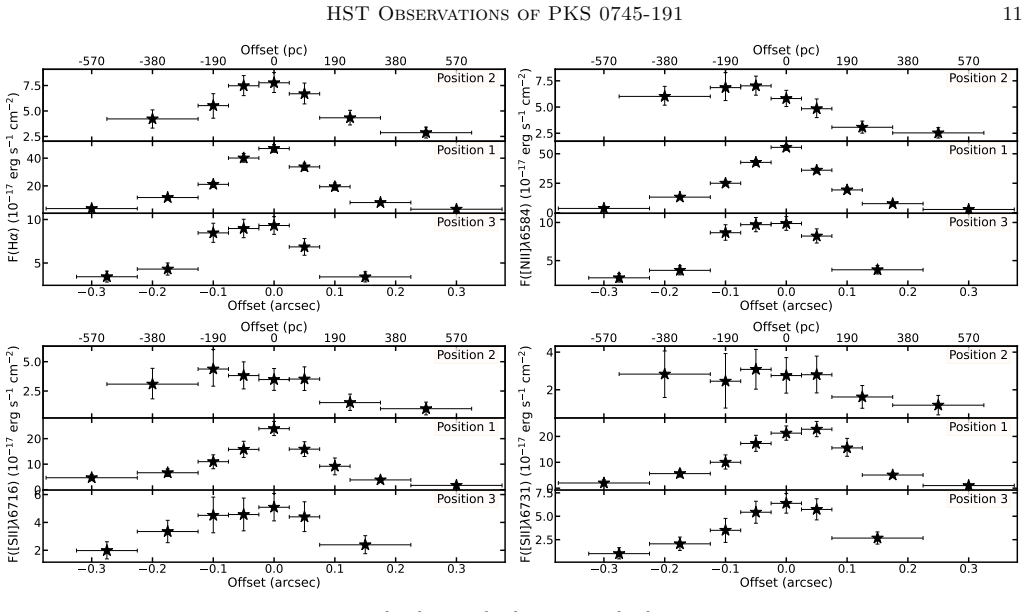
The central claim is that the ionized gas within the central ~600 pc of PKS 0745-191 — inside the sphere of influence of an ultramassive black hole — is highly chaotic and non-rotational on the scales probed, in contrast to the coherent rotating flows seen in weaker-feedback BCGs such as M84 and M87. The evidence is the kinematic map from three STIS slits: the velocity field shows no organized gradient, adjacent pixels differ by up to $\pm400$ km s$^{-1}$, and the velocity dispersion climbs from a few hundred km s$^{-1}$ at ~570 pc to a peak of $\sigma = 595 \pm 32$ km s$^{-1}$ at the nucleus. The authors interpret this dispersion peak with the virial relation $M\approx \sigma^2 R/G$ at $R=188$ pc (the slit width), obtaining an approximate black-hole mass of $1.5\times10^{10}\,M_\odot$, and they note explicitly that the estimate is preliminary because the chaotic conditions make the virial assumption uncertain. They also find a nearly flat ionized-gas density profile derived from the [S II] line ratio, similar to the flat X-ray gas density profiles around galaxies with resolved Bondi radii, and [N II]/H$\alpha$ ratios above unity indicating AGN- or shock-dominated ionization. The overall picture offered is that within the sphere of influence of a powerful radio-mode feedback system, the hot gas flow decouples from the large-scale medium, loses angular momentum, and may feed the black hole through chaotic accretion.
Load-bearing premise
The black-hole mass estimate rests on interpreting the very wide emission line at the nucleus (about 1400 km s$^{-1}$ wide) as the gravitational pull of a massive black hole on gas within ~190 pc; if that width comes from jet-driven turbulence, an outflow, or many overlapping clouds at different speeds, the derived $1.5\times10^{10}\,M_\odot$ mass would not hold.
Editorial extensions
If this is right
- The sphere of influence of an ultramassive black hole undergoing powerful radio-mode feedback has been kinematically resolved, so feeding processes at about 100-pc scales can now be confronted with data rather than inferred from large-scale arguments.
- The absence of rotation at sub-kpc scales, unlike in M84 and M87, implies that jet powers of $\sim10^{45}$ erg s$^{-1}$ can disrupt ordered nuclear gas disks, a direct constraint on how much angular momentum feedback removes.
- If the virial mass estimate holds, PKS 0745-191 joins a small group of $\gtrsim10^{10}\,M_\odot$ black holes, and the result supports the prediction that the most massive cool-core clusters host the most massive black holes.
- The chaotic velocity field with pixel-to-pixel jumps of several hundred km s$^{-1}$ is consistent with chaotic cold accretion models, and it suggests a self-regulating loop in which jet-driven turbulence lowers angular momentum and thereby fuels the same black hole that drives the feedback.
- The flat ionized-gas density profile parallels the flat X-ray profiles seen around resolved Bondi radii in systems like M84 and NGC 1600, suggesting a common density structure around accreting massive black holes regardless of gas phase.
Reading between the lines
- An implication the paper leaves implicit: if chaotic, non-rotating flows are typical inside the spheres of influence of powerful radio-mode systems, then single-sight-line absorption studies of cold infalling gas against the radio core may systematically miss the full three-dimensional complexity of the inflow; only spatially resolved maps like these can recover it.
- A direct test the authors do not carry out: measuring the stellar velocity dispersion within the same roughly 200-pc region with JWST or adaptive-optics integral-field spectroscopy. If the stars show $\sigma \lesssim 300$ km s$^{-1}$ while the gas shows about 595 km s$^{-1}$, the gas is not tracing the gravitational potential and the black-hole mass estimate would need to be abandoned.
- The absence of CO emission in the core, combined with the flat ionized-gas density, hints that the ionized gas is the inner extension of the cooling flow rather than a separate phase; future far-infrared or molecular-line mapping could test whether a hidden cooling flow terminates at these radii.
- If the chaotic flow does represent a genuinely low-spin accretion state, the coexistence of a powerful jet hints either that spin is not the sole determinant of jet power or that the jet's energy is stored and released episodically; space-based very-long-baseline interferometry of the jet-launching region could discriminate between these.
Editorial analysis
A structured set of objections, weighed in public.
Referee Report
Summary. The paper presents HST/STIS long-slit spectroscopy of the brightest cluster galaxy PKS 0745-191, mapping ionized gas kinematics and densities in the central ~0.3 arcsec (~570 pc). The authors find that the emission-line flux peaks at the AGN, the velocity field is chaotic and non-rotational on sub-kpc scales, velocity jumps between adjacent pixels reach hundreds of km/s, and the velocity dispersion rises sharply to ~595 km/s at the nucleus. From a virial estimate they derive MBH ~ 1.5e10 Msun and argue that the black hole's sphere of influence is resolved. The paper also compares the flat ionized-gas density profile with X-ray profiles in Bondi-radius-resolved systems, interprets the [N II]/Halpha ratios as AGN-dominated ionization, and compares the kinematics with MHD simulations of chaotic cold accretion. The central claim is that this is the first resolved map of gas dynamics inside the sphere of influence of an ultramassive black hole undergoing powerful radio-mode feedback.
Significance. If the SMBH mass estimate were robust, this would be a landmark observation: resolved sub-kpc kinematics inside the sphere of influence of an ultramassive black hole in a strong cool-core cluster, contrasting with the rotating nuclear disks seen in weaker-feedback BCGs. The paper has genuine strengths: the STIS reduction, the MCMC spectral fitting with convergence checks, the explicit alternative-model tests, and the availability of public data and analysis code all support the basic kinematic measurements. The chaotic, non-rotational gas flow with large pixel-to-pixel velocity shifts that exceed the quoted uncertainties is well supported and is itself an important result. However, the quantitative black-hole mass, the resolved-sphere-of-influence claim, the Bondi radius, and the simulation comparison are not independent of a single uncalibrated virial estimate, and that estimate contains an internal inconsistency that affects the headline claim.
major comments (4)
- [§5.1] There is a numerical inconsistency in the sphere-of-influence calculation. The authors define MBH ~ sigma^2 R/G with sigma = 595 km/s and R = 0.1 arcsec = 188 pc. Using these same values, the definition r_inf = G MBH / sigma^2 gives r_inf = R = 188 pc = 0.1 arcsec, not the quoted r_inf ~ 0.4 arcsec (800 pc). The quoted 800 pc must be using a different, presumably stellar, sigma ~ 300 km/s. This matters because the abstract and conclusions claim that the sphere of influence is resolved and 'covers roughly a dozen STIS pixels'; at 188 pc the STIS slit width is comparable to r_inf, and the sphere of influence is only marginally resolved, if at all. The authors should recompute r_inf consistently and discuss how the resolved-SOI claim changes.
- [§5.1] The virial mass estimate MBH ~ sigma^2 R / G neglects the stellar mass within the slit and assumes virialization in a flow that the authors themselves describe as chaotic and possibly not virialized ('it remains unclear whether the virial theorem provides a reliable mass estimate in this context'). The BCG has a stellar velocity dispersion of roughly 300 km/s (Gingras et al. 2024), implying a stellar enclosed mass within 188 pc of order several x 10^9 Msun, which is not negligible relative to 1.5e10 Msun. The estimate also uses no projection factor or dimensionless virial coefficient. The paper should provide a systematic uncertainty budget that includes a range of virial coefficients, an estimate of the stellar contribution from the F814W surface brightness profile, and a test of non-gravitational broadening mechanisms (turbulence, outflows, unresolved multiple components), for example using line-profile asymmetry or the weaker two-component fits already mentioned in §3. Without such a budget, the abstract's statement that the kinematics are 'consistent with a very massive MBH ~ 1.5e10 Msun SMBH' is too strong.
- [§5.3, §5.6, Eq. (1)] The Bondi radius, the sphere of influence, and the MHD simulation comparison all use the same MBH derived in §5.1, so they cannot provide independent corroboration. Specifically, Eq. (1) is evaluated with MBH = 1.5e10 Msun from this paper, and §5.6 states that the simulations 'use a larger black hole mass of 1.5e10 Msun, based on the rough estimate in this work', before being compared with the observed density and kinematics. This is circular for the purpose of supporting the mass estimate. The authors should either adopt an independent MBH range from the literature or clearly label these comparisons as predictions contingent on the assumed mass.
- [Abstract and §5.1] The phrase 'within the sphere of influence' is used as an established fact throughout the paper, but the sphere of influence depends on the uncertain MBH estimate. Given the issues above, the abstract and conclusions overstate the certainty of the measurement. A measured, resolved sphere of influence would normally require a dynamical model in which the BH mass and the enclosed stellar mass are fitted simultaneously to the kinematic data, rather than a single virial estimate. The paper should reframe the central claim as evidence for chaotic sub-kpc kinematics and a velocity-dispersion peak that is plausibly associated with a very massive BH, with the mass estimate presented as preliminary.
minor comments (5)
- [§5.7] There is a typo: 'expsoure' should be 'exposure'; also, 'spexels' in Fig. 8 and the surrounding text should be 'spaxels'.
- [§4.2] The choice of systemic redshift is important for the 'highly redshifted' interpretation; the paper notes that adopting z = 0.1028 would lower velocities by ~120 km/s. This caveat should be stated at the first use of the velocity scale and repeated in the conclusions, since the absolute velocity offsets are a central part of the kinematics discussion.
- [Fig. 4] The overplotted 'sphere of influence for a 1.5e10 Msun SMBH' is based on this paper's own virial estimate; the figure should label this as an assumed value and, ideally, show a range corresponding to the uncertainty in MBH.
- [§3 and Table 1] No dust-extinction correction is described for the emission-line fluxes and ratios; if none is applied, the authors should state so explicitly, as line ratios such as [N II]/Halpha and [S II] are sensitive to reddening.
- [§5.2] The sentence about Bustamante & Springel (2019) says 'This allows the author to trace' but should be plural; the repeated citation of McNamara et al. (2009a, 2009b) should also be consolidated in the reference list.
Circularity Check
The chaotic kinematic maps are independent, but the sphere-of-influence, Bondi-radius, and MHD-simulation comparisons all reuse the same virial M_BH estimate and therefore do not independently corroborate the black-hole mass.
-
self definitional
[Section 5.1 (black hole mass estimate and sphere of influence)]
"The sphere of influence for a SMBH is given by rinf = GMBH/σ2. For an SMBH mass of ∼ 1.5 × 10¹⁰M⊙, the sphere of influence is estimated to be rinf ∼ 0.4′′ (or 800 pc) for our target. This suggests that the sphere of influence is resolved and covers roughly a dozen STIS pixels."
By construction, M_BH is obtained from σ²R/G with R equal to the slit width. Substituting this expression into r_inf = G M_BH/σ² yields r_inf = R whenever the same σ is used, so the claim that the sphere of influence is resolved reduces to the chosen slit width rather than being an independent detection. The quoted 800 pc silently requires using a different, smaller σ than the 595 km/s used for M_BH. The sphere-of-influence framing therefore inherits, rather than tests, the virial mass estimate.
-
fitted input called prediction
[Section 5.3, Eq. (1) (Bondi radius)]
"To obtain a rough estimate of the Bondi radius, we used the innermost bin of the temperature profile from Sanders et al. (2014), where kBT ∼ 2.5 keV within the inner 10 kpc. Additionally, we adopted the SMBH mass determined in Section 5.1 as 1.5 × 10¹⁰M⊙. This yields a Bondi radius of approximately rB ∼ 180 pc"
The Bondi radius is not measured from the X-ray data; it is computed from Eq. (1) using the M_BH value derived in Section 5.1 from the central velocity dispersion. The subsequent interpretive statement that the flat STIS density profile 'parallel[s]' profiles in systems with resolved Bondi radii is thus not an independent confirmation of the mass. It is a propagation of the same preliminary virial estimate into a new length scale.
1 more flagged steps
-
fitted input called prediction
[Section 5.6 (comparison with MHD simulations)]
"The simulations deployed here are similar to those of Guo et al. (2024), but use a larger black hole mass of 1.5×10^10 M⊙, based on the rough estimate in this work. ... These results suggest that cooling flows from large-scale hot gas, combined with magnetic fields and large-scale turbulence, can spontaneously generate small-scale chaotic cold flows and density structures similar to those seen in observations."
The simulation is initialized with the paper's own virial M_BH value (1.5 × 10^10 M⊙) and then compared to the same STIS observations as if it were a forward prediction. Because the adopted mass is an input, agreement in normalization or inflow structure cannot independently confirm that mass; it only demonstrates that chaotic flows develop for that assumed value. The qualitative morphological similarity may be generic, but the quantitative comparison is partly circular by construction.
full rationale
The STIS spectral fitting and the resulting velocity and velocity-dispersion maps (Table 1, Figs. 9–10) are self-contained observational products; the conclusion that the ionized gas is chaotic and non-rotational does not depend on the black-hole mass. The virial estimate M_BH ~ σ²R/G in Section 5.1 is presented by the authors as approximate and uncertain, and they explicitly caution that 'it remains unclear whether the virial theorem provides a reliable mass estimate in this context.' The circularity is therefore not in the mass estimate itself but in the subsequent use of that single fitted number: the sphere of influence r_inf, the Bondi radius r_B, and the MHD simulations in Section 5.6 all adopt M_BH = 1.5 × 10^10 M⊙ and are then used to frame or corroborate the observations. These steps reduce by construction to the same input and do not provide independent support. The paper also cites the authors' own 2012 fundamental-plane prediction as corroboration, but that is auxiliary and externally falsifiable, so it does not by itself drive the score. Since the primary kinematic result stands on its own, the overall circularity is moderate and partial rather than total.
Assumptions & free parameters
free parameters (3)
- Virial coefficient k in MBH = k * sigma^2 * R / G =
k = 1 (implicit)
- Simulation black hole mass =
1.5e10 Msun
- Mass cooling rate in hidden cooling flow model =
332(+88,-80) Msun/yr
assumptions (6)
- domain assumption Flat Lambda-CDM cosmology with H0 = 70 km/s/Mpc, Omega_m = 0.3, and Omega_Lambda = 0.7
- domain assumption Systemic redshift of PKS 0745-191 is z = 0.102428, from stellar population modeling by Gingras et al. (2024)
- domain assumption The [N II], H-alpha, and [S II] lines trace the same 10^4 K gas and share the same bulk velocity and velocity dispersion
- ad hoc to paper Virial theorem applies to the chaotic ionized gas, so MBH ~ sigma^2 R/G
- domain assumption [S II] doublet ratio maps uniquely to gas density at T = 10^4 K under photoionization equilibrium
- ad hoc to paper Bondi radius estimate uses kT ~ 2.5 keV from Sanders et al. (2014) and MBH = 1.5e10 Msun from this paper
Cite this review
Pith. "Pith review of HST Observations within the Sphere of Influence of the Powerful Supermassive Black Hole in PKS0745-191." pith.science (2026). https://pith.science/paper/Y2WTFN6V
@misc{pith2026250103339,
  author       = {Pith},
  title        = {Pith review of: HST Observations within the Sphere of Influence of the Powerful Supermassive Black Hole in PKS0745-191},
  year         = {2026},
  howpublished = {\url{https://pith.science/paper/Y2WTFN6V}},
  note         = {Machine review of arXiv:2501.03339}
}
abstract
We present Space Telescope Imaging Spectrograph observations from the Hubble Space Telescope of the supermassive black hole (SMBH) at the center of PKS0745-191, a brightest cluster galaxy (BCG) undergoing powerful radio-mode AGN feedback ($P_{\rm cav}\sim5\times10^{45}$ erg s$^{-1}$). These high-resolution data offer the first spatially resolved map of gas dynamics within a SMBHs sphere of influence under such powerful feedback. Our results reveal the presence of highly chaotic, non-rotational ionized gas flows on sub-kpc scales, in contrast to the more coherent flows observed on larger scales. While radio-mode feedback effectively thermalizes hot gas in galaxy clusters on kiloparsec scales, within the core, the hot gas flow may decouple, leading to a reduction in angular momentum and supplying ionized gas through cooling, which could enhance accretion onto the SMBH. This process could, in turn, lead to a self-regulating feedback loop. Compared to other BCGs with weaker radio-mode feedback, where rotation is more stable, intense feedback may lead to more chaotic flows, indicating a stronger coupling between jet activity and gas dynamics. Additionally, we observe a sharp increase in velocity dispersion near the nucleus, consistent with a very massive $M_{\rm BH}\sim1.5\times10^{10} M_\odot$ SMBH. The density profile of the ionized gas is also notably flat, paralleling the profiles observed in X-ray gas around galaxies where the Bondi radius is resolved. These results provide valuable insights into the complex mechanisms driving galaxy evolution, highlighting the intricate relationship between SMBH fueling and AGN feedback within the host galaxy.
Figures


Figures from the paper (13 more)




Reference graph
Works this paper leans on
-
[1]
Allen, M. G., Groves, B. A., Dopita, M. A., Sutherland, R. S., & Kewley, L. J. 2008, ApJS, 178, 20, doi: 10.1086/589652
doi:10.1086/589652 2008
-
[2]
Armitage, P. J., & Natarajan, P. 2002, ApJL, 567, L9, doi: 10.1086/339770
doi:10.1086/339770 2002
-
[3]
Arnaud, M., Pointecouteau, E., & Pratt, G. W. 2005, A&A, 441, 893, doi: 10.1051/0004-6361:20052856
-
[4]
2017, ApJ, 837, 91, doi: 10.3847/1538-4357/aa5f5c
Bae, H.-J., Woo, J.-H., Karouzos, M., et al. 2017, ApJ, 837, 91, doi: 10.3847/1538-4357/aa5f5c
-
[5]
K., Maeda, Y., Morris, M., et al
Baganoff, F. K., Maeda, Y., Morris, M., et al. 2003, ApJ, 591, 891, doi: 10.1086/375145
doi:10.1086/375145 2003
-
[6]
Baldwin, J. A., Phillips, M. M., & Terlevich, R. 1981, PASP, 93, 5, doi: 10.1086/130766
doi:10.1086/130766 1981
-
[7]
Bambic, C. J., Russell, H. R., Reynolds, C. S., et al. 2023, MNRAS, 522, 4374, doi: 10.1093/mnras/stad824
-
[8]
Baum, S. A., & O ’Dea, C. P. 1991, Monthly Notices of the Royal Astronomical Society, 250, 737, doi: 10.1093/mnras/250.4.737
Show all 103 references
- [9]
-
[10]
2008, ApJ, 684, 822, doi: 10.1086/590379
Berti, E., & Volonteri, M. 2008, ApJ, 684, 822, doi: 10.1086/590379
2008 doi
-
[11]
D., & Znajek, R
Blandford, R. D., & Znajek, R. L. 1977, MNRAS, 179, 433, doi: 10.1093/mnras/179.3.433
1977 doi
-
[12]
1952, MNRAS, 112, 195, doi: 10.1093/mnras/112.2.195
Bondi, H. 1952, MNRAS, 112, 195, doi: 10.1093/mnras/112.2.195
1952 doi
-
[13]
2019, MNRAS, 490, 4133, doi: 10.1093/mnras/stz2836
Bustamante, S., & Springel, V. 2019, MNRAS, 490, 4133, doi: 10.1093/mnras/stz2836
2019 doi
-
[14]
S., Russell, H
Calzadilla, M. S., Russell, H. R., McDonald, M. A., et al. 2019, ApJ, 875, 65, doi: 10.3847/1538-4357/ab09f6
2019 doi
-
[15]
S., Narayan, R., et al
Cho, H., Prather, B. S., Narayan, R., et al. 2023, ApJL, 959, L22, doi: 10.3847/2041-8213/ad1048
2023 doi
- [16]
-
[17]
2023, Nature, 621, 711, doi: 10.1038/s41586-023-06479-6 Dalla Bont` a, E., Ferrarese, L., Corsini, E
Cui, Y., Hada, K., Kawashima, T., et al. 2023, Nature, 621, 711, doi: 10.1038/s41586-023-06479-6 Dalla Bont` a, E., Ferrarese, L., Corsini, E. M., et al. 2009, ApJ, 690, 537, doi: 10.1088/0004-637X/690/1/537
2023 doi
-
[18]
P., Lim, J., Forman, W., et al
David, L. P., Lim, J., Forman, W., et al. 2014, ApJ, 792, 94, doi: 10.1088/0004-637X/792/2/94
2014 doi
-
[19]
M., et al
Donahue, M., Mack, J., Voit, G. M., et al. 2000, ApJ, 545, 670, doi: 10.1086/317836
2000 doi
-
[20]
C., Wilman, R
Edge, A. C., Wilman, R. J., Johnstone, R. M., et al. 2002, MNRAS, 337, 49, doi: 10.1046/j.1365-8711.2002.05790.x
2002
-
[21]
Fabian, A. C. 2012, ARA&A, 50, 455, doi: 10.1146/annurev-astro-081811-125521
2012 doi
-
[22]
C., Ferland, G
Fabian, A. C., Ferland, G. J., Sanders, J. S., et al. 2022, MNRAS, 515, 3336, doi: 10.1093/mnras/stac2003
2022 doi
-
[23]
C., Sanders, J
Fabian, A. C., Sanders, J. S., Ferland, G. J., et al. 2023a, MNRAS, 521, 1794, doi: 10.1093/mnras/stad507 —. 2023b, MNRAS, 524, 716, doi: 10.1093/mnras/stad1870 —. 2023c, MNRAS, 524, 716, doi: 10.1093/mnras/stad1870
-
[25]
C., Arnaud, K
Fabian, A. C., Arnaud, K. A., Nulsen, P. E. J., et al. 1985, MNRAS, 216, 923, doi: 10.1093/mnras/216.4.923
1985 doi
- [27]
-
[28]
W., Lang, D., & Goodman, J
Foreman-Mackey, D., Hogg, D. W., Lang, D., & Goodman, J. 2013, PASP, 125, 306, doi: 10.1086/670067
2013 doi
-
[29]
2001, in Society of Photo-Optical Instrumentation Engineers (SPIE) Conference Series, Vol
Freeman, P., Doe, S., & Siemiginowska, A. 2001, in Society of Photo-Optical Instrumentation Engineers (SPIE) Conference Series, Vol. 4477, Astronomical Data Analysis, ed. J.-L. Starck & F. D. Murtagh, 76–87, doi: 10.1117/12.447161
2001 doi
-
[30]
C., Riffel, R
Freitas, I. C., Riffel, R. A., Storchi-Bergmann, T., et al. 2018, MNRAS, 476, 2760, doi: 10.1093/mnras/sty303
2018 doi
-
[31]
S., et al., & et al
Fruchter, A. S., et al., & et al. 2010, in 2010 Space Telescope Science Institute Calibration Workshop, 382–387 Garc ´ ıa-Burillo, S., Combes, F., Usero, A., et al. 2014, A&A, 567, A125, doi: 10.1051/0004-6361/201423843
2010 doi
-
[32]
Gaspari, M., Ruszkowski, M., & Oh, S. P. 2013, MNRAS, 432, 3401, doi: 10.1093/mnras/stt692
2013 doi
-
[33]
L., et al
Gaspari, M., McDonald, M., Hamer, S. L., et al. 2018, ApJ, 854, 167, doi: 10.3847/1538-4357/aaaa1b
2018 doi
-
[34]
Gelman, A., & Rubin, D. B. 1992, Statistical Science, 7, 457, doi: 10.1214/ss/1177011136
1992
- [35]
-
[36]
2011, Post-SM4 ACS/WFC Bias Striping: Characterization and Mitigation, Instrument Science Report ACS 2011-05, 25 pages HST Observations of PKS 0745-191 23
Loose, M. 2011, Post-SM4 ACS/WFC Bias Striping: Characterization and Mitigation, Instrument Science Report ACS 2011-05, 25 pages HST Observations of PKS 0745-191 23
2011
-
[37]
M., Kim, C.-G., & Quataert, E
Guo, M., Stone, J. M., Kim, C.-G., & Quataert, E. 2023, ApJ, 946, 26, doi: 10.3847/1538-4357/acb81e
2023 doi
-
[38]
M., Quataert, E., & Kim, C.-G
Guo, M., Stone, J. M., Quataert, E., & Kim, C.-G. 2024, ApJ, 973, 141, doi: 10.3847/1538-4357/ad5fe7
2024 doi
-
[39]
L., Edge, A
Hamer, S. L., Edge, A. C., Swinbank, A. M., et al. 2016, MNRAS, 460, 1758, doi: 10.1093/mnras/stw1054
2016 doi
-
[41]
Heckman, T. M. 1980, A&A, 87, 152
1980
-
[42]
M., & Best, P
Heckman, T. M., & Best, P. N. 2023, Galaxies, 11, 21, doi: 10.3390/galaxies11010021
2023 doi
- [43]
-
[44]
C., Edge, A
Hlavacek-Larrondo, J., Fabian, A. C., Edge, A. C., et al. 2013, MNRAS, 431, 1638, doi: 10.1093/mnras/stt283
2013 doi
-
[46]
T., Edge, A
Hogan, M. T., Edge, A. C., Hlavacek-Larrondo, J., et al. 2015a, MNRAS, 453, 1201, doi: 10.1093/mnras/stv1517
-
[47]
T., Edge, A
Hogan, M. T., Edge, A. C., Geach, J. E., et al. 2015b, MNRAS, 453, 1223, doi: 10.1093/mnras/stv1518
-
[49]
W., Murdoch, H
Hunstead, R. W., Murdoch, H. S., & Shobbrook, R. R. 1978, MNRAS, 185, 149, doi: 10.1093/mnras/185.1.149
1978 doi
-
[50]
D., Akiyama, K., Baturin, R., et al
Johnson, M. D., Akiyama, K., Baturin, R., et al. 2024, in Society of Photo-Optical Instrumentation Engineers (SPIE) Conference Series, Vol. 13092, Space Telescopes and Instrumentation 2024: Optical, Infrared, and Millimeter Wave, ed. L. E. Coyle, S. Matsuura, & M. D. Perrin, 1...
2024 doi
-
[51]
M., Fabian, A
Johnstone, R. M., Fabian, A. C., & Nulsen, P. E. J. 1987, MNRAS, 224, 75, doi: 10.1093/mnras/224.1.75
1987 doi
- [52]
-
[53]
J., Groves, B., Kauffmann, G., & Heckman, T
Kewley, L. J., Groves, B., Kauffmann, G., & Heckman, T. 2006, MNRAS, 372, 961, doi: 10.1111/j.1365-2966.2006.10859.x
2006
-
[54]
2015, ARA&A, 53, 115, doi: 10.1146/annurev-astro-082214-122316
King, A., & Pounds, K. 2015, ARA&A, 53, 115, doi: 10.1146/annurev-astro-082214-122316
2015 doi
-
[55]
Kormendy, J., & Ho, L. C. 2013, ARA&A, 51, 511, doi: 10.1146/annurev-astro-082708-101811
2013 doi
-
[56]
R., Faber, S
Lauer, T. R., Faber, S. M., Richstone, D., et al. 2007, ApJ, 662, 808, doi: 10.1086/518223
2007 doi
-
[57]
G., Marscher, A
Lico, R., Jorstad, S. G., Marscher, A. P., et al. 2023, Galaxies, 11, 17, doi: 10.3390/galaxies11010017
2023 doi
-
[58]
Markwardt, C. B. 2009, in Astronomical Society of the Pacific Conference Series, Vol. 411, Astronomical Data Analysis Software and Systems XVIII, ed. D. A
2009
- [59]
-
[60]
J., Ma, C.-P., Murphy, J
McConnell, N. J., Ma, C.-P., Murphy, J. D., et al. 2012, ApJ, 756, 179, doi: 10.1088/0004-637X/756/2/179
2012 doi
-
[61]
2007, in Astronomical Society of the Pacific Conference Series, Vol
Golap, K. 2007, in Astronomical Society of the Pacific Conference Series, Vol. 376, Astronomical Data Analysis Software and Systems XVI, ed. R. A. Shaw, F. Hill, & D. J. Bell, 127
2007
-
[62]
R., Kazemzadeh, F., Rafferty, D
McNamara, B. R., Kazemzadeh, F., Rafferty, D. A., et al. 2009a, ApJ, 698, 594, doi: 10.1088/0004-637X/698/1/594 —. 2009b, ApJ, 698, 594, doi: 10.1088/0004-637X/698/1/594
-
[63]
R., & Nulsen, P
McNamara, B. R., & Nulsen, P. E. J. 2012, New Journal of Physics, 14, 055023, doi: 10.1088/1367-2630/14/5/055023
2012 doi
-
[64]
R., & O’Connell, R
McNamara, B. R., & O’Connell, R. W. 1989, AJ, 98, 2018, doi: 10.1086/115275
1989 doi
-
[65]
R., Rohanizadegan, M., & Nulsen, P
McNamara, B. R., Rohanizadegan, M., & Nulsen, P. E. J. 2011, ApJ, 727, 39, doi: 10.1088/0004-637X/727/1/39
2011 doi
-
[66]
R., Russell, H
McNamara, B. R., Russell, H. R., Nulsen, P. E. J., et al. 2016, ApJ, 830, 79, doi: 10.3847/0004-637X/830/2/79
2016 doi
-
[67]
2019, ApJ, 887, 195, doi: 10.3847/1538-4357/ab5856
Mehrgan, K., Thomas, J., Saglia, R., et al. 2019, ApJ, 887, 195, doi: 10.3847/1538-4357/ab5856
2019 doi
-
[68]
2003, MNRAS, 345, 1057, doi: 10.1046/j.1365-2966.2003.07017.x
Merloni, A., Heinz, S., & di Matteo, T. 2003, MNRAS, 345, 1057, doi: 10.1046/j.1365-2966.2003.07017.x
2003
-
[69]
T., & Combes, F
Mittal, R., Whelan, J. T., & Combes, F. 2015, MNRAS, 450, 2564, doi: 10.1093/mnras/stv754
2015 doi
-
[70]
Narayan, R., & Fabian, A. C. 2011, MNRAS, 415, 3721, doi: 10.1111/j.1365-2966.2011.18987.x
2011
-
[71]
T., Gualandris, A., Read, J
Nasim, I. T., Gualandris, A., Read, J. I., et al. 2021, MNRAS, 502, 4794, doi: 10.1093/mnras/stab435
2021 doi
-
[72]
2009, MNRAS, 393, 838, doi: 10.1111/j.1365-2966.2008.13864.x
Natarajan, P., & Treister, E. 2009, MNRAS, 393, 838, doi: 10.1111/j.1365-2966.2008.13864.x
2009
-
[73]
W., Smith, R
Nightingale, J. W., Smith, R. J., He, Q., et al. 2023, MNRAS, 521, 3298, doi: 10.1093/mnras/stad587
2023 doi
-
[74]
2019, A&A, 631, A22, doi: 10.1051/0004-6361/201935350
Olivares, V., Salome, P., Combes, F., et al. 2019, A&A, 631, A22, doi: 10.1051/0004-6361/201935350
2019 doi
-
[75]
2023, A&A, 679, A37, doi: 10.1051/0004-6361/202346549
Osorno, J., Nagar, N., Richtler, T., et al. 2023, A&A, 679, A37, doi: 10.1051/0004-6361/202346549
2023 doi
-
[76]
2005, ApJ, 632, 821, doi: 10.1086/444344
Pizzolato, F., & Soker, N. 2005, ApJ, 632, 821, doi: 10.1086/444344
2005 doi
-
[77]
A., Nixon, C
Pounds, K. A., Nixon, C. J., Lobban, A., & King, A. R. 2018, MNRAS, 481, 1832, doi: 10.1093/mnras/sty2359
2018 doi
-
[78]
Wise, M. W. 2006, ApJ, 652, 216, doi: 10.1086/507672
2006 doi
-
[79]
M., Quataert, E., & Stone, J
Ressler, S. M., Quataert, E., & Stone, J. M. 2018, MNRAS, 478, 3544, doi: 10.1093/mnras/sty1146 24 Hlavacek-Larrondo et al
2018 doi
-
[80]
M., White, C
Ressler, S. M., White, C. J., Quataert, E., & Stone, J. M. 2020, ApJL, 896, L6, doi: 10.3847/2041-8213/ab9532
2020 doi
-
[81]
M., Kraemer, S
Revalski, M., Crenshaw, D. M., Kraemer, S. B., et al. 2018, ApJ, 856, 46, doi: 10.3847/1538-4357/aab107
2018 doi
-
[82]
M., Rafelski, M., et al
Revalski, M., Crenshaw, D. M., Rafelski, M., et al. 2022, ApJ, 930, 14, doi: 10.3847/1538-4357/ac5f3d
2022 doi
-
[83]
L., Hlavacek-Larrondo, J., & Prasow- ´Emond, M
Rhea, C. L., Hlavacek-Larrondo, J., & Prasow- ´Emond, M. 2020, X-tra Astronomy Tools, v1.1, OSF, doi: 10.17605/OSF.IO/VWCKS
2020 doi
- [84]
-
[85]
C., Combes, F., et al
Rose, T., Edge, A. C., Combes, F., et al. 2019a, MNRAS, 485, 229, doi: 10.1093/mnras/stz406 —. 2019b, MNRAS, 489, 349, doi: 10.1093/mnras/stz2138
-
[86]
Runge, J., & Walker, S. A. 2021, MNRAS, 502, 5487, doi: 10.1093/mnras/stab444
2021 doi
-
[87]
P., Thomas, J., Saglia, R
Rusli, S. P., Thomas, J., Saglia, R. P., et al. 2013, AJ, 146, 45, doi: 10.1088/0004-6256/146/3/45
2013 doi
-
[88]
Broderick, A. E. 2015, MNRAS, 451, 588, doi: 10.1093/mnras/stv954
2015 doi
-
[89]
R., Fabian, A
Russell, H. R., Fabian, A. C., McNamara, B. R., et al. 2018, MNRAS, 477, 3583, doi: 10.1093/mnras/sty835
2018 doi
-
[90]
R., McNamara, B
Russell, H. R., McNamara, B. R., Edge, A. C., et al. 2013, MNRAS, 432, 530, doi: 10.1093/mnras/stt490
2013 doi
-
[91]
R., McNamara, B
Russell, H. R., McNamara, B. R., Fabian, A. C., et al. 2016, MNRAS, 458, 3134, doi: 10.1093/mnras/stw409
2016 doi
-
[92]
2024, A&A, 685, A92, doi: 10.1051/0004-6361/202348925 Salom´ e, P., & Combes, F
Sala, L., Valentini, M., Biffi, V., & Dolag, K. 2024, A&A, 685, A92, doi: 10.1051/0004-6361/202348925 Salom´ e, P., & Combes, F. 2003, A&A, 412, 657, doi: 10.1051/0004-6361:20031438 S´ anchez Almeida, J., Terlevich, R., Terlevich, E., Cid
2024 doi
-
[93]
Fernandes, R., & Morales-Luis, A. B. 2012, ApJ, 756, 163, doi: 10.1088/0004-637X/756/2/163
2012 doi
-
[94]
S., Fabian, A
Sanders, J. S., Fabian, A. C., Hlavacek-Larrondo, J., et al. 2014, MNRAS, 444, 1497, doi: 10.1093/mnras/stu1543
2014 doi
-
[95]
2013, A&A, 558, A43, doi: 10.1051/0004-6361/201322062
Singh, R., van de Ven, G., Jahnke, K., et al. 2013, A&A, 558, A43, doi: 10.1051/0004-6361/201322062
2013 doi
-
[96]
A., Gavrilovi´ c, N., Moiseev, A
Smirnova, A. A., Gavrilovi´ c, N., Moiseev, A. V., et al. 2007, MNRAS, 377, 480, doi: 10.1111/j.1365-2966.2007.11635.x
2007
-
[98]
D., McNamara, B
Tamhane, P. D., McNamara, B. R., Russell, H. R., et al. 2022, MNRAS, 516, 861, doi: 10.1093/mnras/stac2168
2022 doi
- [99]
-
[100]
J., et al
Thomas, J., Ma, C.-P., McConnell, N. J., et al. 2016, Nature, 532, 340, doi: 10.1038/nature17197
2016 doi
-
[101]
R., O’Dea, C
Tremblay, G. R., O’Dea, C. P., Baum, S. A., et al. 2015, MNRAS, 451, 3768, doi: 10.1093/mnras/stv1151
2015 doi
-
[102]
R., Oonk, J
Tremblay, G. R., Oonk, J. B. R., Combes, F., et al. 2016, Nature, 534, 218, doi: 10.1038/nature17969 van Dokkum, P. G. 2001, PASP, 113, 1420, doi: 10.1086/323894
2016 doi
-
[103]
M., Donahue, M., Bryan, G
Voit, G. M., Donahue, M., Bryan, G. L., & McDonald, M. 2015, Nature, 519, 203, doi: 10.1038/nature14167
2015 doi
-
[104]
A., Fabian, A
Walker, S. A., Fabian, A. C., Sanders, J. S., & George, M. R. 2012, MNRAS, 424, 1826, doi: 10.1111/j.1365-2966.2012.21282.x
2012
-
[105]
L., Barth, A
Walsh, J. L., Barth, A. J., Ho, L. C., & Sarzi, M. 2013, ApJ, 770, 86, doi: 10.1088/0004-637X/770/2/86
2013 doi
-
[106]
L., Barth, A
Walsh, J. L., Barth, A. J., & Sarzi, M. 2010, ApJ, 721, 762, doi: 10.1088/0004-637X/721/1/762
2010 doi
-
[107]
J., Edge, A
Wilman, R. J., Edge, A. C., & Swinbank, A. M. 2009, MNRAS, 395, 1355, doi: 10.1111/j.1365-2966.2009.14674.x
2009
-
[108]
A., Shcherbakov, R
Wong, K.-W., Irwin, J. A., Shcherbakov, R. V., et al. 2014, ApJ, 780, 9, doi: 10.1088/0004-637X/780/1/9
2014 doi
-
[109]
2023, ApJ, 954, 180, doi: 10.3847/1538-4357/ace892
Xu, W. 2023, ApJ, 954, 180, doi: 10.3847/1538-4357/ace892
2023 doi
Reviewed August 10, 2026 · model on record in the stance chip above.
Discussion (0). Continue with ORCID to comment.