REVIEW 6 minor 1 cited by
Advances in RNA secondary structure prediction and RNA modifications: Methods, data, and applications
T0 review · 0 major / 6 minor · reviewed 2026-08-10 · deepseek-v4-flash
Pith's one-line read RNA secondary structure and RNA modifications are one coupled system, and prediction methods are converging on modeling them together.
desk verdict A competent, current survey of RNA secondary structure prediction and modification tools; no new methods, but the synthesis and m6A parameter discussion make it worth refereeing. read the letter →
The pith
A machine-rendered reading of the paper's core claim, the machinery that carries it, and where it could break.
The reading
What carries the argument
The load-bearing object is the nearest-neighbor free energy model: a set of empirically measured parameters that decomposes an RNA secondary structure into loop and stacking units whose free energies add. The review shows how this same machinery, originally built on unmodified nucleotides, is being extended to modified RNAs, most completely for m6A, with full parameter sets from optical melting experiments, and how the Zuker and McCaskill dynamic programming algorithms use these parameters to predict modified structures. On the modification side, the counterpart machinery is the sequence-feature classifiers, including SVM, CNN, transformer, and ensemble methods, that consume RNA structural encodings such as RNAfold MFE values to predict modification sites. The review's organizational machinery is its four-way classification of RNA secondary structure prediction methods.
What would settle it
Run a head-to-head test of m6A-aware folding versus standard folding on in-cell RNA structure probing data such as SHAPE-MaP maps of m6A-containing transcripts; if the m6A parameters do not improve accuracy over unmodified parameters, the review's core recommendation for modified-RNA prediction collapses. Alternatively, retrain a top deep-learning model on a redundancy-filtered holdout from ArchiveII or bpRNA-1m and show that method rankings invert.
Extended reading notes
Core claim
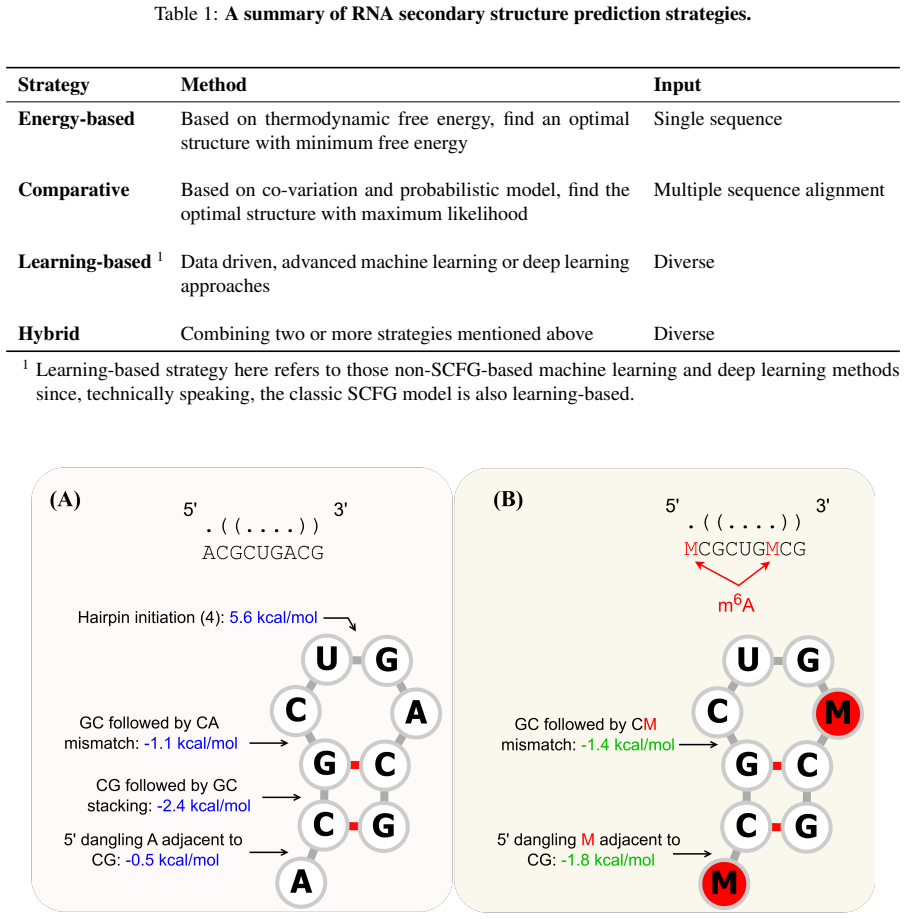
The central discovery the paper seeks to establish is that RNA secondary structure and RNA modifications are not separate phenomena but a coupled regulatory system: RNA secondary structure motifs guide where writers like METTL3/METTL14 install modifications, and modifications such as m6A, A-to-I editing, and pseudouridine reshape the structure by changing base-pair stabilities and annealing kinetics. The review supports this by tracing method progression from Nussinov-style dynamic programming and Turner nearest-neighbor free energy models, through comparative SCFG methods, to deep learning and foundational RNA language models, and by highlighting the emergence of energy parameters for modified nucleotides, particularly the complete m6A nearest-neighbor parameter set measured by optical melting experiments and integrated into RNAstructure and ViennaRNA. The intended conclusion is that accurate prediction of functional RNA behavior requires models that fold modified sequences with modification-aware energy parameters and that exploit structural context to predict modification sites.
Load-bearing premise
The review's guidance assumes that thermodynamic parameters measured on short synthetic RNAs in the laboratory, especially the m6A nearest-neighbor values, transfer faithfully to how modified RNAs fold inside cells, and that the benchmark datasets it highlights are representative enough to rank methods reliably.
Editorial extensions
If this is right
- Structure prediction tools that ignore modifications will systematically mispredict folding of modified transcripts, especially in m6A-rich regions such as 3' UTRs.
- Including m6A-aware nearest-neighbor parameters in mainstream packages like RNAstructure and ViennaRNA makes modified-RNA folding computationally practical today.
- Using RNA secondary structure features in modification predictors improves site prediction for m6A, 2'-O-methylation, and other marks.
- Deep learning and RNA foundation models pre-trained on large sequence collections are the likely route to overcome data scarcity and bias in RNA structure prediction.
- Joint modeling of structure and modification can inform the rational design of RNA vaccines and gene therapies, for example with N1-methylpseudouridine-modified messages.
Reading between the lines
- A testable extension the paper does not run: benchmark m6A-aware folding against transcriptome-wide in-cell probing data such as SHAPE-MaP to see whether melting-derived parameters improve accuracy over unmodified parameters in vivo.
- The review's taxonomy implies that energy-based and learning-based approaches are converging; a plausible next step is fully differentiable folding that trains end-to-end on modified RNA structure data.
- If the m6A-switch mechanism generalizes to other modifications, structure-aware modification prediction could become a general epitranscriptomics design rule rather than a per-modification special case.
Signed reviews
Editorial analysis
A structured set of objections, weighed in public.
Referee Report
Summary. This manuscript is a review of computational methods for RNA secondary structure (RSS) prediction and RNA modification prediction, together with the data resources used in these areas and the interplay between the two fields. It organizes RSS prediction into energy-based, comparative, learning-based, and hybrid approaches, surveys prediction tools for six RNA modification types, discusses the bidirectional effects of modifications and structure with emphasis on m6A and nearest-neighbor thermodynamic parameters, and lists relevant databases. The review closes with challenges such as data scarcity, pseudoknot handling, and therapeutic applications.
Significance. If accurate, this survey provides a useful structured map of a fast-moving field, and it is generally faithful to the cited literature. Its strengths include its breadth—covering method classes, tools, and data—and its focused discussion of m6A thermodynamics, including the Kierzek et al. and Szabat et al. parameter sets and the ViennaRNA modified-base support. It also explicitly flags data biases such as redundancy in ArchiveII and limitations of PDB-derived RNA sets. The review does not introduce new methods, so its value rests on the reliability of its synthesis; the issues found below are local and do not undermine the overall contribution.
minor comments (6)
- [Sec. 1 vs. Sec. 5.2/Table 4] Section 1 states that MODOMICS catalogs 'over 335 natural RNA modifications', but Section 5.2 and Table 4 report 'more than 170 different RNA modifications, 429 different RNA modified residues (335 natural ones)'; this internal inconsistency is a factual error and should be corrected.
- [Table 2 / Sec. 2.4] RNA-FM and RNAErnie are labeled as hybrid (H) in Table 2 and discussed under hybrid methods in Section 2.4, yet they are pre-trained language models rather than combinations of thermodynamic, comparative, and learning strategies as defined in Table 1; please clarify the hybrid definition or reclassify these entries.
- [Sec. 5.2] The subsection title 'RSS related RNA modification datasets' is misleading because ENCORI and eCLIP contain protein-RNA interaction data rather than RNA modification data; consider renaming the subsection or explicitly explaining their indirect relevance.
- [Table 2] The TORNADO entry lists 'Single sequence (FASTA, Stockholm)' as input, but Stockholm is a multiple-sequence alignment format; please clarify what input TORNADO actually accepts.
- [Throughout] There are numerous typographical and formatting errors, including 'Waston-Crick', 'Felsenstain', 'unaired region' (should be 'unpaired'), 'the the NIH grants', 'seqeunces', 'Lewi et al.' (should be 'Lewis et al.'), 'Tanzeret al.', 'Conventional' (should be 'Conventionally'), and inconsistent spacing/casing such as 'L INEAR FOLD', 'RNAFOLD', and 'MODOMICs'.
- [Refs / disclosure] Several of the cited modification prediction tools (e.g., H2Opred, Meta-2OM, ac4C-AFL, MST-m6A) are authored by a co-author of this review; adding a disclosure statement would improve transparency.
Circularity Check
No significant circularity: the review is descriptive, and co-authored tools are cited as external published methods rather than as load-bearing inputs.
Assumptions & free parameters
assumptions (3)
- domain assumption RNA secondary structure prediction can be usefully categorized into energy-based, comparative, learning-based, and hybrid approaches.
- domain assumption The m6A nearest-neighbor thermodynamic parameters measured in vitro (Kierzek et al. 2022; Szabat et al. 2022) are valid for predicting secondary structure of m6A-modified RNA in vivo.
- domain assumption Standard benchmarks (ArchiveII, bpRNA-1m, RNAStralign) and databases (Rfam, MODOMICS) accurately represent the ground truth for RNA secondary structure and modifications.
Cite this review
Pith. "Pith review of Advances in RNA secondary structure prediction and RNA modifications: Methods, data, and applications." pith.science (2026). https://pith.science/paper/VK5FANCU
@misc{pith2026250104056,
  author       = {Pith},
  title        = {Pith review of: Advances in RNA secondary structure prediction and RNA modifications: Methods, data, and applications},
  year         = {2026},
  howpublished = {\url{https://pith.science/paper/VK5FANCU}},
  note         = {Machine review of arXiv:2501.04056}
}
read the original abstract
Due to the hierarchical organization of RNA structures and their pivotal roles in fulfilling RNA functions, the formation of RNA secondary structure critically influences many biological processes and has thus been a crucial research topic. This review sets out to explore the computational prediction of RNA secondary structure and its connections to RNA modifications, which have emerged as an active domain in recent years. We first examine the progression of RNA secondary structure prediction methodology, focusing on a set of representative works categorized into thermodynamic, comparative, machine learning, and hybrid approaches. Next, we survey the advances in RNA modifications and computational methods for identifying RNA modifications, focusing on the prominent modification types. Subsequently, we highlight the interplay between RNA modifications and secondary structures, emphasizing how modifications such as m6A dynamically affect RNA folding and vice versa. In addition, we also review relevant data sources and provide a discussion of current challenges and opportunities in the field. Ultimately, we hope our review will be able to serve as a cornerstone to aid in the development of innovative methods for this emerging topic and foster therapeutic applications in the future.
Figures


Figures from the paper (1 more)

Forward citations
Cited by 1 Pith paper
-
Towards secondary structure prediction of longer mRNA sequences using a quantum-centric optimization scheme
Hybrid CVaR and IQP quantum workflows find CPLEX-verified optimal solutions for mRNA-folding QUBO instances up to 156 qubits, but simulated scaling shows steeply declining success rates.
Reference graph
Works this paper leans on
-
[1]
Probing the dynamic RNA structurome and its functions
Spitale RC, Incarnato D. Probing the dynamic RNA structurome and its functions. Nature Reviews Genetics. 2023;24(3):178- 96
2023
-
[2]
Rock, scissors, paper: How RNA structure informs function
Assmann SM, Chou HL, Bevilacqua PC. Rock, scissors, paper: How RNA structure informs function. The Plant Cell. 2023;35(6):1671-707
2023
-
[3]
The roles of structural dynamics in the cellular functions of RNAs
Ganser LR, Kelly ML, Herschlag D, Al-Hashimi HM. The roles of structural dynamics in the cellular functions of RNAs. Nature reviews Molecular cell biology. 2019;20(8):474-89
2019
-
[4]
Riboswitches: small-molecule recognition by gene regulatory RNAs
Edwards TE, Klein DJ, Ferr ´e-D’Amar´e AR. Riboswitches: small-molecule recognition by gene regulatory RNAs. Current opinion in structural biology. 2007;17(3):273-9
2007
-
[5]
Non-coding RNA: a new frontier in regulatory biology
Fu XD. Non-coding RNA: a new frontier in regulatory biology. National science review. 2014;1(2):190-204
2014
-
[6]
RNA-targeted therapeutics
Crooke ST, Witztum JL, Bennett CF, Baker BF. RNA-targeted therapeutics. Cell metabolism. 2018;27(4):714-39
2018
-
[7]
RNA structure and stability
Nowakowski J, Tinoco Jr I. RNA structure and stability. In: Seminars in virology. vol. 8. Elsevier; 1997. p. 153-65
1997
-
[8]
How RNA folds
Tinoco Jr I, Bustamante C. How RNA folds. Journal of molecular biology. 1999;293(2):271-81
1999
Show all 146 references
-
[9]
RNA quaternary structure and global symmetry
Jones CP, Ferr ´e-D’Amar´e AR. RNA quaternary structure and global symmetry. Trends in biochemical sciences. 2015;40(4):211-20
2015
-
[10]
Folding and finding RNA secondary structure
Mathews DH, Moss WN, Turner DH. Folding and finding RNA secondary structure. Cold Spring Harbor perspectives in biology. 2010;2(12):a003665
2010
-
[11]
Highly accurate protein structure prediction with AlphaFold
Jumper J, Evans R, Pritzel A, Green T, Figurnov M, Ronneberger O, et al. Highly accurate protein structure prediction with AlphaFold. nature. 2021;596(7873):583-9
2021
-
[12]
RNA secondary structure prediction using an ensemble of two-dimensional deep neural networks and transfer learning
Singh J, Hanson J, Paliwal K, Zhou Y . RNA secondary structure prediction using an ensemble of two-dimensional deep neural networks and transfer learning. Nature communications. 2019;10(1):5407
2019
-
[13]
UFold: fast and accurate RNA secondary structure prediction with deep learning
Fu L, Cao Y , Wu J, Peng Q, Nie Q, Xie X. UFold: fast and accurate RNA secondary structure prediction with deep learning. Nucleic acids research. 2022;50(3):e14-4
2022
-
[14]
Interpretable RNA foundation model from unannotated data for highly accurate RNA structure and function predictions
Chen J, Hu Z, Sun S, Tan Q, Wang Y , Yu Q, et al. Interpretable RNA foundation model from unannotated data for highly accurate RNA structure and function predictions. arXiv preprint arXiv:220400300. 2022
2022
-
[15]
Messenger RNA modifications: form, distribution, and function
Gilbert WV , Bell TA, Schaening C. Messenger RNA modifications: form, distribution, and function. Science. 2016;352(6292):1408-12
2016
-
[16]
RNA modifications in structure prediction–Status quo and future challenges
Tanzer A, Hofacker IL, Lorenz R. RNA modifications in structure prediction–Status quo and future challenges. Methods. 2019;156:32-9
2019
-
[17]
MODOMICS: a database of RNA modifications and related information
Cappannini A, Ray A, Purta E, Mukherjee S, Boccaletto P, Moafinejad SN, et al. MODOMICS: a database of RNA modifications and related information. 2023 update. Nucleic Acids Research. 2024;52(D1):D239-44
2023
-
[18]
Secondary structure prediction for RNA sequences including N6-methyladenosine
Kierzek E, Zhang X, Watson RM, Kennedy SD, Szabat M, Kierzek R, et al. Secondary structure prediction for RNA sequences including N6-methyladenosine. Nature communications. 2022;13(1):1271
2022
-
[19]
RNA modifications and structures cooperate to guide RNA–protein interactions
Lewis CJ, Pan T, Kalsotra A. RNA modifications and structures cooperate to guide RNA–protein interactions. Nature reviews Molecular cell biology. 2017;18(3):202-10
2017
-
[20]
The emerging role of RNA modifications in the regulation of mRNA stability
Boo SH, Kim YK. The emerging role of RNA modifications in the regulation of mRNA stability. Experimental & molecular medicine. 2020;52(3):400-8
2020
-
[21]
Dynamic regulation and functions of mRNA m6A modification
Wang S, Lv W, Li T, Zhang S, Wang H, Li X, et al. Dynamic regulation and functions of mRNA m6A modification. Cancer cell international. 2022;22(1):48
2022
-
[22]
RNA modifications: importance in immune cell biology and related diseases
Cui L, Ma R, Cai J, Guo C, Chen Z, Yao L, et al. RNA modifications: importance in immune cell biology and related diseases. Signal transduction and targeted therapy. 2022;7(1):334
2022
-
[23]
RNA modifications in cellular metabolism: implications for metabolism-targeted therapy and immunotherapy
Liu WW, Zheng SQ, Li T, Fei YF, Wang C, Zhang S, et al. RNA modifications in cellular metabolism: implications for metabolism-targeted therapy and immunotherapy. Signal Transduction and Targeted Therapy. 2024;9(1):70
2024
-
[24]
RNA modifications: an overview of select web-based tools
Ramos J. RNA modifications: an overview of select web-based tools. RNA. 2022;28(11):1440-5
2022
-
[25]
Attention-based multi-label neural networks for integrated prediction and interpretation of twelve widely occurring RNA modifications
Song Z, Huang D, Song B, Chen K, Song Y , Liu G, et al. Attention-based multi-label neural networks for integrated prediction and interpretation of twelve widely occurring RNA modifications. Nature communications. 2021;12(1):4011
2021
-
[26]
Towards retraining-free RNA modification prediction with incremental learning
Qiao J, Jin J, Yu H, Wei L. Towards retraining-free RNA modification prediction with incremental learning. Information Sciences. 2024;660:120105
2024
-
[27]
TransRNAm: identifying twelve types of RNA modifications by an interpretable multi-label deep learning model based on Transformer
Chen T, Wu T, Pan D, Xie J, Zhi J, Wang X, et al. TransRNAm: identifying twelve types of RNA modifications by an interpretable multi-label deep learning model based on Transformer. IEEE/ACM Transactions on Computational Biology and Bioinformatics. 2023
2023
-
[28]
RMBase v3
Xuan J, Chen L, Chen Z, Pang J, Huang J, Lin J, et al. RMBase v3. 0: decode the landscape, mechanisms and functions of RNA modifications. Nucleic Acids Research. 2024;52(D1):D273-84
2024
-
[29]
m7GHub V2
Wang X, Zhang Y , Chen K, Liang Z, Ma J, Xia R, et al. m7GHub V2. 0: an updated database for decoding the N7- methylguanosine (m7G) epitranscriptome. Nucleic Acids Research. 2024;52(D1):D203-12
2024
-
[30]
H2Opred: a robust and efficient hybrid deep learning model for predicting 2’-O-methylation sites in human RNA
Pham NT, Rakkiyapan R, Park J, Malik A, Manavalan B. H2Opred: a robust and efficient hybrid deep learning model for predicting 2’-O-methylation sites in human RNA. Briefings in Bioinformatics. 2024;25(1):bbad476
2024
-
[31]
Meta-2OM: a multi-classifier meta-model for the accurate prediction of RNA 2’-O-methylation sites in human RNA
Harun-Or-Roshid M, Pham NT, Manavalan B, Kurata H. Meta-2OM: a multi-classifier meta-model for the accurate prediction of RNA 2’-O-methylation sites in human RNA. PloS One. 2024;19(6):e0305406
2024
-
[32]
Nmix: a hybrid deep learning model for precise prediction of 2’-O-methylation sites based on multi-feature fusion and ensemble learning
Geng YQ, Lai FL, Luo H, Gao F. Nmix: a hybrid deep learning model for precise prediction of 2’-O-methylation sites based on multi-feature fusion and ensemble learning. Briefings in Bioinformatics. 2024;25(6):bbae601
2024
-
[33]
ac4C-AFL: A high-precision identification of human mRNA N4-acetylcytidine sites based on adaptive feature representation learning
Pham NT, Terrance AT, Jeon YJ, Rakkiyappan R, Manavalan B. ac4C-AFL: A high-precision identification of human mRNA N4-acetylcytidine sites based on adaptive feature representation learning. Molecular Therapy-Nucleic Acids. 2024;35(2)
2024
-
[34]
V oting-ac4C: Pre-trained large RNA language model enhances RNA N4- acetylcytidine site prediction
Jia Y , Zhang Z, Yan S, Zhang Q, Wei L, Cui F. V oting-ac4C: Pre-trained large RNA language model enhances RNA N4- acetylcytidine site prediction. International Journal of Biological Macromolecules. 2024;282:136940
2024
-
[35]
iRNA-ac4C: a novel computational method for effectively detecting N4-acetylcytidine sites in human mRNA
Su W, Xie XQ, Liu XW, Gao D, Ma CY , Zulfiqar H, et al. iRNA-ac4C: a novel computational method for effectively detecting N4-acetylcytidine sites in human mRNA. International Journal of Biological Macromolecules. 2023;227:1174-81
2023
-
[36]
TransAC4C—a novel interpretable architecture for multi-species identification of N4- acetylcytidine sites in RNA with single-base resolution
Liu R, Zhang Y , Wang Q, Zhang X. TransAC4C—a novel interpretable architecture for multi-species identification of N4- acetylcytidine sites in RNA with single-base resolution. Briefings in Bioinformatics. 2024;25(3):bbae200
2024
-
[37]
Deepm5C: a deep-learning-based hybrid framework for identifying human RNA N5-methylcytosine sites using a stacking strategy
Hasan MM, Tsukiyama S, Cho JY , Kurata H, Alam MA, Liu X, et al. Deepm5C: a deep-learning-based hybrid framework for identifying human RNA N5-methylcytosine sites using a stacking strategy. Molecular Therapy. 2022;30(8):2856-67
2022
-
[38]
MLm5C: A high-precision human RNA 5-methylcytosine sites predictor based on a combination of hybrid machine learning models
Kurata H, Harun-Or-Roshid M, Hasan MM, Tsukiyama S, Maeda K, Manavalan B. MLm5C: A high-precision human RNA 5-methylcytosine sites predictor based on a combination of hybrid machine learning models. Methods. 2024;227:37-47
2024
-
[39]
XGBoost framework with feature selection for the prediction of RNA N5-methylcytosine sites
Abbas Z, ur Rehman M, Tayara H, Zou Q, Chong KT. XGBoost framework with feature selection for the prediction of RNA N5-methylcytosine sites. Molecular Therapy. 2023;31(8):2543-51
2023
-
[40]
MST-m6A: A Novel Multi-Scale Transformer-based Framework for Accurate Prediction of m6A Modification Sites Across Diverse Cellular Contexts
Su Q, Phan LT, Pham NT, Wei L, Manavalan B, et al. MST-m6A: A Novel Multi-Scale Transformer-based Framework for Accurate Prediction of m6A Modification Sites Across Diverse Cellular Contexts. Journal of Molecular Biology. 2024:168856
2024
-
[41]
BLAM6A-Merge: Leveraging Attention Mechanisms and Feature Fusion Strategies to Improve the Identification of RNA N6-methyladenosine Sites
Xia Y , Zhang Y , Liu D, Zhu YH, Wang Z, Song J, et al. BLAM6A-Merge: Leveraging Attention Mechanisms and Feature Fusion Strategies to Improve the Identification of RNA N6-methyladenosine Sites. IEEE/ACM Transactions on Computational Biology and Bioinformatics. 2024
2024
-
[42]
Moss-m7G: A Motif-Based Interpretable Deep Learning Method for RNA N7- Methlguanosine Site Prediction
Zhao Y , Jin J, Gao W, Qiao J, Wei L. Moss-m7G: A Motif-Based Interpretable Deep Learning Method for RNA N7- Methlguanosine Site Prediction. Journal of Chemical Information and Modeling. 2024;64(15):6230-40
2024
-
[43]
THRONE: a new approach for accurate prediction of human RNA N7-methylguanosine sites
Shoombuatong W, Basith S, Pitti T, Lee G, Manavalan B. THRONE: a new approach for accurate prediction of human RNA N7-methylguanosine sites. Journal of Molecular Biology. 2022;434(11):167549
2022
-
[44]
Secondary structure prediction of long noncoding RNA: review and experimental comparison of existing approaches
Bugnon LA, Edera AA, Prochetto S, Gerard M, Raad J, Fenoy E, et al. Secondary structure prediction of long noncoding RNA: review and experimental comparison of existing approaches. Briefings in Bioinformatics. 2022;23(4):bbac205
2022
-
[45]
Recent trends in RNA informatics: a review of machine learning and deep learning for RNA secondary structure prediction and RNA drug discovery
Sato K, Hamada M. Recent trends in RNA informatics: a review of machine learning and deep learning for RNA secondary structure prediction and RNA drug discovery. Briefings in Bioinformatics. 2023;24(4):bbad186
2023
-
[46]
When will RNA get its AlphaFold moment? Nucleic Acids Research
Schneider B, Sweeney BA, Bateman A, Cerny J, Zok T, Szachniuk M. When will RNA get its AlphaFold moment? Nucleic Acids Research. 2023;51(18):9522-32
2023
-
[47]
Machine learning modeling of RNA structures: methods, challenges and future perspectives
Wu KE, Zou JY , Chang H. Machine learning modeling of RNA structures: methods, challenges and future perspectives. Briefings in Bioinformatics. 2023;24(4):bbad210
2023
-
[48]
Advances and opportunities in RNA structure experimental determination and computational modeling
Zhang J, Fei Y , Sun L, Zhang QC. Advances and opportunities in RNA structure experimental determination and computational modeling. Nature methods. 2022;19(10):1193-207
2022
-
[49]
Forna (force-directed RNA): Simple and effective online RNA secondary structure diagrams
Kerpedjiev P, Hammer S, Hofacker IL. Forna (force-directed RNA): Simple and effective online RNA secondary structure diagrams. Bioinformatics. 2015;31(20):3377-9
2015
-
[50]
Fast algorithm for predicting the secondary structure of single-stranded RNA
Nussinov R, Jacobson AB. Fast algorithm for predicting the secondary structure of single-stranded RNA. Proceedings of the National Academy of Sciences of the USA. 1980;77(11):6309-13
1980
-
[51]
Incorporating chemical modification constraints into a dynamic programming algorithm for prediction of RNA secondary structure
Mathews DH, Disney MD, Childs JL, Schroeder SJ, Zuker M, Turner DH. Incorporating chemical modification constraints into a dynamic programming algorithm for prediction of RNA secondary structure. Proceedings of the National Academy of Sciences. 2004;101(19):7287-92
2004
-
[52]
Optical melting measurements of nucleic acid thermodynamics
Schroeder SJ, Turner DH. Optical melting measurements of nucleic acid thermodynamics. In: Methods in enzymology. vol
-
[53]
NNDB: the nearest neighbor parameter database for predicting stability of nucleic acid secondary structure
Turner DH, Mathews DH. NNDB: the nearest neighbor parameter database for predicting stability of nucleic acid secondary structure. Nucleic acids research. 2010;38(suppl 1):D280-2
2010
-
[54]
Optimal computer folding of large RNA sequences using thermodynamics and auxiliary information
Zuker M, Stiegler P. Optimal computer folding of large RNA sequences using thermodynamics and auxiliary information. Nucleic acids research. 1981;9(1):133-48
1981
-
[55]
Computational biology of RNA interactions
Dieterich1 C, Stadler PF. Computational biology of RNA interactions. Wiley Interdisciplinary Reviews: RNA. 2012;4:107-20
2012
-
[56]
ViennaRNA Package 2.0
Lorenz R, Bernhart SH, H ¨oner zu Siederdissen C, Tafer H, Flamm C, Stadler PF, et al. ViennaRNA Package 2.0. Algorithms for molecular biology. 2011;6:1-14
2011
-
[57]
A dynamic programming algorithm for RNA structure prediction including pseudoknots
Rivas E, Eddy SR. A dynamic programming algorithm for RNA structure prediction including pseudoknots. Journal of molecular biology. 1999;285(5):2053-68
1999
-
[58]
Expanded sequence dependence of thermodynamic parameters provides improved prediction of RNA secondary structure
Mathews D, Sabina J, Zuker M, Turner D. Expanded sequence dependence of thermodynamic parameters provides improved prediction of RNA secondary structure. J Mol Biol 1999b;288
-
[59]
Biopolymers: Original Research on Biomolecules
The equilibrium partition function and base pair binding probabilities for RNA secondary structure. Biopolymers: Original Research on Biomolecules. 1990;29(6-7):1105-19
1990
-
[60]
RNAstructure: software for RNA secondary structure prediction and analysis
Reuter JS, Mathews DH. RNAstructure: software for RNA secondary structure prediction and analysis. BMC bioinformatics. 2010;11:1-9
2010
-
[61]
RNA Secondary Structure Analysis Using RNAstructure
Ali SE, Mittal A, Mathews DH. RNA Secondary Structure Analysis Using RNAstructure. Current protocols. 2023 July;3(7):e846. Available from: https://europepmc.org/articles/PMC11267465
2023
-
[62]
Thermodynamic parameters for an expanded nearest-neighbor model for formation of RNA duplexes with Watson- Crick base pairs
Xia T, SantaLucia Jr J, Burkard ME, Kierzek R, Schroeder SJ, Jiao X, et al. Thermodynamic parameters for an expanded nearest-neighbor model for formation of RNA duplexes with Watson- Crick base pairs. Biochemistry. 1998;37(42):14719-35
1998
-
[63]
A set of nearest neighbor parameters for predicting the enthalpy change of RNA secondary structure formation
Lu ZJ, Turner DH, Mathews DH. A set of nearest neighbor parameters for predicting the enthalpy change of RNA secondary structure formation. Nucleic acids research. 2006;34(17):4912-24
2006
-
[64]
A range of complex probabilistic models for RNA secondary structure prediction that include the nearest neighbor model and more
Rivas E, Lang R, Eddy SR. A range of complex probabilistic models for RNA secondary structure prediction that include the nearest neighbor model and more. RNA. 2012;18(2):193-212
2012
-
[65]
LinearFold: linear-time approximate RNA folding by 5’-to-3’dynamic programming and beam search
Huang L, Zhang H, Deng D, Zhao K, Liu K, Hendrix DA, et al. LinearFold: linear-time approximate RNA folding by 5’-to-3’dynamic programming and beam search. Bioinformatics. 2019;35(14):i295-304
2019
-
[66]
Algorithms for predicting the secondary structure of pairs and combinatorial sets of nucleic acid strands
Andronescu MS. Algorithms for predicting the secondary structure of pairs and combinatorial sets of nucleic acid strands. University of British Columbia; 2003
2003
-
[67]
Efficient parameter estimation for RNA secondary structure prediction
Andronescu M, Condon A, Hoos HH, Mathews DH, Murphy KP. Efficient parameter estimation for RNA secondary structure prediction. Bioinformatics. 2007;23(13):i19-28
2007
-
[68]
PPfold 3.0: fast RNA secondary structure prediction using phylogeny and auxiliary data
S ¨uk¨osd Z, Knudsen B, Kjems J, Pedersen CN. PPfold 3.0: fast RNA secondary structure prediction using phylogeny and auxiliary data. Bioinformatics. 2012;28(20):2691-2
2012
-
[69]
Multithreaded comparative RNA secondary structure prediction using stochastic context-free grammars
S ¨uk¨osd Z, Knudsen B, Værum M, Kjems J, Andersen ES. Multithreaded comparative RNA secondary structure prediction using stochastic context-free grammars. BMC bioinformatics. 2011;12:1-8
2011
-
[70]
A comparative method for finding and folding RNA secondary structures within protein-coding regions
Pedersen JS, Meyer IM, Forsberg R, Simmonds P, Hein J. A comparative method for finding and folding RNA secondary structures within protein-coding regions. Nucleic acids research. 2004;32(16):4925-36
2004
-
[71]
An evolutionary model for protein-coding regions with conserved RNA structure
Pedersen JS, Forsberg R, Meyer IM, Hein J. An evolutionary model for protein-coding regions with conserved RNA structure. Molecular biology and evolution. 2004;21(10):1913-22
2004
-
[72]
RNA secondary structure prediction with convolutional neural networks
Saman Booy M, Ilin A, Orponen P. RNA secondary structure prediction with convolutional neural networks. BMC bioinformatics. 2022;23(1):58
2022
-
[73]
CONTRAfold: RNA secondary structure prediction without physics-based models
Do CB, Woods DA, Batzoglou S. CONTRAfold: RNA secondary structure prediction without physics-based models. Bioinformatics. 2006 07;22(14):e90-8. Available from: https://doi.org/10.1093/bioinformatics/btl246
2006 doi
-
[74]
RNA Secondary Structure Prediction By Learning Unrolled Algorithms
Chen X, Li Y , Umarov R, Gao X, Song L. RNA Secondary Structure Prediction By Learning Unrolled Algorithms. In: International Conference on Learning Representations; 2020. Available from: https://openreview.net/forum?id= S1eALyrYDH
2020
-
[75]
REDfold: accurate RNA secondary structure prediction using residual encoder-decoder network
Chen CC, Chan YM. REDfold: accurate RNA secondary structure prediction using residual encoder-decoder network. BMC bioinformatics. 2023;24(1):122
2023
-
[76]
Improved RNA secondary structure and tertiary base-pairing prediction using evolutionary profile, mutational coupling and two-dimensional transfer learning
Singh J, Paliwal K, Zhang T, Singh J, Litfin T, Zhou Y . Improved RNA secondary structure and tertiary base-pairing prediction using evolutionary profile, mutational coupling and two-dimensional transfer learning. Bioinformatics. 2021;37(17):2589- 600
2021
-
[77]
A max-margin training of RNA secondary structure prediction integrated with the thermodynamic model
Akiyama M, Sato K, Sakakibara Y . A max-margin training of RNA secondary structure prediction integrated with the thermodynamic model. Bioinformatics. 2017;33(22):3373-9
2017
-
[78]
RNA secondary structure prediction using deep learning with thermodynamic integration
Sato K, Akiyama M, Sakakibara Y . RNA secondary structure prediction using deep learning with thermodynamic integration. Nature communications. 2021;12(1):941
2021
-
[79]
RNAalifold: improved consensus structure prediction for RNA alignments
Bernhart SH, Hofacker IL, Will S, Gruber AR, Stadler PF. RNAalifold: improved consensus structure prediction for RNA alignments. BMC bioinformatics. 2008;9:1-13
2008
-
[80]
CENTROIDFOLD: a web server for RNA secondary structure prediction
Sato K, Hamada M, Asai K, Mituyama T. CENTROIDFOLD: a web server for RNA secondary structure prediction. Nucleic acids research. 2009;37(suppl 2):W277-80
2009
-
[81]
Multi-purpose RNA language modelling with motif-aware pretraining and type-guided fine-tuning
Wang N, Bian J, Li Y , Li X, Mumtaz S, Kong L, et al. Multi-purpose RNA language modelling with motif-aware pretraining and type-guided fine-tuning. Nature Machine Intelligence. 2024:1-10
2024
-
[82]
RNA secondary structure prediction using stochastic context-free grammars and evolutionary history
Knudsen B, Hein J. RNA secondary structure prediction using stochastic context-free grammars and evolutionary history. Bioinformatics (Oxford, England). 1999;15(6):446-54
1999
-
[83]
Pfold: RNA secondary structure prediction using stochastic context-free grammars
Knudsen B, Hein J. Pfold: RNA secondary structure prediction using stochastic context-free grammars. Nucleic acids research. 2003;31(13):3423-8
2003
-
[84]
Evolutionary trees from DNA sequences: a maximum likelihood approach
Felsenstein J. Evolutionary trees from DNA sequences: a maximum likelihood approach. Journal of molecular evolution. 1981;17:368-76
1981
-
[85]
Syntax in universal translation
Sakai I. Syntax in universal translation. In: Proceedings of the International Conference on Machine Translation and Applied Language Analysis; 1961
1961
-
[86]
Identity mappings in deep residual networks
He K, Zhang X, Ren S, Sun J. Identity mappings in deep residual networks. In: Computer Vision–ECCV 2016: 14th European Conference, Amsterdam, The Netherlands, October 11–14, 2016, Proceedings, Part IV 14. Springer; 2016. p. 630-45
2016
-
[87]
Long Short-term Memory
Hochreiter S. Long Short-term Memory. Neural Computation MIT-Press. 1997
1997
-
[88]
Bidirectional recurrent neural networks
Schuster M, Paliwal KK. Bidirectional recurrent neural networks. IEEE transactions on Signal Processing. 1997;45(11):2673- 81
1997
-
[89]
Multi-scale context aggregation by dilated convolutions
Yu F, Koltun V . Multi-scale context aggregation by dilated convolutions. In: International Conference on Learning Representations; 2016
2016
-
[90]
E2Efold-3D: End-to-End Deep Learning Method for accurate de novo RNA 3D Structure Prediction; 2022
Shen T, Hu Z, Peng Z, Chen J, Xiong P, Hong L, et al.. E2Efold-3D: End-to-End Deep Learning Method for accurate de novo RNA 3D Structure Prediction; 2022. Available from: https://arxiv.org/abs/2207.01586
2022 arXiv
-
[91]
U-net: Convolutional networks for biomedical image segmentation
Ronneberger O, Fischer P, Brox T. U-net: Convolutional networks for biomedical image segmentation. In: Medical image computing and computer-assisted intervention–MICCAI 2015: 18th international conference, Munich, Germany, October 5-9, 2015, proceedings, part III 18. Springer;...
2015
-
[92]
A New Method of RNA Secondary Structure Prediction Based on Convolutional Neural Network and Dynamic Programming.[J]
Hao Z, et al. A New Method of RNA Secondary Structure Prediction Based on Convolutional Neural Network and Dynamic Programming.[J]. Frontiers in genetics. 2019;10:467
2019
-
[93]
Deep residual learning for image recognition
He K, Zhang X, Ren S, Sun J. Deep residual learning for image recognition. In: Proceedings of the IEEE conference on computer vision and pattern recognition; 2016. p. 770-8
2016
-
[94]
The one hundred layers tiramisu: Fully convolutional densenets for semantic segmentation
J ´egou S, Drozdzal M, Vazquez D, Romero A, Bengio Y . The one hundred layers tiramisu: Fully convolutional densenets for semantic segmentation. In: Proceedings of the IEEE conference on computer vision and pattern recognition workshops
-
[95]
Prediction of RNA secondary structure using generalized centroid estimators
Hamada M, Kiryu H, Sato K, Mituyama T, Asai K. Prediction of RNA secondary structure using generalized centroid estimators. Bioinformatics. 2009;25(4):465-73
2009
-
[96]
Computational approaches for RNA energy parameter estimation
Andronescu M, Condon A, Hoos HH, Mathews DH, Murphy KP. Computational approaches for RNA energy parameter estimation. RNA. 2010;16(12):2304-18
2010
-
[97]
Interpretable prediction models for widespread m6A RNA modification across cell lines and tissues
Zhang Y , Wang Z, Zhang Y , Li S, Guo Y , Song J, et al. Interpretable prediction models for widespread m6A RNA modification across cell lines and tissues. Bioinformatics. 2023;39(12):btad709
2023
-
[98]
Interconnections between m6A RNA modification, RNA structure, and protein–RNA complex assembly
H ¨ofler S, Duss O. Interconnections between m6A RNA modification, RNA structure, and protein–RNA complex assembly. Life Science Alliance. 2024;7(1)
2024
-
[99]
Machine learning applications in RNA modification sites prediction
El Allali A, Elhamraoui Z, Daoud R. Machine learning applications in RNA modification sites prediction. Computational and Structural Biotechnology Journal. 2021;19:5510-24
2021
-
[100]
RNAMethPre: a web server for the prediction and query of mRNA m6A sites
Xiang S, Liu K, Yan Z, Zhang Y , Sun Z. RNAMethPre: a web server for the prediction and query of mRNA m6A sites. PloS one. 2016;11(10):e0162707
2016
-
[101]
N 6-methyladenosine-dependent RNA structural switches regulate RNA– protein interactions
Liu N, Dai Q, Zheng G, He C, Parisien M, Pan T. N 6-methyladenosine-dependent RNA structural switches regulate RNA– protein interactions. Nature. 2015;518(7540):560-4
2015
-
[102]
Structure-mediated modulation of mRNA abundance by A-to-I editing
Br ¨ummer A, Yang Y , Chan TW, Xiao X. Structure-mediated modulation of mRNA abundance by A-to-I editing. Nature communications. 2017;8(1):1255
2017
-
[103]
NNDB: An Expanded Database of Nearest Neighbor Parameters for Predicting Stability of Nucleic Acid Secondary Structures
Mittal A, Turner DH, Mathews DH. NNDB: An Expanded Database of Nearest Neighbor Parameters for Predicting Stability of Nucleic Acid Secondary Structures. Journal of Molecular Biology. 2024:168549
2024
-
[104]
A test and refinement of folding free energy nearest neighbor parameters for RNA including N6-methyladenosine
Szabat M, Prochota M, Kierzek R, Kierzek E, Mathews DH. A test and refinement of folding free energy nearest neighbor parameters for RNA including N6-methyladenosine. Journal of Molecular Biology. 2022;434(18):167632
2022
-
[105]
Modified RNAs and predictions with the ViennaRNA Package
Varenyk Y , Spicher T, Hofacker IL, Lorenz R. Modified RNAs and predictions with the ViennaRNA Package. Bioinformatics. 2023;39(11):btad696
2023
-
[106]
Nearest-neighbor parameters for 7-deaza-adenosine· uridine base pairs in RNA duplexes
Richardson KE, Znosko BM. Nearest-neighbor parameters for 7-deaza-adenosine· uridine base pairs in RNA duplexes. RNA. 2016;22(6):934-42
2016
-
[107]
Nearest Neighbor Parameters for Inosine ·Uridine Pairs in RNA Duplexes
Wright DJ, Rice JL, Yanker DM, Znosko BM. Nearest Neighbor Parameters for Inosine ·Uridine Pairs in RNA Duplexes. Biochemistry. 2007;46(15):4625-34
2007
-
[108]
Stability of RNA duplexes containing inosine· cytosine pairs
Wright DJ, Force CR, Znosko BM. Stability of RNA duplexes containing inosine· cytosine pairs. Nucleic Acids Research. 2018;46(22):12099-108
2018
-
[109]
Thermodynamic contribution and nearest-neighbor parameters of pseudouridine- adenosine base pairs in oligoribonucleotides
Hudson GA, Bloomingdale RJ, Znosko BM. Thermodynamic contribution and nearest-neighbor parameters of pseudouridine- adenosine base pairs in oligoribonucleotides. RNA. 2013;19(11):1474
2013
-
[110]
The loss of a hydrogen bond: Thermodynamic contributions of a non-standard nucleotide
Jolley EA, Znosko BM. The loss of a hydrogen bond: Thermodynamic contributions of a non-standard nucleotide. Nucleic acids research. 2017;45(3):1479-87
2017
-
[111]
Conformational flexibility in RNA: the role of dihydrouridine
Dalluge JJ, Hashizume T, Sopchik AE, McCloskey JA, Davis DR. Conformational flexibility in RNA: the role of dihydrouridine. Nucleic acids research. 1996;24(6):1073-9
1996
-
[112]
Blind tests of RNA nearest-neighbor energy prediction
Chou FC, Kladwang W, Kappel K, Das R. Blind tests of RNA nearest-neighbor energy prediction. Proceedings of the National Academy of Sciences. 2016;113(30):8430-5
2016
-
[113]
RNA folding with hard and soft constraints
Lorenz R, Hofacker IL, Stadler PF. RNA folding with hard and soft constraints. Algorithms for Molecular Biology. 2016;11:1- 13
2016
-
[114]
Exact calculation of loop formation probability identifies folding motifs in RNA secondary structures
Sloma MF, Mathews DH. Exact calculation of loop formation probability identifies folding motifs in RNA secondary structures. RNA. 2016;22(12):1808-18
2016
-
[115]
bpRNA: large-scale automated annotation and analysis of RNA secondary structure
Danaee P, Rouches M, Wiley M, Deng D, Huang L, Hendrix D. bpRNA: large-scale automated annotation and analysis of RNA secondary structure. Nucleic acids research. 2018;46(11):5381-94
2018
-
[116]
Rfam 15: RNA families database in 2025
Ontiveros-Palacios N, Cooke E, Nawrocki EP, Triebel S, Marz M, Rivas E, et al. Rfam 15: RNA families database in 2025. Nucleic Acids Research. 2024:gkae1023
2025
-
[117]
TurboFold II: RNA structural alignment and secondary structure prediction informed by multiple homologs
Tan Z, Fu Y , Sharma G, Mathews DH. TurboFold II: RNA structural alignment and secondary structure prediction informed by multiple homologs. Nucleic acids research. 2017;45(20):11570-81
2017
-
[118]
RNAcentral 2021: secondary structure integration, improved sequence search and new member databases
Consortium TR. RNAcentral 2021: secondary structure integration, improved sequence search and new member databases. Nucleic acids research. 2021;49(D1):D212-20
2021
-
[119]
The Protein Data Bank
Berman HM, Westbrook J, Feng Z, Gilliland G, Bhat TN, Weissig H, et al. The Protein Data Bank. Nucleic Acids Research. 2000;28(1):235-42
2000
-
[120]
RNA3DB: A structurally-dissimilar dataset split for training and benchmarking deep learning models for RNA structure prediction
Szikszai M, Magnus M, Sanghi S, Kadyan S, Bouatta N, Rivas E. RNA3DB: A structurally-dissimilar dataset split for training and benchmarking deep learning models for RNA structure prediction. Journal of Molecular Biology. 2024. Advance online publication
2024
-
[121]
starBase v2
Li JH, Liu S, Zhou H, Qu LH, Yang JH. starBase v2. 0: decoding miRNA-ceRNA, miRNA-ncRNA and protein–RNA interaction networks from large-scale CLIP-Seq data. Nucleic acids research. 2014;42(D1):D92-7
2014
-
[122]
Robust transcriptome-wide discovery of RNA-binding protein binding sites with enhanced CLIP (eCLIP)
Van Nostrand EL, Pratt GA, Shishkin AA, Gelboin-Burkhart C, Fang MY , Sundararaman B, et al. Robust transcriptome-wide discovery of RNA-binding protein binding sites with enhanced CLIP (eCLIP). Nature methods. 2016;13(6):508-14
2016
-
[123]
Expanded sequence dependence of thermodynamic parameters improves prediction of RNA secondary structure
Mathews DH, Sabina J, Zuker M, Turner DH. Expanded sequence dependence of thermodynamic parameters improves prediction of RNA secondary structure. Journal of molecular biology. 1999;288(5):911-40
1999
-
[124]
The comparative RNA web (CRW) site: an online database of comparative sequence and structure information for ribosomal, intron, and other RNAs
Cannone JJ, Subramanian S, Schnare MN, Collett JR, D’Souza LM, Du Y , et al. The comparative RNA web (CRW) site: an online database of comparative sequence and structure information for ribosomal, intron, and other RNAs. BMC bioinformatics. 2002;3:1-31
2002
-
[125]
The tmRDB and SRPDB resources
Andersen ES, Rosenblad MA, Larsen N, Westergaard JC, Burks J, Wower IK, et al. The tmRDB and SRPDB resources. Nucleic acids research. 2006;34(suppl 1):D163-8
2006
-
[126]
tmRDB (tmRNA database)
Zwieb C, Gorodkin J, Knudsen B, Burks J, Wower J. tmRDB (tmRNA database). Nucleic acids research. 2003;31(1):446-7
2003
-
[127]
SRPDB: signal recognition particle database
Rosenblad MA, Gorodkin J, Knudsen B, Zwieb C, Samuelsson T. SRPDB: signal recognition particle database. Nucleic acids research. 2003;31(1):363-4
2003
-
[128]
The ribonuclease P database
Brown JW. The ribonuclease P database. Nucleic acids research. 1998;26(1):351-2
1998
-
[129]
tRNAdb 2009: compilation of tRNA sequences and tRNA genes
J ¨uhling F, M¨orl M, Hartmann RK, Sprinzl M, Stadler PF, P ¨utz J. tRNAdb 2009: compilation of tRNA sequences and tRNA genes. Nucleic acids research. 2009;37(suppl 1):D159-62
2009
-
[130]
The RCSB protein data bank: integrative view of protein, gene and 3D structural information
Rose PW, Prli ´c A, Altunkaya A, Bi C, Bradley AR, Christie CH, et al. The RCSB protein data bank: integrative view of protein, gene and 3D structural information. Nucleic acids research. 2016:gkw1000
2016
-
[131]
Rfam 12.0: updates to the RNA families database
Nawrocki EP, Burge SW, Bateman A, Daub J, Eberhardt RY , Eddy SR, et al. Rfam 12.0: updates to the RNA families database. Nucleic acids research. 2015;43(D1):D130-7
2015
-
[132]
GtRNAdb 2.0: an expanded database of transfer RNA genes identified in complete and draft genomes
Chan PP, Lowe TM. GtRNAdb 2.0: an expanded database of transfer RNA genes identified in complete and draft genomes. Nucleic acids research. 2016;44(D1):D184-9
2016
-
[133]
MARS and RNAcmap3: The Master Database of All Possible RNA Sequences Integrated with RNAcmap for RNA Homology Search
Chen K, Litfin T, Singh J, Zhan J, Zhou Y . MARS and RNAcmap3: The Master Database of All Possible RNA Sequences Integrated with RNAcmap for RNA Homology Search. Genomics, Proteomics & Bioinformatics. 2024;22(1):qzae018
2024
-
[134]
UNI-RNA: universal pre-trained models revolutionize RNA research
Wang X, Gu R, Chen Z, Li Y , Ji X, Ke G, et al. UNI-RNA: universal pre-trained models revolutionize RNA research. bioRxiv. 2023:2023-07
2023
-
[135]
Accurate SHAPE-directed RNA structure determination
Deigan KE, Li TW, Mathews DH, Weeks KM. Accurate SHAPE-directed RNA structure determination. Proceedings of the National Academy of Sciences. 2009;106(1):97-102
2009
-
[136]
Suppression of RNA recognition by Toll-like receptors: the impact of nucleoside modification and the evolutionary origin of RNA
Karik ´o K, Buckstein M, Ni H, Weissman D. Suppression of RNA recognition by Toll-like receptors: the impact of nucleoside modification and the evolutionary origin of RNA. Immunity. 2005;23(2):165-75
2005
-
[137]
An RNA thermosensor controls expression of virulence genes in Listeria monocytogenes
Johansson J, Mandin P, Renzoni A, Chiaruttini C, Springer M, Cossart P. An RNA thermosensor controls expression of virulence genes in Listeria monocytogenes. Cell. 2002;110(5):551-61
2002
-
[138]
Protein interaction network analysis to investigate stress response, virulence, and antibiotic resistance mechanisms in Listeria monocytogenes
Hanes R, Zhang F, Huang Z. Protein interaction network analysis to investigate stress response, virulence, and antibiotic resistance mechanisms in Listeria monocytogenes. Microorganisms. 2023;11(4):930
2023
-
[139]
Discovery of MurA inhibitors as novel antimicrobials through an integrated computational and experimental approach
Zhang F, Graham J, Zhai T, Liu Y , Huang Z. Discovery of MurA inhibitors as novel antimicrobials through an integrated computational and experimental approach. Antibiotics. 2022;11(4):528
2022
-
[140]
Comparative Gene Expression Analysis of Salmonella Typhimurium DT104 in Ground Chicken Extract and Brain Heart Infusion Broth
Liu Y , Zhang F, Hawkins JL, Elder JR, Baranzoni GM, Huang Z, et al. Comparative Gene Expression Analysis of Salmonella Typhimurium DT104 in Ground Chicken Extract and Brain Heart Infusion Broth. Microorganisms. 2024;12(7):1461
2024
-
[141]
Small RNAs encoded within genetic islands of Salmonella typhimurium show host-induced expression and role in virulence
Padalon-Brauch G, Hershberg R, Elgrably-Weiss M, Baruch K, Rosenshine I, Margalit H, et al. Small RNAs encoded within genetic islands of Salmonella typhimurium show host-induced expression and role in virulence. Nucleic acids research. 2008;36(6):1913-27
2008
-
[142]
Investigation of Small Molecule Inhibitors for OAS 1 to Enhance Gene Therapy
Zhai T, Song Z, Warga E, Elmer J, Huang Z. Investigation of Small Molecule Inhibitors for OAS 1 to Enhance Gene Therapy. In: 2023 AIChE Annual Meeting. AIChE; 2023
2023
-
[143]
Dynamic RNA modifications in gene expression regulation
Roundtree IA, Evans ME, Pan T, He C. Dynamic RNA modifications in gene expression regulation. Cell. 2017;169(7):1187- 200
2017
-
[144]
Reading, writing and erasing mRNA methylation
Zaccara S, Ries RJ, Jaffrey SR. Reading, writing and erasing mRNA methylation. Nature reviews Molecular cell biology. 2019;20(10):608-24
2019
-
[145]
Structure Prediction of Large RNAs with AlphaFold3 Highlights its Capabilities and Limitations
McDonnell RT, Henderson AN, Elcock AH. Structure Prediction of Large RNAs with AlphaFold3 Highlights its Capabilities and Limitations. Journal of Molecular Biology. 2024;436(22):168816
2024
-
[468]
Elsevier; 2009. p. 371-87
2009
Reviewed August 10, 2026 · model on record in the stance chip above.
Discussion (0). Continue with ORCID to comment.