REVIEW 3 major objections 5 minor 81 references
ALMA observations of CO isotopologues towards six obscured post-AGB stars
T0 review · 3 major / 5 minor · reviewed 2026-08-10 · deepseek-v4-flash
Pith's one-line read Six heavily obscured post-AGB stars all had initial masses below 2 solar masses, inferred from their 17O/18O isotope ratios, and the four with known spectral types evolved faster than stellar models predict.
desk verdict Solid ALMA pilot study with real new data and five fresh 17O/18O ratios, but the all-six <2 M⊙ claim is softer than the abstract: it holds only under solar-metallicity assumptions the authors themselves flag. read the letter →
The pith
A machine-rendered reading of the paper's core claim, the machinery that carries it, and where it could break.
The reading
What carries the argument
The load-bearing diagnostic is the 17O/18O oxygen isotope ratio, obtained from the flux ratio of the C17O and C18O J=2-1 lines under the assumptions of optically thin emission and a common excitation temperature; because the ratio is set mainly by first dredge-up, it correlates with initial mass in published stellar evolution models. The second mechanism is the kinematic age of the C18O emission region, computed as the radius of the 3-sigma contour divided by the line's expansion velocity, which the paper treats as an upper limit on the time since the high-mass-loss phase ended. Line fluxes and emission sizes are measured from ALMA maps, and circumstellar masses follow from the C18O flux, assumed abundance, and distance.
What would settle it
Measure the 17O/18O ratio in an obscured post-AGB star whose initial mass is known independently, for example from a binary orbit or a parallax-based luminosity, and check whether the adopted stellar evolution models recover that mass; a systematic offset would falsify the calibration.
Extended reading notes
Core claim
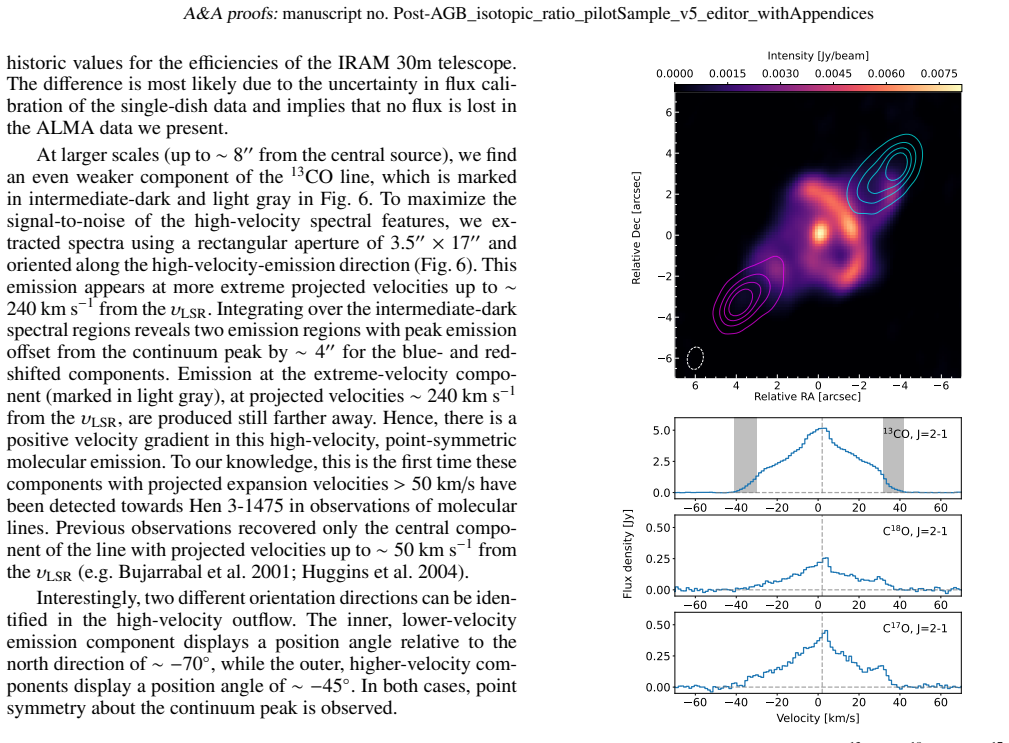
The paper's central claim is that the 17O/18O ratio measured in the ejected gas of six obscured post-AGB stars pins their initial masses to a narrow low range, roughly 1.15 to 1.8 solar masses, with the carbon star HD 187885 near 1.15 solar masses. This is derived by equating the C17O/C18O J=2-1 flux ratio with the oxygen isotope abundance ratio under an assumption of optically thin emission, then comparing with stellar evolution model grids. The paper further reports circumstellar gas masses of about 0.1 to 0.42 solar masses, kinematic ages of 600 to 1500 years, and recent mass-loss rates of about 1e-4 solar masses per year or higher, all pointing to a recent, violent mass-ejection event. Five of the six sources show high-velocity, point-symmetric molecular outflows, with Hen 3-1475 displaying molecular gas interleaved with the ionized jet seen in optical images. The paper concludes that the stars with known spectral types have evolved through the post-AGB phase faster than evolutionary models allow.
Load-bearing premise
The central result stands on the assumption that the oxygen isotope ratios predicted by stellar evolution models for a given initial mass and metal content match what these stars actually started with.
Editorial extensions
If this is right
- If the inferred masses are correct, none of these obscured post-AGB stars had a high-mass progenitor, so earlier high-mass interpretations for sources like Hen 3-1475 and M1-92 are not needed.
- Initial masses near 1.7 to 1.8 solar masses for the two oxygen-rich stars, which are in the range where models predict carbon enrichment, imply their envelopes were removed before carbon-rich chemistry developed, consistent with interaction with a companion.
- Mass-loss rates above 1e-4 solar masses per year are about ten times higher than standard prescriptions for 1 to 2 solar mass AGB stars, supporting a short super-wind phase at the end of the AGB.
- Kinematic ages below about 1500 years mean the observed dense envelopes were ejected essentially at the AGB-to-post-AGB transition, so the high-mass-loss phase and the onset of the post-AGB overlap.
- The faster-than-predicted evolution of the central stars, if confirmed, shortens the expected time between the AGB tip and the appearance of a hot central star in planetary nebulae.
Reading between the lines
- An editorially drawn consequence is that the fast evolutionary timescales, if they hold for a larger sample, would push planetary nebula formation ages downward and make the common-envelope binary channel look more important than the roughly 20 percent expected binarity among AGB progenitors.
- The paper leaves implicit that the five sources with high-velocity point-symmetric outflows are the best targets to search for close companions; a systematic binary search around these objects would directly test the binary-interaction interpretation.
- A testable extension would be to measure 17O/18O in additional obscured post-AGB stars selected the same way, to see whether the narrow mass range found here persists or was an artifact of the small sample.
- Because the mass calibration uses model initial isotope abundances, comparing the derived initial masses with independent dynamical masses of any of these systems would separate model uncertainty from measurement uncertainty.
Editorial analysis
A structured set of objections, weighed in public.
Referee Report
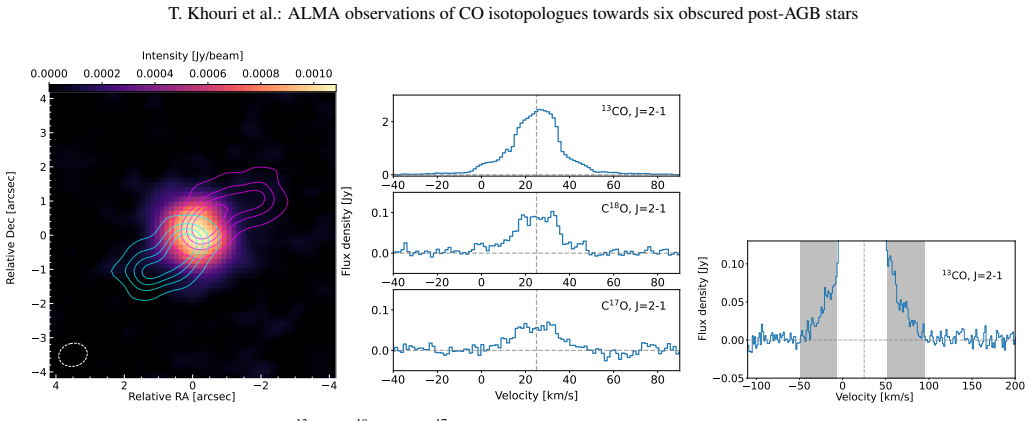
Summary. This paper reports ALMA Band 6 observations of the J=2-1 lines of 13CO, C17O, and C18O, together with 1.3 mm continuum, toward six obscured post-AGB stars: GLMP 950, GLMP 953, AFGL 5385, HD 187885, Hen 3-1475, and M1-92. The authors measure line fluxes and emission sizes, derive 17O/18O isotopic ratios from the C17O/C18O line flux ratio, estimate circumstellar gas masses, kinematic ages, and recent mass-loss rates from the C18O emission, and infer initial masses by mapping the isotopic ratios onto the MONASH and FRUITY stellar evolution grids. Their main conclusions are that all six sources have initial masses below about 2 solar masses, contrary to earlier suggestions of higher masses for some sources; that five of the six sources show high-velocity point-symmetric molecular outflows; and that the four sources with known spectral types appear to have evolved through the post-AGB phase faster than single-star evolutionary models predict. The paper also highlights the new detection of very high velocity molecular gas in Hen 3-1475 that is interleaved with the optical ionized outflow.
Significance. If the initial-mass interpretation holds, the paper would significantly revise the picture of obscured post-AGB stars, connecting them to lower-mass progenitors and to binary-interaction or superwind scenarios rather than to massive AGB evolution. The observational material is valuable: high-quality ALMA detections of rare isotopologues toward six heavily obscured sources, including the first molecular detection of the very fast outflow in Hen 3-1475 at velocities above 200 km/s. The line-ratio to isotope-ratio conversion is clearly documented and is shown to be nearly independent of the assumed excitation temperature, and the use of two independent stellar evolution model grids is a positive feature. However, the central mass claim depends on adopted metallicities and on a model relation that the authors themselves note is not yet observationally validated; these dependencies need to be quantified before the headline conclusion can be accepted at face value.
major comments (3)
- [Abstract and Section 6.1.2] The unconditional claim that all six stars have initial masses below 2 solar masses is not uniquely determined by the data. The masses in Table 4 are derived assuming solar metallicity for five sources and Z=0.0035 for HD 187885, but Section 6.1.2 explicitly concedes that Hen 3-1475 and M1-92 could instead have super-solar metallicity and initial masses of 2.0-2.4 solar masses. Since metallicities are not measured for these objects, the <2 solar mass conclusion is a model-dependent statement, not a direct observational result. I request either a quantitative sensitivity analysis showing how the inferred masses change across a plausible range of metallicities and initial oxygen isotopic ratios, or revised wording that restricts the claim to the adopted composition assumption.
- [Section 6.1.2 and Table 4] The mapping from 17O/18O to initial mass relies on evolutionary model predictions whose initial-mass dependence has not been observationally validated; the authors cite Abia et al. (2017) on this point. Table 4 quotes MKL16 and MFRUITY initial masses but does not include systematic uncertainties from model physics, assumed initial oxygen isotopic ratios, or metallicity. This matters because GLMP 950, GLMP 953, and M1-92 have inferred masses of 1.7-1.8 solar masses, leaving only about 0.2 solar masses of headroom above the 2 solar mass boundary. A moderate shift in the model relation or in the assumed initial 17O/18O could move several sources across the boundary, so the paper should provide an explicit error budget or label the model-inferred masses as point estimates under stated assumptions.
- [Section 6.1.3] The argument that previously proposed distances to Hen 3-1475 are unrealistic inherits the same model dependence as the initial-mass inference. The dmax value of 4.5 kpc in Table 4 is computed from the luminosity limit based on the solar-metallicity initial mass; under the alternative super-solar metallicity solution with an initial mass of 2.0-2.4 solar masses, the allowed maximum distance would be larger. The statement in Section 6.1.3 that distances of 8.3 kpc are not realistic should therefore be explicitly conditioned on the assumed composition and on the model-inferred mass.
minor comments (5)
- [Throughout] The manuscript contains several typographical and formatting errors, including 'the the asymptotic giant branch' in Section 1, 'Nonetheles' in Section 1, 'di fferent' in multiple places, and 'Bof fin' in the references; these should be corrected during editing.
- [Table 4] The column headers MKL16_init and MFRUITY_init are difficult to read in plain text; please use proper subscripts and define the notation in the table caption, including units for the initial masses.
- [Section 5.1] The equation for the 17O/18O ratio should state explicitly that the line fluxes must be measured over the same aperture and that the numerical factor 0.95 applies specifically to the J=2-1 transition and to the assumed optically thin regime, since the text otherwise leaves the exact conditions of validity implicit.
- [Figure 3] The right-hand panel labeled as a single-beam spectrum should state the beam size and the extraction position in the caption, because the reader cannot otherwise assess how the signal-to-noise was maximized or whether the high-velocity wing is spatially resolved.
- [Section 6.2] The discussion of 13CO abundances would benefit from a single explicit definition of f_13CO as the abundance relative to hydrogen nuclei, since the text sometimes refers to 'total number density of hydrogen atoms' and sometimes to 'hydrogen nuclei', which can be confusing.
Circularity Check
No significant circularity: the 17O/18O ratios are measured from line fluxes and mapped through external stellar model grids, while the fast-evolution claim is compared against independent model timescales.
full rationale
The central derivation chain is not circular. The 17O/18O ratios are obtained from the measured C17O/C18O J=2-1 flux ratios via the explicit conversion in Section 5.1, including an excitation-temperature correction; the ratios are not fitted to the conclusions. Initial masses are read off the public MONASH and FRUITY stellar model grids (Karakas & Lugaro 2016; Cristallo et al. 2015), which do not take the observed fluxes of these six stars as inputs; the agreement between the two independent grids corroborates the mapping rather than defining it. Circumstellar masses and recent mass-loss rates follow from Eq. (1), the measured C18O fluxes, adopted distances, and stated abundance and Texc assumptions; the kinematic ages are size-over-velocity ratios. The 'evolved faster than expected' claim is a comparison of these measured kinematic ages, used as upper limits on the post-AGB duration, with post-AGB timescales taken from Miller Bertolami (2016) and Vassiliadis & Wood (1994), i.e., external model predictions. No equation in the paper imposes the low-mass or fast-evolution result by construction. Self-citations such as Khouri et al. (2021) and Alcolea et al. (2022) are contextual or provide an independent earlier ratio for M1-92, and the MONASH-based abundance/mass inputs are independently supported by FRUITY, so they are not load-bearing. The acknowledged assumptions of solar metallicity and solar initial oxygen isotopic ratios for five sources are model-validity and systematic-uncertainty concerns, not circular reductions of the measured ratios to the inferred masses.
Assumptions & free parameters
free parameters (2)
- Excitation temperature Texc =
10 K
- C18O abundance f_C18O =
8.5e-7 (solar), 2.1e-7 (HD 187885)
assumptions (5)
- domain assumption The 17O/18O versus initial mass calibration from the MONASH and FRUITY stellar evolution models is correct for these stars.
- domain assumption The C17O and C18O J=2-1 emission is optically thin, and the line flux ratio equals the abundance ratio.
- domain assumption The size of the C18O J=2-1 emission region traces the gas ejected during the recent high-mass-loss phase.
- domain assumption The adopted distances from Vickers et al. (2015) and Riera et al. (1995) are correct.
- domain assumption No significant hot bottom burning has altered the 18O abundance in these stars' envelopes.
Cite this review
Pith. "Pith review of ALMA observations of CO isotopologues towards six obscured post-AGB stars." pith.science (2026). https://pith.science/paper/Q2MCQJML
@misc{pith2026250104492,
  author       = {Pith},
  title        = {Pith review of: ALMA observations of CO isotopologues towards six obscured post-AGB stars},
  year         = {2026},
  howpublished = {\url{https://pith.science/paper/Q2MCQJML}},
  note         = {Machine review of arXiv:2501.04492}
}
abstract
Low- and intermediate-mass stars evolve through the asymptotic giant branch (AGB), when an efficient mass-loss process removes a significant fraction of their initial mass. A substantial increase in the mass-loss rate at the end of the AGB is observed for at least some stars for unknown reasons. This creates post-AGB objects that are completely enshrouded in thick dusty envelopes and might be associated with binary interactions. We observed the $J=2-1$ line of $^{13}$CO, C$^{17}$O, and C$^{18}$O with the Atacama Large Millimeter / submillimeter Array (ALMA) towards six obscured post-AGB stars (four C-rich and two O-rich sources) to constrain the properties of their circumstellar envelopes, recent mass-loss histories, and initial mass of the central stars. Based on the inferred $^{17}$O/$^{18}$O isotopic ratios, we find all stars to have relatively low initial masses ($< 2~M_\odot$) contrary to suggestions in the literature of higher masses for some sources. We infer a mass for HD~187885 $\sim 1.15~M_\odot$, which is relatively low for a carbon star. For all but one source (GLMP~950), we observe kinematic components with velocities $\gtrsim 30$~km~s$^{-1}$, which are faster than typical AGB wind expansion velocities. For most sources, these higher-velocity outflows display point-symmetric morphologies. The case of Hen~3-1475 is particularly spectacular, with the high-velocity molecular outflow interleaved with the high-velocity outflow of ionised gas observed at optical wavelengths. Based on the size of the emission regions of the slow components of the outflows, we derive typical kinematic ages associated with the C$^{18}$O~$J=2-1$ emission $\lesssim 1500$~years and obtain relatively high associated mass-loss rates ($\gtrsim10^{-4}~M_\odot~{\rm yr}^{-1}$). The sources with known spectral types are found to have evolved faster than expected based on stellar evolutionary models.
Figures


Figures from the paper (5 more)



Reference graph
Works this paper leans on
-
[1]
P., Domínguez, I., & Straniero, O
Abia, C., Hedrosa, R. P., Domínguez, I., & Straniero, O. 2017, A&A, 599, A39
2017
-
[2]
Alcolea, J., Agúndez, M., Bujarrabal, V ., et al. 2022, Galaxies, 10, 47
work page 2022
- [3]
-
[4]
Allen, D. A. & Swings, J. P. 1976, A&A, 47, 293
work page 1976
-
[5]
Blommaert, J. A. D. L., Groenewegen, M. A. T., Justtanont, K., & Decin, L. 2018, MNRAS, 479, 3545
2018
-
[6]
Boboltz, D. A. & Marvel, K. B. 2007, ApJ, 665, 680
work page 2007
-
[7]
Bobrowsky, M., Zijlstra, A. A., Grebel, E. K., et al. 1995, ApJ, 446, L89
work page 1995
-
[8]
Boffin, H. M. J. & Jones, D. 2019, The Importance of Binaries in the Formation and Evolution of Planetary Nebulae
work page 2019
Show all 81 references
-
[9]
J., Blondin, J
Borkowski, K. J., Blondin, J. M., & Harrington, J. P. 1997, ApJ, 482, L97
1997
-
[10]
Borkowski, K. J. & Harrington, J. P. 2001, ApJ, 550, 778
2001
-
[11]
1997, A&A, 320, 540
Bujarrabal, V ., Alcolea, J., Neri, R., & Grewing, M. 1997, A&A, 320, 540
1997
-
[12]
2001, A&A, 377, 868
Bujarrabal, V ., Castro-Carrizo, A., Alcolea, J., & Sánchez Contreras, C. 2001, A&A, 377, 868
2001
-
[13]
2017, A&A, 597, L5
Bujarrabal, V ., Castro-Carrizo, A., Alcolea, J., et al. 2017, A&A, 597, L5
2017
-
[14]
2022, Publications of the Astronom- ical Society of the Pacific, 134, 114501
CASA-Team, Bean, B., Bhatnagar, S., et al. 2022, Publications of the Astronom- ical Society of the Pacific, 134, 114501
2022
-
[15]
Clube, K. L. & Gledhill, T. M. 2004, MNRAS, 355, L17
2004
-
[16]
2015, ApJS, 219, 40
Cristallo, S., Straniero, O., Piersanti, L., & Gobrecht, D. 2015, ApJS, 219, 40
2015
-
[17]
M., Skrutskie, M
Cutri, R. M., Skrutskie, M. F., van Dyk, S., et al. 2003, VizieR Online Data Catalog, 2246
2003
-
[18]
2017, A&A, 602, A14
Danilovich, T., Lombaert, R., Decin, L., et al. 2017, A&A, 602, A14
2017
-
[19]
M., Pihlström, Y
Day, F. M., Pihlström, Y . M., Claussen, M. J., & Sahai, R. 2010, ApJ, 713, 986 De Marco, O. 2009, PASP, 121, 316 De Marco, O., Long, J., Jacoby, G. H., et al. 2015, MNRAS, 448, 3587 De Nutte, R., Decin, L., Olofsson, H., et al. 2017, A&A, 600, A71
2010
-
[20]
Decin, L., Montargès, M., Richards, A. M. S., et al. 2020, Science, 369, 1497
2020
-
[21]
Dehaes, S., Groenewegen, M. A. T., Decin, L., et al. 2007, MNRAS, 377, 931
2007
-
[22]
J., Moore, T
Eden, D. J., Moore, T. J. T., Plume, R., et al. 2017, MNRAS, 469, 2163
2017
-
[23]
I., Toalá, J
Fang, X., Gómez de Castro, A. I., Toalá, J. A., & Riera, A. 2018, ApJ, 865, L23 Gaia Collaboration, Brown, A. G. A., Vallenari, A., et al. 2021, A&A, 649, A1 Gallardo Cava, I., Bujarrabal, V ., Alcolea, J., Gómez-Garrido, M., & Santander- García, M. 2022, A&A, 659, A134 Gallar...
2018
-
[24]
& Siess, L
Goriely, S. & Siess, L. 2018, A&A, 609, A29
2018
-
[25]
Groenewegen, M. A. T. 2002, arXiv e-prints, astro
2002
-
[26]
Groenewegen, M. A. T., van den Hoek, L. B., & de Jong, T. 1995, A&A, 293, 381
1995
-
[27]
1996, A&A, 305, 878
Guertler, J., Koempe, C., & Henning, T. 1996, A&A, 305, 878
1996
-
[28]
J., Lambert, D
Harris, M. J., Lambert, D. L., Hinkle, K. H., Gustafsson, B., & Eriksson, K. 1987, ApJ, 316, 294
1987
-
[29]
2005, ARA&A, 43, 435
Herwig, F. 2005, ARA&A, 43, 435
2005
-
[30]
C., Jones, D., De Marco, O., et al
Hillwig, T. C., Jones, D., De Marco, O., et al. 2016, ApJ, 832, 125
2016
-
[31]
H., Lebzelter, T., & Straniero, O
Hinkle, K. H., Lebzelter, T., & Straniero, O. 2016, ApJ, 825, 38 Höfner, S. & Olofsson, H. 2018, A&A Rev., 26, 1
2016
-
[32]
J., Muthu, C., Bachiller, R., Forveille, T., & Cox, P
Huggins, P. J., Muthu, C., Bachiller, R., Forveille, T., & Cox, P. 2004, A&A, 414, 581
2004
-
[33]
& Renzini, A
Iben, Jr., I. & Renzini, A. 1983, ARA&A, 21, 271
1983
-
[34]
2007, in Astrophysical Masers and their Environments, ed
Imai, H. 2007, in Astrophysical Masers and their Environments, ed. J. M. Chap- man & W. A. Baan, V ol. 242, 279–286
2007
-
[35]
2010, A&A, 514, A2
Ita, Y ., Matsuura, M., Ishihara, D., et al. 2010, A&A, 514, A2
2010
-
[36]
& Boffin, H
Jones, D. & Boffin, H. M. J. 2017, Nature Astronomy, 1, 0117
2017
-
[37]
2012, A&A, 537, A144
Justtanont, K., Khouri, T., Maercker, M., et al. 2012, A&A, 537, A144
2012
-
[38]
Karakas, A. I. & Lattanzio, J. C. 2014, PASA, 31, e030
2014
-
[39]
Karakas, A. I. & Lugaro, M. 2016, ApJ, 825, 26
2016
-
[40]
I., Lugaro, M., Carlos, M., et al
Karakas, A. I., Lugaro, M., Carlos, M., et al. 2018, MNRAS, 477, 421
2018
-
[41]
Khouri, T., Vlemmings, W. H. T., Tafoya, D., et al. 2021, Nature Astronomy, 6, 275
2021
-
[42]
2011, MNRAS, 417, 32
Lagadec, E., Verhoelst, T., Mékarnia, D., et al. 2011, MNRAS, 417, 32
2011
-
[43]
H., Straniero, O., et al
Lebzelter, T., Hinkle, K. H., Straniero, O., et al. 2019, ApJ, 886, 117
2019
-
[44]
Q., Morris, M
Li, Y . Q., Morris, M. R., & Sahai, R. 2024, Galaxies, 12
2024
-
[45]
2011, AJ, 141, 80 Miller Bertolami, M
Lario, P. 2011, AJ, 141, 80 Miller Bertolami, M. M. 2016, A&A, 588, A25
2011
-
[46]
& De Marco, O
Moe, M. & De Marco, O. 2006, ApJ, 650, 916
2006
-
[47]
1985, A&A, 142, 107
Morris, M., Lucas, R., & Omont, A. 1985, A&A, 142, 107
1985
-
[48]
A., et al
Olofsson, H., Khouri, T., Sargent, B. A., et al. 2022, A&A, 665, A82
2022
-
[49]
1993, A&A, 267, 515
Omont, A., Loup, C., Forveille, T., et al. 1993, A&A, 267, 515
1993
-
[50]
2018, A&A, 620, A85
Oomen, G.-M., Van Winckel, H., Pols, O., et al. 2018, A&A, 620, A85
2018
-
[51]
D., Bieging, J
Oppenheimer, B. D., Bieging, J. H., Schmidt, G. D., et al. 2005, ApJ, 624, 957
2005
-
[52]
2021, Uni- verse, 7, 175
Palmerini, S., Cristallo, S., Piersanti, L., Vescovi, D., & Busso, M. 2021, Uni- verse, 7, 175
2021
-
[53]
A., Acker, A., Frew, D
Parker, Q. A., Acker, A., Frew, D. J., et al. 2006, MNRAS, 373, 79
2006
-
[54]
Ramstedt, S., Vlemmings, W. H. T., Doan, L., et al. 2020, A&A, 640, A133
2020
-
[55]
R., Izzard, R
Rees, N. R., Izzard, R. G., & Karakas, A. I. 2024, MNRAS, 527, 9643
2024
-
[56]
1981, Red giants as precursors of planetary nebulae, ed
Renzini, A. 1981, Red giants as precursors of planetary nebulae, ed. J. Iben, I. & A. Renzini, V ol. 88, 431–446
1981
-
[57]
2003, A&A, 401, 1039
Riera, A., García-Lario, P., Manchado, A., Bobrowsky, M., & Estalella, R. 2003, A&A, 401, 1039
2003
-
[58]
R., & Raga, A
Riera, A., Garcia-Lario, P., Manchado, A., Pottasch, S. R., & Raga, A. C. 1995, A&A, 302, 137
1995
-
[59]
H., Frank, A., Morris, M., & Blackman, E
Sahai, R., Kastner, J. H., Frank, A., Morris, M., & Blackman, E. G. 2003, ApJ, 599, L87
2003
-
[60]
2007, AJ, 134, 2200
Sahai, R., Morris, M., Sánchez Contreras, C., & Claussen, M. 2007, AJ, 134, 2200
2007
-
[61]
R., & Villar, G
Sahai, R., Morris, M. R., & Villar, G. G. 2011, AJ, 141, 134
2011
-
[62]
& Trauger, J
Sahai, R. & Trauger, J. T. 1998, AJ, 116, 1357
1998
-
[63]
Sahai, R., Vlemmings, W. H. T., Gledhill, T., et al. 2017, ApJ, 835, L13 Sánchez Contreras, C., Alcolea, J., Bujarrabal, V ., & Neri, R. 1998, A&A, 337, 233 Article number, page 17 of 22 A&A proofs: manuscript no. Post-AGB_isotopic_ratio_pilotSample_v5_editor_withAppendices Sá...
2017
-
[64]
2017, A&A, 603, A67 Sánchez Contreras, C
Pintado, J. 2017, A&A, 603, A67 Sánchez Contreras, C. & Sahai, R. 2001, ApJ, 553, L173 Sánchez Contreras, C. & Sahai, R. 2012, ApJS, 203, 16
2017
-
[65]
Smith, V . V . & Lambert, D. L. 1990, ApJS, 72, 387
1990
-
[66]
2020, Galaxies, 8, 26
Soker, N. 2020, Galaxies, 8, 26
2020
-
[67]
J., Izzard, R
Stancliffe, R. J., Izzard, R. G., & Tout, C. A. 2005, MNRAS, 356, L1
2005
-
[68]
J., Tout, C
Stancliffe, R. J., Tout, C. A., & Pols, O. R. 2004, MNRAS, 352, 984
2004
-
[69]
Su, K. Y . L., Hrivnak, B. J., Kwok, S., & Sahai, R. 2003, AJ, 126, 848
2003
-
[70]
Su, K. Y . L., V olk, K., Kwok, S., & Hrivnak, B. J. 1998, ApJ, 508, 744 Suárez, O., García-Lario, P., Manchado, A., et al. 2006, A&A, 458, 173
1998
-
[71]
2007, A&A, 469, 799
Szczerba, R., Siódmiak, N., Stasi ´nska, G., & Borkowski, J. 2007, A&A, 469, 799
2007
-
[72]
F., et al
Tafoya, D., Imai, H., Gómez, J. F., et al. 2020, ApJ, 890, L14
2020
-
[73]
Trammell, S. R. & Goodrich, R. W. 1996, ApJ, 468, L107
1996
-
[74]
2007, AJ, 133, 1345 Van Winckel, H
Ueta, T., Murakawa, K., & Meixner, M. 2007, AJ, 133, 1345 Van Winckel, H. 2007, Baltic Astronomy, 16, 112 Van Winckel, H. 2018, arXiv e-prints, arXiv:1809.00871 Van Winckel, H. & Reyniers, M. 2000, A&A, 354, 135 Van Winckel, H., Waelkens, C., & Waters, L. B. F. M. 1996, A&A, 306, L37
2007 arXiv
-
[75]
& Wood, P
Vassiliadis, E. & Wood, P. R. 1993, ApJ, 413, 641
1993
-
[76]
& Wood, P
Vassiliadis, E. & Wood, P. R. 1994, ApJS, 92, 125
1994
-
[77]
P., Agúndez, M., et al
Velilla-Prieto, L., Fonfría, J. P., Agúndez, M., et al. 2023, Nature, 617, 696
2023
-
[78]
2018, MNRAS, 475, 2282
Ramirez, L. 2018, MNRAS, 475, 2282
2018
-
[79]
B., Frew, D
Vickers, S. B., Frew, D. J., Parker, Q. A., & Boji ˇci´c, I. S. 2015, MNRAS, 447, 1673 V olk, K., Kwok, S., & Hrivnak, B. J. 2007, ApJ, 670, 1137
2015
-
[80]
& Ferguson, J
Weiss, A. & Ferguson, J. W. 2009, A&A, 508, 1343
2009
-
[81]
40.0" 30.0
Wenger, M., Ochsenbein, F., Egret, D., et al. 2000, A&AS, 143, 9 Article number, page 18 of 22 T. Khouri et al.: ALMA observations of CO isotopologues towards six obscured post-AGB stars Appendix A: Additional table Table A.1. Lines other than those of CO isotopologues detecte...
2000
Reviewed August 10, 2026 · model on record in the stance chip above.
Discussion (0). Continue with ORCID to comment.