REVIEW 2 major objections 7 minor 57 references
Incoherent horizontal emittance growth due to the interplay of beam-beam and longitudinal wakefield in crab-waist colliders
T0 review · 2 major / 7 minor · reviewed 2026-08-10 · deepseek-v4-flash
Pith's one-line read A longitudinal wakefield, by shifting the bunch's peak, turns on odd-order synchrobetatron resonances that inflate the horizontal beam size in crab-waist colliders.
desk verdict A solid, cross-code simulation study that plausibly explains the SuperKEKB (2,3) sideband blowup via a wake-induced bunch-center shift, but the analytic prediction is only proven for small longitudinal amplitudes while the simulated blowup lives at larger amplitudes. read the letter →
The pith
A machine-rendered reading of the paper's core claim, the machinery that carries it, and where it could break.
The reading
What carries the argument
The load-bearing object is the modified resonance-amplitude integral $F^w_{m_x m_z}(A_x, A_z)$ of Eq. (38), obtained by inserting the shifted longitudinal coordinate $z = z_m + \sqrt{2\beta_z J_z}\cos\psi_z$ into the beam-beam potential and expanding in Fourier modes. The integral is over the product of Bessel functions $J_{m_x}(k A_x r_x) J_{m_z}(k A_z r_z)$ times the phase factor $\exp(i k r_z z_m / \sigma_{z0})$; this phase factor is what breaks the $m_x + m_z$ even parity rule and excites odd sidebands. The derivation rests on linearizing the wake-perturbed longitudinal motion as a harmonic oscillator about the shifted peak $z_m$, which the paper notes is valid only for small longitudinal amplitudes $A_z$.
What would settle it
A particle-tracking simulation that uses the full nonlinear longitudinal potential (the self-consistent stationary bunch distribution including potential-well distortion) instead of the linearized oscillator, for the same SuperKEKB parameters and tune scan, would settle the mechanism: if the $(2,3)$ sideband still appears with unchanged strength, the linearization is not the load-bearing premise; if it weakens or shifts, the paper's predictive formula (38) would need an anharmonic correction. An experimental check would be to adjust the RF phase to cancel $z_m$ and observe whether the $(2,3)$ blowup disappears.
Extended reading notes
Core claim
The novel step is the claim that the wake-induced shift of the bunch peak $z_m$, rather than any tune shift alone, changes the selection rule for horizontal synchrobetatron resonances driven by the beam-beam interaction. In the wake-free case the resonance amplitude is an integral whose integrand has definite parity, so only modes with $m_x + m_z$ even survive. With the wake, the integral acquires the phase factor $\exp(i k r_z z_m / \sigma_{z0})$, which makes odd-parity modes such as $(2,3)$ nonzero. The paper states that the horizontal blowup seen in simulations near $2Q_x - 3Q_z = \mathrm{integer}$ is an incoherent effect from the combined beam-beam and wakefield action and is predicted by its Eq. (38). It also reports that the crab-waist transform itself does not change the location or shape of these horizontal resonances, and that the dynamics can be studied in the horizontal-longitudinal plane alone.
Load-bearing premise
The activation of odd sidebands rests on the linearized longitudinal equation of motion around the shifted bunch peak $z_m$, which is only valid for small longitudinal amplitudes; if the real potential well is strongly anharmonic at the amplitudes that actually blow up, the resonance strengths and possibly the odd-sideband selection rule would change.
Editorial extensions
If this is right
- Machine operators at crab-waist colliders must keep the horizontal tune away from odd synchrobetatron sidebands such as $2Q_x - 3Q_z = \mathrm{integer}$, not just the even ones, once longitudinal wakefields are significant.
- Any impedance source that shifts the longitudinal bunch peak will, in this model, produce odd sidebands; the effect is tied to potential-well distortion rather than to the specific wake of one collider.
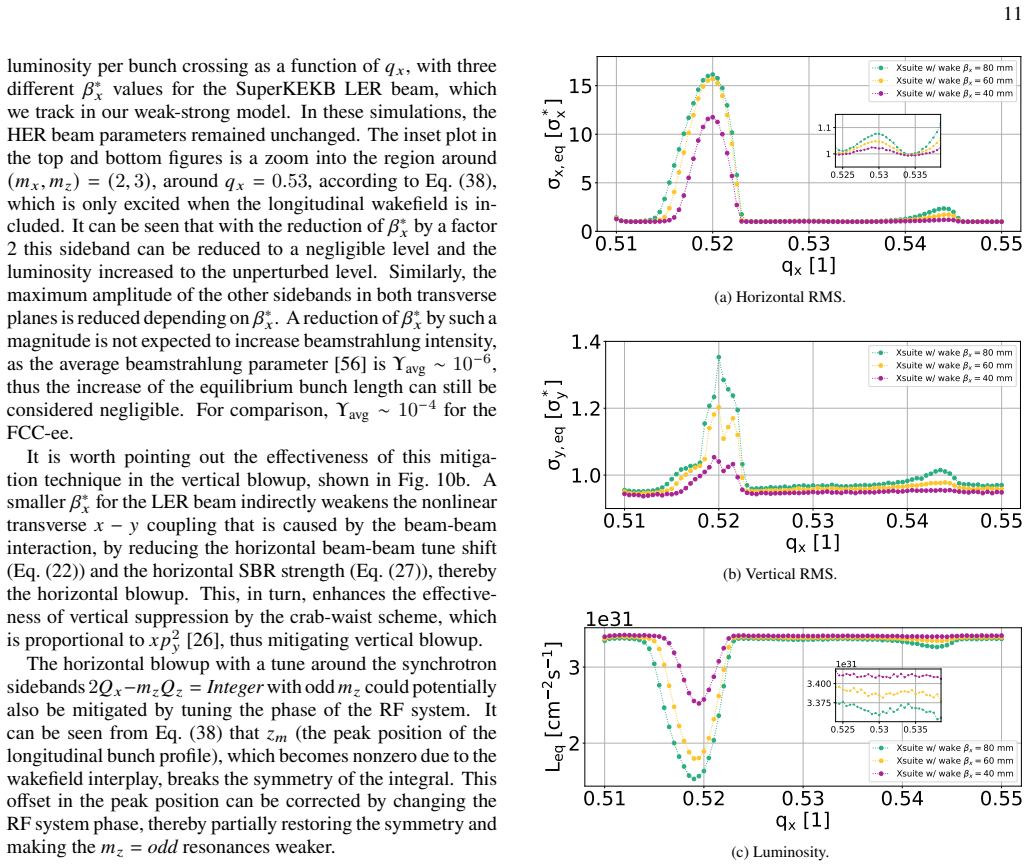
- Halving the horizontal beta function at the interaction point is predicted to reduce the $(2,3)$ sideband to a negligible level and to restore luminosity, with negligible beamstrahlung penalty at SuperKEKB currents.
- Adjusting the RF phase to cancel $z_m$ can partially restore the symmetry and weaken odd sidebands, although the potential-well tilt means the cancellation will not be complete.
Reading between the lines
- If the linearization around $z_m$ is the true mechanism, scanning the wake amplitude at a fixed tune should show the odd sideband growth scaling with the magnitude of $z_m$, a testable trend beyond the paper's single case.
- The same symmetry-breaking argument should apply to any collision scheme with a large crossing angle and a longitudinal wake, including future circular $e^+e^-$ colliders, though the quantitative strengths will depend on the impedance spectrum.
- Because the effect is incoherent, a single-particle Fokker-Planck or diffusion-rate calculation should reproduce the blowup without needing strong-strong effects; such a model could separate resonant diffusion from simple tune spread.
- The paper's reduction to the horizontal-longitudinal plane suggests that vertical blowup near odd sidebands would appear only through $x-y$ coupling once the horizontal amplitude is large; this could be tested by tracking with artificially suppressed coupling.
Editorial analysis
A structured set of objections, weighed in public.
Referee Report
Summary. The paper studies incoherent horizontal emittance growth in crab-waist colliders caused by the combined action of beam-beam interaction and longitudinal wakefields. It revisits the classical theory of horizontal synchrobetatron resonances, extends it to include a simple model of potential-well distortion, and obtains a modified resonance-strength formula, Eq. (38), in which a nonzero shift z_m of the longitudinal bunch center excites odd-m_z sidebands such as 2Q_x - 3Q_z = integer. As a case study, weak-strong simulations of the SuperKEKB LER with Xsuite and BBWS (plus PyHEADTAIL and a Vlasov solver for a microwave-instability benchmark) are used to show a horizontal blowup near the (2,3) sideband that appears only when the longitudinal wakefield is switched on. The paper also proposes two mitigation strategies: reducing beta_x* and adjusting the RF phase to correct z_m.
Significance. If the proposed mechanism is correct, the paper identifies a previously underappreciated incoherent beam-beam/wake coupling channel that affects tune selection and luminosity in SuperKEKB and in future crab-waist e+e- colliders. The cross-code agreement among Xsuite, BBWS, PyHEADTAIL, and the Vlasov solver in the microwave-instability benchmark is a concrete strength, and the paper provides a useful independent verification of Xsuite for impedance-loaded beam-beam simulations. The mitigation studies are practical and clearly presented. However, the central predictive formula Eq. (38) is stated to be valid only for small longitudinal amplitude A_z, while the simulated evidence for the (2,3) sideband extends to larger A_z; the connection between the analytical prediction and the headline observation is therefore not yet quantitatively established.
major comments (2)
- [Sec. II.C, Eq. (38); Sec. V.B, Figs. 8-9] Equations (34)-(38) are derived by linearizing the wake-perturbed longitudinal motion around the shifted bunch peak z_m, and the paper explicitly states that Eq. (38) is only valid for small A_z. However, the simulated (2,3) sideband blowup that supports the central claim is not confined to small A_z: Fig. 9b shows elevated horizontal RMS at longitudinal amplitudes A_z ≳ 3, and the wake-induced broadening attributed to the (2,3) resonance in Fig. 8b is part of the same observation. The paper therefore applies a small-amplitude formula to the amplitude region where the simulated effect is actually seen, without an argument that the linearized phase-shift mechanism remains dominant. To support the claim that the odd sideband is 'predicted by Eq. (38)', the authors should either restrict the conclusion to the small-A_z domain, present a dedicated simulation with a purely linearized wake, or extend the derivation to the anharmonic regime.
- [Sec. II.C and Sec. V] The attribution of the odd-m_z sideband to the phase term exp(i k r_z z_m / sigma_z0) in Eq. (38) is not unique. In the full tracking model the longitudinal wake is nonlinear; an anharmonic but symmetric potential well can itself generate odd harmonics of the synchrotron motion at zero z_m, and these odd harmonics would also produce m_x + m_z odd resonances through the same beam-beam mechanism. The paper does not present a control simulation with z_m artificially set to zero, or with a linearized wake in which the phase-shift effect is isolated. Without such a test, the observed (2,3) blowup could be driven by anharmonic potential-well distortion rather than by the shifted equilibrium posiiton, which also weakens the specific RF-phase mitigation argument in Sec. V.C.
minor comments (7)
- [Abstract and throughout] The word 'synchrobetatron' is misspelled as 'sychrobetatron' in the abstract and in several places; please correct.
- [Sec. II.A, after Eq. (14)] 'large Pwinsiki angle' should be 'large Piwinski angle'.
- [Eq. (4)] The displayed equation for Gamma(x0,tau) contains an apparent typesetting artifact ('vt' before the square root); please check and correct the rendering.
- [Abstract and Sec. V] The abstract states that the dynamics 'can be reduced to the horizontal-longitudinal plane, independent of the motion in the vertical dimension,' but Sec. V describes residual vertical blowup and nonlinear x-y coupling near the same resonances. Please qualify the reduction claim to make clear it applies only to the lowest-order horizontal SBR model, not to the full simulated dynamics.
- [Sec. V.B, Eq. (46) and Figs. 9-10] The proxy A_z defined in Eq. (46) using z/sigma_z and delta/sigma_delta is not the canonical action A_z of Eq. (21), especially for large amplitudes. Please add a caveat that the color-map axes in Figs. 9 and 10 are only approximate indicators of the true longitudinal action.
- [Sec. V.C] In the sentence 'Figure 10 show the equilibrium...' the verb should be 'shows.'
- [Fig. 9 caption] The green vertical lines are labeled as the 'first and second synchrotron sidebands' at Q_x = 0.5 + Q_z and Q_x = 0.5 + 2 Q_z; these correspond to m_z = 2 and 4, respectively. Please clarify the naming to avoid confusion with m_z = 1 and 3.
Circularity Check
No circularity: Eq. (38) derives odd sidebands from the Haissinski wake shift z_m, which is an independent input; the simulations corroborate rather than fit the prediction.
full rationale
The derivation chain is self-contained. The no-wake theory (Eqs. 16-27) yields only modes with even m_x+m_z. The wake extension linearizes the Haissinski-perturbed longitudinal motion around the shifted bunch peak z_m (Eqs. 34-37), and z_m is determined by Eq. (36) from the longitudinal wake potential and beam parameters, not from the horizontal emittance data. Eq. (38) then generates odd-m_z sidebands as a mathematical consequence of the phase exp(i k r_z z_m / sigma_z0). The (2,3) blowup appears in the simulations only when the longitudinal wake kick is switched on (Sec. V, Figs. 5 and 9), so the theory is not fitted to the observed blowup. The simulations are benchmarked across Xsuite, PyHEADTAIL, BBWS, and a Vlasov solver (Sec. IVB, Fig. 4), and the machine observation cited from [9] is corroborative rather than load-bearing. The paper itself flags that Eq. (38) is valid only for small A_z (Sec. IIC); whether the small-amplitude linearization fully explains the simulated resonance strength at larger amplitudes is a validity/robustness question, not a circularity. No step reduces a prediction to its input by construction.
Assumptions & free parameters
free parameters (1)
- z_m/sigma_z0 =
0.4
assumptions (6)
- domain assumption Weak-strong model with the strong beam frozen is sufficient for incoherent horizontal emittance growth.
- domain assumption Vertical motion and hourglass/crab-waist effects can be neglected for horizontal SBRs (y=0, h0=k2=0 in the approximate potential).
- domain assumption The longitudinal wakefield potential is linearizable around the bunch peak z_m for small longitudinal amplitudes.
- domain assumption All longitudinal impedance contributions can be summed and applied as a single lumped wake kick per turn.
- domain assumption Effective synchrotron radiation should update only delta and not z in combined beam-beam/wake simulations.
- standard math Standard Fourier, Bessel, and Jacobi-Anger analysis, and the Haissinski equilibrium distribution from prior literature.
Cite this review
Pith. "Pith review of Incoherent horizontal emittance growth due to the interplay of beam-beam and longitudinal wakefield in crab-waist colliders." pith.science (2026). https://pith.science/paper/4OOIAOWM
@misc{pith2026250104609,
  author       = {Pith},
  title        = {Pith review of: Incoherent horizontal emittance growth due to the interplay of beam-beam and longitudinal wakefield in crab-waist colliders},
  year         = {2026},
  howpublished = {\url{https://pith.science/paper/4OOIAOWM}},
  note         = {Machine review of arXiv:2501.04609}
}
read the original abstract
In this paper, we investigate quadrupolar sychrobetatron resonances caused by beam-beam collisions and their interplay with longitudinal wakefields in the context of crab-waist colliders. We present a comprehensive theoretical review of the established theory of sychrobetatron resonances and extend the formalism to explore horizontal sychrobetatron resonances specific to crab-waist colliders. As a case study, we examine incoherent horizontal emittance growth at the SuperKEKB and demonstrate through simulations that the interplay between beam-beam and longitudinal wakefields leads to a horizontal blowup of the bunch size and that the study of the dynamics can be reduced to the horizontal-longitudinal plane, independent of the motion in the vertical dimension. We present extensive simulation results using the codes BBWS, PyHEADTAIL and Xsuite, connect our analytical findings with these findings, and propose strategies to mitigate horizontal blowup.
Figures


Figures from the paper (6 more)


Reference graph
Works this paper leans on
-
[1]
− 𝑘2𝑦𝜎∗2 𝑦0 2 1+ ℎ2 0𝜏2 𝛽∗2 𝑦0 . (7) By definitions, 𝜂0 = ℎ0𝑘2𝜁𝑥0𝑘 2 𝑦𝜎∗2 𝑦0/𝛽∗ 𝑦0 and 𝜅0 = 𝑘2𝜁𝑥0𝑘𝑦𝜎∗ 𝑦0, where 𝜁𝑥0 = 𝜎∗ 𝑥0/(𝛽∗ 𝑦0 tan(2𝜃𝑐)). It should be noted that𝜅0 indicates a pure crab-waist effect, while𝜂0 signifies a coupling of crab-waist and hourglass effects. Through rotation transforms, the coordinates in the strong beam are expressed by the co...
-
[2]
𝐽𝑛(𝑥) is the 𝑛-th order Bessel function of the first kind. Here, we define 𝐴𝑥 = 𝐼𝑥/𝜎∗ 𝑥0 and 𝐴𝑧 = 𝐼𝑧/𝜎𝑧0, representing the normalized amplitudes of the betatron and synchrotron motions, respec- tively. The factors𝑟𝑥 = 1/ √︃ 1+𝜙2 0 and𝑟𝑧 = 𝜙0/ √︃ 1+𝜙2 0 are scaling factors defined in terms of the Piwinski angle. 4 The so-called beam-beam strength parameter...
arXiv 2000
-
[3]
P. Raimondi, 2nd SuperB Workshop, INFN-LNF, Fras- cati, http://www.lnf.infn.it/conference/superb06/ (2006)
work page 2006
-
[4]
D. Zhouet al., Interplay of Beam-Beam, Lattice Nonlinearity, and Space Charge Effects in the SuperKEKB Collider, inProc. IPAC’15(JACoW Publishing, Geneva, Switzerland) pp. 2413– 2417
-
[5]
K.Ohmi,N.Kuroo,K.Oide,D.Zhou,andF.Zimmermann,Co- herentBeam-BeamInstabilityinCollisionswithaLargeCross- ing Angle, Phys. Rev. Lett.119, 134801 (2017)
work page 2017
- [6]
- [7]
-
[8]
M. Migliorati, E. Carideo, D. De Arcangelis, Y. Zhang, and M. Zobov, An interplay between beam–beam and beam cou- pling impedance effects in the Future Circular ee Collider, The European Physical Journal Plus136, 1190 (2021)
work page 2021
Show all 57 references
-
[9]
C. Lin, K. Ohmi, and Y. Zhang, Coupling effects of beam- beaminteractionandlongitudinalimpedance,Phys.Rev.Accel. Beams25, 011001 (2022)
2022
-
[10]
Y.Zhang,N.Wang,K.Ohmi,D.Zhou,T.Ishibashi,andC.Lin, Combined phenomenon of transverse impedance and beam- beam interaction with large Piwinski angle, Phys. Rev. Accel. Beams26, 064401 (2023)
2023
-
[11]
D. Zhou, K. Ohmi, Y. Funakoshi, Y. Ohnishi, and Y. Zhang, Simulations and experimental results of beam-beam effects in SuperKEKB, Phys. Rev. Accel. Beams26, 071001 (2023)
2023
-
[12]
K. Ohmi, Y. Zhang, and C. Lin, Beam-beam mode coupling in collision with a crossing angle, Phys. Rev. Accel. Beams26, 111001 (2023)
2023
-
[13]
D. Pestrikov, Vertical synchrobetatron resonances due to beam- beam interaction with horizontal crossing, Nuclear Instruments and Methods in Physics Research Section A: Accelerators, Spectrometers, Detectors and Associated Equipment336, 427 (1993)
1993
-
[14]
Dikansky and D
N. Dikansky and D. Pestrikov, Effect of the crab waist and of the micro-beta on the beam–beam instability, Nuclear Instru- ments and Methods in Physics Research Section A: Accelera- tors, Spectrometers, Detectors and Associated Equipment600, 538 (2009)
2009
-
[15]
Crab-Waist
M. Zobov, D. Alesini, M. E. Biagini, C. Biscari, A. Bocci, R. Boni, M. Boscolo, F. Bossi, B. Buonomo, A. Clozza, G. O. Delle Monache, T. Demma, E. Di Pasquale, G. Di Pirro, A. Drago, A. Gallo, A. Ghigo, S. Guiducci, C. Ligi, F. Mar- cellini, G. Mazzitelli, C. Milardi, F. Murta...
2010
-
[16]
Migliorati, E
M. Migliorati, E. Belli, and M. Zobov, Impact of the resistive wall impedance on beam dynamics in the Future Circular𝑒+𝑒− Collider, Phys. Rev. Accel. Beams21, 041001 (2018)
2018
-
[17]
E.A.PerevedentsevandA.A.Valishev,Simulationofthehead- tailinstabilityofcollidingbunches,Phys.Rev.STAccel.Beams 4, 024403 (2001)
2001
-
[18]
S.White,X.Buffat,N.Mounet,andT.Pieloni,Transversemode coupling instability of colliding beams, Phys. Rev. ST Accel. Beams17, 041002 (2014)
2014
-
[19]
T.Abe,K.Akai,N.Akasaka,M.Akemoto,A.Akiyama,M.Ari- naga,Y.Cai,K.Ebihara,K.Egawa,A.Enomoto, etal.,Achieve- ments of KEKB, Progress of Theoretical and Experimental Physics2013, 03A001 (2013)
2013
-
[20]
Abashian, K
A. Abashian, K. Gotow, N. Morgan, L. Piilonen, S. Schrenk, K. Abe, I. Adachi, J. Alexander, K. Aoki, and S. B. et al, The Belledetector,NuclearInstrumentsandMethodsinPhysicsRe- search Section A: Accelerators, Spectrometers, Detectors and Associated Equipment 479, 117 (2002), d...
2002
-
[21]
Ohnishi, T
Y. Ohnishi, T. Abe, T. Adachi, K. Akai, Y. Arimoto, K. Ebi- hara, K. Egawa, J. Flanagan, H. Fukuma, and e. a. Funakoshi, Accelerator design at SuperKEKB, Progress of Theoretical and Experimental Physics2013, 03A011 (2013)
2013
-
[22]
MOB3IO01
Y.Ohnishietal.,CommissioningofthePhase-ISuperKEKBB- FactoryandUpdateontheOverallStatus,in 2ndNorthAmerican Particle Accelerator Conference(2017) p. MOB3IO01
2017
-
[23]
Funakoshiet al., Beam Commissioning of SuperKEKB, in 7th International Particle Accelerator Conference(2016) p
Y. Funakoshiet al., Beam Commissioning of SuperKEKB, in 7th International Particle Accelerator Conference(2016) p. TUOBA01
2016
-
[24]
65 (JA- CoW Publishing, Geneva, Switzerland, 2022) pp
Y.Ohnishi,SuperKEKBLuminosityQuest,in Proc.65thICFA Adv.BeamDyn.WorkshopHighLuminosityCirculare+e-Col- liders (eeFACT’22), ICFA Advanced Beam Dynamics Work- shop on High Luminosity Circular e+e- Colliders No. 65 (JA- CoW Publishing, Geneva, Switzerland, 2022) pp. 1–6
2022
-
[25]
D. Zhou, K. Ohmi, Y. Funakoshi, and Y. Ohnishi, Luminos- ity performance of SuperKEKB, Journal of Instrumentation19 (02), T02002
-
[26]
Fukuma, Y
Y.Ohnishi,T.Abe,K.Akai,Y.Arimoto,K.Egawa,S.Enomoto, H. Fukuma, Y. Funakoshi, K. Furukawa, N. Iida, H. Ikeda, T. Ishibashi, S. Iwabuchi, H. Kaji, T. Kamitani, T. Kawamoto, M. Kikuchi, T. Kobayashi, K. Kodama, and Z. Zong, Su- perKEKB operation using crab waist collision scheme,...
2021
-
[27]
Benedikt, A
M. Benedikt, A. Blondel, O. Brunner, M. Capeans Garrido, F. Cerutti, J. Gutleber, P. Janot, J. M. Jimenez, V. Mertens, A. Milanese, K. Oide, J. A. Osborne, T. Otto, Y. Papaphilip- pou, J. Poole, L. J. Tavian, and F. Zimmermann,FCC-ee: The Lepton Collider: Future Circular Colli...
2019
-
[28]
K. Oide, M. Aiba, S. Aumon, M. Benedikt, A. Blondel, A. Bo- gomyagkov, M. Boscolo, H. Burkhardt, Y. Cai, A. Doblham- 13 mer,B.Haerer,B.Holzer,J.M.Jowett,I.Koop,M.Koratzinos, E.Levichev,L.Medina,K.Ohmi,Y.Papaphilippou,P.Piminov, D. Shatilov, S. Sinyatkin, M. Sullivan, J. Wennin...
2016
-
[29]
M.Zobov,etal.,Crabwaistcollisionscheme: anovelapproach forparticlecolliders,JournalofPhysics: ConferenceSeries 747, 012090 (2016)
2016
-
[30]
Piwinski, Satellite Resonances Due to Beam-Beam Interac- tion, IEEE Transactions on Nuclear Science24, 1408 (1977)
A. Piwinski, Satellite Resonances Due to Beam-Beam Interac- tion, IEEE Transactions on Nuclear Science24, 1408 (1977)
1977
-
[31]
J.Tennyson,Thedynamicsofthebeam-beaminteraction,in AIP Conferenceproceedings,Vol.87(AmericanInstituteofPhysics,
-
[32]
Gerasimov, F
A. Gerasimov, F. Izrailev, and J. Tennyson, Synchrobeta- tron sideband overlap in electron-positron colliding beams, in AIP Conference Proceedings, Vol. 153 (American Institute of Physics, 1987) pp. 474–533
1987
-
[33]
Hirata, Analysis of Beam-Beam Interactions with a Large Crossing Angle, Phys
K. Hirata, Analysis of Beam-Beam Interactions with a Large Crossing Angle, Phys. Rev. Lett.74, 2228 (1995)
1995
-
[34]
Oide and D
K. Oide and D. El Khechen, Beam blowup due to synchro- beta resonance with/without beam-beam effects. Beam Blowup due to Lattice Coupling/Dispersion with/without Beam-beam, , WEXBA03 (2019), presented at the 62nd ICFA Advanced Beam Dynamics Workshop on High Luminosity Circular...
2019 arXiv
-
[35]
Haissinski, Exact longitudinal equilibrium distribution of storedelectronsinthepresenceofself-fields,IlNuovoCimento B (1971-1996)18, 72 (1973)
J. Haissinski, Exact longitudinal equilibrium distribution of storedelectronsinthepresenceofself-fields,IlNuovoCimento B (1971-1996)18, 72 (1973)
1973
-
[36]
D. Zhou, T. Ishibashi, G. Mitsuka, M. Tobiyama, K. Bane, and L. Zhang, Theories derived from Haissinski equation and their applications to electron storage rings, Nuclear Instruments and Methods in Physics Research Section A: Accelerators, Spec- trometers, Detectors and Associ...
2024
-
[37]
A. W. Chao,Special topics in accelerator physics(World Sci- entific, 2022)
2022
-
[38]
K. Ohmi, M. Tawada, and K. Oide, Study of beam-beam in- teractions with/without crossing angle, inProceedings of the 2003 Particle Accelerator Conference, Vol. 1 (IEEE, 2003) pp. 353–355
2003
-
[39]
Ohmi, Simulation of beam-beam effects in a circular𝑒+𝑒− collider, Phys
K. Ohmi, Simulation of beam-beam effects in a circular𝑒+𝑒− collider, Phys. Rev. E62, 7287 (2000)
2000
-
[40]
K.Ohmi,M.Tawada,Y.Cai,S.Kamada,K.Oide,andJ.Qiang, Beam-Beam Limit in𝑒+𝑒− Circular Colliders, Phys. Rev. Lett. 92, 214801 (2004)
2004
-
[41]
Iadarola, R
G. Iadarola, R. D. Maria, S. Lopaciuk, A. Abramov, X. Buffat, D. Demetriadou, L. Deniau, P. Hermes, P. Kicsiny, P. Kruyt, A. Latina, L. Mether, K. Paraschou, Sterbini, F. V. D. Veken, P. Belanger, P. Niedermayer, D. D. Croce, T. Pieloni, and L. V. Riesen-Haupt, Xsuite: an inte...
2023 arXiv
-
[42]
Bassetti and G
M. Bassetti and G. A. Erskine,Closed expression for the elec- trical field of a two-dimensional Gaussian charge, Tech. Rep. (CERN, Geneva, 1980)
1980
-
[43]
Hirata, H
K. Hirata, H. W. Moshammer, and F. Ruggiero, A symplectic beam-beaminteractionwithenergychange,Part.Accel. 40,205 (1993)
1993
-
[44]
Oeftiger,An Overview of PyHEADTAIL, Tech
A. Oeftiger,An Overview of PyHEADTAIL, Tech. Rep. (2019)
2019
-
[45]
G.RumoloandF.Zimmermann, PracticaluserguideforHEAD- TAIL, Tech. Rep. (CERN, Geneva, 2002)
2002
-
[46]
K.Li,NumericalmethodsI&II,in Vol.3(2017): Proceedings of the CAS-CERN Accelerator School on Intensity Limitations inParticleBeams (CERNYellowReports: SchoolProceedings, 2017)
2017
-
[47]
Suetsugu, and S
T.Ishibashi,M.Migliorati,D.Zhou,K.Shibata,T.Abe,M.To- biyama, Y. Suetsugu, and S. Terui, Impedance modelling and single-bunchcollectiveinstabilitysimulationsforthesuperkekb main rings, Journal of Instrumentation19 (02), P02013
-
[48]
Bruns,http://www.gdfidl.de
W. Bruns,http://www.gdfidl.de
-
[49]
Zagorodnov,https://echo4d.de/
I. Zagorodnov,https://echo4d.de/
-
[50]
N.MounetandE.Métral,Electromagneticfieldsandbeamcou- pling impedances in a multilayer flat chamber, CERN-ATS- Note-2010-056 TECH, CERN, Geneva (2010)
2010
-
[51]
Superkekb impedance data repository
-
[52]
Zhouet al., Impedance Calculation and Simulation of Mi- crowaveInstabilityfortheMainRingsofSuperKEKB,in Proc
D. Zhouet al., Impedance Calculation and Simulation of Mi- crowaveInstabilityfortheMainRingsofSuperKEKB,in Proc. 5th International Particle Accelerator Conference (IPAC’14), Dresden, Germany, June 15-20, 2014, International Particle Accelerator Conference No. 5 (JACoW, Geneva,...
2014
-
[53]
K. L. Bane, Y. Cai, and G. Stupakov, Threshold studies of the microwaveinstabilityinelectronstoragerings,PhysicalReview Special Topics—Accelerators and Beams13, 104402 (2010)
2010
-
[54]
Shatilov, Y
D. Shatilov, Y. Alexahin, V. Lebedev, and A. Valishev, Lifetrac code for the weak-strong simulation of the beam-beam effects in tevatron, inProceedings of the 2005 Particle Accelerator Conference(IEEE, 2005) pp. 4138–4140
2005
-
[55]
K. Ohmi, K. Hirata, and K. Oide, From the beam-envelope matrix to synchrotron-radiation integrals, Phys. Rev. E49, 751 (1994)
1994
-
[56]
Shatilov, FCC-ee Parameter Optimization, ICFA Beam Dy- namics Newsletter72, 30 (2017)
D. Shatilov, FCC-ee Parameter Optimization, ICFA Beam Dy- namics Newsletter72, 30 (2017)
2017
-
[57]
Chen,An Introduction to Beamstrahlung and Disruption, Tech
P. Chen,An Introduction to Beamstrahlung and Disruption, Tech. Rep. (SLAC National Accelerator Laboratory, 1996)
1996
Reviewed August 10, 2026 · model on record in the stance chip above.
Discussion (0). Continue with ORCID to comment.