REVIEW 4 major objections 4 minor 64 references
Constraining $\gamma$-ray dissipation site in gravitationally lensed quasar -- PKS 1830$-$211
T0 review · 4 major / 4 minor · reviewed 2026-08-10 · deepseek-v4-flash
Pith's one-line read This paper claims that the gamma-ray flares of the gravitationally lensed quasar PKS 1830–211 all carry a consistent ~20-day lensing time delay, shorter than the radio delay, placing the flaring gamma-ray emission closer to the black hole…
desk verdict A useful consistency check with a promising new tool, but the GPR lag detections need a null test before the 'all five epochs' claim can be trusted. read the letter →
The pith
A machine-rendered reading of the paper's core claim, the machinery that carries it, and where it could break.
The reading
What carries the argument
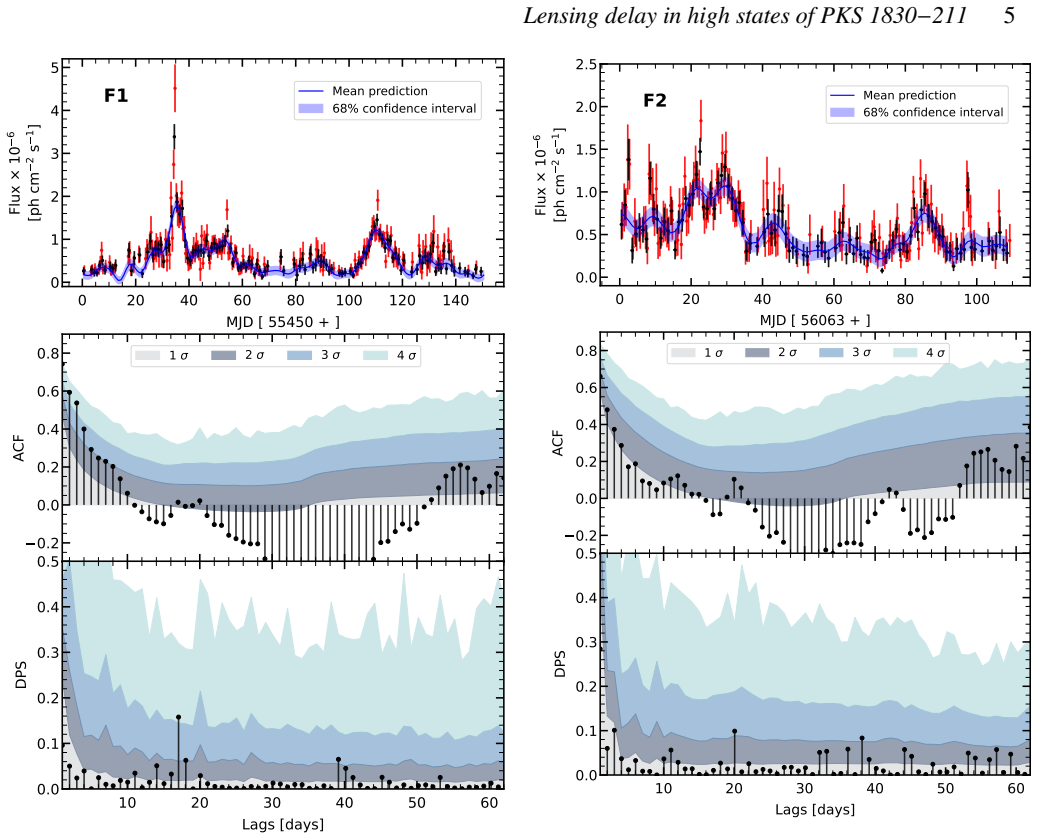
The analysis rests on the model $S_{\rm obs}(t) = s(t) + s(t+a)/b$, in which the unresolved Fermi-LAT signal is the sum of the intrinsic flare $s(t)$ and its demagnified echo delayed by $a$ days with magnification ratio $b$. The principal new tool is Gaussian process regression with a kernel that multiplies a squared-exponential (RBF) term by a periodic term (Eq. 5); the period parameter $p$ of this kernel acts as the lag, and the delay is read off as the argument maximizing the log-marginal-likelihood profile over a 1-to-70-day grid. The autocorrelation function and the double power spectrum (the Fourier transform of the first power spectrum, whose periodicity encodes the lag) serve as independent estimators, with significance assessed through Monte Carlo simulations of light curves sharing the observed power spectral density and non-Gaussian flux distribution.
What would settle it
Generate simulated red-noise light curves for each flaring state with the same power spectral density and flux distribution, apply the same Gaussian process lag-extraction pipeline, and measure the fraction of simulations in which the maximum marginal-likelihood peak lies at ~20 days. If that fraction is comparable to or higher than the 5% level, the GPR lags are not significant, and the consistent-delay conclusion collapses; a simpler check is to rerun the GPR on F4 with an aperiodic kernel and see whether the ~22-day peak persists.
Extended reading notes
Core claim
Using 15.5 years of Fermi-LAT data in the 0.2–300 GeV band, the paper identifies five flaring epochs (F1–F5) in PKS 1830−211 and estimates the gravitational lens time delay in each. The double power spectrum and autocorrelation methods recover lags of ≈17–21 days where they are significant, and the Gaussian process regression with a periodic kernel consistently yields a maximum marginal-likelihood lag of ≈19–22 days for every flaring state, giving a combined picture of a ~20-day delay. Because this is shorter than the 26+4/−5 day radio delay and the 27.1±0.6 day quiescent gamma-ray delay, the authors conclude that the flaring gamma-ray emission zone lies closer to the black hole than the radio dissipation site, on sub-parsec scales ($R_{\rm diss} \approx 0.064$ pc). They further report a linear relation between lag and magnification for the identifiable source–echo flare pairs and consistency of the log-parabola spectral indices between source and echo flares within 3σ.
Load-bearing premise
The claim of a consistent 20-day delay across all five flaring states depends on Gaussian process lag estimates that are not tested against a red-noise null hypothesis; the periodic kernel always yields a best-fit period, so the reported peaks for states like F4, where ACF and DPS find nothing, could be artifacts of the method rather than genuine lensing delays.
Editorial extensions
If this is right
- Flaring gamma-ray emission in PKS 1830–211 is produced in a compact sub-parsec region within the radio core, at $R_{\rm diss} \approx 0.064$ pc, closer to the central engine than the radio dissipation site.
- The consistency of the ~20-day delay across five flaring states implies that gamma-ray dissipation occurs in the same region of the jet across different flux levels and activity states.
- The difference between the gamma-ray flaring delay (~20 days) and the radio/quiescent delay (~26–27 days) indicates separate dissipation sites for radio and flaring gamma-ray emission.
- The observed linear relation between lag and magnification suggests that smaller, more magnified emission regions lie closer to the jet base.
- A Gaussian-process approach to time-delay estimation can recover lensing delays in unresolved Fermi-LAT light curves, potentially identifying hidden lensed blazars in gamma rays.
Reading between the lines
- If the GPR lags are genuine, the same pipeline could be applied to other unresolved lensed blazars, such as QSO B0218+357 where the radio delay is known, to test whether the gamma-ray emission zone also shifts inward during flares.
- The F4 state, where ACF and DPS find no significant delay but GPR reports ~22 days, is the weakest link in the consistent-delay claim; a dedicated null test against red noise would determine whether F4 should be excluded from the average.
- The spectral agreement between source and echo flares, including the ~2.8σ deviation in F21, could be used to constrain differential gamma-ray absorption along the two lensed paths, a test independent of time-delay measurement.
- If the emission zone truly moves inward during flares, simultaneous radio and gamma-ray monitoring of PKS 1830–211 across a flare cycle would be expected to show the radio delay remaining near 26 days while the gamma-ray delay drops to ~20 days.
Signed reviews
Editorial analysis
A structured set of objections, weighed in public.
Referee Report
Summary. The paper analyzes 15.5 years of Fermi-LAT observations of the gravitationally lensed quasar PKS 1830-211, identifies five flaring epochs with a Bayesian-block/HOP procedure, and estimates the gravitational-lens time delay in each epoch using three methods: the autocorrelation function (ACF), the double power spectrum (DPS), and Gaussian process regression (GPR). The authors report a consistent time delay of about 20 days across the five flaring states, shorter than the previously reported radio delay of about 26 days, and interpret this as evidence that the flaring gamma-ray emission originates closer to the central engine than the radio-emitting region. They also fit exponential flares to selected source/echo pairs and claim a linear relation between lag and magnification.
Significance. If the central claim is upheld, the result would provide an interesting constraint on the location of gamma-ray dissipation in a high-redshift lensed blazar, complementing earlier work by Barnacka et al. (2011, 2015) and Abdo et al. (2015). The paper benefits from a long, well-reduced Fermi-LAT dataset, from presenting three independent lag estimators, and from Monte Carlo significance testing for the ACF and DPS methods. However, the main astrophysical conclusion rests on the GPR lags, which are not tested against a red-noise null hypothesis, and on DPS peaks whose significance is below the threshold the paper itself sets. The claimed linear lag-magnification relation is also presented without quantitative support. These issues make the current evidence for the central claim weaker than the abstract suggests.
major comments (4)
- [2.3.3, 2.3.4, Table 3, Fig. 8] The GPR lag estimates are not tested against a null hypothesis. The periodic kernel in Eq. (5) contains a periodicity parameter p, and Section 2.3.3 maximizes the marginal likelihood over a fixed grid of p values; a best-fit period is therefore guaranteed even for pure red noise. The Monte Carlo significance procedure in Section 2.3.4 is applied only to ACF and DPS, not to GPR, yet Table 3 and the Abstract treat the GPR maxima as detections for all five epochs, including F4 where ACF and DPS find no significant signal. Because the central claim of a consistent ~20-day delay across five flaring states relies on these untested GPR peaks, the authors should either run an equivalent red-noise simulation for the GPR period search or explicitly present the GPR results as model-dependent candidates rather than detections.
- [2.3.4, Table 3, Sections 3.2, 3.4, 3.5] There is an internal inconsistency between the stated significance threshold and the values used in the conclusions. Section 2.3.4 says that only powers above 3 sigma are considered intrinsic time delays, but Table 3 lists DPS lags for F2 (~2 sigma), F4 (<2 sigma), and F5 (>2 sigma) as if they were measured delays, and the Discussion builds the 'consistent time delay across all flaring states' upon them. F4 is the clearest case: its 90-day window is short, its fractional variability is the lowest (0.19 +/- 0.05), and ACF and DPS do not detect a significant lag, yet a GPR lag of 22.4 +/- 2.2 days is included in the summary. Either the threshold should be applied uniformly and the sub-threshold points flagged as upper limits or tentative, or the method of combining low-significance estimates should be justified.
- [4, Fig. 9] The Abstract and Section 4 claim 'a linear relationship between lag and magnification' for the identified source and echo flares, but no quantitative analysis is presented. Only four flare pairs (F11, F12, F21, F51) are shown in Fig. 9, and the text does not give lag and magnification values for each pair, nor a regression, correlation coefficient, or uncertainty treatment. As written, the claim is unsupported and should either be substantiated with a fitted relation and its significance or removed from the Abstract and conclusions.
- [4, Table 3] The phrase 'consistent time delay of approximately 20 days' is not tested quantitatively. The lags in Table 3 range from about 17 to 22 days, are derived with different methods and different significance levels, and are sometimes only upper limits or tentative detections. The authors should report a combined estimate or at least a chi-square/consistency statistic across the five epochs and the three methods, rather than asserting consistency by inspection, especially since the spread is as large as the quoted uncertainties for several epochs.
minor comments (4)
- [3.1] In the discussion of Flare F1, the text says 'The corresponding best-fit GPR lightcurve is shown in Fig. 8(a)', but Fig. 8 shows the GPR likelihood metric, not the best-fit light curve; the light curve appears in the top panel of Fig. 3. The figure cross-reference should be corrected.
- [1] The source name is written as 'PKS 1830-21' in one place in the Introduction and as 'PKS 1830-211' elsewhere; the notation should be made consistent.
- [3.1, 3.2] The text refers to 'lower harmonics' of the main lag (9.8 +/- 2.9 days for F1 and 13.3 +/- 4.3 days for F2) without explaining how a harmonic relation would arise from the periodic kernel or from the lensing signal; a short justification or a reference would help.
- [2.3.3] The definition of the 'likelihood metric' is described verbally; it would be clearer to write it as an equation, since it is used to define the reported lags and their uncertainties.
Circularity Check
No circular derivation: the lag estimates are model fits (GPR, ACF, DPS) rather than predictions reduced from their own inputs; the untested GPR significance is a statistical validity concern, not a definitional circularity.
full rationale
The paper's central claim is that five gamma-ray flaring states of PKS 1830-211 show a consistent ~20-day lensing delay. That delay is estimated independently by three tools: autocorrelation function, double power spectrum, and Gaussian Process regression. None of these estimates is defined in terms of the physical conclusion being drawn. The GPR analysis does fit a covariance kernel containing a periodic component, with the periodicity parameter p described as functioning as the lag, and the reported GPR lag is the period maximizing the marginal likelihood over a 1-70 day grid. This is a parameter estimation procedure, not a circular reduction: the fitted p is the quantity reported, and it is then compared with independent ACF/DPS measurements and with prior radio/gamma-ray delays. The absence of a dedicated Monte Carlo null test for the GPR peaks—especially for F4, where ACF and DPS find no significant signal—is a legitimate statistical weakness that weakens the evidential weight of the GPR-only detection, but it does not make the derivation circular, because the reported lag is not a renamed input or a quantity forced to equal an earlier assumption. The paper explicitly records the limiting facts for F4 (90-day window, lowest fractional variability, no ACF/DPS detection) and for the ~2 sigma DPS detections in F2 and F5, which supports treating the issue as one of significance rather than circularity. The grouping of HOP groups separated by less than 70 days is based on an external maximum-delay estimate, but the subsequently measured lags (~20 days) are not equal to this grouping threshold by construction. Self-citations to the authors' prior work (Agarwal et al. 2023, 2024) are contextual and not load-bearing for the delay measurement or the inferred emission-region location. Overall, no step in the claimed derivation chain reduces by construction to its own input; the physical interpretation rests on measured lags whose estimation procedure, while imperfectly calibrated for GPR, is not circular.
Assumptions & free parameters
free parameters (3)
- GPR length scale l =
not reported per flare
- GPR periodicity p =
19.0, 22.1, 21.1, 22.4, 19.4 days (reported lags for F1-F5)
- Exponential flare parameters (F0, t0, tau_rise, tau_decay) =
not tabulated
assumptions (4)
- domain assumption Observed gamma-ray flux is the sum of a leading and a demagnified trailing lensed image: S_obs = s(t) + s(t+a)/b (Eq. 2)
- domain assumption Time delay maps emission-region location relative to the lens mass center; shorter delays imply emission closer to the central engine
- domain assumption Maximum possible lensing delay is about 70 days, so the lag search grid is limited to 1-70 days
- domain assumption Synthetic light curves generated with the Emmanoulopoulos et al. (2013) algorithm reproduce the flux distribution and PSD of the observed data
Cite this review
Pith. "Pith review of Constraining $\gamma$-ray dissipation site in gravitationally lensed quasar -- PKS 1830$-$211." pith.science (2026). https://pith.science/paper/A77UW23P
@misc{pith2026250104775,
  author       = {Pith},
  title        = {Pith review of: Constraining $\gamma$-ray dissipation site in gravitationally lensed quasar -- PKS 1830$-$211},
  year         = {2026},
  howpublished = {\url{https://pith.science/paper/A77UW23P}},
  note         = {Machine review of arXiv:2501.04775}
}
abstract
Variable $\gamma$-ray flares upto minute timescales reflect extreme particle acceleration sites. However, for high-redshift blazars, the detection of such rapid variations remains limited by current telescope sensitivities. Gravitationally lensed blazars serve as powerful tools to probe $\gamma$-ray production zones in distant sources, with time delays between lensed signals providing crucial insights into the spatial distribution of emission regions relative to the lens's mass-weighted center. We have utilized 15 years of Fermi-LAT $\gamma$-ray data from direction of PKS 1830$-$211 to understand the origin of flaring high-energy production zone at varying flux states. To efficiently estimate the (lensed) time delay, we used a machine learning-based tool - the Gaussian Process regression algorithm, in addition to - Autocorrelation function and Double power spectrum. We found a consistent time delay across all flaring activity states, indicating a similar location for the $\gamma$-ray emission zone, possibly within the radio core. The estimated time delay of approximately 20 days for the five flaring epochs was significantly shorter than previously estimated radio delays. This suggests that the $\gamma$-ray emission zone is closer to the central engine, in contrast to the radio emission zone, which is expected to be much farther away. A linear relationship between lag and magnification has been observed in the identified source and echo flares. Our results suggest that the $\gamma$-ray emission zone originates from similar regions away from the site of radio dissipation.
Figures


Figures from the paper (5 more)


Reference graph
Works this paper leans on
-
[1]
write newline
" write newline "" before.all 'output.state := FUNCTION fin.entry write newline FUNCTION new.block output.state before.all = 'skip after.block 'output.state := if FUNCTION new.sentence output.state after.block = 'skip output.state before.all = 'skip after.sentence 'output.state := if if FUNCTION not #0 #1 if FUNCTION and 'skip pop #0 if FUNCTION or pop #1...
-
[2]
Abdo A. A., et al., 2010, @doi [ ] 10.1088/0004-637X/722/1/520 , https://ui.adsabs.harvard.edu/abs/2010ApJ...722..520A 722, 520
-
[3]
Abdo A. A., et al., 2015, @doi [ ] 10.1088/0004-637X/799/2/143 , https://ui.adsabs.harvard.edu/abs/2015ApJ...799..143A 799, 143
-
[4]
Ackermann M., et al., 2016, @doi [ ] 10.3847/2041-8205/824/2/L20 , https://ui.adsabs.harvard.edu/abs/2016ApJ...824L..20A 824, L20
-
[5]
Agarwal S., et al., 2023, @doi [MNRASL] 10.1093/mnrasl/slad023 , https://ui.adsabs.harvard.edu/abs/2023MNRAS.521L..53A 521, L53
-
[6]
Agarwal S., Shukla A., Mannheim K., Vaidya B., Banerjee B., 2024, @doi [ ] 10.3847/2041-8213/ad4994 , https://ui.adsabs.harvard.edu/abs/2024ApJ...968L...1A 968, L1
-
[7]
Aleksi \'c J., et al., 2011, @doi [ ] 10.1088/2041-8205/730/1/L8 , https://ui.adsabs.harvard.edu/abs/2011ApJ...730L...8A 730, L8
-
[8]
Atwood 2007, The Les Houches Winter School, Scineghe2014, 016
work page 2007
Show all 64 references
-
[9]
B., et al., 2009, @doi [ ] 10.1088/0004-637X/697/2/1071 , https://ui.adsabs.harvard.edu/abs/2009ApJ...697.1071A 697, 1071
Atwood W. B., et al., 2009, @doi [ ] 10.1088/0004-637X/697/2/1071 , https://ui.adsabs.harvard.edu/abs/2009ApJ...697.1071A 697, 1071
2009 doi
- [10]
-
[11]
F., Moudden Y., 2011, @doi [ ] 10.1051/0004-6361/201016175 , https://ui.adsabs.harvard.edu/abs/2011A&A...528L...3B 528, L3
Barnacka A., Glicenstein J. F., Moudden Y., 2011, @doi [ ] 10.1051/0004-6361/201016175 , https://ui.adsabs.harvard.edu/abs/2011A&A...528L...3B 528, L3
2011 doi
-
[12]
J., Dell'Antonio I
Barnacka A., Geller M. J., Dell'Antonio I. P., Benbow W., 2014, @doi [ ] 10.1088/0004-637X/788/2/139 , https://ui.adsabs.harvard.edu/abs/2014ApJ...788..139B 788, 139
2014 doi
-
[13]
J., Dell'Antonio I
Barnacka A., Geller M. J., Dell'Antonio I. P., Benbow W., 2015, @doi [ ] 10.1088/0004-637X/809/1/100 , https://ui.adsabs.harvard.edu/abs/2015ApJ...809..100B 809, 100
2015 doi
-
[14]
Bhatta G., 2021, @doi [ ] 10.3847/1538-4357/ac2819 , https://ui.adsabs.harvard.edu/abs/2021ApJ...923....7B 923, 7
2021 doi
-
[15]
D., Levinson A., 1995, @doi [ ] 10.1086/175338 , https://ui.adsabs.harvard.edu/abs/1995ApJ...441...79B 441, 79
Blandford R. D., Levinson A., 1995, @doi [ ] 10.1086/175338 , https://ui.adsabs.harvard.edu/abs/1995ApJ...441...79B 441, 79
1995 doi
-
[16]
D., Narayan R., 1992, @doi [ ] 10.1146/annurev.astro.30.1.311 , https://ui.adsabs.harvard.edu/abs/1992ARA&A..30..311B 30, 311
Blandford R. D., Narayan R., 1992, @doi [ ] 10.1146/annurev.astro.30.1.311 , https://ui.adsabs.harvard.edu/abs/1992ARA&A..30..311B 30, 311
1992 doi
-
[17]
D., Payne D
Blandford R. D., Payne D. G., 1982, @doi [ ] 10.1093/mnras/199.4.883 , https://ui.adsabs.harvard.edu/abs/1982MNRAS.199..883B 199, 883
1982 doi
-
[18]
D., Znajek R
Blandford R. D., Znajek R. L., 1977, @doi [ ] 10.1093/mnras/179.3.433 , https://ui.adsabs.harvard.edu/abs/1977MNRAS.179..433B 179, 433
1977 doi
-
[19]
W., White O
Brault J. W., White O. R., 1971, , https://ui.adsabs.harvard.edu/abs/1971A&A....13..169B 13, 169
1971
-
[20]
C., et al., 2014, @doi [ ] 10.1088/2041-8205/782/2/L14 , https://ui.adsabs.harvard.edu/abs/2014ApJ...782L..14C 782, L14
Cheung C. C., et al., 2014, @doi [ ] 10.1088/2041-8205/782/2/L14 , https://ui.adsabs.harvard.edu/abs/2014ApJ...782L..14C 782, L14
2014 doi
- [21]
-
[22]
Einstein A., 1936, @doi [Science] 10.1126/science.84.2188.506 , https://ui.adsabs.harvard.edu/abs/1936Sci....84..506E 84, 506
1936 doi
-
[23]
J., Hut P., 1998, @doi [ ] 10.1086/305535 , https://ui.adsabs.harvard.edu/abs/1998ApJ...498..137E 498, 137
Eisenstein D. J., Hut P., 1998, @doi [ ] 10.1086/305535 , https://ui.adsabs.harvard.edu/abs/1998ApJ...498..137E 498, 137
1998 doi
-
[24]
M., Papadakis I
Emmanoulopoulos D., McHardy I. M., Papadakis I. E., 2013, @doi [MNRAS] 10.1093/mnras/stt764 , 433, 907
2013 doi
-
[25]
D., Becker P
Finke J. D., Becker P. A., 2014, @doi [ ] 10.1088/0004-637X/791/1/21 , https://ui.adsabs.harvard.edu/abs/2014ApJ...791...21F 791, 21
2014 doi
-
[26]
Fuentes A., et al., 2023, @doi [Nature Astronomy] 10.1038/s41550-023-02105-7 , https://ui.adsabs.harvard.edu/abs/2023NatAs...7.1359F 7, 1359
2023 doi
-
[27]
Ghirlanda G., Ghisellini G., Tavecchio F., Foschini L., Bonnoli G., 2011, @doi [Monthly Notices of the Royal Astronomical Society] 10.1111/j.1365-2966.2010.18173.x , 413, 852
2011
-
[28]
Goyal A., et al., 2022, @doi [ ] 10.3847/1538-4357/ac4d95 , https://ui.adsabs.harvard.edu/abs/2022ApJ...927..214G 927, 214
2022 doi
-
[29]
E., Krawczynski H., 2006, @doi [ ] 10.1146/annurev.astro.44.051905.092446 , https://ui.adsabs.harvard.edu/abs/2006ARA&A..44..463H 44, 463
Harris D. E., Krawczynski H., 2006, @doi [ ] 10.1146/annurev.astro.44.051905.092446 , https://ui.adsabs.harvard.edu/abs/2006ARA&A..44..463H 44, 463
2006
-
[30]
L., et al., 1991, @doi [Nature] 10.1038/352132a0 , 352, 132
Jauncey D. L., et al., 1991, @doi [Nature] 10.1038/352132a0 , 352, 132
1991 doi
-
[31]
G., Marscher A
Jorstad S. G., Marscher A. P., Mattox J. R., Aller M. F., Aller H. D., Wehrle A. E., Bloom S. D., 2001, @doi [The Astrophysical Journal] 10.1086/321605 , 556, 738
2001 doi
-
[32]
Koopmans L. V. E., de Bruyn A. G., 2005, @doi [ ] 10.1111/j.1745-3933.2005.00030.x , https://ui.adsabs.harvard.edu/abs/2005MNRAS.360L...6K 360, L6
2005
-
[33]
T., Bai J
Liu H. T., Bai J. M., 2006, @doi [The Astrophysical Journal] 10.1086/509097 , 653, 1089
2006 doi
-
[34]
Lovell J. E. J., et al., 1996, @doi [ ] 10.1086/310353 , https://ui.adsabs.harvard.edu/abs/1996ApJ...472L...5L 472, L5
1996 doi
-
[35]
Lovell J. E. J., Jauncey D. L., Reynolds J. E., Wieringa M. H., King E. A., Tzioumis A. K., McCulloch P. M., Edwards P. G., 1998, @doi [The Astrophysical Journal] 10.1086/311723 , 508, L51
1998 doi
-
[36]
G., Sikora M., 2016, @doi [ ] 10.1146/annurev-astro-081913-040044 , https://ui.adsabs.harvard.edu/abs/2016ARA&A..54..725M 54, 725
Madejski G. G., Sikora M., 2016, @doi [ ] 10.1146/annurev-astro-081913-040044 , https://ui.adsabs.harvard.edu/abs/2016ARA&A..54..725M 54, 725
2016 doi
-
[38]
P., et al., 2008a, @doi [ ] 10.1038/nature06895 , https://ui.adsabs.harvard.edu/abs/2008Natur.452..966M 452, 966
Marscher A. P., et al., 2008a, @doi [ ] 10.1038/nature06895 , https://ui.adsabs.harvard.edu/abs/2008Natur.452..966M 452, 966
-
[39]
L., Hovatta T., Pavlidou V., Pearson T
Max-Moerbeck W., Richards J. L., Hovatta T., Pavlidou V., Pearson T. J., Readhead A. C. S., 2014, @doi [ ] 10.1093/mnras/stu1707 , https://ui.adsabs.harvard.edu/abs/2014MNRAS.445..437M 445, 437
2014 doi
-
[40]
Muller S., Jaswanth S., Horellou C., Mart \' -Vidal I., 2020, @doi [ ] 10.1051/0004-6361/202038978 , https://ui.adsabs.harvard.edu/abs/2020A&A...641L...2M 641, L2
2020 doi
-
[41]
P., 1993, @doi [ ] 10.1086/172491 , https://ui.adsabs.harvard.edu/abs/1993ApJ...407...46N 407, 46
Nair S., Narasimha D., Rao A. P., 1993, @doi [ ] 10.1086/172491 , https://ui.adsabs.harvard.edu/abs/1993ApJ...407...46N 407, 46
1993 doi
-
[42]
Nakagawa K., Mori M., 2013, @doi [ ] 10.1088/0004-637X/773/2/177 , https://ui.adsabs.harvard.edu/abs/2013ApJ...773..177N 773, 177
2013 doi
-
[43]
Pedregosa F., et al., 2011, Journal of Machine Learning Research, 12, 2825
2011
-
[44]
E., 2004, in Bousquet O., von Luxburg U., Rätsch G., eds, Lecture Notes in Computer Science, Vol
Rasmussen C. E., 2004, in Bousquet O., von Luxburg U., Rätsch G., eds, Lecture Notes in Computer Science, Vol. 3176, Advanced Lectures on Machine Learning. Springer, Berlin, Heidelberg, Chapt. 4, @doi 10.1007/978-3-540-28650-9_4
2004 doi
-
[45]
Refsdal S., 1964, @doi [ ] 10.1093/mnras/128.4.307 , https://ui.adsabs.harvard.edu/abs/1964MNRAS.128..307R 128, 307
1964 doi
-
[46]
M., Blank M., 2018, @doi [Galaxies] 10.3390/galaxies6040135 , https://ui.adsabs.harvard.edu/abs/2018Galax...6..135R 6, 135
Romoli C., Chakraborty N., Dorner D., Taylor A. M., Blank M., 2018, @doi [Galaxies] 10.3390/galaxies6040135 , https://ui.adsabs.harvard.edu/abs/2018Galax...6..135R 6, 135
2018 doi
-
[47]
B., Lightman A
Rybicki G. B., Lightman A. P., 1979, Radiative processes in astrophysics
1979
-
[48]
D., Norris J
Scargle J. D., Norris J. P., Jackson B., Chiang J., 2013, @doi [The Astrophysical Journal] 10.1088/0004-637X/764/2/167 , 764, 167
2013 doi
-
[49]
L., et al., 1997, @doi [ ] 10.1086/310478 , https://ui.adsabs.harvard.edu/abs/1997ApJ...475L..85S 475, L85
Schechter P. L., et al., 1997, @doi [ ] 10.1086/310478 , https://ui.adsabs.harvard.edu/abs/1997ApJ...475L..85S 475, L85
1997 doi
-
[50]
Shukla A., et al., 2018, @doi [The Astrophysical Journal Letters] 10.3847/2041-8213/aaacca , 854, L26
2018 doi
-
[51]
A., Siemiginowska A., Kelly B
Sobolewska M. A., Siemiginowska A., Kelly B. C., Nalewajko K., 2014, @doi [ ] 10.1088/0004-637X/786/2/143 , https://ui.adsabs.harvard.edu/abs/2014ApJ...786..143S 786, 143
2014 doi
-
[52]
Subrahmanyan R., Narasimha D., Pramesh Rao A., Swarup G., 1990, , https://ui.adsabs.harvard.edu/abs/1990MNRAS.246..263S 246, 263
1990
-
[53]
C., Sambruna R
Tavecchio F., Maraschi L., Wolter A., Cheung C. C., Sambruna R. M., Urry C. M., 2007, @doi [The Astrophysical Journal] 10.1086/518085 , 662, 900
2007 doi
-
[54]
Timmer J., K \"o nig M., 1995, , https://ui.adsabs.harvard.edu/abs/1995A&A...300..707T 300, 707
1995
-
[55]
M., Papadakis I
Uttley P., McHardy I. M., Papadakis I. E., 2002, @doi [ ] 10.1046/j.1365-8711.2002.05298.x , https://ui.adsabs.harvard.edu/abs/2002MNRAS.332..231U 332, 231
2002
-
[56]
S., Uttley P., 2003, @doi [Monthly Notices of the Royal Astronomical Society] 10.1046/j.1365-2966.2003.07042.x , 345, 1271
Vaughan S., Edelson R., Warwick R. S., Uttley P., 2003, @doi [Monthly Notices of the Royal Astronomical Society] 10.1046/j.1365-2966.2003.07042.x , 345, 1271
2003
-
[57]
M., et al., 2021, @doi [PoS] 10.22323/1.395.0868 , ICRC2021, 868
Wagner S. M., et al., 2021, @doi [PoS] 10.22323/1.395.0868 , ICRC2021, 868
2021 doi
-
[58]
Wiklind T., Combes F., 1996, @doi [Nature] 10.1038/379139a0 , 379, 139
1996 doi
- [59]
-
[60]
N., Kochanek C
Winn J. N., Kochanek C. S., McLeod B. A., Falco E. E., Impey C. D., Rix H.-W., 2002, @doi [ ] 10.1086/341265 , https://ui.adsabs.harvard.edu/abs/2002ApJ...575..103W 575, 103
2002 doi
-
[61]
S., 2017, @doi [PoS] 10.22323/1.301.0824 , ICRC2017, 824
Wood M., Caputo R., Charles E., Di Mauro M., Magill J., Perkins J. S., 2017, @doi [PoS] 10.22323/1.301.0824 , ICRC2017, 824
2017 doi
-
[62]
F., Wang J.-M., 2008, @doi [ ] 10.1086/589498 , https://ui.adsabs.harvard.edu/abs/2008ApJ...683..400Z 683, 400
Zhang S., Chen Y.-p., Collmar W., Foschini L., Li T.-P., Torres D. F., Wang J.-M., 2008, @doi [ ] 10.1086/589498 , https://ui.adsabs.harvard.edu/abs/2008ApJ...683..400Z 683, 400
2008 doi
-
[63]
Rev.] 10.1103/PhysRev.51.290 , 51, 290
Zwicky F., 1937a, @doi [Phys. Rev.] 10.1103/PhysRev.51.290 , 51, 290
-
[64]
Zwicky F., 1937b, @doi [ ] 10.1086/143864 , https://ui.adsabs.harvard.edu/abs/1937ApJ....86..217Z 86, 217
-
[65]
write newline
" write newline "" before.all 'output.state := FUNCTION fin.entry write newline FUNCTION new.block output.state before.all = 'skip after.block 'output.state := if FUNCTION new.sentence output.state after.block = 'skip output.state before.all = 'skip after.sentence 'output.stat...
Reviewed August 10, 2026 · model on record in the stance chip above.
Discussion (0). Continue with ORCID to comment.