REVIEW 6 minor 15 references
Video-Conferencing Beyond Screen-Sharing and Thumbnail Webcam Videos: Gesture-Aware Augmented Reality Video for Data-Rich Remote Presentations
T0 review · 0 major / 6 minor · reviewed 2026-08-10 · deepseek-v4-flash
Pith's one-line read Remote data talks can replace screen-sharing with gesture-aware AR video composited from a webcam.
desk verdict A coherent workshop position statement on gesture-aware AR video; the central empirical premise is asserted, not demonstrated, which is fine for the genre but should be softened in the abstract. read the letter →
The pith
A machine-rendered reading of the paper's core claim, the machinery that carries it, and where it could break.
The reading
What carries the argument
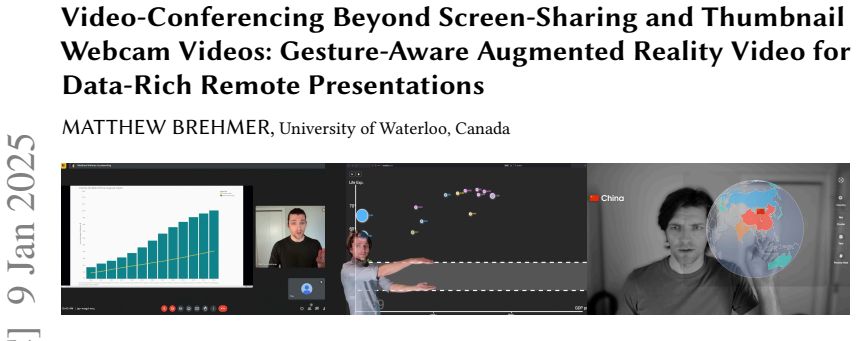
The central mechanism is the composited augmented video feed: a webcam image is mirrored and layered with semi-transparent data visualizations in the foreground, driven in real time by computer-vision hand tracking and speech recognition. Hand gestures serve both operational functions (revealing, comparing, annotating data elements) and expressive or deictic functions (pointing at spatially adjacent charts to direct audience attention). Mirroring makes the mapping from the presenter's body to the on-screen visuals intuitive, and a widget-based interface (from the VisConductor project) lets the presenter specify where visual aids sit and which gestures activate them. This machinery turns an ordinary webcam into a virtual camera feed that can be shared through existing video-conferencing tools.
What would settle it
A controlled comparison of the same data talk delivered via conventional screen-sharing and via gesture-aware augmented video, measuring audience recall of key numbers, gaze following of the presenter's pointing, and self-reported engagement, would settle the claim; if screen-sharing matches or beats the augmented video on these measures, the co-location benefit is not supported.
Extended reading notes
Core claim
The paper's central claim is that video-conferencing technology itself is not the bottleneck for data-rich remote presentations; the default use of screen-sharing and a detached thumbnail webcam is. The author argues that a presenter with only a webcam can appear co-located with their data by compositing semi-transparent charts in the video foreground and using continuous hand tracking to reveal, compare, and annotate data elements, with the video mirrored so the presenter's gestures align with what the audience sees. Later variants add speech recognition for transformations like sorting and aggregation, and an open-source project supports animated data storytelling with configurable widget placement. The author argues these gesture-aware augmented video presentations offer a more engaging alternative to the status quo, while acknowledging that the co-location benefit for audiences is a hypothesis yet to be rigorously tested.
Load-bearing premise
The load-bearing premise is that audiences genuinely understand and remember more when a presenter gestures beside co-located charts, and that the cognitive load of continuous hand-tracking while speaking does not hurt the presenter's delivery.
Editorial extensions
If this is right
- A presenter with only a laptop webcam can give an interactive data talk without building slides or live-demoing a dashboard.
- Audiences see the speaker physically next to the charts, so deictic references like 'this spike' or 'this segment' are spatially clear rather than ambiguous.
- Speech commands extend the gesture vocabulary to operations with no natural hand shape, such as sorting, aggregating, or changing color associations, but presenters must weave those keywords into a natural monologue.
- The approach is designed for largely one-way presenter-to-audience talks; making it work for negotiation or consensus-building requires multi-party interaction with shared data.
Reading between the lines
- Beyond the paper, the same compositing idea could apply to remote education, medical explanation, or technical support, where pointing at shared visual information is central.
- A direct testable extension is to measure audience eye gaze while watching both formats; gaze should follow the presenter's hand to the referenced chart if co-location works.
- The green-screen variant's failure under lighting and choreography constraints suggests that the decisive design requirement is low-friction setup, not expressive power.
- Combining hand tracking with room or object recognition could overlay data onto physical objects in the presenter's environment, moving from 2D charts toward 3D content without head-mounted displays.
Signed reviews
Editorial analysis
A structured set of objections, weighed in public.
Referee Report
Summary. This four-page position statement argues that remote data-rich presentations need not be limited to the conventional combination of screen-sharing and a speaker's thumbnail webcam video. The author reflects on a personal line of work developing gesture- and voice-controlled augmented-reality video techniques, from an early green-screen compositing approach to the hand-tracked Tableau Gestures application and the open-source VisConductor system. The paper describes how commodity webcams and pose/hand-tracking models can composite dynamic data displays into the presenter's video, and it concludes with a set of open research challenges: 3D data representation, multi-party collaboration, AI-based assistance, and evaluating experiences under role/device asymmetry. The abstract frames the thesis as a suggestion rather than a demonstrated claim, and the text repeatedly identifies evaluation as an open problem.
Significance. If the position is taken up, it articulates a viable, low-cost alternative to screen-sharing for synchronous data conversations: presenters appear co-located with their visual aids and use deictic gestures to guide audience attention. The paper's strength is that it grounds the position in published, peer-reviewed systems (e.g., [8] at UIST 2022, [7] at ISS 2024) and in a prior interview study [5], rather than in unpublished pilots. It also makes concrete contributions: the open-source VisConductor project and the community-building efforts through MERCADO and the Shonan seminar are valuable, verifiable outputs. The stress-test concern about a missing empirical comparison does not land as a load-bearing defect, because the manuscript is explicitly a position statement, it cites the relevant peer-reviewed evaluation for the 'more successful' claim, and it openly flags evaluation as a future challenge. The main weakness is that several statements of success and ease are written with more confidence than the reported evidence supports, which can mislead readers who skip the caveats.
minor comments (6)
- [Abstract] The abstract states that current approaches result in 'disappointing audience experiences'; this is an empirical claim that is supported by citation to [5] elsewhere, but the abstract itself gives no anchor. Consider adding a clause such as 'according to our interview study [5]' so the claim is traceable.
- [Augmented Video Presentations] The sentence 'Our next approach proved to be more successful [8]' is a strong comparative claim. Although [8] is a peer-reviewed paper, the four-page position statement does not summarize what 'more successful' means (e.g., which measures, what baseline). Please add a parenthetical indicating the nature of the evidence in [8] or soften the wording to 'we found this approach more successful in our evaluations [8].'
- [Augmented Video Presentations] The claim that mirroring the video 'made it easy for presenters to coordinate their gestures' is presented without supporting evidence. Consider reframing as a design rationale ('we mirrored the video so that presenters could more easily coordinate...') rather than an outcome.
- [Additional Modalities & Interactive Authoring Support] The sentence 'In 2023, myself and a team of international collaborators' uses 'myself' as a subject; the correct form is 'my team of international collaborators and I' or 'I, together with a team...'.
- [Challenges & Research Opportunities] The list of open challenges omits presenter workload and the failure modes of continuous hand-tracking (e.g., occlusion, lighting, recognizer errors), which are central to the feasibility of the proposed approach. Adding one sentence to this paragraph would improve balance.
- [Figure 1] The left subfigure caption cites [5], which is an interview study rather than an example of screen-sharing; please clarify whether the image is adapted from that paper or is an original illustrative mock-up.
Circularity Check
No significant circularity: the paper is a position statement with no derivation, fitted parameters, or predictions that reduce to its inputs.
full rationale
This paper is an explicitly labeled position statement that reflects on the author's prior work in gesture-aware augmented reality video for remote data presentations. It contains no equations, no fitted parameters, and no quantities that are derived and then claimed as predictions. The central suggestion that video-conferencing 'does not need to be limited to screen-sharing and relegating a speaker's video to a separate thumbnail view' is presented as an opinion grounded in prior systems and demonstrations, not as a result derived from first principles. The paper cites several of the author's own prior works, but these citations are used as descriptions of prior systems and workshops, not as a uniqueness theorem or as a mechanism to forbid alternative approaches. The paper openly acknowledges limitations, including that the initial green-screen variant was 'rigid and unnatural' and that evaluating these experiences remains challenging. The load-bearing empirical premise, that audiences benefit from seeing a presenter co-located with visual aids, is explicitly framed as an open question ('we considered whether audiences would benefit'), not as an established result. Any weakness in the paper is a lack of direct comparative evidence, which is a correctness or evidence concern, not circularity. No step in the argument reduces by definition to its own input, so the appropriate circularity score is 0.
Assumptions & free parameters
assumptions (3)
- domain assumption Presenters and audiences benefit from seeing the presenter co-located with visual aids and using deictic gestures.
- domain assumption Commodity webcams with pose recognition and hand-tracking provide sufficient interaction fidelity for enterprise presentation workflows.
- domain assumption Screen-sharing and thumbnail video are inadequate for data-rich presentations.
Cite this review
Pith. "Pith review of Video-Conferencing Beyond Screen-Sharing and Thumbnail Webcam Videos: Gesture-Aware Augmented Reality Video for Data-Rich Remote Presentations." pith.science (2026). https://pith.science/paper/HXGG26O3
@misc{pith2026250105345,
  author       = {Pith},
  title        = {Pith review of: Video-Conferencing Beyond Screen-Sharing and Thumbnail Webcam Videos: Gesture-Aware Augmented Reality Video for Data-Rich Remote Presentations},
  year         = {2026},
  howpublished = {\url{https://pith.science/paper/HXGG26O3}},
  note         = {Machine review of arXiv:2501.05345}
}
read the original abstract
Synchronous data-rich conversations are commonplace within enterprise organizations, taking place at varying degrees of formality between stakeholders at different levels of data literacy. In these conversations, representations of data are used to analyze past decisions, inform future course of action, as well as persuade customers, investors, and executives. However, it is difficult to conduct these conversations between remote stakeholders due to poor support for presenting data when video-conferencing, resulting in disappointing audience experiences. In this position statement, I reflect on our recent work incorporating multimodal interaction and augmented reality video, suggesting that video-conferencing does not need to be limited to screen-sharing and relegating a speaker's video to a separate thumbnail view. I also comment on future research directions and collaboration opportunities.
Figures
Reference graph
Works this paper leans on
-
[8]
Brian D Hall, Lyn Bartram, and Matthew Brehmer. 2022. Augmented Chironomia for Presenting Data to Remote Audiences. In Proceedings of the ACM Symposium on User Interface Software and Technology (UIST) . https://doi.org/10. 1145/3526113.3545614
arXiv 2022
-
[7]
Temiloluwa Femi-Gege, Matthew Brehmer, and Jian Zhao. 2024. VisConductor: Affect-Varying Widgets for Animated Data Storytelling in Gesture-Aware Augmented Video Presentation. Proceedings of the ACM on Human-Computer Interaction (PACM) 8, ISS (2024). https://doi.org/10.1145/3698131
doi:10.1145/3698131 2024
-
[5]
Matthew Brehmer and Robert Kosara. 2022. From Jam Session to Recital: Synchronous Communication and Collabora- tion Around Data in Organizations. IEEE Transactions on Visualization and Computer Graphics (Proceedings of VIS) 28, 1 (2022). https://doi.org/10.1109/TVCG.2021.3114760
arXiv 2022
- [1]
-
[2]
Matthew Brehmer. 2024. Data Storytelling in Augmented Reality and Spatial Computing. Tableau Conference 2024. https://youtu.be/kHQSPnOSpWI
work page 2024
-
[3]
Matthew Brehmer, Maxime Cordeil, Christophe Hurter, and Takayuki Itoh. 2023. The MERCADO Workshop at IEEE VIS 2023: Multimodal Experiences for Remote Communication Around Data Online. Workshop at IEEE VIS 2023. https://arxiv.org/abs/2303.11825
work page Pith review arXiv 2023
-
[4]
Matthew Brehmer, Maxime Cordeil, Christophe Hurter, and Takayuki Itoh. 2024. Augmented Multimodal Interaction for Synchronous Presentation, Collaboration, and Education with Remote Audiences. NII Shonan Report #213. https://shonan.nii.ac.jp/docs/No.213.pdf
work page 2024
-
[6]
Barrett Ens, Benjamin Bach, Maxime Cordeil, Ulrich Engelke, Marcos Serrano, Wesley Willett, Arnaud Prouzeau, Christoph Anthes, Wolfgang Büschel, Cody Dunne, Tim Dwyer, Jens Grubert, Jason H. Haga, Nurit Kirshenbaum, Dylan Kobayashi, Tica Lin, Monsurat Olaosebikan, Fabian Pointecker, David Saffo, Nazmus Saquib, Dieter Schmalstieg, Danielle Albers Szafir, M...
arXiv 2021
Show all 15 references
-
[9]
Adrian Kristanto, Maxime Cordeil, Benjamin Tag, Nathalie Henry Riche, and Tim Dwyer. 2023. Hanstreamer: An Open-Source Webcam-Based Live Data Presentation System. In Proceedings of MERCADO Workshop at IEEE VIS 2023: Multimodal Experiences for Remote Communication Around Data O...
2023 arXiv
-
[10]
Jadon, Rubaiat Habib Kazi, and Ryo Suzuki
Jian Liao, Adnan Karim, S. Jadon, Rubaiat Habib Kazi, and Ryo Suzuki. 2022. RealityTalk: Real-Time Speech-Driven Augmented Presentation for AR Live Storytelling. In Proceedings of the ACM Symposium on User Interface Software and Technology (UIST). https://doi.org/10.1145/35261...
2022
-
[11]
Xingyu Bruce Liu, Vladimir Kirilyuk, Xiuxiu Yuan, Alex Olwal, Peggy Chi, Xiang Anthony Chen, and Ruofei Du. 2023. Visual Captions: Augmenting Verbal Communication With On-the-fly Visuals. In Proc. ACM Conf. Human Factors in Computing Systems (CHI). https://doi.org/10.1145/3544...
2023
-
[12]
David Saffo, Sara Di Bartolomeo, Tarik Crnovrsanin, Laura South, Justin Raynor, Caglar Yildirim, and Cody Dunne
-
[13]
Arjun Srinivasan and Matthew Brehmer. 2023. Combining Voice and Gesture for Presenting Data to Remote Audiences. In Proceedings of MERCADO Workshop at IEEE VIS 2023: Multimodal Experiences for Remote Communication Around Data Online. https://arjun010.github.io/static/papers/mm...
2023
-
[14]
Haijun Xia, Tony Wang, Aditya Gunturu, Peiling Jiang, William Duan, and Xiaoshuo Yao. 2023. CrossTalk: Intelligent Substrates for Language-Oriented Interaction in Video-Based Communication and Collaboration. In Proc. ACM Symp. User Interface Software and Technology (UIST) . ht...
2023
-
[2024]
IEEE Trans
Unraveling the Design Space of Immersive Analytics: A Systematic Review. IEEE Trans. Visualization and Computer Graphics (TVCG) 30, 1 (2024). https://doi.org/10.1109/TVCG.2023.3327368
2024
Reviewed August 10, 2026 · model on record in the stance chip above.
Discussion (0). Continue with ORCID to comment.