REVIEW 2 major objections 5 minor 32 references
Winter Noctilucent Clouds Following Sudden Stratospheric Warming: First Observations
T0 review · 2 major / 5 minor · reviewed 2026-08-10 · deepseek-v4-flash
Pith's one-line read Sudden stratospheric warming produced the first observed winter noctilucent clouds in December 2024, the paper reports.
desk verdict A credible first report of winter mesospheric ice clouds tied to an SSW, with a plausible but not fully proven formation mechanism: the frost-point crossing at cloud height rests on an assumed gravity-wave excursion. read the letter →
The pith
A machine-rendered reading of the paper's core claim, the machinery that carries it, and where it could break.
The reading
What carries the argument
The load-bearing mechanism is sudden stratospheric warming coupling into the mesosphere: planetary-wave activity displaces the polar stratospheric vortex, reverses the zonal wind, stops the usual downwelling winter circulation, and replaces it with upwelling that adiabatically cools the upper mesosphere. The central observational identity is the match between the cloud altitude derived by umbral colorimetric analysis (using the color shift of twilight as the cloud enters Earth's shadow) and the height of the satellite-observed temperature minimum at 68–70 km. The final piece is the frost-point criterion: for the nearly 10 ppm water vapor measured in the cold layer, the empirical ice frost-point temperature is about 155 K, and the paper argues that local gravity-wave temperature excursions below the ~165 K resolved by MLS were large enough to cross that threshold. This combination—cold, moist, upwelling air at 68–70 km—is the same physical recipe that produces summer mesospheric ice, transplanted into winter by an SSW.
What would settle it
A high-resolution temperature measurement over central Siberia during the cloud sightings that shows no air at or below ~155 K near 68 to 70 km would falsify the proposed formation mechanism, as would a particle-property measurement showing the clouds were not water ice.
Extended reading notes
Core claim
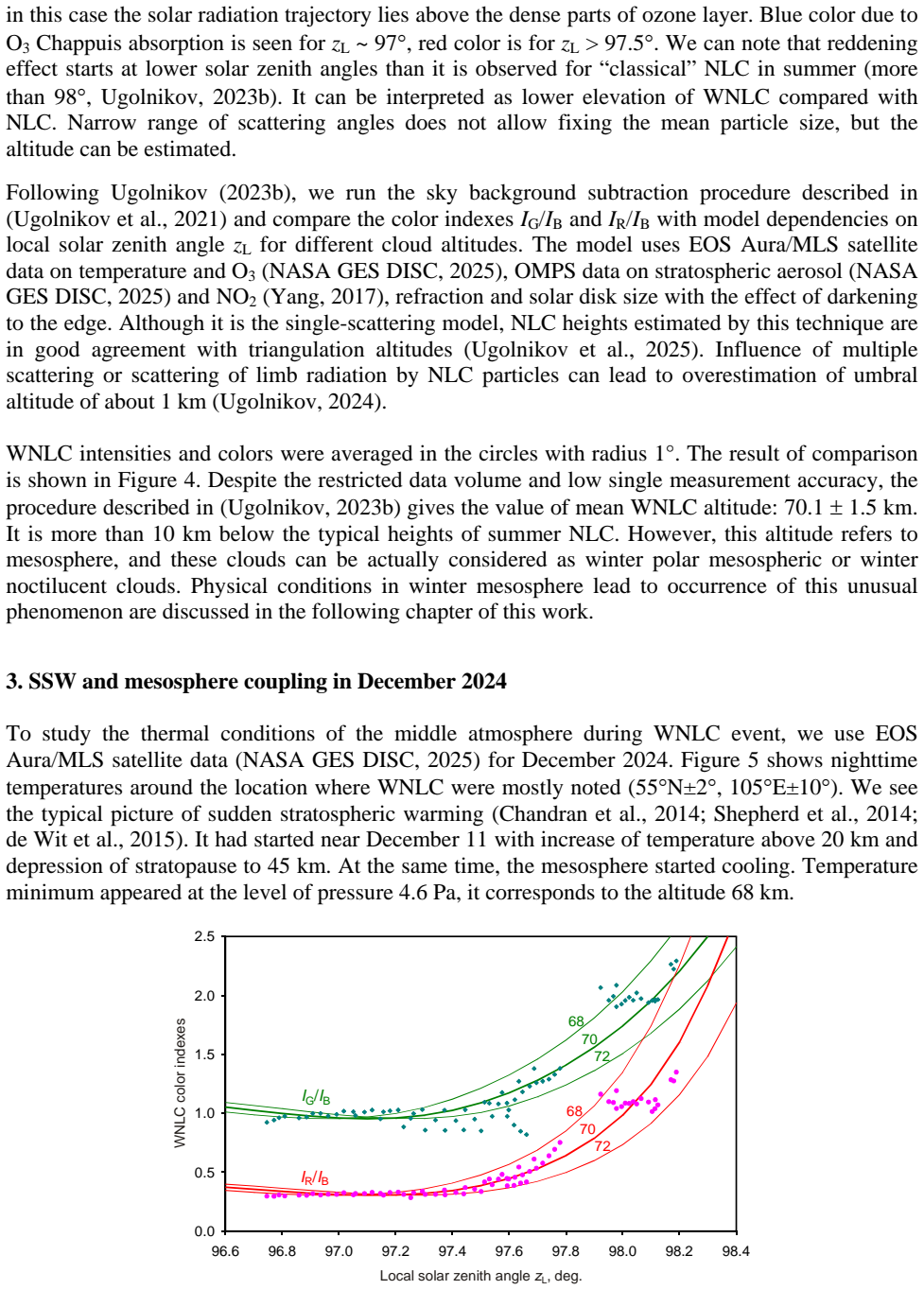
The central claim is that the December 2024 Siberian structures are genuine noctilucent clouds of water ice, observed out of season. Their measured height of $70.1 \pm 1.5$ km sits in the mesosphere and matches the altitude of a deep temperature minimum that followed the onset of a major sudden stratospheric warming around December 11, when temperatures at 44 km reached about 300 K while the mesosphere cooled to about 165 K. MLS water-vapor profiles show the cold layer became nearly twice as humid as the zonal-mean December state, and a SABER nighttime scan in the same region reaches the ice frost point at 69 km, about 1 km below the measured cloud height. The study concludes that SSW-driven upwelling produced the cold, moist layer and that unresolved gravity-wave excursions closed the final ~10 K gap, so the clouds mark the first time winter mesospheric ice has been tied to sudden stratospheric warming. It explicitly argues against rocket exhaust or meteor dust as the primary cause.
Load-bearing premise
The central claim holds only if local mesospheric temperatures actually dipped to or below the ~155 K ice frost point at the cloud location, since the best satellite measurements show ~165 K there and the extra ~10 K cooling must come from gravity-wave fluctuations that were not directly observed.
Editorial extensions
If this is right
- Mesospheric ice can form in winter mid-latitudes, not only in the summer polar mesosphere, when an SSW produces the right combination of cooling and humidity.
- The observed mean cloud height, $70.1 \pm 1.5$ km, is more than 10 km below typical summer noctilucent clouds, so the altitude range for mesospheric ice must be extended downward.
- SSW events can transport water vapor upward, nearly doubling mesospheric humidity to about 10 ppm in the cold layer, increasing the probability of ice nucleation.
- Because the cold spots are small, short-lived, and often hidden by winter weather, such clouds are likely rare and frequently missed; systematic twilight monitoring during SSWs would raise detection odds.
Reading between the lines
- A natural extension would be to search historical satellite polar-mesospheric-cloud records during major SSWs for low-altitude ice signatures near 68–72 km; if found, this event would become a class rather than a single sighting.
- The mechanism implies that the best observing locations during future SSWs are on the eastern side of the displaced vortex, where the mesospheric cold anomaly sits; coordinated twilight camera networks could test this prediction.
- Because these clouds form near 70 km, well below typical summer noctilucent clouds, they offer a natural test for ice-nucleation models outside their usual temperature and water-vapor parameter range.
Signed reviews
Editorial analysis
A structured set of objections, weighed in public.
Referee Report
Summary. This paper reports observations of bright, noctilucent-cloud-like structures in the Siberian sky on December 17-19, 2024, and estimates their altitude as 70.1 +/- 1.5 km using a single-site twilight colorimetric method. The author compares the event with Aura/MLS temperature and water vapor data, documenting a pronounced mesospheric temperature minimum near 68 km associated with a sudden stratospheric warming, elevated H2O of about 10 ppm, and a nearby TIMED/SABER profile that reaches the ice frost point at 69 km. The paper argues that this combination - SSW-induced mesospheric upwelling, adiabatic cooling, and water vapor enhancement - explains the formation of 'winter noctilucent clouds.' The central claim is that these are the first observed winter mesospheric ice clouds caused by an SSW.
Significance. If the altitude and timing are correct, this is the first documented case of winter mesospheric ice clouds associated with a sudden stratospheric warming, and it extends the known parameter space of NLC formation. The paper makes good use of publicly available satellite data, and the colorimetric method has been validated in the author's prior work. The strength of the report is the direct observation and the coincidence arguments; its main limitation is that the final causal step - frost-point crossing by unresolved gravity-wave cooling - is assumed rather than measured. The paper is valuable as an observational report, but the mechanism should be framed as a plausible hypothesis unless additional quantitative support is provided.
major comments (2)
- [Section 3, paragraph after Figure 8; Section 4] The causal claim that the clouds were nucleated by SSW-induced cooling depends on the local temperature falling below the frost point at the cloud location and time. The MLS profiles show about 165 K at 68 km, roughly 10 K above the Murphy-Koop frost point for the measured ~10 ppm H2O; only a single SABER profile reaches 155 K at 69 km, possibly offset in space or time. The text then 'assume[s] that mesosphere temperatures locally dropped even deeper during that night' because gravity waves can be short-lived. This assumed fluctuation is load-bearing for the central formation mechanism. Please either soften the conclusion to a plausible hypothesis or provide quantitative support, such as a microphysical estimate of whether a transient few-kelvin frost-point crossing can produce visible ice, or independent gravity-wave temperature observations. As written, the mechanism is not demonstrated.
- [Section 2, Figure 4] The altitude of 70.1 +/- 1.5 km is based on a single twilight sequence, and the paper itself notes 'restricted data volume and low single measurement accuracy' plus a potential ~1 km overestimation from multiple scattering. Because the mesospheric nature of the clouds is central to the paper's title and interpretation, please explicitly discuss how systematic errors (e.g., background subtraction, assumed aerosol/NO2 profiles, single-scattering model) are bounded, and whether any could bias the altitude by more than the quoted 1.5 km. If this cannot be quantified, state it as a limitation in the conclusions.
minor comments (5)
- [Abstract] The phrase 'coincided spatially and temporary' should read 'coincided spatially and temporally.'
- [Section 1, paragraph 2] The instrument name 'SHIAMACHY' is a typo for 'SCIAMACHY.'
- [References] The reference for Bremer and Berger (2002) is misspelled as 'Bermer, J.'; it should be 'Bremer, J.'
- [Section 3, paragraph after Figure 8] The sentence 'It is 1 km below the measured height of WNLC, the reason of this difference was discussed above' is grammatically awkward; consider revising to 'This is 1 km below the measured height of WNLC, a difference whose reason was discussed above.'
- [References] The Gadsden and Schroder reference lists the title as 'Nocilucent Clouds'; the correct spelling is 'Noctilucent Clouds.'
Circularity Check
No significant circularity: the altitude measurement and the SSW-causation inference are independent, and the self-cited colorimetric method is externally validated by triangulation.
full rationale
The paper's central claims are (i) that the December 2024 structures are winter mesospheric ice clouds at 70.1±1.5 km, measured by umbral colorimetry, and (ii) that they formed because SSW-driven upwelling cooled the mesosphere to the ice frost point. These chains are independent. The altitude retrieval in Section 2 (Fig. 4) compares observed color-index evolution with a radiative-transfer model parameterized by external MLS/OMPS satellite data; it does not assume any SSW mechanism or frost-point crossing. The method originates in the author's prior work (Ugolnikov 2023b), but the paper cites validation against triangulation (Ugolnikov et al. 2025), which is independent of the present target result. The temperature and water-vapor arguments in Section 3 (Figs. 5-8) use external MLS and SABER data and the Murphy-Koop formula; the frost-point comparison is not fitted to the observed cloud altitude. The one genuinely weak link is not circular: the paper explicitly assumes that 'mesosphere temperatures locally dropped even deeper during that night' (Section 3) to close the roughly 10 K gap between MLS temperatures and the frost point. That is an unverified gravity-wave excursion assumption, a correctness/evidence limitation rather than a reduction of the derivation to its own inputs. The self-citations are methodological and externally anchored; no fitted parameter is renamed as a prediction, and no uniqueness theorem is imported. Overall circularity is minimal, consistent with a normal non-circular observational study.
Assumptions & free parameters
assumptions (6)
- domain assumption The single-scattering twilight color model of Ugolnikov (2023b) gives unbiased altitude estimates for noctilucent clouds, with about 1 km systematic error from multiple scattering.
- domain assumption Gravity waves produced local mesospheric temperature minima at least about 10 K below the MLS and SABER large-scale values at 68-70 km during December 17-19, 2024.
- domain assumption The observed structures are water-ice clouds, not dust or other aerosol, despite no direct composition measurement.
- domain assumption MLS and SABER profiles in the region averaged over 55N ± 2, 105E ± 10 are representative of the airmass at the cloud locations.
- standard math The Murphy-Koop (2005) vapor pressure relation correctly predicts the ice frost temperature at mesospheric conditions.
- domain assumption A displaced polar vortex during a sudden stratospheric warming reverses or weakens mesospheric downwelling, producing upwelling and adiabatic cooling at about 70 km.
Cite this review
Pith. "Pith review of Winter Noctilucent Clouds Following Sudden Stratospheric Warming: First Observations." pith.science (2026). https://pith.science/paper/KLWKBZBB
@misc{pith2026250105432,
  author       = {Pith},
  title        = {Pith review of: Winter Noctilucent Clouds Following Sudden Stratospheric Warming: First Observations},
  year         = {2026},
  howpublished = {\url{https://pith.science/paper/KLWKBZBB}},
  note         = {Machine review of arXiv:2501.05432}
}
read the original abstract
Mesospheric structures identical to summer noctilucent clouds were observed during the nights of December 17-19, 2024 in Siberian Russia. Basing on the available photo data, the mean altitude of the clouds 70.1+-1.5 km was measured by umbral colorimetric method. This coincided spatially and temporary with deep temperature minimum below 160K in mesosphere, followed the polar vortex displacement and warming of stratosphere below the clouds. The satellite data on temperature and water vapor is used to study the nature of this unexpected event.
Figures


Figures from the paper (4 more)


Reference graph
Works this paper leans on
-
[9]
Gravity waves and mesospheric clouds in the summer middle atmosphere: A comparison of lidar measurements and ray modeling of gravity waves over Sondrestrom, Gr eenland. J. Geophys. Res. 109, D10103. https://doi.org/10.1029/2002JD002783 Gorkavyi, N., Rault, D.F., Newman, P.A., da Silva, A.M., Dudorov, A.E.,
-
[19]
On the anthropogenic impact on long-term evolution of noctilucent clouds. Geophys. Res. Lett. 45, 6681-6689. https://doi.org/10.1029/2018GL077719. Manney, G.L., Schwartz, M.J., Krüger, K., Santee, M.L., Pawson, S., Lee, J.N., Daffer, W.H., Fuller, R.A., Livesey, N.J.,
-
[25]
Climatology of noctilucent cloud radii and occurrence freque ncy using SCIAMACHY. J. Atmos. Sol. Terr. Phys. 71, 408-423. https://doi.org/10.1016/j.jastp.2008.10.015. Russell, J.M. III, Mlynczak, M.G., Gordley, L.L., Ta nsock, J., Esplin, R.,
-
[26]
Stratospheric warming influence on the mesosphere/lower thermosphere as seen by the extended CMAM. Ann. Geophys. 32, 589–608. https://doi.org/10.5194/angeo-32-589-2014. Siskind, D.E., Eckermann, S.D., McCormack, J.P., Coy, L., Hoppel, K.W., Baker, N.L.,
-
[31]
Zülicke, C., Becker, E., Matthias, V., Peters, D
OMPS-NPP L2 NM Nitrogen Dioxi de (NO2) Total and Tropospheric Column swath orbital V2, Greenbe lt, MD, USA, Goddard Earth Sciences Data and Information Services Center (GES DISC), Accessed: January 3, 2025, https://doi.org/10.5067/N0XVLE2QAVR3. Zülicke, C., Becker, E., Matthias, V., Peters, D. H.W.,
-
[32]
Coupling of st ratospheric warmings with mesospheric coolings in observations and simulations. Journal of Climate. 31, 1107–1133. https://doi.org/10.1175/JCLI-D-17-0047.1
-
[83]
Mid-latitude lidar observati ons of planetary waves in the middle atmosphere during the winter of 1981-1982. J. Geophys. Res. 88, 3843-3849. Hervig, M., Thompson, R.E., McHugh, M., Gordley, L.L., Russell, G.M. III,
work page 1981
-
[391]
Hauchecorne, A., Chanin, M.L., 19
https://doi.org/10.1002/j.1477-8696.1987.tb07516.x. Hauchecorne, A., Chanin, M.L., 19
Show all 32 references
-
[1971]
A dynamical model of the stratospheric sudden wa rming. J. Atmos. Sci. 28, 1479-1494, https://doi.org/10.1175/1520-0469(1971)028<1479:ADMOTS>2.0.CO;2 Merkel, A.W., Thomas, G.E., Palo, S.E., Bailey, S.M.,
1971 doi
-
[1982]
The role of gravity wave induced drag and diffusion in the momentum budget of the mesosphere. J. Atmos. Sci. 39, 791–799. https://doi.org/10.1175/1520- 0469(1982)039%3C0791:TROGWI%3E2.0.CO;2. Jensen, E.J., Thomas, G.E.,
1982 doi
-
[1994]
Journal of Ge ophysical Research, 99, D2, 3421-3430
Numerical simu lations of the effects of gravity waves on noctilucent clouds. Journal of Ge ophysical Research, 99, D2, 3421-3430. https://doi.org/10.1029/93JD01736. Karlsson, B., Körnich, H., Gumbel, J.,
-
[2001]
First confirmation that water ice is the primary com ponent of polar mesospheric clouds. Geophys. Res. Lett. 28, 971-974. https://doi.org/10.1029/2000GL012104. Holton, J.R.,
-
[2002]
Mesospheric temperature trends derived from ground-based LF phase- height observations at mid-latitude s: comparison with model simulations. J. Atm. Sol-Terr. Phys. 64, 805–816. http://dx.doi.org/10.1016/S1364-6826(02)00073-1. Bremer, J., Peters, D.,
-
[2003]
Geophysical Research Letters, 30, 1196-1199
Observations of the 5-day planetary wave in PMC measurements from the Student Nitric Oxide Explorer Satellite. Geophysical Research Letters, 30, 1196-1199. https://doi.org/10.1029/2002GL016524. MPEC 2024-X68, 2024: 2024 XA1. Minor Planet Elec tronic Circular. Minor Planet Cent...
2024 doi
-
[2004]
A case study of gravity waves in noctilucent clouds. Ann. Geophys. 22, 1875–1884. https://doi.org/10.5194/angeo- 22-1875-2004. Dalin, P., Perminov, V., Pertsev, N., Romejko, V.,
2004 doi
-
[2005]
Review of the vapour pressures of ice and supercooled water for atmospheric applications. Q. J. R. Meteorol. Soc. 131, 1539–1565. https://doi.org/10.1256/qj.04.94. NASA Goddard Earth science data and information services center (GES DISC). Accessed January 4, 2025 at: https://...
-
[2007]
Ev idence for interhemispheric stratosphere- mesosphere coupling derived from noctilucent cl oud properties. Geophys. Res. Lett. 34, L16806, https://doi.org/10.1029/2007GL030282. Köhnke, M., von Savigny, C., Robert, C.,
-
[2008]
Influence of stratos pheric ozone changes on long-term trends in the meso- and lower thermosphere. J. Atm. Sol-Terr. Phys. 70, 1473–1481. http://dx.doi.org/10.1016/j.jastp.2008.03.024. Chandran, A., Collins, R.L., Harvey, V.L.,
2008 doi
-
[2009]
Aura Microwav e Limb Sounder observations of dynamics and transport during the record-break ing 2009 Arctic stratospheric ma jor warming. Geophys. Res. Lett. 36, L12815. https://doi.org/10.1029/2009GL038586. Matsuno, T.,
2009 doi
-
[2010]
Case studies of the mesospheric response to recent minor, major, and extended stratospheric warmings. J. Geophys. Res. 115, D00N03, https://doi.org/10.1029/2010JD014114. Ugolnikov, O.S., Kozelov, B.V., Pilgaev, S.V., Rol dugin, A.V.,
-
[2013]
New stratospheric dust belt due to the Chelyabinsk bolide. Geophys. Res. Lett. 40, 4728-4733. https://doi.org/10.1002/grl.50788, 2013 10 Griffiths, L.A., Shanklin, J.D.,
2013 doi
-
[2014]
Stratosphere-mesosphere coupling during stratospheric sudden warming events. Adv. Space Res. 53, 1265–1289. http://dx.doi.org/10.1016/j.asr.2014.02.005. Dalin, P., Kirkwood, S., Moström, A., Stebel, K ., Hoffmann, P., Singer, W.,
2014 doi
-
[2015]
Coupling in the middle atmosphere related to the 2013 major sudden stra tospheric warming. Ann. Geophys. 33, 309–319. https://doi.org/10.5194/angeo-33-309-2015. Gadsden, M., Schröder, W.,
2013 doi
-
[2017]
Izvestiya, Atmospheric and Oceanic Physics 53, 477–486
Sudden stratospheric warmings: statistical characteristics and influence on NO 2 and O 3 total contents. Izvestiya, Atmospheric and Oceanic Physics 53, 477–486. https://doi.org/10.1134/S0001433817050036. Andrews, D.G., Holton, J.R., Leovy, C.B.,
-
[2018]
Advances in Space Research, 61, 2531–2539
Obse rvation of a 27-day solar signature in noctilucent cloud altitude. Advances in Space Research, 61, 2531–2539. https://doi.org/ 10.1016/j.asr.2018.02.035. Liu, H.-L., Roble, R.G.,
2018 doi
-
[2020]
Updated long -term trends in mesopause temperature, airglow emissions, and noctilu cent clouds. J. Geophys. Res. Atmos. 125, e2019JD030814. https://doi.org/10.1029/2019JD030814. De Wit, R.J., Hibbins, R.E., Espy, P.J., Hennum, E.A.,
-
[2021]
Planetary and Space Science, 200, 105213
Retrieval of particle size distribution of polar stratosphe ric clouds based on Wide-Angle Co lor and Polarization Analysis. Planetary and Space Science, 200, 105213. Ugolnikov, O.S., 2023a. Cross-wave profiles of altit ude and particle size of noctilucent clouds in the case o...
-
[2022]
Inter-hemispheric coupling during sudden stratospheric warming events with elevated stratopause. J. Geophys. Res. Atmos. 127, e2020JD033761. https://doi.org/10.1029/2020JD033761. Bermer, J., Berger, U.,
-
[2024]
Noctilucent clouds altitude and particle size mapping based on spread observations by ground-based all-sky cameras. J. Atm. Sol. Terr. Phys. 259, 106242. https://doi.org/ 10.1016/j.jastp.2024.106242. Ugolnikov, O.S., et al.,
2024
-
[2025]
Five-y ears altitude statistics of noc tilucent clouds based on multi-site wide-field camera survey. J. Atm. Sol. Terr. Phys. (submitted). http://arxiv.org/abs/2412.04951. Walterscheid, R.L., Sivjee, G.G., Roble, R. G.,
-
[4392]
Robert, C.E., von Savigny, C., Burrows, J.P., Baumgarten, G.,
https://doi.org/10.1029/2001JD001241. Robert, C.E., von Savigny, C., Burrows, J.P., Baumgarten, G.,
-
[4695]
Lübken, F.-J., Berger, U., Baumgarten, G.,
https://doi.org/10.1029/2001JD001533. Lübken, F.-J., Berger, U., Baumgarten, G.,
Reviewed August 10, 2026 · model on record in the stance chip above.
Discussion (0). Continue with ORCID to comment.