REVIEW 5 major objections 10 minor 18 references
Rotational-hyperfine cooling of $^{205}$TlF in a cryogenic beam
T0 review · 5 major / 10 minor · reviewed 2026-08-10 · deepseek-v4-flash
Pith's one-line read Rotational-hyperfine cooling of a cryogenic thallium-fluoride beam, driven by one ultraviolet laser and two microwave fields, concentrates the population into the $J=0, F=0$ ground state with a measured gain of 20.1(4).
desk verdict The cooling scheme works and is worth citing, but the headline gain's precision is hostage to an unquantified branching-fraction ratio. read the letter →
The pith
A machine-rendered reading of the paper's core claim, the machinery that carries it, and where it could break.
The reading
What carries the argument
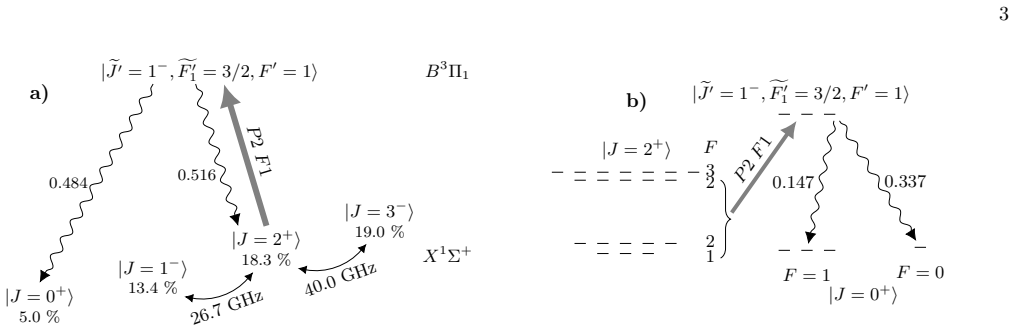
The cooling cycle is driven by the $P(2)$ $\tilde{F}_1'=3/2$, $F'=1$ transition at 271.75 nm, which excites $J=2$ molecules to a $B\,^3\Pi_1$ level whose decays land about 48% in $J=0$ and 52% back in $J=2$; microwaves at 26.6 and 40.0 GHz continuously repopulate $J=2$ from $J=1$ and $J=3$. The hyperfine selectivity comes from the excited-state decay branching fractions, which put about 70% of the $J=0$ decays into $F=0$ rather than $F=1$; the paper computes these fractions by diagonalizing the strongly mixed $B\,^3\Pi_1$ Hamiltonian. Rapidly switched laser and microwave polarizations break the coherent dark states that would otherwise trap population and slow the scattering rate.
What would settle it
Measure the branching-fraction ratio directly by driving the $P(2)$ transition and counting decays into each resolved $J=0$ hyperfine level, or compare the inferred gain with a probe that resolves the 13 kHz splitting; if $\mathrm{bf}_{F=0}/\mathrm{bf}_{F=1}$ differs from $0.337/0.147$, the reported 20.1(4) gain changes proportionally.
Extended reading notes
Core claim
The central claim is that rotational-hyperfine cooling of a cryogenic-beam molecule is practical and effective: a single ultraviolet laser plus two microwave fields transfer the majority of the Boltzmann distribution of TlF into the $|J=0, F=0\rangle$ ground state, yielding a gain of $G_0 = 20.1(4)$ in that level's population. This is the first demonstration of hyperfine cooling in a closed-shell molecule, and it works despite long-lived coherent dark states that would otherwise stall the optical pumping. The paper argues that this gain is sufficient for the experiment's projected sensitivity and that straightforward upgrades, more laser power and a second pump transition, could raise it to roughly 40.
Load-bearing premise
The load-bearing premise is that the computed decay branching fractions from the $P(2)$ excited state into the $J=0, F=0$ and $J=0, F=1$ ground levels are correct, since the reported gain scales with the ratio of those two numbers.
Editorial extensions
If this is right
- The experiment can now operate with the beam population concentrated in the useful $J=0, F=0$ state, reaching its projected statistical sensitivity for the $^{205}$Tl Schiff-moment search.
- Increasing the cooling-laser power to about 500 mW should fully deplete the $J=1,2,3$ states and raise the gain above 25.
- Adding a second laser on the $R(0)$ transition to empty the $J=0, F=1$ manifold could push the total gain to nearly 40.
- The method provides a template for rotational-hyperfine cooling of other heavy closed-shell molecules used in symmetry-violation searches.
- The demonstration that rapid polarization switching destabilizes dark states at 1 MHz rates is directly useful for optical cycling in other molecular species.
Reading between the lines
- The same optical-pumping-plus-microwave-mixing cycle should transfer to other heavy closed-shell diatomics whose excited-state hyperfine structure is resolved in the optical transition, so a gain near 20 is not specific to TlF.
- Because the reported $F=0$ gain is obtained by multiplying the measured $F=1$ gain by the computed branching-fraction ratio, an independent measurement of that ratio—for instance by resolving the 13 kHz ground-state splitting in a microwave-optical double-resonance experiment—would directly test the headline number.
- If the microwave-leakage effect flagged in the depletion measurements were eliminated, the depletion-based gain of 24.1(1.1) would provide a sharp cross-check of the branching-fraction calculation.
Signed reviews
Editorial analysis
A structured set of objections, weighed in public.
Referee Report
Summary. The manuscript reports a demonstration of rotational and hyperfine cooling in a cryogenic beam of 205TlF, aimed at increasing the population in the J=0, F=0 ground hyperfine level that is used for the CeNTREX Schiff-moment search. The method uses one UV laser on the P(2) F1'=3/2, F'=1 transition of the B3Pi1-X1Sigma+ system, together with two microwave fields coupling J=1-2 and J=2-3, to funnel population into J=0. The gain is inferred indirectly: Scheme 1 (claimed as primary) measures the gain in the J=0, F=1 population via the R(0) F1'=3/2, F'=2 transition, then converts to the F=0 gain using a computed branching-fraction ratio bf_F=0/bf_F=1. The result quoted in Section IV and the abstract is G0^(1)=20.1(4), averaged over |v_perp|<2 m/s. Two other schemes (R(0) F1'=1/2, F'=1 branching method and a differential method) give 22.1(4) and 22.9(6) but are explicitly regarded as biased by dark states. Appendix C gives a depletion-based estimate of 24.1(11), dismissed as unreliable because of microwave leakage. Appendix D contains a new calculation of the B3Pi1 branching fractions; Table I notes that the values 'differ significantly' from those of Ref. [9], with the justification being correspondence with the authors of Ref. [10] rather than an independent measurement.
Significance. If the central claim is right, this is an important experimental milestone for CeNTREX: a population gain of ~20 in the single usable hyperfine state translates directly into improved statistical sensitivity for the Schiff-moment measurement, and the paper is the first demonstration of hyperfine-level rotational cooling in a closed-shell molecule. The paper is also valuable for its detailed description of the multi-pass UV scheme, polarization/dark-state management, and the three-way cross-check of gain diagnostics. The authors are appropriately conservative in choosing the lowest of the three gain estimates as the headline result and in flagging the dark-state bias of Schemes 2 and 3. However, the headline number is not a direct measurement of the J=0,F=0 population: it is the product of a directly measured F=1 gain and a computed branching-fraction ratio. The manuscript nowhere assigns a systematic uncertainty to that ratio, even though Appendix D states that its values disagree significantly with a prior published calculation. This is the load-bearing point for the paper's quantitative claim.
major comments (5)
- [Section IV and Eq. (4)] The quoted central result G0^(1)=20.1(4) relies on Eq. (4), G0 = 3 r (G1-1)+1 with r = bf_F=0/bf_F=1, and the stated 0.4 is only the statistical uncertainty from the fluorescence ratio. From the numbers given, G1 ~ 3.78 and r ~ 2.29, so dG0/dr = 3(G1-1) ~ 8.3. A 10% uncertainty in r alone would shift G0 by ~1.9, about five times the reported statistical error. The manuscript does not provide any estimate of the systematic uncertainty in r, and Appendix D explicitly states that the values in Table I 'differ significantly' from those in Ref. [9]. Because the excited state is strongly mixed in J' and F1', r is not fixed by simple angular-momentum algebra but depends on the same Hamiltonian diagonalization that is in dispute. The headline gain is therefore conditional on an unresolved theoretical input; the paper needs either an independent calibration of r, a quantified systematic error, or a differently framed claim that avoids making r load-bearing.
- [Appendix D and Table I] Table I's note that the branching fractions 'differ significantly' from Ref. [9], with 'after correspondence ... we believe the values presented here to be correct' as the only justification, is not a sufficient basis for a quantitative measurement claim. The manuscript should report the actual differences between the two calculations, identify which Hamiltonian parameters cause them, and propagate the resulting uncertainty into Eq. (4). In particular, the paper should state whether the discrepancy arises from the hyperfine-mixing Hamiltonian of Ref. [10] versus Ref. [9], and whether the predicted decay branching fractions to J=0 (0.4841 and 0.5159 from the relevant excited state) are testable by any existing or proposed measurement.
- [Section IV and Appendix C] The depletion-based estimate G0 ~ 24 is dismissed because of microwave leakage in the detection chamber, but this estimate is also the only in-paper cross-check that does not use the disputed branching fractions for the conversion (it uses only the sum bf_F=0+bf_F=1 through the factor in Eq. C1). If the microwave-leakage concern applies equally to the depletion measurements and to the Scheme-1 fluorescence measurements, the paper should say so explicitly; if the leakage affects only the depletion measurement, the 24.1(11) value provides some independent support for the central claim, and the reason for not using it as a systematic bound on r should be stated. As written, the manuscript leaves the reader unable to tell whether the leakage is a generic systematic that could also affect G1.
- [Section III E and Appendix B] The dark-state bias of Schemes 2 and 3 is quantified only through a phenomenological efficiency ratio epsilon1/epsilon0, and Figure 5 shows that the apparent gain depends strongly on this ratio. The paper reports G0^(2)=22.1(4) and G0^(3)=22.9(6) but gives no measured value or uncertainty for epsilon1/epsilon0. It would strengthen the paper to report the inferred epsilon1/epsilon0 from the difference between the schemes, and to check that the inferred value is consistent with the dark-state model. Without this, the claim that Scheme 1 is the 'more reliable' method rests on a qualitative argument.
- [Section IV, first paragraph] The sentence 'Given the drawbacks of employing the R(0) F1'=1/2 F'=1 transition ... we only use the result Scheme 1 for our quantitative conclusions' is in tension with the abstract and conclusion, which present 20.1(4) as an unconditional achieved gain. The conditional nature of the number (conditioned on the computed branching-fraction ratio, and on the correctness of the dark-state model for Schemes 2 and 3) should be stated in the abstract or at least in the conclusion, so that the quantitative claim is not overstated.
minor comments (10)
- [Eq. (4) and Appendix A] The derivation of Eq. (4) assumes that the thermal population ratio rho_1/rho_0 = 3 exactly and that the branching fractions are the only mechanism changing the F=0 population. The paper should state explicitly that hyperfine-changing collisions, off-resonant excitation of other P(2) hyperfine components, and decays from the F'=1 excited state to J=0,F=1 with subsequent microwave transfer to J=1,2 are all neglected or included in the quoted uncertainty; if they are neglected, a bound should be given.
- [Section II, Fig. 1 caption] The caption of Fig. 1(b) states 'Decays back to J=2+ are not shown', but the text says 'roughly half the decays from J'=1 end up in J=0, and nearly all of the remainder returns to J=2'. A reader would benefit from a single figure showing both the J=0 and J=2 decay channels with the branching fractions 0.484, 0.516 (and the 0.337/0.147 sub-branching), since the numerical values are central to the scheme.
- [Section III D] The statement that the R(0) F1'=1/2, F'=1 transition 'excites from the unresolved F=0 and F=1 hyperfine levels' should be clarified: the ground-state hyperfine splitting of 13 kHz is indeed unresolved by the laser, but the branching fractions for the detection transition into the F'=1 excited state are not presented here. Since the detection transition's own branching fractions affect the interpretation of Schemes 2 and 3, a reference or table entry would be helpful.
- [Appendix D, Eq. (D4)] The 9-j symbol in Eq. (D4) is written with a 1 in the bottom row, which likely denotes a rank-1 tensor component; this notation is nonstandard and could be confused with a scalar. Please define the symbol (e.g., as a 9-j symbol involving q) and ensure the phase convention is stated.
- [Appendix D, Eq. (D6)] The prefactor 3*omega^3/(3 hbar c^3) is dimensionally correct but written in a redundant way; the factor 3 in the numerator and denominator cancels. This is cosmetic but could be simplified to avoid confusion with the standard expression.
- [Abstract and Conclusion] The abstract says 'a factor of 20.1(4) gain in the population of the J=0, F=0 hyperfine sublevel'. As noted in the major comments, this is an inferred quantity. Even if the systematic issue is resolved, the uncertainty should include the branching-fraction contribution; if it is not resolved, the abstract should say 'inferred'.
- [Section II] The statement that 'the only loss is branching to other vibrational states which amounts to ≲1%' cites Refs. [9-11]; however, the Franck-Condon factor for B-X vibrational decay is typically a few percent for TlF, so the authors should clarify whether the 1% figure refers to the total loss per optical cycle or to some other quantity.
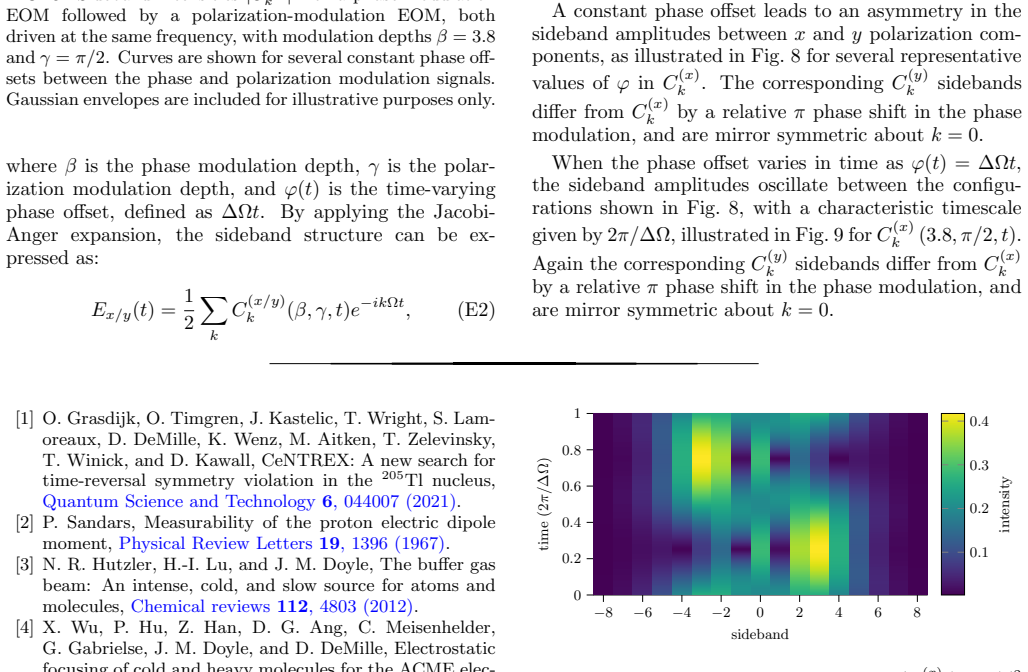
- [Appendix E] The time-dependent phase offset Delta_Omega t with Delta_Omega = 65 kHz and the claim that molecules see 'approximately two complete cycles' of the sideband variation is not derived. A short estimate of the interaction time (beam diameter / forward velocity) would make this quantitative.
- [Fig. 6 and Fig. 7] The two figures show gain and depletion as functions of detuning with a grey-shaded region corresponding to +/-2 m/s. The text should explicitly state that the average over the shaded region is unweighted over the transverse-velocity distribution, or if it is weighted, how the weighting was determined.
- [References] Ref. [9] (Norrgard et al., PRA 95, 062506 (2017)) is the prior hyperfine-structure calculation that allegedly disagrees with Table I. The manuscript should give the specific numbers from Ref. [9] for the branching fractions of the P(2) F1'=3/2,F'=1 excited state, so the reader can see the magnitude of the discrepancy without chasing the reference.
Circularity Check
No significant circularity: the reported gain is inferred from a measured fluorescence ratio and an independently computed branching-fraction ratio; no fitted parameter is renamed as a prediction.
full rationale
The derivation chain is not circular. The central result G0^(1)=20.1(4) comes from Eq. (4), G0 = 3(bf_F=0/bf_F=1)(G1-1)+1, where G1 is the directly measured fluorescence ratio S1^on/S1^off (Eq. 1) and the branching-fraction ratio bf_F=0/bf_F=1 is computed in Appendix D from a diagonalization of the B3Pi1 Hamiltonian using eigenstates from Ref. [10]. The branching fractions are not fitted to G0 or G1; they are theoretical inputs whose accuracy is a separate physics concern. The paper's own Table I note admits that the values 'differ significantly from those in [9]' and justifies them only by correspondence with the authors, but this is a limitation on systematic uncertainty, not a reduction of the result to its inputs. Schemes 2 and 3 are explicitly affected by dark states and are not used for the quantitative conclusion; Scheme 1 uses the R(0) ~F1'=3/2 F'=2 probe, which has no dark states. The self-citations to Refs. [1], [8], and [9] are not load-bearing: Ref. [1] supplies the beam temperature and experimental context, Ref. [8] is superseded by the explicit recalculation in Appendix D, and Ref. [9] is the prior value being corrected. No equation in the paper is equivalent by construction to its inputs, and no fitted parameter is relabeled as a prediction.
Assumptions & free parameters
assumptions (4)
- domain assumption The B3Pi1 Hamiltonian eigenstates from Ref. [10] accurately describe the hyperfine mixing, making the resulting decay branching fractions in Table I correct.
- domain assumption The initial J=0 hyperfine populations are thermal with rho1 = 3 rho0, i.e., the 13 kHz splitting is negligible at Trot = 6.3 K.
- domain assumption Probe fluorescence signals are proportional to the addressed level populations, with no cooling-induced change in detection efficiency from radiation pressure or velocity redistribution.
- domain assumption The microwave fields and polarization switching address all hyperfine/Zeeman sublevels of J=1,2,3 and prevent dark states from halting the optical pumping.
Cite this review
Pith. "Pith review of Rotational-hyperfine cooling of $^{205}$TlF in a cryogenic beam." pith.science (2026). https://pith.science/paper/KMSGEBDZ
@misc{pith2026250105578,
  author       = {Pith},
  title        = {Pith review of: Rotational-hyperfine cooling of $^205$TlF in a cryogenic beam},
  year         = {2026},
  howpublished = {\url{https://pith.science/paper/KMSGEBDZ}},
  note         = {Machine review of arXiv:2501.05578}
}
abstract
The aim of CeNTREX (Cold Molecule Nuclear Time-Reversal Experiment) is to search for time-reversal symmetry violation in the thallium nucleus, by measuring the Schiff moment of $^{205}$Tl in the polar molecule thallium fluoride (TlF). CeNTREX uses a cryogenic beam of TlF with a rotational temperature of 6.3(2) K. This results in population spread over dozens of rotational and hyperfine sublevels of TlF, while only a single level is useful for the Schiff moment measurement. Here we present a protocol for cooling the rotational and hyperfine degrees of freedom in the CeNTREX beam, transferring the majority of the Boltzmann distribution into a single rotational and hyperfine sublevel by using a single ultraviolet laser and a pair of microwave beams. We achieve a factor of $20.1(4)$ gain in the population of the $J=0$, $F=0$ hyperfine sublevel of the TlF ground state.
Figures


Figures from the paper (6 more)


Reference graph
Works this paper leans on
-
[9]
E. Norrgard, E. Edwards, D. McCarron, M. Steinecker, D. DeMille, S. S. Alam, S. Peck, N. Wadia, and L. Hunter, Hyperfine structure of theB 3Π1 state and predictions of optical cycling behavior in theX→B transition of TlF, Physical Review A95, 062506 (2017)
work page 2017
-
[10]
T. Courageux, A. Cournol, D. Comparat, B. V. de Lesegno, and H. Lignier, Efficient rotational cooling of a cold beam of barium monofluoride, New Journal of Physics24, 025007 (2022)
work page 2022
-
[1]
The 205Tl and 19F nuclear spins give rise to hyperfine substructure in the rotational states
The ground state X 1Σ+ has a rotational constant B= 6.66733 GHz and nominal rotational energiesE J = BJ(J+ 1). The 205Tl and 19F nuclear spins give rise to hyperfine substructure in the rotational states. The low- est rotational state,|J= 0⟩, splits into two levels, with F= 0 andF= 1. All higher rotational states split into four hyperfine states, separate...
-
[2]
Sandars, Measurability of the proton electric dipole moment, Physical Review Letters19, 1396 (1967)
P. Sandars, Measurability of the proton electric dipole moment, Physical Review Letters19, 1396 (1967)
work page 1967
-
[3]
N. R. Hutzler, H.-I. Lu, and J. M. Doyle, The buffer gas beam: An intense, cold, and slow source for atoms and molecules, Chemical reviews112, 4803 (2012)
2012
-
[4]
O. Grasdijk, O. Timgren, J. Kastelic, T. Wright, S. Lam- oreaux, D. DeMille, K. Wenz, M. Aitken, T. Zelevinsky, T. Winick, and D. Kawall, CeNTREX: A new search for time-reversal symmetry violation in the 205Tl nucleus, Quantum Science and Technology6, 044007 (2021)
work page 2021
-
[5]
N. R. Hutzler, M. F. Parsons, Y. V. Gurevich, P. W. Hess, E. Petrik, B. Spaun, A. C. Vutha, D. DeMille, G. Gabrielse, and J. M. Doyle, A cryogenic beam of re- fractory, chemically reactive molecules with expansion cooling, Phys. Chem. Chem. Phys.13, 18976 (2011)
work page 2011
-
[6]
R. Gl¨ ockner, A. Prehn, B. G. U. Englert, G. Rempe, and M. Zeppenfeld, Rotational Cooling of Trapped Poly- atomic Molecules, Phys. Rev. Lett.115, 233001 (2015)
work page 2015
Show all 18 references
-
[7]
X. Wu, P. Hu, Z. Han, D. G. Ang, C. Meisenhelder, G. Gabrielse, J. M. Doyle, and D. DeMille, Electrostatic focusing of cold and heavy molecules for the ACME elec- tron EDM search, New Journal of Physics24, 073043 (2022)
2022
-
[8]
Timgren,Progress towards a measurement of time- reversal symmetry violation in thallium fluoride, Ph.D
O. Timgren,Progress towards a measurement of time- reversal symmetry violation in thallium fluoride, Ph.D. −8 −6 −4 −2 0 2 4 6 8 0 0.2 0.4 0.6 0.8 1 sideband time (2π/∆Ω) 0.1 0.2 0.3 0.4 intensity FIG. 9. Time-varying sideband intensities|C (x) k (β, γ, t)|2 for a phase-modula...
2023
-
[11]
Hunter, S
L. Hunter, S. Peck, A. Greenspon, S. S. Alam, and D. De- 11 Mille, Prospects for laser cooling TlF, Physical Review A85, 012511 (2012)
2012
-
[12]
After this interaction region, the molecules travel downstream∼40 cm to a detection region
that could otherwise slow the optical pumping rate. After this interaction region, the molecules travel downstream∼40 cm to a detection region. Here a probe laser, again propagating orthogonal to the molecular tra- jectories, is tuned to excite molecules in selected sublevels ...
-
[13]
Meijer and B
G. Meijer and B. G. Sartakov, Λ doubling in theB 3Π1 state of TlF, Physical Review A101, 042506 (2020)
2020
-
[14]
M. Yeo, M. T. Hummon, A. L. Collopy, B. Yan, B. Hem- merling, E. Chae, J. M. Doyle, and J. Ye, Rotational State Microwave Mixing for laser Cooling of Complex Di- atomic Molecules, Phys. Rev. Lett.114, 223003 (2015)
2015
-
[15]
D. J. Berkeland and M. G. Boshier, Destabilization of dark states and optical spectroscopy in Zeeman- degenerate atomic systems, Phys. Rev. A65, 033413 (2002)
2002
-
[16]
E. S. Shuman, J. F. Barry, D. R. Glenn, and D. De- Mille, Radiative Force from Optical Cycling on a Di- atomic Molecule, Phys. Rev. Lett.103, 223001 (2009)
2009
-
[18]
M. R. Tarbutt, B. E. Sauer, J. J. Hudson, and E. A. Hinds, Design for a fountain of YbF molecules to mea- sure the electron's electric dipole moment, New Journal of Physics15, 053034 (2013)
2013
-
[25]
We are currently implementing a new laser system capable of achieving this power. Another factor of∼1.5 improvement in the gain could be obtained by adding a second cooling laser to pump out the|J= 0, F= 1⟩ hyperfine manifold via theR(0) ˜F ′ 1 = 3/2F ′ = 2 tran- sition. This ...
Reviewed August 10, 2026 · model on record in the stance chip above.
Discussion (0). Continue with ORCID to comment.