REVIEW 3 major objections 5 minor 56 references
Fast Approximate Solution of Stein Equations for Post-Processing of MCMC
T0 review · 3 major / 5 minor · reviewed 2026-08-10 · deepseek-v4-flash
Pith's one-line read Preconditioned conjugate gradients with a randomized Nyström eigenvalue decomposition solve the Stein-equation linear system up to 10–20 times faster than plain CG on ill-conditioned problems, making Stein-equation post-processing of MCMC…
desk verdict Solid empirical benchmark of preconditioners for Stein systems, but the complexity claim for randomized Nyström EVD is off by a factor of N and the 'fast' recommendation needs correction. read the letter →
The pith
A machine-rendered reading of the paper's core claim, the machinery that carries it, and where it could break.
The reading
What carries the argument
The central object is the Stein reproducing kernel matrix $K_p$ defined in (11), built from a base kernel and the score $\nabla\log p$; it encodes the posterior and determines the collocation estimator $c_N = f^\top K_p^{-1}\mathbf{1}/\mathbf{1}^\top K_p^{-1}\mathbf{1}$ as the solution of $K_p w = \mathbf{1}$. The method for making that solve fast is preconditioned conjugate gradient: a symmetric preconditioner $M = EE^\top$ with $M^{-1}$ available in $O(n^3 + n^2N)$ time is applied at each iteration. The winning variant, randomized Nyström EVD, builds $M$ from a two-stage randomized eigendecomposition of $K_p$ (range finding with power iterations followed by the Nyström trick), storing only the low-rank factors $U$ and $\Lambda$. Convergence is monitored through the computable worst-case error $\sigma(w_m) = (w_m^\top K_p w_m)^{1/2}/\mathbf{1}^\top w_m$, which lets the solver stop within a user-specified tolerance of the exact solution without ever forming $K_p^{-1}$.
What would settle it
Run the same preconditioner comparison on a heavy-tailed or multimodal posterior in dimension $d \geq 20$ using the paper's gain metric; if randomized Nyström EVD shows zero or negative gain on several such targets while plain CG reaches the same $\sigma(w_m)$ tolerance, the paper's central recommendation fails to generalize. A second check is to rerun the $N=20{,}000$ experiment with multiple independent chains and measure wall-clock time, since a single unseeded run cannot distinguish a robust speedup from a favourable draw.
Extended reading notes
Core claim
The collocation solution of the canonical Stein equation produces the estimate $c_N = f^\top K_p^{-1}\mathbf{1}/\mathbf{1}^\top K_p^{-1}\mathbf{1}$, so the entire computational burden is the linear system $K_p w = \mathbf{1}$ for the Stein kernel matrix $K_p$. The paper's central claim is that this system should be solved iteratively with a preconditioner, and that among Jacobi, block Jacobi, Nyström with uniform or diagonal sampling, FITC, randomized Nyström, and randomized Nyström EVD, the randomized Nyström EVD is the winner: it 'performed best over all problem settings considered' and achieves gains of 2–3, corresponding to 10–20 times fewer iterations in favourable settings. The paper further reports that the ranking is not strongly affected by the dimension ($d=4$ vs $d=10$) or by the kernel (inverse multi-quadric, Matérn $\nu=5/2,7/2$, Gaussian), and that preconditioned solvers reach low integration error for specific posterior predictives in far fewer iterations than plain CG or averaging MCMC output.
Load-bearing premise
That the ranking of preconditioners and the 10–20 times iteration savings observed on a logistic regression test bed transfer to other posteriors, higher dimensions, and other MCMC samplers.
Editorial extensions
If this is right
- Randomized Nyström EVD becomes the recommended default preconditioner for the canonical Stein-equation system $K_p w = \mathbf{1}$, particularly at large length scales where the system is most ill-conditioned.
- Stein-equation post-processing moves from $O(N^3)$ direct solves to iterative solves with $O(N^2)$ per-iteration cost and $O(N)$ storage, making it feasible for MCMC outputs of $10^4$–$10^5$ samples.
- The computable stopping criterion $\sigma(w_m)$ enables users to trade iterations against a certified worst-case integration error, without needing a ground-truth solution.
- The same preconditioning machinery transfers to other linear systems involving $K_p$, such as kernel-based cubature and Stein importance sampling.
Reading between the lines
- The empirical support is a single logistic regression test bed; a natural next experiment is a systematic comparison on heavy-tailed or multimodal posteriors in higher dimensions, where the paper's own discussion concedes cumulative evidence is needed.
- The paper's large-$N$ demonstration ($N = 20{,}000$) is a single run without error bars or timings; replicating it with several MCMC chains and wall-clock measurements would clarify whether the advertised speedup is robust.
- Combining randomized Nyström EVD preconditioning with warm-starting or subspace recycling across a family of related systems — which the paper suggests in its outlook — could further multiply the savings when tuning kernel length scales by cross-validation.
- The integration-error experiments use integrands outside the RKHS $H(k_p)$ on which the bound (16) rests; a testable extension is to verify whether the preconditioned solver still preserves the worst-case error ranking for RKHS integrands, where the theory applies.
Editorial analysis
A structured set of objections, weighed in public.
Referee Report
Summary. The paper studies the numerical solution of the canonical Stein equation for post-processing MCMC output, focusing on the linear system Kp w = 1. It derives the closed-form estimator cN, proposes preconditioned conjugate gradient solvers with several preconditioning strategies (Jacobi, block Jacobi, Nyström, Nyström with diagonal sampling, FITC, randomized Nyström, and randomized Nyström EVD), and compares them on a logistic regression posterior in terms of CG iteration counts. The central empirical claim is that randomized Nyström EVD preconditioning performs best, with reported gains of 2–3 on the log scale corresponding to 10–20 times reduction in iteration counts in favourable settings, and that the method scales to N = 20,000.
Significance. If the claims are correct, the paper would provide a practical recipe for scaling Stein-equation-based estimators to realistic MCMC sample sizes, which is an active area of computational statistics. The paper's strengths include a self-contained proof of Proposition 1, an explicit worst-case error bound (16) that allows monitoring without knowing the integrand, a reproducible open-source implementation, and a systematic empirical comparison with ablations over kernel choice and dimension. However, the central 'fast' claim is currently undermined by a complexity-accounting error and the absence of wall-clock timings, so the transfer of the empirical iteration-count ranking to actual computational cost is not established.
major comments (3)
- [Section 3.3.6] The stated cost O((q+1)N n + n^3) for forming Y = (KpKp^T)^q Kp Ω is incorrect for a dense N×N Stein kernel matrix. Each application of Kp or Kp^T to an N×n matrix costs O(N^2 n) flops, so the range-finding stage costs O((2q+1)N^2 n) operations (or O(N^2 n) for q=0), not O(N n) per matvec. With the paper's own choice n = O(N^{1/2}) in Section 4.1, the setup cost is O(N^{2.5}) for q=0 and worse for q>0, which exceeds one PCG iteration by the factor n. Since the paper's performance metric in Section 4.1 counts only iterations and explicitly does not report timings, the advertised speedups for randomized Nyström EVD do not account for preconditioner construction; the claim of 'fast approximate solutions' is therefore not established.
- [Section 3.3.5, Eq. (20)] The displayed formula for M^{-1} is mathematically inconsistent. The matrix KpΩ(Ω^T KpΩ + ηI)^{-1}(KpΩ)^T is of rank at most n < N and is not invertible, yet its inverse is taken in the first line of (20); the second line is the correct Woodbury expression for the inverse of ηI + KpΩ(Ω^T KpΩ)^{-1}(KpΩ)^T. The text conflates the low-rank approximation with the preconditioner. This needs correction so that the preconditioner's definition is unambiguous and reproducible.
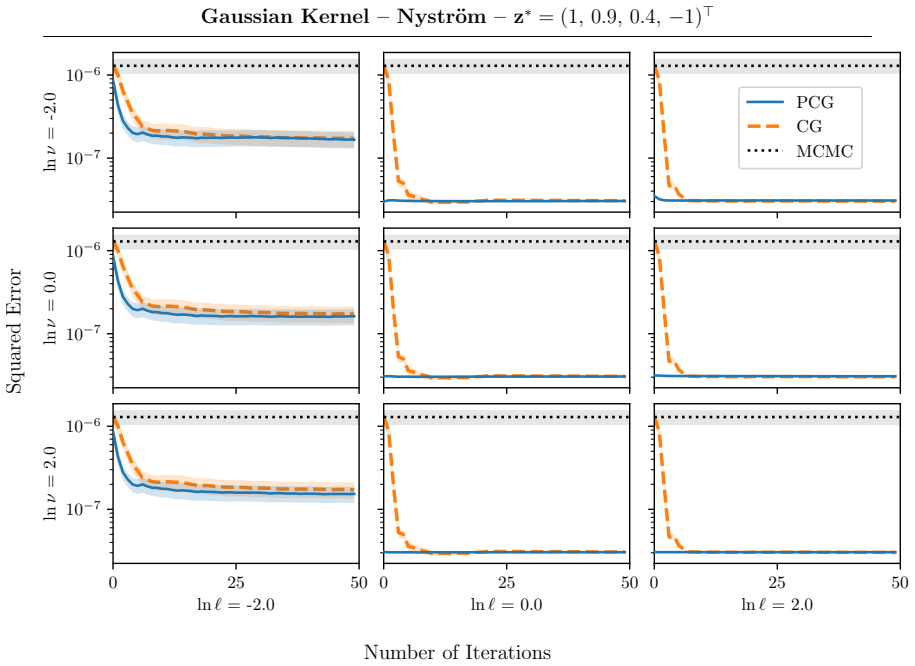
- [Section 4.3 and Figure 4] The only large-N experiment (N = 20,000) is a single run with no replicates, no timings, and no uncertainty quantification. Given that this is the sole evidence for scalability to realistic MCMC output, and given the setup-cost issue raised above, the conclusion that randomized Nyström EVD is beneficial at scale is not supported. Reporting wall-clock time (or at least adding the preconditioner setup cost to the reported iteration counts) and multiple seeds would be necessary to substantiate the scalability claim.
minor comments (5)
- [Section 1] The sentence 'these do not not enjoy comparable software support' contains a duplicated 'not' and should read 'these do not enjoy comparable software support'.
- [Section 3.3.2] The sentence 'The time complexity of calculating M^{-1} is O(n^3 + n^2N)' should clarify that this is the cost of building the preconditioner, not of applying it in each CG iteration.
- [Section 3.3.6 and Appendix D.2.5] The power-iteration count q is not reported in the experimental details; Appendix D.2.5 gives only n = 50. Please report q (or state that q = 0 was used) so that the setup cost is reproducible.
- [Section 4.1] The performance metric uses min{10^4, mPCG} in the denominator, which makes the comparison sensitive to the 10^4 iteration cap. The paper states that negative gains are under-reported, but it would be helpful to also report how often this cap was reached for each preconditioner.
- [Figure 2 caption] The panel labels ('Matérn Kernel (ν=5/2, d=4)', 'Matérn Kernel (ν=5/2, d=10)', 'Gaussian Kernel (d=4)') are listed in the caption in a different order than they appear in the figure; please align the descriptions with the actual panel layout.
Circularity Check
No significant circularity: the cN estimator is derived from first principles and the preconditioner comparison is not fitted to its conclusions.
full rationale
The central estimator cN in Proposition 1 is derived self-containedly in Appendix A by solving the constrained quadratic programme with Lagrange multipliers; it does not assume the value of cN or the posterior integral. The worst-case error bound (16) is an exact algebraic identity, and the empirical gain metric compares iterations to a fixed 1% tolerance, so no fitted parameter is renamed as a prediction. The preconditioners (Jacobi, Nyström, FITC, randomized Nyström EVD) are standard and are compared on an objective, pre-specified criterion. The paper's self-citations, notably Theorem 1 of [42] for the Stein kernel representation, are load-bearing but are published, parameter-free results that do not assume the solver-comparison conclusion, and the specific proposition used here is proven in the appendix. The paper itself identifies a circularity in Galerkin methods (Section 2.3) and avoids it via collocation; that admission does not make the paper circular. The main weaknesses are external validity (single logistic-regression test bed, integrands outside the RKHS admitted in Appendix E.3) and an apparent complexity undercount in Section 3.3.6 for randomized Nyström EVD setup, but these are correctness or generality risks, not circular reasoning.
Assumptions & free parameters
free parameters (7)
- Kernel length scale ℓ =
ln ℓ in {-2,-1,0,1,2} (grid)
- Woodbury nugget η =
10^-4, 10^-2, 1, 10^2, 10^4
- Number of inducing points n =
50 (for N=1000), 200 (for N=20000)
- Block size b =
1,2,3,4,5
- Power iterations q in randomized Nyström EVD =
not reported
- MCMC proposal scale ϵ =
acceptance rates 0.251 (d=4), 0.059 (d=10)
- Termination tolerance τ =
1.01
assumptions (5)
- domain assumption Existence and uniqueness of the solution to the canonical Stein equation on R^d for the densities and integrands considered.
- domain assumption The Stein kernel kp in (11) is well-defined, symmetric positive definite, and the collocation matrix Kp is invertible for distinct nodes.
- standard math Functions in H(kp) integrate to zero under p via the divergence theorem, so ∫ v p dx = 0 for v ∈ H(kp).
- domain assumption MCMC output need not be p-invariant for consistency of cN; the Stein kernel encodes all needed information about p.
- domain assumption The integrands of interest lie in the RKHS H(kp) (or f - c ∈ H(kp)); this fails for the predictive functions used in the experiments.
Cite this review
Pith. "Pith review of Fast Approximate Solution of Stein Equations for Post-Processing of MCMC." pith.science (2026). https://pith.science/paper/3CM24GKP
@misc{pith2026250106634,
  author       = {Pith},
  title        = {Pith review of: Fast Approximate Solution of Stein Equations for Post-Processing of MCMC},
  year         = {2026},
  howpublished = {\url{https://pith.science/paper/3CM24GKP}},
  note         = {Machine review of arXiv:2501.06634}
}
read the original abstract
Bayesian inference is conceptually elegant, but calculating posterior expectations can entail a heavy computational cost. Monte Carlo methods are reliable and supported by strong asymptotic guarantees, but do not leverage smoothness of the integrand. Solving Stein equations has emerged as a possible alternative, providing a framework for numerical approximation of posterior expectations in which smoothness can be exploited. However, existing numerical methods for Stein equations are associated with high computational cost due to the need to solve large linear systems. This paper considers the combination of iterative linear solvers and preconditioning strategies to obtain fast approximate solutions of Stein equations.
Figures


Figures from the paper (11 more)



Reference graph
Works this paper leans on
-
[1]
In: International Conference on Artificial Intelligence and Statistics, pp
Abedsoltan, A., Pandit, P., Rademacher, L., Belkin, M.: On the Nystr¨ om approx- imation for preconditioning in kernel machines. In: International Conference on Artificial Intelligence and Statistics, pp. 3718–3726. PMLR (2024)
work page 2024
-
[2]
Swan, Y.: Stein’s method meets computational statistics: A review of some recent developments
Anastasiou, A., Barp, A., Briol, F.X., Ebner, B., Gaunt, R.E., Ghaderinezhad, F., Gorham, J., Gretton, A., Ley, C., Liu, Q., Mackey, L., Oates, C.J., Reinert, G., 23 -2 -1 0 1 2 ln 𝓁 1 5 10 15 20 b 0.00 0.00 0.01 0.01 0.01 0.01 0.00 0.01 0.01 0.01 0.01 0.00 0.01 0.01 0.01 0.01 0.01 0.01 0.01 0.01 0.01 0.00 0.01 0.01 0.01 Block Jacobi -2 -1 0 1 2 ln 𝓁 -2 -...
work page 2023
-
[3]
Bernoulli 28(4), 2181–2208 (2022)
Barp, A., Oates, C.J., Porcu, E., Girolami, M.: A Riemann–Stein kernel method. Bernoulli 28(4), 2181–2208 (2022)
work page 2022
-
[4]
Targeted Separation and Convergence with Kernel Discrepancies
Barp, A., Simon-Gabriel, C.J., Girolami, M., Mackey, L.: Targeted separation and convergence with kernel discrepancies. arXiv preprint arXiv:2209.12835 (2022)
work page Pith review arXiv 2022
-
[5]
Mathematics and Computers in Simulation 220, 382–405 (2024)
Belomestny, D., Goldman, A., Naumov, A., Samsonov, S.: Theoretical guarantees for neural control variates in MCMC. Mathematics and Computers in Simulation 220, 382–405 (2024)
work page 2024
-
[6]
Statistics and Computing 30, 973–997 (2020)
Belomestny, D., Iosipoi, L., Moulines, E., Naumov, A., Samsonov, S.: Variance reduction for Markov chains with application to MCMC. Statistics and Computing 30, 973–997 (2020)
work page 2020
-
[7]
Bulletin of the International Society for Bayesian Analysis 31(3) (2024)
Bhattacharya, A., Linero, A., Oates, C.J.: Grand challenges in Bayesian computa- tion. Bulletin of the International Society for Bayesian Analysis 31(3) (2024)
work page 2024
-
[8]
Blei, D.M., Kucukelbir, A., McAuliffe, J.D.: Variational inference: A review for statisticians. Journal of the American statistical Association 112(518), 859–877 (2017) 24 -2 -1 0 1 2 ln 𝓁 1 5 10 15 20 b 0.00 0.01 0.01 0.02 0.02 0.01 0.01 0.02 0.04 0.04 0.01 0.01 0.02 0.03 0.03 0.01 0.01 0.03 0.04 0.04 0.01 0.01 0.03 0.04 0.03 Block Jacobi -2 -1 0 1 2 ln ...
work page 2017
Show all 56 references
-
[9]
URL http:// github.com/jax-ml/jax
Bradbury, J., Frostig, R., Hawkins, P., Johnson, M.J., Leary, C., Maclaurin, D., Necula, G., Paszke, A., VanderPlas, J., Wanderman-Milne, S., Zhang, Q.: JAX: composable transformations of Python+NumPy programs (2018). URL http:// github.com/jax-ml/jax
2018
-
[10]
In: Proceedings of the International Conference on Machine Learning, pp
Briol, F.X., Oates, C.J., Cockayne, J., Chen, W.Y., Girolami, M.: On the sampling problem for kernel quadrature. In: Proceedings of the International Conference on Machine Learning, pp. 586–595 (2017)
2017
-
[11]
Journal of Statistical Software 76(1), 1–32 (2017)
Carpenter, B., Gelman, A., Hoffman, M.D., Lee, D., Goodrich, B., Betancourt, M., Brubaker, M.A., Guo, J., Li, P., Riddell, A.: Stan: A probabilistic programming language. Journal of Statistical Software 76(1), 1–32 (2017)
2017
-
[12]
Journal of Engineering Mechanics 143(4), 04017,001 (2017)
Chen, J.S., Hillman, M., Chi, S.W.: Meshfree methods: Progress made after 20 years. Journal of Engineering Mechanics 143(4), 04017,001 (2017)
2017
-
[13]
arXiv preprint arXiv:2302.11024 (2023)
Chen, Y., Huang, D.Z., Huang, J., Reich, S., Stuart, A.M.: Gradient flows for sampling: Mean-field models, Gaussian approximations and affine invariance. arXiv preprint arXiv:2302.11024 (2023)
2023 arXiv
-
[14]
In: Uncertainty in Artificial Intelligence (2024)
Chen, Z., Naslidnyk, M., Gretton, A., Briol, F.X.: Conditional Bayesian quadrature. In: Uncertainty in Artificial Intelligence (2024)
2024
-
[15]
Chopin, N., Papaspiliopoulos, O.: An Introduction to Sequential Monte Carlo. Springer (2020) 25 -2 -1 0 1 2 ln 𝓁 1 5 10 15 20 b 0.01 0.00 0.00 0.01 0.01 0.01 0.00 0.00 0.01 0.01 0.01 0.01 0.01 0.01 0.01 0.01 0.01 0.01 0.01 0.01 0.01 0.01 0.01 0.01 0.01 Block Jacobi -2 -1 0 1 2...
2020
-
[16]
In: International Conference on Machine Learning, pp
Cutajar, K., Osborne, M., Cunningham, J., Filippone, M.: Preconditioning kernel matrices. In: International Conference on Machine Learning, pp. 2529–2538. PMLR (2016)
2016
-
[17]
SIAM Journal on Matrix Analysis and Applications 44(2), 559–591 (2023)
Demmel, J., Grigori, L., Rusciano, A.: An improved analysis and unified perspective on deterministic and randomized low-rank matrix approximation. SIAM Journal on Matrix Analysis and Applications 44(2), 559–591 (2023)
2023
-
[18]
Journal of Machine Learning Research 6, 2153–2175 (2005)
Drineas, P., Mahoney, M.W.: On the Nystr¨ om method for approximating a Gram matrix for improved kernel-based learning. Journal of Machine Learning Research 6, 2153–2175 (2005)
2005
-
[19]
World Scientific (2008)
Fasshauer, G.: Meshfree Approximation with MATLAB. World Scientific (2008)
2008
-
[20]
In: Proceedings of Chamonix, pp
Fasshauer, G.E.: Solving partial differential equations by collocation with radial basis functions. In: Proceedings of Chamonix, pp. 1–8 (1996)
1996
-
[21]
Advances in Computational Mathematics 11(2), 139–159 (1999)
Fasshauer, G.E.: Solving differential equations with radial basis functions: Multilevel methods and smoothing. Advances in Computational Mathematics 11(2), 139–159 (1999)
1999
-
[22]
Cambridge University Press (2025)
Fearnhead, P., Nemeth, C., Oates, C.J., Sherlock, C.: Scalable Monte Carlo for Bayesian Learning. Cambridge University Press (2025). In press. 26 10−7 10−6 ln ν = -2.0 10−7 10−6 ln ν = 0.0 0 25 50 ln 𝓁 = -2.0 10−7 10−6 ln ν = 2.0 0 25 50 ln 𝓁 = 0.0 0 25 50 ln 𝓁 = 2.0 Gaussian ...
2025
-
[23]
In: Advances in Neural Information Processing Systems, vol
Fisher, M., Oates, C.J.: Gradient-free kernel Stein discrepancy. In: Advances in Neural Information Processing Systems, vol. 36 (2023)
2023
-
[24]
and Udell, Madeleine: Randomized Nystr¨ om Preconditioning
Frangella, Zachary and Tropp, Joel A. and Udell, Madeleine: Randomized Nystr¨ om Preconditioning. SIAM Journal on Matrix Analysis and Applications 44(2), 718–752 (2023)
2023
-
[25]
The Johns Hopkins University Press (2013)
Golub, G.H., Van Loan, C.F.: Matrix Computations, 4th edn. The Johns Hopkins University Press (2013)
2013
-
[26]
In: International Conference on Machine Learning, pp
Gorham, J., Mackey, L.: Measuring sample quality with kernels. In: International Conference on Machine Learning, pp. 1292–1301. PMLR (2017)
2017
-
[27]
Halko, N., Martinsson, P.G., Tropp, J.A.: Finding structure with randomness: Prob- abilistic algorithms for constructing approximate matrix decompositions. SIAM Re- view 53(2), 217–288 (2011) 27 10−9 10−8 ln ν = -2.0 10−9 10−8 ln ν = 0.0 0 25 50 ln 𝓁 = -2.0 10−9 10−8 ln ν = 2....
2011
-
[28]
Journal of Research of the National Bureau of Standards 49(6) (1952)
Hestenes, M.R., Stiefel, E.: Methods of conjugate gradients for solving linear sys- tems. Journal of Research of the National Bureau of Standards 49(6) (1952)
1952
-
[29]
arXiv preprint arXiv:2001.09266 (2020)
Hodgkinson, L., Salomone, R., Roosta, F.: The reproducing Stein kernel approach for post-hoc corrected sampling. arXiv preprint arXiv:2001.09266 (2020)
2020 arXiv
-
[30]
arXiv preprint arXiv:2406.08401 (2024)
Kalinke, F., Szabo, Z., Sriperumbudur, B.K.: Nystr¨ om kernel Stein discrepancy. arXiv preprint arXiv:2406.08401 (2024)
2024 arXiv
-
[31]
arXiv preprint arXiv:2211.05408 (2022)
Kanagawa, H., Barp, A., Gretton, A., Mackey, L.: Controlling moments with kernel Stein discrepancies. arXiv preprint arXiv:2211.05408 (2022)
2022 arXiv
-
[32]
arXiv preprint arXiv:2305.06151 (2023)
Leluc, R., Portier, F., Segers, J., Zhuman, A.: Speeding up Monte Carlo integration: Control neighbors for optimal convergence. arXiv preprint arXiv:2305.06151 (2023)
2023 arXiv
-
[33]
Lin, J.A., Padhy, S., Mlodozeniec, B., Antor´ an, J., Hern´ andez-Lobato, J.M.: Im- proving linear system solvers for hyperparameter optimisation in iterative Gaussian processes. arXiv preprint arXiv:2405.18457 (2024) 28 10−7 10−6 ln ν = -2.0 10−7 10−6 ln ν = 0.0 0 25 50 ln 𝓁 ...
2024 arXiv
-
[34]
In: Artificial Intelligence and Statistics, pp
Liu, Q., Lee, J.: Black-box importance sampling. In: Artificial Intelligence and Statistics, pp. 952–961. PMLR (2017)
2017
-
[35]
In: Advances in Neural Information Processing Systems, pp
Meanti, G., Carratino, L., Rosasco, L., Rudi, A.: Kernel methods through the roof: Handling billions of points efficiently. In: Advances in Neural Information Processing Systems, pp. 14,410–14,422 (2020)
2020
-
[36]
Springer Science & Business Media (2012)
Meyn, S.P., Tweedie, R.L.: Markov Chains and Stochastic Stability. Springer Science & Business Media (2012)
2012
-
[37]
Springer (1999)
Nocedal, J., Wright, S.J.: Numerical Optimization. Springer (1999)
1999
-
[38]
In: Monte Carlo and Quasi-Monte Carlo Methods, pp
Novak, E.: Optimal algorithms for numerical integration: Recent results and open problems. In: Monte Carlo and Quasi-Monte Carlo Methods, pp. 105–131 (2024)
2024
-
[39]
Nystr¨ om, E.J.: ¨Uber die praktische aufl¨ osung von integralgleichungen mit anwen- dungen auf randwertaufgaben. Acta Mathematica 54(1), 185–204 (1930) 29 10−9 10−8 ln ν = -2.0 10−9 10−8 ln ν = 0.0 0 25 50 ln 𝓁 = -2.0 10−9 10−8 ln ν = 2.0 0 25 50 ln 𝓁 = 0.0 0 25 50 ln 𝓁 = 2.0...
1930
-
[40]
In: International Conference on Monte Carlo and Quasi-Monte Carlo Methods in Scientific Computing, pp
Oates, C.J.: Minimum kernel discrepancy estimators. In: International Conference on Monte Carlo and Quasi-Monte Carlo Methods in Scientific Computing, pp. 133–
-
[41]
Bernoulli 25(2), 1141–1159 (2019)
Oates, C.J., Cockayne, J., Briol, F.X., Girolami, M.: Convergence rates for a class of estimators based on Stein’s method. Bernoulli 25(2), 1141–1159 (2019)
2019
-
[42]
Journal of the Royal Statistical Society Series B: Statistical Methodology 79(3), 695–718 (2017)
Oates, C.J., Girolami, M., Chopin, N.: Control functionals for Monte Carlo inte- gration. Journal of the Royal Statistical Society Series B: Statistical Methodology 79(3), 695–718 (2017)
2017
-
[43]
Proceedings of the National Academy of Sciences 102(25), 8844–8849 (2005)
Owen, A.B., Tribble, S.D.: A quasi-Monte Carlo Metropolis algorithm. Proceedings of the National Academy of Sciences 102(25), 8844–8849 (2005)
2005
-
[44]
SIAM Journal on Scientific Computing 28(5), 1651–1674 (2006) 30
Parks, M.L., De Sturler, E., Mackey, G., Johnson, D.D., Maiti, S.: Recycling Krylov subspaces for sequences of linear systems. SIAM Journal on Scientific Computing 28(5), 1651–1674 (2006) 30
2006
-
[45]
The Journal of Machine Learning Research 6, 1939– 1959 (2005)
Quinonero-Candela, J., Rasmussen, C.E.: A unifying view of sparse approximate Gaussian process regression. The Journal of Machine Learning Research 6, 1939– 1959 (2005)
2005
-
[46]
In: Advances in Neural Information Processing Systems (2017)
Rudi, A., Carratino, L., Rosasco, L.: F ALKON: An optimal large scale kernel method. In: Advances in Neural Information Processing Systems (2017)
2017
-
[47]
In: International Conference on Monte Carlo and Quasi-Monte Carlo Methods in Scientific Computing, pp
Si, S., Oates, C.J., Duncan, A.B., Carin, L., Briol, F.X.: Scalable control variates for Monte Carlo methods via stochastic optimization. In: International Conference on Monte Carlo and Quasi-Monte Carlo Methods in Scientific Computing, pp. 205–221. Springer (2020)
2020
-
[48]
Biometrika 109(2), 351–367 (2022)
South, L.F., Karvonen, T., Nemeth, C., Girolami, M., Oates, C.J.: Semi-exact control functionals from Sard’s method. Biometrika 109(2), 351–367 (2022)
2022
-
[49]
Bayesian Analysis 18(3), 865–888 (2023)
South, L.F., Oates, C.J., Mira, A., Drovandi, C.: Regularized zero-variance control variates. Bayesian Analysis 18(3), 865–888 (2023)
2023
-
[50]
Annual Review of Statistics and Its Application 9(1), 529–555 (2022)
South, L.F., Riabiz, M., Teymur, O., Oates, C.J.: Postprocessing of MCMC. Annual Review of Statistics and Its Application 9(1), 529–555 (2022)
2022
-
[51]
In: Proceedings of the 6th Berkeley Symposium on Mathematical Statistics and Probability, Volume 2: Probability Theory, pp
Stein, C.: A bound for the error in the normal approximation to the distribution of a sum of dependent random variables. In: Proceedings of the 6th Berkeley Symposium on Mathematical Statistics and Probability, Volume 2: Probability Theory, pp. 583–
-
[52]
In: International Conference on Machine Learning, pp
Sun, Z., Barp, A., Briol, F.X.: Vector-valued control variates. In: International Conference on Machine Learning, pp. 32,819–32,846. PMLR (2023)
2023
-
[53]
In: Uncertainty in Artificial Intelligence, pp
Sun, Z., Oates, C.J., Briol, F.X.: Meta-learning control variates: Variance reduction with limited data. In: Uncertainty in Artificial Intelligence, pp. 2047–2057. PMLR (2023)
2023
-
[54]
In: Advances in Neural Information Processing Systems (2023)
Wang, C., Chen, Y., Kanagawa, H., Oates, C.J.: Stein Π-importance sampling. In: Advances in Neural Information Processing Systems (2023)
2023
-
[55]
Cambridge University Press (2004) 31
Wendland, H.: Scattered Data Approximation. Cambridge University Press (2004) 31
2004
-
[603]
University of California Press (1972)
1972
Reviewed August 10, 2026 · model on record in the stance chip above.
Discussion (0). Continue with ORCID to comment.