REVIEW 2 major objections 4 minor 19 references
Gr\"obner Cones for Finite Type Cluster Algebras
T0 review · 2 major / 4 minor · reviewed 2026-08-10 · deepseek-v4-flash
Pith's one-line read Compatibility-degree vectors of any cluster variable lie in the Gröbner cone for every finite-type cluster algebra, and the cone is explicitly described in types A_n, B_n, C_n, D_n.
desk verdict A solid, genuinely new description of Gröbner cones for finite type cluster algebras, with a load-bearing but plausibly correct computer check for the exceptional types. read the letter →
The pith
A machine-rendered reading of the paper's core claim, the machinery that carries it, and where it could break.
The reading
What carries the argument
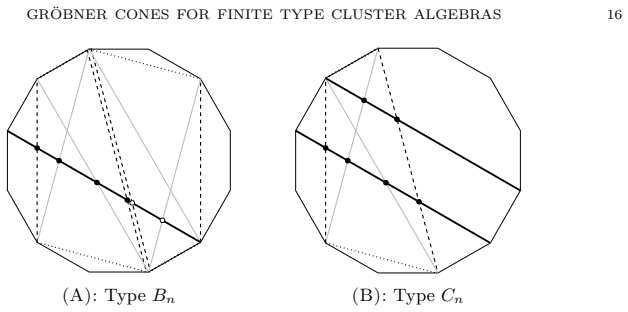
The load-bearing machinery is the compatibility-degree vector $\omega_v$ together with the dual description of the Gröbner cone: by Lemma 2.2.4, $C_A$ is the dual cone of $C_{\mathrm{prim}}$, the cone generated by degrees $\deg(xx') - \deg(y_1)$ of primitive exchange relations $xx' = y_1 + y_2$. To place $\omega_v$ in $C_A$ it suffices to check that $\omega_v$ has nonnegative dot product with every such degree, and Proposition 4.1.2 proves the stronger balancing statement that left and right sides give the same maximum. In the classical types the geometry of exchange quadrilaterals turns this algebraic check into crossing counts: a cluster variable $v$ corresponds to a diagonal or pair of diagonals, and $\omega_v \cdot \deg(y_i)$ equals the number of crossings between that diagonal and the sides of the quadrilateral encoding the monomial $y_i$ (up to a constant). For the exceptional types the same inequality is checked computationally through the Coxeter-element construction, where cluster variables are weights $c^k\omega_i$ and exchange relations are produced from the two-element set $\{\lambda+\mu, \lambda \uplus_c \mu\}$ associated to exchangeable weights.
What would settle it
Independently recompute, for type $E_8$, the complete list of cluster variables, all compatibility-degree vectors $\omega_v$, and all primitive exchange relations from the Coxeter-element model, then test inequality (4.1.3) for every cluster variable and every primitive relation. Finding one $v$ and one primitive relation where the inequality fails would disprove Theorem 4.1.1; a clean independent pass would convert the asserted computational verification into reproducible evidence.
Extended reading notes
Core claim
The paper's central claim is Theorem 4.1.1: for any cluster algebra $A$ of finite cluster type, with cluster variables $V$ and frozen variables $W$, and for any $v \in V$, the vector $\omega_v = [(v||y)]_{y \in V \cup W}$ belongs to the Gröbner cone $C_A$ of $I_A$ with respect to $I^\times_A$. The proof of this membership is reduced to Proposition 4.1.2, which asserts that for every primitive exchange relation $xx' = y_1 + y_2$ and every $v \neq x,x'$, the weight $\omega_v$ pairs equally with the left-hand monomial and with the maximum of the two right-hand monomials. In the classical types this equality is proved by translating exchange relations into quadrilaterals in regular polygons, where dot products become crossing counts and the relevant inequality becomes a small geometric lemma about line segments crossing a quadrilateral. In the exceptional types the same equality is verified by a computer calculation, using the Coxeter-element model to compute compatibility degrees and exchange monomials. The paper then upgrades the membership statement into explicit structure theorems: the sum of all $\omega_v$ lies in the interior of $C_A$, and in types $A_n,B_n,C_n,D_n$ the cone's lineality space and rays are described by explicit vectors built from diagonals of the polygon model.
Load-bearing premise
The load-bearing premise is that the computer verification for the exceptional types $E_6,E_7,E_8,F_4,G_2$ is correct; the code is only referenced as an accompanying file, not reproduced in the paper, so if the computation or the reconstruction of exchange relations from $g$-vectors contains an error, Theorem 4.1.1 would fail for those types.
Editorial extensions
If this is right
- Every finite-type cluster algebra has at least one explicit circular term order: the weight $\omega = \sum_v \omega_v$ lies in the interior of $C_A$, so the initial ideal of $I_A$ is exactly $I^\times_A$ under a term order constructed directly from compatibility degrees.
- For any fixed cluster variable $v$, the weight $\omega_v$ is itself circular, so one can build many distinct degenerations of $I_A$ to $I^\times_A$ by varying the chosen $v$.
- In types $A_n,B_n,C_n,D_n$ the Gröbner cone is completely determined: the paper's lists give bases of the lineality space and generators of the rays, both with the special frozen variables and with no frozen variables.
- The deformation conjecture, stated as Conjecture 6.2.9 in the earlier deformation-theory paper, is proven: if a first-order embedded deformation of $\operatorname{Spec}(K[z]/I^\times_A)$ is nontrivial, then the negative of its multidegree is not a nonnegative combination of primitive exchange degrees.
- The type $A_n$ result recovers the known Gröbner-cone description for the Plücker coordinate ring of the Grassmannian $G(2,n+3)$, placing it as a special case of the cluster-algebra framework.
Reading between the lines
- The realization that all $\omega_v$ lie in $C_A$ suggests that in the exceptional types the rays may also be expressible as small alternating sums of compatibility-degree vectors; extending the computer check to search for such expressions would give structural formulas matching the classical ray lists.
- Because setting frozen variables to $1$ recovers the no-frozen case, the explicit polyhedral descriptions here are compatible with coefficient specialization; this suggests that other choices of frozen variables should produce Gröbner cones obtained by linear projections of the same cones, connecting these ray lists to tropical cluster varieties.
- The circular term order produced by summing all $\omega_v$ is uniform but likely far from minimal; a testable extension is to find whether a small subset of cluster variables already gives an interior point of $C_A$, which would yield cheaper term orders for explicit computation.
- The computer verification for exceptional types is a black box in the paper; an independent, non-computational proof of Proposition 4.1.2 for one exceptional type would likely reveal combinatorial structures analogous to the exchange quadrilaterals used in the classical types.
Editorial analysis
A structured set of objections, weighed in public.
Referee Report
Summary. The paper studies the Gröbner cone C_A parametrizing weights whose initial degeneration of the relation ideal I_A of a finite-type cluster algebra A is the Stanley-Reisner ideal I^×_A generated by products of incompatible cluster variables. The main theorem (Theorem 4.1.1) asserts that for every cluster variable v, the compatibility-degree vector ω_v = [(v||y)]_{y ∈ V∪W} lies in C_A. The authors prove this by reducing to indecomposable finite types: a combinatorial cross-counting argument covers A_n, B_n, C_n, D_n (§4.2), and a SageMath verification covers E_6, E_7, E_8, F_4, G_2 (§4.3). From this they derive an interior point of C_A giving a circular term order (Corollary 4.5.1), prove Conjecture 6.2.9 of [INCT21] (Corollary 4.4.1), and give explicit ray and lineality-space generators for the cone in the classical types, both with the special frozen variables of §3 (Propositions 5.1.1–5.1.2, Theorems 5.2.1–5.2.2) and without frozen variables (Theorems 6.1.1–6.1.4).
Significance. If fully justified, the results are a substantial contribution to the combinatorial and computational algebra of cluster algebras. Theorem 4.1.1 is a clean universal statement with a short and natural proof once Proposition 4.1.2 is established, and it yields concrete consequences: an explicit circular term order, a proof of a published conjecture, and complete ray/lineality descriptions that recover Speyer and Sturmfels' tropical Grassmannian result as a special case. A particular strength of the paper is that the central theorem is not obtained by fitting parameters; it is a proof by reduction to finite types, with the computational part explicitly isolated and honestly identified. The explicit descriptions in §§5–6 are falsifiable and likely to be useful for future work on degenerations of cluster algebras. The main unresolved question is whether the computational verification for the exceptional types is sufficiently self-contained and independently checkable.
major comments (2)
- [§4.3, Proposition 4.1.2] The universal assertion of Theorem 4.1.1 depends on the verification of Proposition 4.1.2 for E6, E7, E8, F4, and G2. The text describes an algorithm but the only evidence is the SageMath code relegated to the ancillary reference [IS25]; the correctness of the exchange-relation reconstruction is not independently established. In particular, taking S_{λ,μ} to be "a maximum clique" of the graph of variables compatible with λ and μ assumes that this clique is the common extended cluster; non-uniqueness, or failure of the expansion of λ+μ and λ⊎μ to have non-negative coefficients on S_{λ,μ}∪{λ}, would silently invalidate the inequality (4.1.3). The same auxiliary computation underlies Remark 4.5.4 and therefore Theorem 4.5.5 for F4. Please include the code or, at minimum, a precise certificate of its verified output for each type, and state explicitly the correctness conditions under which the clique-reconstruction algorithm recovers every exchange relation.
- [§5.3, Lemma 5.3.1] The proof of Proposition 5.1.2 and Theorem 5.2.2 in type D_n relies on the assertion that every extended exchange matrix in the D_n model has rank n−1, so that the lineality space of C_A has dimension one more than the number of frozen variables. The text says this is "straightforward to verify" but gives no argument or reference. Since the claimed basis of the lineality space and the ray-generation statements both depend on this rank fact, please supply a proof or an explicit citation.
minor comments (4)
- [§4.2, Lemma 4.2.1] The proof of Lemma 4.2.1 is by inspection of three configurations. The combinatorial claim is plausible and the figure helps, but since Proposition 4.1.2 for all classical types rests on this lemma, a short coordinate-based proof or an explicit list of crossing inequalities would make the argument easier to verify.
- [Example 3.2.3] There is a typo in the sentence "it is straightforward to calculate that the Gröbner cone A has lineality space generated by"; it should read "the Gröbner cone C_A of A has lineality space generated by".
- [Throughout] The manuscript contains several spacing and punctuation artifacts, such as "Theorems 5.1.1 5.1.2" in the Introduction and "the coneCA" in Definition 2.2.3. A careful copyedit would improve readability.
- [References] The reference [INCT21] is cited as arXiv:2111.02566v1; if a later or published version exists, the authors should update the citation.
Circularity Check
No significant circularity; Theorem 4.1.1 and the ray/lineality descriptions are proved from independent combinatorial, root-system, and computer-checked inputs, with self-citations used only as background.
full rationale
The paper's central claim (Theorem 4.1.1) is that omega_v = [(v||y)] belongs to C_A. This is proved by establishing Proposition 4.1.2, an independent inequality (4.1.3) for every exchange relation, checked in types A_n, B_n, C_n, D_n by explicit polygon combinatorics (Lemmas 4.2.1 and 4.2.2) and in types E6, E7, E8, F4, G2 by a SageMath verification described in Section 4.3. Neither the statement nor the proof defines omega_v in terms of C_A, and no parameter is fitted to any subset of the cone; the duality with C_prim is cited from prior work (Lemma 2.2.4, [INCT21, Cor. 5.3.2]) and used in the direction proved there. The later ray and lineality descriptions in Sections 5 and 6 are derived from the primitive-exchange degrees and the same polygon combinatorics, not from the conclusion. The only load-bearing external input not reproduced in the text is the computer check for exceptional types; that is a reproducibility or correctness risk, not a circularity, because the computation tests the same inequality (4.1.3) against independently defined compatibility degrees and exchange relations. Self-citations to [INCT21] are present but are background theorems, and no step reduces to an unverified assertion that the present result holds.
Assumptions & free parameters
assumptions (7)
- domain assumption Lemma 2.2.4 (from [INCT21, Cor. 5.3.2]): C_A is the dual cone of Cprim, the cone generated by degrees of primitive exchange relations.
- domain assumption Classification of finite type cluster algebras by finite type Cartan matrices (FZ03a, Theorem 1.4).
- domain assumption Combinatorial models for types A_n, B_n, C_n, D_n via diagonals and edge or diameter pairs in regular polygons (FZ03a, FZ03b).
- domain assumption Yang-Zelevinsky and Stella theorems: cluster variables parametrized by weights in Pi(c); compatibility degrees via c-compatibility; exchange relations x_lambda x_mu = x_{lambda+mu} + x_{lambda circ mu}.
- ad hoc to paper Correctness of the SageMath computation verifying Proposition 4.1.2 for E6, E7, E8, F4, G2 (code referenced as [IS25]).
- ad hoc to paper In type D_n, any extended exchange matrix has rank n-1 (asserted in the proof of Lemma 5.3.1).
- ad hoc to paper Remark 4.5.4: the permutation T has no even-sized orbits exactly for types A_n, B_n, C_n (n even) and F4; exceptional cases checked with SageMath.
Cite this review
Pith. "Pith review of Gr\"obner Cones for Finite Type Cluster Algebras." pith.science (2026). https://pith.science/paper/WKETJ6DZ
@misc{pith2026250107065,
  author       = {Pith},
  title        = {Pith review of: Gr\"obner Cones for Finite Type Cluster Algebras},
  year         = {2026},
  howpublished = {\url{https://pith.science/paper/WKETJ6DZ}},
  note         = {Machine review of arXiv:2501.07065}
}
abstract
Let $\mathcal{A}$ be a cluster algebra of finite cluster type. We study the Gr\"obner cone $\mathcal{C}_{\mathcal{A}}$ parametrizing term orders inducing an initial degeneration of the ideal $I_{\mathcal{A}}$ of relations among the cluster variables of $\mathcal{A}$ to the ideal generated by products of incompatible cluster variables. We show that for any cluster variable $v$, the weight induced by taking compatibility degrees with $v$ belongs to $\mathcal{C}_{\mathcal{A}}$. This allows us to construct an explicit circular term order and prove a conjecture of Ilten, N\'ajera Ch\'avez, and Treffinger. Furthermore, we give explicit descriptions of the rays and lineality spaces of $\mathcal{C}_{\mathcal{A}}$ in terms of combinatorial models for cluster algebras of types $A_n$, $B_n$, $C_n$, $D_n$ with a special choice of frozen variables, and in the case of no frozen variables.
Figures


Figures from the paper (15 more)



Reference graph
Works this paper leans on
-
[1]
Tropical totally positive cluster varieties
Lara Bossinger. Tropical totally positive cluster varieties. arXiv:2208.01723, 2022
arXiv 2022
-
[2]
Lie groups and L ie algebras
Nicolas Bourbaki. Lie groups and L ie algebras. C hapters 4--6 . Elements of Mathematics (Berlin). Springer-Verlag, Berlin, 2002. Translated from the 1968 French original by Andrew Pressley
2002
-
[3]
Degenerations to unobstructed F ano S tanley- R eisner schemes
Jan Arthur Christophersen and Nathan Owen Ilten. Degenerations to unobstructed F ano S tanley- R eisner schemes. Math. Z. , 278(1-2):131--148, 2014
work page 2014
-
[4]
Introduction to cluster algebras
Sergey Fomin, Lauren Williams, and Andrei Zelevinsky. Introduction to cluster algebras. C hapter 6. arXiv:2008.09189, 2021
arXiv 2008
-
[5]
Introduction to cluster algebras
Sergey Fomin, Lauren Williams, and Andrei Zelevinsky. Introduction to cluster algebras. C hapters 1-3. arXiv:1608.05735, 2021
arXiv 2021
-
[6]
Cluster algebras
Sergey Fomin and Andrei Zelevinsky. Cluster algebras. I . F oundations. J. Amer. Math. Soc. , 15(2):497--529, 2002
2002
-
[7]
Cluster algebras
Sergey Fomin and Andrei Zelevinsky. Cluster algebras. II . F inite type classification. Invent. Math. , 154(1):63--121, 2003
2003
-
[8]
Y -systems and generalized associahedra
Sergey Fomin and Andrei Zelevinsky. Y -systems and generalized associahedra. Ann. of Math. (2) , 158(3):977--1018, 2003
work page 2003
Show all 19 references
-
[9]
Cluster algebras
Sergey Fomin and Andrei Zelevinsky. Cluster algebras. IV . C oefficients. Compos. Math. , 143(1):112--164, 2007
2007
-
[10]
Lie groups, L ie algebras, and representations , volume 222 of Graduate Texts in Mathematics
Brian Hall. Lie groups, L ie algebras, and representations , volume 222 of Graduate Texts in Mathematics . Springer, Cham, second edition, 2015. An elementary introduction
2015
-
[11]
Humphreys
James E. Humphreys. Reflection groups and C oxeter groups , volume 29 of Cambridge Studies in Advanced Mathematics . Cambridge University Press, Cambridge, 1990
1990
-
[12]
Deformation theory for finite cluster complexes
Nathan Ilten, Alfredo Nájera Chávez, and Hipolito Treffinger. Deformation theory for finite cluster complexes. arXiv:2111.02566v1, 2021
2021 arXiv
-
[13]
Gr\"obner cones for finite type cluster algebras
Nathan Ilten and Karolyn So. Gr\"obner cones for finite type cluster algebras. arXiv ancillary files, 2025
2025
-
[14]
The tropical G rassmannian
David Speyer and Bernd Sturmfels. The tropical G rassmannian. Adv. Geom. , 4(3):389--411, 2004
2004
-
[15]
Exchange relations for finite type cluster algebras with acyclic initial seed and principal coefficients
Salvatore Stella and Pavel Tumarkin. Exchange relations for finite type cluster algebras with acyclic initial seed and principal coefficients. SIGMA Symmetry Integrability Geom. Methods Appl. , 12:Paper No. 067, 9, 2016
2016
-
[16]
Polyhedral models for generalized associahedra via C oxeter elements
Salvatore Stella. Polyhedral models for generalized associahedra via C oxeter elements. J. Algebraic Combin. , 38(1):121--158, 2013
2013
-
[17]
Algorithms in invariant theory
Bernd Sturmfels. Algorithms in invariant theory . Texts and Monographs in Symbolic Computation. SpringerWienNewYork, Vienna, second edition, 2008
2008
-
[18]
S ageMath, the S age M athematics S oftware S ystem ( V ersion 9.5) , 2022
The Sage Developers . S ageMath, the S age M athematics S oftware S ystem ( V ersion 9.5) , 2022
2022
-
[19]
Cluster algebras of finite type via C oxeter elements and principal minors
Shih-Wei Yang and Andrei Zelevinsky. Cluster algebras of finite type via C oxeter elements and principal minors. Transform. Groups , 13(3-4):855--895, 2008
2008
Reviewed August 10, 2026 · model on record in the stance chip above.
Discussion (0). Continue with ORCID to comment.