REVIEW 4 major objections 5 minor 126 references
Cassiopeia A's Reverse Shock and its Effects on the Expanding SN Ejecta
T0 review · 4 major / 5 minor · reviewed 2026-08-10 · deepseek-v4-flash
Pith's one-line read Seven decades of optical images show that Cassiopeia A's reverse shock moves outward at 1000-2000 km/s, about 1000 km/s slower than X-ray estimates, and is nearly stationary along the western limb.
desk verdict A genuinely useful optical proper-motion survey of Cas A's reverse shock, conditional on an unquantified brightening-delay systematic and an overstated western-limb claim. read the letter →
The pith
A machine-rendered reading of the paper's core claim, the machinery that carries it, and where it could break.
The reading
What carries the argument
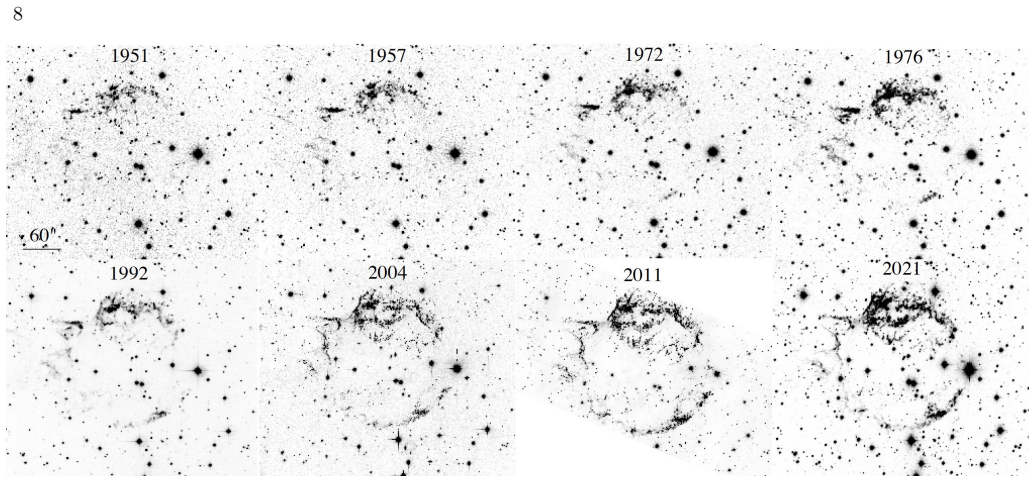
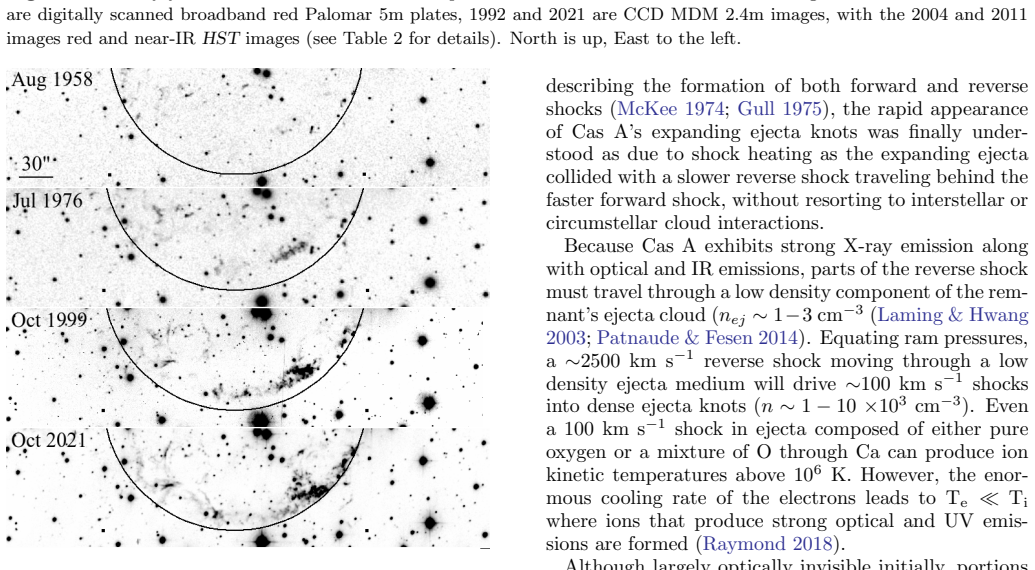
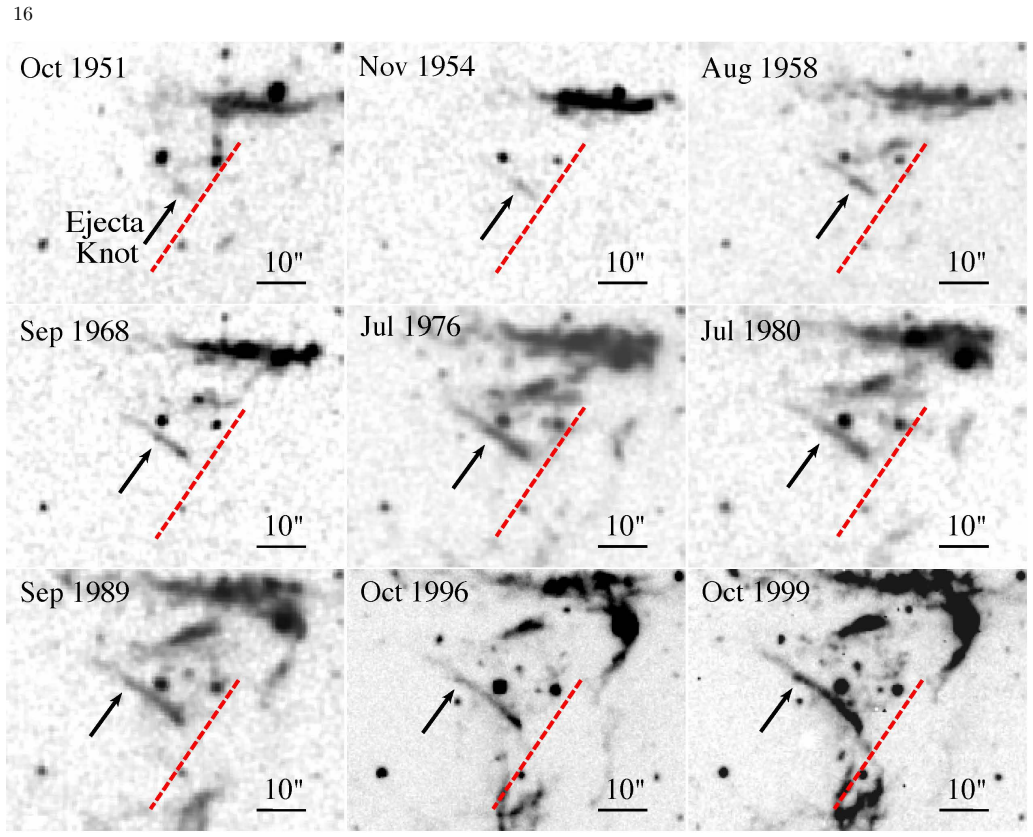
The central object is the base of newly brightened optical ejecta, especially the P1 northeast ejecta stream, whose starting point is identified as the reverse shock front. The method works by aligning multi-epoch HST and ground-based images in the expanding ejecta's rest frame and measuring the proper motion of newly appearing emission relative to outward-moving knots; subtracting the ejecta's sky-frame motion gives the reverse shock's velocity in the sky frame. The identification relies on the claim that optical ejecta become visible within about a year of shock passage, so the first brightening location approximates the shock front's position to sub-arcsecond precision.
What would settle it
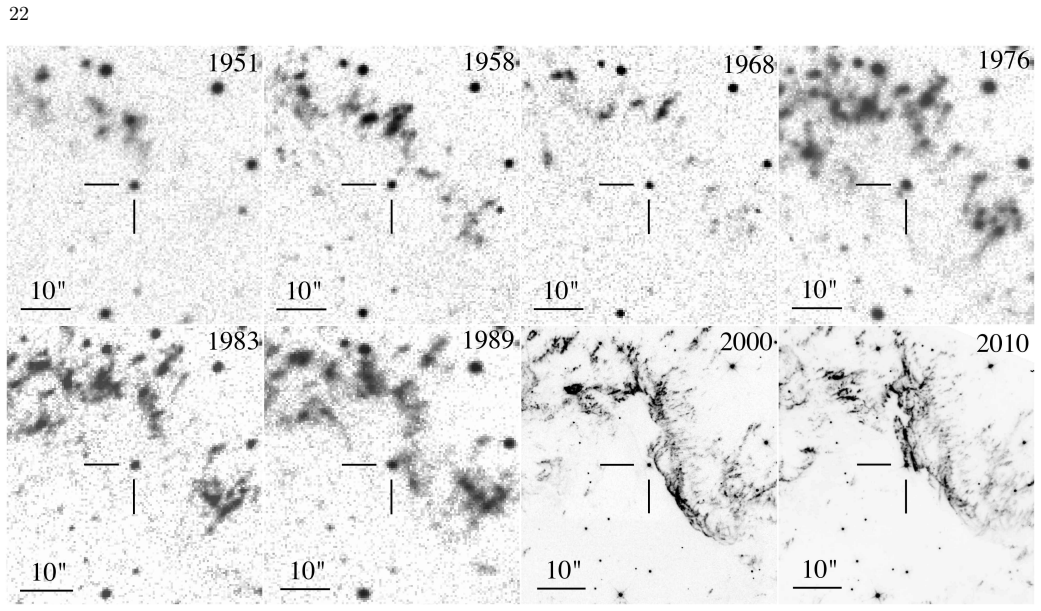
A high-cadence monitoring campaign that catches the same ejecta knot turn on in the optical within months, while independently locating the reverse shock front at that time from contemporaneous X-ray or radio images, would test whether the first-appearance base tracks the shock front; a measured delay of several years would shift the inferred reverse shock positions and velocities. A second check is re-measuring the P1 stream's base brightness across the 1951-1999 plates, since a varying base intensity would break the assumption of a constant, identifiable base location.
Extended reading notes
Core claim
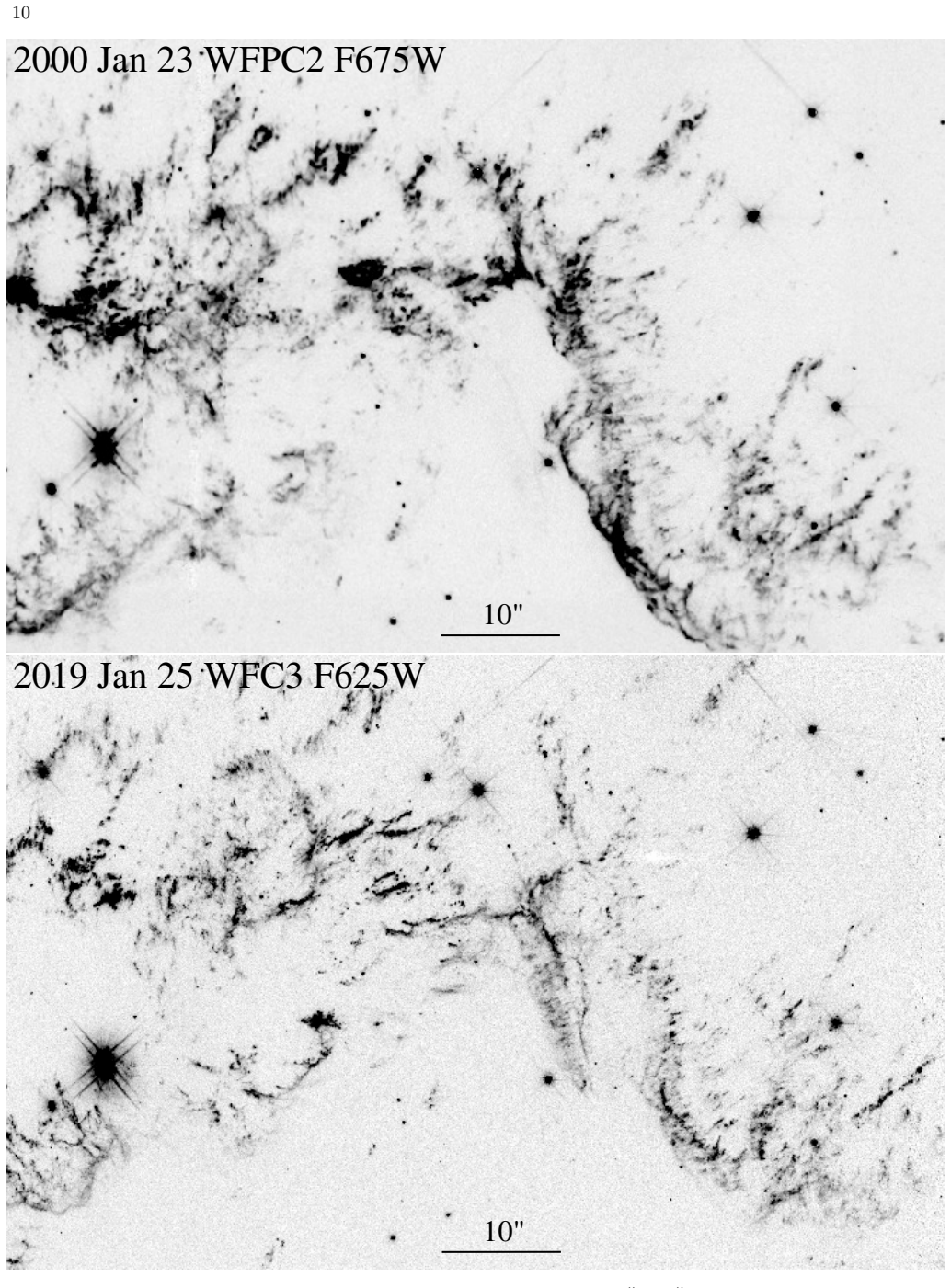
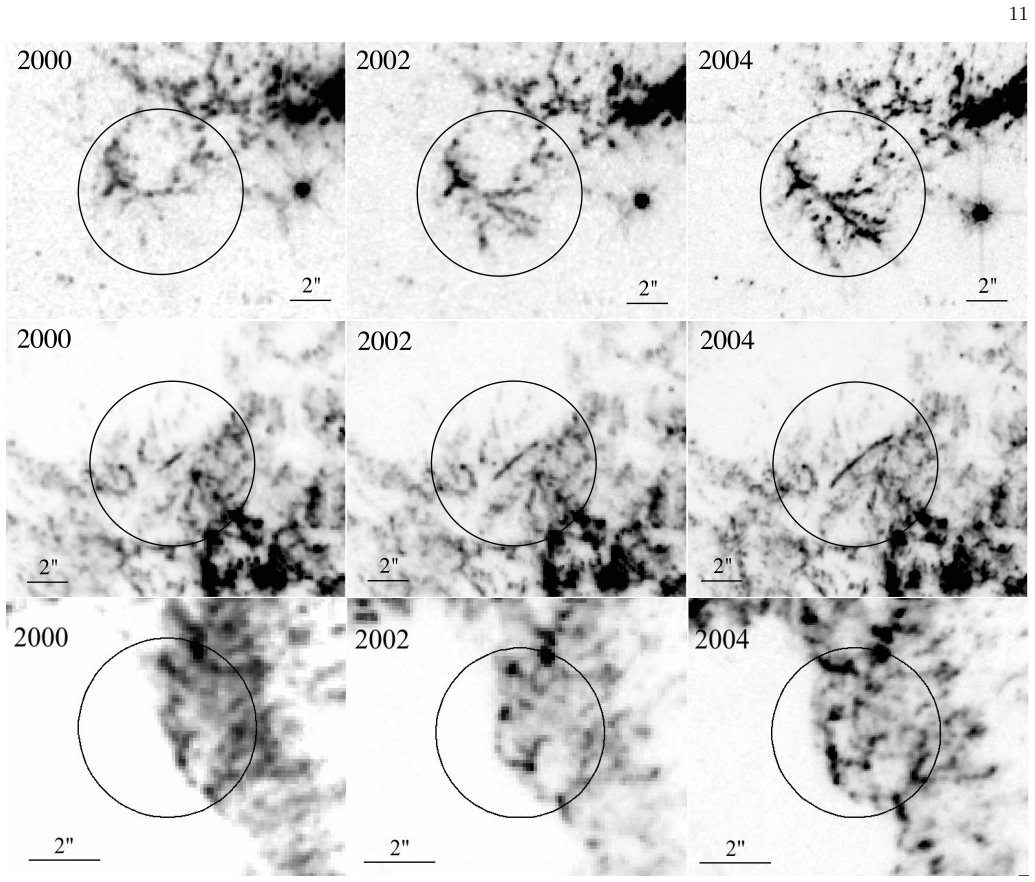
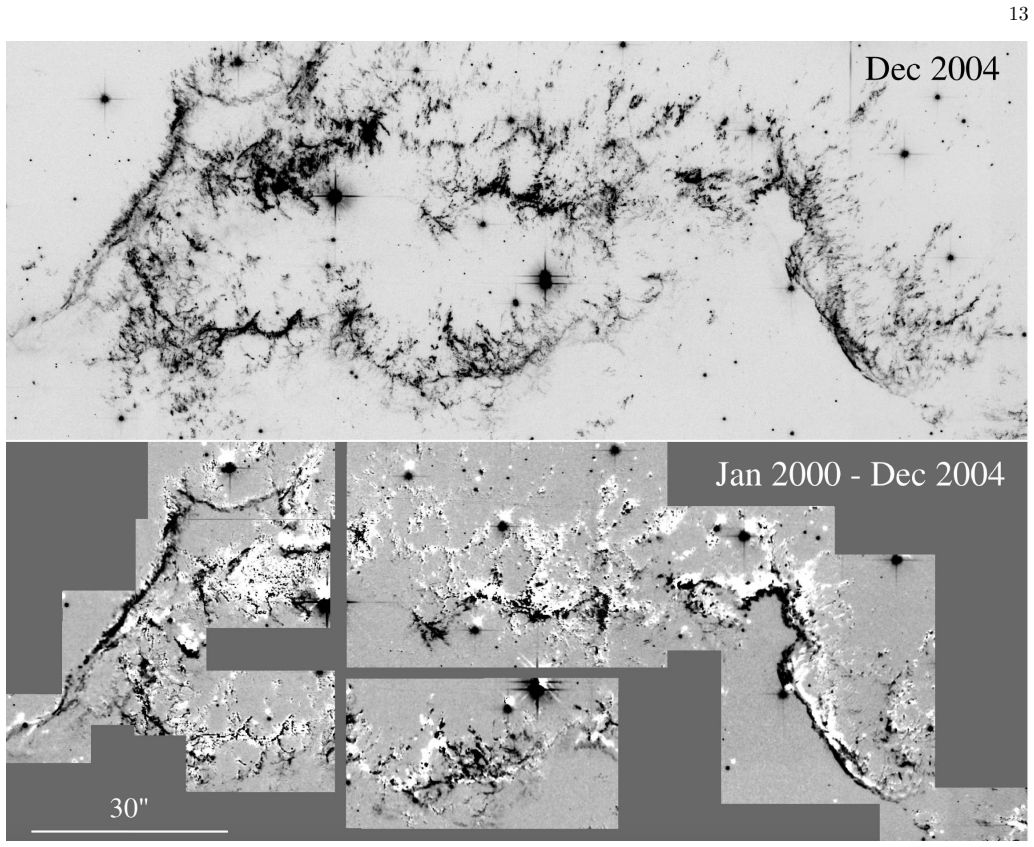
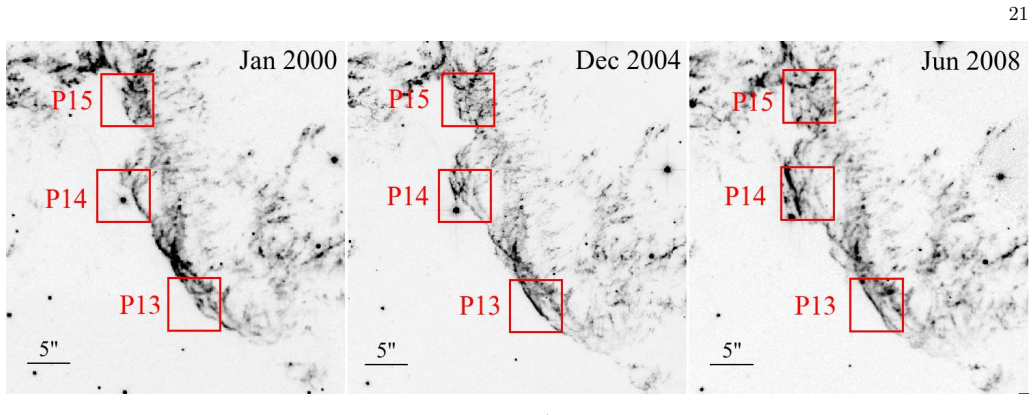
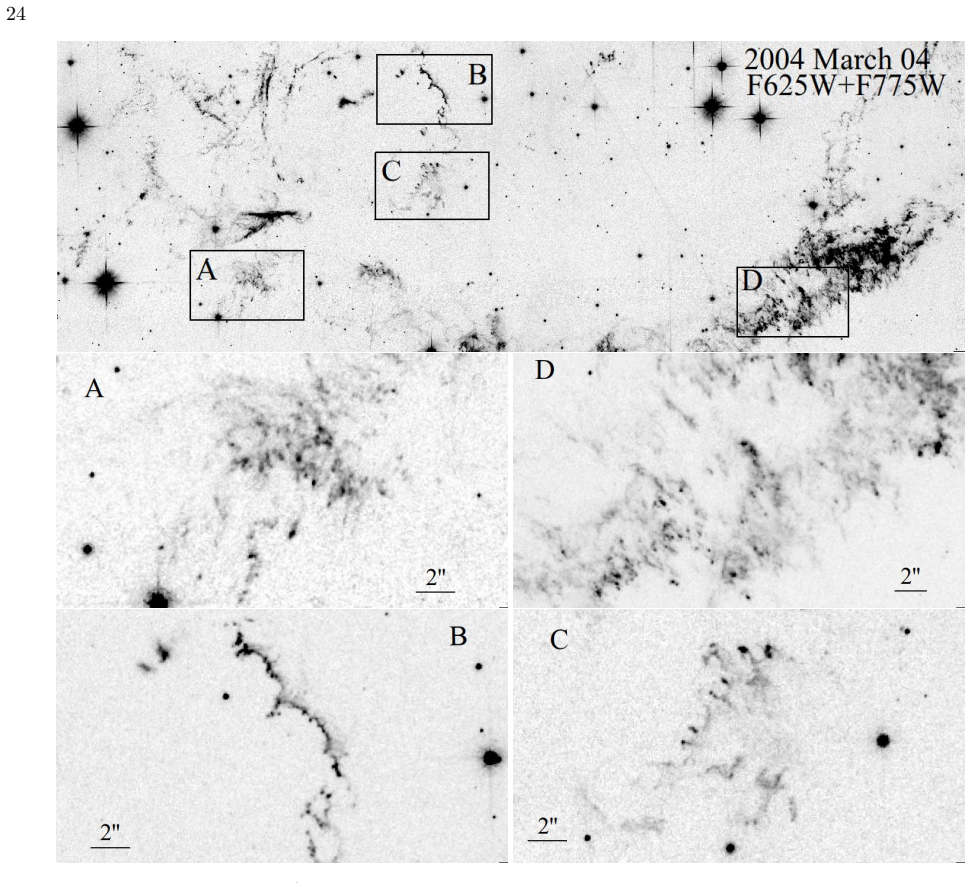
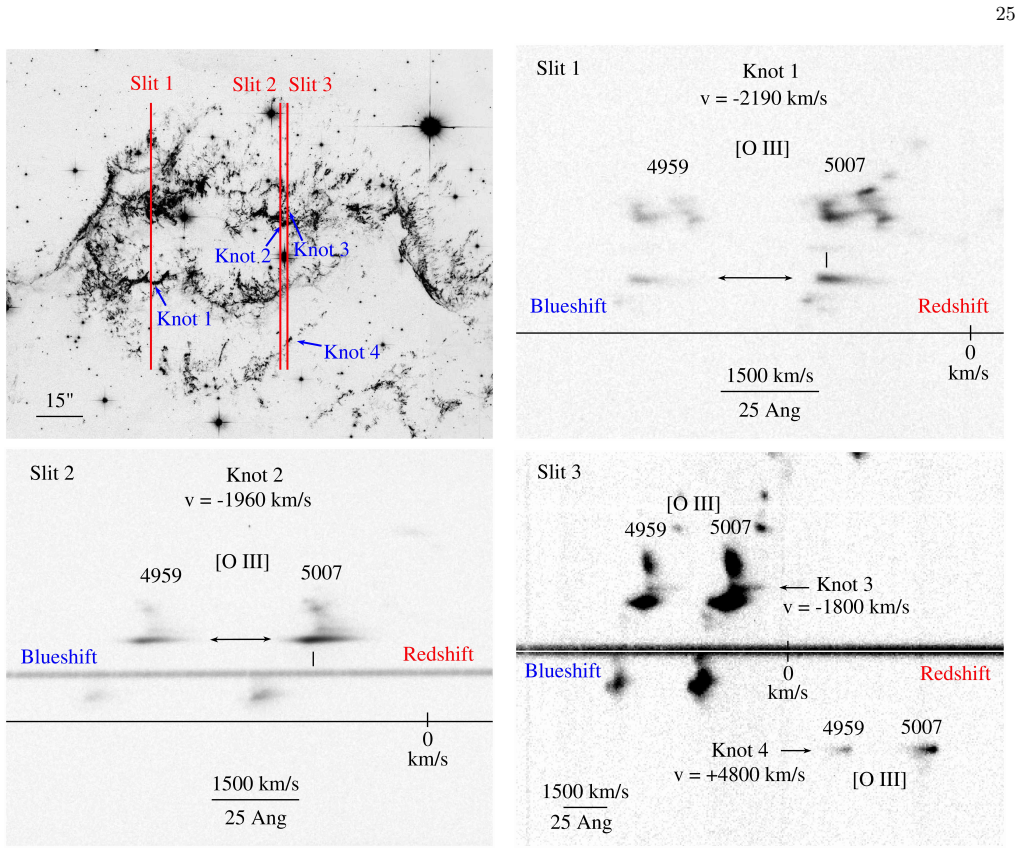
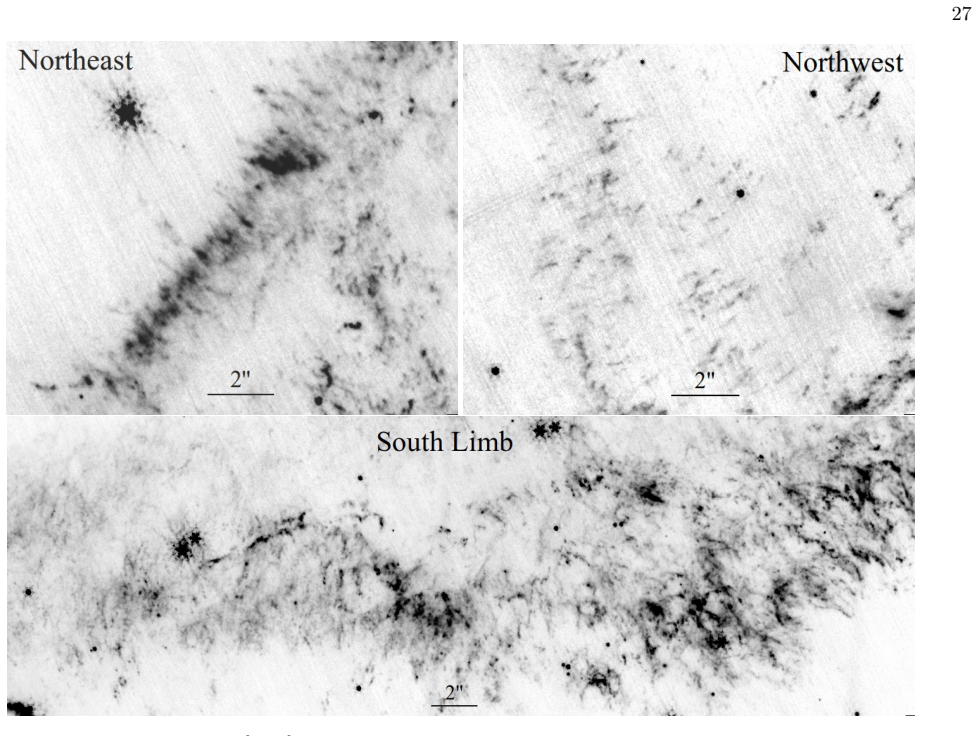
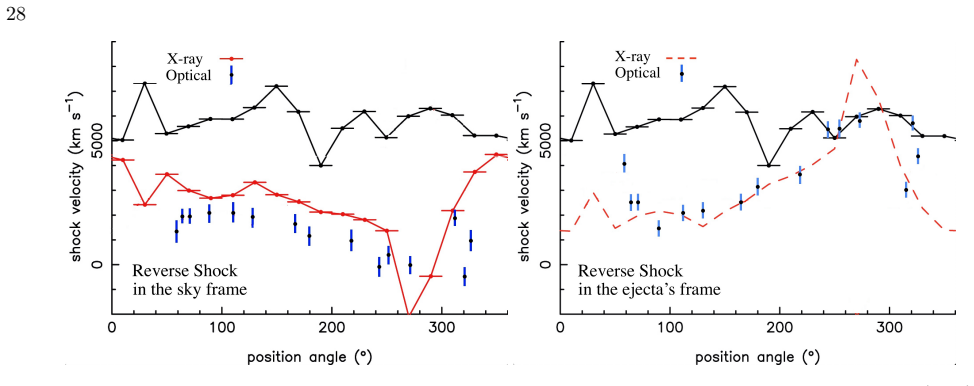
The paper's central claim is that the sequence of optical ejecta brightening, the appearance of freshly shocked knots at the base of expanding streams, tracks the reverse shock front, and that front moves outward in the observer's sky frame at typically 1000 to 2000 km/s across the main shell, not at the roughly 2000 to 4000 km/s speeds inferred from X-ray proper motions. At the western limb, the optical data show the front is close to stationary in the sky frame, with a best value near zero and no evidence for the roughly 1900 km/s inward motion reported from X-rays. The same measurements give outward tangential ejecta motions of 3500 to 6000 km/s, with slower values in the south, and post-shock knots display 0.2 to 0.5 arcsecond ablation tails whose low-density material is decelerated by up to about 1000 km/s while the dense cores stay close to free expansion with a deceleration parameter of 0.95 to 0.99.
Load-bearing premise
The measurement assumes that an ejecta knot's first brightening marks the reverse shock front's location at that epoch, with a brightening delay of roughly one year or less; if the delay is longer or a knot's internal density shifts where the brightening appears, the measured motion of the base is not the reverse shock's true velocity.
Editorial extensions
If this is right
- Most of Cas A's main shell experiences reverse shock speeds of 1000 to 2000 km/s in the sky frame, roughly 1000 km/s slower than recent X-ray values and below the 2000 to 4000 km/s speeds predicted by hydrodynamic models.
- Along the western limb the reverse shock is nearly stationary in the sky frame, so western ejecta still encounter it at a high relative speed of about 5500 to 5800 km/s because the ejecta themselves are moving outward fast, but there is no need for an inward-plunging shock.
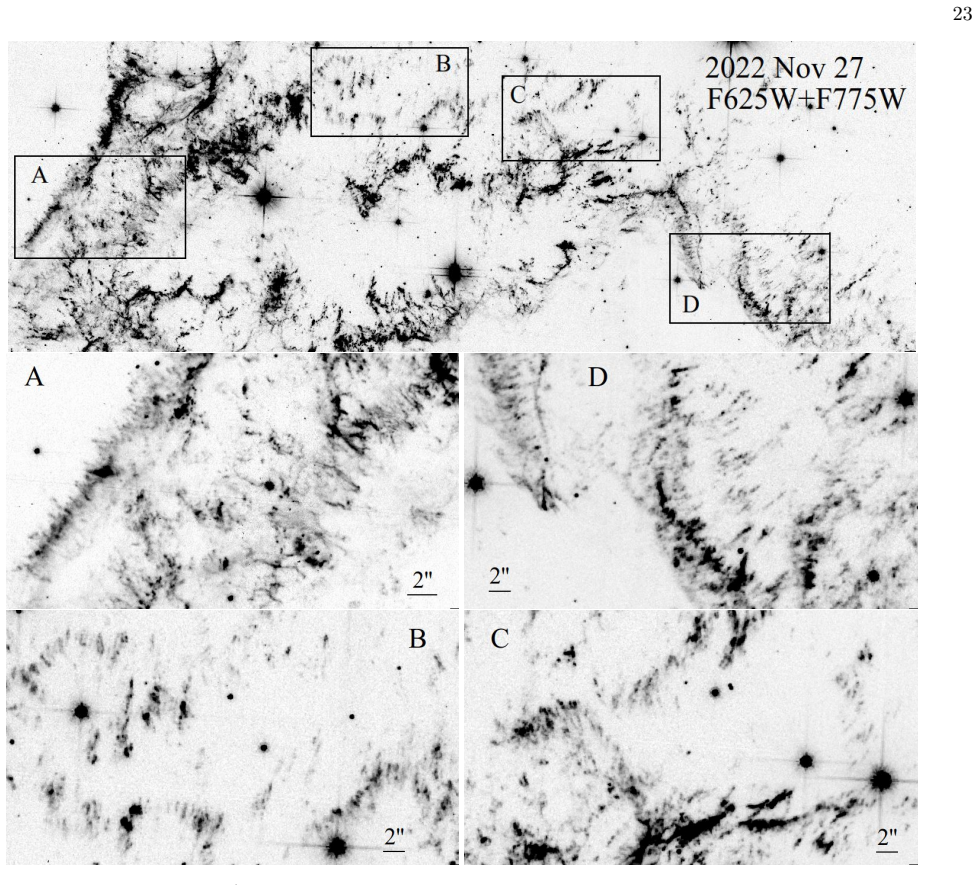
- Ejecta knots are not strongly decelerated as a whole: dense cores keep a deceleration parameter of 0.95 to 0.99, near free expansion, while lower-density ablated material is decelerated by up to about 1000 km/s and appears as trailing tails in lines such as [O III] and [S III].
- Slower southern ejecta motions of 3500 to 5000 km/s may explain why Cas A's southern rim is fainter and evolves more slowly than the north, where speeds reach 5500 to 6000 km/s.
Reading between the lines
- Inference: if the roughly one-year brightening delay is correct, aligned X-ray and optical images taken at the same epoch should show the optical turn-on front at a slightly smaller radius than the X-ray reverse shock shell, with an offset equal to ejecta speed times the delay; measuring that offset would directly test the identification.
- Inference: the lack of unusually high-ionization optical lines in western ejecta, despite the high relative shock speeds implied by the X-ray inward motion, suggests the western X-ray synchrotron filaments may need an explanation other than a fast inward reverse shock, such as a distorted or projected shock front.
- Inference: because dense knot cores decelerate so little, most ejecta mass may continue in nearly free expansion while only low-density envelopes are stripped; distinguishing these two components could refine models of dust destruction and metal mixing into the surrounding medium.
Editorial analysis
A structured set of objections, weighed in public.
Referee Report
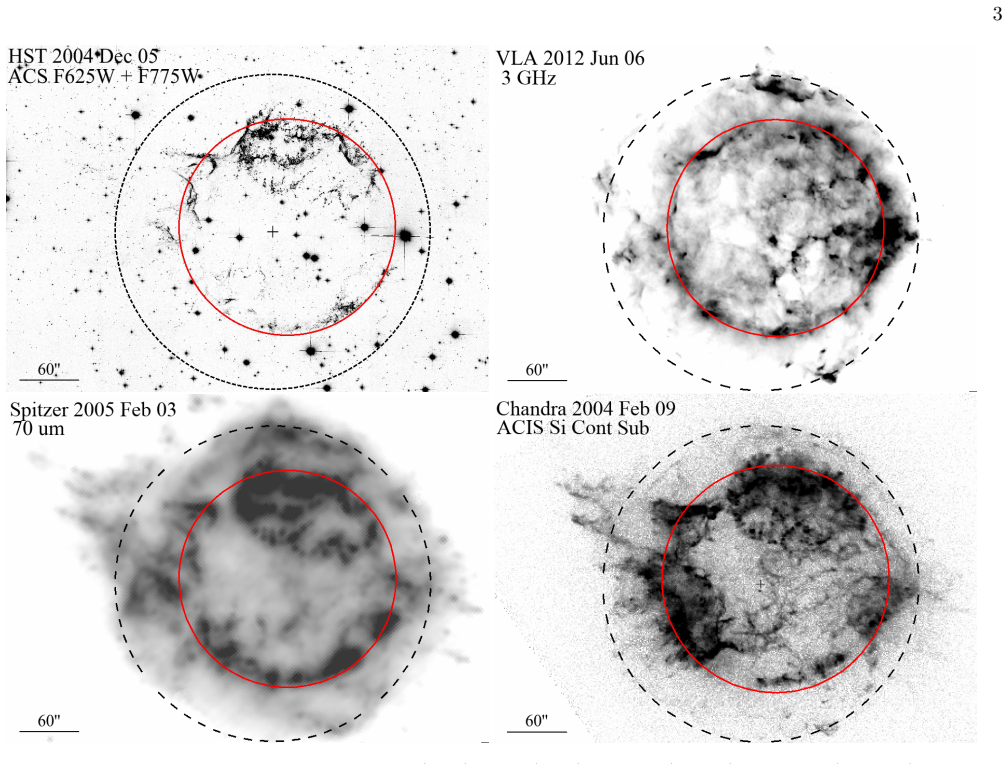
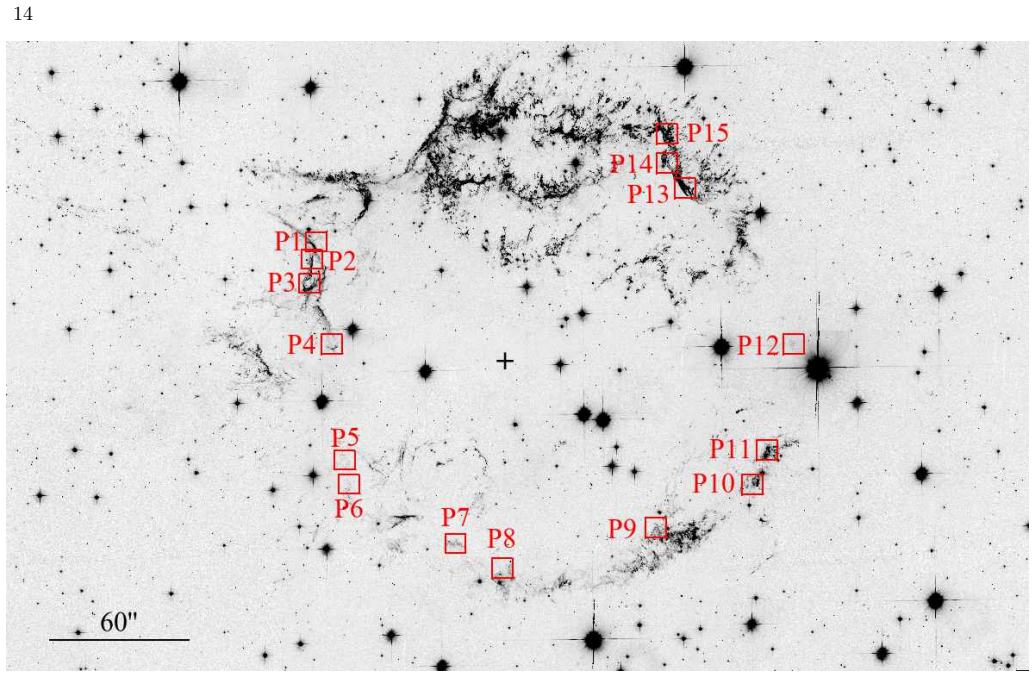
Summary. This paper uses optical and near-infrared images of Cassiopeia A spanning 1951–2022, together with optical spectra, to measure the motion of the reverse shock through the remnant's main shell. The authors identify the sequential brightening of ejecta knots with the advancement of the reverse shock in the ejecta frame, and from the difference between this and the measured ejecta proper motions they derive sky-frame reverse shock velocities at 15 positions. They report typical reverse shock velocities of 1000–2000 km/s, about 1000 km/s lower than recent X-ray estimates, and a nearly stationary or only slowly moving reverse shock along the western limb, contradicting the inward motion of ~1900 km/s reported by Vink et al. (2022). They also present HST and JWST images showing ablated ejecta tails and spectroscopic evidence for ~500–1000 km/s deceleration of ablated material.
Significance. If the central velocity claim holds, the paper provides an important optical anchor for the reverse shock velocity in Cas A and sharpens the discrepancy between optical and X-ray measurements, with implications for the western limb's synchrotron emission and for reverse shock models. The paper's strengths include the assembly of a unique multi-epoch dataset, including digitized Palomar plates, HST, and JWST images, and the explicit public archiving of the digitized plates. The measurements are reported with error bars and with candid discussion of difficult regions, which is commendable. However, the headline result rests on an uncalibrated assumption about the brightening delay of main-shell ejecta after reverse shock passage, and on several positions that the authors themselves describe as 'seriously subjective.' These issues do not invalidate the dataset but they are load-bearing for the paper's main claim, and they need to be addressed before the velocity numbers can be taken at face value.
major comments (4)
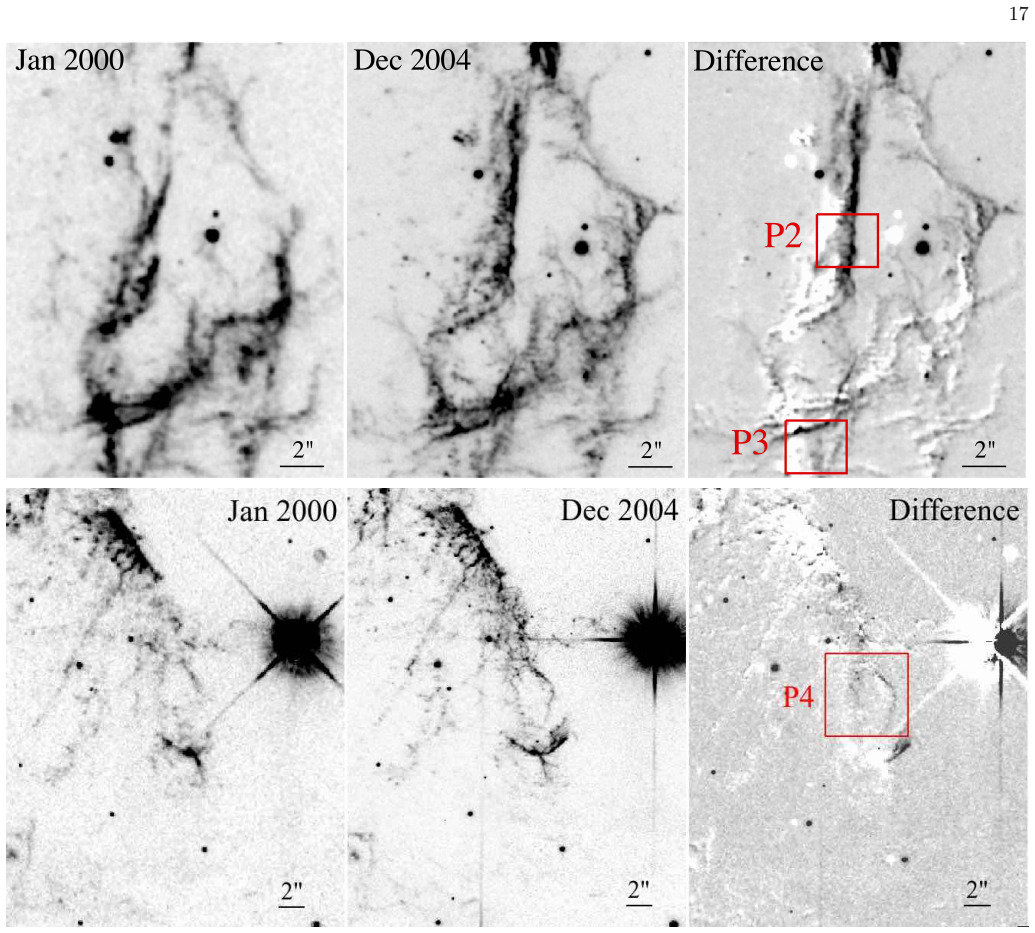
- [§3.2.3 and Table 5] The identification of the first appearance of optical emission with the reverse shock location at that epoch assumes that the brightening delay τ is about one year or less for main-shell O/S/Ar/Ca ejecta. The only quantitative constraint cited, the <9-month turn-on of outer [N II] knots (Fesen et al. 2011), is explicitly acknowledged to come from chemically and dynamically distinct ejecta. The paper gives no observational or modeling constraint on τ for the main-shell knots, and the quoted 10–20 yr shock-crossing time for 0.1" knots at 100 km/s suggests that the cooling/ionization front may take substantially longer than one year to brighten. If τ ≈ 5–10 yr, then the proper motion measured in the ejecta frame (Table 5, column 7) tracks the brightening front rather than the reverse shock, and the sky-frame velocities in column 9 are biased; for V_RS ~1500 km/s and τ = 5 yr the offset is ~0.5", comparable to the reported advances. The paper should quantify this systematic error, for example by treating τ as a free parameter and plotting V_RS(τ), or by using radiative-shock models for main-shell densities. Without such an analysis, the headline '1000–2000 km/s' is conditional on an unverified assumption.
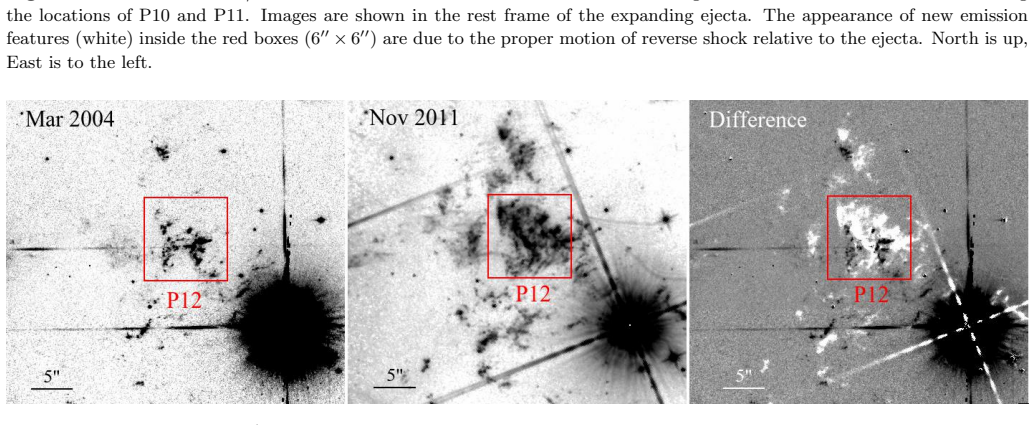
- [§4.7, Abstract, and Conclusions] The text in §4.7 states that the P12 measurement is 'not sufficient to firmly reject a value as large as ≈0.41″' (the value attributed to Vink et al. 2022), yet the abstract asserts 'we do not find the reverse shock to move inward at velocities as large as ~2000 km/s as has been reported' and conclusion (2) says 'we do not find evidence for high velocity inward reverse shock motions.' These statements are stronger than the measurement supports. In addition, the quoted '≈0.41″' is inconsistent with the Vink et al. (2022) value listed in Table 3 (−0.1167″/yr; −1880 km/s), and the source of 0.41″ should be clarified. The abstract and conclusions should be brought into line with the actual uncertainty, for example by stating that the optical western-limb data are consistent with a nearly stationary reverse shock but cannot exclude the Vink et al. inward value at high significance.
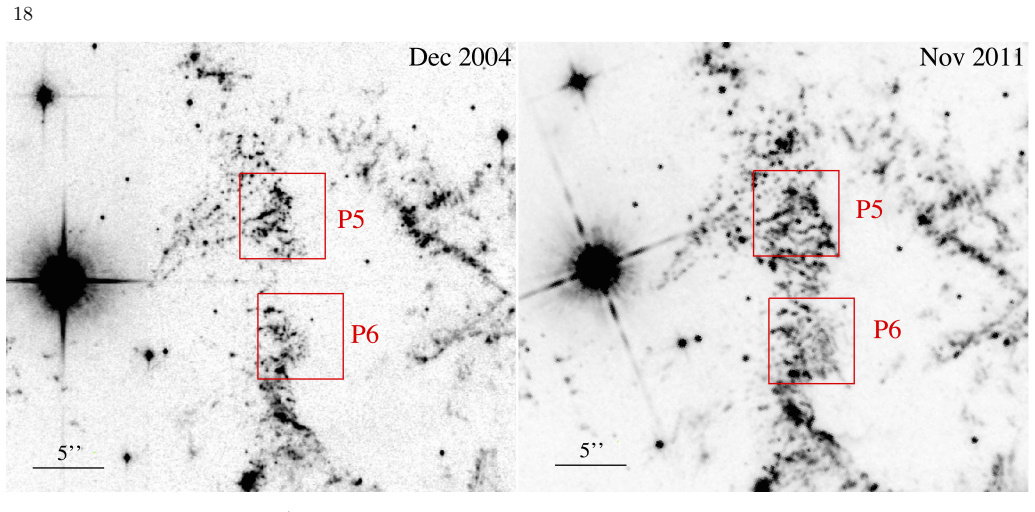
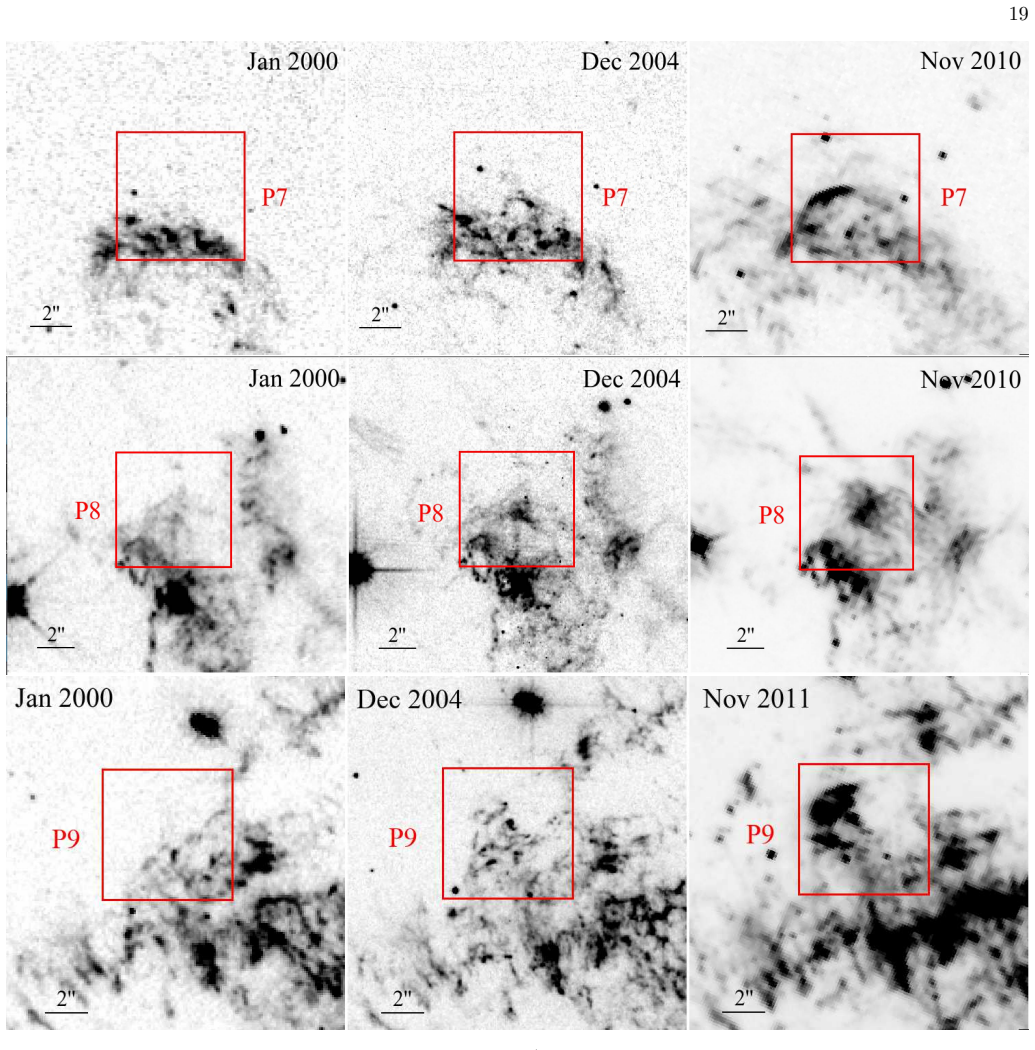
- [§4.5 and Table 5] The reverse shock velocities at P7, P8, and P9 are described as 'seriously subjective' and 'particularly challenging,' yet these three points carry some of the lowest sky-frame velocities in Table 5 (1020–1460 km/s) and are central to the claim that southern ejecta experience slower reverse shock velocities. A robustness check that recomputes the headline velocity range after removing or downweighting these three subjective positions should be presented; if the 1000–2000 km/s claim depends on them, the text should say so explicitly. As written, the summary statement 'typically 1000–2000 km/s over most of the remnant' is partly supported by measurements that the authors themselves caution should be taken with caution.
- [§4.1] The P1 measurement assumes that the intensity of the streak's base did not vary significantly over the nearly 50-year baseline, and that the base marks the reverse shock location. The authors note that after 1980 the base shifts southward as the stream loses its radial orientation; this raises the possibility that the apparent base motion of 0.078″/yr is at least partly a geometric effect of viewing a delayed brightening front rather than a clean reverse shock motion. The 1951–1999 Palomar data are a unique resource, but the constant-intensity assumption should be tested, e.g., by measuring the base position with a more explicit model of the stream orientation and by comparing the base motion to the motion of the brightening front in more recent epochs.
minor comments (5)
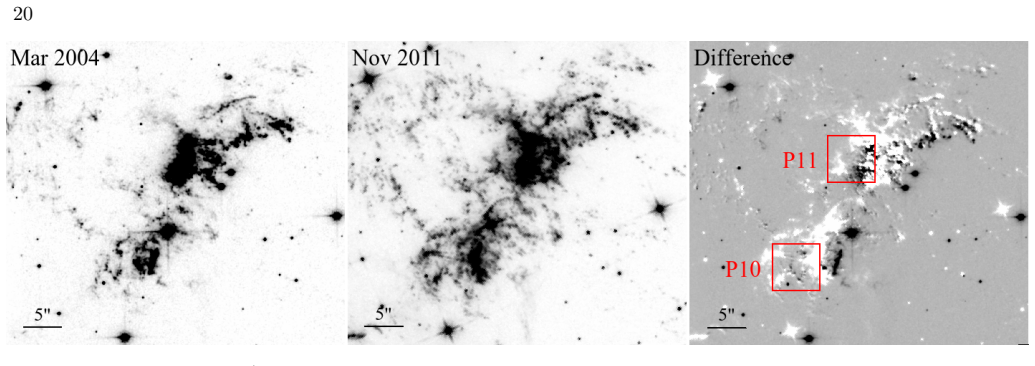
- [§4.6] The sentence 'this gave consistent results across both P10 and P10 regions' should read 'P10 and P11 regions.'
- [§4.7] The phrase 'transverse velocity ∼1000' is missing units; it should read '∼1000 km/s' (or '−1000 km/s') when referring to Vink et al.'s western-limb reverse shock motion.
- [Figure 2 caption] The caption refers to 'Table 2 for details' but the observation log is in Table 4; please update the cross-reference.
- [§3.2.2] The phrase 'creating a discontinuous brightening process at times for even for seemingly adjacent ejecta knots' contains a doubled 'for'; please reword.
- [§2.1] The sentence 'Multi-passband HST images of Cas A were obtained at several epochs using the Wide Field Planetary Camera 2 (WFPC2) starting in 1999 and ending in 2008' is grammatically awkward; consider revising for clarity.
Circularity Check
No significant circularity: the reverse-shock velocities are derived from measured proper motions, not from fitted parameters or self-referential definitions.
full rationale
The paper's central claim is an observational measurement, not a derivation from a fitted model. The reverse-shock sky-frame velocities in Table 5 are computed as the difference between measured ejecta proper motions and measured brightening-front proper motions in the ejecta frame (V_RS^sky = V_ejecta^sky - V_RS^ejecta), which is a kinematic identity, not a circular reduction. The identification of newly brightened optical emission with the reverse-shock front involves a physical assumption that the post-shock brightening delay is about one year; the paper states this delay is 'not firmly established observationally' and is 'likely a function of knot density and reverse shock velocity' (Section 3.2.3). That is a systematic-uncertainty concern, but it is not an input that is later renamed as the output. No fitted parameter is presented as a prediction. Self-citations (e.g., Milisavljevic & Fesen 2013 radial-velocity catalog, Morse et al. 2004, Fesen et al. 2011) are used as reference data or comparison points; the paper explicitly notes that the outer [N II] knots with sub-9-month turn-on are chemically distinct from main-shell O/S/Ar/Ca ejecta, so that citation is not quietly importing the central assumption. No uniqueness theorem or ansatz is smuggled in via citation, and the disagreement with Vink et al. (2022) rests on independent optical proper motions, not on the authors' own prior result.
Assumptions & free parameters
assumptions (5)
- domain assumption Distance to Cas A is 3.4 kpc.
- domain assumption The center of expansion and explosion epoch are as determined by Thorstensen et al. (2001).
- domain assumption Optical brightening of ejecta follows reverse shock passage within about one year.
- domain assumption Radial velocities from Milisavljevic & Fesen (2013) are accurate for the measured knots.
- ad hoc to paper The base of the P1 ejecta stream marks the reverse shock and its intensity remained stable over 50 years.
Cite this review
Pith. "Pith review of Cassiopeia A's Reverse Shock and its Effects on the Expanding SN Ejecta." pith.science (2026). https://pith.science/paper/3BFBBDVU
@misc{pith2026250107708,
  author       = {Pith},
  title        = {Pith review of: Cassiopeia A's Reverse Shock and its Effects on the Expanding SN Ejecta},
  year         = {2026},
  howpublished = {\url{https://pith.science/paper/3BFBBDVU}},
  note         = {Machine review of arXiv:2501.07708}
}
read the original abstract
Using optical and near-infrared images of the Cassiopeia A (Cas A) supernova remnant covering the time period 1951 to 2022, together with optical spectra of selected filaments, we present an investigation of Cas A's reverse shock velocity and the effects it has on the remnant's metal-rich ejecta. We find the sequence of optical ejecta brightening and the appearance of new optical ejecta indicating the advancement of the remnant's reverse shock in the remnant's main shell has velocities typically between 1000 and 2000 km/s, which is ~1000 km/s less than recent measurements made in X-rays. We further find the reverse shock appears to move much more slowly and is nearly even stationary in the sky frame along the remnant's western limb. However, we do not find the reverse shock to move inward at velocities as large as ~2000 km/s as has been reported. Optical ejecta in Cas A's main emission shell have proper motions indicating outward tangential motions ~3500 - 6000 km/s, with the smaller values preferentially along the remnant's southern regions which we speculate may be partially the cause of the remnant's faint and more slowly evolving southern sections. Following interaction with the reverse shock, ejecta knots exhibit extended mass ablated trails 0.2" - 0.5" in length leading to extended emission indicating reverse shock induced decelerated velocities as large as 1000 km/s. Such ablated material is most prominently seen in higher ionization line emissions, whereas denser parts of ejecta knots show surprisingly little deceleration.
Figures
Figures from the paper (17 more)
Reference graph
Works this paper leans on
-
[1]
, " * write output.state after.block = add.period write newline
ENTRY address archivePrefix author booktitle chapter doi edition editor eprint howpublished institution journal key month number organization pages publisher school series title misctitle type volume year version url label extra.label sort.label short.list INTEGERS output.state before.all mid.sentence after.sentence after.block FUNCTION init.state.consts ...
-
[2]
write newline
" write newline "" before.all 'output.state := FUNCTION format.url url empty "" new.block "" url * "" * if FUNCTION format.eprint eprint empty "" archivePrefix empty "" archivePrefix "arXiv" = new.block " " eprint * " " * new.block " " eprint * " " * if if if FUNCTION format.doi doi empty "" " " doi * " " * if FUNCTION format.pid doi empty eprint empty ur...
-
[3]
,# (7),01444 '9=82<.342C 2! !22222222222222222222222222222222222222222222222222
thebibliography [1] 20pt to REFERENCES 6pt =0pt 10pt plus 3pt =0pt =0pt =1pt plus 1pt =0pt =0pt -12pt =13pt plus 1pt =20pt =13pt plus 1pt \@M =10000 =-1.0em =0pt =0pt 0pt =0pt =1.0em @enumiv\@empty 10000 10000 `\.\@m \@noitemerr \@latex@warning Empty `thebibliography' environment \@ifnextchar \@reference \@latexerr Missing key on reference command Each re...
2019
-
[4]
2014, , 441, 2996, 10.1093/mnras/stu774
Alarie , A., Bilodeau , A., & Drissen , L. 2014, , 441, 2996, 10.1093/mnras/stu774
-
[5]
Anderson , M. C., & Rudnick , L. 1995, , 441, 307, 10.1086/175357
-
[6]
2018, , 612, A110, 10.1051/0004-6361/201732411
Arias , M., Vink , J., de Gasperin , F., et al. 2018, , 612, A110, 10.1051/0004-6361/201732411
-
[7]
1954, , 119, 206, 10.1086/145812
Baade , W., & Minkowski , R. 1954, , 119, 206, 10.1086/145812
doi:10.1086/145812 1954
-
[8]
Besel , M. A., & Krause , O. 2012, , 541, L3, 10.1051/0004-6361/201219082
Show all 126 references
-
[9]
R., Bohlin , R
Boffi , F. R., Bohlin , R. C., McLean , D. F., & Pavlovsky , C. M. 2003, Baseline Tests for the Advanced Camera for Surveys Astronomer's Proposal Tool Exposure Time Calculator , Instrument Science Report ACS 2003-008
2003
-
[10]
Chevalier , R. A. 1977, , 15, 175, 10.1146/annurev.aa.15.090177.001135
1977
- [11]
- [12]
- [13]
- [14]
-
[15]
2024, , 976, L4, 10.3847/2041-8213/ad855d
De Looze , I., Milisavljevic , D., Temim , T., et al. 2024, , 976, L4, 10.3847/2041-8213/ad855d
2024 doi
-
[16]
2003, , 589, 818, 10.1086/374813
DeLaney , T., & Rudnick , L. 2003, , 589, 818, 10.1086/374813
2003 doi
-
[17]
D., et al
DeLaney , T., Rudnick , L., Stage , M. D., et al. 2010, , 725, 2038, 10.1088/0004-637X/725/2/2038
2010 doi
-
[18]
Fesen , R. A. 2001, , 133, 161, 10.1086/319181
2001 doi
-
[19]
A., Becker , R
Fesen , R. A., Becker , R. H., & Blair , W. P. 1987, , 313, 378, 10.1086/164974
1987 doi
-
[20]
A., Becker , R
Fesen , R. A., Becker , R. H., & Goodrich , R. W. 1988, , 329, L89, 10.1086/185183
1988 doi
-
[21]
A., & Milisavljevic , D
Fesen , R. A., & Milisavljevic , D. 2016, , 818, 17, 10.3847/0004-637X/818/1/17
2016 doi
-
[22]
A., Morse , J
Fesen , R. A., Morse , J. A., Chevalier , R. A., et al. 2001, , 122, 2644, 10.1086/323539
2001 doi
-
[23]
A., Zastrow , J
Fesen , R. A., Zastrow , J. A., Hammell , M. C., Shull , J. M., & Silvia , D. W. 2011, , 736, 109, 10.1088/0004-637X/736/2/109
2011 doi
-
[24]
A., Hammell , M
Fesen , R. A., Hammell , M. C., Morse , J., et al. 2006 a , , 645, 283, 10.1086/504254
2006 doi
- [25]
-
[26]
C., Bartko , F., Bely , P
Ford , H. C., Bartko , F., Bely , P. Y., et al. 1998, in Society of Photo-Optical Instrumentation Engineers (SPIE) Conference Series, Vol. 3356, Space Telescopes and Instruments V, ed. P. Y. Bely & J. B. Breckinridge , 234--248, 10.1117/12.324464
1998 doi
-
[27]
1991, , 367, 619, 10.1086/169657
Fryxell , B., Mueller , E., & Arnett , D. 1991, , 367, 619, 10.1086/169657
1991 doi
-
[28]
V., Koralesky , B., Rudnick , L., et al
Gotthelf , E. V., Koralesky , B., Rudnick , L., et al. 2001, , 552, L39, 10.1086/320250
2001 doi
-
[29]
Gull , S. F. 1975, , 171, 263, 10.1093/mnras/171.2.263
1975 doi
- [30]
-
[31]
J., Janka , H
Hammer , N. J., Janka , H. T., & M \"u ller , E. 2010, , 714, 1371, 10.1088/0004-637X/714/2/1371
2010 doi
-
[32]
C., Frank , A., Hartigan , P., & Lebedev , S
Hansen , E. C., Frank , A., Hartigan , P., & Lebedev , S. V. 2017, , 837, 143, 10.3847/1538-4357/aa5ca8
2017 doi
- [33]
- [34]
-
[35]
A., & Auchettl , K
Holland-Ashford , T., Lopez , L. A., & Auchettl , K. 2020, , 889, 144, 10.3847/1538-4357/ab64e4
2020 doi
-
[36]
Hughes , J. P. 2000, , 545, L53, 10.1086/317337
2000 doi
- [37]
- [38]
-
[39]
Hwang , U., & Laming , J. M. 2012, , 746, 130, 10.1088/0004-637X/746/2/130
2012 doi
-
[40]
A., & Mandel , E
Joye , W. A., & Mandel , E. 2003, in Astronomical Society of the Pacific Conference Series, Vol. 295, Astronomical Data Analysis Software and Systems XII, ed. H. E. Payne , R. I. Jedrzejewski , & R. N. Hook , 489
2003
-
[41]
1976 a , , 51, 236
Kamper , K., & van den Bergh , S. 1976 a , , 51, 236
1976
- [42]
-
[43]
2018, , 856, 18, 10.3847/1538-4357/aab092
Katsuda , S., Morii , M., Janka , H.-T., et al. 2018, , 856, 18, 10.3847/1538-4357/aab092
2018 doi
-
[44]
E., Do , T., de Mink , S
Kerzendorf , W. E., Do , T., de Mink , S. E., et al. 2019, , 623, A34, 10.1051/0004-6361/201732206
2019 doi
-
[45]
T., & M \"u ller , E
Kifonidis , K., Plewa , T., Janka , H. T., & M \"u ller , E. 2003, , 408, 621, 10.1051/0004-6361:20030863
2003 doi
-
[46]
S., De Looze , I., et al
Kirchschlager , F., Sartorio , N. S., De Looze , I., et al. 2024, , 528, 5364, 10.1093/mnras/stae365
2024 doi
-
[47]
D., Barlow , M
Kirchschlager , F., Schmidt , F. D., Barlow , M. J., De Looze , I., & Sartorio , N. S. 2023, , 520, 5042, 10.1093/mnras/stad290
2023 doi
-
[48]
D., Barlow , M
Kirchschlager , F., Schmidt , F. D., Barlow , M. J., et al. 2019, , 489, 4465, 10.1093/mnras/stz2399
2019 doi
-
[49]
I., McKee , C
Klein , R. I., McKee , C. F., & Colella , P. 1994, , 420, 213, 10.1086/173554
1994 doi
-
[50]
2018, , 866, 139, 10.3847/1538-4357/aae20e
Koo , B.-C., Kim , H.-J., Lee , Y.-H., et al. 2018, , 866, 139, 10.3847/1538-4357/aae20e
2018 doi
-
[51]
V., & Keohane , J
Koralesky , B., Rudnick , L., Gotthelf , E. V., & Keohane , J. W. 1998, , 505, L27, 10.1086/311604
1998 doi
-
[52]
M., Usuda , T., et al
Krause , O., Birkmann , S. M., Usuda , T., et al. 2008, Science, 320, 1195, 10.1126/science.1155788
2008 doi
- [53]
-
[54]
Latham , D. W. 1974, Methods of Experimental Physics, 12, 221, 10.1016/S0076-695X(08)60497-4
1974 doi
-
[55]
S., MacAlpine , G
Lawrence , S. S., MacAlpine , G. M., Uomoto , A., et al. 1995, , 109, 2635, 10.1086/117477
1995 doi
-
[56]
2010, , 140, 1062, 10.1088/0004-6256/140/4/1062
Laycock , S., Tang , S., Grindlay , J., et al. 2010, , 140, 1062, 10.1088/0004-6256/140/4/1062
2010 doi
-
[57]
P., & Slane , P
Lee , J.-J., Park , S., Hughes , J. P., & Slane , P. O. 2014, , 789, 7, 10.1088/0004-637X/789/1/7
2014 doi
-
[58]
F., Klein , R
Mac Low , M.-M., McKee , C. F., Klein , R. I., Stone , J. M., & Norman , M. L. 1994, , 433, 757, 10.1086/174685
1994 doi
- [59]
-
[60]
McKee , C. F. 1974, , 188, 335, 10.1086/152721
1974 doi
-
[61]
F., & Truelove , J
McKee , C. F., & Truelove , J. K. 1995, , 256, 157, 10.1016/0370-1573(94)00106-D
1995 doi
-
[62]
D., & R \"o ttgering , H
Mellema , G., Kurk , J. D., & R \"o ttgering , H. J. A. 2002, , 395, L13, 10.1051/0004-6361:20021408
2002 doi
-
[63]
R., Dwek , E., & Slavin , J
Micelotta , E. R., Dwek , E., & Slavin , J. D. 2016, , 590, A65, 10.1051/0004-6361/201527350
2016 doi
-
[64]
Milisavljevic , D., & Fesen , R. A. 2013, , 772, 134, 10.1088/0004-637X/772/2/134
2013 doi
-
[65]
2015, Science, 347, 526, 10.1126/science.1261949
---. 2015, Science, 347, 526, 10.1126/science.1261949
2015 doi
-
[66]
2024, , 965, L27, 10.3847/2041-8213/ad324b
Milisavljevic , D., Temim , T., De Looze , I., et al. 2024, , 965, L27, 10.3847/2041-8213/ad324b
2024 doi
-
[67]
1959, in URSI Symp
Minkowski , R. 1959, in URSI Symp. 1: Paris Symposium on Radio Astronomy, ed. R. N. Bracewell , Vol. 9, 315
1959
-
[68]
1964, Annual Review of Astronomy and Astrophysics, 2, 247, 10.1146/annurev.aa.02.090164.001335
Minkowski , R. 1964, Annual Review of Astronomy and Astrophysics, 2, 247, 10.1146/annurev.aa.02.090164.001335
1964
- [69]
-
[70]
1968, Nonthermal Galactic Radio Sources , ed
---. 1968, Nonthermal Galactic Radio Sources , ed. B. M. Middlehurst & L. H. Aller , 623
1968
-
[71]
Minkowski , R., & Aller , L. H. 1954, , 119, 232, 10.1086/145814
1954 doi
-
[72]
A., Fesen , R
Morse , J. A., Fesen , R. A., Chevalier , R. A., et al. 2004, , 614, 727, 10.1086/423709
2004 doi
-
[73]
1991, , 251, 505
Mueller , E., Fryxell , B., & Arnett , D. 1991, , 251, 505
1991
-
[74]
Nagasawa , M., Nakamura , T., & Miyama , S. M. 1988, , 40, 691
1988
- [75]
-
[76]
L., & Bocchino , F
Orlando , S., Miceli , M., Pumo , M. L., & Bocchino , F. 2016, , 822, 22, 10.3847/0004-637X/822/1/22
2016 doi
-
[77]
T., et al
Orlando , S., Wongwathanarat , A., Janka , H. T., et al. 2021, , 645, A66, 10.1051/0004-6361/202039335
2021 doi
-
[78]
2022, , 666, A2, 10.1051/0004-6361/202243258
---. 2022, , 666, A2, 10.1051/0004-6361/202243258
2022 doi
-
[79]
J., & Fesen , R
Patnaude , D. J., & Fesen , R. A. 2009, , 697, 535, 10.1088/0004-637X/697/1/535
2009 doi
-
[80]
2014, , 789, 138, 10.1088/0004-637X/789/2/138
---. 2014, , 789, 138, 10.1088/0004-637X/789/2/138
2014 doi
-
[81]
M., Clampin , M., De Marchi , G., et al
Pavlovsky , C. M., Clampin , M., De Marchi , G., et al. 2002, in American Astronomical Society Meeting Abstracts, Vol. 200, American Astronomical Society Meeting Abstracts \#200, 62.01
2002
- [82]
-
[83]
1971, , 167, 223, 10.1086/151024
Peimbert , M., & van den Bergh , S. 1971, , 167, 223, 10.1086/151024
1971 doi
-
[84]
A., & Bobin , J
Picquenot , A., Acero , F., Holland-Ashford , T., Lopez , L. A., & Bobin , J. 2021, , 646, A82, 10.1051/0004-6361/202039170
2021 doi
-
[85]
M., Falle , S
Pittard , J. M., Falle , S. A. E. G., Hartquist , T. W., & Dyson , J. E. 2009, , 394, 1351, 10.1111/j.1365-2966.2009.13759.x
2009
- [86]
-
[87]
Y., Frank , A., & Mitran , S
Poludnenko , A. Y., Frank , A., & Mitran , S. 2004 a , , 613, 387, 10.1086/422988
2004 doi
-
[88]
Y., Dannenberg , K
Poludnenko , A. Y., Dannenberg , K. K., Drake , R. P., et al. 2004 b , , 604, 213, 10.1086/381792
2004 doi
-
[89]
C., Esquivel , A., Riera , A., & Vel \'a zquez , P
Raga , A. C., Esquivel , A., Riera , A., & Vel \'a zquez , P. F. 2007, , 668, 310, 10.1086/521143
2007 doi
-
[90]
Raymond , J. C. 2018, , 214, 28, 10.1007/s11214-017-0453-6
2018 doi
-
[91]
C., Koo , B
Raymond , J. C., Koo , B. C., Lee , Y. H., et al. 2018, , 866, 128, 10.3847/1538-4357/aadf93
2018 doi
-
[92]
E., Hester , J
Reed , J. E., Hester , J. J., Fabian , A. C., & Winkler , P. F. 1995, , 440, 706, 10.1086/175308
1995 doi
-
[93]
L., Suntzeff , N
Rest , A., Welch , D. L., Suntzeff , N. B., et al. 2008, , 681, L81, 10.1086/590427
2008 doi
-
[94]
J., Sinnott , B., et al
Rest , A., Foley , R. J., Sinnott , B., et al. 2011, , 732, 3, 10.1088/0004-637X/732/1/3
2011 doi
-
[95]
Ryle , M., & Smith , F. G. 1948, , 162, 462, 10.1038/162462a0
1948 doi
-
[96]
2024, , 974, 245, 10.3847/1538-4357/ad739f
Sakai , Y., Yamada , S., Sato , T., Hayakawa , R., & Kominato , N. 2024, , 974, 245, 10.3847/1538-4357/ad739f
2024 doi
-
[97]
2018, , 853, 46, 10.3847/1538-4357/aaa021
Sato , T., Katsuda , S., Morii , M., et al. 2018, , 853, 46, 10.3847/1538-4357/aaa021
2018 doi
-
[98]
M., Vink , J., Garc \' a-Segura , G., & Achterberg , A
Schure , K. M., Vink , J., Garc \' a-Segura , G., & Achterberg , A. 2008, , 686, 399, 10.1086/591432
2008 doi
-
[99]
Shklovskii , I. S. 1973, , 16, 749
1973
-
[100]
W., Smith , B
Silvia , D. W., Smith , B. D., & Shull , J. M. 2010, , 715, 1575, 10.1088/0004-637X/715/2/1575
2010 doi
-
[101]
2012, , 748, 12, 10.1088/0004-637X/748/1/12
---. 2012, , 748, 12, 10.1088/0004-637X/748/1/12
2012 doi
-
[102]
J., Grindlay , J
Simcoe , R. J., Grindlay , J. E., Los , E. J., et al. 2006, in Society of Photo-Optical Instrumentation Engineers (SPIE) Conference Series, Vol. 6312, Society of Photo-Optical Instrumentation Engineers (SPIE) Conference Series, ed. A. G. Tescher , 631217, 10.1117/12.681365
2006 doi
-
[103]
Smith , F. G. 1951, , 168, 555, 10.1038/168555a0
1951 doi
-
[104]
Smith , J. D. T., Rudnick , L., Delaney , T., et al. 2009, , 693, 713, 10.1088/0004-637X/693/1/713
2009 doi
-
[105]
2013, , 30, e028, 10.1017/pas.2013.003
Soria , R., Balestrieri , R., & Ohtsuka , Y. 2013, , 30, e028, 10.1017/pas.2013.003
2013 doi
-
[106]
R., Fesen , R
Thorstensen , J. R., Fesen , R. A., & van den Bergh , S. 2001, , 122, 297, 10.1086/321138
2001 doi
- [107]
- [108]
- [109]
-
[110]
1971 c , in IAU Symposium, Vol
van den Bergh , S. 1971 c , in IAU Symposium, Vol. 46, The Crab Nebula, ed. R. D. Davies & F. Graham-Smith , 263
1971
-
[111]
1974, in The Outer Layers of Novae and Supernovae, 559--563
van den Bergh , S. 1974, in The Outer Layers of Novae and Supernovae, 559--563
1974
-
[112]
van den Bergh , S., & Dodd , W. W. 1970, , 162, 485, 10.1086/150681
1970 doi
-
[113]
1985, , 293, 537, 10.1086/163259
van den Bergh , S., & Kamper , K. 1985, , 293, 537, 10.1086/163259
1985 doi
-
[114]
van den Bergh , S., & Kamper , K. W. 1983, , 268, 129, 10.1086/160938
1983 doi
-
[115]
van den Bergh , S., & Pritchet , C. J. 1986, , 307, 723, 10.1086/164457
1986 doi
-
[116]
S., & Bleeker , J
Vink , J., Bloemen , H., Kaastra , J. S., & Bleeker , J. A. M. 1998, , 339, 201. astro-ph/9806319
1998 arXiv
-
[117]
J., & Castro , D
Vink , J., Patnaude , D. J., & Castro , D. 2022, , 929, 57, 10.3847/1538-4357/ac590f
2022 doi
-
[118]
Wang , C.-Y., & Chevalier , R. A. 2001, , 549, 1119, 10.1086/319439
2001 doi
-
[119]
E., Fesen , R
Weil , K. E., Fesen , R. A., Patnaude , D. J., et al. 2020, , 891, 116, 10.3847/1538-4357/ab76bf
2020 doi
-
[120]
C., Maund , J
Wheeler , J. C., Maund , J. R., & Couch , S. M. 2008, , 677, 1091, 10.1086/528366
2008 doi
-
[121]
Willingale , R., Bleeker , J. A. M., van der Heyden , K. J., Kaastra , J. S., & Vink , J. 2002, , 381, 1039, 10.1051/0004-6361:20011614
2002 doi
-
[122]
2017, , 842, 13, 10.3847/1538-4357/aa72de
Wongwathanarat , A., Janka , H.-T., M \"u ller , E., Pllumbi , E., & Wanajo , S. 2017, , 842, 13, 10.3847/1538-4357/aa72de
2017 doi
-
[123]
Wu , Y., & Yang , X. J. 2024, , 969, 155, 10.3847/1538-4357/ad509f
2024 doi
-
[124]
2020, Research in Astronomy and Astrophysics, 20, 048, 10.1088/1674-4527/20/4/48
Yang , C.-Y., Bao , B.-W., & Liu , S.-M. 2020, Research in Astronomy and Astrophysics, 20, 048, 10.1088/1674-4527/20/4/48
2020 doi
-
[125]
A., Fryer , C
Young , P. A., Fryer , C. L., Hungerford , A., et al. 2006, , 640, 891, 10.1086/500108
2006 doi
-
[126]
2010, , 139, 2184, 10.1088/0004-6256/139/6/2184
Zacharias , N., Finch , C., Girard , T., et al. 2010, , 139, 2184, 10.1088/0004-6256/139/6/2184
2010 doi
Reviewed August 10, 2026 · model on record in the stance chip above.
Discussion (0). Continue with ORCID to comment.