REVIEW 3 major objections 5 minor 2 cited by
Cosmological Constraints using the Void Size Function Data from BOSS DR16
T0 review · 3 major / 5 minor · reviewed 2026-08-10 · deepseek-v4-flash
Pith's one-line read Voids in BOSS DR16 constrain dark energy to $w=-1.263^{+0.329}_{-0.396}$ and matter density to $\Omega_{\rm m}=0.293^{+0.060}_{-0.053}$.
desk verdict A competent, honest DR16 VSF extension with constraints consistent with DR12; the caveats are the empirical model-to-void mapping and scale-cut systematics that the paper itself reports. read the letter →
The pith
A machine-rendered reading of the paper's core claim, the machinery that carries it, and where it could break.
The reading
What carries the argument
The load-bearing object is the $V\,\mathrm{d}n$ void size function, $\mathrm{d}n_v/\mathrm{d}\ln R_v = (3/4\pi R_v^3)\,F(\nu,\delta_v,\delta_c)\,\mathrm{d}\nu/\mathrm{d}\ln R_L$. The first-crossing factor $F$ is the Sheth–van de Weygaert distribution for random walks that hit the void barrier $\delta_v$ before the collapse barrier $\delta_c=1.686$, with significance $\nu=|\delta_v|/\sigma_M(z)$. Lagrangian and Eulerian void sizes are linked by the spherical mapping $R_L\simeq R_v(1-\delta_v/c_v)^{c_v/3}$ with $c_v=1.594$, and observed radii are corrected by $R^{\rm obs}_v = q_{\rm RSD}\,q_{\rm AP}\,R_v$, with one free RSD parameter $B$ per redshift bin. These pieces convert counts of watershed voids into a cosmological likelihood.
What would settle it
Run the identical void finder and MCMC fitter on mock galaxy catalogs with known $w$, $\Omega_{\rm m}$, and $\sigma_8$ and with BOSS DR16-like geometry and density; if the recovered values depart from the truth by more than the reported 68% intervals, the empirical model-to-void mapping is biased. A simpler data-side test is to map how the best-fit parameters shift as the ellipticity threshold moves in steps of 0.01 around 0.15.
Extended reading notes
Core claim
The paper reports that the abundance of nearly spherical voids identified by a Voronoi-tessellation watershed algorithm in BOSS DR16 can, by itself, produce competitive cosmological constraints. Selecting voids with ellipticity $\epsilon_v<0.15$ and excluding small voids below roughly $2.5\times$ the mean galaxy separation, it derives void size functions in two redshift bins and jointly fits $w$, $\Omega_{\rm m}$, and $\sigma_8$ together with a void linear underdensity threshold $\delta_v$ and an RSD nuisance parameter $B$ in each bin. The fitted values are consistent with earlier BOSS DR12-based void results and the paper argues the constraints are insensitive to the width of the Planck-based priors on $h$, $\Omega_{\rm b}$, and $n_s$. It also finds that the best-fit $\delta_v$ increases toward zero at higher redshift, which it interprets as more linear void evolution and a closer match between Eulerian and Lagrangian void radii.
Load-bearing premise
The load-bearing premise is that the empirical connection between the excursion-set void model and the watershed voids—with $\delta_v$ and $B$ left free and the ellipticity cut fixed at 0.15—is accurate enough that any mismatch does not bias the recovered cosmological parameters.
Editorial extensions
If this is right
- From one spectroscopic survey, void size functions alone constrain $w$ to about $\pm0.3$–$0.4$ and $\Omega_{\rm m}$ and $\sigma_8$ to about $\pm20$ percent.
- Combining the VSF with galaxy clustering can break the $\Omega_{\rm m}$–$\sigma_8$ degeneracy, because the two probes' contours are nearly orthogonal.
- The same fitting pipeline can be applied to upcoming spectroscopic surveys, where void counts are expected to increase by one to two orders of magnitude.
- The fitted void barrier $\delta_v$ rises from $-0.162^{+0.022}_{-0.024}$ to $-0.123^{+0.014}_{-0.015}$ between the low- and high-redshift bins, a trend the paper attributes to more linear evolution and galaxy bias.
Reading between the lines
- A natural extension is to combine the VSF with weak lensing or cluster counts to shrink the broad $w$–$\sigma_8$ plane, which this paper leaves open.
- Because the ellipticity threshold is empirical and the paper itself notes that larger voids are rounder, a size-dependent ellipticity prior could reduce the largest systematic of the method.
- The reported $w<-1$ could be checked with end-to-end mock catalogs of known cosmology: if the pipeline recovers wrong $w$ at the level of the 68% error bars, the model–data mapping, not the Universe, is the source.
Editorial analysis
A structured set of objections, weighed in public.
Referee Report
Summary. The paper measures the void size function (VSF) from BOSS DR16 galaxies in two redshift bins (0.2<z<0.5 and 0.5<z<0.8) using VIDE watershed voids selected by ellipticity <0.15 and a minimum radius of about 2.5 times the mean galaxy separation. It fits the Jennings et al. (2013) volume-conserving Vdn excursion-set model, with free void linear underdensity thresholds delta_v and RSD parameters B in each bin, together with wCDM parameters w, Omega_m, and A_s, using MCMC with a jackknife covariance and 10-sigma Planck Gaussian priors on A_s, h, Omega_b, and n_s. The headline results are w = -1.263^{+0.329}_{-0.396}, Omega_m = 0.293^{+0.060}_{-0.053}, and sigma8 = 0.897^{+0.159}_{-0.192}. The paper argues that the VSF provides a complementary probe to galaxy clustering, and it explicitly acknowledges that the relation between the theoretical model and the observed watershed void catalog is empirical and that no theoretical framework fixes the optimal ellipticity threshold.
Significance. If the model-to-data mapping were validated, this paper would be a useful demonstration that VSF measurements from spectroscopic surveys can constrain w and Omega_m with uncertainties competitive with some clustering analyses and with a complementary degeneracy direction. The analysis uses standard public tools (VIDE, CAMB, emcee), a reasonable jackknife covariance, and transparent prior choices, and the paper explicitly acknowledges several limitations. I do not share the characterization of the joint fitting of delta_v and B as circular in the statistical sense; these are nuisance parameters estimated from the data. The decisive weakness is that the mapping between the spherical excursion-set model and VIDE watershed voids is empirical and is unvalidated at the number density and selection of the BOSS DR16 catalog, and the paper's own robustness tests show >1-sigma shifts in key parameters when the selection is changed. In addition, the sigma8 result is largely prior-driven. If the authors address these systematics, the paper could be a solid contribution; in its current form, the headline 1-sigma intervals understate the model uncertainty.
major comments (3)
- [Section 3, Eqs. (5)-(9); Section 4, delta_v comparison] The load-bearing model-to-data connection is explicitly empirical. Section 3 states that the relation between the Jennings et al. (2013) excursion-set model and the watershed-void abundance is empirical, and that no theoretical framework fixes the optimal ellipticity threshold. Since delta_v and B are fitted jointly with w, Omega_m, and A_s from the same VSF data, any bias in this mapping propagates directly into the cosmological parameters. The paper's own Section 4 notes that the DR16 delta_v best fits differ from the mock-calibrated values because of the lower galaxy number density and larger void size, so the mock validation in Song et al. (2024a) does not transfer to this catalog. The quoted 1-sigma intervals therefore omit the dominant systematic in the model-to-data connection; please add mock-based validation at the BOSS DR16 density and selection, or include an explicit systematic term and soften the central claim.
- [Section 3, radius- and ellipticity-robustness paragraphs] The robustness tests reported in Section 3 show that lowering the minimum radius cut from ~2.5xMGS to ~2.3x or ~2.0xMGS shifts Omega_m, w, and delta_v by more than 1 sigma, and that ellipticity cuts outside 0.14-0.16 produce >1-sigma deviations in Omega_m. These cuts define the very data vector used for the headline constraints, so the shifts are selection systematics rather than small perturbations. They are not propagated into the statistical errors in Table 2 or the abstract. The assertion that the current choice 'can provide reliable constraint results' is not supported by these tests; at minimum, the final intervals should include the selection systematic, or the analysis should be restricted to a selection with demonstrated stability.
- [Section 4, Table 2] The sigma8 constraint is not an independent VSF measurement. sigma8 is derived from A_s, and A_s is sampled with a 10-sigma Planck Gaussian prior N(2.105, 0.3) (Table 2). The A_s posterior, 2.181^{+0.293}_{-0.297}, is essentially the prior, so the sigma8 posterior is dominated by the Planck prior volume rather than by the void abundance data. The abstract and summary present sigma8 = 0.897^{+0.159}_{-0.192} as a headline VSF result; this should be qualified as a prior-influenced derived parameter, with w, Omega_m, and the void parameters highlighted as the directly constrained quantities.
minor comments (5)
- [Section 2.1, Table 1] The text refers to the 'MSG value'; this should be 'MGS' for mean galaxy separation.
- [Eq. (7)] The infinite series and the closed-form exponential expression in Eq. (7) are not exactly equal; please state which expression is used in the fits.
- [Section 3, Fig. 3] The minimum radius cuts are described as ~2.5xMGS, but for the first redshift bin 40 h^-1 Mpc divided by MGS=15 h^-1 Mpc is 2.67, not 2.5; please reconcile the wording with the numbers.
- [Abstract; Section 3] The abstract emphasizes that voids are identified 'without assuming any void shape', while the VSF model assumes spherical voids and the analysis keeps only voids with ellipticity<0.15; this wording should be reconciled.
- [Section 4] The MCMC section reports burn-in and thinning but no convergence diagnostic; reporting a Gelman-Rubin statistic would strengthen the reproducibility of the chains.
Circularity Check
No significant circularity found: the cosmological constraints are parameter estimates from the same VSF data, with the model-to-data mapping explicitly acknowledged as empirical; the cited mock calibrations are external support, not a circular load-bearing chain.
full rationale
The paper's derivation chain is not circular. The measured VSF is compared to the Jennings et al. (2013) Vdn excursion-set model via a chi-square likelihood, and the cosmological parameters w, Omega_m, and sigma8 are inferred jointly with the nuisance parameters delta_v^i and B^i. No quantity is called a prediction and then also used as an input: delta_v and B are fitted nuisance parameters, not independent predictions, and sigma8 is obtained by converting the sampled A_s, which carries a deliberately broad 10-sigma Planck prior. The paper explicitly states that "the relation between the theoretical model based on the excursion-set model of Jennings et al. (2013) and the abundance derived from the observed watershed void catalog is empirical," so it does not present the model-data mapping as a first-principles derivation. The self-citations to Song et al. (2024a) are used to cite mock-calibration tests of the method and to interpret delta_v trends; these are externally generated simulation checks, not a uniqueness theorem or an equation that reduces to itself. The robustness tests showing more than 1-sigma shifts when the ellipticity or radius cuts are changed are a systematic-uncertainty concern, not a circularity: they indicate the quoted 1-sigma intervals may understate model dependence, but they do not make any prediction equivalent to a fitted input. Accordingly, no specific circular step can be quoted.
Assumptions & free parameters
free parameters (13)
- w =
-1.263^{+0.329}_{-0.396}
- Omega_m =
0.293^{+0.060}_{-0.053}
- A_s =
2.181^{+0.293}_{-0.297} (x10^{-9})
- h =
0.711^{+0.033}_{-0.032}
- Omega_b =
0.049 +/- 0.003
- n_s =
0.971^{+0.037}_{-0.038}
- delta_v1 =
-0.162^{+0.022}_{-0.024}
- delta_v2 =
-0.123^{+0.014}_{-0.015}
- B1 =
0.777^{+0.160}_{-0.267}
- B2 =
0.289^{+0.335}_{-0.209}
- Minimum void radius cut, bin 1 =
40 h^-1 Mpc (2.5 x MGS)
- Minimum void radius cut, bin 2 =
45 h^-1 Mpc (2.5 x MGS)
- Ellipticity cut =
epsilon_v < 0.15
assumptions (6)
- domain assumption Excursion-set VSF model (SvdW/Jennings) describes void abundance
- domain assumption Spherical collapse mapping with c_v = 1.594 (Eq. 9)
- standard math delta_c = 1.686 is the collapse barrier
- domain assumption RSD correction q_RSD = 1 - (1/3) delta_Rv beta Delta(R_v)
- domain assumption Jackknife with 200 sky-area subsamples estimates the VSF covariance
- domain assumption Fiducial cosmology (Planck 2018) for distance conversion
Cite this review
Pith. "Pith review of Cosmological Constraints using the Void Size Function Data from BOSS DR16." pith.science (2026). https://pith.science/paper/XGDVIQDL
@misc{pith2026250107817,
  author       = {Pith},
  title        = {Pith review of: Cosmological Constraints using the Void Size Function Data from BOSS DR16},
  year         = {2026},
  howpublished = {\url{https://pith.science/paper/XGDVIQDL}},
  note         = {Machine review of arXiv:2501.07817}
}
abstract
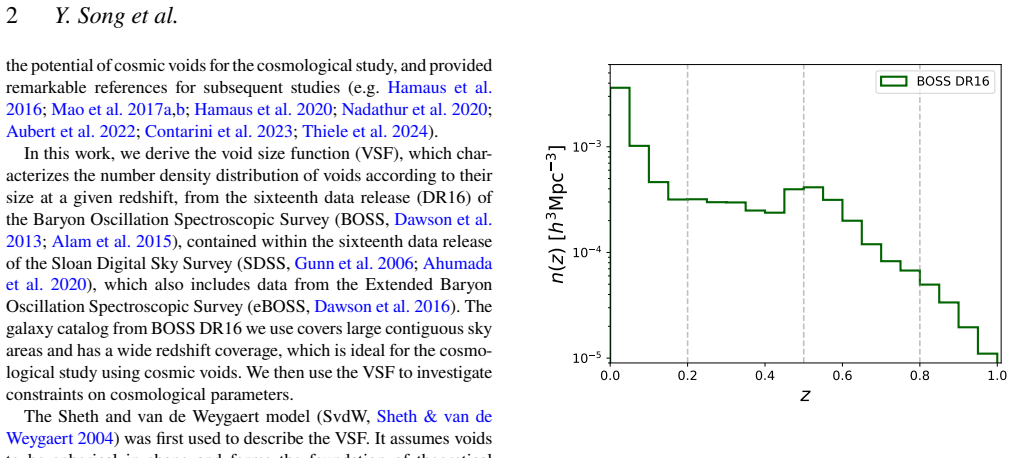
We measure the void size function (VSF) from the Baryon Oscillation Spectroscopic Survey (BOSS DR16) and perform the cosmological constraints. The BOSS DR16 galaxy sample is selected in the redshift range from $z = 0.2$ to 0.8, considering the selection criteria based on galaxy number density. We identify non-spherical voids from this galaxy catalog using the Voronoi tessellation and watershed algorithm without assuming any void shape. We select the void samples based on the void ellipticity, and derive the VSFs in two redshift bins, i.e. $z=0.2-0.5$ and $0.5-0.8$. The VSF model we use is based on the excursion-set theory, including the void linear underdensity threshold $\delta_{\rm v}$ and the redshift space distortion (RSD) parameter $B$. The Markov Chain Monte Carlo (MCMC) method is applied to perform the joint constraints on the cosmological and void parameters. We find that the VSF measurement from BOSS DR16 gives $w = -1.263_{-0.396}^{+0.329}$, $\Omega_{\rm m} = 0.293_{-0.053}^{+0.060}$, and $\sigma_8 = 0.897_{-0.192}^{+0.159}$, which can be a good complementary probe to galaxy clustering measurements. Our method demonstrates the potential of using the VSF to study cosmological models, and it can provide a reference for future VSF analysis in the upcoming galaxy spectroscopic surveys.
Figures


Figures from the paper (2 more)


Forward citations
Cited by 2 Pith papers
-
Cosmic voids evolution in modified gravity via hydrodynamics
Voids in luminal Galileon gravity are always unscreened, and a reality requirement on the fifth force rules out ~82% of the favored parameter space, yielding a redshift-dependent minimum void depth.
-
Future Cosmology: New Physics and Opportunity from the China Space Station Telescope (CSST)
A review of CSST cosmological probes forecasting percent-level constraints on dark energy and dark matter from weak lensing, clustering, clusters, voids, SNe Ia, and BAO, based mostly on the authors' prior mock analyses.
Reference graph
Works this paper leans on
-
[1]
write newline
" write newline "" before.all 'output.state := FUNCTION fin.entry write newline FUNCTION new.block output.state before.all = 'skip after.block 'output.state := if FUNCTION new.sentence output.state after.block = 'skip output.state before.all = 'skip after.sentence 'output.state := if if FUNCTION not #0 #1 if FUNCTION and 'skip pop #0 if FUNCTION or pop #1...
-
[2]
Achitouv I., 2016, @doi [ ] 10.1103/PhysRevD.94.103524 , https://ui.adsabs.harvard.edu/abs/2016PhRvD..94j3524A 94, 103524
-
[3]
Ahumada R., et al., 2020, @doi [ ] 10.3847/1538-4365/ab929e , https://ui.adsabs.harvard.edu/abs/2020ApJS..249....3A 249, 3
-
[4]
Akeson R., et al., 2019, @doi [arXiv e-prints] 10.48550/arXiv.1902.05569 , https://ui.adsabs.harvard.edu/abs/2019arXiv190205569A p. arXiv:1902.05569
-
[5]
Alam S., et al., 2015, @doi [ ] 10.1088/0067-0049/219/1/12 , https://ui.adsabs.harvard.edu/abs/2015ApJS..219...12A 219, 12
-
[6]
Alam S., et al., 2017, @doi [ ] 10.1093/mnras/stx721 , https://ui.adsabs.harvard.edu/abs/2017MNRAS.470.2617A 470, 2617
-
[7]
Alam S., et al., 2021, @doi [ ] 10.1103/PhysRevD.103.083533 , https://ui.adsabs.harvard.edu/abs/2021PhRvD.103h3533A 103, 083533
-
[8]
Alcock C., Paczynski B., 1979, @doi [ ] 10.1038/281358a0 , https://ui.adsabs.harvard.edu/abs/1979Natur.281..358A 281, 358
doi:10.1038/281358a0 1979
Show all 104 references
-
[9]
Aubert M., et al., 2022, @doi [ ] 10.1093/mnras/stac828 , https://ui.adsabs.harvard.edu/abs/2022MNRAS.513..186A 513, 186
2022 doi
-
[10]
A., Skillman E
Aver E., Olive K. A., Skillman E. D., 2015, @doi [ ] 10.1088/1475-7516/2015/07/011 , https://ui.adsabs.harvard.edu/abs/2015JCAP...07..011A 2015, 011
2015 doi
-
[11]
Bernardeau F., 1994, @doi [ ] 10.1086/174121 , https://ui.adsabs.harvard.edu/abs/1994ApJ...427...51B 427, 51
1994 doi
-
[12]
Bonici M., et al., 2023, @doi [ ] 10.1051/0004-6361/202244445 , https://ui.adsabs.harvard.edu/abs/2023A&A...670A..47B 670, A47
2023 doi
-
[13]
Cai Y.-C., Padilla N., Li B., 2015, @doi [ ] 10.1093/mnras/stv777 , https://ui.adsabs.harvard.edu/abs/2015MNRAS.451.1036C 451, 1036
2015 doi
-
[15]
A., Padilla N., 2016b, @doi [ ] 10.1093/mnras/stw1809 , https://ui.adsabs.harvard.edu/abs/2016MNRAS.462.2465C 462, 2465
Cai Y.-C., Taylor A., Peacock J. A., Padilla N., 2016b, @doi [ ] 10.1093/mnras/stw1809 , https://ui.adsabs.harvard.edu/abs/2016MNRAS.462.2465C 462, 2465
- [16]
-
[17]
Cautun M., Paillas E., Cai Y.-C., Bose S., Armijo J., Li B., Padilla N., 2018, @doi [ ] 10.1093/mnras/sty463 , https://ui.adsabs.harvard.edu/abs/2018MNRAS.476.3195C 476, 3195
2018 doi
-
[18]
C., Hamaus N., 2021, @doi [ ] 10.1103/PhysRevD.103.043502 , https://ui.adsabs.harvard.edu/abs/2021PhRvD.103d3502C 103, 043502
Chan K. C., Hamaus N., 2021, @doi [ ] 10.1103/PhysRevD.103.043502 , https://ui.adsabs.harvard.edu/abs/2021PhRvD.103d3502C 103, 043502
2021 doi
-
[19]
Chuang C.-H., Kitaura F.-S., Liang Y., Font-Ribera A., Zhao C., McDonald P., Tao C., 2017, @doi [ ] 10.1103/PhysRevD.95.063528 , https://ui.adsabs.harvard.edu/abs/2017PhRvD..95f3528C 95, 063528
2017 doi
-
[20]
Contarini S., Ronconi T., Marulli F., Moscardini L., Veropalumbo A., Baldi M., 2019, @doi [ ] 10.1093/mnras/stz1989 , https://ui.adsabs.harvard.edu/abs/2019MNRAS.488.3526C 488, 3526
2019 doi
-
[21]
Contarini S., Marulli F., Moscardini L., Veropalumbo A., Giocoli C., Baldi M., 2021, @doi [ ] 10.1093/mnras/stab1112 , https://ui.adsabs.harvard.edu/abs/2021MNRAS.504.5021C 504, 5021
2021 doi
-
[22]
Contarini S., et al., 2022, @doi [ ] 10.1051/0004-6361/202244095 , https://ui.adsabs.harvard.edu/abs/2022A&A...667A.162C 667, A162
2022 doi
-
[23]
Contarini S., Pisani A., Hamaus N., Marulli F., Moscardini L., Baldi M., 2023, @doi [ ] 10.3847/1538-4357/acde54 , https://ui.adsabs.harvard.edu/abs/2023ApJ...953...46C 953, 46
2023 doi
-
[24]
Contarini S., Pisani A., Hamaus N., Marulli F., Moscardini L., Baldi M., 2024, @doi [ ] 10.1051/0004-6361/202347572 , https://ui.adsabs.harvard.edu/abs/2024A&A...682A..20C 682, A20
2024 doi
-
[25]
J., Pettini M., Steidel C
Cooke R. J., Pettini M., Steidel C. C., 2018, @doi [ ] 10.3847/1538-4357/aaab53 , https://ui.adsabs.harvard.edu/abs/2018ApJ...855..102C 855, 102
2018 doi
-
[26]
M., Paz D
Correa C. M., Paz D. J., S \'a nchez A. G., Ruiz A. N., Padilla N. D., Angulo R. E., 2021, @doi [ ] 10.1093/mnras/staa3252 , https://ui.adsabs.harvard.edu/abs/2021MNRAS.500..911C 500, 911
2021 doi
-
[27]
M., Paz D
Correa C. M., Paz D. J., Padilla N. D., S \'a nchez A. G., Ruiz A. N., Angulo R. E., 2022, @doi [ ] 10.1093/mnras/stab3070 , https://ui.adsabs.harvard.edu/abs/2022MNRAS.509.1871C 509, 1871
2022 doi
- [28]
-
[29]
S., et al., 2013, @doi [ ] 10.1088/0004-6256/145/1/10 , https://ui.adsabs.harvard.edu/abs/2013AJ....145...10D 145, 10
Dawson K. S., et al., 2013, @doi [ ] 10.1088/0004-6256/145/1/10 , https://ui.adsabs.harvard.edu/abs/2013AJ....145...10D 145, 10
2013 doi
-
[30]
S., et al., 2016, @doi [ ] 10.3847/0004-6256/151/2/44 , https://ui.adsabs.harvard.edu/abs/2016AJ....151...44D 151, 44
Dawson K. S., et al., 2016, @doi [ ] 10.3847/0004-6256/151/2/44 , https://ui.adsabs.harvard.edu/abs/2016AJ....151...44D 151, 44
2016 doi
-
[31]
Desjacques V., Jeong D., Schmidt F., 2018, @doi [ ] 10.1016/j.physrep.2017.12.002 , https://ui.adsabs.harvard.edu/abs/2018PhR...733....1D 733, 1
2018 doi
-
[32]
Euclid Collaboration et al., 2022, @doi [ ] 10.1051/0004-6361/202141938 , https://ui.adsabs.harvard.edu/abs/2022A&A...662A.112E 662, A112
2022 doi
-
[33]
Falck B., Koyama K., Zhao G.-B., Cautun M., 2018, @doi [ ] 10.1093/mnras/stx3288 , https://ui.adsabs.harvard.edu/abs/2018MNRAS.475.3262F 475, 3262
2018 doi
-
[34]
R., Silva Lafaurie J., Sapone D., 2021, @doi [ ] 10.1093/mnras/stab1720 , https://ui.adsabs.harvard.edu/abs/2021MNRAS.505.5833F 505, 5833
Favole G., Granett B. R., Silva Lafaurie J., Sapone D., 2021, @doi [ ] 10.1093/mnras/stab1720 , https://ui.adsabs.harvard.edu/abs/2021MNRAS.505.5833F 505, 5833
2021 doi
-
[35]
W., Lang D., Goodman J., 2013, @doi [ ] 10.1086/670067 , https://ui.adsabs.harvard.edu/abs/2013PASP..125..306F 125, 306
Foreman-Mackey D., Hogg D. W., Lang D., Goodman J., 2013, @doi [ ] 10.1086/670067 , https://ui.adsabs.harvard.edu/abs/2013PASP..125..306F 125, 306
2013 doi
-
[36]
Forero-S \'a nchez D., Zhao C., Tao C., Chuang C.-H., Kitaura F.-S., Variu A., Tamone A., Kneib J.-P., 2022, @doi [ ] 10.1093/mnras/stac1268 , https://ui.adsabs.harvard.edu/abs/2022MNRAS.513.5407F 513, 5407
2022 doi
-
[37]
Gong Y., et al., 2019, @doi [ ] 10.3847/1538-4357/ab391e , https://ui.adsabs.harvard.edu/abs/2019ApJ...883..203G 883, 203
2019 doi
-
[38]
Goodman J., Weare J., 2010, @doi [Communications in Applied Mathematics and Computational Science] 10.2140/camcos.2010.5.65 , https://ui.adsabs.harvard.edu/abs/2010CAMCS...5...65G 5, 65
2010 doi
-
[39]
E., et al., 2006, @doi [ ] 10.1086/500975 , https://ui.adsabs.harvard.edu/abs/2006AJ....131.2332G 131, 2332
Gunn J. E., et al., 2006, @doi [ ] 10.1086/500975 , https://ui.adsabs.harvard.edu/abs/2006AJ....131.2332G 131, 2332
2006 doi
-
[40]
M., Lavaux G., Escoffier S., Wandelt B
Hamaus N., Pisani A., Sutter P. M., Lavaux G., Escoffier S., Wandelt B. D., Weller J., 2016, @doi [ ] 10.1103/PhysRevLett.117.091302 , https://ui.adsabs.harvard.edu/abs/2016PhRvL.117i1302H 117, 091302
2016 doi
-
[41]
Hamaus N., Cousinou M.-C., Pisani A., Aubert M., Escoffier S., Weller J., 2017, @doi [ ] 10.1088/1475-7516/2017/07/014 , https://ui.adsabs.harvard.edu/abs/2017JCAP...07..014H 2017, 014
2017 doi
-
[42]
D., Weller J., 2020, @doi [ ] 10.1088/1475-7516/2020/12/023 , https://ui.adsabs.harvard.edu/abs/2020JCAP...12..023H 2020, 023
Hamaus N., Pisani A., Choi J.-A., Lavaux G., Wandelt B. D., Weller J., 2020, @doi [ ] 10.1088/1475-7516/2020/12/023 , https://ui.adsabs.harvard.edu/abs/2020JCAP...12..023H 2020, 023
2020 doi
-
[43]
Hamaus N., et al., 2022, @doi [ ] 10.1051/0004-6361/202142073 , https://ui.adsabs.harvard.edu/abs/2022A&A...658A..20H 658, A20
2022 doi
-
[44]
Jennings E., Li Y., Hu W., 2013, @doi [ ] 10.1093/mnras/stt1169 , https://ui.adsabs.harvard.edu/abs/2013MNRAS.434.2167J 434, 2167
2013 doi
-
[45]
Khoraminezhad H., Vielzeuf P., Lazeyras T., Baccigalupi C., Viel M., 2022, @doi [ ] 10.1093/mnras/stac331 , https://ui.adsabs.harvard.edu/abs/2022MNRAS.511.4333K 511, 4333
2022 doi
-
[46]
D., Pisani A., Carbone C., Liu J., Hawken A
Kreisch C. D., Pisani A., Carbone C., Liu J., Hawken A. J., Massara E., Spergel D. N., Wandelt B. D., 2019, @doi [ ] 10.1093/mnras/stz1944 , https://ui.adsabs.harvard.edu/abs/2019MNRAS.488.4413K 488, 4413
2019 doi
-
[47]
D., Pisani A., Villaescusa-Navarro F., Spergel D
Kreisch C. D., Pisani A., Villaescusa-Navarro F., Spergel D. N., Wandelt B. D., Hamaus N., Bayer A. E., 2022, @doi [ ] 10.3847/1538-4357/ac7d4b , https://ui.adsabs.harvard.edu/abs/2022ApJ...935..100K 935, 100
2022 doi
-
[48]
Lewis A., Challinor A., Lasenby A., 2000, @doi [ ] 10.1086/309179 , https://ui.adsabs.harvard.edu/abs/2000ApJ...538..473L 538, 473
2000 doi
-
[49]
A., Scherrer R
Mao Q., Berlind A. A., Scherrer R. J., Neyrinck M. C., Scoccimarro R., Tinker J. L., McBride C. K., Schneider D. P., 2017a, @doi [ ] 10.3847/1538-4357/835/2/160 , https://ui.adsabs.harvard.edu/abs/2017ApJ...835..160M 835, 160
-
[50]
Mao Q., et al., 2017b, @doi [ ] 10.3847/1538-4357/835/2/161 , https://ui.adsabs.harvard.edu/abs/2017ApJ...835..161M 835, 161
-
[51]
F., Winther H
Mauland R., Elgar y ., Mota D. F., Winther H. A., 2023, @doi [ ] 10.1051/0004-6361/202346287 , https://ui.adsabs.harvard.edu/abs/2023A&A...674A.185M 674, A185
2023 doi
-
[52]
Miao H., Gong Y., Chen X., Huang Z., Li X.-D., Zhan H., 2023, @doi [ ] 10.1093/mnras/stac3583 , https://ui.adsabs.harvard.edu/abs/2023MNRAS.519.1132M 519, 1132
2023 doi
-
[53]
Nadathur S., 2016, @doi [ ] 10.1093/mnras/stw1340 , https://ui.adsabs.harvard.edu/abs/2016MNRAS.461..358N 461, 358
2016 doi
-
[54]
Nadathur S., Hotchkiss S., 2015, @doi [ ] 10.1093/mnras/stv2131 , https://ui.adsabs.harvard.edu/abs/2015MNRAS.454.2228N 454, 2228
2015 doi
-
[56]
J., 2019b, @doi [ ] 10.1093/mnras/sty3372 , https://ui.adsabs.harvard.edu/abs/2019MNRAS.483.3472N 483, 3472
Nadathur S., Percival W. J., 2019b, @doi [ ] 10.1093/mnras/sty3372 , https://ui.adsabs.harvard.edu/abs/2019MNRAS.483.3472N 483, 3472
-
[57]
Nadathur S., et al., 2020, @doi [ ] 10.1093/mnras/staa3074 , https://ui.adsabs.harvard.edu/abs/2020MNRAS.499.4140N 499, 4140
2020 doi
-
[58]
C., 2008, @doi [ ] 10.1111/j.1365-2966.2008.13180.x , https://ui.adsabs.harvard.edu/abs/2008MNRAS.386.2101N 386, 2101
Neyrinck M. C., 2008, @doi [ ] 10.1111/j.1365-2966.2008.13180.x , https://ui.adsabs.harvard.edu/abs/2008MNRAS.386.2101N 386, 2101
2008
-
[59]
Paillas E., Cautun M., Li B., Cai Y.-C., Padilla N., Armijo J., Bose S., 2019, @doi [ ] 10.1093/mnras/stz022 , https://ui.adsabs.harvard.edu/abs/2019MNRAS.484.1149P 484, 1149
2019 doi
-
[60]
G., 2013, @doi [ ] 10.1093/mnras/stt1836 , https://ui.adsabs.harvard.edu/abs/2013MNRAS.436.3480P 436, 3480
Paz D., Lares M., Ceccarelli L., Padilla N., Lambas D. G., 2013, @doi [ ] 10.1093/mnras/stt1836 , https://ui.adsabs.harvard.edu/abs/2013MNRAS.436.3480P 436, 3480
2013 doi
-
[61]
F., Dolag K., 2023, @doi [ ] 10.1093/mnras/stad956 , https://ui.adsabs.harvard.edu/abs/2023MNRAS.522..152P 522, 152
Pelliciari D., Contarini S., Marulli F., Moscardini L., Giocoli C., Lesci G. F., Dolag K., 2023, @doi [ ] 10.1093/mnras/stad956 , https://ui.adsabs.harvard.edu/abs/2023MNRAS.522..152P 522, 152
2023 doi
-
[62]
Perico E. L. D., Voivodic R., Lima M., Mota D. F., 2019, @doi [ ] 10.1051/0004-6361/201935949 , https://ui.adsabs.harvard.edu/abs/2019A&A...632A..52P 632, A52
2019 doi
-
[63]
Philcox O. H. E., Ivanov M. M., 2022, @doi [ ] 10.1103/PhysRevD.105.043517 , https://ui.adsabs.harvard.edu/abs/2022PhRvD.105d3517P 105, 043517
2022 doi
- [64]
-
[65]
M., Hamaus N., Alizadeh E., Biswas R., Wandelt B
Pisani A., Sutter P. M., Hamaus N., Alizadeh E., Biswas R., Wandelt B. D., Hirata C. M., 2015b, @doi [ ] 10.1103/PhysRevD.92.083531 , https://ui.adsabs.harvard.edu/abs/2015PhRvD..92h3531P 92, 083531
-
[66]
Planck Collaboration et al., 2020, @doi [ ] 10.1051/0004-6361/201833910 , https://ui.adsabs.harvard.edu/abs/2020A&A...641A...6P 641, A6
2020 doi
-
[67]
Platen E., van de Weygaert R., Jones B. J. T., 2007, @doi [ ] 10.1111/j.1365-2966.2007.12125.x , https://ui.adsabs.harvard.edu/abs/2007MNRAS.380..551P 380, 551
2007
-
[68]
Pollina G., Baldi M., Marulli F., Moscardini L., 2016, @doi [ ] 10.1093/mnras/stv2503 , https://ui.adsabs.harvard.edu/abs/2016MNRAS.455.3075P 455, 3075
2016 doi
-
[69]
Pollina G., Hamaus N., Dolag K., Weller J., Baldi M., Moscardini L., 2017, @doi [ ] 10.1093/mnras/stx785 , https://ui.adsabs.harvard.edu/abs/2017MNRAS.469..787P 469, 787
2017 doi
-
[70]
Pollina G., et al., 2019, @doi [ ] 10.1093/mnras/stz1470 , https://ui.adsabs.harvard.edu/abs/2019MNRAS.487.2836P 487, 2836
2019 doi
-
[71]
Radinovi \'c S., et al., 2023, @doi [ ] 10.1051/0004-6361/202346121 , https://ui.adsabs.harvard.edu/abs/2023A&A...677A..78R 677, A78
2023 doi
-
[72]
A., Nadathur S., Percival W
Radinovi \'c S., Winther H. A., Nadathur S., Percival W. J., Paillas E., Sohrab Fraser T., Massara E., Woodfinden A., 2024, @doi [ ] 10.1051/0004-6361/202451358 , https://ui.adsabs.harvard.edu/abs/2024A&A...691A..39R 691, A39
2024 doi
-
[73]
Reid B., et al., 2016, @doi [ ] 10.1093/mnras/stv2382 , https://ui.adsabs.harvard.edu/abs/2016MNRAS.455.1553R 455, 1553
2016 doi
-
[74]
Ronconi T., Contarini S., Marulli F., Baldi M., Moscardini L., 2019, @doi [ ] 10.1093/mnras/stz2115 , https://ui.adsabs.harvard.edu/abs/2019MNRAS.488.5075R 488, 5075
2019 doi
-
[75]
Sahl \'e n M., Silk J., 2018, @doi [ ] 10.1103/PhysRevD.97.103504 , https://ui.adsabs.harvard.edu/abs/2018PhRvD..97j3504S 97, 103504
2018 doi
-
[76]
Sahl \'e n M., Zubeld \' a \'I ., Silk J., 2016, @doi [ ] 10.3847/2041-8205/820/1/L7 , https://ui.adsabs.harvard.edu/abs/2016ApJ...820L...7S 820, L7
2016 doi
-
[77]
G., et al., 2017a, @doi [ ] 10.1093/mnras/stw2443 , https://ui.adsabs.harvard.edu/abs/2017MNRAS.464.1640S 464, 1640
S \'a nchez A. G., et al., 2017a, @doi [ ] 10.1093/mnras/stw2443 , https://ui.adsabs.harvard.edu/abs/2017MNRAS.464.1640S 464, 1640
-
[78]
S \'a nchez C., et al., 2017b, @doi [ ] 10.1093/mnras/stw2745 , https://ui.adsabs.harvard.edu/abs/2017MNRAS.465..746S 465, 746
-
[79]
C., 2019, @doi [ ] 10.1088/1475-7516/2019/10/029 , https://ui.adsabs.harvard.edu/abs/2019JCAP...10..029S 2019, 029
Sch \"o neberg N., Lesgourgues J., Hooper D. C., 2019, @doi [ ] 10.1088/1475-7516/2019/10/029 , https://ui.adsabs.harvard.edu/abs/2019JCAP...10..029S 2019, 029
2019 doi
-
[80]
D., Pollina G., Weller J., 2019, @doi [ ] 10.1088/1475-7516/2019/12/055 , https://ui.adsabs.harvard.edu/abs/2019JCAP...12..055S 2019, 055
Schuster N., Hamaus N., Pisani A., Carbone C., Kreisch C. D., Pollina G., Weller J., 2019, @doi [ ] 10.1088/1475-7516/2019/12/055 , https://ui.adsabs.harvard.edu/abs/2019JCAP...12..055S 2019, 055
2019 doi
-
[81]
K., van de Weygaert R., 2004, @doi [ ] 10.1111/j.1365-2966.2004.07661.x , https://ui.adsabs.harvard.edu/abs/2004MNRAS.350..517S 350, 517
Sheth R. K., van de Weygaert R., 2004, @doi [ ] 10.1111/j.1365-2966.2004.07661.x , https://ui.adsabs.harvard.edu/abs/2004MNRAS.350..517S 350, 517
2004
-
[82]
Song Y., et al., 2024a, @doi [ ] 10.1093/mnras/stae1575 , https://ui.adsabs.harvard.edu/abs/2024MNRAS.532.1049S 532, 1049
-
[83]
Song Y., et al., 2024b, @doi [ ] 10.1093/mnras/stae2094 , https://ui.adsabs.harvard.edu/abs/2024MNRAS.534..128S 534, 128
-
[84]
Song Y., et al., 2024c, @doi [ ] 10.3847/1538-4357/ad8de9 , https://ui.adsabs.harvard.edu/abs/2024ApJ...976..244S 976, 244
-
[85]
C., Chen X., Guo Q., Liu Y., Pei W., 2025, @doi [ ] 10.1093/mnras/staf305 , https://ui.adsabs.harvard.edu/abs/2025MNRAS.538..114S 538, 114
Song Y., Gong Y., Xiong Q., Chan K. C., Chen X., Guo Q., Liu Y., Pei W., 2025, @doi [ ] 10.1093/mnras/staf305 , https://ui.adsabs.harvard.edu/abs/2025MNRAS.538..114S 538, 114
2025 doi
-
[86]
M., Lavaux G., Wandelt B
Sutter P. M., Lavaux G., Wandelt B. D., Weinberg D. H., 2012, @doi [ ] 10.1088/0004-637X/761/2/187 , https://ui.adsabs.harvard.edu/abs/2012ApJ...761..187S 761, 187
2012 doi
-
[87]
M., Pisani A., Wandelt B
Sutter P. M., Pisani A., Wandelt B. D., Weinberg D. H., 2014, @doi [ ] 10.1093/mnras/stu1392 , https://ui.adsabs.harvard.edu/abs/2014MNRAS.443.2983S 443, 2983
2014 doi
-
[88]
M., et al., 2015, @doi [Astronomy and Computing] 10.1016/j.ascom.2014.10.002 , https://ui.adsabs.harvard.edu/abs/2015A&C.....9....1S 9, 1
Sutter P. M., et al., 2015, @doi [Astronomy and Computing] 10.1016/j.ascom.2014.10.002 , https://ui.adsabs.harvard.edu/abs/2015A&C.....9....1S 9, 1
2015 doi
-
[89]
Tamone A., Zhao C., Forero-S \'a nchez D., Variu A., Chuang C.-H., Kitaura F.-S., Kneib J.-P., Tao C., 2023, @doi [ ] 10.1093/mnras/stad2898 , https://ui.adsabs.harvard.edu/abs/2023MNRAS.526.2889T 526, 2889
2023 doi
-
[90]
N., Ho S., Wandelt B., 2024, @doi [ ] 10.3847/1538-4357/ad434e , https://ui.adsabs.harvard.edu/abs/2024ApJ...969...89T 969, 89
Thiele L., Massara E., Pisani A., Hahn C., Spergel D. N., Ho S., Wandelt B., 2024, @doi [ ] 10.3847/1538-4357/ad434e , https://ui.adsabs.harvard.edu/abs/2024ApJ...969...89T 969, 89
2024 doi
-
[91]
Verza G., Pisani A., Carbone C., Hamaus N., Guzzo L., 2019, @doi [ ] 10.1088/1475-7516/2019/12/040 , https://ui.adsabs.harvard.edu/abs/2019JCAP...12..040V 2019, 040
2019 doi
-
[92]
Verza G., Carbone C., Pisani A., Renzi A., 2023, @doi [ ] 10.1088/1475-7516/2023/12/044 , https://ui.adsabs.harvard.edu/abs/2023JCAP...12..044V 2023, 044
2023 doi
-
[93]
arXiv:2410.19713
Verza G., et al., 2024a, @doi [arXiv e-prints] 10.48550/arXiv.2410.19713 , https://ui.adsabs.harvard.edu/abs/2024arXiv241019713V p. arXiv:2410.19713
-
[94]
Verza G., Carbone C., Pisani A., Porciani C., Matarrese S., 2024b, @doi [ ] 10.1088/1475-7516/2024/10/079 , https://ui.adsabs.harvard.edu/abs/2024JCAP...10..079V 2024, 079
2024 doi
-
[95]
Vielzeuf P., et al., 2021, @doi [ ] 10.1093/mnras/staa3231 , https://ui.adsabs.harvard.edu/abs/2021MNRAS.500..464V 500, 464
2021 doi
-
[96]
Vielzeuf P., Calabrese M., Carbone C., Fabbian G., Baccigalupi C., 2023, @doi [ ] 10.1088/1475-7516/2023/08/010 , https://ui.adsabs.harvard.edu/abs/2023JCAP...08..010V 2023, 010
2023 doi
-
[97]
J., et al., 2019, @doi [The Messenger] 10.18727/0722-6691/5118 , https://ui.adsabs.harvard.edu/abs/2019Msngr.175...12W 175, 12
Walcher C. J., et al., 2019, @doi [The Messenger] 10.18727/0722-6691/5118 , https://ui.adsabs.harvard.edu/abs/2019Msngr.175...12W 175, 12
2019 doi
-
[98]
J., Radinovic S., Massara E., Winther H
Woodfinden A., Nadathur S., Percival W. J., Radinovic S., Massara E., Winther H. A., 2022, @doi [ ] 10.1093/mnras/stac2475 , https://ui.adsabs.harvard.edu/abs/2022MNRAS.516.4307W 516, 4307
2022 doi
-
[99]
Zhan H., 2011, @doi [Scientia Sinica Physica, Mechanica & Astronomica] 10.1360/132011-961 , https://ui.adsabs.harvard.edu/abs/2011SSPMA..41.1441Z 41, 1441
2011 doi
-
[100]
Zhan H., 2021, @doi [Chinese Science Bulletin] 10.1360/TB-2021-0016 , 66, 1290
2021 doi
-
[101]
Zhao C., Tao C., Liang Y., Kitaura F.-S., Chuang C.-H., 2016, @doi [ ] 10.1093/mnras/stw660 , https://ui.adsabs.harvard.edu/abs/2016MNRAS.459.2670Z 459, 2670
2016 doi
-
[102]
Zhao C., et al., 2022, @doi [ ] 10.1093/mnras/stac390 , https://ui.adsabs.harvard.edu/abs/2022MNRAS.511.5492Z 511, 5492
2022 doi
- [103]
-
[104]
Zhou R., et al., 2021, @doi [ ] 10.1093/mnras/staa3764 , https://ui.adsabs.harvard.edu/abs/2021MNRAS.501.3309Z 501, 3309
2021 doi
-
[105]
M., Wandelt B
Zivick P., Sutter P. M., Wandelt B. D., Li B., Lam T. Y., 2015, @doi [ ] 10.1093/mnras/stv1209 , https://ui.adsabs.harvard.edu/abs/2015MNRAS.451.4215Z 451, 4215
2015 doi
-
[106]
S., et al., 2019, @doi [The Messenger] 10.18727/0722-6691/5117 , https://ui.adsabs.harvard.edu/abs/2019Msngr.175....3D 175, 3
de Jong R. S., et al., 2019, @doi [The Messenger] 10.18727/0722-6691/5117 , https://ui.adsabs.harvard.edu/abs/2019Msngr.175....3D 175, 3
2019 doi
Reviewed August 10, 2026 · model on record in the stance chip above.
Discussion (0). Continue with ORCID to comment.