REVIEW 3 major objections 4 minor 27 references
Technical Report: Exploring Automatic Model-Checking of the Ethereum specification
T0 review · 3 major / 4 minor · reviewed 2026-08-10 · deepseek-v4-flash
Pith's one-line read Exhaustive model checking of the Ethereum 3SF protocol confirms Accountable Safety on all tested configurations up to 7 checkpoints and 24 validator votes, with no violations in larger scopes.
desk verdict A useful, honest bounded model-checking case study of 3SF; the headline Alloy result depends on a completeness constraint the paper doesn't show. read the letter →
The pith
A machine-rendered reading of the paper's core claim, the machinery that carries it, and where it could break.
The reading
What carries the argument
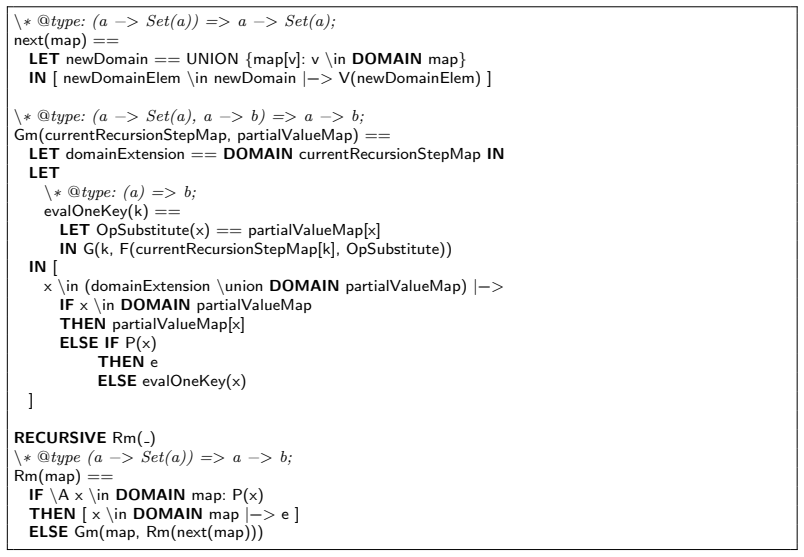
The argument runs on a chain of abstractions that converts the Python spec's recursive, graph-heavy definitions into a bounded satisfiability problem. Recursive computations are rewritten as bounded fold operations (ApaFoldSeqLeft) so Apalache can handle them; the block graph is abstracted to integer-labelled chains, with a fork represented by a sign change; and the infinite space of chain configurations is decomposed into a handful of hand-chosen instances (M3, M4a, M4b, M5a, M5b). Cardinality constraints for supermajority and slashing thresholds are replaced either by the specialized theory of finite set cardinalities (CVC5) or by explicit quorum sets (TLA+). The decisive artifact is an Alloy specification that searches with a SAT solver for a model of 'noAccountableSafety'; within the bounded scopes that formula is unsatisfiable.
What would settle it
Run the Alloy encoding (Spec3c) with the same instance parameters (e.g., 6 blocks, 6 checkpoints, 4 signatures, 6 FFG votes, 15 votes) and ask Kissat to satisfy the predicate noAccountableSafety; a satisfying assignment would be a concrete state with two conflicting finalized checkpoints and fewer than n/3 slashable validators. A complementary test is to generate random or guided block graphs and votes directly from the Python specification ffg.py and look for such a state; finding one would falsify the report's conclusion even if the abstract models miss it.
Extended reading notes
Core claim
On the paper's own terms, the central discovery is that the modeled 3SF protocol satisfies Accountable Safety in every configuration that could be exhaustively searched, and no configuration violating it was found in any larger search. The largest exhaustive instances cover up to 7 checkpoints and 24 validator votes (Alloy/Kissat), with TLA+/Apalache handling smaller configurations and CVC5 up to 5 blocks and 6 checkpoints. The claim is bounded by the search scopes and by the unproven correspondence between the abstract models and the executable Python specification: the paper states that an equivalence proof 'could' be produced with TLAPS but has not been written, and that the Alloy encoding was derived from Spec3 without a formal correspondence proof.
Load-bearing premise
The load-bearing premise is that the abstract TLA+, SMT, and Alloy models faithfully represent the executable Python specification, in the strong sense that every protocol state—and in particular every Accountable Safety violation—of the Python code has a corresponding instance in one of the checked models within the given search bounds.
Editorial extensions
If this is right
- If the bounds hold, 3SF is accountably safe for every configuration with up to 7 checkpoints and 24 votes, giving strong evidence for the protocol's core safety guarantee before larger-scope verification is attempted.
- The specifications double as example generators: both Apalache and Alloy quickly produce configurations with justified and finalized checkpoints, which the authors note are hard to reach by random inputs to the Python spec.
- The Alloy/SAT encoding is the fastest of the three, suggesting that Boolean encodings with fine scope control may be the pragmatic route for verifying similar inductive properties of consensus protocols.
- The paper's sequence of specifications (Spec1 to Spec4b) provides a worked template: one can start from an executable Python spec, translate directly, then iteratively abstract until a model checker finishes.
- The same artifact suite could be used to verify other 3SF properties, such as reorg resilience and honest-node non-slashing, which the authors expect to be easier than Accountable Safety.
Reading between the lines
- If the abstraction correspondence were proven (e.g., a simulation between the Python spec and Spec3c), the bounded check would upgrade to an unconditional statement about the executable spec for those sizes; the report leaves this connection open.
- The decomposition into a few chain configurations suggests a cheap screening heuristic: for small block counts, fork-shaped two-chain graphs with justified non-genesis checkpoints are the configurations most likely to violate Accountable Safety, so future checks can target the search there.
- Because the number of block graphs grows super-exponentially, exhaustive SAT-based checking will not scale past a handful of blocks; combining bounded checks with inductive invariants or theorem proving is the natural path to unbounded verification.
- The three encodings form a ready-made benchmark set for evaluating new model checkers on cardinality-heavy, inductively defined consensus properties, since the same property can be checked in TLA+/SMT/SAT with known difficulty levels.
Signed reviews
Editorial analysis
A structured set of objections, weighed in public.
Referee Report
Summary. The paper reports a model-checking study of the Accountable Safety property of the 3SF finality gadget as specified in the Ethereum Python specification. It develops a chain of artifacts: Spec1 (a direct TLA+ translation), Spec2 (a fold-based version), Spec3 (a state-machine abstraction), Spec4/Spec4b (a two-chain restriction with an inductive invariant and configuration decomposition), Spec3b (an SMT/CVC5 encoding), and Spec3c (an Alloy/Kissat encoding). The headline claim is exhaustive verification of Accountable Safety for configurations up to 7 checkpoints and 24 validator votes (Table 5, row 8), with no counterexamples found in larger timed-out runs, and quick counterexamples on deliberately mutated models.
Significance. If the verification claim is sound, the paper is a useful case study of how manual abstraction layers and cross-tool validation can make an intricate consensus property amenable to bounded exhaustive checking. Strengths include the public artifacts, the cross-validation across three solver families, the mutation experiments that act as sensitivity checks, and the detailed translation rules with supporting proofs in Appendix B. However, the scientific value depends on the soundness of the Alloy encoding and on the abstraction correspondence between the executable Python specification and the checked models, and both of these are not yet established.
major comments (3)
- [8.1 / Table 5] The displayed Alloy fact `justifiedCheckpointsAreJustified` is only a consistency constraint: it says every member of `JustifiedCheckpoints.justified` satisfies the justification condition. It does not assert the converse, that every checkpoint satisfying that condition belongs to the set. Without such a completeness constraint, `noAccountableSafety` can be unsatisfiable for the trivial reason that `JustifiedCheckpoints.justified` is chosen too small, so no conflicting finalized checkpoints exist. The paper itself identifies this pitfall for Spec4 in Section 9.1. Because Table 5 and the Key Outcomes rely on the Alloy runs, the main claim is vacuous unless the actual Alloy file contains a completeness fact and the experiments are re-run with it. Please include the full fact and confirm that the reported runs used it.
- [6.2 / Figure 12] In Figure 12, the second conjunct of `CastVotes` is written as `all c in (allCheckpoints intersection allJustifiedCheckpoints): not IsJustified(c, votes0, allJustifiedCheckpoints)`. Since `allJustifiedCheckpoints` is declared to be a subset of `allCheckpoints`, this intersection is exactly `allJustifiedCheckpoints`, so the action requires every justified checkpoint both to satisfy `IsJustified` (first conjunct) and not to satisfy it. The transition relation is therefore inconsistent as written, which undermines the Spec3 results in Table 3. If this is a typographical error for set difference, it should be corrected and the experiments re-checked against the corrected formula.
- [5.2, 8.1, 10.3] The central claim concerns the executable Python specification, but no soundness or completeness argument is supplied for the abstraction chain. Section 5.2 says an equivalence proof for the fold optimization could be produced with TLAPS but is not. Section 8.1 says the Alloy specification was written "relatively easily" from Spec3 without a correspondence proof. Section 10.3 replaces a general family of chain configurations by five hand-picked instances (M3, M4a, M4b, M5a, M5b), while Section 3.1 itself notes that the number of labelled rooted forests on n vertices is (n+1)^(n-1). The paper should either prove that each abstraction preserves or over-approximates the reachable states with respect to Accountable Safety, or explicitly restate the verified theorem as applying only to the abstract models, not to the Python specification.
minor comments (4)
- [1 / Abstract] The phrase "absolute confidence" overstates what bounded exhaustive checking and timed-out runs can establish; recommend rewording to "no counterexample found within the checked scopes."
- [Abstract / Section 8.3] The statement that "no violations of Accountable Safety are observed, even in slightly larger configurations" should be qualified: Table 5 rows with timeouts did not terminate, so absence of counterexamples is not a verification result.
- [7.1] The SMT snippet defines `justified checkpoints` by a set comprehension that refers to itself through `(set.member (source vote) justified checkpoints)`. Since this is a fixed-point definition, its semantics should be stated explicitly and the CVC5 treatment of self-referential set comprehensions should be documented; otherwise the SMT results are not reproducible.
- [Appendix A] Many translation rules are annotated with "see Source" or "Source" without including the source text in the report; for a standalone technical report, the relevant Python definitions or stable links should be included so the claimed equivalences can be checked.
Circularity Check
No significant circularity: AccountableSafety is an externally defined property, no parameter is fitted to the verification outcome, and the load-bearing self-citations are tooling or protocol context rather than the argument for the property.
full rationale
The claimed derivation chain starts from the executable Python ffg.py and produces Spec1 through Spec4b, Spec3b, and Spec3c; the property checked is Accountable Safety, defined externally in Section 3 (Definition 1) as the implication from two conflicting finalized chains to a slashable set of at least n/3 validators, and encoded as an invariant in Figure 10. Nothing in the specifications is fitted to make that implication true: the SMT version (Section 7.2) negates the property and asks CVC5 for a model, the Alloy version runs `noAccountableSafety` as a satisfiability query (Section 8.2), and the mutation experiments (Section 1) show that deliberately broken specifications do yield counterexamples. The only self-citations are tooling ([13,14] Apalache), an optimization pattern ([15] Tendermint quorum sets), and the protocol/executable artifact under test ([9]/ffg.py); none is used as a uniqueness theorem or as the sole justification for the protocol property. The manuscript does flag genuine completeness risks: Section 5.2 admits the fold-flattening equivalence proof was not carried out, and Section 9.1 warns that omitting the completeness half of the justified-checkpoint characterization 'leads us to be unable to detect real violations of AccountableSafety.' The Alloy snippet in Section 8.1 shows only the consistency fact (`justifiedCheckpointsAreJustified`), so if the full Alloy model lacks the converse constraint, Table 5's no-violation results could be vacuous; the report's prose claims a fixpoint but does not display the Alloy converse. This is a soundness and model-completeness risk, not a demonstrated reduction of the conclusion to the input, so it does not raise the circularity score beyond 1.
Assumptions & free parameters
free parameters (2)
- Search scope bounds (blocks, checkpoints, signatures, FFG votes, votes) =
e.g., 5 blocks, 7 checkpoints, 4 signatures, 6 FFG votes, 24 votes (largest exhaustive case)
- MAX_SLOT (fold depth bound) =
not stated in the paper
assumptions (3)
- domain assumption The Python executable specification (ffg.py) faithfully formalizes the 3SF protocol.
- ad hoc to paper The abstractions (folds, integer graph encoding, two-chain restriction, configuration decomposition, Alloy/SMT encodings) preserve reachable states and the Accountable Safety property.
- domain assumption The chosen search scopes are large enough to contain all essentially different configurations for the claimed instance sizes.
Cite this review
Pith. "Pith review of Technical Report: Exploring Automatic Model-Checking of the Ethereum specification." pith.science (2026). https://pith.science/paper/MZWEJ3CX
@misc{pith2026250107958,
  author       = {Pith},
  title        = {Pith review of: Technical Report: Exploring Automatic Model-Checking of the Ethereum specification},
  year         = {2026},
  howpublished = {\url{https://pith.science/paper/MZWEJ3CX}},
  note         = {Machine review of arXiv:2501.07958}
}
read the original abstract
We investigate automated model-checking of the Ethereum specification, focusing on the Accountable Safety property of the 3SF consensus protocol. We select 3SF due to its relevance and the unique challenges it poses for formal verification. Our primary tools are TLA+ for specification and the Apalache model checker for verification. Our formalization builds on the executable Python specification of 3SF. To begin, we manually translate this specification into TLA+, revealing significant combinatorial complexity in the definition of Accountable Safety. To address these challenges, we introduce several layers of manual abstraction: (1) replacing recursion with folds, (2) substituting abstract graphs with integers, and (3) decomposing chain configurations. To cross-validate our results, we develop alternative encodings in SMT (CVC5) and Alloy. Despite the inherent complexity, our results demonstrate that exhaustive verification of Accountable Safety is feasible for small instances - supporting up to 7 checkpoints and 24 validator votes. Moreover, no violations of Accountable Safety are observed, even in slightly larger configurations. Beyond these findings, our study highlights the importance of manual abstraction and domain expertise in enhancing model-checking efficiency and showcases the flexibility of TLA+ for managing intricate specifications.
Figures


Figures from the paper (14 more)


Reference graph
Works this paper leans on
-
[1]
The Apalache model checker. https://apalache-mc.org, 2024. Ac- cessed: 2024-10-25
work page 2024
-
[2]
https: //github.com/tlaplus/Examples, 2024
A collection of TLA + specifications of varying complexities. https: //github.com/tlaplus/Examples, 2024. Accessed: 2024-10-25
work page 2024
-
[3]
Barrett, Andrew Reynolds, and Cesare Tinelli
Kshitij Bansal, Clark W. Barrett, Andrew Reynolds, and Cesare Tinelli. Reasoning with finite sets and cardinality constraints in SMT. Log. Methods Comput. Sci. , 14(4), 2018
work page 2018
-
[4]
Haniel Barbosa, Clark W. Barrett, Martin Brain, Gereon Kremer, Hanna Lachnitt, Makai Mann, Abdalrhman Mohamed, Mudathir Mo- hamed, Aina Niemetz, Andres N¨ otzli, Alex Ozdemir, Mathias Preiner, Andrew Reynolds, Ying Sheng, Cesare Tinelli, and Yoni Zohar. CVC5: A versatile and industrial-strength SMT solver. In Dana Fisman and Grigore Rosu, editors, TACAS, ...
work page 2022
-
[5]
CaDiCaL, Gimsatul, IsaSAT and Kissat en- tering the SAT Competition 2024
Armin Biere, Tobias Faller, Katalin Fazekas, Mathias Fleury, Nils Fro- leyks, and Florian Pollitt. CaDiCaL, Gimsatul, IsaSAT and Kissat en- tering the SAT Competition 2024. In Marijn Heule, Markus Iser, Matti J¨ arvisalo, and Martin Suda, editors,SAT Competition, volume B-2024- 1, pages 8–10, 2024
work page 2024
-
[6]
The latest gossip on BFT consensus
Ethan Buchman, Jae Kwon, and Zarko Milosevic. The latest gossip on BFT consensus. CoRR, abs/1807.04938, 2018
arXiv 2018
-
[7]
Vitalik Buterin, Diego Hernandez, Thor Kamphefner, Khiem Pham, Zhi Qiao, Danny Ryan, Juhyeok Sin, Ying Wang, and Yan X Zhang. Combining ghost and casper. arXiv preprint arXiv:2003.03052 , 2020
arXiv 2003
- [8]
Show all 27 references
-
[9]
3-slot-finality protocol for ethereum
Francesco D’Amato, Roberto Saltini, Thanh-Hai Tran, and Luca Zanolini. 3-slot-finality protocol for ethereum. arXiv preprint arXiv:2411.00558, 2024
2024 arXiv
-
[10]
Leonardo Mendon¸ ca de Moura and Nikolaj S. Bjørner. Z3: an efficient SMT solver. In C. R. Ramakrishnan and Jakob Rehof, editors, TACAS, volume 4963 of LNCS, pages 337–340. Springer, 2008. 41
2008
-
[11]
Software Abstractions: logic, language, and analysis
Daniel Jackson. Software Abstractions: logic, language, and analysis . MIT press, 2012
2012
-
[12]
alloytools.org
Daniel Jackson. alloytools.org. https://https://alloytools.org/,
-
[13]
TLA+ model check- ing made symbolic
Igor Konnov, Jure Kukovec, and Thanh-Hai Tran. TLA+ model check- ing made symbolic. Proc. ACM Program. Lang. , 3(OOPSLA):123:1– 123:30, 2019
2019
-
[14]
Specification and verification with the TLA + trifecta: Tlc, apalache, and TLAPS
Igor Konnov, Markus Kuppe, and Stephan Merz. Specification and verification with the TLA + trifecta: Tlc, apalache, and TLAPS. In Tiziana Margaria and Bernhard Steffen, editors, ISoLA, volume 13701 of LNCS, pages 88–105. Springer, 2022
2022
-
[15]
TLA + specification of Tendermint consensus and its accountability
Igor Konnov and Zarko Milosevic. TLA + specification of Tendermint consensus and its accountability. https://github.com/cometbft/ cometbft/blob/main/spec/light-client/accountability/ TendermintAcc_004_draft.tla, 2024. Accessed: 2024-10-23
2024
-
[16]
Paxos made simple
Leslie Lamport. Paxos made simple. ACM SIGACT News (Distributed Computing Column) 32, 4 (Whole Number 121, December 2001) , pages 51–58, 2001
2001
-
[17]
TLA + specification of Paxos
Leslie Lamport. TLA + specification of Paxos. https: //github.com/tlaplus/Examples/blob/master/specifications/ Paxos/Paxos.tla, 2024. Accessed: 2024-12-17
2024
-
[18]
Ebb-and-flow proto- cols: A resolution of the availability-finality dilemma
Joachim Neu, Ertem Nusret Tas, and David Tse. Ebb-and-flow proto- cols: A resolution of the availability-finality dilemma. In 2021 IEEE Symposium on Security and Privacy (SP) , pages 446–465. IEEE, 2021
2021
-
[19]
Consensus: bridging theory and practice
Diego Ongaro. Consensus: bridging theory and practice . PhD thesis, Stanford University, USA, 2014
2014
-
[20]
The sleepy model of consensus
Rafael Pass and Elaine Shi. The sleepy model of consensus. In Advances in Cryptology–ASIACRYPT 2017: 23rd International Conference on the Theory and Applications of Cryptology and Information Security, Hong Kong, China, December 3-7, 2017, Proceedings, Part II 23 , pages 380–
2017
-
[23]
Formulate translations from Python to TLA+ in the intuitive way, potentially introducing constructs like recursion, and then
-
[24]
iterative
Pair them with a TLA+-to-TLA+ rule, ending in a supported frag- ment. We have to do that, as the ssf code extensively uses recursive definitions. A.2.1 Bounded recursion rule Assume we are given a recursive operator R. Without loss of generality, we can take the arity to be 1,...
-
[25]
If x ∈ DRm (f ′), by the induction hypothesis, we know that R m(f ′)[x ] = R(x )
-
[26]
Here, G m(f , Rm(f ′)) trivially evaluates to e as well
If x /∈ DRm (f ′), but P (x ) holds, we know R(x ) = e. Here, G m(f , Rm(f ′)) trivially evaluates to e as well
-
[27]
As x ∈ Df , f [x ] ⊆ Df ′ by definition and Df ′ ⊆ DRm (f ′) by Lemma B.1, so for every element v ∈ V (x ) it is the case that R(v ) = Rm(f ′)[v ]
Otherwise, it remains to be shown that the following holds true: G(x , F (f [x ], Rm(f ′))) = R(x ) Since we know P (x ) does not hold for this x , it follows that: R(x ) = G(x , F (V (x ), Op)) Hence, it suffices to see that: 59 F (f [x ], Rm(f ′)) = F (V (x ), Op) By the pro...
-
[409]
42 The work done in this section is the main contribution of Milestone 3
Springer, 2017. 42 The work done in this section is the main contribution of Milestone 3. Since this section is quite long and technical, we have decided to add it in the appendix. A Translating Python Specifications to TLA + In this section, we present our results on translat...
2017
-
[2024]
Accessed: 2024-10-11
2024
Reviewed August 10, 2026 · model on record in the stance chip above.
Discussion (0). Continue with ORCID to comment.