REVIEW 3 major objections 5 minor 1 cited by
Reflection-dominated Compton-thick AGN Candidates in the SRG/eROSITA Lockman Hole Survey
T0 review · 3 major / 5 minor · reviewed 2026-08-10 · deepseek-v4-flash
Pith's one-line read The Lockman Hole survey yields 291 candidate Compton-thick AGN, about 5% of its extragalactic X-ray sources.
desk verdict Useful catalogue of 291 hard-spectrum sources, but the 'Compton-thick' label is a step beyond what the data support. read the letter →
The pith
A machine-rendered reading of the paper's core claim, the machinery that carries it, and where it could break.
The reading
What carries the argument
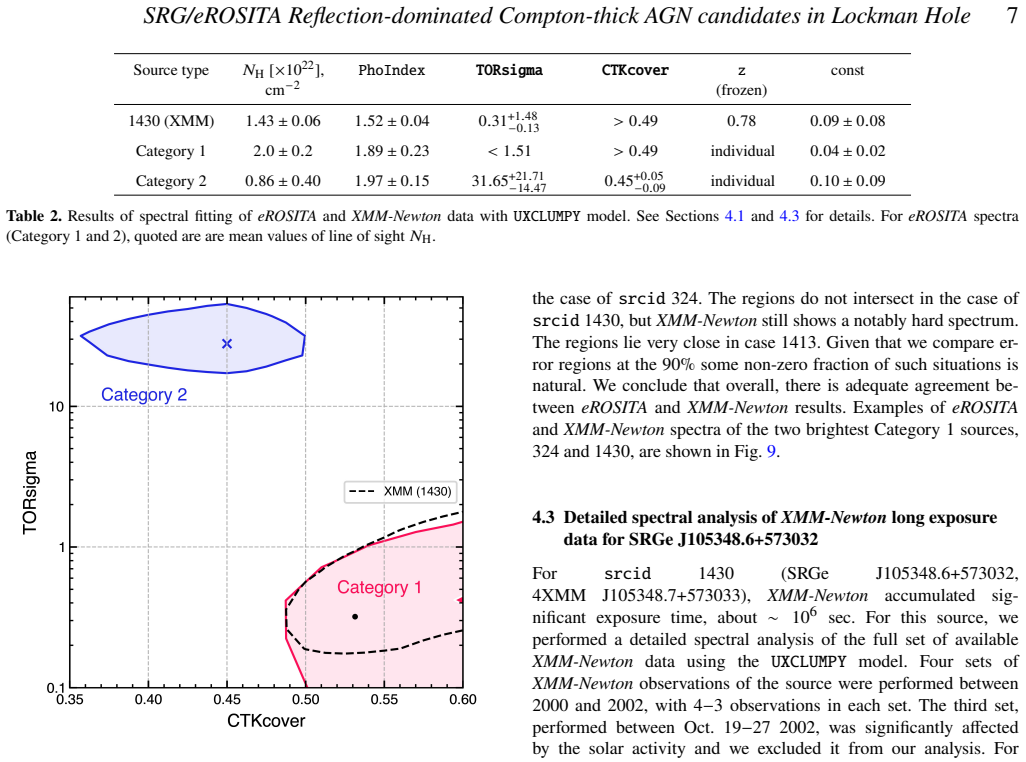
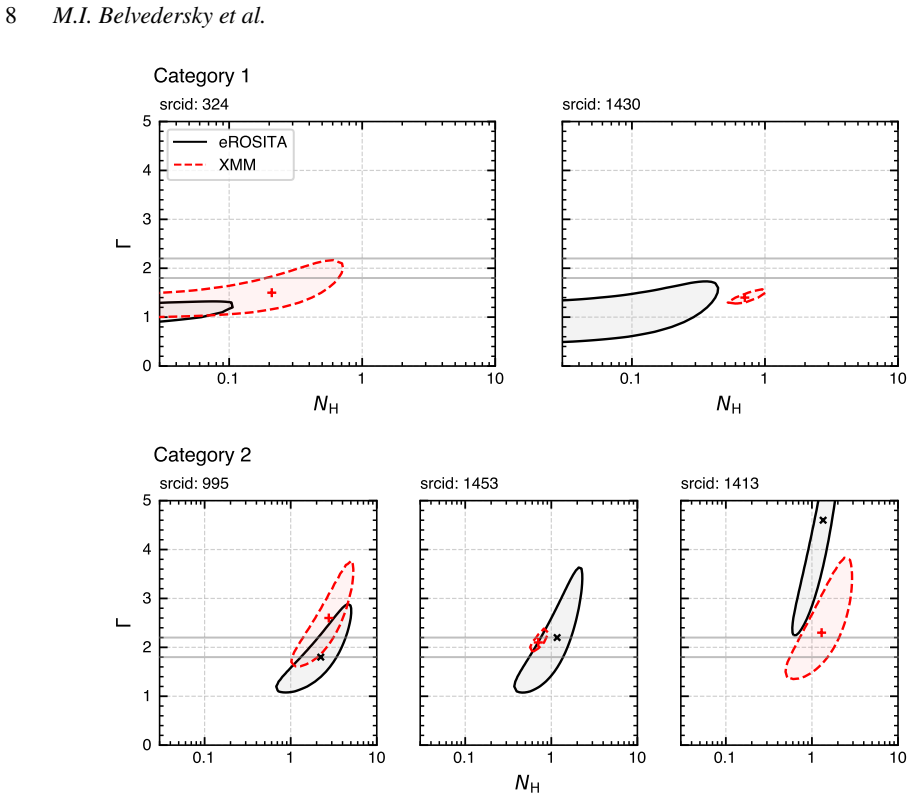
The selection rests on the photon index cut: each source is fitted with an absorbed power-law model ($\texttt{phabs*powerlaw}$), and those whose 90% upper uncertainty bound on $\Gamma$ lies below the fiducial value $\Gamma_0=1.3$ are flagged as CT AGN candidates. The underlying physics is that unsaturated Comptonization in a hot corona, which yields the standard $\Gamma\approx2$ spectra of unobscured AGN, cannot produce such shallow slopes; a hard reflection-dominated continuum must come from reprocessing by Compton-thick material. A second fit with $\texttt{phabs*zphabs*zpowerlw}$ adds intrinsic absorption at the source redshift, allowing separation of Category 1 (no significant absorption) from Category 2 (absorption present) sources. For the bright subsample, combined spectra are then fitted with the UXCLUMPY unification model, whose parameters (covering fraction of a Compton-thick inner ring and angular thickness of a clumpy absorber) provide a geometric picture that distinguishes the two categories.
What would settle it
Deep hard X-ray observations of the nine brightest Category 1 sources above 10 keV with instruments such as NuSTAR or SRG/ART-XC: if these spectra show no Compton hump near 20–30 keV and no strong neutral iron line at 6.4 keV, the reflection-dominated interpretation would be refuted.
Extended reading notes
Core claim
The paper identifies 291 extragalactic X-ray sources in the Lockman Hole whose spectra in the 0.3–8 keV band are anomalously hard, with the 90% upper bound on the power-law photon index $\Gamma$ below $1.3$. Because unobscured type I AGN typically show $\Gamma \approx 2$, such shallow slopes are uncharacteristic of direct coronal emission; the authors interpret them as dominated by emission reflected from Compton-thick material with column density $\gtrsim 10^{24}$ cm$^{-2}$ (i.e. reflection-dominated Compton-thick AGN). Fitting models with and without intrinsic absorption, 81 sources (Category 1) show no statistically significant intrinsic absorption and are designated the best candidates; 49 sources (Category 2) show absorption consistent with mildly obscured AGN; and 161 sources (Category 3) lack reliable redshifts. The authors construct bright (37 sources) and faint (254 sources) catalogues, derive a lower limit of $0.35$ deg$^{-2}$ for the sky density of these candidates, and show that physically motivated UXCLUMPY fits to combined eROSITA spectra are fully consistent with a ~1 Msec XMM-Newton observation of one Category 1 source, the Type 2 galaxy SRGe J105348.6+573032.
Load-bearing premise
The central assumption is that a 90%-confidence photon index upper bound below 1.3 is produced by reflection from Compton-thick material and not mimicked by other effects such as an absorption turnover, a warm absorber, a soft excess, or low-count statistical fluctuations.
Editorial extensions
If this is right
- If the selection is correct, reflection-dominated Compton-thick AGN form a rare subpopulation (~5%) among extragalactic X-ray sources in the Lockman Hole, with a lower limit on sky density of 0.35 deg$^{-2}$ at a limiting flux of $1.5\times10^{-14}$ erg s$^{-1}$ cm$^{-2}$.
- The published bright and faint catalogues serve as target lists for hard X-ray follow-up with observatories such as NuSTAR and SRG/ART-XC to confirm the Compton-thick nature.
- Applying the same photon-index cut to the full eROSITA all-sky survey should uncover many more such candidates, enabling a more complete census of heavily obscured supermassive black hole growth.
- The UXCLUMPY fitting suggests that Category 1 and Category 2 sources occupy distinct regions of parameter space (high inner-ring covering fraction vs. clumpy absorber thickness), a distinction that can be tested with broadband observations.
Reading between the lines
- If the hard-photon-index selection is an efficient proxy for reflection dominance, the implied fraction of heavily obscured AGN among the X-ray-selected population may be higher than some earlier estimates, suggesting that a larger share of supermassive black hole growth is hidden behind Compton-thick material.
- The authors note that several Category 1 sources with high X-ray hardness are optically classified as Type 1 AGN; this hints that optical and X-ray classifications probe different parts of the circumnuclear geometry, an interpretation not established by the paper itself.
- The stacked low-redshift Category 1 spectra have tight upper limits on intrinsic absorption (~$10^{20}$–$10^{21}$ cm$^{-2}$) and very shallow photon indices; future detection of a soft excess or warm absorber in these objects would reveal that their hard continua are not purely reflection-dominated.
Editorial analysis
A structured set of objections, weighed in public.
Referee Report
Summary. The paper presents a search for reflection-dominated Compton-thick AGN (CT AGN) candidates in the SRG/eROSITA Lockman Hole survey, selecting sources whose 90% upper bound on the photon index from a simple power-law fit lies below a fiducial threshold of Gamma0 = 1.3 in the 0.3-8 keV band. From 6528 extragalactic sources, 291 candidates are found, of which 81 have no significant intrinsic absorption (Category 1), 49 show significant absorption (Category 2), and 161 lack reliable redshifts (Category 3). The authors publish bright (37 sources) and faint (254 sources) catalogues, perform stacking analysis to look for redshift evolution, fit combined eROSITA spectra with the UXCLUMPY model, and compare one Category 1 source (srcid 1430) with ~1 Ms of XMM-Newton data. They estimate the fraction and sky density of reflection-dominated CT AGN candidates, finding a lower limit on the sky density of 0.35 deg^-2 at a limiting flux of 1.5e-14 erg/s/cm^2.
Significance. The paper's main product is a well-defined, carefully selected catalogue of hard-spectrum X-ray sources, built with a transparent methodology (W-statistic fitting, 90% confidence intervals, a bright subsample, and XMM-Newton cross-checks). If the interpretation that these sources are reflection-dominated CT AGN is correct, the sample would be among the first of its kind from eROSITA and would provide a valuable target list for follow-up at higher energies. The authors are honest about the limitations of their data and propose a physically motivated, albeit speculative, model to reconcile the low fitted column densities with a CT interpretation. However, the direct evidence for the CT nature is weak: the UXCLUMPY fits yield NH ~ 1e22 cm^-2, the Fe K-alpha equivalent width in the prototype is only ~0.2 keV, and the Category 1 definition relies on non-detection of absorption rather than a positive detection of a reflection component. The significance of the paper therefore rests heavily on the interpretation, which is not yet secure.
major comments (3)
- [Sect. 4.1, Table 2] The definition of Category 1 as 'reflection-dominated CT AGN candidates' is based on the absence of a statistically significant intrinsic NH in phabs*zphabs*zpowerlw fits. As the authors themselves state in Sect. 3.2, the NH upper limits for many Category 1 sources are unconstraining, often in the 1e22-1e23 cm^-2 range, and adding intrinsic absorption to faint sources increases the degeneracy and the photon-index error. Non-detection of absorption at these low count levels is therefore not equivalent to a reflection-dominated spectrum. The paper should assess the probability that a normal (non-CT) AGN with an intrinsically hard photon index, or an absorbed source with poor photon statistics, would satisfy the Category 1 criteria. Without such a contamination estimate, the physical interpretation of the Category 1 sample and the density lower limit derived from it in Sect. 5.4 are not robust.
- [Sect. 5.2] The deep XMM-Newton spectrum of the prototype Category 1 source srcid 1430, used as an anchor for the physical interpretation, yields NH = (1.43 ± 0.06) × 10^22 cm^-2 and an Fe K-alpha equivalent width of 0.19 keV (Sect. 4.3), both far below the canonical values expected for reflection-dominated CT AGN (NH > 1e24 cm^-2, EW ~ 1 keV). The UXCLUMPY fits to the combined eROSITA Category 1 spectra also give NH = (2.0 ± 0.2) × 10^22 cm^-2 (Table 2). The paper proposes an inner Compton-thick ring with a transparent outer torus to explain these values, but this scenario is explicitly speculative (Sect. 5.2). The manuscript should directly test whether a simple hard power law (without any reflection component) can describe the available spectra as well as UXCLUMPY, and report the statistical comparison. Without such a test, the assignment of the 'Compton-thick' label is not supported by the data.
- [Sect. 3.2, Sect. 5.4] The lower limit on the sky density of reflection-dominated CT AGN (0.35 deg^-2) is computed using the number of Category 1 sources above the flux threshold. Because the Category 1 selection does not establish that the sources are reflection-dominated (see comments above), this number is not a lower limit on the CT AGN density. The paper should either reframe this quantity as the density of 'hard-spectrum, unabsorbed sources' or provide evidence that the Category 1 population is dominated by true CT AGN, for example by showing that reflection models are statistically required over simple power-law models in the stacked spectra. As presented, the lower limit in Sect. 5.4 inherits the assumption that the absence of absorption implies reflection dominance, which is not justified.
minor comments (5)
- [Table 2] The table header spells the UXCLUMPY parameter as 'CTKover' while the text and Fig. 7 caption use 'CTKcover'; please make the notation consistent.
- [Sect. 5.2] There is a typo in the sentence 'Indeed, it is is well known, that broadband spectral modelling...' — 'is is' should be 'is'.
- [Sect. 5.4] The text states 'the area of the survey is 28.65deg' and later 'deg^2'; please use deg^2 consistently for the area units.
- [Sect. 3.2] The sentence 'For 81 sources, no statistically significant intrinsic absorption was detected, suggesting that the data do not require absorption turnover' is slightly ambiguous; 'do not require' would be clearer as 'do not require an absorption turnover'.
- [Data Availability] The statement that catalogues 'will be made publicly available via the VizieR system after the publication of this work' is fine for a preprint, but the paper should clarify whether the catalogue is provided as supplementary material at submission or only after acceptance.
Circularity Check
No significant circularity: the sample cut uses a literature-based photon-index threshold, the physical classification is tested against independent XMM-Newton data, and the quoted density limits are explicit definitions rather than model-derived predictions.
full rationale
The paper's selection step is not circular: the hard-spectrum cut is defined by Gamma + Gamma_err < 1.3, with Gamma_0 = 1.3 taken from published AGN spectral-index distributions (Nandra & Pounds 1994; Liu et al. 2022), not fitted to the eROSITA sample. The Category 1/2/3 taxonomy is an explicitly defined classification applied after fitting phabs*zphabs*zpowerlw, using a quoted Delta C-stat > 2.71 and AIC criterion, and the paper itself states that Category 1 upper limits on NH are often unconstraining (Sect. 3.2), so the label is not presented as a measured column density. The UXCLUMPY modelling is interpretative rather than load-bearing for the catalogue definition; the paper explicitly reports fitted line-of-sight NH of about (1-2)x10^22 cm^-2, far below the 10^24 cm^-2 Compton-thick threshold (Sects 4.1, 4.3), and Sect. 5.2 labels the inner-ring/torus explanation as 'admittedly speculative', which is an acknowledged physical-ambiguity limitation, not a circular derivation. The sky-density lower limit in Sect. 5.4 is literally defined as the Category 1 count divided by the total extragalactic source count, i.e. a definitional bound rather than a prediction generated from the fitted model. The same-group citations (Gilfanov et al. 2024 in prep.; Meshcheryakov et al. 2023; Belvedersky et al. 2022; Bykov et al. 2022) are data-infrastructure references for the survey catalogue, redshifts and optical identifications; they are not used to justify the central physical interpretation, and no uniqueness theorem or ansatz is imported from them. The main consistency check is genuinely independent: the 1.04 Ms XMM-Newton spectrum of srcid 1430 is compared with eROSITA, and srcid 1430 is explicitly excluded from the eROSITA Category 1 stack (Sect. 4.3), so the agreement is not forced by shared data. The paper also compares its density lower limit with external predictions from Akylas et al. (2012) and Ananna et al. (2019), providing external benchmarks. Overall, the derivation chain is self-contained for what it actually claims: a catalogue of candidates selected by a fixed, externally motivated spectral-index threshold, with all limitations openly stated. No equation or parameter in the paper reduces a claimed prediction to its own input by construction.
Assumptions & free parameters
free parameters (3)
- Gamma0 (hardness threshold) =
1.3
- Bright sample count threshold =
100 source counts
- UXCLUMPY best-fit parameters =
Category 1: NH=2.0e22, PhoIndex=1.89, TORsigma<1.51, CTKcover>0.49; Category 2: NH=0.86e22, PhoIndex=1.97…
assumptions (8)
- domain assumption The eROSITA Lockman Hole source catalogue of Gilfanov et al. (2024, in prep.) is complete to DL>10 and provides accurate source counts, fluxes, and redshifts.
- domain assumption A single absorbed power law is an adequate approximation for hardness selection of AGN spectra.
- domain assumption The model phabs*zphabs*zpowerlw with a reliable redshift separates intrinsic absorption from reflection dominance.
- ad hoc to paper Non-detection of intrinsic NH at 90 percent confidence implies a reflection-dominated spectrum rather than a low-count artifact.
- domain assumption Galactic absorption is fixed at NH=7e19 cm^-2 in the Lockman Hole.
- domain assumption UXCLUMPY model parameters Ecut=400 keV and Theta_inc=90 deg are fixed as in Buchner et al. (2019).
- domain assumption All sources in a category/redshift bin have identical spectral shapes except normalization.
- domain assumption The sky density of CT AGN is equal in log NH=24-25 and 25-26.
Cite this review
Pith. "Pith review of Reflection-dominated Compton-thick AGN Candidates in the SRG/eROSITA Lockman Hole Survey." pith.science (2026). https://pith.science/paper/3HA63664
@misc{pith2026250108076,
  author       = {Pith},
  title        = {Pith review of: Reflection-dominated Compton-thick AGN Candidates in the SRG/eROSITA Lockman Hole Survey},
  year         = {2026},
  howpublished = {\url{https://pith.science/paper/3HA63664}},
  note         = {Machine review of arXiv:2501.08076}
}
abstract
We search for reflection-dominated Compton-thick active galactic nuclei (CT AGN) candidates in the Lockman Hole region using the data of SRG/eROSITA Lockman Hole survey. We selected sources with anomalously hard photon indices in the $0.3 - 8.0$ keV band, untypical for type I AGN. In particular, we required that the upper end of the $90\%$ error interval did not exceed a fiducial boundary of $\Gamma=1.3$. We found 291 sources which constitute a rare subpopulation among extragalactic X-ray sources detected by eROSITA in the Lockman Hole field, $\approx 5\%$. These sources constitute the eROSITA sample of CT AGN candidates in the Lockman Hole field. We further divide the sources into three categories depending on the availability of reliable redshift and statistically significant detection of intrinsic absorption. We present two catalogues: the bright sample (37 sources) and the faint one (254). We estimate the fraction and sky density of reflection-dominated CT AGN candidates. We show examples of individual spectra and use stacking analysis to search for possible redshift evolution of their properties with redshift. We analyse combined eROSITA spectra of bright sources of different categories with a physically motivated spectral model UXCLUMPY and find them fully consistent with the fits to the about $\sim 1$ Msec XMM-Newton data for one of our reflection-dominated CT candidates, Type 2 galaxy $\text{SRGe J105348.6+573032}$. The catalogues of CT AGN candidates could be a good starting point for planning future studies and follow-ups at all wavelengths.
Figures


Figures from the paper (6 more)



Forward citations
Cited by 1 Pith paper
-
X-ray Absorption Variability in NGC 1142: Another Constraint on the Nature of the Torus/Broad-Line Region in Active Galactic Nuclei
NGC 1142’s NH varies across nine epochs; detection probability scales with observation count, and simple cloud simulations favor many simultaneous eclipsing clouds.
Reference graph
Works this paper leans on
-
[1]
L., Georgakakis A., Nandra K., Barro G., P \'e rez-Gonz \'a lez P
Aird J., Coil A. L., Georgakakis A., Nandra K., Barro G., P \'e rez-Gonz \'a lez P. G., 2015, @doi [ ] 10.1093/mnras/stv1062 , https://ui.adsabs.harvard.edu/abs/2015MNRAS.451.1892A 451, 1892
-
[2]
Akaike H., 1974, IEEE Transactions on Automatic Control, https://ui.adsabs.harvard.edu/abs/1974ITAC...19..716A 19, 716
1974
-
[3]
Akylas A., Georgakakis A., Georgantopoulos I., Brightman M., Nandra K., 2012, Astronomy & Astrophysics, 546, A98
2012
-
[4]
Akylas A., Georgantopoulos I., Ranalli P., Gkiokas E., Corral A., Lanzuisi G., 2016, @doi [ ] 10.1051/0004-6361/201628711 , https://ui.adsabs.harvard.edu/abs/2016A&A...594A..73A 594, A73
-
[5]
Alexander D. M., Brandt W. N., Hornschemeier A. E., Garmire G. P., Schneider D. P., Bauer F. E., Griffiths R. E., 2001, @doi [ ] 10.1086/323540 , https://ui.adsabs.harvard.edu/abs/2001AJ....122.2156A 122, 2156
doi:10.1086/323540 2001
-
[6]
Alexander D. M., et al., 2003, @doi [ ] 10.1086/346088 , https://ui.adsabs.harvard.edu/abs/2003AJ....125..383A 125, 383
doi:10.1086/346088 2003
-
[7]
Ananna T. T., et al., 2019, @doi [ ] 10.3847/1538-4357/aafb77 , https://ui.adsabs.harvard.edu/abs/2019ApJ...871..240A 871, 240
-
[8]
Antonucci R., 1993, @doi [ ] 10.1146/annurev.aa.31.090193.002353 , https://ui.adsabs.harvard.edu/abs/1993ARA&A..31..473A 31, 473
arXiv 1993
Show all 96 references
-
[9]
Ar \'e valo P., et al., 2014, @doi [ ] 10.1088/0004-637X/791/2/81 , https://ui.adsabs.harvard.edu/abs/2014ApJ...791...81A 791, 81
2014 doi
-
[10]
A., 1996, in Jacoby G
Arnaud K. A., 1996, in Jacoby G. H., Barnes J., eds, Astronomical Society of the Pacific Conference Series Vol. 101, Astronomical Data Analysis Software and Systems V. p. 17
1996
-
[11]
Astropy Collaboration et al., 2018, @doi [ ] 10.3847/1538-3881/aabc4f , https://ui.adsabs.harvard.edu/abs/2018AJ....156..123A 156, 123
2018 doi
-
[12]
R., Draper A
Ballantyne D. R., Draper A. R., Madsen K. K., Rigby J. R., Treister E., 2011, @doi [ ] 10.1088/0004-637X/736/1/56 , https://ui.adsabs.harvard.edu/abs/2011ApJ...736...56B 736, 56
2011 doi
-
[13]
Balokovi \'c M., et al., 2018, @doi [ ] 10.3847/1538-4357/aaa7eb , https://ui.adsabs.harvard.edu/abs/2018ApJ...854...42B 854, 42
2018 doi
-
[14]
Balokovi \'c M., et al., 2020, @doi [ ] 10.3847/1538-4357/abc342 , https://ui.adsabs.harvard.edu/abs/2020ApJ...905...41B 905, 41
2020 doi
-
[15]
Baronchelli L., et al., 2017, @doi [ ] 10.1093/mnras/stx1561 , https://ui.adsabs.harvard.edu/abs/2017MNRAS.471..364B 471, 364
2017 doi
-
[16]
M., Sunyaev R
Basko M. M., Sunyaev R. A., Titarchuk L. G., 1974, , https://ui.adsabs.harvard.edu/abs/1974A&A....31..249B 31, 249
1974
-
[17]
I., Bykov S
Belvedersky M. I., Bykov S. D., Gilfanov M. R., 2022, @doi [Astronomy Letters] 10.1134/S1063773722110020 , https://ui.adsabs.harvard.edu/abs/2022AstL...48..755B 48, 755
2022 doi
-
[18]
J., Page M
Blustin A. J., Page M. J., Fuerst S. V., Branduardi-Raymont G., Ashton C. E., 2005, @doi [ ] 10.1051/0004-6361:20041775 , https://ui.adsabs.harvard.edu/abs/2005A&A...431..111B 431, 111
2005 doi
-
[19]
N., Alexander D
Brandt W. N., Alexander D. M., 2015, @doi [ ] 10.1007/s00159-014-0081-z , https://ui.adsabs.harvard.edu/abs/2015A&ARv..23....1B 23, 1
2015 doi
-
[21]
Brightman M., et al., 2015, @doi [ ] 10.1088/0004-637X/805/1/41 , https://ui.adsabs.harvard.edu/abs/2015ApJ...805...41B 805, 41
2015 doi
-
[22]
Brunner H., et al., 2022, @doi [ ] 10.1051/0004-6361/202141266 , https://ui.adsabs.harvard.edu/abs/2022A&A...661A...1B 661, A1
2022 doi
-
[23]
Brusa M., et al., 2010, @doi [ ] 10.1088/0004-637X/716/1/348 , https://ui.adsabs.harvard.edu/abs/2010ApJ...716..348B 716, 348
2010 doi
-
[24]
F., eds, TORUS2015: The AGN Unification Scheme After 30 Years
Buchner J., 2015, in Gandhi P., Hoenig S. F., eds, TORUS2015: The AGN Unification Scheme After 30 Years
2015
-
[25]
Buchner J., et al., 2014, @doi [ ] 10.1051/0004-6361/201322971 , https://ui.adsabs.harvard.edu/abs/2014A&A...564A.125B 564, A125
2014 doi
-
[26]
E., 2019, @doi [ ] 10.1051/0004-6361/201834771 , https://ui.adsabs.harvard.edu/abs/2019A&A...629A..16B 629, A16
Buchner J., Brightman M., Nandra K., Nikutta R., Bauer F. E., 2019, @doi [ ] 10.1051/0004-6361/201834771 , https://ui.adsabs.harvard.edu/abs/2019A&A...629A..16B 629, A16
2019 doi
-
[27]
E., Nandra K., 2021, @doi [ ] 10.1051/0004-6361/201834963 , https://ui.adsabs.harvard.edu/abs/2021A&A...651A..58B 651, A58
Buchner J., Brightman M., Balokovi \'c M., Wada K., Bauer F. E., Nandra K., 2021, @doi [ ] 10.1051/0004-6361/201834963 , https://ui.adsabs.harvard.edu/abs/2021A&A...651A..58B 651, A58
2021 doi
-
[28]
D., Belvedersky M
Bykov S. D., Belvedersky M. I., Gilfanov M. R., 2022, @doi [Astronomy Letters] 10.1134/S1063773722110044 , https://ui.adsabs.harvard.edu/abs/2022AstL...48..653B 48, 653
2022 doi
-
[29]
J., ed., Astrophysics and Space Science Library Vol
Comastri A., 2004, in Barger A. J., ed., Astrophysics and Space Science Library Vol. 308, Supermassive Black Holes in the Distant Universe. p. 245 ( @eprint arXiv astro-ph/0403693 ), @doi 10.1007/978-1-4020-2471-9_8
2004 arXiv
-
[30]
Comastri A., et al., 2011, @doi [ ] 10.1051/0004-6361/201016119 , https://ui.adsabs.harvard.edu/abs/2011A&A...526L...9C 526, L9
2011 doi
-
[31]
M., Lockman F
Dickey J. M., Lockman F. J., 1990, @doi [ ] 10.1146/annurev.aa.28.090190.001243 , https://ui.adsabs.harvard.edu/abs/1990ARA&A..28..215D 28, 215
1990
- [32]
-
[33]
W., Jin C., Blaes O., Ward M., 2012, @doi [ ] 10.1111/j.1365-2966.2011.19779.x , https://ui.adsabs.harvard.edu/abs/2012MNRAS.420.1848D 420, 1848
Done C., Davis S. W., Jin C., Blaes O., Ward M., 2012, @doi [ ] 10.1111/j.1365-2966.2011.19779.x , https://ui.adsabs.harvard.edu/abs/2012MNRAS.420.1848D 420, 1848
2012
-
[34]
Elvis M., 2000, @doi [ ] 10.1086/317778 , https://ui.adsabs.harvard.edu/abs/2000ApJ...545...63E 545, 63
2000 doi
-
[35]
Fiore F., et al., 2012, @doi [ ] 10.1051/0004-6361/201117581 , https://ui.adsabs.harvard.edu/abs/2012A&A...537A..16F 537, A16
2012 doi
-
[36]
Fontanot F., et al., 2020, @doi [ ] 10.1093/mnras/staa1716 , https://ui.adsabs.harvard.edu/abs/2020MNRAS.496.3943F 496, 3943
2020 doi
-
[37]
Gandhi P., et al., 2013, @doi [ ] 10.1088/0004-637X/773/1/51 , https://ui.adsabs.harvard.edu/abs/2013ApJ...773...51G 773, 51
2013 doi
-
[38]
Georgantopoulos I., Akylas A., Georgakakis A., Rowan-Robinson M., 2009, @doi [ ] 10.1051/0004-6361/200912395 , https://ui.adsabs.harvard.edu/abs/2009A&A...507..747G 507, 747
2009 doi
-
[39]
Georgantopoulos I., et al., 2013, @doi [ ] 10.1051/0004-6361/201220828 , https://ui.adsabs.harvard.edu/abs/2013A&A...555A..43G 555, A43
2013 doi
-
[40]
M., Fabian A
George I. M., Fabian A. C., 1991, @doi [ ] 10.1093/mnras/249.2.352 , https://ui.adsabs.harvard.edu/abs/1991MNRAS.249..352G 249, 352
1991 doi
-
[42]
Gilli R., Comastri A., Hasinger G., 2007, @doi [ ] 10.1051/0004-6361:20066334 , https://ui.adsabs.harvard.edu/abs/2007A&A...463...79G 463, 79
2007 doi
-
[43]
Guainazzi M., Bianchi S., 2007, @doi [ ] 10.1111/j.1365-2966.2006.11229.x , https://ui.adsabs.harvard.edu/abs/2007MNRAS.374.1290G 374, 1290
2007
-
[44]
Guainazzi M., Siemiginowska A., Rodriguez-Pascual P., Stanghellini C., 2004, @doi [ ] 10.1051/0004-6361:20047051 , https://ui.adsabs.harvard.edu/abs/2004A&A...421..461G 421, 461
2004 doi
-
[45]
C., 2005, @doi [ ] 10.1051/0004-6361:20053643 , https://ui.adsabs.harvard.edu/abs/2005A&A...444..119G 444, 119
Guainazzi M., Matt G., Perola G. C., 2005, @doi [ ] 10.1051/0004-6361:20053643 , https://ui.adsabs.harvard.edu/abs/2005A&A...444..119G 444, 119
2005 doi
-
[46]
HI4PI Collaboration et al., 2016, @doi [ ] 10.1051/0004-6361/201629178 , https://ui.adsabs.harvard.edu/abs/2016A&A...594A.116H 594, A116
2016 doi
-
[47]
R., et al., 2020, @doi [Nature] 10.1038/s41586-020-2649-2 , 585, 357
Harris C. R., et al., 2020, @doi [Nature] 10.1038/s41586-020-2649-2 , 585, 357
2020 doi
-
[48]
A., et al., 2013, @doi [ ] 10.1088/0004-637X/770/2/103 , https://ui.adsabs.harvard.edu/abs/2013ApJ...770..103H 770, 103
Harrison F. A., et al., 2013, @doi [ ] 10.1088/0004-637X/770/2/103 , https://ui.adsabs.harvard.edu/abs/2013ApJ...770..103H 770, 103
2013 doi
-
[49]
C., Alexander D
Hickox R. C., Alexander D. M., 2018, @doi [ ] 10.1146/annurev-astro-081817-051803 , https://ui.adsabs.harvard.edu/abs/2018ARA&A..56..625H 56, 625
2018 doi
-
[50]
D., 2007, @doi [Computing in Science & Engineering] 10.1109/MCSE.2007.55 , 9, 90
Hunter J. D., 2007, @doi [Computing in Science & Engineering] 10.1109/MCSE.2007.55 , 9, 90
2007 doi
-
[51]
Ichikawa K., et al., 2019, @doi [ ] 10.3847/1538-4357/aaef8f , https://ui.adsabs.harvard.edu/abs/2019ApJ...870...31I 870, 31
2019 doi
-
[52]
Jansen F., et al., 2001, @doi [ ] 10.1051/0004-6361:20000036 , https://ui.adsabs.harvard.edu/abs/2001A&A...365L...1J 365, L1
2001 doi
-
[53]
Kallman T., Dorodnitsyn A., 2019, @doi [ ] 10.3847/1538-4357/ab40aa , https://ui.adsabs.harvard.edu/abs/2019ApJ...884..111K 884, 111
2019 doi
-
[54]
G., Ricci C., 2024, @doi [ ] 10.3847/1538-4357/ad3235 , https://ui.adsabs.harvard.edu/abs/2024ApJ...966..116K 966, 116
Kallov \'a K., Boorman P. G., Ricci C., 2024, @doi [ ] 10.3847/1538-4357/ad3235 , https://ui.adsabs.harvard.edu/abs/2024ApJ...966..116K 966, 116
2024 doi
-
[55]
Kawamuro T., Ueda Y., Tazaki F., Ricci C., Terashima Y., 2016, @doi [ ] 10.3847/0067-0049/225/1/14 , https://ui.adsabs.harvard.edu/abs/2016ApJS..225...14K 225, 14
2016 doi
-
[56]
C., 2013, @doi [ ] 10.1146/annurev-astro-082708-101811 , https://ui.adsabs.harvard.edu/abs/2013ARA&A..51..511K 51, 511
Kormendy J., Ho L. C., 2013, @doi [ ] 10.1146/annurev-astro-082708-101811 , https://ui.adsabs.harvard.edu/abs/2013ARA&A..51..511K 51, 511
2013 doi
-
[57]
C., Chakravorty S., Kembhavi A
Laha S., Guainazzi M., Dewangan G. C., Chakravorty S., Kembhavi A. K., 2014, @doi [ ] 10.1093/mnras/stu669 , https://ui.adsabs.harvard.edu/abs/2014MNRAS.441.2613L 441, 2613
2014 doi
-
[58]
B., et al., 2017, @doi [ ] 10.3847/1538-4357/aa8176 , https://ui.adsabs.harvard.edu/abs/2017ApJ...846...20L 846, 20
Lansbury G. B., et al., 2017, @doi [ ] 10.3847/1538-4357/aa8176 , https://ui.adsabs.harvard.edu/abs/2017ApJ...846...20L 846, 20
2017 doi
-
[59]
Liu T., et al., 2022, @doi [ ] 10.1051/0004-6361/202141643 , https://ui.adsabs.harvard.edu/abs/2022A&A...661A...5L 661, A5
2022 doi
-
[60]
J., Jahoda K., McCammon D., 1986, @doi [ ] 10.1086/164002 , https://ui.adsabs.harvard.edu/abs/1986ApJ...302..432L 302, 432
Lockman F. J., Jahoda K., McCammon D., 1986, @doi [ ] 10.1086/164002 , https://ui.adsabs.harvard.edu/abs/1986ApJ...302..432L 302, 432
1986 doi
-
[61]
A., 1995, @doi [ ] 10.1093/mnras/273.3.837 , https://ui.adsabs.harvard.edu/abs/1995MNRAS.273..837M 273, 837
Magdziarz P., Zdziarski A. A., 1995, @doi [ ] 10.1093/mnras/273.3.837 , https://ui.adsabs.harvard.edu/abs/1995MNRAS.273..837M 273, 837
1995 doi
-
[63]
K., Maiolino R., Salvati M., 2004, @doi [ ] 10.1111/j.1365-2966.2004.07765.x , https://ui.adsabs.harvard.edu/abs/2004MNRAS.351..169M 351, 169
Marconi A., Risaliti G., Gilli R., Hunt L. K., Maiolino R., Salvati M., 2004, @doi [ ] 10.1111/j.1365-2966.2004.07765.x , https://ui.adsabs.harvard.edu/abs/2004MNRAS.351..169M 351, 169
2004
-
[64]
C., Koss M., Civano F., Brigthman M., Brusa M., Lanzuisi G., 2019, @doi [ ] 10.3847/1538-4357/ab3214 , https://ui.adsabs.harvard.edu/abs/2019ApJ...882...83M 882, 83
Masini A., Comastri A., Hickox R. C., Koss M., Civano F., Brigthman M., Brusa M., Lanzuisi G., 2019, @doi [ ] 10.3847/1538-4357/ab3214 , https://ui.adsabs.harvard.edu/abs/2019ApJ...882...83M 882, 83
2019 doi
-
[65]
V., et al., 2023, @doi [Astronomy Letters] 10.1134/S1063773723070022 , https://ui.adsabs.harvard.edu/abs/2023AstL...49..359M 49, 359
Meshcheryakov A. V., et al., 2023, @doi [Astronomy Letters] 10.1134/S1063773723070022 , https://ui.adsabs.harvard.edu/abs/2023AstL...49..359M 49, 359
2023 doi
-
[66]
D., Yaqoob T., 2009, @doi [ ] 10.1111/j.1365-2966.2009.15025.x , https://ui.adsabs.harvard.edu/abs/2009MNRAS.397.1549M 397, 1549
Murphy K. D., Yaqoob T., 2009, @doi [ ] 10.1111/j.1365-2966.2009.15025.x , https://ui.adsabs.harvard.edu/abs/2009MNRAS.397.1549M 397, 1549
2009
-
[67]
A., 1994, @doi [ ] 10.1093/mnras/268.2.405 , https://ui.adsabs.harvard.edu/abs/1994MNRAS.268..405N 268, 405
Nandra K., Pounds K. A., 1994, @doi [ ] 10.1093/mnras/268.2.405 , https://ui.adsabs.harvard.edu/abs/1994MNRAS.268..405N 268, 405
1994 doi
-
[68]
M., Ivezi \'c Z ., Elitzur M., 2008, @doi [ ] 10.1086/590482 , https://ui.adsabs.harvard.edu/abs/2008ApJ...685..147N 685, 147
Nenkova M., Sirocky M. M., Ivezi \'c Z ., Elitzur M., 2008, @doi [ ] 10.1086/590482 , https://ui.adsabs.harvard.edu/abs/2008ApJ...685..147N 685, 147
2008 doi
-
[69]
Netzer H., 2015, @doi [ ] 10.1146/annurev-astro-082214-122302 , https://ui.adsabs.harvard.edu/abs/2015ARA&A..53..365N 53, 365
2015 doi
-
[70]
Padovani P., et al., 2017, @doi [ ] 10.1007/s00159-017-0102-9 , https://ui.adsabs.harvard.edu/abs/2017A&ARv..25....2P 25, 2
2017 doi
-
[71]
J., Stevens J
Page M. J., Stevens J. A., Ivison R. J., Carrera F. J., 2004, @doi [ ] 10.1086/423892 , https://ui.adsabs.harvard.edu/abs/2004ApJ...611L..85P 611, L85
2004 doi
-
[72]
Paltani S., Ricci C., 2017, @doi [ ] 10.1051/0004-6361/201629623 , https://ui.adsabs.harvard.edu/abs/2017A&A...607A..31P 607, A31
2017 doi
-
[73]
Pavlinsky M., et al., 2021, @doi [ ] 10.1051/0004-6361/202040265 , https://ui.adsabs.harvard.edu/abs/2021A&A...650A..42P 650, A42
2021 doi
-
[74]
Peca A., et al., 2023, @doi [ ] 10.3847/1538-4357/acac28 , https://ui.adsabs.harvard.edu/abs/2023ApJ...943..162P 943, 162
2023 doi
-
[75]
V., Rodriguez-Pascual P., Ojero-Pascual E., Tom \'a s L., Gabriel C., 2019, in Molinaro M., Shortridge K., Pasian F., eds, Astronomical Society of the Pacific Conference Series Vol
Perea-Calder \'o n J. V., Rodriguez-Pascual P., Ojero-Pascual E., Tom \'a s L., Gabriel C., 2019, in Molinaro M., Shortridge K., Pasian F., eds, Astronomical Society of the Pacific Conference Series Vol. 521, Astronomical Data Analysis Software and Systems XXVI. p. 695
2019
-
[76]
A., Nandra K., Stewart G
Pounds K. A., Nandra K., Stewart G. C., George I. M., Fabian A. C., 1990, @doi [ ] 10.1038/344132a0 , https://ui.adsabs.harvard.edu/abs/1990Natur.344..132P 344, 132
1990 doi
-
[77]
Predehl P., et al., 2021, @doi [ ] 10.1051/0004-6361/202039313 , https://ui.adsabs.harvard.edu/abs/2021A&A...647A...1P 647, A1
2021 doi
-
[78]
S., Fabian A
Reynolds C. S., Fabian A. C., 1995, @doi [ ] 10.1093/mnras/273.4.1167 , https://ui.adsabs.harvard.edu/abs/1995MNRAS.273.1167R 273, 1167
1995 doi
-
[79]
J., Trakhtenbrot B., Bauer F
Ricci C., Ueda Y., Koss M. J., Trakhtenbrot B., Bauer F. E., Gandhi P., 2015, @doi [ ] 10.1088/2041-8205/815/1/L13 , https://ui.adsabs.harvard.edu/abs/2015ApJ...815L..13R 815, L13
2015 doi
-
[80]
R., Fabian A
Ross R. R., Fabian A. C., 2007, @doi [ ] 10.1111/j.1365-2966.2007.12339.x , https://ui.adsabs.harvard.edu/abs/2007MNRAS.381.1697R 381, 1697
2007
-
[81]
Sazonov S., Revnivtsev M., Krivonos R., Churazov E., Sunyaev R., 2007, @doi [ ] 10.1051/0004-6361:20066277 , https://ui.adsabs.harvard.edu/abs/2007A&A...462...57S 462, 57
2007 doi
-
[82]
Sengupta D., et al., 2023, @doi [ ] 10.1051/0004-6361/202245646 , https://ui.adsabs.harvard.edu/abs/2023A&A...676A.103S 676, A103
2023 doi
-
[83]
Signorini M., et al., 2023, @doi [ ] 10.1051/0004-6361/202346364 , https://ui.adsabs.harvard.edu/abs/2023A&A...676A..49S 676, A49
2023 doi
-
[84]
Silver R., et al., 2022, @doi [ ] 10.3847/1538-4357/ac9bf8 , https://ui.adsabs.harvard.edu/abs/2022ApJ...940..148S 940, 148
2022 doi
-
[85]
Stern D., et al., 2014, @doi [ ] 10.1088/0004-637X/794/2/102 , https://ui.adsabs.harvard.edu/abs/2014ApJ...794..102S 794, 102
2014 doi
-
[86]
A., Titarchuk L
Sunyaev R. A., Titarchuk L. G., 1980, , https://ui.adsabs.harvard.edu/abs/1980A&A....86..121S 86, 121
1980
-
[87]
Sunyaev R., et al., 2021, @doi [ ] 10.1051/0004-6361/202141179 , https://ui.adsabs.harvard.edu/abs/2021A&A...656A.132S 656, A132
2021 doi
-
[88]
Toba Y., et al., 2014, @doi [ ] 10.1088/0004-637X/788/1/45 , https://ui.adsabs.harvard.edu/abs/2014ApJ...788...45T 788, 45
2014 doi
-
[89]
Tozzi P., et al., 2006, @doi [ ] 10.1051/0004-6361:20042592 , https://ui.adsabs.harvard.edu/abs/2006A&A...451..457T 451, 457
2006 doi
-
[90]
Traina A., et al., 2021, The Astrophysical Journal, 922, 159
2021
-
[91]
G., 2014, @doi [ ] 10.1088/0004-637X/786/2/104 , https://ui.adsabs.harvard.edu/abs/2014ApJ...786..104U 786, 104
Ueda Y., Akiyama M., Hasinger G., Miyaji T., Watson M. G., 2014, @doi [ ] 10.1088/0004-637X/786/2/104 , https://ui.adsabs.harvard.edu/abs/2014ApJ...786..104U 786, 104
2014 doi
-
[92]
Virtanen P., et al., 2020, @doi [Nature Methods] 10.1038/s41592-019-0686-2 , https://rdcu.be/b08Wh 17, 261
2020 doi
- [93]
-
[94]
Waddell S. G. H., et al., 2024, @doi [arXiv e-prints] 10.48550/arXiv.2401.17306 , https://ui.adsabs.harvard.edu/abs/2024arXiv240117306W p. arXiv:2401.17306
2024 doi
-
[95]
A., et al., 2020, @doi [ ] 10.1051/0004-6361/201937353 , https://ui.adsabs.harvard.edu/abs/2020A&A...641A.136W 641, A136
Webb N. A., et al., 2020, @doi [ ] 10.1051/0004-6361/201937353 , https://ui.adsabs.harvard.edu/abs/2020A&A...641A.136W 641, A136
2020 doi
-
[96]
C., Tananbaum H
Weisskopf M. C., Tananbaum H. D., Van Speybroeck L. P., O'Dell S. L., 2000, in Truemper J. E., Aschenbach B., eds, Society of Photo-Optical Instrumentation Engineers (SPIE) Conference Series Vol. 4012, X-Ray Optics, Instruments, and Missions III. pp 2--16 ( @eprint arXiv astro...
2000 arXiv
-
[97]
pp 56 -- 61, @doi 10.25080/Majora-92bf1922-00a
W es M c K inney 2010, in S t\'efan van der W alt J arrod M illman eds, P roceedings of the 9th P ython in S cience C onference. pp 56 -- 61, @doi 10.25080/Majora-92bf1922-00a
2010 doi
-
[98]
Yaqoob T., 2012, @doi [ ] 10.1111/j.1365-2966.2012.21129.x , https://ui.adsabs.harvard.edu/abs/2012MNRAS.423.3360Y 423, 3360
2012
-
[99]
write newline
" write newline "" before.all 'output.state := FUNCTION fin.entry write newline FUNCTION new.block output.state before.all = 'skip after.block 'output.state := if FUNCTION new.sentence output.state after.block = 'skip output.state before.all = 'skip after.sentence 'output.stat...
Reviewed August 10, 2026 · model on record in the stance chip above.
Discussion (0). Continue with ORCID to comment.