REVIEW 2 major objections 6 minor 34 references
LAMOST medium-resolution spectroscopic survey of Galactic Open Clusters (LAMOST-MRS-O): An overview of survey plan and preliminary results
T0 review · 2 major / 6 minor · reviewed 2026-08-10 · deepseek-v4-flash
Pith's one-line read The LAMOST-MRS-O survey has finished ten open cluster fields, delivering 235,184 medium-resolution spectra of 133,792 stars and reaching about 70% sampling completeness for member stars brighter than $G=15$ mag; the data's radial…
desk verdict Useful survey overview with strong independent validation; the 70% member-sampling claim overstates what Figure 4 actually shows. read the letter →
The pith
A machine-rendered reading of the paper's core claim, the machinery that carries it, and where it could break.
The reading
What carries the argument
The load-bearing mechanism is the multi-visit observing mode: each open cluster field is observed with at least eight plates that share the same pointing but assign fibers to different stars, so that the total number of distinct member stars sampled is far larger than a single-pass configuration would allow given LAMOST's fiber density of about 200 fibers per square degree. The paper validates the resulting catalog by cross-matching it against the CG20 member list (a cluster membership catalog, matched with a 3 arcsec radius) to compute completeness, and against independent high-resolution datasets—Gaia DR3 for radial velocities and APOGEE DR17 for abundances—to demonstrate parameter accuracy.
What would settle it
Independently identify cluster members in one of the ten fields using Gaia DR3 astrometry (proper motion and parallax) without using CG20, then check what fraction of those members with $G<15$ mag have a LAMOST-MRS-O spectrum; if that fraction is substantially below 70%, the claimed completeness is an artifact of the CG20 reference list rather than a property of the survey.
Extended reading notes
Core claim
The central claim is that the LAMOST-MRS-O survey has successfully executed its multi-visit observational strategy, achieving roughly 70% sampling completeness of CG20 member stars with $G<15$ mag in the ten completed cluster fields. The paper validates the survey's data quality by showing that the radial velocities of 72,737 stars match Gaia DR3 with a mean offset of 0.08 km/s and a dispersion of 3.09 km/s, while cluster-level mean radial velocities agree with CG20 and Tarricq21 within a few km/s. It further shows that the metallicities of 1,137 stars agree with APOGEE DR17 to a mean offset of $-0.013$ dex with a dispersion of 0.025 dex. These agreements establish that the survey has delivered medium-resolution spectra whose parameters are accurate enough for the intended studies of cluster member properties.
Load-bearing premise
The 70% completeness figure assumes that the CG20 member catalog is a complete and unbiased list of true cluster members down to $G=15$ mag, so any members CG20 misses, especially at the faint end, are absent from the denominator and would lower the real sampling fraction; the paper's own Figure 4 shows completeness dropping to about 27% at the faintest magnitude bin.
Editorial extensions
If this is right
- The survey provides about 235,000 medium-resolution spectra of roughly 134,000 stars in ten cluster fields, giving a large sample for studies of cluster kinematics, binarity, and chemical composition.
- Radial velocities accurate to about 0.08 km/s relative to Gaia DR3 allow measurements of cluster internal velocity dispersions and identification of binary stars from repeated observations.
- Metallicities and elemental abundances consistent with APOGEE DR17 enable chemical tagging and studies of the Galactic disk's abundance gradients and evolution.
- The multi-epoch spectra (one to eight visits per star) can be used for time-domain analyses of radial-velocity variability and stellar activity.
- Combined with Gaia astrometry, the data yield three-dimensional positions, velocities, and abundances for a large member sample, improving membership determination and enabling studies of tidal tails and extended cluster structures.
Reading between the lines
- A natural extension would be to apply the same completeness analysis to the eight remaining planned fields; if the 70% member completeness holds across all 18 fields, the survey could roughly double its current sample of clusters with high-completeness spectra.
- The repeated-visit spectra carry information about radial-velocity variability that the paper only gestures at; a dedicated search for spectroscopic binaries in these fields is a concrete follow-up the data already support.
- The sharp completeness drop at $G\approx14$–$15$ mag suggests that a deeper, more concentrated follow-up program would be needed to sample the faint end of cluster luminosity functions, where the current multi-visit strategy loses efficiency.
- The same multi-visit, re-pointed-fiber strategy could be adopted by other multi-object spectrograph surveys wishing to maximize member completeness in compact stellar systems, not just open clusters.
Signed reviews
Editorial analysis
A structured set of objections, weighed in public.
Referee Report
Summary. The paper presents the LAMOST-MRS-O survey, a medium-resolution spectroscopic survey of Galactic open cluster fields, and reports initial results from ten completed fields. The authors describe the scientific goals, the observing strategy, the data release, and the completion status, and they validate the radial velocities and metallicities against Gaia DR3, APOGEE DR17, the CG20 member catalog, and other literature cluster catalogs. The paper claims that the survey has reached its initial design goal of sampling roughly 70% of member stars with Gmag < 15 mag, based on the number of observed stars relative to the input catalog and on a cross-match with CG20.
Significance. If the survey data are as validated, this program will be a valuable resource for open cluster studies, providing homogeneous medium-resolution radial velocities and multi-element abundances for a large sample of cluster members. The external validation is a clear strength: the radial velocity offset is 0.08 km/s relative to Gaia DR3, the [Fe/H] offset is -0.013 dex relative to APOGEE DR17, with small scatter, and the comparisons to literature cluster catalogs are broadly consistent. However, the headline completeness claim conflates input-catalog completion with member-specific completeness, and the per-magnitude member completeness shown in Figure 4 does not support the statement that 70% member sampling is reached for G < 15. The survey description and data validation are otherwise sound and likely publishable after the completeness claim is corrected.
major comments (2)
- [Abstract, Sec. 2.2, Sec. 4] The claim that 'the sampling ratio of members stars with Gmag < 15 mag can reach 70%' is not supported by the paper's own accounting. In Sec. 4, the 70% completion rate is obtained by dividing 133,792 observed stars by 197,357 scheduled input-catalog stars, which is an input-catalog completion rate; the input catalog is dominated by field stars (Table 1 lists roughly 15,000 planned member stars against about 198,000 total planned stars across the ten completed fields). The member-specific completeness, shown in Figure 4, is 78.95%, 82.05%, 73.85%, 65.46%, and 27.45% for G = 10-11, 11-12, 12-13, 13-14, and 14-15, respectively. Thus the 70% target is reached only for the G = 10-13 range, not for the full G < 15 range. The authors should re-express the design-goal claim as a per-magnitude member-completeness statement and explicitly separate it from the input-catalog completion rate, or provide a separate member-completeness calculation for the entire G < 15 interval.
- [Sec. 4] The member completeness figures are computed by cross-matching with the CG20 member catalog using a 3 arcsec radius, but the paper never states that the resulting completeness is relative to CG20 rather than an absolute member completeness, nor does it discuss the completeness and contamination of CG20 at faint magnitudes. This matters because the G = 14-15 bin shows only 27.45% completeness; if CG20 is incomplete or contains interlopers at those magnitudes, the true member sampling could differ substantially. The text should explicitly qualify all member-completeness numbers as 'relative to the CG20 member catalog' and add a caveat about the reference catalog's limitations at faint magnitudes.
minor comments (6)
- [Figure 4] The legend item 'OC_meb' appears to be a typo and should read 'OC_member' or 'OC_memb'.
- [Abstract] 'members stars' should be 'member stars'.
- [Sec. 2.2] The sentence 'the completeness of obtained cluster members will increase to 70% through 8 plates of spectroscopic observations, down to G=15mag' is phrased as a statement of fact; it should be rephrased as a design target or an expectation, since Sec. 4 shows that the target is not met for the faint end.
- [Figure 2] The right panel lists a completeness value of 0.37% for the first magnitude bin; the caption should clarify the exact bin edges (e.g., whether the first bin is G = 9-10 or G < 10) and explain why the completeness is so low at the bright end.
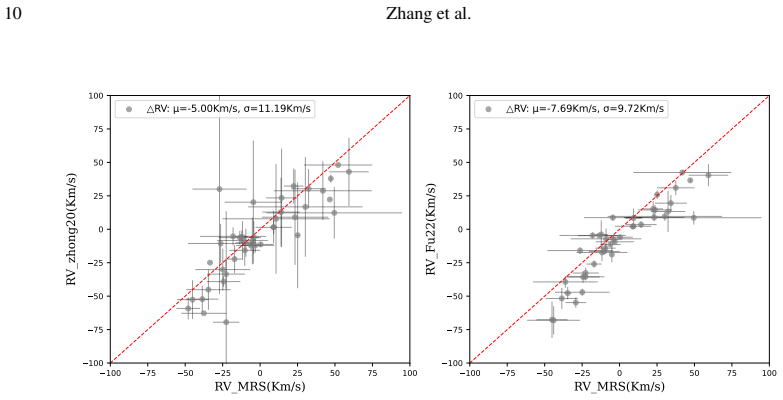
- [Sec. 5.1] The comparisons with Zhong20 and Fu22 yield radial velocity offsets of -5.0 km/s and -7.69 km/s, respectively; the paper calls these 'small', but it should comment on whether these offsets are consistent with known systematics between the LAMOST low-resolution and medium-resolution pipelines.
- [Table 2] Several abundance ratios (O, Al, S, Ti, Cr, Cu) are based on only two member stars; the quoted standard deviations are not meaningful for such small samples and should be flagged or omitted.
Circularity Check
No circularity: the survey's completeness and parameter comparisons are direct counts and external-benchmark checks, with no fitted quantity or self-citation chain carrying the results.
full rationale
The paper makes no derivation or fitting step that could reduce to its own inputs. The 70% completion figure in Section 4 is a direct ratio of 133,792 observed stars to 197,357 input-catalog stars, and the per-magnitude completeness is a direct cross-match count against Gaia DR3 and CG20. The radial-velocity and metallicity validations in Section 5 are comparisons against independent external catalogs and literature values (Gaia DR3, APOGEE DR17, CG20, Tarricq et al. 2021, Zhong et al. 2020, Fu et al. 2022); these serve as benchmarks, not as parameters fitted to produce the reported values. Self-citations such as Zhong et al. 2020 and Fu et al. 2022 are used only for comparison of cluster-averaged quantities, so they are not load-bearing in a way that would make the results self-confirming. The skeptical concern that the abstract's 'sampling ratio of member stars with Gmag < 15 mag can reach 70%' is an aggregate over a field-star-dominated input catalog, while Figure 4 shows member completeness dropping to 27.45% at G = 14-15, is an internal-consistency or reporting-accuracy issue, not a circularity: no quantity is defined in terms of the claim it is supposed to establish, and no prediction is statistically forced by the construction. Under the stated rules, this is an honest non-finding with score 0.
Assumptions & free parameters
assumptions (4)
- domain assumption CG20 membership catalog accurately represents cluster membership down to G=15.
- domain assumption LAMOST MRS DR11 v1.1 stellar parameter pipeline is accurate after external calibration.
- domain assumption Gaia DR3 and APOGEE DR17 provide reliable zero-points for RV and [Fe/H].
- domain assumption The input catalog drawn from CG18 (Cantat-Gaudin et al. 2018) properly defines the target open cluster populations.
Cite this review
Pith. "Pith review of LAMOST medium-resolution spectroscopic survey of Galactic Open Clusters (LAMOST-MRS-O): An overview of survey plan and preliminary results." pith.science (2026). https://pith.science/paper/MYLYUCAA
@misc{pith2026250108548,
  author       = {Pith},
  title        = {Pith review of: LAMOST medium-resolution spectroscopic survey of Galactic Open Clusters (LAMOST-MRS-O): An overview of survey plan and preliminary results},
  year         = {2026},
  howpublished = {\url{https://pith.science/paper/MYLYUCAA}},
  note         = {Machine review of arXiv:2501.08548}
}
read the original abstract
As part of the LAMOST medium-resolution spectroscopic survey, the LAMOST-MRS-O is a non-time domain survey that aims to perform medium-resolution spectral observations for member stars in the open cluster area. This survey plans to obtain the spectroscopic parameters such as radial velocity and metal abundances of member stars and provide data support for further study on the chemical and dynamical characteristics and evolution of open clusters in combination with Gaia data. We have completed the observations on ten open cluster fields and obtained 235184 medium-resolution spectra of 133792 stars. Based on the data analyzed of LAMOST DR11V1.1, for some clusters of particular concern, it is found that the sampling ratio of members stars with Gmag < 15 mag can reach 70%, which indicates that the LAMOST-MRS-O has reached our initial design goal.
Figures


Figures from the paper (8 more)




Reference graph
Works this paper leans on
-
[1]
Ahumada, R., Allende Prieto, C., Almeida, A., et al. 2020, ApJS, 249,
work page 2020
-
[3]
doi:10.3847/1538-4365/ab929e 8 Andr´e, P., Arzoumanian, D., K ¨onyves, V ., et al. 2019, A&A, 629, L4. doi:10.1051/0004-6361/201935915 2 Bai, L., Zhong, J., Chen, L., et al. 2022, Research in Astronomy and Astrophysics, 22, 055022. doi:10.1088/1674-4527/ac60d2 3, 4 Barros, D. A., P´erez-Villegas, A., L´epine, J. R. D., et al. 2020, ApJ, 888,
-
[7]
doi:10.3847/1538-4357/ab298d 2 Magrini, L., Smiljanic, R., Franciosini, E., et al. 2021, A&A, 655, A23. doi:10.1051/0004-6361/202141275 4 Mauc´o, K., Brice˜no, C., Calvet, N., et al. 2018, ApJ, 859,
-
[8]
doi:10.3847/1538-4365/ac5cbb 3 Hunt, E. L. & Reffert, S. 2023, A&A, 673, A114. doi:10.1051/0004-6361/202346285 3 Hunt, E. L. & Reffert, S. 2024, A&A, 686, A42. doi:10.1051/0004-6361/202348662 3 Jiang, Y ., Zhong, J., Qin, S., et al. 2024, ApJ, 971,
-
[12]
doi:10.3847/1538-3881/aaef8d 3 Bragaglia, A., Carretta, E., Gratton, R. G., et al. 2001, AJ, 121,
-
[20]
doi:10.3847/1538-4357/aabf40 4 Odenkirchen, M., Grebel, E. K., Dehnen, W., et al. 2003, AJ, 126,
-
[23]
doi:10.3847/1538-4357/ab6dea 3 Zhang, Y ., Tang, S.-Y ., Chen, W. P., et al. 2020, ApJ, 889,
-
[25]
doi:10.3847/1538-4365/acadd6 3 Rain, M. J., Carraro, G., Ahumada, J. A., et al. 2020, AJ, 159,
Show all 34 references
-
[27]
2020, ApJ, 891,
doi:10.3847/1538-4365/ab3cc0 9 Wang, R., Luo, A.-L., Chen, J.-J., et al. 2020, ApJ, 891,
2020 doi
- [32]
- [33]
-
[44]
2022, ApJ, 938,
doi:10.3847/1538-4357/ac5f4f 2 lin, Z., Xu, Y ., Hao, C., et al. 2022, ApJ, 938,
2022 doi
-
[45]
2023, ApJS, 265,
doi:10.1088/1674-4527/21/2/45 3 Qin, S., Zhong, J., Tang, T., et al. 2023, ApJS, 265,
2023 doi
-
[54]
doi:10.3847/1538-3881/ac77fa 4
-
[59]
J., Ahumada, J
doi:10.3847/1538-3881/ab5f0b 4 Rain, M. J., Ahumada, J. A., & Carraro, G. 2021, A&A, 650, A67. doi:10.1051/0004-6361/202040072 4 Randich, S., Gilmore, G., & Gaia-ESO Consortium 2013, The Messenger, 154, 47 8 Romano, D., Magrini, L., Randich, S., et al. 2021, A&A, 653, A72. doi...
2021 doi
- [65]
-
[71]
2019, A&A, 622, A205
doi:10.3847/1538-4357/ad5344 2 Katz, D., Sartoretti, P., Cropper, M., et al. 2019, A&A, 622, A205. doi:10.1051/0004-6361/201833273 8 K¨onyves, V ., Andr´e, P., Men’shchikov, A., et al. 2015, A&A, 584, A91. doi:10.1051/0004-6361/201525861 2 Lin, C.-C., Hou, J.-L., Chen, L., et ...
2019 doi
-
[75]
B., Bonatto, C
doi:10.3847/1538-4357/ab59d1 9 Bica, E., Pavani, D. B., Bonatto, C. J., et al. 2019, AJ, 157,
2019 doi
-
[77]
M., Cunha, K., et al
doi:10.3847/1538-4357/aa6d0f 4 Donor, J., Frinchaboy, P. M., Cunha, K., et al. 2020, AJ, 159,
2020 doi
-
[83]
2019, ApJ, 876,
doi:10.3847/1538-3881/ab9ab8 8 Sun, W., de Grijs, R., Deng, L., et al. 2019, ApJ, 876,
2019 doi
-
[93]
2022, ApJS, 260,
doi:10.1088/1674-4527/21/4/93 3 He, Z., Li, C., Zhong, J., et al. 2022, ApJS, 260,
2022 doi
-
[99]
doi:10.3847/1538-4357/ab63d4 3 Zhong, J., Chen, L., Kouwenhoven, M. B. N., et al. 2019, A&A, 624, A34. doi:10.1051/0004- 6361/201834334 3, 4 Zhong, J., Chen, L., Wu, D., et al. 2020, A&A, 640, A127. doi:10.1051/0004-6361/201937131 2, 3, 4, 9, 10, 11 Zhong, J., Chen, L., Jiang,...
2019 doi
-
[113]
doi:10.3847/1538-4357/ab16e4 4 Tarasov, A. E. & Malchenko, S. L. 2012, Astronomy Letters, 38,
2012 doi
-
[199]
2022, A&A, 668, A4
doi:10.3847/1538-3881/ab77bc 2 Fu, X., Bragaglia, A., Liu, C., et al. 2022, A&A, 668, A4. doi:10.1051/0004-6361/202243590 2, 9, 10, 11 LAMOST medium-resolution spectral survey of Open clusters 15 Gaia Collaboration, Brown, A. G. A., Vallenari, A., et al. 2018, A&A, 616, A1. do...
2022 doi
-
[205]
2005, ApJS, 160,
doi:10.32023/0001- 5237/71.3.2 4 Preibisch, T., Kim, Y .-C., Favata, F., et al. 2005, ApJS, 160,
2005 doi
-
[226]
2010, A&A, 510, A50
doi:10.1093/mnras/sty2283 4 Smiljanic, R., Pasquini, L., Charbonnel, C., et al. 2010, A&A, 510, A50. doi:10.1051/0004- 6361/200912957 4 Steinmetz, M., Guiglion, G., McMillan, P. J., et al. 2020, AJ, 160,
2010 doi
-
[327]
2018, A&A, 618, A93
doi:10.1086/318042 2 Cantat-Gaudin, T., Jordi, C., Vallenari, A., et al. 2018, A&A, 618, A93. doi:10.1051/0004-6361/201833476 4 Cantat-Gaudin, T., Anders, F., Castro-Ginard, A., et al. 2020, A&A, 640, A1. doi:10.1051/0004- 6361/202038192 3, 6 Carrera, R., Pasquato, M., Vallena...
2018 doi
-
[401]
2021, Research in Astronomy and Astrophysics, 21,
doi:10.1086/432891 4 Qin, S.-M., Li, J., Chen, L., et al. 2021, Research in Astronomy and Astrophysics, 21,
2021 doi
-
[428]
2021, A&A, 647, A19
doi:10.1134/S1063773712060059 4 Tarricq, Y ., Soubiran, C., Casamiquela, L., et al. 2021, A&A, 647, A19. doi:10.1051/0004-6361/202039388 8, 9 Wang, R., Luo, A.-L., Chen, J.-J., et al. 2019, ApJS, 244,
2021 doi
-
[1325]
2023, A&A, 672, A81
doi:10.1088/1674-4527/15/8/015 4 Li, C., Zhong, J., Qin, S., et al. 2023, A&A, 672, A81. doi:10.1051/0004-6361/202244998 2, 4 Li, C., Zhong, J., Qin, S., et al. 2024, A&A, 686, A215. doi:10.1051/0004-6361/202449393 2, 4 Li, C., Sun, W., de Grijs, R., et al. 2019, ApJ, 876,
2023 doi
-
[1368]
Q., Casagrande, L., Zhao, G., et al
doi:10.1086/521022 2 Chen, Y . Q., Casagrande, L., Zhao, G., et al. 2017, ApJ, 840,
2017 doi
-
[2385]
2021, Acta Astronomica, 71,
doi:10.1086/378601 4 Pietrukowicz, P., Soszy ´nski, I., & Udalski, A. 2021, Acta Astronomica, 71,
2021 doi
-
[4637]
doi:10.1093/mnras/staa1827 4 Chen, L., de Grijs, R., & Zhao, J. L. 2007, AJ, 134,
2007 doi
-
[5880]
2021, Research in Astronomy and Astrophysics, 21,
doi:10.1093/mnras/stad2674 4 He, Z.-H., Xu, Y ., Hao, C.-J., et al. 2021, Research in Astronomy and Astrophysics, 21,
2021 doi
Reviewed August 10, 2026 · model on record in the stance chip above.
Discussion (0). Continue with ORCID to comment.