REVIEW 4 major objections 5 minor 105 references
Potential Contribution of Young Pulsar Wind Nebulae to Galactic High-Energy Neutrino Emission
T0 review · 4 major / 5 minor · reviewed 2026-08-10 · deepseek-v4-flash
Pith's one-line read This paper claims that unresolved young pulsar wind nebulae, simulated as Crab-like systems, can contribute about 5 percent of the Galactic high-energy neutrino flux detected by IceCube at 100 TeV.
desk verdict A synthetic-population estimate of neutrino emission from young PWNe; the 5% IceCube contribution is an optimized upper bound, not a robust prediction, but the paper is honest about what it depends on. read the letter →
The pith
A machine-rendered reading of the paper's core claim, the machinery that carries it, and where it could break.
The reading
What carries the argument
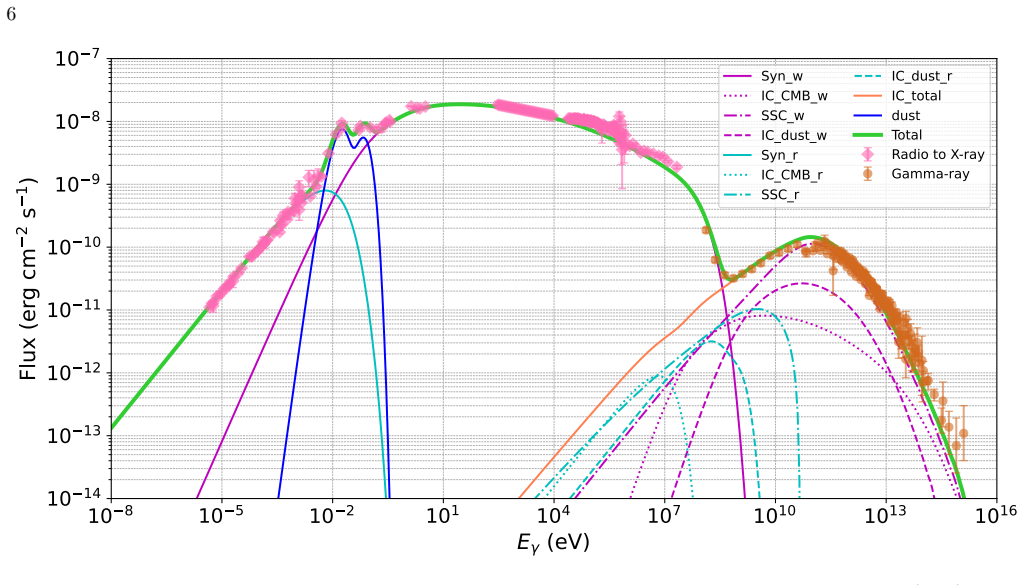
The carrying machinery is a spherically symmetric, time-dependent model of a free-expanding pulsar wind nebula: pulsar spin-down drives radial advection, a power-law magnetic field $B(r)=B_0(r/R_{\rm ts})^{-0.5}$, and a transport equation for protons and electrons with diffusion, adiabatic and synchrotron losses, injection at the termination shock, and free escape at the outer boundary. The Crab nebula serves as the template fixing the model parameters, most importantly the proton energy fraction $\eta_p=0.05$ and the filament gas amplification factor $f_a$ (about 15 for proton index $\alpha_p=1.5$, about 60 for $\alpha_p=2.0$), tuned so that the hadronic component reproduces the LHAASO 1 PeV gamma-ray flux. This template is then applied to a synthetic Galactic population of roughly 50 young PWNe per realization, laid down with spiral-arm structure and realistic pulsar birth properties, whose pp neutrino spectra are summed for comparison with the IceCube diffuse templates.
What would settle it
A measurement showing that the Crab's 1 PeV gamma-ray excess is fully accounted for by inverse Compton emission from electrons, leaving no hadronic component, would remove the calibration of $\eta_p$ and $f_a$ and collapse the template, falsifying the predicted 5% contribution. Alternatively, IceCube or KM3NeT measuring a Galactic-plane neutrino flux at 100 TeV that is statistically consistent with zero contribution from the three brightest young PWNe in the simulated sample would rule out the optimistic population prediction.
Extended reading notes
Core claim
The central claim is that unresolved young PWNe, simulated as Crab-like systems, produce a collective high-energy neutrino flux that is small but not negligible, reaching roughly 5% of the IceCube-measured Galactic flux at 100 TeV in the optimistic case. To get there, the paper time-evolves each PWN's radius, termination shock, magnetic field, and particle distribution through the free-expansion phase, injects protons at the termination shock, and computes pp neutrino emission from a two-zone gas density whose filament amplification factor is calibrated so that the Crab's hadronic gamma-ray flux matches the LHAASO 1 PeV point. For the synthetic population, only sources younger than their reverse-shock collision time and older than 50 years are kept, and a flux cut removes three extremely bright nearby objects. The authors conclude that while the bulk of the Galactic neutrino flux remains diffuse, a few luminous young PWNe can shape the observable sky at the highest energies, especially if the proton spectrum is hard.
Load-bearing premise
The central assumption is that every young pulsar wind nebula behaves like the Crab, converting the same 5% of spin-down power into protons and having the same filament-amplified target gas density, calibrated to the Crab's 1 PeV gamma-ray excess; if that excess is leptonic, or if other nebulae accelerate protons more weakly, the predicted neutrino flux drops sharply.
Editorial extensions
If this is right
- If the optimistic prediction holds, unresolved young PWNe account for roughly one twentieth of IceCube's Galactic neutrino flux at 100 TeV, so diffuse-only templates slightly overestimate the truly diffuse component.
- At about 1 PeV with a hard proton index of 1.5, the young-PWN population contributes about 45% of the KRA$^5_\gamma$ template, meaning discrete hadronic sources can dominate the highest-energy Galactic neutrino sky even if they are minor at 100 TeV.
- The three brightest simulated sources alone set the upper bound of the predicted flux; removing them cuts the upper bound by nearly an order of magnitude, so the Milky Way's PeV neutrino sky is likely clumpy rather than smooth.
- For the canonical soft proton spectrum with index 2.0, the neutrino flux declines steeply toward PeV energies, making the injection spectral index a decisive observable for distinguishing hadronic acceleration models.
- The population approach sidesteps the TeV sensitivity bias of catalog-based stacking, so the 5% estimate includes sources too faint to appear in current gamma-ray catalogs.
Reading between the lines
- If the Crab-like template is representative, future detectors such as KM3NeT, IceCube-Gen2, or Baikal-GVD may resolve individual young PWNe as neutrino point sources, and the same data would directly measure the proton fraction that this paper only calibrates from the Crab.
- The model's gas-density prescription is testable at other wavelengths: mapping filament mass and clumpiness in young PWNe of different ages, for example with ALMA or JWST, would confirm or reject the age-dependent amplification factor assumed here.
- The paper deliberately excludes reverberation-phase PWNe, but those nebulae can be compressed to higher densities; if protons survive the reverse shock, a follow-up population including that phase could raise the total Galactic PWN neutrino flux above the 5% estimate.
- Because the proton fraction is the single most sensitive parameter, a future multi-wavelength fit of any young PWN other than the Crab, such as Vela-X, that includes a hadronic PeV component would provide an independent check on whether the 5% number is a floor or a ceiling.
Editorial analysis
A structured set of objections, weighed in public.
Referee Report
Summary. The paper constructs a synthetic population of young, free-expanding pulsar wind nebulae in the Galaxy and computes their all-flavor high-energy neutrino emission using a time-dependent, spherically symmetric transport model. The Crab nebula is used as a template: its multi-wavelength spectrum is fitted with synchrotron and inverse-Compton emission from two electron populations plus a hadronic component, and the LHAASO 1 PeV gamma-ray point is used to fix the product of the proton energy fraction and the filament gas amplification factor. Applying the resulting Crab-like parameters to simulated young PWNe, the authors find that, in their optimistic case, the population contributes about 5% of the IceCube Galactic-plane flux around 100 TeV and that at PeV energies the contribution depends strongly on the proton injection index and on a few nearby bright sources.
Significance. If the estimate is taken as an upper bound, the paper provides a useful new estimate of an unresolved, population-level contribution to the Galactic high-energy neutrino flux that is not accessible to catalog stacking. The main strength is the forward-modeling approach: rather than relying on gamma-ray selected catalogs, the authors simulate the PWN population and propagate Crab-calibrated microphysics through a time-dependent transport equation. The paper also explicitly identifies several limitations, including the simplified filament treatment and the uncertain hadronic interpretation of the Crab's PeV excess. The central number, however, is not a measurement-based prediction: it is an optimistic upper limit under the assumption that the Crab's PeV gamma-ray excess is hadronic and that every young PWN shares the Crab's proton fraction and gas amplification. The manuscript would be strengthened by stating this status consistently and by quantifying the linear sensitivity of the neutrino flux to the calibrated parameters.
major comments (4)
- [§4.1 and Table 3 vs. §3 and Table 1] The synthetic population uses Vf = 0.5, while the Crab template fit that is supposed to calibrate the population uses Vf = 0.15. Since Vf enters Eq. (8) and therefore controls advective transport in Eq. (11), it directly sets the proton residence time and the pp neutrino yield. A source with Vf = 0.5 is not 'Crab-like' in this important respect, so the transfer of the calibrated ηp and fa from the Crab to the synthetic population is not internally consistent. Please either adopt the Crab value Vf = 0.15 for the population or show a sensitivity scan demonstrating that the 100 TeV and 1 PeV conclusions are insensitive to Vf.
- [§4.2, Abstract, and §6] The headline '5% of the measured flux by IceCube' is not supported by the quantitative statement in §4.2, which says the post-flux-cut upper band is '∼ 5% relative to the lower limit of the KRAγ model'. The lower edge of a diffuse-model 1σ band is not the same as the measured IceCube flux, and the conclusion's wording ('about 5% of the best-fit results from IceCube') is again different. Moreover, this 5% number is the upper bound of the band after applying the optional flux cut F > 10^-5 erg cm^-2 s^-1 that removes the three dominant nearby sources. The abstract and conclusion should be rephrased to say: under the optimistic hadronic assumption and after excluding a few ultra-bright sources, the upper bound of the predicted young-PWN flux is about 5% of the lower edge of the KRAγ diffuse template.
- [§3.1–3.2 and Eq. (27)] The neutrino normalization is calibrated to the Crab under a specific hadronic interpretation: ηp = 0.05 is obtained as the maximum allowed after requiring ηe ≥ 0.93, and fa is then tuned so that the pp gamma-ray flux matches the LHAASO 1 PeV point. Because the neutrino and gamma-ray fluxes are produced by the same pp mechanism, this is a circular normalization in the sense that the neutrino flux inherits the assumed hadronic gamma-ray flux, and the result scales linearly with the product ηp × fa. If the PeV excess is leptonic, or if ηp is lower than its maximum in other PWNe, the neutrino flux decreases proportionally. The paper should explicitly label this as an upper-limit scenario and provide at least a one-parameter scaling (e.g., 'the contribution scales as (ηp/0.05) × (fa/fa,Crab)') or a short sensitivity table over ηp and fa.
- [§4.2 and Figures 4] The quoted 5% result is the upper envelope of 100 Monte Carlo realizations after the age cut and the optional flux cut, not a central value with propagated uncertainties. The text reports only min/max bands over realizations with fixed physics parameters (ηp, fa, Vf, Crab fitting parameters); the wide distributions in Table 3 for P0, Bs, Esn, and Mej are sampled, but the calibrated parameters themselves are not varied. Since the conclusion depends on three excluded bright sources and on the adopted Vf value, a proper estimate of the spread around the 5% number, including variation of the Crab-calibrated parameters, is needed before this can be presented as a quantitative contribution rather than an illustrative optimistic curve.
minor comments (5)
- [§2.2] The text contains the typo 'spacial variance' in the description of the diffusion coefficient; it should be 'spatial variance'.
- [§3.2] The word 'manetohydrodynamic' appears in the discussion of filament simulations; it should be 'magnetohydrodynamic'.
- [§4.2] The sentence describing the number of removed sources is easy to misread: 'Among the sample 71 sources are removed according to the 50-year criterion' should specify that this is the total across 100 realizations, i.e., about 0.7 sources per realization, before the optional flux criterion is applied.
- [Eq. (27)] The definition of fa as a 'general effect of accumulation' differs from Atoyan & Aharonian (1996), but no explicit prescription is given for how fa multiplies n_m beyond Eq. (27). A one-sentence clarification that the effective density in the filament zone is neff = fa × nm would remove ambiguity.
- [Table 3] The caption and text use 'Log10-normal' for Esn and Bs and 'normal' for P0; please state explicitly whether the parameters are drawn in log10 space and cite the source choices for the standard deviations, since the σ = 35 ms for the initial spin period is stated to be 'somehow arbitrary'.
Circularity Check
No significant circularity: the neutrino flux is a conditional prediction from a Crab-calibrated hadronic model, not a result defined by its own target.
full rationale
The derivation chain is: Section 2 sets up the transport and pp-emission equations, with Eq. 24 linking gamma-ray and neutrino emissivities to the same proton distribution and target gas density. Section 3 calibrates the Crab template: ηp is bounded by the leptonic fit (ηe ≥ 0.93) and fa is fitted to the LHAASO 1 PeV gamma-ray flux. Section 4 then applies these values to a synthetic population and compares the resulting neutrino flux to IceCube. This is model calibration followed by an out-of-sample prediction in a different messenger, not a circular reduction: the 5% figure is not obtained by fitting to IceCube neutrino data, and no model-defining equation contains the predicted neutrino flux as an input. The dependence of the predicted neutrino flux on the fitted product ηp × fa is a real model limitation, and the paper itself flags it in Section 5.2 ('the amplification factor fa only represents a general effect of accumulation and does not vary over time for a given injection index', and 'more observations of the filaments as well as precise gamma-ray measurement will definitely help constrain this factor'). The self-citations (Liu & Wang 2021; Liang et al. 2022; Chen et al. 2024a,b) are contextual and not load-bearing: the chosen ηp = 0.05 is obtained from the paper's own spectral fit, not from Liu & Wang's cited upper-limit range. The hadronic origin of the PeV excess is an assumption and a correctness risk, but no exhibited equation reduces the neutrino prediction to the gamma-ray fit by construction.
Assumptions & free parameters
free parameters (8)
- eta_p (proton energy fraction) =
0.05
- fa (filament gas amplification factor) =
15 for alpha_p=1.5, 60 for alpha_p=2.0
- eta_B (magnetic energy fraction) =
0.02
- eta_e (electron energy fraction) =
0.93
- B0 (magnetic field at termination shock for Crab) =
234 microG
- Crab electron injection parameters alpha1, alpha2, gamma_b, gamma_e_min =
1.7, 2.3, 1e6, 2e5
- Vf (velocity factor) =
0.15 for Crab, 0.5 for population
- Population priors for P0, Bs, Esn, Mej =
P0 normal mu=50 ms sigma=35 ms; Bs lognormal mu=12.65 sigma=0.55; Esn lognormal mu=51 sigma=0.2; Mej normal mu=10…
assumptions (6)
- domain assumption A spherically symmetric PWN with radial flow and a toroidal magnetic field adequately represents real young PWNe.
- ad hoc to paper The LHAASO PeV gamma-ray excess in the Crab is mostly hadronic, produced by protons injected at the termination shock.
- ad hoc to paper All synthetic PWNe evolve with the same energy partition and filament prescription as the Crab.
- domain assumption Pulsar spin-down in the synthetic population follows pure dipole braking with n=3.
- ad hoc to paper The two-zone gas density model with time-independent amplification factor fa captures the hadronic target density in young PWNe.
- domain assumption The transport equation with free escape at the PWN boundary describes particle propagation and losses.
Cite this review
Pith. "Pith review of Potential Contribution of Young Pulsar Wind Nebulae to Galactic High-Energy Neutrino Emission." pith.science (2026). https://pith.science/paper/LQVNWYDU
@misc{pith2026250108957,
  author       = {Pith},
  title        = {Pith review of: Potential Contribution of Young Pulsar Wind Nebulae to Galactic High-Energy Neutrino Emission},
  year         = {2026},
  howpublished = {\url{https://pith.science/paper/LQVNWYDU}},
  note         = {Machine review of arXiv:2501.08957}
}
read the original abstract
Pulsar wind nebulae (PWNe), especially the young ones, are among the most energetic astrophysical sources in the Galaxy. It is usually believed that the spin-down energy injected from the pulsars is converted into magnetic field and relativistic electrons, but the possible presence of proton acceleration inside PWNe cannot be ruled out. Previous works have estimated the neutrino emission from PWNe using various source catalogs measured in gamma-rays. However, such results rely on the sensitivity of TeV gamma-ray observations and may omit the contribution by unresolved sources. Here we estimate the potential neutrino emission from a synthetic population of PWNe in the Galaxy with a focus on the ones that are still in the free expansion phase. In the calculation, we model the temporal evolution of the free-expanding PWNe and consider the transport of protons inside the PWNe. The Crab nebula is treated as a standard template for young PWNe to evaluate some model parameters, such as the energy conversion fraction of relativistic protons and the target gas density for the hadronic process, which are relevant to neutrino production. In the optimistic case, the neutrino flux from the simulated young PWNe may constitute to 5% of the measured flux by IceCube around 100 TeV. At higher energy around 1 PeV, the neutrino emission from the population highly depends on the injection spectral shape, and also on the emission of the nearby prominent sources.
Figures


Figures from the paper (1 more)

Reference graph
Works this paper leans on
-
[1]
G., Ackermann, M., Adams, J., et al
Aartsen, M. G., Ackermann, M., Adams, J., et al. 2017a, Journal of Instrumentation, 12, P03012, doi: 10.1088/1748-0221/12/03/P03012 —. 2017b, ApJ, 849, 67, doi: 10.3847/1538-4357/aa8dfb —. 2020, ApJ, 898, 117, doi: 10.3847/1538-4357/ab9fa0
-
[2]
G., Abbasi, R., Ackermann, M., et al
Aartsen, M. G., Abbasi, R., Ackermann, M., et al. 2021, Journal of Physics G Nuclear Physics, 48, 060501, doi: 10.1088/1361-6471/abbd48
-
[3]
2023, Science, 380, 1338, doi: 10.1126/science.adc9818
Abbasi, R., Ackermann, M., Adams, J., et al. 2023, Science, 380, 1338, doi: 10.1126/science.adc9818
-
[4]
U., Albert, A., Alfaro, R., et al
Abeysekara, A. U., Albert, A., Alfaro, R., et al. 2019, ApJ, 881, 134, doi: 10.3847/1538-4357/ab2f7d
-
[5]
Acciari, V. A., Ansoldi, S., Antonelli, L. A., et al. 2020, A&A, 635, A158, doi: 10.1051/0004-6361/201936899 Adri´ an-Mart ´ ınez, S., Ageron, M., Aharonian, F., et al. 2016a, Journal of Physics G Nuclear Physics, 43, 084001, doi: 10.1088/0954-3899/43/8/084001 Adri´ an-Mart ´ ınez, S., Albert, A., Andr´ e, M., et al. 2016b, Physics Letters B, 760, 143, do...
-
[6]
Ageron, M., Aguilar, J. A., Al Samarai, I., et al. 2011, Nuclear Instruments and Methods in Physics Research A, 656, 11, doi: 10.1016/j.nima.2011.06.103
-
[7]
2020, Nature Astronomy, 4, 913, doi: 10.1038/s41550-020-1182-4
Agostini, M., B¨ ohmer, M., Bosma, J., et al. 2020, Nature Astronomy, 4, 913, doi: 10.1038/s41550-020-1182-4
-
[8]
2004, ApJ, 614, 897, doi: 10.1086/423931
Aharonian, F., Akhperjanian, A., Beilicke, M., et al. 2004, ApJ, 614, 897, doi: 10.1086/423931
doi:10.1086/423931 2004
Show all 105 references
-
[9]
2024, A&A, 686, A308, doi: 10.1051/0004-6361/202348651
Aharonian, F., Ait Benkhali, F., Aschersleben, J., et al. 2024, A&A, 686, A308, doi: 10.1051/0004-6361/202348651
2024 doi
-
[10]
2017, PRD, 96, 062001, doi: 10.1103/PhysRevD.96.062001 —
Albert, A., Andr´ e, M., Anghinolfi, M., et al. 2017, PRD, 96, 062001, doi: 10.1103/PhysRevD.96.062001 —. 2018, ApJL, 868, L20, doi: 10.3847/2041-8213/aaeecf
2017 doi
-
[11]
2023, Physics Letters B, 841, 137951, doi: 10.1016/j.physletb.2023.137951 Aleksi´ c, J., Ansoldi, S., Antonelli, L
Albert, A., Alves, S., Andr´ e, M., et al. 2023, Physics Letters B, 841, 137951, doi: 10.1016/j.physletb.2023.137951 Aleksi´ c, J., Ansoldi, S., Antonelli, L. A., et al. 2015, Journal of High Energy Astrophysics, 5, 30, doi: 10.1016/j.jheap.2015.01.002
2023
- [12]
-
[13]
2003, A&A, 402, 827, doi: 10.1051/0004-6361:20030279
Amato, E., Guetta, D., & Blasi, P. 2003, A&A, 402, 827, doi: 10.1051/0004-6361:20030279
2003 doi
-
[14]
W., Bi, X
Amenomori, M., Bao, Y. W., Bi, X. J., et al. 2019, PhRvL, 123, 051101, doi: 10.1103/PhysRevLett.123.051101
2019 doi
-
[15]
2020, ApJ, 897, 33, doi: 10.3847/1538-4357/ab9368
Arakawa, M., Hayashida, M., Khangulyan, D., & Uchiyama, Y. 2020, ApJ, 897, 33, doi: 10.3847/1538-4357/ab9368
2020 doi
- [16]
-
[17]
M., & Aharonian, F
Atoyan, A. M., & Aharonian, F. A. 1996, MNRAS, 278, 525, doi: 10.1093/mnras/278.2.525
1996 doi
-
[18]
M., & Nahapetian, A
Atoyan, A. M., & Nahapetian, A. 1989, A&A, 219, 53
1989
-
[19]
2011, Nuclear Instruments and Methods in Physics Research A, 639, 30, doi: 10.1016/j.nima.2010.09.137
Avrorin, A., Aynutdinov, V., Belolaptikov, I., et al. 2011, Nuclear Instruments and Methods in Physics Research A, 639, 30, doi: 10.1016/j.nima.2010.09.137
2011 doi
-
[20]
Torres, D. F. 2020, MNRAS, 499, 2051, doi: 10.1093/mnras/staa2956 —. 2023a, MNRAS, 520, 2451, doi: 10.1093/mnras/stad134
2020 doi
-
[21]
Bandiera, R., Bucciantini, N., Olmi, B., & Torres, D. F. 2023b, MNRAS, 525, 2839, doi: 10.1093/mnras/stad2387
-
[22]
2002, A&A, 386, 1044, doi: 10.1051/0004-6361:20020325
Bandiera, R., Neri, R., & Cesaroni, R. 2002, A&A, 386, 1044, doi: 10.1051/0004-6361:20020325
2002 doi
-
[23]
1983, A&A, 126, 7
Bandiera, R., Pacini, F., & Salvati, M. 1983, A&A, 126, 7
1983
-
[24]
2003, A&A, 407, 1, doi: 10.1051/0004-6361:20030929
Bednarek, W. 2003, A&A, 407, 1, doi: 10.1051/0004-6361:20030929
2003 doi
-
[25]
2003, A&A, 405, 689, doi: 10.1051/0004-6361:20030593
Bednarek, W., & Bartosik, M. 2003, A&A, 405, 689, doi: 10.1051/0004-6361:20030593
2003 doi
-
[26]
Bednarek, W., & Protheroe, R. J. 1997, PhRvL, 79, 2616, doi: 10.1103/PhysRevLett.79.2616
1997 doi
-
[27]
Bouyahiaoui, M., Kachelrieß, M., & Semikoz, D. V. 2020, PRD, 101, 123023, doi: 10.1103/PhysRevD.101.123023
2020 doi
-
[28]
M., & Del Zanna, L
Bucciantini, N., Amato, E., Bandiera, R., Blondin, J. M., & Del Zanna, L. 2004, A&A, 423, 253, doi: 10.1051/0004-6361:20040360
2004 doi
-
[29]
2011, MNRAS, 410, 381, doi: 10.1111/j.1365-2966.2010.17449.x
Bucciantini, N., Arons, J., & Amato, E. 2011, MNRAS, 410, 381, doi: 10.1111/j.1365-2966.2010.17449.x
2011
-
[30]
2023, Nature Astronomy, 7, 602, doi: 10.1038/s41550-023-01936-8
Bucciantini, N., Ferrazzoli, R., Bachetti, M., et al. 2023, Nature Astronomy, 7, 602, doi: 10.1038/s41550-023-01936-8
2023 doi
-
[31]
2021, Science, 373, 425, doi: 10.1126/science.abg5137
Cao, Z., Aharonian, F., An, Q., et al. 2021, Science, 373, 425, doi: 10.1126/science.abg5137
2021 doi
-
[32]
Q., Huang, Y., Hou, L
Chen, B. Q., Huang, Y., Hou, L. G., et al. 2019, MNRAS, 487, 1400, doi: 10.1093/mnras/stz1357
2019 doi
-
[33]
2024a, ApJ, 976, 172, doi: 10.3847/1538-4357/ad87d2
Chen, X.-B., Liang, X.-H., Liu, R.-Y., & Wang, X.-Y. 2024a, ApJ, 976, 172, doi: 10.3847/1538-4357/ad87d2
-
[34]
2024b, MNRAS, 527, 7915, doi: 10.1093/mnras/stad3733
Chen, X.-B., Liu, R.-Y., Wang, X.-Y., & Chang, X.-C. 2024b, MNRAS, 527, 7915, doi: 10.1093/mnras/stad3733
-
[35]
S., Cheung, T., Lau, M
Cheng, K. S., Cheung, T., Lau, M. M., Yu, K. N., & Kwok, P. W. 1990, Journal of Physics G Nuclear Physics, 16, 1115, doi: 10.1088/0954-3899/16/7/022
1990 doi
- [36]
-
[37]
B., et al
Cristofari, P., Gabici, S., Humensky, T. B., et al. 2017, MNRAS, 471, 201, doi: 10.1093/mnras/stx1574 Del Zanna, L., Amato, E., & Bucciantini, N. 2004, A&A, 421, 1063, doi: 10.1051/0004-6361:20035936 14 Di Palma, I., Guetta, D., & Amato, E. 2017, ApJ, 836, 159, doi: 10.3847/15...
2017 doi
-
[38]
2023, A&A, 671, A67, doi: 10.1051/0004-6361/202243578
Dirson, L., & Horns, D. 2023, A&A, 671, A67, doi: 10.1051/0004-6361/202243578
2023 doi
-
[39]
Drury, L. O. 1983, Reports on Progress in Physics, 46, 973, doi: 10.1088/0034-4885/46/8/002
1983 doi
-
[40]
2007, JCAP, 2007, 003, doi: 10.1088/1475-7516/2007/06/003 Faucher-Gigu` ere, C.-A., & Kaspi, V
Evoli, C., Grasso, D., & Maccione, L. 2007, JCAP, 2007, 003, doi: 10.1088/1475-7516/2007/06/003 Faucher-Gigu` ere, C.-A., & Kaspi, V. M. 2006, ApJ, 643, 332, doi: 10.1086/501516
2007 doi
-
[41]
2022, MNRAS, 511, 1439, doi: 10.1093/mnras/stac019
Fiori, M., Olmi, B., Amato, E., et al. 2022, MNRAS, 511, 1439, doi: 10.1093/mnras/stac019
2022 doi
-
[42]
2013, Research in Astronomy and Astrophysics, 13, 680, doi: 10.1088/1674-4527/13/6/007
Fouka, M., & Ouichaoui, S. 2013, Research in Astronomy and Astrophysics, 13, 680, doi: 10.1088/1674-4527/13/6/007
2013 doi
-
[43]
M., & Slane, P
Gaensler, B. M., & Slane, P. O. 2006, ARA&A, 44, 17, doi: 10.1146/annurev.astro.44.051905.092528
2006 arXiv
-
[44]
2015, ApJL, 815, L25, doi: 10.1088/2041-8205/815/2/L25
Gaggero, D., Grasso, D., Marinelli, A., Urbano, A., & Valli, M. 2015, ApJL, 815, L25, doi: 10.1088/2041-8205/815/2/L25
2015 doi
-
[45]
2024, ApJ, 969, 161, doi: 10.3847/1538-4357/ad4960
Gagliardini, S., Langella, A., Guetta, D., & Capone, A. 2024, ApJ, 969, 161, doi: 10.3847/1538-4357/ad4960
2024 doi
-
[46]
D., Slane, P
Gelfand, J. D., Slane, P. O., & Zhang, W. 2009, ApJ, 703, 2051, doi: 10.1088/0004-637X/703/2/2051
2009 doi
- [47]
-
[48]
2003, Astroparticle Physics, 19, 403, doi: 10.1016/S0927-6505(02)00221-9
Guetta, D., & Amato, E. 2003, Astroparticle Physics, 19, 403, doi: 10.1016/S0927-6505(02)00221-9
2003 doi
-
[49]
Hester, J. J. 2008, ARA&A, 46, 127, doi: 10.1146/annurev.astro.45.051806.110608
2008 arXiv
-
[50]
J., Stone, J
Hester, J. J., Stone, J. M., Scowen, P. A., et al. 1996, ApJ, 456, 225, doi: 10.1086/176643
1996 doi
-
[51]
A., Funk, S., Parsons, R
Hinton, J. A., Funk, S., Parsons, R. D., & Ohm, S. 2011, ApJL, 743, L7, doi: 10.1088/2041-8205/743/1/L7
2011 doi
-
[52]
Horns, D., Aharonian, F., Santangelo, A., Hoffmann, A. I. D., & Masterson, C. 2006, A&A, 451, L51, doi: 10.1051/0004-6361:20065116
2006 doi
-
[53]
G., & Han, J
Hou, L. G., & Han, J. L. 2014, A&A, 569, A125, doi: 10.1051/0004-6361/201424039
2014 doi
-
[54]
Q., Cao, Z., Chen, M., et al
Huang, T. Q., Cao, Z., Chen, M., et al. 2024, in 38th International Cosmic Ray Conference, 1080
2024
-
[55]
A., Karastergiou, A., & Kramer, M
Johnston, S., Smith, D. A., Karastergiou, A., & Kramer, M. 2020, MNRAS, 497, 1957, doi: 10.1093/mnras/staa2110
2020 doi
-
[56]
Jones, F. C. 1968, Physical Review, 167, 1159, doi: 10.1103/PhysRev.167.1159
1968 doi
-
[57]
1998, ApJ, 499, 282, doi: 10.1086/305627
Jun, B.-I. 1998, ApJ, 499, 282, doi: 10.1086/305627
1998 doi
-
[58]
Kasen, D., & Woosley, S. E. 2009, ApJ, 703, 2205, doi: 10.1088/0004-637X/703/2/2205
2009 doi
-
[59]
F., & Coroniti, F
Kennel, C. F., & Coroniti, F. V. 1984a, ApJ, 283, 694, doi: 10.1086/162356 —. 1984b, ApJ, 283, 710, doi: 10.1086/162357
-
[60]
2021, PRD, 104, 123027, doi: 10.1103/PhysRevD.104.123027
Koldobskiy, S., Kachelrieß, M., Lskavyan, A., et al. 2021, PRD, 104, 123027, doi: 10.1103/PhysRevD.104.123027
2021 doi
-
[61]
Y., Plavin, A
Kovalev, Y. Y., Plavin, A. V., & Troitsky, S. V. 2022, ApJL, 940, L41, doi: 10.3847/2041-8213/aca1ae LHAASO Collaboration. 2024, Science Bulletin, 69, 449, doi: 10.1016/j.scib.2023.12.040
2022 doi
-
[62]
2022, Universe, 8, 547, doi: 10.3390/universe8100547
Liang, X.-H., Li, C.-M., Wu, Q.-Z., Pan, J.-S., & Liu, R.-Y. 2022, Universe, 8, 547, doi: 10.3390/universe8100547
2022 doi
-
[63]
2018, PRD, 98, 043003, doi: 10.1103/PhysRevD.98.043003
Lipari, P., & Vernetto, S. 2018, PRD, 98, 043003, doi: 10.1103/PhysRevD.98.043003
2018 doi
-
[64]
2021, ApJ, 922, 221, doi: 10.3847/1538-4357/ac2ba0
Liu, R.-Y., & Wang, X.-Y. 2021, ApJ, 922, 221, doi: 10.3847/1538-4357/ac2ba0
2021 doi
-
[65]
2017, ApJ, 834, 43, doi: 10.3847/1538-4357/834/1/43
Lu, F.-W., Gao, Q.-G., & Zhang, L. 2017, ApJ, 834, 43, doi: 10.3847/1538-4357/834/1/43
2017 doi
-
[66]
2020, ApJ, 896, 147, doi: 10.3847/1538-4357/ab93c0
Luo, Y., Lyutikov, M., Temim, T., & Comisso, L. 2020, ApJ, 896, 147, doi: 10.3847/1538-4357/ab93c0
2020 doi
-
[67]
2019, MNRAS, 489, 2403, doi: 10.1093/mnras/stz2023
Lyutikov, M., Temim, T., Komissarov, S., et al. 2019, MNRAS, 489, 2403, doi: 10.1093/mnras/stz2023
2019 doi
-
[68]
Martin, J., & Torres, D. F. 2022, Journal of High Energy Astrophysics, 36, 128, doi: 10.1016/j.jheap.2022.09.003 Mart ´ ın, J., Torres, D. F., & Rea, N. 2012, MNRAS, 427, 415, doi: 10.1111/j.1365-2966.2012.22014.x
2022
-
[69]
2022, A&A, 666, A7, doi: 10.1051/0004-6361/202244002
Martin, P., Tibaldo, L., Marcowith, A., & Abdollahi, S. 2022, A&A, 666, A7, doi: 10.1051/0004-6361/202244002
2022 doi
-
[70]
2021, MNRAS, 502, 1864, doi: 10.1093/mnras/staa4046
Martin, T., Milisavljevic, D., & Drissen, L. 2021, MNRAS, 502, 1864, doi: 10.1093/mnras/staa4046
2021 doi
-
[71]
2015, in International Cosmic Ray Conference, Vol
Meagher, K. 2015, in International Cosmic Ray Conference, Vol. 34, 34th International Cosmic Ray Conference (ICRC2015), 792, doi: 10.22323/1.236.0792
2015 doi
-
[72]
Meyer, M., Horns, D., & Zechlin, H. S. 2010, A&A, 523, A2, doi: 10.1051/0004-6361/201014108
2010 doi
-
[73]
2023, PRD, 108, 103044, doi: 10.1103/PhysRevD.108.103044
Kouchner, A. 2023, PRD, 108, 103044, doi: 10.1103/PhysRevD.108.103044
2023 doi
-
[74]
2022, ApJ, 924, 42, doi: 10.3847/1538-4357/ac348d
Nie, L., Liu, Y., Jiang, Z., & Geng, X. 2022, ApJ, 924, 42, doi: 10.3847/1538-4357/ac348d
2022 doi
-
[75]
T., Gritschneder, M., & Lesch, H
Nodes, C., Birk, G. T., Gritschneder, M., & Lesch, H. 2004, A&A, 423, 13, doi: 10.1051/0004-6361:20047065
2004 doi
-
[76]
2014, MNRAS, 438, 1518, doi: 10.1093/mnras/stt2308
Bucciantini, N. 2014, MNRAS, 438, 1518, doi: 10.1093/mnras/stt2308
2014 doi
-
[77]
2016, Journal of Plasma Physics, 82, 635820601, doi: 10.1017/S0022377816000957
Mignone, A. 2016, Journal of Plasma Physics, 82, 635820601, doi: 10.1017/S0022377816000957
2016 doi
-
[78]
J., & Barlow, M
Owen, P. J., & Barlow, M. J. 2015, ApJ, 801, 141, doi: 10.1088/0004-637X/801/2/141
2015 doi
-
[79]
Parker, E. N. 1965, Planet. Space Sci., 13, 9, doi: 10.1016/0032-0633(65)90131-5 15
1965 doi
-
[80]
2022, ApJ, 926, 7, doi: 10.3847/1538-4357/ac4161
Peng, Q.-Y., Bao, B.-W., Lu, F.-W., & Zhang, L. 2022, ApJ, 926, 7, doi: 10.3847/1538-4357/ac4161
2022 doi
-
[81]
S., & Keppens, R
Porth, O., Komissarov, S. S., & Keppens, R. 2014a, MNRAS, 438, 278, doi: 10.1093/mnras/stt2176 —. 2014b, MNRAS, 443, 547, doi: 10.1093/mnras/stu1082
-
[82]
J., Menten, K
Reid, M. J., Menten, K. M., Brunthaler, A., et al. 2019, ApJ, 885, 131, doi: 10.3847/1538-4357/ab4a11
2019 doi
-
[83]
Smartt, S. J. 2009, ARA&A, 47, 63, doi: 10.1146/annurev-astro-082708-101737
2009 doi
-
[84]
2013, MNRAS, 434, 102, doi: 10.1093/mnras/stt1004
Smith, N. 2013, MNRAS, 434, 102, doi: 10.1093/mnras/stt1004
2013 doi
-
[85]
Stecker, F. W. 1979, ApJ, 228, 919, doi: 10.1086/156919
1979 doi
-
[86]
T., Kresse, D., et al
Stockinger, G., Janka, H. T., Kresse, D., et al. 2020, MNRAS, 496, 2039, doi: 10.1093/mnras/staa1691
2020 doi
-
[87]
J., & Asano, K
Tanaka, S. J., & Asano, K. 2017, ApJ, 841, 78, doi: 10.3847/1538-4357/aa6f13
2017 doi
-
[88]
J., & Takahara, F
Tanaka, S. J., & Takahara, F. 2010, ApJ, 715, 1248, doi: 10.1088/0004-637X/715/2/1248
2010 doi
-
[89]
M., & Manchester, R
Tauris, T. M., & Manchester, R. N. 1998, MNRAS, 298, 625, doi: 10.1046/j.1365-8711.1998.01369.x
1998
-
[90]
M., Kavanagh, P
Temim, T., Laming, J. M., Kavanagh, P. J., et al. 2024, ApJL, 968, L18, doi: 10.3847/2041-8213/ad50d1
2024 doi
-
[91]
F., Cillis, A., Mart ´ ın, J., & de O˜ na Wilhelmi, E
Torres, D. F., Cillis, A., Mart ´ ın, J., & de O˜ na Wilhelmi, E. 2014, Journal of High Energy Astrophysics, 1, 31, doi: 10.1016/j.jheap.2014.02.001
2014 doi
-
[92]
F., Mart ´ ın, J., de O˜ na Wilhelmi, E., & Cillis, A
Torres, D. F., Mart ´ ın, J., de O˜ na Wilhelmi, E., & Cillis, A. 2013, MNRAS, 436, 3112, doi: 10.1093/mnras/stt1793
2013 doi
-
[93]
Troitsky, S. V. 2024, Physics Uspekhi, 67, 349, doi: 10.3367/UFNe.2023.04.039581
2024 doi
- [94]
-
[95]
J., & Moraal, H
Vorster, M. J., & Moraal, H. 2013, ApJ, 765, 30, doi: 10.1088/0004-637X/765/1/30
2013 doi
-
[96]
J., Tibolla, O., Ferreira, S
Vorster, M. J., Tibolla, O., Ferreira, S. E. S., & Kaufmann, S. 2013, ApJ, 773, 139, doi: 10.1088/0004-637X/773/2/139
2013 doi
-
[97]
P., & Romani, R
Watters, K. P., & Romani, R. W. 2011, ApJ, 727, 123, doi: 10.1088/0004-637X/727/2/123
2011 doi
-
[98]
C., Elsner, R
Weisskopf, M. C., Elsner, R. F., Kolodziejczak, J. J., O’Dell, S. L., & Tennant, A. F. 2012, ApJ, 746, 41, doi: 10.1088/0004-637X/746/1/41
2012 doi
-
[99]
2024, ApJL, 963, L39, doi: 10.3847/2041-8213/ad2850
Hobbs, G. 2024, ApJL, 963, L39, doi: 10.3847/2041-8213/ad2850
2024 doi
-
[100]
M., Manchester, R
Yao, J. M., Manchester, R. N., & Wang, N. 2017, ApJ, 835, 29, doi: 10.3847/1538-4357/835/1/29
2017 doi
-
[101]
P., Hu, F., Tian, W., et al
Ye, Z. P., Hu, F., Tian, W., et al. 2023, Nature Astronomy, 7, 1497, doi: 10.1038/s41550-023-02087-6
2023 doi
-
[102]
2024, ApJ, 970, 145, doi: 10.3847/1538-4357/ad50c6
You, K.-A., Chen, K.-J., Pan, Y.-C., Tsai, S.-H., & Ou, P.-S. 2024, ApJ, 970, 145, doi: 10.3847/1538-4357/ad50c6
2024 doi
-
[103]
2004, A&A, 422, 545, doi: 10.1051/0004-6361:20040152
Yusifov, I., & K¨ u¸ c¨ uk, I. 2004, A&A, 422, 545, doi: 10.1051/0004-6361:20040152
2004 doi
-
[104]
Zhang, L., & Yang, X. C. 2009, ApJL, 699, L153, doi: 10.1088/0004-637X/699/2/L153
2009 doi
-
[105]
2020, MNRAS, 497, 3477, doi: 10.1093/mnras/staa2151
Zhang, X., Chen, Y., Huang, J., & Chen, D. 2020, MNRAS, 497, 3477, doi: 10.1093/mnras/staa2151
2020 doi
Reviewed August 10, 2026 · model on record in the stance chip above.
Discussion (0). Continue with ORCID to comment.