REVIEW 4 major objections 6 minor 1 cited by
Adaptive Contextual Caching for Mobile Edge Large Language Model Service
T0 review · 4 major / 6 minor · reviewed 2026-08-10 · deepseek-v4-flash
Pith's one-line read A deep reinforcement learning cache policy for RAG at the mobile edge is claimed to reach hit rates above 80% after 11 episodes, cutting retrieval latency by 40% and cache-update overhead by 55%.
desk verdict A plausible DRL caching idea for edge RAG that is not yet supported by its own evaluation; the paper needs a real experimental section before it can be taken as a research result. read the letter →
The pith
A machine-rendered reading of the paper's core claim, the machinery that carries it, and where it could break.
The reading
What carries the argument
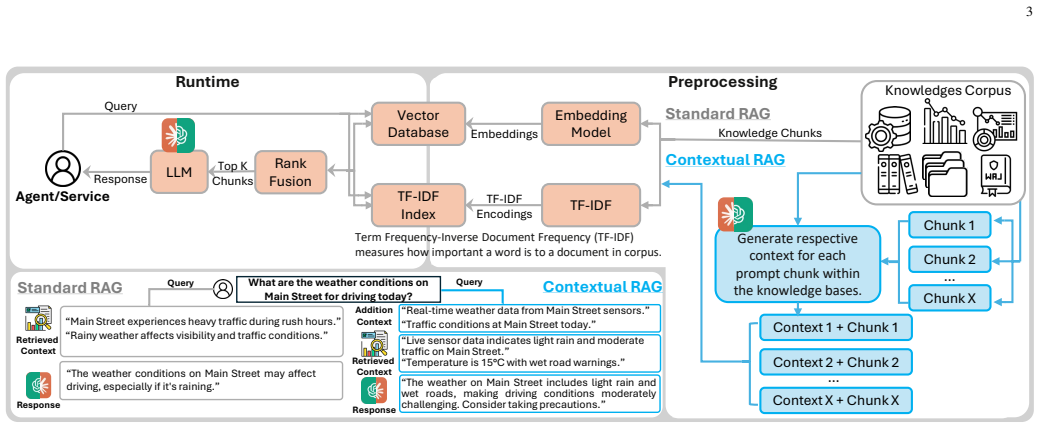
The load-bearing component is a deep reinforcement learning (DRL) cache-replacement agent embedded in a proactive cache server between the edge LLM and the knowledge base. Its state is built from semantic similarity relationships among the prompt P, current cached content C, and newly retrieved candidate content R; its action is whether to keep or replace cache entries; and its reward is the measured cache hit rate over subsequent task-related queries. On each miss, the framework also performs proactive extraction by retrieving a larger candidate set R, not just the directly needed chunk, so the cache can serve future queries without another remote fetch. This machinery replaces fixed recency or frequency rules with a policy that balances immediate relevance, predicted future need, and the cost of updating the cache.
What would settle it
Run ACC on a held-out trace of real mobile-edge RAG queries, without retraining on that trace, and compare hit rate and latency against LRU and semantic-only caching; if ACC falls to baseline levels or the 40% latency reduction disappears, the reported gains do not generalize. A cheaper probe is to shuffle the order of the same query sequence across episodes and check whether the above-80% hit rate depends on the original ordering.
Extended reading notes
Core claim
ACC's central claim is that caching for edge RAG should be proactive and learned rather than reactive or purely relevance-based. On a cache miss, the framework retrieves the missing knowledge chunk T1 along with a larger candidate set R from the knowledge base, computes semantic similarity scores among the prompt P, the current cache content C, and R, and feeds these scores to a deep reinforcement learning agent. The agent decides which entries to store or replace, and the cache hit rate over subsequent task-related queries is used as the reward signal. The paper reports that this mechanism yields hit rates above 80% after 11 episodes, beats FIFO, LRU, and semantic-only caching on average retrieval latency, and reduces local caching overhead by up to 55%. In the authors' framing, the framework demonstrates that contextual, learning-based cache replacement can make mobile-edge LLM services scalable and low-latency.
Load-bearing premise
The load-bearing premise is that the authors' self-curated text corpus and its query sequence reflect real mobile-edge LLM usage, because the DRL agent is trained and evaluated on that same workload rather than on a held-out real trace.
Editorial extensions
If this is right
- An edge RAG service can adopt ACC as a drop-in cache server in front of its vector database, since ACC's caching decisions sit between the embedding search and the LLM.
- Higher hit rates mean fewer remote knowledge-base retrievals, so bandwidth consumption and end-to-end latency fall for repeated or contextually similar queries.
- A 55% reduction in cache-update overhead makes the system more scalable: larger knowledge bases and higher query rates can be served before update costs become the bottleneck.
- Because the policy is learned from the workload, ACC can in principle track shifts in user behavior or in the update frequency of different knowledge domains without manual policy reconfiguration.
Reading between the lines
- The reported numbers rest on a self-curated 'moderate-scale text corpus' with an unspecified query sequence; whether the 80% hit rate transfers to real mobile-edge traces is not established by the paper.
- The 40% latency gain is net of the DRL agent's own computation and the proactive retrieval of candidate chunks; an edge deployment should verify that this overhead remains small on realistic device hardware.
- A plausible simplifying hypothesis not tested in the paper is that a lightweight similarity-aware prefetching heuristic with cost-weighted replacement would capture much of ACC's gain, with the DRL contribution being automatic tuning rather than the core mechanism.
- The same prompt-cache-retrieval similarity state could be lifted to hierarchical caches or cross-modal embeddings, directions the paper itself identifies as future work.
Editorial analysis
A structured set of objections, weighed in public.
Referee Report
Summary. The paper proposes Adaptive Contextual Caching (ACC), a deep reinforcement learning (DRL) based proactive caching framework for retrieval-augmented generation (RAG) in mobile edge LLM services. ACC introduces a cache server that, on a cache miss, performs contextual analysis and uses a DRL module to decide which chunks to cache or replace, with the cache hit rate used as the reward signal. The authors report experiments on a self-curated corpus showing that ACC achieves over 80% cache hit rate after 11 training episodes, outperforming FIFO, LRU, and semantic-only caching, while reducing retrieval latency by up to 40% and local caching overhead by up to 55%. The paper also includes a survey of RAG caching mechanisms and outlines future directions.
Significance. If the reported performance were credible, ACC would address a real practical problem in mobile-edge LLM deployment, and the idea of using DRL for context-aware cache replacement is reasonable. However, the paper's significance rests almost entirely on the experimental results, and those results are not supported as presented: the headline metric is the DRL training objective evaluated on the training episodes, no held-out evaluation is provided, and the experimental setup is missing so many essential details that independent assessment is impossible. The related-work survey in Sections II–III is structured and useful, but the absence of any comparison with the cited RAG caching systems (RAGCache, GPTCache, LLM-DCache, DeepCache) further weakens the claimed contributions. As it stands, the paper does not establish a working system or a validated algorithm.
major comments (4)
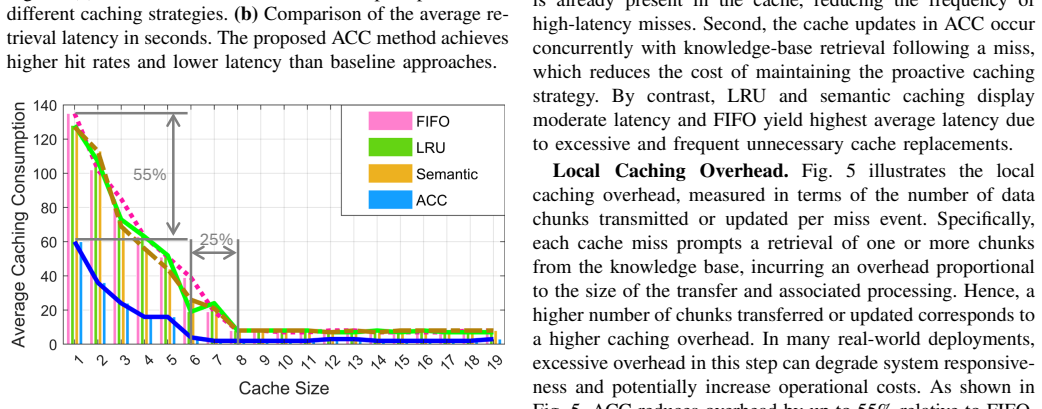
- [Section IV-D, Fig. 4(a)] The cache hit rate reported in Fig. 4(a) is the DRL reward defined in Section IV-A, Step 5, computed on the same training episodes used to train the agent. Thus the figure shows convergence of the training objective, not an independent measure of policy quality. The claim that ACC outperforms FIFO, LRU, and semantic-only caching is therefore based on in-sample training curves, and no held-out query trace or test set is used. Please evaluate the learned policy on a held-out trace or separate test period and report test-time hit rate, latency, and overhead.
- [Section IV-C and IV-D] The experimental setup omits critical details needed for reproducibility and for assessing the fairness of the comparison: corpus size and composition, chunking parameters, the specific embedding model (only 'locally hosted sentence transformer' is mentioned), vector database and indexing method, cache capacity, number of queries per episode, number of training episodes, and the DRL algorithm's state/action/reward definitions, network architecture, and hyperparameters. Without these, the results cannot be independently assessed, and it is unclear whether the baselines are executed under equivalent conditions. Please provide a complete specification and, if possible, release the workload and code.
- [Section I and References [3]–[5], [11]] The paper cites RAGCache, GPTCache, LLM-DCache, and DeepCache as closely related caching systems for LLM/RAG workloads but does not include any of them as experimental baselines. These are the most directly relevant prior systems, so the claimed improvements over existing approaches are not established. Please add at least one of these systems as a baseline in the experiments, or explicitly justify why they are not applicable to the mobile-edge RAG setting.
- [Section IV-A, Steps 3–5] The DRL module is described only in natural language. There is no formal definition of the state space, action space, reward function, or the underlying Markov decision process, nor any pseudocode, network architecture, or training procedure. This is load-bearing because the proposed mechanism is the DRL policy; without a precise formulation, the algorithm cannot be implemented, tested, or compared. Please provide a formal model and implementation details.
minor comments (6)
- [Figures 2 and 3] Several typos appear in the figures and text: "Reveed" in Fig. 2, "sematic" in Fig. 3, "Cache Sever" in Fig. 2, and "replacement policie" in Section IV-D. Please proofread carefully.
- [Section II-B] There are grammatical errors in this section, e.g., "The prepared bases undergoes transformation" and "the knowledge base is well-structured and optimized" (subject-verb agreement and article usage). Please revise for clarity.
- [Section III-A(1), Reference [7]] Reference [7] (NSCaching) is about negative sampling for knowledge graph embedding, not caching for LLM services. The citation in the context of identifying and caching contextually relevant content appears to be a mismatch; please replace it with a more relevant reference.
- [Fig. 5 caption] The caption says "Average caching consumption" while the text in Section IV-D describes overhead as the number of chunks transmitted or updated per miss event. Please clarify the metric being plotted and state its units.
- [Abstract and Fig. 4(a)] The abstract claims "over 80% after only 11 training episodes," but Fig. 4(a) plots 20 episodes. Please specify whether the 80% figure is the value at episode 11, the converged value, or the value averaged over a window; the current wording is ambiguous.
- [Section IV-D, Average Latency paragraph] The sentence "ACC's mechanisms which include contextual analysis and DRL-based caching policie is higher" is ungrammatical and should be rewritten, e.g., "The latency of ACC's mechanisms, which include contextual analysis and DRL-based caching policies, is higher..."
Circularity Check
ACC's headline hit rate is the DRL training reward on the same episode sequence, so the central empirical claim reduces to the optimized objective.
-
fitted input called prediction
[Section IV-A, Step 5; Section IV-D, Fig. 4(a)]
"Step 5: The cache hit rate is calculated for consecutive queries related to Task T as a reward function for the DRL model. ... Fig. 4(a) presents the changes of cache hit rates across 20 experimental episodes ... ACC rapidly converges to a hit rate exceeding 80%."
The DRL policy is trained with the cache hit rate as its reward, and the headline result in Fig. 4(a) is the cache hit rate measured on the same 20 episodes used for training, with the paper explicitly saying 'after only 11 training episodes.' Thus the reported 'over 80%' is the training reward trajectory, not a held-out or independently predicted quantity. An agent trained to maximize hit rate is expected to increase that same metric on the training distribution, so the central performance claim is forced by the reward definition. The baseline comparisons provide some independent grounding, but they do not convert the reported hit rate into an out-of-sample prediction.
full rationale
The paper contains no self-citations among its load-bearing references, no imported uniqueness theorem, and no ansatz smuggled in via citation; the only circular element is the identity between the DRL reward and the headline evaluation metric. Step 5 defines the reward as the cache hit rate, and Section IV-D reports exactly that cache hit rate over the training episodes as the main evidence of ACC's effectiveness. This makes the hit-rate improvement partly self-definitional: the reported quantity is the objective the agent was trained to maximize, on the same data distribution used for training. Other reported outcomes (latency, caching overhead) and the comparison against FIFO, LRU, and semantic caching are not themselves the training objective and therefore carry some independent content. However, because the paper's central claim of superiority rests on a metric that is identical to the training reward, with no held-out trace or separate prediction task, the result is partially circular rather than fully independent.
Assumptions & free parameters
free parameters (2)
- DRL policy network weights and hyperparameters =
not disclosed
- Episode length and number of queries per episode =
not disclosed
assumptions (3)
- domain assumption Semantic similarity between prompt, cached content, and retrieved content is a sufficient state representation for choosing cache replacements.
- domain assumption Cache hit rate is an appropriate reward that aligns with latency and overhead reduction.
- ad hoc to paper The synthetic corpus and query stream are representative of mobile-edge RAG workloads.
Cite this review
Pith. "Pith review of Adaptive Contextual Caching for Mobile Edge Large Language Model Service." pith.science (2026). https://pith.science/paper/T5LV5EPL
@misc{pith2026250109383,
  author       = {Pith},
  title        = {Pith review of: Adaptive Contextual Caching for Mobile Edge Large Language Model Service},
  year         = {2026},
  howpublished = {\url{https://pith.science/paper/T5LV5EPL}},
  note         = {Machine review of arXiv:2501.09383}
}
read the original abstract
Mobile edge Large Language Model (LLM) deployments face inherent constraints, such as limited computational resources and network bandwidth. Although Retrieval-Augmented Generation (RAG) mitigates some challenges by integrating external knowledge bases, inefficient cache management can still result in high retrieval latency and frequent cache updates. To address these issues, we propose an Adaptive Contextual Caching (ACC) framework that anticipates user needs by proactively caching semantically relevant data for mobile-edge LLMs. ACC utilizes a deep reinforcement learning (DRL) module to refine cache replacement policies, balancing user context, document similarity, and the overhead associated with cache misses. Experimental results demonstrate that ACC increases cache hit rates to over 80\% after only 11 training episodes, outperforming FIFO, LRU, and semantic-only caching while reducing retrieval latency by up to 40\%. In particular, ACC also reduces local caching overhead (i.e., the cost of updating the cache when a miss occurs) by as much as 55\%, enabling scalable, low-latency LLM services in resource-constrained edge environments.
Figures


Figures from the paper (1 more)
Forward citations
Cited by 1 Pith paper
-
AI Reasoning for Wireless Communications and Networking: A Survey and Perspectives
A survey that organizes LLM and AI reasoning methods into a taxonomy and maps them onto the physical, link, network, transport, and application layers of wireless networks.
Reference graph
Works this paper leans on
-
[1]
Mobile edge intelligence for large language models: A contemporary survey,
G. Qu, Q. Chen, W. Wei, Z. Lin, X. Chen, and K. Huang, “Mobile edge intelligence for large language models: A contemporary survey,” arXiv preprint arXiv:2407.18921, 2024
arXiv 2024
-
[2]
Stark: Benchmarking llm retrieval on textual and relational knowledge bases,
S. Wu, S. Zhao, M. Yasunaga, K. Huang, K. Cao, Q. Huang, V . N. Ioannidis, K. Subbian, J. Zou, and J. Leskovec, “Stark: Benchmarking llm retrieval on textual and relational knowledge bases,” arXiv preprint arXiv:2404.13207, 2024
arXiv 2024
-
[3]
Ragcache: Efficient knowledge caching for retrieval-augmented generation,
C. Jin, Z. Zhang, X. Jiang, F. Liu, X. Liu, X. Liu, and X. Jin, “Ragcache: Efficient knowledge caching for retrieval-augmented generation,” arXiv preprint arXiv:2404.12457, 2024
arXiv 2024
-
[4]
Llm-dcache: Improving tool- augmented llms with gpt-driven localized data caching,
S. Singh, M. Fore, A. Karatzas, C. Lee, Y . Jian, L. Shangguan, F. Yu, I. Anagnostopoulos, and D. Stamoulis, “Llm-dcache: Improving tool- augmented llms with gpt-driven localized data caching,” arXiv preprint arXiv:2406.06799, 2024
arXiv 2024
-
[5]
F. Bang, “Gptcache: An open-source semantic cache for llm applications enabling faster answers and cost savings,” in Proceedings of the 3rd Workshop for Natural Language Processing Open Source Software (NLP-OSS 2023) , 2023, pp. 212–218
work page 2023
-
[6]
S. Ganesh, A. Purwar et al. , “Context-augmented retrieval: A novel framework for fast information retrieval based response generation using large language model,” arXiv preprint arXiv:2406.16383 , 2024
work page Pith review arXiv 2024
-
[7]
Nscaching: simple and efficient negative sampling for knowledge graph embedding,
Y . Zhang, Q. Yao, Y . Shao, and L. Chen, “Nscaching: simple and efficient negative sampling for knowledge graph embedding,” in 2019 IEEE 35th International Conference on Data Engineering (ICDE) . IEEE, 2019, pp. 614–625
2019
-
[8]
Sentence-bert: Sentence embeddings using siamese bert- networks,
N. Reimers, “Sentence-bert: Sentence embeddings using siamese bert- networks,” arXiv preprint arXiv:1908.10084 , 2019
arXiv 1908
Show all 15 references
-
[9]
Efficient and robust approxi- mate nearest neighbor search using hierarchical navigable small world graphs,
Y . A. Malkov and D. A. Yashunin, “Efficient and robust approxi- mate nearest neighbor search using hierarchical navigable small world graphs,” IEEE transactions on pattern analysis and machine intelligence , vol. 42, no. 4, pp. 824–836, 2018
2018
-
[10]
Accelerating large-scale inference with anisotropic vec- tor quantization,
R. Guo, P. Sun, E. Lindgren, Q. Geng, D. Simcha, F. Chern, and S. Kumar, “Accelerating large-scale inference with anisotropic vec- tor quantization,” in International Conference on Machine Learning . PMLR, 2020, pp. 3887–3896
2020
-
[11]
Deepcache: A deep learning based framework for content caching,
A. Narayanan, S. Verma, E. Ramadan, P. Babaie, and Z.-L. Zhang, “Deepcache: A deep learning based framework for content caching,” in Proceedings of the 2018 Workshop on Network Meets AI & ML , 2018, pp. 48–53
2018
-
[12]
Edge caching based on deep reinforcement learning,
F. Niknia, P. Wang, A. Agarwal, and Z. Wang, “Edge caching based on deep reinforcement learning,” in 2023 IEEE/CIC International Confer- ence on Communications in China (ICCC) . IEEE, 2023, pp. 1–6
2023
-
[13]
A knowledge graph-based cooperative caching scheme in mec-enabled heterogeneous networks,
Y . Bai, D. Wang, and B. Song, “A knowledge graph-based cooperative caching scheme in mec-enabled heterogeneous networks,” in GLOBE- COM 2022-2022 IEEE Global Communications Conference . IEEE, 2022, pp. 5959–5964
2022
-
[14]
Minilm: Deep self-attention distillation for task-agnostic compression of pre- trained transformers,
W. Wang, F. Wei, L. Dong, H. Bao, N. Yang, and M. Zhou, “Minilm: Deep self-attention distillation for task-agnostic compression of pre- trained transformers,” Advances in Neural Information Processing Sys- tems, vol. 33, pp. 5776–5788, 2020
2020
-
[15]
Generative cross- modal retrieval: Memorizing images in multimodal language models for retrieval and beyond,
Y . Li, W. Wang, L. Qu, L. Nie, W. Li, and T.-S. Chua, “Generative cross- modal retrieval: Memorizing images in multimodal language models for retrieval and beyond,” arXiv preprint arXiv:2402.10805 , 2024
2024 arXiv
Reviewed August 10, 2026 · model on record in the stance chip above.
Discussion (0). Continue with ORCID to comment.