REVIEW 4 major objections 5 minor 114 references
Discord's Design Encourages "Third Place" Social Media Experiences
T0 review · 4 major / 5 minor · reviewed 2026-08-10 · deepseek-v4-flash
Pith's one-line read Discord's spatial design—servers, channels, roles, and open access—can create virtual third places that support both close friendships and community ties, according to interviews with 25 young users.
desk verdict The 21-element taxonomy of Discord's third-place design is a genuinely useful empirical contribution, but the causal framing in the abstract and conclusion outruns the evidence. read the letter →
The pith
A machine-rendered reading of the paper's core claim, the machinery that carries it, and where it could break.
The reading
What carries the argument
The central object is the 21-element taxonomy linking Discord affordances to the eight third-place characteristics, organized under four design principles: themed spaces for repeated interactions, autonomy and customization, mutually engaging activities, and casual low-pressure interactions. The argument is carried by the space-versus-place distinction: the platform provides spatial structure, but a sense of place emerges only through repeated user interaction, adaptation, and appropriation. This distinction lets the paper claim that Discord's design creates the conditions for third-place experiences without claiming that the platform itself is a place.
What would settle it
Track friendship formation on Discord at scale—for example, record when two users first exchange a direct message after meeting in a server—and compare servers whose design includes these 21 elements with servers that lack them. If friendship-formation rates do not differ, the taxonomy is not doing the causal work the interviews credit it with.
Extended reading notes
Core claim
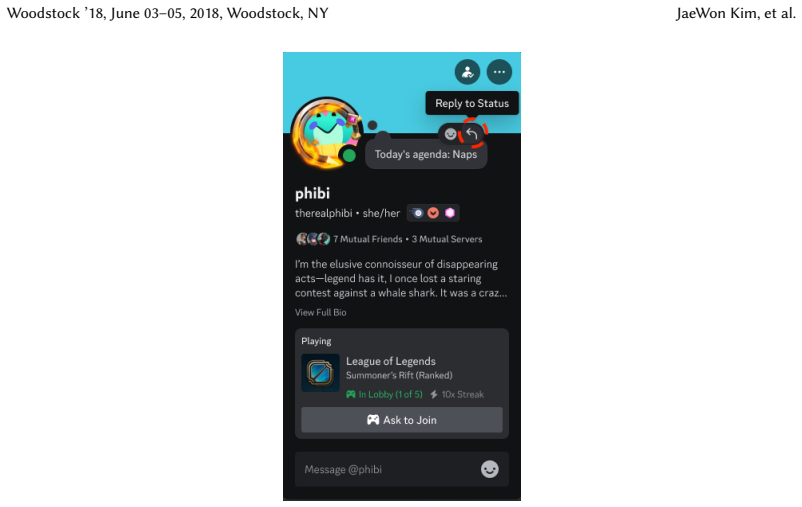
The paper's central claim is that Discord's intentional design facilitates third-place experiences on social media, fostering both dyadic and community-based relationship-building. To support this, it constructs a taxonomy of 21 design elements mapped onto the eight third-place characteristics—neutral ground, leveling, conversation as the main activity, accessibility, regulars, low profile, playful mood, and home away from home. The elements include search- and invite-based joining, open-access channels, pseudonymous profiles, contribution-based roles, persistent servers, activity visibility, ephemeral chat, gaming and bot integrations, server customization, interest-based subspaces, and contextual per-server profiles. Users described Discord as a town square, cafe, or game room, and reported forming close friendships, some lasting years and some becoming romantic. The paper's interpretive move is that these features work together as a space that users convert into a place through repeated interaction, following the space-versus-place distinction from prior design theory, and that this design-based approach contrasts with network-based platforms like Instagram.
Load-bearing premise
The causal story depends on the 25 interviewees, all of whom had already formed at least one new friendship on Discord, being able to accurately recall and attribute those friendships to specific design features, rather than reconstructing the causes after the fact.
Editorial extensions
If this is right
- Social-media designers get a concrete checklist of 21 features—such as persistent servers, open-access channels, and activity visibility—for making a platform feel like an informal gathering place.
- A space-based architecture, organized around servers and channels rather than feeds, can support casual conversation and community belonging for youth even as physical third places disappear.
- The same design can foster both intimate dyadic friendships and broader community bonds, as participants reported long-lasting and even romantic relationships formed through servers.
- The taxonomy is offered as extendable beyond Discord to text-based platforms and extended-reality environments, with the caveat that avatar-based spatial features like proximity and action remain unexplored.
Reading between the lines
- A direct extension the paper leaves untested is an experiment that varies one element at a time—for instance, with or without persistent servers or visible activity status—and measures friendship formation, which would separate necessary features from optional ones.
- The finding that algorithmic recommendation feels like an intrusion on neutral ground suggests that recommendation-driven platforms may undermine the sense of ownership that supports third-place feelings; this connection is an extrapolation, not a claim in the paper.
- Because all participants were required to have formed at least one new friendship on Discord, the taxonomy describes conditions that can support tie formation, not conditions that prevent it; studying lurkers, failed communities, or users who leave could reveal missing design requirements.
- Lowering barriers to connection also lowers barriers to harm, so a design-focused agenda for virtual third places should pair these affordances with safeguards against grooming and harassment, a risk the paper acknowledges but does not develop.
Signed reviews
Editorial analysis
A structured set of objections, weighed in public.
Referee Report
Summary. The paper reports a qualitative interview study (N=25) of youth aged 15–24 who are active Discord users and who had formed at least one new friendship on the platform. Drawing on Oldenburg's third-place framework and Small and Adler's spatial framework, the authors identify 21 design elements across eight third-place characteristics, grouped into four design principles, and argue that Discord's intentional design facilitates third-place experiences and supports both dyadic and community-based relationship-building.
Significance. If the descriptive taxonomy is taken as what it is—a well-grounded qualitative account of perceived affordances—the paper is a useful contribution. It offers a concrete list of 21 design considerations mapped to a classic sociological framework, with illustrative participant quotes and a full interview protocol in Appendix B, which is a transparency strength. The work also connects spatial reasoning and place-making literature to a mainstream 2D social platform, which is a worthwhile extension. However, the central claim as stated in the abstract and conclusion is causal ('Discord's design encourages...'), whereas the evidence is retrospective self-report from a sample selected on the friendship-formation outcome, with no comparison group. The descriptive findings are defensible; the causal language is not.
major comments (4)
- [Abstract and Section 6 (Conclusion)] The claim that 'Discord's intentional design facilitates third-place experiences' overstates what the data can support. All participants were required to have formed at least one new friendship on Discord (Section 3.2, criterion 3), and Appendix B questions 6c and 7c ask participants to name which element of Discord 'helped' them, inviting post-hoc attribution. With no comparison group of users who did not form friendships and no baseline measure, the design cannot distinguish design-driven effects from selection or hindsight bias. The authors' own Section 5.4 acknowledges this limitation, so the conclusion and abstract should be softened to 'may support' or 'are perceived by users as supporting,' and alternative explanations should be discussed.
- [Table 1 and Section 3.2] There is an internal inconsistency in the sample description. Eligibility criterion 3 requires 'having formed at least one new friendship through Discord,' yet Table 1 reports that 5 of 25 participants (20%) described their Discord connection experience as 'I've made a few casual acquaintances.' If casual acquaintances qualify as friendships under the authors' definition, that definition should be stated explicitly; if not, the authors should report how these five fit the criterion or present a sensitivity analysis excluding them. As written, the inconsistency undermines the claim that all participants represent successful friendship-formation cases.
- [Table 2] The 21-element taxonomy is the paper's central empirical contribution, but Table 2 does not report how many of the 25 participants mentioned each element or how many coded segments support each row. Several rows appear to rest on a single quote (e.g., 4D Cross-Platform Support, 7A Gaming Integration), which makes it difficult to assess whether these are robust themes or isolated observations. The authors should report code frequencies, or at least the number of participants contributing to each element, so readers can judge the weight of evidence behind each taxonomy entry.
- [Section 4.9] The paper states that ten participants used 'place-like' analogies to describe Discord. That is 40% of the sample, not 'many' as the Introduction claims. The interpretative weight placed on these analogies should be calibrated to their actual prevalence, and the paper should be explicit that a majority of participants did not spontaneously use such analogies.
minor comments (5)
- [Section 1] The sentence 'with 28% Discord's design aim is to create...' appears to be missing a clause about the percentage of U.S. teenagers using Discord; please complete the sentence.
- [Section 4.6] Typo: 'this person won't kill me' appears mid-sentence with a stray parenthesis in the paragraph on visual anonymity; also '(B)y minimizing' should read 'By minimizing.'
- [Section 3.3] The sentence describing the division of interviews between the first and second authors is awkwardly phrased; please clarify whether the first author conducted 21 and the second author 4 interviews, or vice versa.
- [Table 1] The demographic table uses '(12; 60%)' for girls while the text reports 15 women (60%); the percentages are inconsistent with N=25 and should be reconciled.
- [Appendix B] Questions 6c and 7c are phrased as 'What element of Discord do you think helped you the most...' which is a leading question that presupposes that some element helped. Consider reframing to 'Did any element...' in future work.
Circularity Check
No significant circularity: the taxonomy is an external-framework coding of interview data; minor self-citations are background only.
full rationale
This paper's central contribution is an interview-based taxonomy, not a formal derivation, so there are no equations whose terms reduce to one another. The coding framework (Oldenburg's eight third-place characteristics) is external to the authors, and the paper states the protocol did not introduce third-place concepts: 'We did not introduce the concept of a third place, but when participants made analogies to physical third places, we explored these further while maintaining neutrality' (Section 3.3). The 21 design elements in Table 2 are supported by participant quotes about Discord features that helped relationship-building, and the mapping from quotes to framework categories is an interpretive coding step, not a definitional identity. The authors' prior work is cited only for background: [58] supports the uncontroversial claim that teens spontaneously name Discord as a primary platform (also supported by [8,49,100]), and [59] supports a research-direction claim in the Discussion; neither citation carries the central result. The paper's own limitation statement (Section 5.4) concedes that the sample was selected on the outcome: 'our interviews were conducted with people who actively use Discord and have prior experience forming friendships on the platform. This may introduce bias, particularly in comparisons between Discord and other social media platforms.' That is a real threat to the causal wording in the abstract and conclusion, but it is a validity limitation, not a circularity. No fitted parameter is renamed as a prediction, no self-citation chain forces the conclusion, and no known result is relabeled. The causal claim overreaches the qualitative evidence, but the derivation chain is not circular.
Assumptions & free parameters
assumptions (4)
- domain assumption Oldenburg's eight third-place characteristics are applicable to virtual social platforms.
- domain assumption Retrospective self-reports accurately reflect the design features that caused friendship formation.
- domain assumption Small and Adler's spatial mechanisms (propinquity, composition, configuration) generalize from physical to virtual spaces.
- ad hoc to paper Participants who formed friendships are a sufficient population for identifying design elements that support third places.
Cite this review
Pith. "Pith review of Discord's Design Encourages "Third Place" Social Media Experiences." pith.science (2026). https://pith.science/paper/TMAVFVLD
@misc{pith2026250109951,
  author       = {Pith},
  title        = {Pith review of: Discord's Design Encourages "Third Place" Social Media Experiences},
  year         = {2026},
  howpublished = {\url{https://pith.science/paper/TMAVFVLD}},
  note         = {Machine review of arXiv:2501.09951}
}
read the original abstract
In light of the diminishing presence of physical third places -- informal gathering spaces essential for social connection -- this study explores how the social media platform Discord fosters third-place experiences. Drawing on Oldenburg's conceptual framework, we analyze how Discord's design elements support the creation of virtual third places that foster both dyadic and community-based relationships. Through 25 semi-structured interviews with active Discord users, we identified 21 design elements aligned with Oldenburg's third-place characteristics. These elements cluster around four core principles: providing themed spaces for repeated interactions, supporting user autonomy and customization, facilitating mutually engaging activities, and enabling casual, low-pressure interactions. This work contributes to understanding how intentional platform design can cultivate virtual spaces that support meaningful social connections. The findings have implications for designing future social technologies that can help address growing concerns about social isolation in an increasingly digital world.
Figures


Figures from the paper (4 more)



Reference graph
Works this paper leans on
-
[1]
[n. d.]. Animal Crossing series – Official Site. https://animalcrossing.nintendo.com/. Accessed: 2024-9-4
2024
-
[2]
[n. d.]. Chat. Stream. Vibe. Accessed: 2024-09-04
2024
- [3]
-
[4]
[n. d.]. Telegram – a new era of messaging . Accessed: 2024-09-04
2024
-
[5]
Discord Activities: Play Games and Watch Together
2024. Discord Activities: Play Games and Watch Together. https://discord.com/blog/server-activities-games-voice- watch-together. Accessed: 2024-12-8
2024
-
[6]
Paul C Adams. 2010. Cyberspace and virtual places. Geogr. Rev. 87, 2 (April 2010), 155–171. https://doi.org/10.1111/j. 1931-0846.1997.tb00069.x
arXiv 2010
-
[7]
Katrina Alcala, Anthony D’Achille, and Amy Bruckman. 2023. The Stage and the Theatre: AltspaceVR and its Relationship to Discord. Proc. ACM Hum.-Comput. Interact. 7, CSCW1 (April 2023), 1–21. https://doi.org/10.1145/ 3579529
2023
-
[8]
Monica Anderson, Michelle Faverio, and Jeffrey Gottfried. 2023. Teens, social media and technology 2023. Pew Res Cent (2023)
2023
Show all 114 references
-
[9]
Katie Baumel, Mara Hamlett, Brittany Wheeler, Deborah Hall, Ashley K Randall, and Kristin Mickelson. 2021. Living Through COVID-19: Social Distancing, Computer-Mediated Communication, and Well-Being in Sexual Minority and Heterosexual Adults. Journal of Homosexuality 68, 4 (Ma...
2021
-
[10]
N Baym. 1995. The emergence of community in computer mediated communication. (1995)
1995
-
[11]
J M Bishop, L Taylor, and F Froy. 2000. Computer-mediated communication use by the deaf and hard-of-hearing. Kybernetes 29, 9/10 (Dec. 2000), 1078–1086. https://doi.org/10.1108/03684920010342143
2000 doi
-
[12]
Caryl Bosman and Joanne Dolley. 2019. Rethinking third places and community building. Rethinking Third Places (May 2019). https://doi.org/10.4337/9781786433916.00009
2019
-
[13]
danah boyd. 2014. It’s Complicated: The Social Lives of Networked Teens (1 ed.). Yale University Press, New York
2014
-
[14]
Kellen Browning. 2021. 5 Ways Young People Are Using Discord. The New York Times (Dec. 2021)
2021
-
[15]
Kellen Browning. 2021. How Discord, Born From an Obscure Game, Became a Social Hub for Young People. The New York Times (Dec. 2021)
2021
-
[16]
Amy Bruckman. [n. d.]. Finding One’s Own in Cyberspace
-
[17]
Amy Bruckman and Mitchel Resnick. 1995. The MediaMOO project: Constructionism and professional community. Converg. Int. J. Res. New Media Technol. 1, 1 (March 1995), 94–109. https://doi.org/10.1177/135485659500100110
1995 doi
-
[18]
bumble bff [n. d.]. Find New Friends With Bumble For Friends App. https://bumble.com/bff. Accessed: 2024-9-4
2024
-
[19]
Business of Apps. 2020. Discord Revenue and Usage Statistics (2024). https://www.businessofapps.com/data/discord- statistics/. Accessed: 2024-9-4
2024
-
[20]
Pablo Cabrera-Barona, Gabriel Gaona, and Andrea Carrión. 2023. Importance of public space, neighbors’ support, and safety in the context of the COVID-19 pandemic lockdown. J. Urban Manag. 12, 3 (June 2023), 284–294. https://doi.org/10.1016/j.jum.2023.06.001
2023 doi
-
[21]
Vicky Cattell, Nick Dines, Wil Gesler, and Sarah Curtis. 2008. Mingling, observing, and lingering: everyday public spaces and their implications for well-being and social relations. Health Place 14, 3 (Sept. 2008), 544–561. https: //doi.org/10.1016/j.healthplace.2007.10.007
2008 doi
-
[22]
Third Place
Mina Choi and Hyesun Choung. 2021. Mediated communication matters during the COVID-19 pandemic: The use of interpersonal and masspersonal media and psychological well-being. Journal of Social and Personal Relationships 38, 8 (Aug. 2021), 2397–2418. https://doi.org/10.1177/0265...
2021 doi
-
[23]
Tatiana Cirisano. 2020. How Gamer Chat App Discord Is Connecting Artists With Core Fans. http://www.billboard. com/pro/discord-connecting-music-artists-with-fans-chat-platform/. Accessed: 2024-9-3
2020
-
[24]
Jason Citron. 2020. Building On Our Momentum. https://discord.com/blog/building-on-our-momentum. Accessed: 2024-12-8
2020
-
[25]
Randall Collins and Peter M Blau. 1979. Inequality and heterogeneity: A primitive theory of social structure. Soc. Forces 58, 2 (Dec. 1979), 677. https://doi.org/10.2307/2577612
1979 doi
-
[26]
Neil S Coulson, Heather Buchanan, and Aimee Aubeeluck. 2007. Social support in cyberspace: a content analysis of communication within a Huntington’s disease online support group. Patient Educ. Couns. 68, 2 (Oct. 2007), 173–178. https://doi.org/10.1016/j.pec.2007.06.002
2007 doi
-
[27]
Discord. [n. d.]. Discord - Group Chat That’s All Fun & Games. https://discord.com/. Accessed: 2024-9-4
2024
-
[28]
Discord. [n. d.]. Role Management 101. https://support.discord.com/hc/en-us/articles/214836687-Role-Management-
-
[29]
Discord connects friends, peers during pandemic
discord connects friends, peers during pandemic 2021. Discord connects friends, peers during pandemic. https: //www.coastreportonline.com/features/article_9a7a4db2-bf25-11eb-90ce-0bf413ec7b54.html. Accessed: 2024-9-4
2021
-
[30]
Discord’s COVID-19 Response
discord covid 19 response 2020. Discord’s COVID-19 Response. https://www.zendesk.com/customer/discords-covid- 19-response/. Accessed: 2024-9-4
2020
-
[31]
third places
Nicolas Ducheneaut, Robert J Moore, and Eric Nickell. 2007. Virtual “third places”: A case study of sociability in massively multiplayer games. Comput. Support. Coop. Work 16, 1-2 (April 2007), 129–166. https://doi.org/10.1007/ s10606-007-9041-8
2007
-
[32]
Brianna Dym and Casey Fiesler. 2018. Generations, migrations, and the future of fandom’s private spaces. TWC 28 (Sept. 2018). https://doi.org/10.3983/twc.2018.1583
2018
-
[33]
Katie Ellis and G Goggin. 2013. Disability and social media. The social media handbook (Oct. 2013), 134–151. https://doi.org/10.4324/9780203407615-15
2013 doi
-
[34]
Firat Erdoğmuş. 2009. CONCEPTUALIZING ONLINE ENVIRONMENTS AS THIRD PLACES: AN ANALYSIS ON SECOND LIFE AND FACEBOOK
2009
-
[35]
Thomas Erickson and Wendy A Kellogg. 2000. Social translucence: an approach to designing systems that support social processes. ACM Trans. Comput.-Hum. Interact. 7, 1 (2000), 59–83
2000
-
[36]
Jennifer Fereday and Eimear Muir-Cochrane. 2006. Demonstrating rigor using thematic analysis: A hybrid approach of inductive and deductive coding and theme development. International journal of qualitative methods 5, 1 (2006), 80–92
2006
-
[37]
Geraldine Fitzpatrick, Simon Kaplan, and Tim Mansfield. 1996. Physical spaces, virtual places and social worlds: a study of work in the virtual. In Proceedings of the 1996 ACM conference on Computer supported cooperative work - CSCW ’96. ACM Press, New York, New York, USA. htt...
1996
-
[38]
J W Foster. 2013. Oldenburg’s great good places online: assessing the potential for social network sites to serve as third places. (2013)
2013
-
[39]
Guo Freeman and E Jacob. 2012. Reconceptualizing Cyberspace: “Real” Places in Digital Space. International Journal of Science in Society 3, 2 (2012), 91–102. https://doi.org/10.18848/1836-6236/CGP/V03I02/51318
2012 doi
-
[40]
Barbro Fröding and Martin Peterson. 2012. Why virtual friendship is no genuine friendship. Ethics Inf. Technol. 14, 3 (Sept. 2012), 201–207. https://doi.org/10.1007/s10676-011-9284-4
2012 doi
-
[41]
Mark Giese. 1998. Constructing a virtual geography: Narratives of space in a text-based environment. J. Commun. Inq. 22, 2 (April 1998), 152–176. https://doi.org/10.1177/0196859998022002004
1998 doi
-
[42]
Erving Goffman. 2016. The presentation of self in everyday life. In Social Theory Re-Wired. Routledge, 482–493
2016
-
[43]
Rebecca Haddad. [n. d.]. The Rise of Discord Among Students During the COVID-19 Pandemic. https://www.thelance. ca/2021/09/27/the-rise-of-discord-among-students-during-the-covid-19-pandemic/. Accessed: 2024-9-4
2021
-
[44]
Oliver L Haimson, Justin Buss, Zu Weinger, Denny L Starks, Dykee Gorrell, and Briar Sweetbriar Baron. 2020. Trans Time: Safety, Privacy, and Content Warnings on a Transgender-Specific Social Media Site. Proc. ACM Hum.-Comput. Interact. 4, CSCW2 (Oct. 2020), 1–27. https://doi.o...
2020 doi
-
[45]
William A Hamilton, Oliver Garretson, and Andruid Kerne. 2014. Streaming on twitch: fostering participatory communities of play within live mixed media. InProceedings of the SIGCHI Conference on Human Factors in Computing Systems. ACM, New York, NY, USA. https://doi.org/10.114...
2014
-
[46]
Steve Harrison and Paul Dourish. 1996. Re-place-ing space: the roles of place and space in collaborative systems. In Proceedings of the 1996 ACM conference on Computer supported cooperative work - CSCW ’96 . ACM Press, New York, New York, USA. https://doi.org/10.1145/240080.240193
1996
-
[47]
Jim Hollan and Scott Stornetta. 1992. Beyond being there. In Proceedings of the SIGCHI Conference on Human Factors in Computing Systems (Monterey, California, USA) (Chi ’92). Association for Computing Machinery, New York, NY, USA, 119–125. 27 Woodstock ’18, June 03–05, 2018, W...
1992
-
[48]
Third Place
John B Horrigan. 2001. Part 2: The Internet, Communities, and the Virtual “Third Place”. https://www.pewresearch. org/internet/2001/10/31/part-2-the-internet-communities-and-the-virtual-third-place/. Accessed: 2024-8-20
2001
-
[49]
Josh Howarth. 2023. Top 35 Social Media Platforms (September 2024). https://explodingtopics.com/blog/top-social- media-platforms. Accessed: 2024-12-9
2023
-
[50]
Kelin Hull and Cory Pettit. 2021. Making community through the utilization of discord in a (suddenly) online writing center. The Peer Review 5, 2 (2021)
2021
-
[51]
Julie Jargon. 2019. The Dark Side of Discord, Your Teen’s Favorite Chat App. The Wall Street Journal (June 2019)
2019
-
[52]
Elijah Jhee. [n. d.]. It’s called Discord, but the instant messaging app has actually done more uniting during COVID-19 pandemic. https://shhsaccolade.com/4890/ae/its-called-discord-but-the-instant-messaging-app-has-actually-done- more-uniting-during-covid-19-pandemic/. Access...
2024
-
[53]
Heather Kelly. 2021. They laughed, they cried, they killed monsters: How friendships thrived in video games during the pandemic. https://www.seattletimes.com/entertainment/they-laughed-they-cried-they-killed-monsters-how- friendships-thrived-in-video-games-during-the-pandemic/...
2021
-
[54]
Samantha Murphy Kelly. 2022. The dark side of Discord for teens. https://www.cnn.com/2022/03/22/tech/discord- teens/index.html. Accessed: 2024-7-29
2022
-
[55]
Lori Kendall. 2002. Hanging out in the virtual pub: Masculinities and relationships online . University of California Press
2002
-
[56]
Amy Jo Kim. 2000. Community building on the web: Secret strategies for successful online communities . Addison Wesley, London, England
2000
-
[57]
Da-Jung Kim and Youn-Kyung Lim. 2015. Dwelling Places in KakaoTalk: Understanding the Roles and Meanings of Chatrooms in Mobile Instant Messengers. In Proceedings of the 18th ACM Conference on Computer Supported Cooperative Work & Social Computing . ACM, New York, NY, USA, 775...
2015
-
[58]
Jaewon Kim, Soobin Cho, Robert Wolfe, Jishnu Hari Nair, and Alexis Hiniker. 2024. Privacy as Social Norm: Systemat- ically Reducing Dysfunctional Privacy Concerns on Social Media. arXiv [cs.HC] (Oct. 2024). arXiv:2410.16137 [cs.HC]
2024
-
[59]
Jaewon Kim, Lindsay Popowski, Anna Fang, Cassidy Pyle, Guo Freeman, Ryan M Kelly, Angela Y Lee, Fannie Liu, Angela D R Smith, Alexandra To, and Amy X Zhang. 2024. Envisioning new futures of positive social technology: Beyond paradigms of fixing, protecting, and preventing. InC...
2024
-
[60]
Robert E Kraut, Paul Resnick, and Sara Kiesler. 2011. Building successful online communities: evidence-based social design. MIT Press, Cambridge, Mass
2011
-
[61]
Werner Kuhn and Brad Blumenthal. 1996. Spatialization: spatial metaphors for user interfaces. In Conference companion on Human factors in computing systems common ground - CHI ’96 . ACM Press, New York, New York, USA. https://doi.org/10.1145/257089.257361
1996
-
[62]
Frankie Lantican. 2020. I Found a Family in Strangers I Met on Discord During the Pandemic. https://www.vice. com/en/article/making-friends-strangers-discord-coronavirus-pandemic-internet-social-media-online/. Accessed: 2024-9-4
2020
-
[63]
Soyoung Lee and Kentaro Toyama. 2024. Friendship formation in an enforced online regime: Findings from a U.s. university under COVID. Proc. ACM Hum. Comput. Interact. 8, CSCW1 (April 2024), 1–30. https://doi.org/10.1145/ 3641007
2024
-
[64]
Taylor Lorenz. 2019. How an App for Gamers Went Mainstream. https://www.theatlantic.com/technology/archive/ 2019/03/how-discord-went-mainstream-influencers/584671/. Accessed: 2024-7-29
2019
-
[65]
Paul P Maglio and Teenie Matlock. 1999. The conceptual structure of information space. In Social Navigation of Information Space. Springer London, London, 155–173. https://doi.org/10.1007/978-1-4471-0837-5_9
1999 doi
-
[66]
Making Markets. [n. d.]. Discord: Building the Third Place - [Founder’s Field Guide, Replay]
-
[67]
E Markiewicz. 2019. Third places in the era of virtual communities. Studia Periegetica 28 (2019), 9–21
2019
-
[68]
John A McArthur and Ashleigh Farley White. 2016. Twitter chats as third places: Conceptualizing a digital gathering site. Soc. Media Soc. 2, 3 (July 2016), 205630511666585. https://doi.org/10.1177/2056305116665857
2016 doi
-
[69]
Rea McNamara. 2021. How Artists Used the Discord App to Build Community During COVID-19. http://hyperallergic. com/632565/how-artists-used-the-discord-app-to-build-community-during-covid-19/. Accessed: 2024-9-3
2021
-
[70]
meetup [n. d.]. Meetup. https://www.meetup.com/. Accessed: 2024-9-4
2024
-
[71]
Jennifer V Meier, Josephine A Noel, and Kai Kaspar. 2021. Alone together: Computer-mediated communication in leisure time during and after the COVID-19 pandemic. Front. Psychol. 12 (June 2021), 666655. https://doi.org/10.3389/ fpsyg.2021.666655
2021
-
[72]
Third Place
Robert Moore, E Hankinson Gathman, and Nicolas Ducheneaut. 2009. From 3D space to third place: The social life of small virtual spaces. Hum. Organ. 68, 2 (June 2009), 230–240. https://doi.org/10.17730/humo.68.2.q673k16185u68v15 28 Discord’s Design Encourages “Third Place” Soci...
2009 doi
-
[73]
Jo Moses. [n. d.]. In praise of Discord for making quarantine connections. http://eic.opalstacked.com/in-praise-of- discord-for-making-quarantine-connections/. Accessed: 2024-9-4
2024
-
[74]
Michael Nitsche. 2009. Video game spaces: Image, play, and structure in 3D worlds . Mit Press
2009
-
[75]
Office of the Surgeon General (OSG). 2023. Our Epidemic of Loneliness and Isolation: The U.S. Surgeon General’s Advisory on the Healing Effects of Social Connection and Community . Technical Report. US Department of Health and Human Services, Washington (DC)
2023
-
[76]
Office of the Surgeon General (OSG). 2023. Social Media and Youth Mental Health: The U.S. Surgeon General’s Advisory . Technical Report. US Department of Health and Human Services
2023
-
[77]
R Oldenburg. 1997. Our vanishing third places. Planning commissioners journal 25, 4 (1997), 6–10
1997
-
[78]
Ray Oldenburg. 1999. The Great Good Place: Cafes, coffee shops, bookstores, bars, hair salons, and other hangouts at the heart of a community . Da Capo Press, London, England
1999
-
[79]
Ramon Oldenburg and Dennis Brissett. 1982. The third place. Qualitative sociology 5, 4 (1982), 265–284
1982
-
[80]
Malcolm R Parks and Lynne D Roberts. 1998. ‘Making Moosic’: The Development of Personal Relationships on Line and a Comparison to their Off-Line Counterparts. Journal of Social and Personal Relationships 15, 4 (Aug. 1998), 517–537. https://doi.org/10.1177/0265407598154005
1998 doi
-
[81]
L Rainie. 2012. Networked: The new social operating system. (2012)
2012
-
[82]
Devika Rao and The Week US. 2024. The unfortunate, ongoing disappearance of ’third places’. https://theweek.com/ culture-life/third-places-disappearing. Accessed: 2024-8-20
2024
-
[83]
Third Places
Kali Saposnick. 2016. Making a Garden Out of a Jungle: The Power of “Third Places”. https://thesystemsthinker.com/ making-a-garden-out-of-a-jungle-the-power-of-third-places/. Accessed: 2024-9-4
2016
-
[84]
C Saunders, A Rutkowski, M Genuchten, D Vogel, and J M Orrego. 2011. Virtual space and place: Theory and test. Miss. Q. 35 (Dec. 2011), 1079–1098. https://doi.org/10.2307/41409974
2011 doi
-
[85]
Douglas Schuler. 1996. New community networks: Wired for change. (Jan. 1996)
1996
-
[86]
Kevin N Shufford, Deborah L Hall, Ashley K Randall, Bailey M Braunstein, Mary M O’Brien, and Kristin D Mickelson
-
[87]
Slack. [n. d.]. Where work happens. https://slack.com/. Accessed: 2024-12-9
2024
-
[88]
Mario L Small and Laura Adler. 2019. The role of space in the formation of social ties. Annu. Rev. Sociol. 45, 1 (July 2019), 111–132. https://doi.org/10.1146/annurev-soc-073018-022707
2019 doi
-
[89]
Renato Soeiro, Gabriel David, and Ana M A Neves. 2023. Discord in a university STEM learning environment: collective learning. (2023)
2023
-
[90]
Charles Soukup. 2006. Computer-mediated communication as a virtual third place: building Oldenburg’s great good places on the world wide web. New Media & Society 8, 3 (June 2006), 421–440. https://doi.org/10.1177/ 1461444806061953
2006
-
[91]
Russell Spears and Martin Lea. 1994. Panacea or panopticon?: The hidden power in computer-mediated communication. Communic. Res. 21, 4 (Aug. 1994), 427–459. https://doi.org/10.1177/009365094021004001
1994 doi
-
[92]
third places
Constance A Steinkuehler and Dmitri Williams. 2006. Where everybody knows your (screen) name: Online games as “third places”. J. Comput. Mediat. Commun. 11, 4 (July 2006), 885–909. https://doi.org/10.1111/j.1083-6101.2006.00300.x
2006
-
[93]
Kate Sukhanova. 2023. The Latest Discord Statistics & Trends for 2023. https://techreport.com/statistics/software- web/discord-statistics/. Accessed: 2024-9-4
2023
-
[94]
Christy Tidwell. 2023. In Defense of FacelessnessNot In-Person but Not Impersonal. Pedagogy 23, 2 (April 2023), 321–332. https://doi.org/10.1215/15314200-10296042
2023 doi
-
[95]
S Tong and J B Walther. 2011. Relational maintenance and CMC. Computer-mediated communication in personal relationships 53, 9 (2011), 1689–1699
2011
-
[96]
United Nations. [n. d.]. Youth | United Nations. ([n. d.])
-
[97]
Monica Vladoiu and Zoran Constantinescu. 2020. Learning During COVID-19 Pandemic: Online Education Commu- nity, Based on Discord. In 2020 19th RoEduNet Conference: Networking in Education and Research (RoEduNet) . IEEE, 1–6. https://doi.org/10.1109/RoEduNet51892.2020.9324863
2020
-
[98]
Welmoed Fenna Wagenaar. 2024. Discord as a fandom platform: Locating a new playground. TWC 42 (March 2024). https://doi.org/10.3983/twc.2024.2473
2024
-
[99]
M White and S M Dorman. 2001. Receiving social support online: implications for health education. Health Educ. Res. 16, 6 (Dec. 2001), 693–707. https://doi.org/10.1093/her/16.6.693
2001 doi
-
[100]
Wikipedia contributors. 2024. List of social platforms with at least 100 million active users. https://en.wikipedia.org/ wiki/List_of_social_platforms_with_at_least_100_million_active_users
2024
-
[101]
World Health Organization (WHO). [n. d.]. Adolescent health SEARO. https://www.who.int/southeastasia/health- topics/adolescent-health. Accessed: 2024-9-4. 29 Woodstock ’18, June 03–05, 2018, Woodstock, NY JaeWon Kim, et al
2024
-
[102]
Amy X Zhang, Michael S Bernstein, David R Karger, and Mark S Ackerman. 2024. Form-From: A Design Space of Social Media Systems. arXiv preprint arXiv:2402.05388 (2024)
2024 arXiv
-
[103]
Third Place
Guo Zhang and Elin K Jacob. 2013. Understanding boundaries: physical, epistemological and virtual dimensions. (2013). 30 Discord’s Design Encourages “Third Place” Social Media Experiences Woodstock ’18, June 03–05, 2018, Woodstock, NY A DEMOGRAPHICS DATA Table 3. Demographics ...
2013
-
[105]
How did you learn about the platform and why did you decide to use it? b
Do you remember when you first decided to download and join Discord? a. How did you learn about the platform and why did you decide to use it? b. What is it known for amongst your friends? c. What was your first impression of Discord?
-
[106]
What do you mainly use it for? b
How often do you use it? a. What do you mainly use it for? b. What’s your typical session when you use Discord? c. How many servers do you have joined? d. Could you briefly describe each server? Maybe, like how many members there are, what the purpose of it is, etc
-
[107]
Can you walk me through your typical experience of joining a new Discord server?
-
[108]
How do you make sense of a new server? Its rules, its vibes, the people there, and more
-
[109]
Who, what kind, where, when, how, why? b
Could you briefly describe how your experience has been like making new connections or friendships over Discord? a. Who, what kind, where, when, how, why? b. Is there a specific reason to choosing Discord to make friends, or no?
-
[110]
Where and how did you meet? b
Can you recall any of your typical first interactions with strangers on Discord? a. Where and how did you meet? b. How big was the server or the channel that you both were a part of? c. What element of Discord do you think helped you the most with that experience of meeting so...
-
[111]
How do you decide who to develop stronger relationships with? i
Can you describe your typical experience when you transitioned from being a stranger to becoming friends with someone on Discord? a. How do you decide who to develop stronger relationships with? i. What are some signals that make you decide not to want to develop a connection ...
2018
-
[112]
What features of Discord do you think contribute most to building friendships? b
Are there any unique aspects of Discord that you think contribute to friendship development? a. What features of Discord do you think contribute most to building friendships? b. How do you use these to maintain and deepen your friendships? c. Are these features available on ot...
-
[113]
What might be some hurdles to making friends over Discord, if any?
-
[114]
Which platforms were the most effective for you in making and/or developing new con- nections? b
Which social media platforms, besides Discord, do you use or have used before? a. Which platforms were the most effective for you in making and/or developing new con- nections? b. How does Discord compare to that platform? What’s unique or different about Discord? c. What is y...
-
[2021]
Journal of Social and Personal Relationships 38, 10 (Oct
Connected while apart: Associations between social distancing, computer-mediated communication frequency, and positive affect during the early phases of COVID-19. Journal of Social and Personal Relationships 38, 10 (Oct. 2021), 2906–2920. https://doi.org/10.1177/02654075211041316
2021 doi
Reviewed August 10, 2026 · model on record in the stance chip above.
Discussion (0). Continue with ORCID to comment.