REVIEW 3 major objections 6 minor 49 references
CWTHF: Identifying Dark Matter Halos with Continuous Wavelet Transform
T0 review · 3 major / 6 minor · reviewed 2026-08-10 · deepseek-v4-flash
Pith's one-line read The paper claims that dark matter halos in N-body simulations can be identified as cross-scale maxima of a continuous wavelet transform, producing catalogs comparable to friends-of-friends, with linear time complexity.
desk verdict A useful 3D wavelet halo finder with shipped code and a real FOF comparison, but the peak-correction calibration in Appendix B is hand-tuned and should be stress-tested before the method is trusted at face value. read the letter →
The pith
A machine-rendered reading of the paper's core claim, the machinery that carries it, and where it could break.
The reading
What carries the argument
The central object is the continuous wavelet transform computed from the cloud-in-cell (CIC) grid using the isotropic Mexican-hat wavelet, defined as Ψ(w,x) = $w^{{3/2}}$(6 - $w^{2}$ $r^{2}$) $e^{{-w^2 r^2/4}}$, where w is the scale parameter (kw = w Lbox/1000 in dimensionless form). Because the CIC grid turns particles into pseudo-particles on a regular lattice, the transform reduces to a weighted sum of wavelets over grid points, giving linear time O(N) and making MPI domain decomposition along one axis straightforward. The argument is carried by the criterion that real halos are local maxima in the 4D space of 3D position plus scale — the cross-scale maximum — together with the positive region of the wavelet as the halo boundary. Two correction steps are load-bearing: fitting a 3D isotropic quadratic to the peak grid point to remove grid-position bias, and rescaling peak values across different grid resolutions to remove the averaging bias.
What would settle it
Re-run CWTHF on the same dataset with the peak-bias correction replaced by a high-resolution direct evaluation of the wavelet transform at the true peak (bypassing the quadratic approximation), and compare the resulting halo sizes and HMF to the FOF catalog; if halo boundaries or the rvir–kw relation shift noticeably when the 3/5 factor is reintroduced, the central claim that CWT catalogs match FOF is not robust.
Extended reading notes
Core claim
CWTHF (Continuous Wavelet Transform Halo Finder) operates in 3D by binning particles onto a cloud-in-cell grid, computing the isotropic Mexican-hat wavelet transform at a sequence of scales, finding local maxima in each scale, and keeping only maxima that persist across adjacent scales. Around each cross-scale maximum the grid is segmented by the positive region of the wavelet, groups below a density threshold of 4ρ are discarded, and a self-boundness check removes unbound particles. Tested on a dark-matter-only sub-simulation with $512^{3}$ particles in a 50 h−1Mpc box, the CWT catalog contains 162,872 halos versus 253,112 FOF halos; when FOF groups are subjected to the same unbinding procedure the FOF count drops to 182,362 and the halo mass functions come into much closer agreement. The largest CWT halos match the largest FOF halos in position, mass, and particle content, and the halo power spectra agree once unbound FOF halos are removed. The paper also reports a fitted relation between the dimensionless wavelet scale and virial radius, rvir = 0.091/kw - 0.012 (equivalently rvir ≈ 1.8/w), giving the method a direct physical calibration.
Load-bearing premise
The load-bearing premise is that the continuous-wavelet field near a peak is well approximated by a 3D isotropic quadratic so that a grid-averaging bias can be corrected analytically — the paper itself concedes the real peak is sharper, and the 3/5 correction factor is removed by hand.
Editorial extensions
If this is right
- If the central claim holds, CWTHF provides a halo finder with linear time complexity whose memory use can be traded against the maximum scale kw high, letting users inspect large halos quickly with low memory.
- The comparison implies that roughly 30% of FOF halos are unbound, and that an unbinding post-processing step reconciles FOF and wavelet catalogs; this supports the community practice of unbinding FOF outputs.
- The CWT boundary combined with self-boundness check effectively turns CWTHF into a phase-space halo finder, addressing the 'linking bridge' problem of FOF.
- The fitted scale–radius relation rvir ≈ 1.8/w gives a direct way to translate wavelet scales into physical halo sizes, useful for designing multiscale searches.
- Because the algorithm's complexity is independent of grid resolution, larger simulations with fixed box length can be processed in roughly linear time.
Reading between the lines
- The quadratic peak-shape assumption in Appendix B is the main technical risk; an obvious extension is to replace it with the exact wavelet peak profile or an empirically calibrated correction, which would remove the hand-tuned 3/5 factor and likely stabilize halo sizes further.
- The rvir–kw calibration is derived from one simulation at one resolution; testing it on simulations with different box sizes, resolutions, and cosmologies would show whether the relation is universal or needs re-fitting.
- Because the algorithm segments the grid by the positive wavelet region, the method implicitly defines halo boundaries by the scale of the wavelet; comparing CWT boundaries against other boundary definitions (e.g., splashback radii) could reveal whether the wavelet boundary carries physical meaning.
- If linear-time complexity is realized in a compiled implementation, CWT-based halo finding could become competitive with FOF for trillions of particles, where FOF's linked-list overhead grows.
Signed reviews
Editorial analysis
A structured set of objections, weighed in public.
Referee Report
Summary. The paper introduces CWTHF, a halo finder that identifies dark matter halos in cosmological simulations by computing the continuous wavelet transform (CWT) of a cloud-in-cell density grid and locating local maxima in the resulting 4D (3D plus scale) space. The algorithm segments the grid around these maxima, applies a density threshold and a self-boundness check, and assigns particles to halos. The method is MPI-parallelized and claimed to have O(N) time complexity. The authors test CWTHF on the SIMBA m50n512 dark-matter sub-simulation, compare the resulting catalog with a friends-of-friends (FOF) catalog built with yt, and report catalog counts, halo mass functions, halo power spectra, and a fitted relation between wavelet scale and virial radius. The central claim is that the agreement with FOF demonstrates the viability of CWT for halo finding, with the linear time complexity cited as the route to future gains.
Significance. If the central claim holds, CWTHF represents a novel and potentially scalable approach to halo identification, and the paper's release of the source code on Zenodo is a useful contribution to the community. The validation against an external FOF catalog on public SIMBA data, the parameter study in Section 4, and the actual performance measurements in Appendix A are all strengths. However, the paper's central comparison depends on a peak-correction calibration (Appendix B) that is explicitly conceded to be an analytic model with a manually adjusted factor, and this calibration affects which maxima survive cross-scale verification, the segmented halo boundaries, and the fitted wavelet-scale-to-virial-radius relation. The grid-resolution dependence noted in Section 4 further suggests that the halo sizes and statistics may not be converged at the default settings. These issues are fixable but must be addressed before the viability claim is fully established.
major comments (3)
- [Section 2.2 and Appendix B, Eqs. (B2)-(B6)] The cross-scale peak comparison, which decides which maxima are real halos and how large they are, rests on the assumption that the CWT near a peak is a 3D isotropic quadratic function. The paper itself concedes, in the last paragraph of Appendix B, that 'the precise form of the CWT peak is sharper than that of a quadratic function' and that 'removing the factor 3/5 will improve consistency across different resolutions.' This is a one-parameter ad hoc adjustment, not a derived result. Because this correction feeds directly into the cross-scale verification and the segmented halo boundary, and through Eq. (5) into the conversion from wavelet scale to virial radius, the catalog-level agreement with FOF reported in Section 3 could be partly a product of this calibration. I ask the authors to add a synthetic recovery test: insert halos with known density profiles, sizes, and masses into a particle distribution, run CWTHF, and show that the recovered sizes and masses, the cross-scale maxima, and the rvir-kw relation are unbiased and converge as n_ref and w_resolution increase. This test would also address the residual grid-resolution bias noted in Section 4.
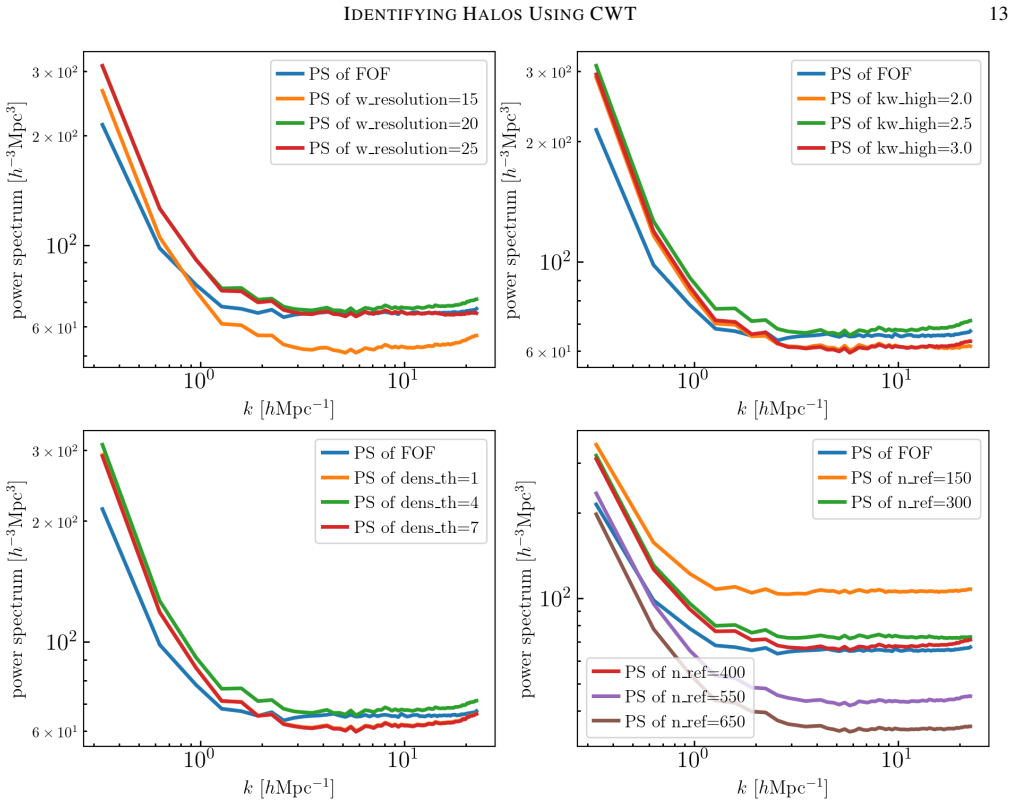
- [Section 4 and Figure 12] The paper states that 'increasing n_ref consistently results in a reduction in halo size' and that the HMF changes significantly for n_ref < 300. This means the default n_ref=400 may not be at numerical convergence, and the HMF/HPS comparisons in Section 3 are made at a resolution where halo sizes are still resolution-dependent. This is load-bearing because the abstract's viability claim relies on these comparisons. Please provide a convergence test in n_ref and w_resolution for the m50n512 catalog, showing that the HMF, the HPS, and the rvir-kw fit (Eq. 5) stabilize at the default settings within the quoted uncertainties. If convergence cannot be reached at practical grid sizes, the paper should state the systematic uncertainty on the halo-catalog statistics.
- [Section 3, Figures 9 and 10] The comparison FOF catalog is post-processed by a self-boundness check that, as the paper notes, 'does not retain any particles' and discards entire FOF groups when a large fraction of particles are unbound. This crude unbinding is not the standard way to produce a bound FOF catalog, and it is different from the iterative unbinding used inside CWTHF. The resulting 182,362-halo FOF catalog is therefore not a standard reference, and the claim that the HMF discrepancy at the low-mass end is 'primarily due to the unbound halos identified by the FOF method' is not fully supported. Please either compare against a properly unbound FOF catalog (e.g., from AHF or ROCKSTAR on the same data) or clearly frame the comparison as being against FOF-plus-crude-unbinding, and adjust the conclusions accordingly.
minor comments (6)
- [Section 3, first paragraph] The catalog name 'd4 r400 w20' is used without defining the meaning of the 'd4' component; footnote 3 gives the naming pattern only implicitly. Please define the notation explicitly.
- [Section 3, Figure 11 and Eq. (5)] The fit of rvir versus 1/kw excludes 'halos from the three largest scales' with the justification that very large virial radii are not feasible in CDM. Please quantify this cutoff (e.g., by comparing with the maximum expected halo radius in the m50n512 box) and test the sensitivity of Eq. (6) to the exclusion.
- [Section 2.1, Eq. (4)] The normalization of the Mexican hat wavelet is not explained; please state the normalization convention and cite the source (Wang & He 2021) more explicitly.
- [Section 4, Figures 12 and 13] The text states that 'increasing n_ref consistently results in a reduction in halo size, as questionable boundary regions are excluded.' Please specify which boundary regions are 'questionable' and how they are identified.
- [Section 1] The claim of being 'the first wavelet-based, MPI-parallelized halo finder' should be supported by a more thorough literature search or weakened to 'to our knowledge'.
- [Appendix A] The performance statement 'A dataset that is eight times larger results in only approximately 0.6 times more computation time' is ambiguous; please clarify whether this is total time or time per particle and specify the exact numbers.
Circularity Check
No circularity: CWTHF's viability claim is benchmarked against an external FOF catalog; self-citations are lineage, and the 3/5 correction is an acknowledged calibration, not an input that forces the comparison.
full rationale
The paper's load-bearing claim is that CWT halo catalogs agree with an FOF catalog for the SIMBA m50n512 dark-matter sub-simulation, as measured by spatial distribution, halo mass function, and power spectrum. That FOF reference catalog is built independently with the yt-project on public SIMBA data, and the unbinding procedure applied to the FOF catalog is the standard AHF-style self-boundness check, applied symmetrically rather than derived from the CWT algorithm. The CWTHF code does not take the FOF catalog as input, so the reported agreement is external and falsifiable, not forced by construction. The methodological elements borrowed from the authors' own prior series (Wang & He 2021, 2022, 2023, 2024; Li et al. 2024) are explicit definitions and conventions: the Mexican-hat wavelet is given in Eq. 4, the halo boundary is defined by CWT > 0, and cross-scale maxima define halo centers and sizes. These are assumptions of the method, not uniqueness theorems or hidden fits to the benchmark. The closest candidate for a circularity concern is Appendix B: the paper assumes a 3D isotropic quadratic peak, derives a grid-bias correction, then concedes that 'the precise form of the CWT peak is sharper than that of a quadratic function' and hand-removes the factor 3/5 to 'improve consistency across different resolutions.' This is an acknowledged calibration or correctness risk: if the quadratic model and the hand-removed factor are wrong, halo sizes, the fitted scale-radius relation in Eq. 5, and the HMF comparison shift. But it is not circularity, because the factor is not fitted to the FOF benchmark in the text, and the central viability comparison remains an independent external test. No specific reduction of a prediction to an input, by equation or by self-citation chain, was found.
Assumptions & free parameters
free parameters (6)
- dens_th, grid density threshold =
4 rho (any value 1 to 7 'produces acceptable results')
- Peak-correction compensation factor =
3/5 removed by hand
- rvir-kw fit coefficients =
0.091 and -0.012 (Eq. 5)
- kw high, upper scale limit =
2.5
- n ref and w resolution =
400 and 20
- particle th, minimum particle number =
15
assumptions (6)
- domain assumption The isotropic Mexican hat wavelet (Eq. 4, with its positive core and negative ring) is the right probe at each scale, so the CWT > 0 region marks the halo boundary (Section 2.3).
- domain assumption The CIC grid faithfully approximates the particle distribution, with grid resolution Ng = Int(400 kw + 150) tying physical resolution to scale (Section 2.1).
- ad hoc to paper The CWT field near a peak is a 3D isotropic quadratic, and the grid-averaging bias between scales can be corrected analytically (Appendix B).
- domain assumption A candidate is a real halo only if its maximum persists to an adjacent smaller scale (cross-scale maximum, Section 2.4).
- domain assumption Self-boundness can be judged with a spherical escape-velocity estimate and a 40% unbinding threshold (Section 2.3, citing Knollmann and Knebe 2009).
- domain assumption LCDM cannot produce halos with very large virial radii, justifying exclusion of the three largest wavelet scales from the fit (Section 3, Figure 11).
Cite this review
Pith. "Pith review of CWTHF: Identifying Dark Matter Halos with Continuous Wavelet Transform." pith.science (2026). https://pith.science/paper/XHQGTBX4
@misc{pith2026250110622,
  author       = {Pith},
  title        = {Pith review of: CWTHF: Identifying Dark Matter Halos with Continuous Wavelet Transform},
  year         = {2026},
  howpublished = {\url{https://pith.science/paper/XHQGTBX4}},
  note         = {Machine review of arXiv:2501.10622}
}
abstract
Cosmological simulations are an important method for investigating the evolution of the Universe. In order to gain further insight into the processes of structure formation, it is necessary to identify isolated bound objects within the simulations, namely, the dark matter halos. The continuous wavelet transform (CWT) is an effective tool used as a halo finder due to its ability to extract clustering information from the input data. In this study, we introduce CWTHF (Continuous Wavelet Transform Halo Finder), the first wavelet-based, MPI-parallelized halo finder, marking a novel approach in the field of cosmology. We calculate the CWT from the cloud-in-cell (CIC) grid and segment the grid based on the local CWT maxima. We then investigate the effects of the parameters that influence our program and identify the default settings. A comparison with the conventional friends-of-friends (FOF) method demonstrates the viability of CWT for halo finding. Although the actual performance is not faster than FOF, the linear time complexity of $\mathcal{O}(N)$ of our identification scheme indicates its significant potential for future optimization and application.
Figures


Figures from the paper (8 more)


Reference graph
Works this paper leans on
-
[1]
Arag´on-Calvo, M. A., Jones, B. J. T., van de Weygaert, R., & van der Hulst, J. M. 2007, A&A, 474, 315, doi: 10.1051/0004-6361:20077880
-
[2]
2024, JCAP, 2024, 001, doi: 10.1088/1475-7516/2024/02/001
Balaudo, A., Calore, F., De Romeri, V ., & Donato, F. 2024, JCAP, 2024, 001, doi: 10.1088/1475-7516/2024/02/001
-
[3]
Baluev, R. V ., & Rodionov, E. I. 2020, Celestial Mechanics and Dynamical Astronomy, 132, 34, doi: 10.1007/s10569-020-09976-2
-
[4]
Behroozi, P. S., Wechsler, R. H., & Wu, H.-Y . 2013, ApJ, 762, 109, doi: 10.1088/0004-637X/762/2/109
- [5]
-
[6]
Bertschinger, E., & Gelb, J. M. 1991, Computers in Physics, 5, 164, doi: 10.1063/1.4822978
-
[7]
1992, in Distribution of Matter in the Universe, ed
Bijaoui, A., Slezak, E., & Mars, G. 1992, in Distribution of Matter in the Universe, ed. G. A. Mamon & D. Gerbal, 323–332 Cay´on, L., Sanz, J. L., Barreiro, R. B., et al. 2000, MNRAS, 315, 757, doi: 10.1046/j.1365-8711.2000.03462.x
arXiv 1992
-
[8]
2007, in American Institute of Physics Conference Series, V ol
Ciprini, S., Tosti, G., Marcucci, F., et al. 2007, in American Institute of Physics Conference Series, V ol. 921, The First GLAST Symposium, ed. S. Ritz, P. Michelson, & C. A. Meegan, 546–547 Dav´e, R., Angl´es-Alc´azar, D., Narayanan, D., et al. 2019, MNRAS, 486, 2827, doi: 10.1093/mnras/stz937
Show all 49 references
-
[9]
S., & White, S
Davis, M., Efstathiou, G., Frenk, C. S., & White, S. D. M. 1985, ApJ, 292, 371, doi: 10.1086/163168
1985 doi
-
[10]
2012, SoPh, 281, 863, doi: 10.1007/s11207-012-0109-3
Djafer, D., Irbah, A., & Meftah, M. 2012, SoPh, 281, 863, doi: 10.1007/s11207-012-0109-3
2012 doi
- [11]
-
[12]
2006, A&A, 450, 9, doi: 10.1051/0004-6361:20041635
Flin, P., & Krywult, J. 2006, A&A, 450, 9, doi: 10.1051/0004-6361:20041635
2006 doi
-
[13]
E., Kashyap, V ., Rosner, R., & Lamb, D
Freeman, P. E., Kashyap, V ., Rosner, R., & Lamb, D. Q. 2002, ApJS, 138, 185, doi: 10.1086/324017
2002 doi
-
[14]
S., & White, S
Frenk, C. S., & White, S. D. M. 2012, Annalen der Physik, 524, 507, doi: 10.1002/andp.201200212
2012 doi
-
[15]
M., & Bertschinger, E
Gelb, J. M., & Bertschinger, E. 1994, ApJ, 436, 467, doi: 10.1086/174922
1994 doi
- [16]
-
[17]
A., Forman, W., Jones, C., & Murray, S
Grebenev, S. A., Forman, W., Jones, C., & Murray, S. 1995, ApJ, 445, 607, doi: 10.1086/175725
1995 doi
-
[18]
2022, MNRAS, 509, 501, doi: 10.1093/mnras/stab2980
Maksimova, N. 2022, MNRAS, 509, 501, doi: 10.1093/mnras/stab2980
2022 doi
-
[19]
R., Millman, K
Harris, C. R., Millman, K. J., van der Walt, S. J., et al. 2020, Nature, 585, 357, doi: 10.1038/s41586-020-2649-2
2020 doi
-
[20]
2012, Geophysical Journal International, 189, 1430, doi: 10.1111/j.1365-246X.2012.05455.x
Hayn, M., Panet, I., Diament, M., et al. 2012, Geophysical Journal International, 189, 1430, doi: 10.1111/j.1365-246X.2012.05455.x
2012 arXiv
-
[21]
Hopkins, P. F. 2015, MNRAS, 450, 53, doi: 10.1093/mnras/stv195 18 L I, WANG & H E
2015 doi
-
[22]
Hunter, J. D. 2007, Computing in Science and Engineering, 9, 90, doi: 10.1109/MCSE.2007.55
2007 doi
-
[23]
R., Muldrew, S
Knebe, A., Knollmann, S. R., Muldrew, S. I., et al. 2011, MNRAS, 415, 2293, doi: 10.1111/j.1365-2966.2011.18858.x
2011
-
[24]
R., Lux, H., et al
Knebe, A., Pearce, F. R., Lux, H., et al. 2013, MNRAS, 435, 1618, doi: 10.1093/mnras/stt1403
2013 doi
-
[25]
R., & Knebe, A
Knollmann, S. R., & Knebe, A. 2009, ApJS, 182, 608, doi: 10.1088/0067-0049/182/2/608
2009 doi
-
[26]
2012, Physics of the Dark Universe, 1, 50, doi: 10.1016/j.dark.2012.10.002
Kuhlen, M., V ogelsberger, M., & Angulo, R. 2012, Physics of the Dark Universe, 1, 50, doi: 10.1016/j.dark.2012.10.002
2012 doi
-
[27]
1994, MNRAS, 271, 676, doi: 10.1093/mnras/271.3.676
Lacey, C., & Cole, S. 1994, MNRAS, 271, 676, doi: 10.1093/mnras/271.3.676
1994 doi
-
[28]
R., & Tagliaferri, G
Lazzati, D., Campana, S., Rosati, P., Panzera, M. R., & Tagliaferri, G. 1999, ApJ, 524, 414, doi: 10.1086/307788
1999 doi
-
[29]
2025, CWTHF (Continuous Wavelet Transform Halo Finder), Zenodo, doi: 10.5281/zenodo.15015510
Li, M. 2025, CWTHF (Continuous Wavelet Transform Halo Finder), Zenodo, doi: 10.5281/zenodo.15015510. https://doi.org/10.5281/zenodo.15015510
2025 doi
-
[30]
2024, ApJ, 973, 39, doi: 10.3847/1538-4357/ad65d1
Li, M., Wang, Y ., & He, P. 2024, ApJ, 973, 39, doi: 10.3847/1538-4357/ad65d1
2024 doi
-
[31]
2018, Communications in Theoretical Physics, 70, 728, doi: 10.1088/0253-6102/70/6/728
Li, Z.-W., & He, P. 2018, Communications in Theoretical Physics, 70, 728, doi: 10.1088/0253-6102/70/6/728
2018 doi
-
[32]
2015, A&A, 574, A67, doi: 10.1051/0004-6361/201424566
Mertens, F., & Lobanov, A. 2015, A&A, 574, A67, doi: 10.1051/0004-6361/201424566
2015 doi
-
[33]
2019, Computational Astrophysics and Cosmology, 6, 2, doi: 10.1186/s40668-019-0028-x
Nelson, D., Springel, V ., Pillepich, A., et al. 2019, Computational Astrophysics and Cosmology, 6, 2, doi: 10.1186/s40668-019-0028-x
2019 doi
-
[34]
2006, A&A, 458, 441, doi: 10.1051/0004-6361:20065225
Patrikeev, I., Fletcher, A., Stepanov, R., et al. 2006, A&A, 458, 441, doi: 10.1051/0004-6361:20065225
2006 doi
-
[35]
Peebles, P. J. E. 1974, ApJL, 189, L51, doi: 10.1086/181462 Planck Collaboration, Ade, P. A. R., Aghanim, N., et al. 2016, A&A, 594, A13, doi: 10.1051/0004-6361/201525830
1974 doi
-
[36]
2010, A&A, 519, A94, doi: 10.1051/0004-6361/201014214
Planelles, S., & Quilis, V . 2010, A&A, 519, A94, doi: 10.1051/0004-6361/201014214
2010 doi
- [37]
-
[38]
B., Agertz, O., Moore, B., & Stadel, J
Romeo, A. B., Agertz, O., Moore, B., & Stadel, J. 2008, ApJ, 686, 1, doi: 10.1086/591236
2008 doi
-
[39]
1993, ApJ, 409, 517, doi: 10.1086/172683
Slezak, E., de Lapparent, V ., & Bijaoui, A. 1993, ApJ, 409, 517, doi: 10.1086/172683
1993 doi
-
[40]
Springel, V ., White, S. D. M., Tormen, G., & Kauffmann, G. 2001, MNRAS, 328, 726, doi: 10.1046/j.1365-8711.2001.04912.x
2001
-
[41]
Stadel, J. G. 2001, PhD thesis, University of Washington, Seattle
2001
-
[42]
J., Smith, B
Turk, M. J., Smith, B. D., Oishi, J. S., et al. 2011, ApJS, 192, 9, doi: 10.1088/0067-0049/192/1/9 Vall´es-P´erez, D., Planelles, S., & Quilis, V . 2022, A&A, 664, A42, doi: 10.1051/0004-6361/202243712 van der Walt, S., Colbert, S. C., & Varoquaux, G. 2011, Computing in Scienc...
2011 doi
-
[43]
B., & Babyk, I
Vavilova, I. B., & Babyk, I. V . 2018, Odessa Astronomical Publications, 30, 239, doi: 10.18524/1810-4215.2018.31.146678
2018
-
[44]
2020, ApJS, 250, 2, doi: 10.3847/1538-4365/ab9d82
Villaescusa-Navarro, F., Hahn, C., Massara, E., et al. 2020, ApJS, 250, 2, doi: 10.3847/1538-4365/ab9d82
2020 doi
-
[45]
E., et al
Virtanen, P., Gommers, R., Oliphant, T. E., et al. 2020, Nature Methods, 17, 261, doi: 10.1038/s41592-019-0686-2
2020 doi
-
[46]
2008, MNRAS, 387, 601, doi: 10.1111/j.1365-2966.2008.13292.x
Wang, L., Rowan-Robinson, M., Yamamura, I., et al. 2008, MNRAS, 387, 601, doi: 10.1111/j.1365-2966.2008.13292.x
2008
-
[47]
2021, Communications in Theoretical Physics, 73, 095402, doi: 10.1088/1572-9494/ac10be —
Wang, Y ., & He, P. 2021, Communications in Theoretical Physics, 73, 095402, doi: 10.1088/1572-9494/ac10be —. 2022, ApJ, 934, 112, doi: 10.3847/1538-4357/ac7a3d —. 2023, RAS Techniques and Instruments, 2, 307, doi: 10.1093/rasti/rzad020 —. 2024a, MNRAS, 528, 3797, doi: 10.1093...
-
[48]
2022, ApJ, 934, 77, doi: 10.3847/1538-4357/ac752c
Wang, Y ., Yang, H.-Y ., & He, P. 2022, ApJ, 934, 77, doi: 10.3847/1538-4357/ac752c
2022 doi
-
[49]
H., Hernquist, L., & Katz, N
Weinberg, D. H., Hernquist, L., & Katz, N. 1997, ApJ, 477, 8, doi: 10.1086/303683
1997 doi
Reviewed August 10, 2026 · model on record in the stance chip above.
Discussion (0). Continue with ORCID to comment.