REVIEW 2 major objections 4 minor 20 references
Classical waves and instabilities using the minimalist approach
T0 review · 2 major / 4 minor · reviewed 2026-08-10 · deepseek-v4-flash
Pith's one-line read The paper claims that every linear wave and instability problem in planar ideal magnetohydrodynamics reduces to a single first-order differential equation, the principal equation, whose continuity and boundary conditions determine the…
desk verdict A clean ODE-based route to classical MHD stability results, with useful new KH formulas that require one more proof step to be fully convincing. read the letter →
The pith
A machine-rendered reading of the paper's core claim, the machinery that carries it, and where it could break.
The reading
What carries the argument
The machinery is the principal equation $Y'=f_{21}Y^2-2f_{11}Y-f_{12}$, together with the continuity and asymptotic boundary conditions on $Y$. It converts the linearized perturbation system into a single Riccati equation for the ratio $Y=y_1/y_2$, so the dispersion relation is obtained by integrating one first-order ODE rather than by matching many perturbation variables. For the symmetric Kelvin-Helmholtz problem the paper also uses the parametrization $\omega=i k_z V_0\tan(\Lambda/2)$ to turn the dispersion relation into polynomial equations for the growth rate: the quartic (28), and the cubic (30) that fixes the edges of the unstable Mach-number range.
What would settle it
Solve the full dispersion relation (22) for two identical fluids with, say, $M=1$, $c_s>0$, and $\mathbf{B}_0=0$, allowing $\omega$ to be complex; finding any root with $\Re\omega\neq0$ and $\Im\omega>0$ would disprove the claim that the unstable mode is purely imaginary and would expose the reported growth rate as incomplete.
Extended reading notes
Core claim
The central claim is that linearized ideal-MHD perturbations of a steady state depending on one Cartesian coordinate are fully controlled by the ratio $Y=y_1/y_2$ of the Lagrangian $x$-displacement to the perturbed total pressure, and that this ratio obeys the principal equation $Y'=f_{21}Y^2-2f_{11}Y-f_{12}$. The coefficients $f_{ij}$ encode the local wave physics through the Doppler-shifted frequency $\omega_0=\omega-\mathbf{k}_0\cdot\mathbf{V}_0$, the magnetic-tension factor $F=\mathbf{k}_0\cdot\mathbf{B}_0$, the Alfvén factor $A=\rho_0\omega_0^2-F^2$, and the compressibility factor $S=\rho_0(Ac_s^2+\omega_0^2B_0^2)$. Requiring $Y$ to be continuous at every interface and to tend to $(f_{11}\pm\sqrt{f_{11}^2+f_{12}f_{21}})/f_{21}$ as $x\to\pm\infty$ is argued to determine the dispersion relation. On this basis the paper rederives classical results for magnetosonic, Alfvén, gravity, Rayleigh-Taylor, and Kelvin-Helmholtz waves, and provides analytical growth rates and instability intervals for the compressible and magnetized Kelvin-Helmholtz instability in two fluids with identical properties.
Load-bearing premise
In the symmetric two-fluid Kelvin-Helmholtz analysis, the paper assumes that the unstable mode has a purely imaginary frequency, $\omega=i k_z V_0\tan(\Lambda/2)$; if a genuinely overstable mode with a nonzero real frequency exists at the same parameters, the quoted growth rates and instability intervals would be incomplete.
Editorial extensions
If this is right
- For two identical compressible fluids moving at opposite velocities $\pm V_0$, the unstable Kelvin-Helmholtz mode has growth rate $\Im\omega=k_0V_0\tan(\mu/2)$ with $\mu=\arccos((\sqrt{1+4M^2}-1)/2)$, recovering the incompressible growth rate $k_0V_0$ as $M\to0$ and vanishing at $M=\sqrt{2}$.
- A magnetic field parallel to the wavevector suppresses the instability: when $\mathbf{B}_0\parallel\mathbf{k}_0$ the instability occurs only for $v_A<c_s$, with $V_0$ lying between $c_s\sqrt{1\pm\sqrt{(c_s^2-v_A^2)/(c_s^2+v_A^2)}}$.
- In a cold plasma with $c_s=0$, the instability exists only for $|B_{0z}|/\sqrt{\rho_0}<V_0<\sqrt{2B_0^2-B_{0z}^2}/\sqrt{\rho_0}$, where the $z$-axis is the direction of the relative flow and of the wavevector.
- The endpoints of the unstable intervals coincide with bifurcations of the dispersion relation, where $\partial f/\partial\omega=0$ at $\omega=0$, and the limiting states are Alfvén or magnetosonic waves with real $x$-wavenumbers.
- The same principal equation and boundary conditions reproduce the standard dispersion relations for surface gravity waves, the Rayleigh-Taylor instability, and magnetosonic and Alfvén waves, including finite-depth variants.
Reading between the lines
- Extension: because the reduction uses only the ratio $Y$ and its continuity, the same route should apply to layered or continuously stratified configurations, where numerical integration of the principal equation replaces mode matching across many interfaces.
- Extension: the bifurcation criterion used to locate the edges of the Kelvin-Helmholtz instability could be applied to unequal-density or oblique-field versions of the problem, giving closed-form boundary curves without solving the full dispersion relation.
- Extension: the planar ansatz is the only geometry-specific ingredient, so translating the principal equation to cylindrical or spherical shear layers is a natural next step that would extend the unified treatment beyond Cartesian flows.
Signed reviews
Editorial analysis
A structured set of objections, weighed in public.
Referee Report
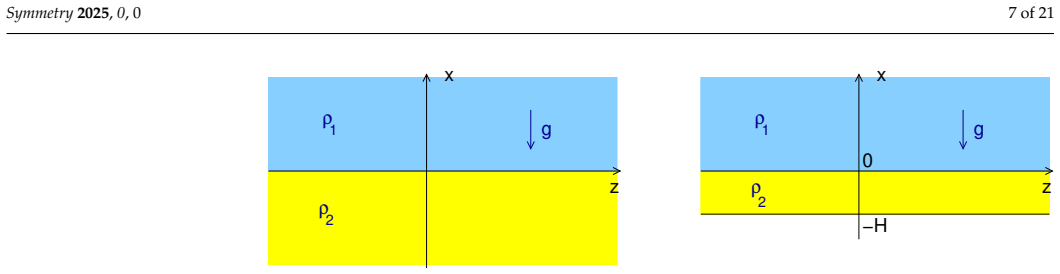
Summary. The paper presents the 'minimalist approach' to linear perturbation theory in planar ideal MHD, in which the linearized equations reduce to a single first-order ODE (the principal equation) for the ratio Y = y1/y2, with dispersion relations obtained by requiring Y to be continuous and to satisfy prescribed boundary conditions at infinity. The principal equation is derived from the linearized MHD system in Appendix A, and the formalism is applied to magnetosonic waves, Alfvén waves, two-fluid interface problems (incompressible plasma, Rayleigh-Taylor instability, gravito-acoustic waves), and most extensively to the Kelvin-Helmholtz instability. For the latter, the paper derives analytical growth-rate expressions for two identical compressible fluids (Eqs. 23 and 28), studies the influence of magnetic fields, and determines instability ranges through bifurcation analysis (Section 6.5 and Eq. 30). The classical applications are cross-checked against textbook results from Chandrasekhar.
Significance. If the main claims are correct, the paper offers a unified and economical route to dispersion relations in classical planar MHD problems, and the new analytical results for the compressible and magnetized Kelvin-Helmholtz instability of identical-fluid configurations are potentially useful additions to the literature. A clear strength is that the principal equation is derived from first principles rather than assumed, and the reproduction of known dispersion relations for Rayleigh-Taylor, gravity wave, and incompressible KH cases gives confidence in the formalism. The paper is also carefully written with detailed appendices showing the algebra. However, the central new results for KH instability depend on an unproven assumption about the form of unstable modes, which is the main issue to be resolved before acceptance.
major comments (2)
- [Sections 6.3–6.5, Eq. (27)–(30), Appendix C] The derivation of the compressible and magnetized Kelvin-Helmholtz growth rates restricts ω to the purely imaginary form ω = i k_z V0 tan(Λ/2) (Eq. 29). The paper constructs solutions of this form and shows they satisfy Eq. (28), but it does not prove that every unstable mode of the full dispersion relation (27) has this form. The full relation is transcendental in ω and contains principal-branch square roots; nothing in Section 6.3 or Appendix C excludes overstable modes with ℑω>0 and ℜω≠0. If such modes exist, the reported growth-rate formulas would not give the maximum growth rate, and the instability intervals would be incomplete. For the unmagnetized identical-fluid case, squaring (27) yields M²(x²−1)²−2(x²+1)=0, whose roots are purely imaginary after discarding branch-violating real roots; no analogous argument is given for the magnetized case. The statement at the end of Appendix C that the substitution 'excludes trivial solutions... proves that the solution is purely imaginary' appears to refer only to the constructed family, not to exhaustiveness. This point is load-bearing for the paper's central new results.
- [Section 6.5, Eqs. (30)] The instability boundaries are located by requiring ω=0 and imposing the bifurcation condition ∂f/∂ω|ω=0=0. This procedure presupposes that marginal stability of the KH mode occurs at zero frequency. In the magnetized compressible problem, neutral modes at the boundary of an instability region could in principle have nonzero real frequency (overstable threshold), in which case the computed intervals (e.g., the interval for B0 ∥ k0 and the cold-case interval) would not be the true instability ranges. The paper provides no argument ruling out such thresholds, so the stated ranges of instability in Section 6.5 are not fully established.
minor comments (4)
- [Abstract and Section 2] The word 'cartesian' should be capitalized as 'Cartesian'; similarly, 'Alfvèn' in Section 3.2 should be 'Alfvén'.
- [Section 6.4] There is a typographical error: 'magnetic filed' should read 'magnetic field'.
- [Section 2.3] In the sentence 'this is not constant sine the unperturbed total pressure...', 'sine' should be 'since'.
- [Section 6.5, Eq. (30)] The cubic displayed as 'V6 0 − (2c2 s + 2v2 A − v2 A∥)V4 0 + 2c2 s v2 A∥ c2 s + v2 A (2c2 s + 2v2 A − v2 A∥)V2 0 − 2c4 s v4 A∥ c2 s + v2 A = 0' is ambiguous: the coefficient multiplying V0² should be written with explicit parentheses, e.g., [2 c_s² v_A∥²/(c_s²+v_A²)] (2c_s²+2v_A²−v_A∥²), to avoid misreading.
Circularity Check
No significant circularity: the principal equation is derived from the linearized MHD equations, and the new Kelvin-Helmholtz results are analytic solutions of the derived dispersion relation rather than assumptions relabeled as predictions.
full rationale
The paper's central derivation is self-contained. The principal equation (17) is obtained in Section 2.2 by taking the ratio Y = y1/y2 of the linearized system (14), which itself is derived from the ideal MHD equations in Appendix A; it is not assumed or imported. The boundary conditions in Table 1 are derived from the asymptotic solutions of the principal equation in Appendix B. The classical applications in Sections 3-5 reproduce textbook results, explicitly checked against Chandrasekhar's Ref. [1], providing external independent benchmarks. The new compressible Kelvin-Helmholtz results are obtained by substituting the purely imaginary form ω = ikzV0 tan(µ/2) into the dispersion relation (22), which reduces algebraically to cos^2µ + cosµ = M^2 in the unmagnetized case, and in the magnetized case to the quartic (28) via the elimination of µ in Appendix C. These are genuine algebraic reductions of the dispersion relation, not parameters fitted to the predicted quantity. The paper does restrict attention to purely imaginary ω and does not prove the absence of overstable modes with nonzero real frequency; that is a possible completeness or rigor gap, but it is not circularity because the derived expressions do not presuppose the growth rate they claim to compute. The self-citations to Refs. [15] and [16] are not load-bearing: the minimalist approach is rederived here, and the Schwarzian method is only mentioned in a footnote and is not used in the derivation. No fitted input is renamed as a prediction, and no load-bearing claim reduces by construction to its own input.
Assumptions & free parameters
assumptions (6)
- domain assumption Ideal MHD equations with no viscosity, resistivity, or surface tension (Eqs. 1-5) describe the fluids.
- domain assumption The unperturbed state is planar, depends only on x, has tangential velocity and magnetic field, and satisfies hydrostatic equilibrium Π0' = -ρ0 g (Eq. 7).
- standard math Perturbations are normal modes with real wavevector k0 and complex frequency ω (Eqs. 8-11).
- domain assumption At infinity the solution must not diverge, and the physical branch is selected by principal square roots (Section 2.3 and Table 1).
- ad hoc to paper For the symmetric two-fluid Kelvin-Helmholtz problem, the unstable frequency is purely imaginary, ω = i k_z V0 tan(Λ/2) (Section 6.3 and Appendix C).
- ad hoc to paper The edges of the Kelvin-Helmholtz instability intervals are located by the bifurcation condition ∂f/∂ω|_{ω=0}=0 plus singular cases (Section 6.5).
Cite this review
Pith. "Pith review of Classical waves and instabilities using the minimalist approach." pith.science (2026). https://pith.science/paper/I3TDVNJW
@misc{pith2026250110708,
  author       = {Pith},
  title        = {Pith review of: Classical waves and instabilities using the minimalist approach},
  year         = {2026},
  howpublished = {\url{https://pith.science/paper/I3TDVNJW}},
  note         = {Machine review of arXiv:2501.10708}
}
read the original abstract
The minimalist approach in the study of perturbations in fluid dynamics and magnetohydrodynamics involves describing their evolution in the linear regime using a single first-order ordinary differential equation, dubbed principal equation. The dispersion relation is determined by requiring that the solution of the principal equation be continuous and satisfy specific boundary conditions for each problem. The formalism is presented for flows in cartesian geometry and applied to classical cases such as the magnetosonic and gravity waves, the Rayleigh-Taylor instability, and the Kelvin-Helmholtz instability. For the latter, we discuss the influence of compressibility and the magnetic field, and also derive analytical expressions for the growth rates and the range of instability in the case of two fluids with the same characteristics.
Figures


Figures from the paper (1 more)

Reference graph
Works this paper leans on
-
[1]
Hydrodynamic and hydromagnetic stability; Oxford: Clarendon Press, 1961
Chandrasekhar, S. Hydrodynamic and hydromagnetic stability; Oxford: Clarendon Press, 1961
work page 1961
-
[2]
Plasma Dynamics ; Nelson, Great Britain, 1969
Boyd, T.J.M.; Sanderson, J.J. Plasma Dynamics ; Nelson, Great Britain, 1969
work page 1969
- [3]
-
[4]
Freidberg, J.P . Ideal MHD; 2014. https://doi.org/10.1017/CBO9780511795046. Symmetry 2025, 0, 0 21 of 21
-
[5]
Magnetohydrodynamics of Laboratory and Astrophysical Plasmas; Cambridge Univ
Goedbloed, H.; Keppens, R.; Poedts, S. Magnetohydrodynamics of Laboratory and Astrophysical Plasmas; Cambridge Univ. Press, Cambridge, 2019
work page 2019
- [6]
-
[7]
Spatial Stability of the Slab Jet
Hardee, P .E.; Norman, M.L. Spatial Stability of the Slab Jet. I. Linearized Stability Analysis. Astroph. J. 1988, 334, 70. https://doi.org/10.1086/166818
-
[8]
Osmanov, Z.; Mignone, A.; Massaglia, S.; Bodo, G.; Ferrari, A. On the linear theory of Kelvin-Helmholtz instabilities of relativistic magnetohydrodynamic planar flows. Astron. Astrophys. 2008, 490, 493–500. https://doi.org/10.1051/0004-6361:200809605
Show all 20 references
-
[9]
Linear theory of the Rayleigh-Taylor instability at a discontinuous surface of a relativistic flow
Matsumoto, J.; Aloy, M.A.; Perucho, M. Linear theory of the Rayleigh-Taylor instability at a discontinuous surface of a relativistic flow. Mon. Not. R. Astron. Soc. 2017, 472, 1421–1431. https://doi.org/10.1093/mnras/stx2012
2017 doi
-
[10]
The magnetic Rayleigh-Taylor instability around astrophysical black holes
Papadopoulos, D.B.; Contopoulos, I. The magnetic Rayleigh-Taylor instability around astrophysical black holes. Mon. Not. R. Astron. Soc. 2019, 483, 2325–2336. https://doi.org/10.1093/mnras/sty3167
2019 doi
-
[11]
Relativistic centrifugal instability
Gourgouliatos, K.N.; Komissarov, S.S. Relativistic centrifugal instability. Mon. Not. R. Astron. Soc. 2018, 475, L125–L129. https://doi.org/10.1093/mnrasl/sly016
2018 doi
-
[12]
Linear analysis of the Kelvin-Helmholtz instability in relativistic magnetized symmetric flows
Chow, A.; Rowan, M.E.; Sironi, L.; Davelaar, J.; Bodo, G.; Narayan, R. Linear analysis of the Kelvin-Helmholtz instability in relativistic magnetized symmetric flows. Mon. Not. R. Astron. Soc. 2023, 524, 90–99, [arXiv:astro-ph.HE/2305.00036]. https://doi.org/10.1093/mnras/stad1833
2023 arXiv
-
[13]
Kelvin-Helmholtz instability and heating in oscillating loops perturbed by power-law transverse wave drivers
Karampelas, K.; Van Doorsselaere, T.; Guo, M.; Duckenfield, T.; Pelouze, G. Kelvin-Helmholtz instability and heating in oscillating loops perturbed by power-law transverse wave drivers. Astron. Astrophys. 2024, 688, A80. https://doi.org/10.1051/0004-6361/ 202348972
2024 doi
-
[14]
Giant Kelvin-Helmholtz (KH) Waves at the Boundary Layer of the Coronal Mass Ejections (CMEs) Responsible for the Largest Geomagnetic Storm in 20 Years
Nykyri, K. Giant Kelvin-Helmholtz (KH) Waves at the Boundary Layer of the Coronal Mass Ejections (CMEs) Responsible for the Largest Geomagnetic Storm in 20 Years. Geophysical Research Letters 2024, 51, e2024GL110477. https://doi.org/10.1029/2024GL1 1047710.22541/au.172167325.5...
2024
-
[15]
Linear Stability Analysis of Relativistic Magnetized Jets: The Minimalist Approach
Vlahakis, N. Linear Stability Analysis of Relativistic Magnetized Jets: The Minimalist Approach. Universe 2024, 10, 183. https://doi.org/10.3390/universe10040183
2024 doi
-
[16]
The Schwarzian Approach in Sturm-Liouville Problems
Vlahakis, N. The Schwarzian Approach in Sturm-Liouville Problems. Symmetry 2024, 16, 648. https://doi.org/10.3390/sym160 60648
2024 doi
-
[17]
Investigation of the Character of the Equilibrium of an Incompressible Heavy Fluid of Variable Density*
Rayleigh. Investigation of the Character of the Equilibrium of an Incompressible Heavy Fluid of Variable Density*. Proceedings of the London Mathematical Society 1882, s1-14, 170–177. https://doi.org/10.1112/plms/s1-14.1.170
-
[18]
The instability of liquid surfaces when accelerated in a direction perpendicular to their planes
Taylor, G.I. The instability of liquid surfaces when accelerated in a direction perpendicular to their planes. I. Proceedings of the Royal Society of London. Series A. Mathematical and Physical Sciences 1950, 201, 192–196. https://doi.org/10.1098/rspa.1950.0052
1950
-
[19]
Thomson, W. XLVI. Hydrokinetic solutions and observations. The London, Edinburgh, and Dublin Philosophical Magazine and Journal of Science 1871, 42, 362–377. https://doi.org/10.1080/14786447108640585
-
[20]
Helmholtz. XLIII. On discontinuous movements of fluids. The London, Edinburgh, and Dublin Philosophical Magazine and Journal of Science 1868, 36, 337–346. https://doi.org/10.1080/14786446808640073. Disclaimer/Publisher’s Note: The statements, opinions and data contained in all...
Reviewed August 10, 2026 · model on record in the stance chip above.
Discussion (0). Continue with ORCID to comment.