REVIEW 3 major objections 5 minor 36 references
ParkView: Visualizing Monotone Interleavings
T0 review · 3 major / 5 minor · reviewed 2026-08-10 · deepseek-v4-flash
Pith's one-line read ParkView is a compact schematic encoding of monotone interleavings that lets a viewer reconstruct both shift maps, read off the interleaving height $\delta$, and see mapped and unmapped regions, using three colors per tree and a…
desk verdict Solid theory for a new merge-tree interleaving visualization; the main missing proof is a small corollary, not a flaw. read the letter →
The pith
A machine-rendered reading of the paper's core claim, the machinery that carries it, and where it could break.
The reading
What carries the argument
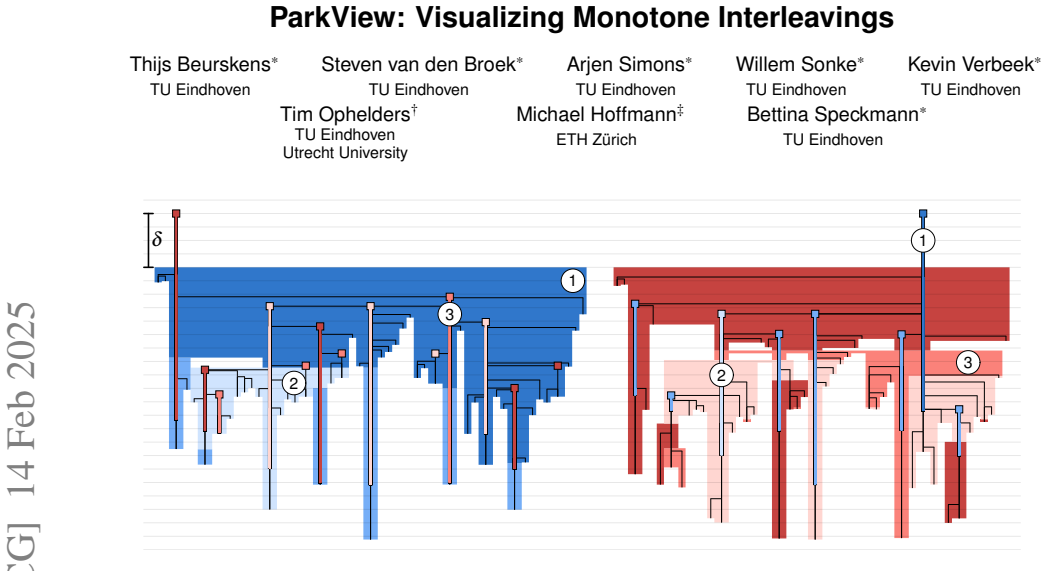
The load-bearing object is the heavy path-branch decomposition. For a shift map $\alpha$ from $T$ to $T'$, a path decomposition of $T'$ is obtained by choosing, at each internal vertex, one down edge as the through edge; each resulting leaf-to-root path $\pi$ has a preimage branch $B_\pi$ in $T$. Choosing the down edge of maximum weight, where weight is the number of connected components of the preimage of that edge, gives a heavy decomposition, and Theorem 1 shows this choice is optimal for both component-count objectives. The visual machinery is the hedge: a histogram-shaped union of tree bars, fillers, and bridges whose top height equals the top of the branch and whose left-to-right position follows the leaf order. Three structural properties of these hedges, namely interior-disjointness, having at most one parent, and having no hedge adjacent to the bottom of a longest bar, together yield the 3-colorability proof.
What would settle it
Enumerate all ordered merge trees with a small number of leaves, say four or five, and all monotone $\delta$-shift maps between them; for each path in the heavy decomposition, compute the preimage branch and check whether its image is a contiguous suffix ending at the path's top. Any example where the image has a gap, or ends below the top, would refute the completeness of ParkView's matching rules.
Extended reading notes
Core claim
ParkView claims that a monotone interleaving is completely and compactly captured by an optimal decomposition of both ordered merge trees into paths, together with the branches these paths pull back in the opposite tree. By choosing at every internal vertex the heaviest down edge, meaning the one whose preimage has the most connected components, the heavy path-branch decomposition simultaneously minimizes the maximum number of branch components per path and the total number of branch components (Theorem 1), and a greedy traversal computes it in linear time. Each non-empty branch is drawn as a histogram-shaped hedge and maps to one contiguous active path at the top of its path, so the two shift maps can be superimposed: hedges and active paths are matched by left-to-right leaf order, by equal height, and by color, and the paper proves the hedge set is 3-colorable (Theorem 2). The accompanying design elements, including square glyphs, grid lines at multiples of $\delta$, and narrowed columns for unmapped regions, are chosen to satisfy the stated requirements R0--R3: reconstruct the image of any point, read $\delta$, identify mapped versus unmapped regions, and detect equal-image points. The paper demonstrates the encoding on ionization-front and volcanic-eruption scalar fields.
Load-bearing premise
The encoding assumes that every non-empty branch maps to one contiguous stretch of its path ending exactly at the path's top, a property stated in Section 2.2 but not proved; if a branch's image could have gaps or stop short, the hedge-to-active-path matching and the square glyph would not line up, and the drawing would no longer be complete.
Editorial extensions
If this is right
- A user can recover either shift map point by point: every point inside a hedge maps to the corresponding active path, so requirement R0 is met by the drawing alone.
- The interleaving height $\delta$ is read as the vertical gap between the topmost square glyph and the hedge below it, giving requirement R1 without extra computation.
- Regions with no active path are drawn in narrow columns, so mapped versus unmapped parts of each tree are visually separated (R2), and shared images can be spotted through matching hedges (R3).
- Because heavy decompositions are optimal and computable in linear time, the encoding can be produced for ordered merge trees with roughly one hundred leaves, the scale the design targets.
- Only three colors per tree are ever needed, and with a separate hue for each of the two shift maps the full drawing uses at most six colors, keeping the color channel discriminable for arbitrary tree size.
Reading between the lines
- Beyond the paper: the 3-coloring argument applies to any histogram drawing satisfying the three stated properties, so the same color bound should transfer to other rectilinear encodings of tree matchings, not only ParkView.
- Beyond the paper: the usefulness of ParkView for time-series analysis hinges on choosing stable, meaningful leaf orders; the space-filling-curve order used in the demos is a heuristic, and a stability guarantee for order construction would be a natural next step.
- Beyond the paper: the contiguity-of-active-paths assumption could be stress-tested by exhaustive search over small ordered merge trees; if a counterexample exists, ParkView would need a modified glyph marking the actual image endpoints to remain complete.
- Beyond the paper: an interactive folding of inactive columns, not just static compression, would directly address the cluttered large-tree case that the supplementary material shows for trees with over nine hundred leaves.
Editorial analysis
A structured set of objections, weighed in public.
Referee Report
Summary. The paper introduces ParkView, a schematic visual encoding for monotone interleavings between ordered merge trees. The proposed drawing decomposes each tree into paths and represents the preimage of each path under a shift map as a histogram-shaped hedge; the image of a branch is drawn as a colored active path on the other tree. The authors prove that a heavy path decomposition minimizes both the total number and the maximum number of branch components (Theorem 1), that the resulting hedges are 3-colorable (Theorem 2), and that an optimal decomposition can be computed in linear time (Section 4). The encoding is designed to satisfy four visual requirements R0-R3, and the paper demonstrates it on real-world ionization-front and volcanic datasets. The supplementary material contains the omitted proofs of the geometric properties used in the coloring argument and a large-scale example.
Significance. If the construction is correct, ParkView is a genuinely useful contribution: it gives a compact, order-respecting drawing from which both interleaving maps can in principle be reconstructed, and it scales to trees with many leaves while using only six colors. The paper's strength is its formal component: Theorem 1 is proved from the definitions, Theorem 2 reduces 3-colorability to three local geometric properties that are proved in the appendix, and the authors make their implementation publicly available and test it on real data. The paper is also honest about limitations, including readability at 900+ leaves and the open problem of constructing stable leaf orders. The main weakness is that two structural properties that are load-bearing for the completeness claim (R0) are stated in Section 2.2 without proof, and one algorithmic claim in Section 4 is only sketched.
major comments (3)
- [Section 2.2 (Active paths)] The statement that a nonempty branch Bπ maps to a contiguous suffix π* of π, so that the active path always forms the top part of π, is load-bearing for requirement R0 and for the height- and color-based matching, but it is never proved. Lemma 1 in Section 3.1 shows that each connected component of Bπ contains a point mapping to the top edge of π, which comes close, but the paper does not state the corollary that the image of each component is a connected interval ending at the top of π, nor does it treat the unique path that extends to infinity, for which there is no finite top edge. Please add a proof of the suffix property for all paths, including the infinite path, or, if the property can fail, give a concrete counterexample and adjust the encoding.
- [Section 2.2 (Properties) and Section 5 (Showcase)] The claim that the left-to-right order of the lowest leaf in each hedge matches the left-to-right order of the corresponding active paths is asserted without proof, and it is explicitly used in Section 5 to resolve the matching in the path-3 example. This order property is essential for R0 because it allows the user to disambiguate the hedge-to-active-path matching. Please provide a proof or a precise reference, and specify how the property is defined for compound branches, which have several connected components and hence potentially several lowest leaves.
- [Section 4 (Algorithm 1 and running-time paragraph)] The linear-time computation of the heavy path-branch decomposition relies on precomputing the values |Be|, the number of connected components of the preimage of each edge e of T'. The text says this is done by 'simultaneously traversing the trees' and 'iteratively traversing T from each leaf to its root', but it does not explain how connected components are counted rather than merely points. Since linear-time optimal decomposition is one of the central claims, please give a precise description of the component-counting procedure and its linear-time bound, or point to the specific part of the released implementation that realizes it.
minor comments (5)
- [Figure 1 caption] The phrase 'hedges and active paths have the same height' is ambiguous: it is reconciled with the later statement that the top of each hedge is δ lower than the top of the active path only if 'height' means vertical extent, not top position. Please clarify this terminology.
- [Section 5 (Showcase)] In the path-3 discussion, the sentence 'as path 3 is left of path 2, it must map to hedge 3 as it the leaf it encloses is left of the lowest leaf hedge 2 encloses' contains a typo ('as it the leaf') and is hard to parse; please rewrite it.
- [Abstract and Section 3.2] The abstract's 'maximum of 6 colors' is not directly tied to Theorem 2, which proves 3-colorability per tree; adding a sentence explaining that the total of six comes from using two 3-colorings, one for each shift map, would help readers connect the two statements.
- [Section 5 (Pipeline)] The construction of leaf orders via a space-filling curve is described in two sentences, and the paper itself notes that stable orders are an open question; a brief comment on the observed stability of the space-filling-curve orders in the examples would strengthen the proof-of-concept.
- [Supplementary material] The supplementary 900-leaf example is reported as difficult to read; consider adding a sentence in Section 5 that summarizes this scalability limitation in the main text, since it is relevant to the paper's scalability claims.
Circularity Check
No circularity found; ParkView's structural theorems follow from definitions of monotone interleavings, with prior work cited only as the input pipeline.
full rationale
The paper's derivation chain is self-contained from the definitions of monotone interleavings and shift maps. Theorem 1 (optimal heavy path-branch decomposition) is proven from Lemma 1, which is derived from continuity and the tree property; the greedy choice of a maximum-weight through edge is shown to minimize the per-vertex cost, so optimality is not assumed by definition. Theorem 2 (3-colorability) is a graph-coloring theorem about histograms satisfying properties (i)-(iii), and the properties are proven from monotonicity and drawing-order observations; no fitted quantity or target result is imported. The 'active path is a top suffix' property used in the visual encoding is stated tersely in Section 2.2, but it is supported by the continuity argument in Lemma 1 (each branch component reaches the top edge), so any issue there is proof compression rather than circularity. The only self-citation, [2], supplies the formal ordered-tree definition and the Frechet-based pipeline that produces the input interleaving; this is external input to ParkView, not the engine of the visualization theorems, and the cited SODA result is independent supporting work. No step renames a known result, fits a parameter to a target quantity, or defines an object in terms of the claim being derived.
Assumptions & free parameters
assumptions (4)
- domain assumption Monotone delta-interleavings are given as continuous height-shifting maps alpha, beta satisfying the ancestor conditions alpha(beta(y)) and beta(alpha(x)), and respecting the leaf orders.
- ad hoc to paper The drawing places each path in a column in leaf order, with horizontal segments for internal vertices; this order is what Observations 1 and 2 and the left-to-right matching use.
- ad hoc to paper For every path pi in the heavy decomposition, alpha(B_pi) is a contiguous suffix of pi ending at the path's top.
- domain assumption The interleavings shown in Section 5 are monotone and correctly computed via the Frechet matching relation of the authors' SODA25 paper [2].
Cite this review
Pith. "Pith review of ParkView: Visualizing Monotone Interleavings." pith.science (2026). https://pith.science/paper/YZN7E2ZX
@misc{pith2026250110728,
  author       = {Pith},
  title        = {Pith review of: ParkView: Visualizing Monotone Interleavings},
  year         = {2026},
  howpublished = {\url{https://pith.science/paper/YZN7E2ZX}},
  note         = {Machine review of arXiv:2501.10728}
}
read the original abstract
Merge trees are a powerful tool from topological data analysis that is frequently used to analyze scalar fields. The similarity between two merge trees can be captured by an interleaving: a pair of maps between the trees that jointly preserve ancestor relations in the trees. Interleavings can have a complex structure; visualizing them requires a sense of (drawing) order which is not inherent in this purely topological concept. However, in practice it is often desirable to introduce additional geometric constraints, which leads to variants such as labeled or monotone interleavings. Monotone interleavings respect a given order on the leaves of the merge trees and hence have the potential to be visualized in a clear and comprehensive manner. In this paper, we introduce ParkView: a schematic, scalable encoding for monotone interleavings. ParkView captures both maps of the interleaving using an optimal decomposition of both trees into paths and corresponding branches. We prove several structural properties of monotone interleavings, which support a sparse visual encoding using active paths and hedges that can be linked using a maximum of 6 colors for merge trees of arbitrary size. We show how to compute an optimal path-branch decomposition in linear time and illustrate ParkView on a number of real-world datasets.
Figures


Figures from the paper (11 more)


Reference graph
Works this paper leans on
-
[1]
write newline
" write newline "" before.all 'output.state := STRINGS d dc pc.str doi.urlstr INTEGERS nth.dash doi.string.pos doilen FUNCTION add.doi doi empty "\ doi 'd := "" 'doi.urlstr := #0 'nth.dash := #1 'doi.string.pos := d text.length 'doilen := nth.dash #3 < d doi.string.pos #1 substring 'dc := #1 doi.string.pos + 'doi.string.pos := dc "/" = #1 nth.dash + 'nth....
-
[2]
P. Agarwal, K. Fox, A. Nath, A. Sidiropoulos, and Y. Wang https://doi.org/10.1145/3185466. https://doi.org/10.1145/3185466 Computing the G romov- H ausdorff distance for metric trees . https://doi.org/10.1145/3185466 ACM Transactions on Algorithms , 14(2):1--20 https://doi.org/10.1145/3185466, Apr. 2018 https://doi.org/10.1145/3185466. https://doi.org/10....
-
[3]
T. Beurskens, T. Ophelders, B. Speckmann, and K. Verbeek https://doi.org/10.1137/1.9781611978322.170. https://doi.org/10.1137/1.9781611978322.170 Relating interleaving and F réchet distances via ordered merge trees . https://doi.org/10.1137/1.9781611978322.170 In Proc.\ ACM-SIAM Symposium on Discrete Algorithms (SODA25) , pp. 5027--5050 https://doi.org/10...
-
[4]
S. Biasotti, D. Giorgi, M. Spagnuolo, and B. Falcidieno https://doi.org/10.1016/j.tcs.2007.10.018. Reeb graphs for shape analysis and applications https://doi.org/10.1016/j.tcs.2007.10.018. https://doi.org/10.1016/j.tcs.2007.10.018 Theoretical Computer Science , 392(1-3):5--22 https://doi.org/10.1016/j.tcs.2007.10.018, Feb. 2008 https://doi.org/10.1016/j....
- [5]
-
[6]
B. Bollen, P. Tennakoon, and J. Levine https://doi.org/10.1109/TVCG.2022.3209395. Computing a stable distance on merge trees https://doi.org/10.1109/TVCG.2022.3209395. https://doi.org/10.1109/TVCG.2022.3209395 IEEE Transactions on Visualization and Computer Graphics , 29(1):1168--1177 https://doi.org/10.1109/TVCG.2022.3209395, Jan. 2023 https://doi.org/10...
arXiv 2022
-
[7]
J. Curry, H. Hang, W. Mio, T. Needham, and O. Okutan https://doi.org/10.1007/s41468-022-00089-3. Decorated merge trees for persistent topology https://doi.org/10.1007/s41468-022-00089-3. https://doi.org/10.1007/s41468-022-00089-3 Journal of Applied and Computational Topology , 6(3):371--428 https://doi.org/10.1007/s41468-022-00089-3, Feb. 2022 https://doi...
-
[8]
H. Edelsbrunner, J. Harer, and A. Zomorodian https://doi.org/10.1007/s00454-003-2926-5. https://doi.org/10.1007/s00454-003-2926-5 Hierarchical M orse-- S male complexes for piecewise linear 2-manifolds . https://doi.org/10.1007/s00454-003-2926-5 Discrete & Computational Geometry , 30:87--107 https://doi.org/10.1007/s00454-003-2926-5, May 2003 https://doi....
Show all 36 references
-
[9]
Edelsbrunner, D
H. Edelsbrunner, D. Letscher, and A. Zomorodian https://doi.org/10.1007/s00454-002-2885-2. Topological persistence and simplification https://doi.org/10.1007/s00454-002-2885-2. https://doi.org/10.1007/s00454-002-2885-2 Discrete & Computational Geometry , 28:511--533 https://do...
-
[10]
Gasparovich, E
E. Gasparovich, E. Munch, S. Oudot, K. Turner, B. Wang, and Y. Wang. Intrinsic interleaving distance for merge trees. Digital preprint, arXiv:1908.00063 https://arxiv.org/abs/1908.00063
1908 arXiv
-
[11]
Holten and J
D. Holten and J. J. van Wijk https://doi.org/10.1111/J.1467-8659.2008.01205.X. Visual comparison of hierarchically organized data https://doi.org/10.1111/J.1467-8659.2008.01205.X. https://doi.org/10.1111/J.1467-8659.2008.01205.X Computer Graphics Forum , 27(3):759--766 https:/...
2008
-
[12]
Lukasczyk, C
J. Lukasczyk, C. Garth, R. Maciejewski, and J. Tierny https://doi.org/10.1109/TVCG.2020.3030353. Localized topological simplification of scalar data https://doi.org/10.1109/TVCG.2020.3030353. https://doi.org/10.1109/TVCG.2020.3030353 IEEE Transactions on Visualization and Comp...
2020
-
[13]
Lukasczyk, M
J. Lukasczyk, M. Will, F. Wetzels, G. H. Weber, and C. Garth https://doi.org/10.1109/TVCG.2023.3326526. Extreem: Scalable augmented merge tree computation via extremum graphs https://doi.org/10.1109/TVCG.2023.3326526. https://doi.org/10.1109/TVCG.2023.3326526 IEEE Transactions...
2023
-
[15]
Morozov, K
D. Morozov, K. Beketayev, and G. Weber. Interleaving distance between merge trees. Manuscript, 2013
2013
-
[16]
Munch and A
E. Munch and A. Stefanou https://doi.org/10.1007/978-3-030-11566-1_5. https://doi.org/10.1007/978-3-030-11566-1_5 The ^ - C ophenetic metric for phylogenetic trees as an interleaving distance . https://doi.org/10.1007/978-3-030-11566-1_5 In Research in D ata S cience , https:/...
-
[17]
Munzner, F
https://doi.org/10.1145/882262.882291 T. Munzner, F. Guimbreti \` e re, S. Tasiran, L. Zhang, and Y. Zhou . https://doi.org/10.1145/882262.882291 TreeJuxtaposer : scalable tree comparison using Focus+Context with guaranteed visibility . https://doi.org/10.1145/882262.882291 AC...
-
[18]
Pegoraro
M. Pegoraro. A graph-matching formulation of the interleaving distance between merge trees. Digital preprint, arXiv:2111.15531 https://arxiv.org/abs/2111.15531
-
[19]
Pont and J
M. Pont and J. Tierny https://doi.org/10.1109/TVCG.2023.3334755. Wasserstein auto-encoders of merge trees (and persistence diagrams) https://doi.org/10.1109/TVCG.2023.3334755. https://doi.org/10.1109/TVCG.2023.3334755 IEEE Transactions on Visualization and Computer Graphics , ...
2023
-
[20]
M. Pont, J. Vidal, J. Delon, and J. Tierny https://doi.org/10.1109/TVCG.2021.3114839. Wasserstein distances, geodesics and barycenters of merge trees https://doi.org/10.1109/TVCG.2021.3114839. https://doi.org/10.1109/TVCG.2021.3114839 IEEE Transactions on Visualization and Com...
2021
-
[21]
Y. Qin, B. T. Fasy, C. Wenk, and B. Summa https://doi.org/10.1109/TVCG.2024.3456395. Rapid and precise topological comparison with merge tree neural networks https://doi.org/10.1109/TVCG.2024.3456395. https://doi.org/10.1109/TVCG.2024.3456395 IEEE Transactions on Visualization...
2024
-
[22]
G. Reeb. Sur les points singuliers d'une forme de P faff completement integrable ou d'une fonction numerique [ O n the singular points of a completely integrable P faff form or of a numerical function]. Comptes R endus A cad. S ciences P aris , 222(1):847--849, 1946
1946
-
[23]
Saikia and T
H. Saikia and T. Weinkauf https://doi.org/10.1111/cgf.13163. Global feature tracking and similarity estimation in time-dependent scalar fields https://doi.org/10.1111/cgf.13163. https://doi.org/10.1111/cgf.13163 In Computer Graphics Forum , vol. 36 https://doi.org/10.1111/cgf....
-
[24]
Scornavacca, F
C. Scornavacca, F. Zickmann, and D. H. Huson https://doi.org/10.1093/BIOINFORMATICS/BTR210. Tanglegrams for rooted phylogenetic trees and networks https://doi.org/10.1093/BIOINFORMATICS/BTR210. https://doi.org/10.1093/BIOINFORMATICS/BTR210 Bioinform. , 27(13):248--256 https://...
-
[25]
Singh, C
Y. Singh, C. Farrelly, Q. Hathaway, T. Leiner, J. Jagtap, G. Carlsson, and B. Erickson https://doi.org/10.1186/s13244-023-01413-w. https://doi.org/10.1186/s13244-023-01413-w Topological data analysis in medical imaging: C urrent state of the art . https://doi.org/10.1186/s1324...
-
[26]
Sridharamurthy, T
R. Sridharamurthy, T. Masood, A. Kamakshidasan, and V. Natarajan https://doi.org/10.1109/TVCG.2018.2873612. Edit distance between merge trees https://doi.org/10.1109/TVCG.2018.2873612. https://doi.org/10.1109/TVCG.2018.2873612 IEEE Transactions on Visualization and Computer Gr...
2018
-
[27]
Sridharamurthy and V
R. Sridharamurthy and V. Natarajan https://doi.org/10.1109/TVCG.2021.3122176. Comparative analysis of merge trees using local tree edit distance https://doi.org/10.1109/TVCG.2021.3122176. https://doi.org/10.1109/TVCG.2021.3122176 IEEE Transactions on Visualization and Computer...
2021
-
[28]
Tierny, G
J. Tierny, G. Favelier, J. A. Levine, C. Gueunet, and M. Michaux. The T opology T ool K it. IEEE Transactions on Visualization and Computer Graphics (Proc. of IEEE VIS) , 2017. https://topology-tool-kit.github.io/
2017
-
[29]
Touli and Y
E. Touli and Y. Wang https://doi.org/10.20382/jocg.v13i1a4. https://doi.org/10.20382/jocg.v13i1a4 FPT -algorithms for computing the G romov- H ausdorff and interleaving distances between trees . https://doi.org/10.20382/jocg.v13i1a4 Journal of Computational Geometry , 13(1):89...
-
[30]
M. Uray, B. Giunti, M. Kerber, and S. Huber https://doi.org/10.1016/j.jmsy.2024.07.006. https://doi.org/10.1016/j.jmsy.2024.07.006 Topological data analysis in smart manufacturing: S tate of the art and future directions . https://doi.org/10.1016/j.jmsy.2024.07.006 Journal of ...
2024 doi
-
[31]
Ver Hoef, H
L. Ver Hoef, H. Adams, E. King, and I. Ebert-Uphoff https://doi.org/10.1175/AIES-D-22-0039.1. A primer on topological data analysis to support image analysis tasks in environmental science https://doi.org/10.1175/AIES-D-22-0039.1. https://doi.org/10.1175/AIES-D-22-0039.1 Artif...
-
[32]
Wetzels, H
F. Wetzels, H. Leitte, and C. Garth https://doi.org/10.1111/cgf.14547. Branch decomposition-independent edit distances for merge trees https://doi.org/10.1111/cgf.14547. https://doi.org/10.1111/cgf.14547 In Computer Graphics Forum , vol. 41 https://doi.org/10.1111/cgf.14547, p...
-
[33]
Wetzels, T
F. Wetzels, T. Masood, N. List, I. Hotz, and G. Garth https://doi.org/10.2312/evs.20241069. Exploring electron density evolution using merge tree mappings https://doi.org/10.2312/evs.20241069. https://doi.org/10.2312/evs.20241069 In EuroVis 2024 -- Short papers . The Eurograph...
-
[34]
Wetzels, M
F. Wetzels, M. Pont, J. Tierny, and C. Garth https://doi.org/10.1109/TVCG.2023.3326601. Merge tree geodesics and barycenters with path mappings https://doi.org/10.1109/TVCG.2023.3326601. https://doi.org/10.1109/TVCG.2023.3326601 IEEE Transactions on Visualization and Computer ...
2023
-
[35]
L. Yan, T. Masood, R. Sridharamurthy, F. Rasheed, V. Natarajan, I. Hotz, and B. Wang https://doi.org/https://doi.org/10.1111/cgf.14331. Scalar field comparison with topological descriptors: Properties and applications for scientific visualization https://doi.org/https://doi.or...
-
[36]
L. Yan, T. B. Masood, F. Rasheed, I. Hotz, and B. Wang https://doi.org/10.1109/TVCG.2022.3163349. Geometry aware merge tree comparisons for time-varying data with interleaving distances https://doi.org/10.1109/TVCG.2022.3163349. https://doi.org/10.1109/TVCG.2022.3163349 IEEE T...
2022
-
[37]
L. Yan, Y. Wang, E. Munch, E. Gasparovich, and B. Wang https://doi.org/10.1109/TVCG.2019.2934242. A structural average of labeled merge trees for uncertainty visualisation https://doi.org/10.1109/TVCG.2019.2934242. https://doi.org/10.1109/TVCG.2019.2934242 IEEE Transactions on...
2019
Reviewed August 10, 2026 · model on record in the stance chip above.
Discussion (0). Continue with ORCID to comment.