REVIEW 3 major objections 7 minor 1 cited by
Loss of earning capacity in Denmark -- an actuarial perspective
T0 review · 3 major / 7 minor · reviewed 2026-08-10 · deepseek-v4-flash
Pith's one-line read For pricing at inception, claim-settlement delays can be ignored; for ongoing reserving and risk management they cannot.
desk verdict A clear, well-written review of Danish disability insurance that makes a plausible case for information-aware multistate models; the central quantitative conclusion rests on unvalidated independence assumptions, but the paper is honest about that. read the letter →
The pith
A machine-rendered reading of the paper's core claim, the machinery that carries it, and where it could break.
The reading
What carries the argument
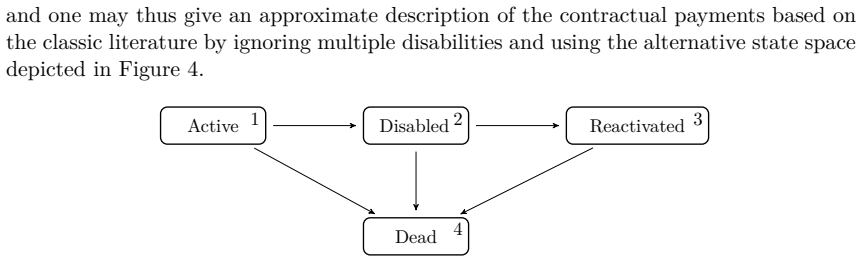
The central object is the operational filtration $\mathcal{G}_t$ — the insurer's actual available claim-level information, including reports, adjudications, payments, and backpay — together with the realized cash flow $d\bar{B}$, as opposed to the classic filtration $\mathcal{F}_t=\sigma\{Y(s):s\le t\}$ generated by the hidden biometric state process and the contractual payments $dB$. The reserve that carries the argument is $\bar{V}(t)=E[\bar{P}(t)|\mathcal{G}_t]$, the conditional expectation of the present value of realized future benefits given what the insurer genuinely knows. Structural independence assumptions let the paper write this operational reserve in closed form: for an insured with no reported claim it is the classic active reserve plus an integral over unreported disabilities weighted by the probability that the reporting delay exceeds the elapsed time; for reported claims it uses the probability that the claim is (re)awarded times the corresponding classic reserve. This machinery turns a textbook reserve that is not computable in practice into a computable one, and it feeds a two-step estimator in which award probabilities are estimated first and disability and reactivation hazards second.
What would settle it
On a Danish disability portfolio with average reporting delays of several months and a material share of initially rejected claims, compute reserves under the classic biometric filtration and under the operational filtration with realized cash flows; if the gap between the two is negligible relative to the portfolio's stochastic fluctuation, the paper's claim that delays matter after inception is wrong, while a large gap explained by backpay and unreported disabilities would confirm it.
Extended reading notes
Core claim
The core discovery is that the question 'Can the claim-settlement process be ignored?' has a time-dependent answer. At time zero the operational reserve equals the classic reserve, because nothing has been reported and no backpay can relate to events before inception; this makes the classic models adequate for pricing and initial reserving. After inception, the classic reserve is built on information the insurer does not actually have: the insured may be disabled before time $t$ but report only later, or have a claim awarded after a rejection, triggering interest-bearing backpay. The paper therefore defines the reserve as the conditional expectation of the realized cash flow given the insurer's operational information and, following results from the recent multistate literature it surveys, expresses it as the classic reserve plus a correction for unreported disabilities, while reported claims fall into three cases with reserves proportional to the probability of (re)award. In estimation, the paper claims that reporting delays and incomplete adjudications bias the observed sample, and that unbiased disability and reactivation hazards require scaling exposures by reporting-delay survival and outcomes by award and reaward probabilities.
Load-bearing premise
The load-bearing premise is that reporting delays and claim adjudication outcomes are conditionally independent of the insured's true health trajectory and of future claims once all the insurer's information is known.
Editorial extensions
If this is right
- At contract inception, premiums and initial reserves can still be set with the classic multistate models, because no backpay can relate to events before inception.
- Once coverage is underway, reserves that ignore reporting and adjudication delays will be wrong in both size and timing, so risk-management and hedging decisions based on them are not reliable.
- Disability and reactivation hazards estimated from raw observed claim data are biased; the two-step correction using reporting-delay survival and award probabilities is needed before the fitted model is used for reserving.
- Multistate individual reserving remains a computationally moderate route, so insurers already using multistate models can adopt the delay-adjusted reserve more easily than switching to high-dimensional non-life-style models.
- Prevention programs should be evaluated with causal-inference designs, such as no-unmeasured-confounding plus positivity or regression discontinuity, rather than by comparing high-risk participants with non-participants.
Reading between the lines
- If the independence assumptions fail, the reserve formulas may still be approximately right in expectation but will understate reserve uncertainty; a natural extension is to model reporting and adjudication jointly with the biometric process rather than conditionally independently.
- The same filtration gap should appear in other insurance products with long settlement lags, such as income protection or critical illness, so the framework likely transfers beyond the Danish disability market.
- Because backpay accrues interest over the delay, interest-rate stress tests should be part of reserve validation: a rising rate path makes the delay correction larger than it looks in a level-rate calculation.
- Insurers could intentionally design prevention targeting rules that create regression discontinuities or exogenous assignment, turning 'happy accidents' into planned experiments.
Editorial analysis
A structured set of objections, weighed in public.
Referee Report
Summary. This paper is a review and position statement on loss-of-earning-capacity (disability) insurance in Denmark. It describes the interplay among the insured, the insurer, the employer, and the public benefit system, using two stylized cases, then formalizes contractual versus realized payment streams. The central technical argument is that classic multistate reserving models, which condition on the filtration generated by the biometric state process, are not operational once reporting delays and claim adjudication are present: the biometric state may not be observed at time t, and backpay makes the classic present value differ from the realized one. The paper reviews non-life individual reserving, aggregate reserving, and a recently proposed multistate framework based on an operational filtration G_t and realized cash flows, with formulas for the corrected reserve in four states (no reported claim, reported-but-not-paid, currently eligible, previously eligible). It also discusses two-step estimation of disability and reactivation hazards and argues that prevention initiatives should be evaluated through causal inference. The main conclusion is that for pricing at inception the classic model suffices, but for reserving and risk management during the coverage period the classic model fails unless reporting and adjudication delays are very short.
Significance. If the central claim is accepted, the paper fills a gap in the actuarial literature by systematically connecting the Danish institutional setting to formal reserving methodology. Its strength lies in a clear articulation of why the filtration sigma{Y(s): s <= t} is not observable under reporting delays and why realized cash flows with backpay change the reserve dynamics. The paper also gives credit where due to the authors' own recent work (Buchardt et al. 2023, 2025; Sandqvist 2025) and to the non-life reserving literature. At the same time, the headline recommendation is not empirically calibrated: no quantitative threshold for 'very short' delays is given, and the corrected reserve formulas require conditional-independence assumptions that are stated but not validated. As a review paper, it will be useful for practitioners entering the Danish disability market, but the strength of the 'resounding no' should be tempered or supported with data or simulation.
major comments (3)
- [Section 3.2 and Section 4.4.1] The central claim that classic multistate models are inadequate for reserving 'unless the reporting and adjudication delays are very short' is not quantified. The manuscript does not provide a numerical threshold for 'very short,' nor does it show with Danish delay data or a sensitivity analysis that the difference between the classic reserve (conditioned on the biometric filtration) and the G_t reserve (conditioned on the operational filtration with realized cash flows) is material for typical delay distributions. The qualitative operational argument is sound, but the practical conclusion ('a resounding no') needs at least an illustrative calibration to be actionable. Please add a numerical example or explicit bounds on delay durations under which the classic model is adequate.
- [Section 4.4.1 and Section 4.4.2] The corrected reserve formulas and the two-step hazard estimation procedure are not derived in this manuscript; they are taken from Sandqvist (2025) and Buchardt et al. (2025), which are authored by the same group. As the manuscript itself concedes, these formulas require 'rather strong independence assumptions' (Section 4.4.1), and if reporting delays or adjudication outcomes are correlated with disability severity or recovery, both the size and the timing of the reserves are affected. The paper's own Charlie case (Section 2.2) illustrates that adjudication can be informative about recovery. No Danish data or simulation is provided to support the conditional independence of reporting delays and adjudication outcomes given G_t, so the reliability of the headline recommendation is not demonstrated. The authors should either provide evidence for the assumptions or explicitly frame the recommendation as conditional on them, with a discussion of the likely direction and magnitude of bias under plausible violations.
- [Section 4.4.2] The 'approximately' in the reserve formulas (for example, V(t) = Va(t) + integral term and V(t) = P(Claim is awarded | G_t) Vi(G(t),0)) is not defined. Since the paper's conclusion that the classic model is inadequate depends on the magnitude of the G_t correction, the order of the approximation and the conditions for its accuracy should be stated, at least by reference to the relevant theorems in Sandqvist (2025). Without this, the reader cannot assess when the correction is a first-order effect versus a second-order refinement.
minor comments (7)
- [Section 2.1] In the sentence 'Disabilities can very in form, degree, and duration,' 'very' should be 'vary.'
- [Section 2.5] The phrase 'The emphasize will be' should read 'The emphasis will be.'
- [Section 3.2] In the description of reporting delay, 'until the insured notifies the insured' should be 'until the insured notifies the insurer.'
- [Section 4.4.2] The notation for the two reserves (the classic reserve and the G_t-based reserve) is visually indistinguishable in the text; please use distinct symbols, for example V^F and V^G, throughout the discussion.
- [Table 1] The caption contains the typo 'T able 1'; it should be 'Table 1.' In addition, the entries such as 'decent/good' and 'poor/good' are subjective and would benefit from a one-sentence definition of the scale in the text.
- [References] The entry 'Delong, /suppress L.' appears corrupted; it should read 'Delong, L.'
- [Section 4.4.2] In the exposure formula for the two-step estimation, 'P(Reporting delay <= t - t_i)' should be written conditionally on the operational filtration (for example, P(Reporting delay <= t - t_i | G_t)) to be consistent with the conditioning used elsewhere in the same subsection.
Circularity Check
No significant circularity: the key conceptual claim is argued directly, and the cited reserve formulas are transparent attributions to prior same-group work, not hidden redefinitions or fitted predictions.
full rationale
This is a review/perspective paper rather than a self-contained derivation. Its central operational claim—that under reporting and adjudication delays the classic filtration F_t=sigma{Y(s):s<=t} is not usable for in-force reserving—is argued on its own terms in Section 4.4.1: the information may not be available at time t and the insurer may not have paid B(t), so the classical present value is not the relevant one. That argument does not depend on the authors' prior theorems. The quantitative reserve and estimation formulas in Section 4.4.2 are explicitly attributed to Sandqvist (2025) and Buchardt et al. (2025), which are same-group preprints; this is heavy self-citation, but it is transparent attribution to the original sources rather than an unacknowledged reuse, and this review does not pass the formulas off as newly derived here. The paper also openly states the main caveat (Section 4.4.1: 'rather strong independence assumptions which if violated may impair both the size and timing of the reserves'); that is a validity/robustness limitation, not a circularity, and the absence of a quantitative threshold for 'very short' delays is a calibration gap rather than a circular step. No fitted parameter is renamed as a prediction, no definition is fixed in terms of the target, and no uniqueness theorem from the same authors is invoked to forbid alternatives. Under the stated evidence, there is no circular step that reduces a claimed result to its own inputs.
Assumptions & free parameters
assumptions (6)
- standard math Reserve V(t)=E[P(t)|F_t] in Eq. (1)-(2) is the conditional expectation of discounted future cash flows under a market-consistent measure.
- domain assumption Contractual payment streams can be modeled in continuous time with rates dB(t), treating monthly payments as a high-frequency approximation.
- standard math By the law of iterated expectations, reserves can be based on average future payments rather than explicit forecasts of earnings capacity e_t and social security offsets c_t.
- domain assumption The modeling framework of Buchardt et al. (2023) and Sandqvist (2025) relies on structural independence assumptions between the biometric process, reporting delays, and adjudication outcomes.
- domain assumption Causal inference for prevention requires either no unmeasured confounding plus positivity, or a valid regression discontinuity design.
- domain assumption Claim settlement information is not available to the insurer at time t before reporting; the filtration G_t is the relevant operational information.
Cite this review
Pith. "Pith review of Loss of earning capacity in Denmark -- an actuarial perspective." pith.science (2026). https://pith.science/paper/7TTI2FN3
@misc{pith2026250111578,
  author       = {Pith},
  title        = {Pith review of: Loss of earning capacity in Denmark -- an actuarial perspective},
  year         = {2026},
  howpublished = {\url{https://pith.science/paper/7TTI2FN3}},
  note         = {Machine review of arXiv:2501.11578}
}
read the original abstract
We describe challenges and opportunities related to risk assessment and mitigation for loss of earning capacity insurance with a special focus on Denmark. The presence of public benefits, claim settlement processes, and prevention initiatives introduces significant intricacy to the risk landscape. Accommodating this requires the development of innovative approaches from researchers and practitioners alike. Actuaries are uniquely positioned to lead the way, leveraging their domain knowledge and mathematical-statistical expertise to develop equitable, data-driven solutions that mitigate risk and enhance societal well-being.
Figures


Figures from the paper (1 more)
Forward citations
Cited by 1 Pith paper
-
Payment Process Estimation in Aggregated Insurance Models
Establishes strong consistency and weak convergence for inverse-probability-weighted estimators of state-specific cumulative payment processes in a sojourn-payment model for aggregated multi-state systems under left-t...
Reference graph
Works this paper leans on
- [1]
-
[2]
Aro, H. , Djehiche, B. & L \"o fdahl, B. (2015). Stochastic modelling of disability insurance in a multi-period framework . Scandinavian Actuarial Journal 2015, 88--106
work page 2015
-
[3]
Barabas, C. , Virza, M. , Dinakar, K. , Ito, J. , & Zittrain, J. (2018). Interventions over Predictions: Reframing the Ethical Debate for Actuarial Risk Assessment . Proceedings of the 1st Conference on Fairness, Accountability and Transparency, PMLR 81, 62--76
work page 2018
-
[4]
Bischofberger, S.M. , Hiabu, M. & Isakson, A. (2020). Continuous chain-ladder with paid data . Scandinavian Actuarial Journal 2020(6), 477--502
work page 2020
-
[5]
Botzen, W.J.W. , Kunreuther, H. , & Michel-Kerjan, E. (2019). Protecting against disaster risks: Why insurance and prevention may be complements. Journal of Risk and Uncertainty 59, 151--169
work page 2019
-
[6]
Bratsberg, B. , Fevang, E. , & Røed, K. (2013). Job loss and disability insurance . Labour Economics 24, 137--150
work page 2013
-
[7]
Buchardt, K. , Furrer, C. & Sandqvist, O.L. (2023). Transaction time models in multi-state life insurance . Scandinavian Actuarial Journal 2023, 974--999
work page 2023
-
[8]
Buchardt, K. , Furrer, C. & Sandqvist, O.L. (2025). Estimation for multistate models subject to reporting delays and incomplete event adjudication. Preprint. Available online at https://arxiv.org/abs/2311.04318
work page Pith review arXiv 2025
Show all 44 references
-
[9]
& Rosenstock, A
Bücher, A. & Rosenstock, A. (2024). Combined modelling of micro-level outstanding claim counts and individual claim frequencies in non-life insurance . European Actuarial Journal 14, 623–-655
2024
-
[10]
Christiansen, M. (2012). Multistate models in health insurance . AStA Advances in Statistical Analysis 96, 155--186
2012
-
[11]
, Robben, J
Crevecoeur, J. , Robben, J. & Antonio, K. (2022a). A hierarchical reserving model for reported non-life insurance claims . Insurance: Mathematics and Economics 104, 158--184
2022
-
[12]
, Antonio, K
Crevecoeur, J. , Antonio, K. , Desmedt, S. & Masquelein, A. (2022b). Bridging the gap between pricing and reserving with an occurrence and development model for non-life insurance claims . ASTIN Bulletin 53(2), 185--212
2022
-
[13]
, Lindholm, M
Delong, . , Lindholm, M. , & W \"u thrich, M.V. (2022). Collective reserving using individual claims data . Scandinavian Actuarial Journal 2022, 1--28
2022
-
[14]
& L \"o fdahl, B
Djehiche, B. & L \"o fdahl, B. (2014). Risk aggregation and stochastic claims reserving in disability insurance . Insurance: Mathematics and Economics 59, 100--108
2014
-
[15]
Dubois, M. (2011). Insurance and prevention: Ethical aspects . The Journal of Primary Prevention 32, 3--15
2011
-
[16]
& Becker, G.S
Ehrlich, I. & Becker, G.S. (1972). Market Insurance, Self-Insurance, and Self-Protection. Journal of Political Economy 80(4), 623--648
1972
-
[17]
Anbefalinger til fremtidens beskæftigelsesindsats
Ekspertgruppen for fremtidens beskæftigelsesindsats (2024). Anbefalinger til fremtidens beskæftigelsesindsats. Report from expert group commissioned by the Danish government. Available online at https://xn--fremtidensbeskftigelsesindsats-0uc.dk/afrapportering/
2024
-
[18]
& Kvist, J
Fischer, J.B. & Kvist, J. (2023). Frihed, lighed og privat velfærd: På vej mod en ny samfundsmodel. København, Danmark: Gyldendal
2023
-
[19]
, Loisel, S
Gauchon, R. , Loisel, S. , & Rulli \`e re, J. (2020). Health-policyholder clustering using health consumption . European Actuarial Journal 10, 599–-626
2020
-
[20]
, Loisel, S
Gauchon, R. , Loisel, S. , Rulli \`e re, J. , & Trufin, J. (2020). Optimal prevention strategies in the classical risk model . Insurance: Mathematics and Economics 91, 202--208
2020
-
[21]
, Loisel, S
Gauchon, R. , Loisel, S. , Rulli \`e re, J. , & Trufin, J. (2021). Optimal prevention of large risks with two types of claims . Scandinavian Actuarial Journal 2021(4), 323--334
2021
-
[22]
& Arjas, E
Haastrup, S. & Arjas, E. (1996). Claims Reserving in Continuous Time; A Nonparametric Bayesian Approach . ASTIN Bulletin 26(2), 139--164
1996
-
[23]
& Pitacco, E
Haberman, S. & Pitacco, E. (1998). Actuarial Models for Disability Insurance. Boca Raton, United States: Chapman & Hall
1998
-
[24]
& Robins, J.M
Hernán, M.A. & Robins, J.M. (2020). Causal Inference: What If . Boca Raton, United States: Chapman & Hall
2020
-
[25]
, Kallestrup-Lamb, M
Jensen, S.E.H. , Kallestrup-Lamb, M. , Kierkegaard, L.M. , Steffensen, M. , & Tanggaard, C. (2019). Forbrugernes udfordringer med pensionsbeslutninger. Report from expert group commissioned by Penge- og Pensionspanelet. Available online at https://www.raadtilpenge.dk/-/media/P...
2019
-
[26]
Kaminsky, K.S. (1987). Prediction of IBNR claim counts by modelling the distribution of report lags . Insurance: Mathematics and Economics 6(2), 151--159
1987
-
[27]
Kenkel, D.S. (2000). Prevention. In: Culyer, A.J., & Newhouse, J.P., Eds. Handbook of health economics (Vol.\ 1B), 1675--1722. Oxford, United Kingdom: North Holland
2000
-
[28]
Kennedy, E.H. (2022). Semiparametric doubly robust targeted double machine learning: a review . Preprint. Available online at https://arxiv.org/abs/2203.06469
2022 arXiv
-
[29]
Fremtidssikring af et stærkt pensionssytem
Kommissionen om tilbagetrækning og nedslidning (2022). Fremtidssikring af et stærkt pensionssytem. Report from expert group commissioned by the Danish government. Available online at https://bm.dk/media/20703/fremtidssikring-af-et-staerkt-pensionssystem.pdf
2022
-
[30]
o nig, B. , Weber, F. , & W \
K \"o nig, B. , Weber, F. , & W \"u thrich, M.V. (2011). Prediction of disability frequencies in life insurance. Zavarovalniski horizonti 7(3), 51--69
2011
-
[31]
, Xavier, M
Lopez, O. , Xavier, M. , & Th \'e rond, P. (2019). A TREE-BASED ALGORITHM ADAPTED TO MICROLEVEL RESERVING AND LONG DEVELOPMENT CLAIMS. ASTIN Bulletin 49(3), 741--762
2019
-
[32]
& R \"o hrs, V
Milbrodt, M. & R \"o hrs, V. (2016). Aktuarielle Methoden der deutschen Privaten Krankenversicherung (2nd Edition). Karlsruhe, Germany: VVW GmbH
2016
-
[33]
Norberg, R. (1993). Prediction of Outstanding Liabilities in Non-Life Insurance . ASTIN Bulletin 23, 95--115
1993
-
[34]
Norberg, R. (1999). Prediction of Outstanding Liabilities II. Model Variations and Extensions . ASTIN Bulletin 29, 5--25
1999
-
[35]
, Frees, E.W
Okine, A.N.A. , Frees, E.W. , & Shi, P. (2022). JOINT MODEL PREDICTION AND APPLICATION TO INDIVIDUAL-LEVEL LOSS RESERVING. ASTIN Bulletin 52, 91--116
2022
-
[36]
Pearl, J. (2009). Causality: Models, Reasoning and Inference (2nd Edition). New York, United States: Cambridge University Press
2009
-
[37]
& Kuhnle, S
Pedersen, A.W. & Kuhnle, S. (2017). The Nordic welfare state models. In: Knutsen, O., Ed. The Nordic models in political science: Challenged, but still viable? 219--238. Bergen, Norway: Fagbokforlaget
2017
-
[38]
Sandqvist, O.L. (2025). A multistate approach to disability insurance reserving with information delays. Preprint. Available online at https://arxiv.org/abs/2312.14324
2025 arXiv
-
[39]
Sandqvist, O.L. (2024). Doubly robust inference with censoring unbiased transformations. Preprint. Available online at https://arxiv.org/abs/2411.04909
2024 arXiv
-
[40]
Segerer, G. (1993). The actuarial treatment of the disability risk in Germany, Austria and Switzerland . Insurance: Mathematics and Economics 13(2), 131--140
1993
-
[41]
, Bullen, C
Spender, A. , Bullen, C. , Altmann-Richer, L. , Cripps, J. , Duffy, R. , Falkous, C. , Farrell, M. , Horn, T. , Wigzell, J. , & Yeap, W. (2019). Wearables and the internet of things: considerations for the life and health insurance industry. British Actuarial Journal 24(e22), 1--31
2019
-
[42]
Taylor, G.C. (1971). SICKNESS: A STOCHASTIC PROCESS . Journal of the Institute of Actuaries 97, 69--83
1971
-
[43]
W \"u thrich, M.V. (2018). Neural networks applied to chain--ladder reserving . European Actuarial Journal 8, 407--436
2018
-
[44]
, Shi, P
Yang, L. , Shi, P. , and Huang, S. (2024). A copula model for marked point process with a terminal event: An application in dynamic prediction of insurance claims. Annals of Applied Statistics 18, 2679--2704
2024
Reviewed August 10, 2026 · model on record in the stance chip above.
Discussion (0). Continue with ORCID to comment.