REVIEW 3 major objections 5 minor 45 references
Naturality for higher-dimensional path types
T0 review · 3 major / 5 minor · reviewed 2026-08-10 · deepseek-v4-flash
Pith's one-line read A well-founded recursion builds naturality witnesses for operations of weak omega-categories, from which cylinder composites, stacking, and cone composites follow in all dimensions, machine-checked by a proof assistant.
desk verdict A genuinely new depth-1 naturality meta-operation for weak omega-categories, with real payoff for cylinder and cone composites; the proof has two fixable gaps that should be addressed before publication. read the letter →
The pith
A machine-rendered reading of the paper's core claim, the machinery that carries it, and where it could break.
The reading
What carries the argument
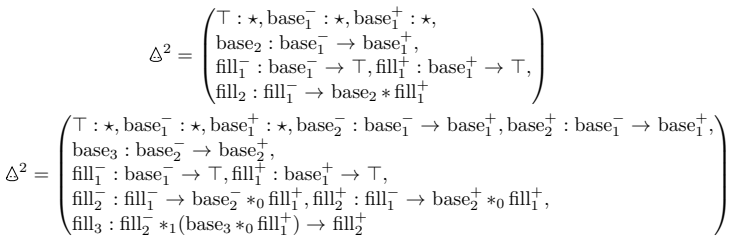
The carrying object is the naturality construction itself: a mutual recursion on the derivation trees of Catt that, for depths $d \in \{-1,0,1\}$ and $k \in \{0,1\}$, builds six families of outputs — duplicated contexts $\Gamma \uparrow X$ with two injections $\mathrm{in}^{\pm}$, type naturality $A \uparrow^t X$, term naturality $t \uparrow X$, substitution naturality $\sigma \uparrow X$, and naturality of coherence constructors $\mathrm{coh} \uparrow X$. The operative move is context duplication: each variable $x$ in the up-closed set $X$ gains a lower copy $x^-$, an upper copy $x^+$, and a filler cell $x^{\to}$ between them, which is exactly a local tensor product with the directed interval. Term naturality is assembled by cases: depth-0 terms use functoriality (the duplicated context is again a pasting context and the promoted type stays full, keeping the side condition that makes coherences well-typed), depth-1 linear composites are stacked from associators and whiskerings, reduced composites put a functorial core between two interchanger coherences, and general composites pass through the reduction of pasting contexts, with boundary-adjusting coherences on either side. The recursion is well-founded because derivations in Catt are unique, making induction on the derivation tree legitimate.
What would settle it
Run the companion proof assistant over small pasting contexts, generate $t \uparrow X$ for every up-closed set $X$ of depth at most 1, and type-check: the construction is correct only if every generated term is well-typed and the recursion terminates. The sharpest test is the general-composite case of Section 3.2(6)(iii), which passes through the reduction substitution; a pasting context whose reduced version fails to have the same source and target, or for which the $\alpha$-equivalence of Lemma B.21 fails, would refute Theorem 3.1.
Extended reading notes
Core claim
The central claim, Theorem 3.1, is that the recursive construction of naturality is well-founded and that its outputs satisfy judgements (1)-(6). Given a context $\Gamma$ and an up-closed set $X$ of its variables (if a variable in $X$ appears in the source or target of another variable, that other variable is also in $X$) with depth at most 1, and a term $t$ whose $X$-variables also have depth at most 1, the construction produces a term $t \uparrow X$ valid in the duplicated context $\Gamma \uparrow X$, where each variable $x \in X$ is split into a lower copy $x^-$, an upper copy $x^+$, and a filler cell $x^{\to}$ of type $x^- \to x^+$; it simultaneously produces types, substitutions, and naturality of coherence constructors. The depth-0 case is functoriality and was already known; the depth-1 case is genuine naturality, and it is exactly this case that yields the cylinder composites, cylinder stacking, and cone composites of Sections 4 and 5. Because the construction is a meta-operation on the syntax of Catt, the generated terms can be checked by machine and exported to homotopy type theory.
Load-bearing premise
The load-bearing premise is that every pasting context has a reduced pasting context with the same source and target, reached by a reduction substitution; this is a theorem taken, without proof, from a companion preprint by two of the present authors, and the general-composite case of the naturality construction, hence the cone and cylinder composites, collapses if that theorem fails.
Editorial extensions
If this is right
- For any dimensions $m,n$ and direction $k$, two cylinders meeting along their $k$-boundary admit a composite $m \ast^{\square}_{k} n$, and two cylinders with matching bottom admit a vertical stacking $a \boxminus b$ (Theorems 4.2 and 4.3); these were previously known in full generality only in the strict case.
- Cone composites $m \ast^{\triangle}_{k} n$ exist in all dimensions (Theorem 5.2); the paper states this is the first construction of cone composites in the weak $\omega$-category setting.
- Every generated term can be exported to homotopy type theory, giving explicit computation of inhabitants of higher-dimensional path types (identity types), a concrete interface between coherence machinery and HoTT.
- The cylinder construction is a step toward the long-sought path-object construction for weak $\omega$-categories, the missing component for a model structure on weak $\omega$-categories, and toward a weak $\omega$-category of weak $\omega$-categories.
- All generated terms are type-checked in the implementation; artifact sizes grow rapidly (818, 10,236, 67,498, 509,702 bytes for the horizontal cylinder composites in dimensions 2 through 5), so computer memory currently bounds what can be computed on a workstation.
Reading between the lines
- The depth restriction (variables in $X$ of depth at most 1) is presumably the main boundary of the method, not a deep one: the paper itself notes that higher-depth cases would govern weak higher transfors, so extending the recursion to greater depth is the natural next step.
- Because the cylinder and cone composites are themselves produced by reapplying the naturality construction, the method suggests a general principle: any natural (depth-1) operation can be iterated into composite-forming operations in higher dimensions, potentially automating coherence generation beyond the geometric cases treated here.
- Testable extension: the rapid growth of proof artifacts hints that sharing subterms (let-bindings or a DAG representation) could push feasible computations from dimension 5 to higher dimensions; this can be checked directly with the provided implementation.
Editorial analysis
A structured set of objections, weighed in public.
Referee Report
Summary. The paper defines a meta-operation in the dependent type theory Catt that, for any up-closed set X of variables of depth at most 1 in a context, produces a naturality cell t↑X for any term t, together with analogous constructions for contexts, types, substitutions and coherence constructors. The main result is Theorem 3.1, which asserts that the recursive construction is well-founded and that all generated terms satisfy the stated typing judgements. The paper then applies this construction to define horizontal composites and stacking of cylinders (Section 4) and composites of cones (Section 5), and reports a proof-assistant implementation that type-checks all examples (Section 6). The technical development is largely self-contained, but a central case of the main theorem, the naturality of general composites in Section 3.2(6)(iii), depends on a reduction theorem for pasting contexts cited from the same-author preprint [13], and Lemma B.21 additionally uses a strict-ω-category composition fact for Batanin trees without proof.
Significance. If the main theorem is correct, the paper makes a substantial contribution: it provides a uniform, type-theoretic construction of naturality for all operations of weak ω-categories, with a geometric interpretation as a local tensor product with the directed interval. The resulting explicit cylinder composites and cone composites are new in the weak setting for dimensions ≥ 4 and ≥ 2 respectively, and the implementation provides machine-checked witnesses for the stated types, which is a genuine strength. The dependence of the central theorem on an external reduction theorem is currently the main obstacle to accepting the paper as fully self-contained.
major comments (3)
- [Section 3.2(6)(iii) and proof of Theorem 3.1] The general composite case of the naturality construction is defined using the assertion, cited from [13, Section 4.4], that every pasting context Γ has a reduced pasting context Γ_r with the same source and target and a reduction substitution ρ_Γ. This assertion is load-bearing: without it, coh_{Γ,A}↑X is undefined for every non-reduced depth-1 composite, so Theorem 3.1 fails for that branch. Since [13] is a preprint by two of the present authors and the needed statement is not proved or even stated precisely in this paper, please either include a proof of the reduction theorem in an appendix, or state it explicitly as an assumption and mark which parts of Theorem 3.1 are conditional on it.
- [Appendix B, Lemma B.21] The proof of Lemma B.21 asserts that ∂^-Ψ ≅ ∂^-Γ because composition of Batanin trees satisfies the rules of strict ω-categories, citing [8]. This is a nontrivial strictification claim, and it is used to justify the interchangers j^± in the reduced-composite construction, which are in turn needed for Theorem 3.1(6). The paper does not provide the required derivation or a precise reference with a statement matching this use. Please expand this step or supply a reference that proves the exact identification used.
- [Section 3.2(6)(i) and Lemma B.17] The inductive step for linear composites claims that suspension commutes with the depth-1 naturality for the contexts Ψ^n_k, using Lemma B.16. However, Lemma B.16 is stated for X of depth 0 in the unsuspended context Γ, while X has depth 1 in Ψ^n_k. The intended reading is presumably that depth-1 variables of Ψ^n_k are suspensions of depth-0 variables of Ψ^{n-1}_k, but this is not stated. As written, the proof of Lemma B.17 does not justify the application of Lemma B.16. Please make this correspondence explicit.
minor comments (5)
- [Section 1] The reference to 'Bernady et al.' should be 'Bernardy et al.'.
- [Section 2.3] There is a typo in the sentence 'We present a brief overview of those that we use use in this article'; delete the second 'use'.
- [Section 6] The command 'cylcone(3,1,3)' appears to be a typo for 'cylcomp(3,1,3)'; please correct it for consistency with the other built-ins.
- [Appendix B, Lemma B.19] The notation in∓ is used without definition; please define it or avoid the ∓ symbol, since the reader otherwise has to infer it as the dual of in±.
- [Appendix D] In the description of the interchangers, the phrase 'Defines to be the source of of the type' contains a duplicated word and should be rephrased.
Circularity Check
General composite naturality is defined via a reduction substitution imported from a same-author preprint ([13, Sec. 4.4]); Lemma B.21 uses the same black box, making that branch of Theorem 3.1 load-bearing self-citation.
-
self citation load bearing
[Section 3.2(6)(iii), "Naturality of General Composites"; also Lemma B.21 and proof of Theorem 3.1, case d=1, general composites.]
"For the general case, we will use that every pasting context Γ gives rise to a reduced pasting context Γ r with the same source and target, along with a reduction substitution Γ ⊢ ρΓ : Γ r. This substitution acts as the identity on the boundary, and sends maximal-dimensional variables of Γ r to linear composites of maximal-dimensional variables of Γ [13, Section 4.4]."
Clause (6)(iii) defines the naturality of a general composite coherence only after importing the existence and exact boundary/linear-composite properties of ρΓ from [13, Section 4.4], a preprint by two of the present authors. The definition is literally built on that substitution: c′Γ,X,A = (coh Γr,A ↑ ρ−1Γ(X))[ρΓ ↑ X], and the proof of Theorem 3.1 delegates exactly this case to the cited reduction theorem. Lemma B.21 uses the same theorem, together with asserted facts about Batanin-tree composition, to identify Ψr with Γ. No proof of the reduction theorem is included or independently checked in the present paper.
full rationale
The construction is largely self-contained and genuinely inductive: the paper defines naturality for variables, substitutions and linear/reduced composites, and proves the relevant typing judgements for those cases; the proof assistant also checks the generated examples. The main concern is local and citation-borne. In Section 3.2(6)(iii), the general-composite case is defined through the reduction substitution ρΓ whose existence and boundary/linear-composite properties are imported from [13, Section 4.4], a preprint by two of the present authors, and Lemma B.21 uses that same theorem as a black box. This is not a fitted parameter renamed as a prediction, nor is the target typing judgement assumed in its own definition. It is, however, a load-bearing same-author citation: if the reduction theorem failed, cohΓ,A↑X would be undefined for every non-reduced depth-1 composite, including the smallest pasting contexts needed for associator-like coherences. The paper also relies on the first author's thesis [10] for structural facts such as [10, Lemma 87] that Γ↑X is a pasting context, though the main depth-1 cases are argued locally. Because the central claim retains substantial independent content and the dependency is an imported theorem rather than a definitional equivalence, the score is 4 rather than higher.
Assumptions & free parameters
assumptions (6)
- domain assumption Catt derivations are unique (Finster-Mimram, [24, Lemma 7]).
- domain assumption Every pasting context admits a reduction to a reduced pasting context with the same source and target ([13, Section 4.4]).
- domain assumption Depth-0 naturality preserves pasting contexts and fullness ([10, Lemmas 87-90]).
- domain assumption Suspension and opposite meta-operations are correct ([10], [12]).
- standard math Composition of Batanin trees satisfies the rules of strict omega-categories ([8]).
- standard math Pasting contexts have no non-trivial isomorphisms ([17, Lemma 1.7]).
Cite this review
Pith. "Pith review of Naturality for higher-dimensional path types." pith.science (2026). https://pith.science/paper/U4TOS5AU
@misc{pith2026250111620,
  author       = {Pith},
  title        = {Pith review of: Naturality for higher-dimensional path types},
  year         = {2026},
  howpublished = {\url{https://pith.science/paper/U4TOS5AU}},
  note         = {Machine review of arXiv:2501.11620}
}
read the original abstract
We define a naturality construction for the operations of weak omega-categories, as a meta-operation in a dependent type theory. Our construction has a geometrical motivation as a local tensor product with a directed interval, and behaves logically as a globular analogue of Reynolds parametricity. Our construction operates as a ``power tool'' to support construction of terms with geometrical structure, and we use it to define composition operations for cylinders and cones in omega-categories. The machinery can generate terms of high complexity, and we have implemented our construction in a proof assistant, which verifies that the generated terms have the correct type. All our results can be exported to homotopy type theory, allowing the explicit computation of complex path type inhabitants.
Figures


Figures from the paper (18 more)





Reference graph
Works this paper leans on
-
[13]
‘Invertible cells in ω-categories’
Thibaut Benjamin and Ioannis Markakis. ‘Invertible cells in ω-categories’
-
[8]
Michael A. Batanin. ‘Monoidal Globular Categories As a Natural En viron- ment for the Theory of Weak n-Categories’. In: Advances in Mathematics 136.1 (1998), pp. 39–103. doi: 10.1006/aima.1998.1724
arXiv 1998
-
[1]
‘A Syntactical Appro ach to Weak ω-Groupoids’
Thorsten Altenkirch and Ondrej Rypacek. ‘A Syntactical Appro ach to Weak ω-Groupoids’. In: 21st Annual Conference of the EACSL (CSL 2012). 2012. doi: 10.4230/LIPICS.CSL.2012.16
-
[2]
‘Sur les ∞-groupo ¨ ıdes de Grothendieck et une variante∞- cat´ egorique’
Dimitri Ara. ‘Sur les ∞-groupo ¨ ıdes de Grothendieck et une variante∞- cat´ egorique’. Th` ese de doctorat. Universit´ e Paris Diderot (Paris 7), 2010
work page 2010
-
[3]
‘The folk model category structur e on strictω-categories is monoidal’
Dimitri Ara and Maxime Lucas. ‘The folk model category structur e on strictω-categories is monoidal’. In: Theory and Applications of Categories 35 (2020), pp. 745–808. arXiv: 1909.13564
arXiv 2020
-
[4]
‘Joint et tranches pour les ∞- cat´ egories strictes’
Dimitri Ara and Georges Maltsiniotis. ‘Joint et tranches pour les ∞- cat´ egories strictes’. In:M´ emoires de la Soci´ et´ e math´ ematique de France 165 (2020), pp. 1–213. doi: 10.24033/msmf.473
-
[5]
John C. Baez and James Dolan. ‘Higher-dimensional algebra and to po- logical quantum field theory’. In: Journal of Mathematical Physics 36.11 (1995), pp. 6073–6105. doi: 10.1063/1.531236. 29
doi:10.1063/1.531236 1995
-
[6]
‘Modular categories as representations of the 3- dimensional bordism 2-category’
Bruce Bartlett et al. ‘Modular categories as representations of the 3- dimensional bordism 2-category’. 2015. arXiv: 1509.06811
arXiv 2015
Show all 45 references
-
[7]
Michael A. Batanin. Computads and slices of operads. 2002. arXiv: math/0209035. url: http://arxiv.org/abs/math/0209035 (visited on 18/02/2023). Pre- published
2002 arXiv
-
[9]
‘Introduction to bicategories’
Jean B´ enabou. ‘Introduction to bicategories’. In: Reports of the Midwest Category Seminar. Vol. 47. Lecture Notes in Mathematics. 1967, pp. 1–77. doi: 10.1007/BFb0074299
1967 doi
-
[10]
‘A type theoretic approach to weak ω-categories and related higher structures’
Thibaut Benjamin. ‘A type theoretic approach to weak ω-categories and related higher structures’. Th` ese de doctorat. Institut Polyte chnique de Paris, 2020
2020
-
[11]
‘Generating Higher Identity Proofs in Homoto py Type Theory’
Thibaut Benjamin. ‘Generating Higher Identity Proofs in Homoto py Type Theory’. 2024. arXiv: 2412.01667
2024 arXiv
-
[12]
Hom ω-Categories of a Com- putad Are Free
Thibaut Benjamin and Ioannis Markakis. Hom ω-Categories of a Com- putad Are Free. 2024. arXiv: 2402.01611
2024 arXiv
-
[14]
‘CaTT cont exts are finite computads’
Thibaut Benjamin, Ioannis Markakis and Chiara Sarti. ‘CaTT cont exts are finite computads’. In: Electronic Notes in Theoretical Informatics and Computer Science. Vol. 4 - Proceedings of MFPS XL. 2024, 5. doi: 10.46298/entics.14675
2024 doi
-
[15]
‘Globular Weak ω- Categories as Models of a Type Theory’
Thibaut Benjamin, Samuel Mimram and Eric Finster. ‘Globular Weak ω- Categories as Models of a Type Theory’. In: Higher Structures 8.2 (2024), pp. 1–69. doi: 10.21136/HS.2024.07
2024 doi
-
[16]
‘Types are weak ω-groupoids’
Benno van den Berg and Richard Garner. ‘Types are weak ω-groupoids’. In: Proceedings of the London Mathematical Society 102.2 (2011), pp. 370–
2011
-
[17]
‘A Cellular Nerve for Higher Categories’
Clemens Berger. ‘A Cellular Nerve for Higher Categories’. In: Advances in Mathematics 169.1 (2002), pp. 118–175. doi: 10.1006/aima.2001.2056
2002
-
[18]
‘P roofs for Free: Parametricity for Dependent Types’
Jean-Philippe Bernardy, Patrik Jansson and Ross Paterson. ‘P roofs for Free: Parametricity for Dependent Types’. In: Journal of Functional Pro- gramming 22.2 (2012), pp. 107–152. doi: 10.1017/S0956796812000056
2012 doi
-
[19]
‘Iterated algebraic injectivity and the faithfulne ss conjec- ture’
John Bourke. ‘Iterated algebraic injectivity and the faithfulne ss conjec- ture’. In:Higher Structures 4.2 (2020), pp. 183–210. doi: 10.21136/HS.2020.13
2020 doi
-
[20]
‘Orientals and Cubes, Indu ctively’
Mitchell Buckley and Richard Garner. ‘Orientals and Cubes, Indu ctively’. In: Advances in Mathematics 303 (2016), pp. 175–191. doi: 10.1016/j.aim.2016.07.026
2016 doi
-
[21]
Sjoerd E. Crans. ‘Localizations of Transfors’. In: K-Theory 28.1 (2003), pp. 39–105. doi: 10.1023/A:1024186923002. 30
2003 doi
-
[22]
‘Lambda calculus notation with nameless dummies, a tool for automatic formula manipulation, with application to the Chur ch- Rosser theorem’
N.G De Bruijn. ‘Lambda calculus notation with nameless dummies, a tool for automatic formula manipulation, with application to the Chur ch- Rosser theorem’. In:Indagationes Mathematicae (Proceedings)75.5 (1972), pp. 381–392. doi: 10.1016/1385-7258(72)90034-0
1972 doi
-
[23]
Dean et al
Christopher J. Dean et al. ‘Computads for weak ω-categories as an in- ductive type’. In: Advances in Mathematics 450 (2024), p. 109739. doi: 10.1016/j.aim.2024.109739
2024
-
[24]
‘A type-theoretical definition o f weak ω-categories’
Eric Finster and Samuel Mimram. ‘A type-theoretical definition o f weak ω-categories’. In: Proceedings of the 32nd Annual ACM/IEEE Symposium on Logic in Computer Science (LICS 2017) . ACM, 2017, pp. 1–12. doi: 10.5555/3329995.3330059
2017
-
[25]
‘Algebraic models of homotopy types and the homot opy hypothesis’
Simon Henry. ‘Algebraic models of homotopy types and the homot opy hypothesis’. 2016. arXiv: 1609.04622
2016 arXiv
-
[26]
‘On the homotopy hypothesis in di- mension 3’
Simon Henry and Edoardo Lanari. ‘On the homotopy hypothesis in di- mension 3’. In: Theory and Applications of Categories 39 (2023), pp. 735– 768
2023
-
[27]
‘A folk model structure on omega-cat’
Yves Lafont, Fran¸ cois M´ etayer and Krzysztof Worytkiewicz. ‘A folk model structure on omega-cat’. In:Advances in Mathematics 224.3 (2010), pp. 1183–
2010
-
[28]
‘A semi-model structure for Grothendieck we ak 3-groupoids’
Edoardo Lanari. ‘A semi-model structure for Grothendieck we ak 3-groupoids’
-
[29]
‘Towards a globular path object for weak ∞-groupoids’
Edoardo Lanari. ‘Towards a globular path object for weak ∞-groupoids’. In: Journal of Pure and Applied Algebra 224.2 (2020), pp. 630–702. doi: 10.1016/j.jpaa.2019.06.004
2020 doi
-
[30]
‘Weak ω-Categories from Intensional Type The- ory’
Peter LeFanu Lumsdaine. ‘Weak ω-Categories from Intensional Type The- ory’. In:Typed Lambda Calculi and Applications. Vol. 5608. 2009, pp. 172–
2009
-
[31]
‘Derived algebraic geometry’
Jacob Lurie. ‘Derived algebraic geometry’. PhD thesis. Massach usetts In- stitute of Technology, Dept. of Mathematics, 2004
2004
-
[32]
Higher Topos Theory
Jacob Lurie. Higher Topos Theory. Annals of Mathematics Studies n ◦ 170. Princeton, N.J: Princeton university press, 2009
2009
-
[33]
‘Grothendieck ∞-groupoids, and still another defin- ition of ∞-categories’
Georges Maltsiniotis. ‘Grothendieck ∞-groupoids, and still another defin- ition of ∞-categories’. 2010. arXiv: 1009.2331 [math]
2010 arXiv
-
[34]
‘Towards 3-Dimensional Rewriting Theory’
Samuel Mimram. ‘Towards 3-Dimensional Rewriting Theory’. In: Logical Methods in Computer Science 10.2 (2014), p. 1. doi: 10.2168/LMCS-10(2:1)2014
2014 doi
-
[35]
Reynolds
John C. Reynolds. ‘Types, Abstraction and Parametric Polymor phism’. In: Information Processing 83. Vol. 9. IFIP Congress Series. 1983, pp. 513– 523
1983
-
[36]
Schommer-Pries
Christopher J. Schommer-Pries. ‘The Classification of Two-Dime nsional Extended Topological Field Theories’. PhD Thesis. Max Planck Institu te for Mathematics, Bonn, 2011. 31
2011
-
[37]
Robert A. G. Seely. ‘Modelling computations: a 2-categorical fr amework’. In: Logic in Computer Science . 1987
1987
-
[38]
‘The petit topos of globular sets’
Ross Street. ‘The petit topos of globular sets’. In: Journal of Pure and Ap- plied Algebra 154.1-3 (2000), pp. 299–315. doi: 10.1016/S0022-4049(99)00183-8
2000 doi
-
[39]
‘Generic morphisms, parametric representations and weakly cartesian monads.’ In: Theory and Applications of Categories 13 (2004), pp
Mark Weber. ‘Generic morphisms, parametric representations and weakly cartesian monads.’ In: Theory and Applications of Categories 13 (2004), pp. 191–234. 32 A Naturality of Coherences In this appendix, we provide the full definition of the naturality of line ar com- positions ...
2004
-
[43]
z =fj+1 ∈X and y =fj
-
[44]
z =xj+1 ∈X and y =fj ∈X
-
[45]
In the first case, xj+1 /∈X, hence the phases are respectively of the form wX k,j+1 andwX k,j
z =fj ∈X and y =xj ∈X. In the first case, xj+1 /∈X, hence the phases are respectively of the form wX k,j+1 andwX k,j . By Lemma B.13, the target of the former and the source of the lat ter both compute to: f0[in−] ∗0... ∗0f − j ∗0f + j+1 ∗0... ∗0f [in+] In the second case, the ...
-
[187]
doi: 10.1007/978-3-642-02273-9_14
-
[394]
doi: 10.1112/plms/pdq026
-
[1231]
doi: 10.1016/j.aim.2010.01.007
2010 doi
Reviewed August 10, 2026 · model on record in the stance chip above.
Discussion (0). Continue with ORCID to comment.