REVIEW 4 major objections 6 minor 8 cited by
GLIMPSE: An ultra-faint $\simeq$ 10$^{5}$ $M_{\odot}$ Pop III Galaxy Candidate and First Constraints on the Pop III UV Luminosity Function at $z\simeq6-7$
T0 review · 4 major / 6 minor · reviewed 2026-08-10 · deepseek-v4-flash
Pith's one-line read This paper reports the discovery of an ultra-faint, lensed galaxy at z≈6.5 whose colors and spectrum match a young, metal-free Population III stellar population, and uses it to set the first observational constraints on the Pop III…
desk verdict A serious, honest photometric search with one plausible Pop III candidate and first UVLF constraints at z~6-7; the identification is plausible but hinges on an F410M upper limit and needs spectroscopy. read the letter →
The pith
A machine-rendered reading of the paper's core claim, the machinery that carries it, and where it could break.
The reading
What carries the argument
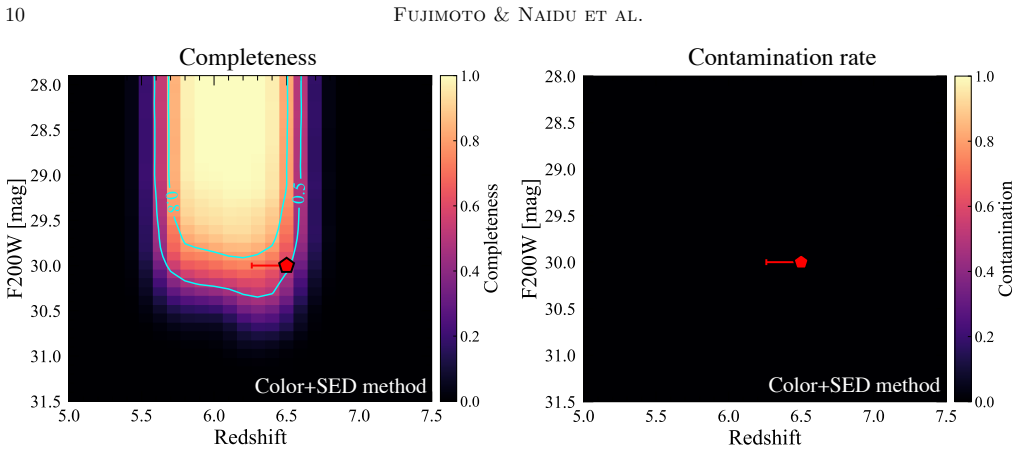
The load-bearing machinery is a NIRCam-only selection method that isolates three features of Pop III SEDs — extremely strong Hα (rest-frame EW ≳ 2000–3000 Å), a pronounced Balmer jump, and the complete absence of the [O III] λ5008 line — using the broad- and medium-band filters F200W, F277W, F356W, F410M, and F444W. Candidates must pass three color-color cuts and an SED-fit criterion: the difference in χ² between the best metal-enriched-galaxy template and the best Pop III template (from the Yggdrasil and Nakajima–Maiolino model families) must favor Pop III by Δχ²>9, with the Pop III photometric redshift in 5<z<7.5. The method is validated with Monte Carlo completeness simulations and contamination tests against a semi-analytic mock catalog; combining color and SED criteria drives the contamination rate to zero across the relevant magnitude–redshift grid. Gravitational lensing in the GLIMPSE field (Abell S1063) is what pushes the imaging depth past ~30.5 mag, making an intrinsically ~$10^{5}$ M⊙ galaxy detectable.
What would settle it
A deep NIRSpec spectrum of GLIMPSE-16043 would settle it: detection of [O III] λ5008 (bringing [O III]/Hβ above ~0.44 at 1σ), broad Balmer emission characteristic of an active black hole, or identification of a Paschen-α emitter near z≈1.5 would falsify the Pop III interpretation; likewise, a >2σ detection in F410M would weaken the Balmer-jump-plus-extreme-Hα solution that the candidate's photometry rests on.
Extended reading notes
Core claim
On the paper's own terms, the central discovery is a photometrically selected, lensed galaxy — GLIMPSE-16043 — whose spectral energy distribution is dominated by nebular emission from a very young, essentially metal-free stellar population at z=6.50(+0.03,-0.24). After correcting for a magnification of μ=2.9 the source has intrinsic M_UV=-15.89, a stellar mass near $10^{5}$ M⊙, an age of ~2.8 Myr, a rest-frame Hα equivalent width of 2810±550 Å, a UV slope β=-2.34±0.36, and a 1σ upper limit [O III]/Hβ<0.44 that implies gas-phase metallicity below ~0.5% solar. The authors interpret these as textbook Pop III signatures: strong hydrogen lines, a Balmer jump, and no metal lines. They also present the first Pop III UV luminosity function constraints at z≈5.6–6.6, anchored by GLIMPSE-16043 and bounded by upper limits from ~500 arcmin² of JWST legacy fields; the measured space density (~$10^{-4}$ $cMpc^{-3}$ at M_UV≈-16) falls squarely within the range of theoretical models. A second source, JOF-21739, is presented as tentative because while it shows similar SED features, it does not pass all color thresholds and a z≈1.5 Paschen-α solution is nearly as good. The paper explicitly concedes that an extremely metal-poor galaxy, an ultra-faint metal-poor AGN, or an as-yet-unseen low-redshift contaminant cannot be fully excluded until deep spectroscopy is obtained.
Load-bearing premise
The load-bearing premise is that the faint photometric pattern — a strong Hα excess, a Balmer jump, and no metal lines — is produced by a young, metal-free stellar population at z≈6.5, and not by a rare kind of low-redshift galaxy or an extremely metal-poor black hole that mimics the same colors; the paper itself notes that this distinction cannot be closed without deep spectroscopy.
Editorial extensions
If this is right
- If GLIMPSE-16043 is what the SEDs indicate, metal-free star formation persisted in pristine pockets of gas until z≈6.5, well below the z≈15–20 epoch where Pop III stars are usually sought.
- The Pop III UV luminosity function at z≈5.6–6.6 now has its first data point: a space density of ≈10^-4 cMpc^-3 at M_UV≈-16, with upper limits at brighter magnitudes that simulations of late Pop III formation must reproduce.
- The inferred cosmic Pop III star-formation rate density at z≈6–7 falls near 10^-6 to 10^-4 M⊙ yr^-1 Mpc^-3, roughly 0.01–1% of the total star formation at that epoch.
- Because the selection method is purely photometric, it can be rolled out over other deep NIRCam surveys, so even non-detections place useful bounds on Pop III models.
- Even if the Pop III interpretation fails, the object is an extremely metal-poor compact galaxy or a low-mass seed-black-hole candidate, either of which is itself a rare find at z>6.
Reading between the lines
- If the Pop III interpretation survives spectroscopy, the strong deviation from the extrapolated luminosity–metallicity relation independently supports a top-heavy initial mass function in metal-free gas, which would strengthen the case that the first stars were massive and efficient producers of ionizing photons and seed black holes.
- The same three-feature selection could be pushed to z≈4–5 with different medium-band filters, where JWST is even more sensitive to Hα; a wide-field campaign there could turn the single candidate into a statistical sample and test whether the Pop III volume density decline with time matches the models.
- A decisive test is a single NIRSpec medium-resolution spectrum searching for He II λ1640 or λ4686 at the expected strength and pushing [O III]/Hβ below ~0.1; broad Balmer lines would instead reveal a ~10^4–10^5 M⊙ black hole, connecting this object to the seed-black-hole problem.
- The quoted space density implies roughly one Pop III candidate per deep lensing-cluster NIRCam pointing, so a wide lensing-snapshot survey program could yield a sample large enough to separate genuine Pop III galaxies from the mimicking populations.
Editorial analysis
A structured set of objections, weighed in public.
Referee Report
Summary. This paper presents a photometric search for Population III galaxies at z~6–7 using JWST/NIRCam data. The authors define a selection based on three NIRCam color-color diagrams and an EAZY-based SED fit that compares Pop III templates (Yggdrasil and Nakajima & Maiolino) against metal-enriched templates, with thresholds Δχ²≥9. They validate completeness and contamination using Monte Carlo simulations and the Santa Cruz semi-analytic mock catalog, then apply the method to ~500 arcmin² in GLIMPSE, UNCOVER, CEERS, PRIMER, and JOF. One candidate, GLIMPSE-16043 at z_phot=6.50, passes all criteria; a second, JOF-21739, is tentative. From the photometry they infer strong Hα, a Balmer jump, low gas metallicity, Mstar~1e5 Msun, and derive a Pop III UVLF and SFRD with one detection and several upper limits. The paper explicitly discusses alternative interpretations—extremely metal-poor galaxies, metal-poor AGN, and z~1.5 Paschen-α interlopers—and concludes that spectroscopy is required.
Significance. If confirmed, this would be a landmark result: an ultra-faint, ~1e5 Msun, extremely metal-poor galaxy at z~6.5 and the first observational constraints on the Pop III UV luminosity function. The paper's method is carefully designed and, unusually, ships quantified completeness/contamination tests, forced low-z fits, a comparison to real prism spectra, and an explicit discussion of degenerate solutions. The authors are transparent about the limitations of photometric selection. At present, however, the identification and the UVLF constraints rest on a small number of low-S/N photometric points and on template families that were also used to define the selection, so the strength of the evidence is lower than the abstract's wording suggests. The work is nonetheless a valuable step toward the first stars, and the selection method itself should be reusable.
major comments (4)
- [§2.4–2.5, Figure 4] The contamination analysis uses only the SC SAM metal-enriched galaxy catalog, so the claim of 'zero contamination across the entire parameter space' is valid only within that model set. The paper itself identifies two contaminant classes that are not included in SC SAM: metal-poor AGN (§5.2) and rare z≈1.5 Paschen-α emitters (§5.3). Because the UVLF and SFRD results in §4.3–4.4 adopt this fiducial selection function, please state this limitation wherever 'zero contamination' appears, and either quantify contamination for these classes (for example, using the DAWN prism analogs as a prior for Paα emitters) or convert the affected UVLF bins to upper limits.
- [§4.2.1, Table 3] The most distinctive feature separating Pop III from other solutions is the F410M deficit (Balmer jump), yet Table 3 gives F410M = 0.71 ± 1.21 nJy, i.e., a non-detection. As a result, the Δχ² values in Table 4, the EW(Hα)=2810±550 Å, and the [Oiii]/Hβ<0.44 limit are all determined by an upper limit and by the assumed Pop III continuum shape, not by a measured Balmer jump. Please show how Δχ² and the derived quantities change if F410M is replaced by a 1σ or 2σ upper limit, and discuss the effect of the adopted 5% flux floor; the current presentation overstates the significance of this key SED feature.
- [§4.3, Table 6, Appendix D] Table 6 and Figure 11 include JOF-21739 as a detection at MUV=-17.5, but Appendix D shows that its best low-z Paα solution differs from the Pop III solution by Δχ²=1.2, and the source fails the full color selection. Since the abstract and §4.3 advertise 'first constraints' on the Pop III UVLF, this bin should be presented only as an upper limit or clearly separated as a non-fiducial bin; as written, a source whose nature is nearly degenerate with a low-z interloper contributes to the central scientific claim.
- [§4.3, Appendix E] The agreement between GLIMPSE-16043 and simulated UVLFs is described as 'independently reinforcing' the Pop III interpretation, but the comparison is not fully independent: the Visbal et al. model is run with a star-formation efficiency increased from 0.001 to 0.01 to produce ~1e5 Msun clusters matching the candidate, and the Venditti et al. UVLF is computed from Yggdrasil templates with fcov=1, the same template family used to fit GLIMPSE-16043. Please reframe this as a consistency check, and add a sensitivity test showing how the model curves move when efficiency, visibility time, or IMF assumptions are varied.
minor comments (6)
- [§1] The reference list entry in the sentence 'e.g., ?Tornatore et al. 2007' appears to be a broken citation placeholder; please fix the reference formatting throughout the introduction.
- [§2.2, Eqs. (5)–(6)] Please specify the number of degrees of freedom corresponding to the χ²(PopIII)<10 and χ²(PopIII)<20 thresholds; without the DoF the thresholds are not statistically interpretable.
- [§5.3, Figure 14] The comparison with DAWN prism spectra is a strong empirical test, but please report the number of z≈1.5 galaxies whose synthesized F480M excess is comparable to GLIMPSE-16043, rather than only the full z=0–1.7 sample, so that the reader can assess how many Paα analogs were actually tested.
- [§4.3] The UVLF calculation adopts an 'average completeness of 75%' for lensing fields, while Figure 4 shows strong variation with redshift and observed magnitude; please justify this average and propagate its uncertainty into the volume-density estimates and upper limits.
- [§4.2.4] The [Oiii]/Hβ and Zgas limits assume Hα/Hβ=2.74 with Te=2×10^4 K and ne=10^4 cm^-3; please state how the upper limits shift for a lower electron temperature or a different Case B ratio.
- [§4.2.2, Table 5] Table 5 lists Mstar≈10^5 Msun as a single value even though §4.2.2 emphasizes order-of-magnitude model dependence; please quote an explicit range (for example, 0.7–3.3×10^5 Msun) and note the dependence on IMF and tage.
Circularity Check
The candidate's 'key Pop III features' largely restate the Yggdrasil-based color cuts used to find it, but independent SED-code comparisons and real low-z spectral checks keep the central claim from being purely circular.
-
self definitional
[§2.1 selection criteria and Fig. 2 caption; Abstract and §4.1]
"To facilitate the identification of Pop III candidates, we define the red dashed-line regions in the color-color diagrams as selection criteria for Pop III galaxies... In all diagrams, the selection (dashed red line) is guided by the same set of features: the x-axis colors detect weak [O iii] lines and/or the Balmer jump, while the y-axis colors capture the strong H α EW."
GLIMPSE-16043 is admitted only because its photometry falls inside boxes built from the Yggdrasil Pop III SEDs to isolate exactly the 'key features' later claimed for the source: strong Halpha, a Balmer jump, and the absence of [OIII]. The Abstract's list ('strong Halpha emission ... a Balmer jump ... undetectable metal lines') is therefore a restatement of the selection cuts rather than an independent detection of those features. The loop is real, but it is not the entire argument: the Delta-chi^2 comparisons against flexible metal-enriched templates (BEAGLE, BAGPIPES, Prospector), the z~1.5 Paschen-alpha interloper tests, and the real prism-spectrum archive check provide external anchors, so the Pop III identification is not forced purely by construction.
full rationale
Most of the measurement pipeline is self-contained and non-circular: photometry is independently extracted; completeness is assessed by injecting Yggdrasil models with noise; contamination is estimated from the SC SAM mock catalog and later checked against 2,365 real z=0-1.7 JWST prism spectra shifted to z=1.5. The Delta-chi^2 tests with EAZY, BEAGLE, BAGPIPES, and Prospector give a genuine preference for the Pop III solution over flexible metal-enriched templates, and the JWST spectral archive test is an external falsification attempt. The circularity that exists is in the discovery narrative: the color cuts are literally defined by the features that are later reported as the candidate's 'key Pop III features,' and the derived EW(Halpha), Balmer-jump strength, and [OIII]/Hbeta limit are re-expressions of the same F410M/F444W/F356W/F480M excesses used to select the source, under the Yggdrasil continuum model. This does not by itself force the Pop III interpretation because the alternative-template fits are independent, but it does mean the abstract's feature list is partly a restatement of the selection function. The self-citations to coauthored simulation frameworks such as Visbal et al. (2020) and Venditti et al. are not load-bearing: the observational UVLF point is computed directly from the survey volume and candidate count, and the theory agreement is used only as a plausibility argument rather than as input to the detection.
Assumptions & free parameters
free parameters (7)
- Color-color selection polygon vertices =
Eqs. 2-4 and B1-B3
- SED selection threshold Cthresh =
9 (with secondary 30)
- Ionization parameter log U =
>= -1.5
- Balmer decrement Halpha/Hbeta =
2.74
- Stellar mass normalization =
3.3e5 Msun lens-corrected; 0.7e5 if Pop III.1 IMF
- Average completeness for lensing fields =
75%
- UV-to-SFR conversion kappa_UV =
0.5e-28
assumptions (7)
- domain assumption Yggdrasil and Nakajima-Maiolino SEDs faithfully represent Pop III galaxies
- domain assumption SC SAM and BAGPIPES mocks capture the full contaminant population
- domain assumption Case B recombination Halpha/Hbeta = 2.74
- domain assumption Photometric redshift from Pop III templates is correct and the low-z Pa-alpha solution is negligible for GLIMPSE-16043
- domain assumption Updated lens model for Abell S1063 is accurate
- domain assumption Atomic cooling threshold with fcool=0.01 and eps*=0.1 produces Mstar~1e5 Msun baseline
- standard math Flat LCDM cosmology with H0=70 km/s/Mpc
Cite this review
Pith. "Pith review of GLIMPSE: An ultra-faint $\simeq$ 10$^{5}$ $M_{\odot}$ Pop III Galaxy Candidate and First Constraints on the Pop III UV Luminosity Function at $z\simeq6-7$." pith.science (2026). https://pith.science/paper/K6VDB4TA
@misc{pith2026250111678,
  author       = {Pith},
  title        = {Pith review of: GLIMPSE: An ultra-faint $\simeq$ 10$^5$ $M_\odot$ Pop III Galaxy Candidate and First Constraints on the Pop III UV Luminosity Function at $z\simeq6-7$},
  year         = {2026},
  howpublished = {\url{https://pith.science/paper/K6VDB4TA}},
  note         = {Machine review of arXiv:2501.11678}
}
abstract
Detecting the first generation of stars, Population III (PopIII), has been a long-standing goal in astrophysics, yet they remain elusive even in the JWST era. Here we present a novel NIRCam-based selection method for PopIII galaxies, and carefully validate it through completeness and contamination simulations. We systematically search ~500 arcmin$^{2}$ across JWST legacy fields for PopIII candidates, including GLIMPSE which, assisted by gravitational lensing, has produced JWST's deepest NIRCam imaging thus far. We discover one promising PopIII galaxy candidate (GLIMPSE-16043) at $z=6.50^{+0.03}_{-0.24}$, a moderately lensed galaxy (mu=2.9) with an intrinsic UV magnitude of $M_{UV}$=-15.89. It exhibits key PopIII features: strong H$\alpha$ emission (rest-frame EW $2810\pm550$\AA); a Balmer jump; no dust (UV slope $\beta=-2.34\pm0.36$); and undetectable metal lines (e.g., [OIII]; [OIII]/H$\beta$<0.44) implying a gas-phase metallicity of Zgas/Zsun<0.5%. These properties indicate the presence of a nascent, metal-deficient young stellar population (<5Myr) with a stellar mass of $\simeq10^{5}M_{\odot}$. Intriguingly, this source deviates significantly from the extrapolated UV-metallicity relation derived from recent JWST observations at $z=4-10$, consistent with UV enhancement by a top-heavy PopIII initial mass function or the presence of an extremely metal-poor AGN. We also derive the first observational constraints on the PopIII UV luminosity function at z~6-7. The volume density of GLIMPSE-16043 ($\approx10^{-4}$ cMpc$^{-3}$) is in excellent agreement with theoretical predictions, independently reinforcing its plausibility. This study demonstrates the power of our novel NIRCam method to finally reveal distant galaxies even more pristine than the Milky Way's most metal-poor satellites, thereby promising to bring us closer to the first generation of stars than we have ever been before.
Figures


Figures from the paper (16 more)


Forward citations
Cited by 8 Pith papers
-
Pristine Massive Star Formation Caught at the Break of Cosmic Dawn
The lensed galaxy AMORE6 at z=5.725 shows H-beta but no [OIII], giving an oxygen abundance upper limit of 0.19% solar, the most metal-poor galaxy known.
-
Searching for Population III stars with line intensity mapping cross-correlations
Adding Pop III stars to the oLIMpus analytical framework shows that only next-generation instruments can detect the H-alpha/HeII cross-correlation and constrain the first stars' IMF.
-
How Massive Can a Population III Starburst Be? Simulating the First Galaxies with High Lyman-Werner Background
Strong Lyman-Werner radiation can delay star formation in 10^8-solar-mass halos, enabling Population III starbursts of up to ~10^6 solar masses before internal metal enrichment ends them.
-
MINERVA: A NIRCam Medium Band and MIRI Imaging Survey to Unlock the Hidden Gems of the Distant Universe
The MINERVA survey will expand JWST medium-band imaging area by about 7 times and is forecast to cut photometric-redshift scatter and outlier fractions by factors of 3.7 and 2.6.
-
pySTARBURST99: The Next Generation of STARBURST99
A Python rewrite of STARBURST99 with new low-metallicity and very massive star models predicts a 0.3 dex boost in HI ionising flux when the upper mass limit is raised from 120 to 300 solar masses.
-
In Search of the First Stars: An Ultra-Compact and Very Low Metallicity Lyman-$\alpha$ Emitter Deep Within the Epoch of Reionization
A JWST survey finds an ultra-compact, lensed galaxy at z=8.2 with gas metallicity of about 1.4 percent solar, among the lowest known at this epoch.
-
Magnetic fields limit the mass of Population III stars even before the onset of protostellar radiation feedback
Magnetic fields halve the early mass growth of Population III stars, capping the most massive star near 65 solar masses before radiation feedback becomes strong.
-
GNHeII J1236+6215: A He II $\lambda$1640 emitting and potentially LyC leaking galaxy at $z$ = 2.9803 unveiled through JWST & Keck observations
A JWST and Keck study reports a metal-poor, compact galaxy at z=2.98 with strong He II 1640 emission, possibly powered by pockets of Population III or very massive stars, and with ISM conditions that favor escaping Ly...
Reference graph
Works this paper leans on
-
[1]
D., Vanzella, E., et al
Adamo, A., Bradley, L. D., Vanzella, E., et al. 2024, Nature, 632, 513 Arrabal Haro, P., Dickinson, M., Finkelstein, S. L., et al. 2023a, Nature, 622, 707 38 Fujimoto & Naidu et al. —. 2023b, ApJL, 951, L22 Astropy Collaboration, Robitaille, T. P., Tollerud, E. J., et al. 2013, A&A, 558, A33
2024
-
[2]
B., Finkelstein, S
Bagley, M. B., Finkelstein, S. L., Koekemoer, A. M., et al. 2023, ApJL, 946, L12
2023
-
[3]
2024, arXiv e-prints, arXiv:2404.08052
Barrufet, L., Oesch, P., Marques-Chaves, R., et al. 2024, arXiv e-prints, arXiv:2404.08052
arXiv 2024
-
[4]
1996, A&A, 117, 393
Bertin, E., & Arnouts, S. 1996, A&A, 117, 393
1996
- [5]
-
[6]
J., Smit, R., Schouws, S., et al
Bouwens, R. J., Smit, R., Schouws, S., et al. 2021, arXiv e-prints, arXiv:2106.13719
arXiv 2021
-
[7]
D., Coe, D., Brammer, G., et al
Bradley, L. D., Coe, D., Brammer, G., et al. 2023, ApJ, 955, 13
2023
-
[8]
Brammer, G. 2022, gbrammer/msaexp: Full working version with 2d drizzling and extraction, doi:10.5281/zenodo.7299501
Show all 167 references
-
[9]
B., van Dokkum, P
Brammer, G. B., van Dokkum, P. G., & Coppi, P. 2008, ApJ, 686, 1503
2008
-
[10]
2013, Reports on Progress in Physics, 76, 112901
Bromm, V. 2013, Reports on Progress in Physics, 76, 112901
2013
-
[11]
P., & Loeb, A
Bromm, V., Kudritzki, R. P., & Loeb, A. 2001, ApJ, 552, 464
2001
-
[12]
2003, Nature, 425, 812
Bromm, V., & Loeb, A. 2003, Nature, 425, 812
2003
-
[13]
2011, ARA&A, 49, 373
Bromm, V., & Yoshida, N. 2011, ARA&A, 49, 373
2011
-
[14]
M., Tumlinson, J., Geha, M., et al
Brown, T. M., Tumlinson, J., Geha, M., et al. 2014, ApJ, 796, 91
2014
-
[15]
2003, MNRAS, 344, 1000
Bruzual, G., & Charlot, S. 2003, MNRAS, 344, 1000
2003
-
[16]
J., Cameron, A
Bunker, A. J., Cameron, A. J., Curtis-Lake, E., et al. 2023, arXiv e-prints, arXiv:2306.02467
2023 arXiv
-
[17]
C., McLure, R
Carnall, A. C., McLure, R. J., Dunlop, J. S., & Dav´ e, R. 2018, MNRAS, 480, 4379
2018
-
[18]
C., McLure, R
Carnall, A. C., McLure, R. J., Dunlop, J. S., et al. 2023b, arXiv e-prints, arXiv:2301.11413
-
[19]
2024a, arXiv e-prints, arXiv:2405.18485
Carniani, S., Hainline, K., D’Eugenio, F., et al. 2024a, arXiv e-prints, arXiv:2405.18485
-
[20]
2024b, arXiv e-prints, arXiv:2409.20533
Carniani, S., D’Eugenio, F., Ji, X., et al. 2024b, arXiv e-prints, arXiv:2409.20533
-
[21]
M., Kartaltepe, J
Casey, C. M., Kartaltepe, J. S., Drakos, N. E., et al. 2022, arXiv e-prints, arXiv:2211.07865
2022 arXiv
-
[22]
2024, arXiv e-prints, arXiv:2403.10238
Castellano, M., Napolitano, L., Fontana, A., et al. 2024, arXiv e-prints, arXiv:2403.10238
2024 arXiv
-
[23]
J., et al
Chemerynska, I., Atek, H., Furtak, L. J., et al. 2024, MNRAS, 531, 2615
2024
-
[24]
2016, MNRAS, 462, 1415
Chevallard, J., & Charlot, S. 2016, MNRAS, 462, 1415
2016
-
[25]
2024, arXiv e-prints, arXiv:2412.14900
Chon, S., & Omukai, K. 2024, arXiv e-prints, arXiv:2412.14900
2024 arXiv
-
[26]
2021, MNRAS, 508, 4175
Chon, S., Omukai, K., & Schneider, R. 2021, MNRAS, 508, 4175
2021
-
[27]
2024, arXiv e-prints, arXiv:2410.10974 Dav´ e, R
Claeyssens, A., Adamo, A., Messa, M., et al. 2024, arXiv e-prints, arXiv:2410.10974 Dav´ e, R. 2008, MNRAS, 385, 147 de Graaff, A., Setton, D. J., Brammer, G., et al. 2024, arXiv e-prints, arXiv:2404.05683
2024 arXiv
-
[28]
2025, A&A, 693, A17 D’Eugenio, F., P´ erez-Gonz´ alez, P
Dessauges-Zavadsky, M., Marques-Chaves, R., Schaerer, D., et al. 2025, A&A, 693, A17 D’Eugenio, F., P´ erez-Gonz´ alez, P. G., Maiolino, R., et al. 2024, Nature Astronomy, arXiv:2308.06317 Di Cesare, C., Graziani, L., Schneider, R., et al. 2023, MNRAS, 519, 4632
2025 arXiv
-
[29]
T., Dunlop, J
Donnan, C. T., Dunlop, J. S., McLure, R. J., McLeod, D. J., & Cullen, F. 2025, arXiv e-prints, arXiv:2501.03217
2025 arXiv
-
[30]
T., McLeod, D
Donnan, C. T., McLeod, D. J., Dunlop, J. S., et al. 2023, MNRAS, 518, 6011
2023
-
[31]
T., McLure, R
Donnan, C. T., McLure, R. J., Dunlop, J. S., et al. 2024, MNRAS, 533, 3222
2024
-
[32]
Downes, A. J. B., Peacock, J. A., Savage, A., & Carrie, D. R. 1986, MNRAS, 218, 31
1986
-
[33]
J., Willott, C., Alberts, S., et al
Eisenstein, D. J., Willott, C., Alberts, S., et al. 2023a, arXiv e-prints, arXiv:2306.02465
-
[34]
J., Johnson, B
Eisenstein, D. J., Johnson, B. D., Robertson, B., et al. 2023b, arXiv e-prints, arXiv:2310.12340
-
[35]
2024, arXiv e-prints, arXiv:2410.01905
Whitler, L. 2024, arXiv e-prints, arXiv:2410.01905
2024 arXiv
-
[36]
P., Whitler, L., et al
Endsley, R., Stark, D. P., Whitler, L., et al. 2023, MNRAS, 524, 2312
2023
-
[37]
A., Katz, N., Weinberg, D
Fardal, M. A., Katz, N., Weinberg, D. H., & Dav´ e, R. 2007, MNRAS, 379, 985
2007
-
[38]
J., Korista, K
Ferland, G. J., Korista, K. T., Verner, D. A., et al. 1998, PASP, 110, 761
1998
-
[39]
J., Porter, R
Ferland, G. J., Porter, R. L., van Hoof, P. A. M., et al. 2013, Rev. Mexicana Astron. Astrofis., 49, 137
2013
-
[40]
J., Chatzikos, M., Guzm´ an, F., et al
Ferland, G. J., Chatzikos, M., Guzm´ an, F., et al. 2017, Rev. Mexicana Astron. Astrofis., 53, 385
2017
-
[41]
L., Ryan, Russell E., J., Papovich, C., et al
Finkelstein, S. L., Ryan, Russell E., J., Papovich, C., et al. 2015, ApJ, 810, 71
2015
-
[42]
L., Leung, G
Finkelstein, S. L., Leung, G. C. K., Bagley, M. B., et al. 2024, ApJL, 969, L2
2024
-
[43]
Frebel, A., & Norris, J. E. 2015, ARA&A, 53, 631
2015
-
[44]
L., Pascale, M., Pierel, J., et al
Frye, B. L., Pascale, M., Pierel, J., et al. 2023, arXiv e-prints, arXiv:2309.07326
2023 arXiv
-
[45]
W., Weisz, D
Fu, S. W., Weisz, D. R., Starkenburg, E., et al. 2023, ApJ, 958, 167
2023
-
[46]
2023, arXiv e-prints, arXiv:2308.11609
Fujimoto, S., Wang, B., Weaver, J., et al. 2023, arXiv e-prints, arXiv:2308.11609
2023 arXiv
-
[47]
2024b, arXiv e-prints, arXiv:2402.18543
Fujimoto, S., Ouchi, M., Kohno, K., et al. 2024b, arXiv e-prints, arXiv:2402.18543
-
[48]
J., Zitrin, A., Weaver, J
Furtak, L. J., Zitrin, A., Weaver, J. R., et al. 2023, MNRAS, 523, 4568
2023
-
[49]
P., Mather, J
Gardner, J. P., Mather, J. C., Abbott, R., et al. 2023, PASP, 135, 068001
2023
-
[50]
1986, ApJ, 303, 336
Gehrels, N. 1986, ApJ, 303, 336
1986
-
[51]
2020, MNRAS, 494, 1071
Graziani, L., Schneider, R., Ginolfi, M., et al. 2020, MNRAS, 494, 1071
2020
-
[52]
E., Strader, J., & Ho, L
Greene, J. E., Strader, J., & Ho, L. C. 2020, ARA&A, 58, 257
2020
-
[53]
E., Labbe, I., Goulding, A
Greene, J. E., Labbe, I., Goulding, A. D., et al. 2024, ApJ, 964, 39
2024
-
[54]
Hegde, S., & Furlanetto, S. R. 2023, MNRAS, 525, 428
2023
-
[55]
E., Brammer, G
Heintz, K. E., Brammer, G. B., Watson, D., et al. 2024, arXiv e-prints, arXiv:2404.02211
2024 arXiv
-
[56]
M., Rieke, G
Helton, J. M., Rieke, G. H., Alberts, S., et al. 2024, arXiv e-prints, arXiv:2405.18462
2024 arXiv
-
[57]
2014, ApJ, 781, 60
Hirano, S., Hosokawa, T., Yoshida, N., et al. 2014, ApJ, 781, 60
2014
-
[58]
Y.-Y., ´Alvarez-M´ arquez, J., Coe, D., et al
Hsiao, T. Y.-Y., ´Alvarez-M´ arquez, J., Coe, D., et al. 2024, arXiv e-prints, arXiv:2404.16200
2024 arXiv
-
[59]
Hubble, E. P. 1925, Popular Astronomy, 33, 252
1925
-
[60]
2020, ARA&A, 58, 27
Inayoshi, K., Visbal, E., & Haiman, Z. 2020, ARA&A, 58, 27
2020
-
[61]
2023, ApJ, 959, 100
Isobe, Y., Ouchi, M., Tominaga, N., et al. 2023, ApJ, 959, 100
2023
-
[62]
I., Thuan, T
Izotov, Y. I., Thuan, T. X., & Lipovetsky, V. A. 1997, ApJS, 108, 1
1997
-
[63]
L., & Bromm, V
Jaacks, J., Finkelstein, S. L., & Bromm, V. 2019, MNRAS, 488, 2202
2019
-
[64]
2017, ApJ, 848, 85
Jeon, M., Besla, G., & Bromm, V. 2017, ApJ, 848, 85
2017
-
[65]
2021, MNRAS, 502, 1
Jeon, M., Bromm, V., Besla, G., Yoon, J., & Choi, Y. 2021, MNRAS, 502, 1
2021
-
[66]
H., Bromm, V., & Milosavljevi´ c, M
Jeon, M., Pawlik, A. H., Bromm, V., & Milosavljevi´ c, M. 2014, MNRAS, 444, 3288
2014
-
[67]
D., Leja, J., Conroy, C., & Speagle, J
Johnson, B. D., Leja, J., Conroy, C., & Speagle, J. S. 2021, ApJS, 254, 22
2021
-
[68]
L., Greif, T
Johnson, J. L., Greif, T. H., & Bromm, V. 2008, MNRAS, 388, 26
2008
-
[69]
2013, Reviews of Modern Physics, 85, 809
Karlsson, T., Bromm, V., & Bland-Hawthorn, J. 2013, Reviews of Modern Physics, 85, 809
2013
-
[70]
L., & Bromm, V
Karlsson, T., Johnson, J. L., & Bromm, V. 2008, ApJ, 679, 6
2008
-
[71]
J., Matthee, J., et al
Kashino, D., Lilly, S. J., Matthee, J., et al. 2023, ApJ, 950, 66
2023
-
[72]
S., Devriendt, J., & Slyz, A
Katz, H., Kimm, T., Ellis, R. S., Devriendt, J., & Slyz, A. 2023, MNRAS, 524, 351
2023
-
[73]
S., & Glover, S
Klessen, R. S., & Glover, S. C. O. 2023, ARA&A, 61, 65
2023
-
[74]
D., Onoue, M., Inayoshi, K., et al
Kocevski, D. D., Onoue, M., Inayoshi, K., et al. 2023, ApJL, 954, L4
2023
-
[75]
2020, ApJ, 898, 142
Kojima, T., Ouchi, M., Rauch, M., et al. 2020, ApJ, 898, 142
2020
-
[76]
I., Greene, J
Kokorev, V., Caputi, K. I., Greene, J. E., et al. 2024, arXiv e-prints, arXiv:2401.09981
2024 arXiv
-
[77]
Kroupa, P., & Boily, C. M. 2002, MNRAS, 336, 1188
2002
-
[78]
Kulkarni, M., Visbal, E., & Bryan, G. L. 2021, ApJ, 917, 40 Labb´ e, I., Oesch, P. A., Bouwens, R. J., et al. 2013, ApJL, 777, L19
2021
-
[79]
D., et al
Leitherer, C., Schaerer, D., Goldader, J. D., et al. 1999, ApJS, 123, 3
1999
-
[80]
2020, MNRAS, 497, 2839
Liu, B., & Bromm, V. 2020, MNRAS, 497, 2839
2020
-
[81]
2024b, arXiv e-prints, arXiv:2412.02002
Liu, B., Sibony, Y., Meynet, G., & Bromm, V. 2024b, arXiv e-prints, arXiv:2412.02002
-
[82]
2024, A&A, 691, A59
Llerena, M., Amor ´ ın, R., Pentericci, L., et al. 2024, A&A, 691, A59
2024
-
[83]
M., Koekemoer, A., Coe, D., et al
Lotz, J. M., Koekemoer, A., Coe, D., et al. 2017, ApJ, 837, 97
2017
-
[84]
F., et al
Lusso, E., Worseck, G., Hennawi, J. F., et al. 2015, MNRAS, 449, 4204
2015
-
[85]
2016, A&A, 591, A136
Lutz, D., Berta, S., Contursi, A., et al. 2016, A&A, 591, A136
2016
-
[86]
Magg, M., Schauer, A. T. P., Klessen, R. S., et al. 2022, ApJ, 929, 119
2022
-
[87]
2010, MNRAS, 407, 1003
Maio, U., Ciardi, B., Dolag, K., Tornatore, L., & Khochfar, S. 2010, MNRAS, 407, 1003
2010
-
[88]
2016, MNRAS, 460, 3733
Maio, U., Petkova, M., De Lucia, G., & Borgani, S. 2016, MNRAS, 460, 3733
2016
-
[89]
2023a, arXiv e-prints, arXiv:2308.01230
Maiolino, R., Scholtz, J., Curtis-Lake, E., et al. 2023a, arXiv e-prints, arXiv:2308.01230
-
[90]
2023b, arXiv e-prints, arXiv:2306.00953
Maiolino, R., Uebler, H., Perna, M., et al. 2023b, arXiv e-prints, arXiv:2306.00953
-
[91]
V., de Graaff, A., Franx, M., et al
Maseda, M. V., de Graaff, A., Franx, M., et al. 2024, A&A, 689, A73
2024
-
[92]
P., Brammer, G., et al
Matthee, J., Naidu, R. P., Brammer, G., et al. 2023, arXiv e-prints, arXiv:2306.05448
2023 arXiv
-
[93]
2022, MNRAS, 516, 2420
Messa, M., Dessauges-Zavadsky, M., Richard, J., et al. 2022, MNRAS, 516, 2420
2022
-
[94]
2024, ApJ, 963, 9 40 Fujimoto & Naidu et al
Morishita, T., Stiavelli, M., Chary, R.-R., et al. 2024, ApJ, 963, 9 40 Fujimoto & Naidu et al
2024
-
[95]
J., Inserra, C., Tanaka, M., et al
Moriya, T. J., Inserra, C., Tanaka, M., et al. 2022, A&A, 666, A157
2022
-
[96]
2024, arXiv e-prints, arXiv:2402.08696 Mu˜ noz, J
Mowla, L., Iyer, K., Asada, Y., et al. 2024, arXiv e-prints, arXiv:2402.08696 Mu˜ noz, J. B., Qin, Y., Mesinger, A., et al. 2022, MNRAS, 511, 3657
2024 arXiv
-
[97]
P., Oesch, P
Naidu, R. P., Oesch, P. A., Setton, D. J., et al. 2022a, arXiv e-prints, arXiv:2208.02794
-
[98]
P., Matthee, J., Kramarenko, I., et al
Naidu, R. P., Matthee, J., Kramarenko, I., et al. 2024, arXiv e-prints, arXiv:2410.01874
2024 arXiv
-
[99]
2022, MNRAS, 513, 5134
Nakajima, K., & Maiolino, R. 2022, MNRAS, 513, 5134
2022
-
[100]
2023, ApJS, 269, 33
Nakajima, K., Ouchi, M., Isobe, Y., et al. 2023, ApJS, 269, 33
2023
-
[101]
2022, arXiv e-prints, arXiv:2206.02824
Nakajima, K., Ouchi, M., Xu, Y., et al. 2022, arXiv e-prints, arXiv:2206.02824
2022 arXiv
-
[102]
2023, ApJL, 947, L26
Nanayakkara, T., Glazebrook, K., Jacobs, C., et al. 2023, ApJL, 947, L26
2023
-
[103]
2024, arXiv e-prints, arXiv:2410.10967
Napolitano, L., Castellano, M., Pentericci, L., et al. 2024, arXiv e-prints, arXiv:2410.10967
2024 arXiv
-
[104]
2021, MNRAS, 501, 1413
Natarajan, P. 2021, MNRAS, 501, 1413
2021
-
[105]
2017, ApJ, 838, 117
Natarajan, P., Pacucci, F., Ferrara, A., et al. 2017, ApJ, 838, 117
2017
-
[106]
2023, ApJ, 952, 11
Nishigaki, M., Ouchi, M., Nakajima, K., et al. 2023, ApJ, 952, 11
2023
-
[107]
2010, ApJ, 713, 356
Nozawa, T., Kozasa, T., Tominaga, N., et al. 2010, ApJ, 713, 356
2010
-
[108]
A., Brammer, G., Naidu, R
Oesch, P. A., Brammer, G., Naidu, R. P., et al. 2023, MNRAS, 525, 2864
2023
-
[109]
P., & Haiman, Z
Oh, S. P., & Haiman, Z. 2002, ApJ, 569, 558
2002
-
[110]
B., & Gunn, J
Oke, J. B., & Gunn, J. E. 1983, ApJ, 266, 713
1983
-
[111]
2023, ApJ, 951, 72
Ono, Y., Harikane, Y., Ouchi, M., et al. 2023, ApJ, 951, 72
2023
-
[112]
Osterbrock, D. E. 1989, Astrophysics of gaseous nebulae and active galactic nuclei
1989
-
[113]
1966, Science, 151, 1411
Page, T. 1966, Science, 151, 1411
1966
-
[114]
Y., Ho, L
Peng, C. Y., Ho, L. C., Impey, C. D., & Rix, H.-W. 2010, AJ, 139, 2097
2010
-
[115]
P., Andersson, E
Prgomet, M., Rey, M. P., Andersson, E. P., et al. 2022, MNRAS, 513, 2326
2022
-
[116]
H., Bezanson, R., Labbe, I., et al
Price, S. H., Bezanson, R., Labbe, I., et al. 2024, arXiv e-prints, arXiv:2408.03920
2024 arXiv
-
[117]
Raiter, A., Schaerer, D., & Fosbury, R. A. E. 2010, A&A, 523, A64
2010
-
[118]
A., Topping, M
Reddy, N. A., Topping, M. W., Sanders, R. L., Shapley, A. E., & Brammer, G. 2023, ApJ, 952, 167
2023
-
[119]
R., Vieira, J
Rigby, J. R., Vieira, J. D., Phadke, K. A., et al. 2023, arXiv e-prints, arXiv:2312.10465
2023 arXiv
-
[120]
2024, arXiv e-prints, arXiv:2403.07103
Roberts-Borsani, G., Treu, T., Shapley, A., et al. 2024, arXiv e-prints, arXiv:2403.07103
2024 arXiv
-
[121]
W., Bouwens, R
Roberts-Borsani, G. W., Bouwens, R. J., Oesch, P. A., et al. 2016, ApJ, 823, 143
2016
-
[122]
D., Tacchella, S., et al
Robertson, B., Johnson, B. D., Tacchella, S., et al. 2024, ApJ, 970, 31
2024
-
[123]
2013, MNRAS, 436, 2188
Teyssier, R. 2013, MNRAS, 436, 2188
2013
-
[124]
2015, MNRAS, 449, 4380
Rosdahl, J., & Teyssier, R. 2015, MNRAS, 449, 4380
2015
-
[125]
Salpeter, E. E. 1955, ApJ, 121, 161
1955
-
[126]
L., Shapley, A
Sanders, R. L., Shapley, A. E., Topping, M. W., Reddy, N. A., & Brammer, G. B. 2023, ApJ, 955, 54
2023
-
[127]
2022, ApJ, 935, 174
Sarmento, R., & Scannapieco, E. 2022, ApJ, 935, 174
2022
-
[128]
2018, ApJ, 854, 75
Sarmento, R., Scannapieco, E., & Cohen, S. 2018, ApJ, 854, 75
2018
-
[129]
2017, ApJ, 834, 23
Sarmento, R., Scannapieco, E., & Pan, L. 2017, ApJ, 834, 23
2017
-
[130]
R., Skillman, E
Savino, A., Weisz, D. R., Skillman, E. D., et al. 2023, ApJ, 956, 86
2023
-
[131]
2002, A&A, 382, 28 —
Schaerer, D. 2002, A&A, 382, 28 —. 2003, A&A, 397, 527
2002
-
[132]
2024, arXiv e-prints, arXiv:2407.12122
Schaerer, D., Guibert, J., Marques-Chaves, R., & Martins, F. 2024, arXiv e-prints, arXiv:2407.12122
2024 arXiv
-
[133]
Schauer, A. T. P., Drory, N., & Bromm, V. 2020, ApJ, 904, 145
2020
-
[134]
2012, MNRAS, 419, 1566
Schneider, R., Omukai, K., Bianchi, S., & Valiante, R. 2012, MNRAS, 419, 1566
2012
-
[135]
K., & Ferrara, A
Schneider, R., Omukai, K., Inoue, A. K., & Ferrara, A. 2006, MNRAS, 369, 1437
2006
-
[136]
J., Ormerod, K., et al
Schouws, S., Bouwens, R. J., Ormerod, K., et al. 2024, arXiv e-prints, arXiv:2409.20549
2024 arXiv
-
[137]
2024, MNRAS, 527, 6139
Simmonds, C., Tacchella, S., Hainline, K., et al. 2024, MNRAS, 527, 6139
2024
-
[138]
Simon, J. D. 2019, ARA&A, 57, 375
2019
-
[139]
Skinner, D., & Wise, J. H. 2020, MNRAS, 492, 4386
2020
-
[140]
J., Franx, M., et al
Smit, R., Bouwens, R. J., Franx, M., et al. 2015, ApJ, 801, 122
2015
-
[141]
2015, ApJ, 808, 139
Sobral, D., Matthee, J., Darvish, B., et al. 2015, ApJ, 808, 139
2015
-
[142]
J., Illingworth, G
Stefanon, M., Bouwens, R. J., Illingworth, G. D., et al. 2022, ApJ, 935, 94
2022
-
[143]
A., Weaver, J
Suess, K. A., Weaver, J. R., Price, S. H., et al. 2024, arXiv e-prints, arXiv:2404.13132
2024 arXiv
-
[144]
P., Chen, Z., et al
Tang, M., Stark, D. P., Chen, Z., et al. 2023, arXiv e-prints, arXiv:2301.07072
2023 arXiv
-
[145]
2002, A&A, 385, 337
Teyssier, R. 2002, A&A, 385, 337
2002
-
[146]
2007, MNRAS, 382, 945 An Ultra-faint Pop III Candidate at z = 6.5 Discovered in GLIMPSE 41
Tornatore, L., Ferrara, A., & Schneider, R. 2007, MNRAS, 382, 945 An Ultra-faint Pop III Candidate at z = 6.5 Discovered in GLIMPSE 41
2007
-
[147]
Trussler, J. A. A., Conselice, C. J., Adams, N. J., et al. 2023, MNRAS, 525, 5328
2023
-
[148]
2010, Phys
Tseliakhovich, D., & Hirata, C. 2010, Phys. Rev. D, 82, 083520
2010
-
[149]
2006, ApJ, 641, 1
Tumlinson, J. 2006, ApJ, 641, 1
2006
-
[150]
L., & Shull, J
Tumlinson, J., Giroux, M. L., & Shull, J. M. 2001, ApJL, 550, L1
2001
-
[151]
Valentino, F., Brammer, G., Gould, K. M. L., et al. 2023, ApJ, 947, 20
2023
-
[152]
2023a, arXiv e-prints, arXiv:2305.14413
Vanzella, E., Loiacono, F., Bergamini, P., et al. 2023a, arXiv e-prints, arXiv:2305.14413
-
[153]
2023, MNRAS, 522, 3809
Venditti, A., Graziani, L., Schneider, R., et al. 2023, MNRAS, 522, 3809
2023
-
[154]
2022, MNRAS, 512, 3030
Vikaeus, A., Zackrisson, E., Schaerer, D., et al. 2022, MNRAS, 512, 3030
2022
-
[155]
L., & Haiman, Z
Visbal, E., Bryan, G. L., & Haiman, Z. 2020, ApJ, 897, 95
2020
-
[156]
2010, A&A Rev., 18, 279
Volonteri, M. 2010, A&A Rev., 18, 279
2010
-
[157]
2017, ApJ, 849, 155
Trebitsch, M. 2017, ApJ, 849, 155
2017
-
[158]
2023, arXiv e-prints, arXiv:2310.15284
Vujeva, L., Steinhardt, C., Jespersen, C., & Frye, B. 2023, arXiv e-prints, arXiv:2310.15284
2023 arXiv
-
[159]
2024, ApJL, 967, L42
Wang, X., Cheng, C., Ge, J., et al. 2024, ApJL, 967, L42
2024
-
[160]
R., Cutler, S
Weaver, J. R., Cutler, S. E., Pan, R., et al. 2024, ApJS, 270, 7
2024
-
[161]
A., Barrufet, L., et al
Weibel, A., Oesch, P. A., Barrufet, L., et al. 2024, MNRAS, 533, 1808
2024
-
[162]
R., Dolphin, A
Weisz, D. R., Dolphin, A. E., Skillman, E. D., et al. 2014, ApJ, 789, 147
2014
-
[163]
C., Tacchella, S., Maseda, M
Williams, C. C., Tacchella, S., Maseda, M. V., et al. 2023, arXiv e-prints, arXiv:2301.09780
2023 arXiv
-
[164]
A., Elbaz, D., et al
Xiao, M., Oesch, P. A., Elbaz, D., et al. 2024, Nature, 635, 311
2024
-
[165]
L., O’Shea, B
Xu, H., Norman, M. L., O’Shea, B. W., & Wise, J. H. 2016, ApJ, 823, 140
2016
-
[166]
2017, MNRAS, 467, L51
Yajima, H., & Khochfar, S. 2017, MNRAS, 467, L51
2017
-
[167]
Yung, L. Y. A., Somerville, R. S., Ferguson, H. C., et al. 2022, MNRAS, 515, 5416
2022
Reviewed August 10, 2026 · model on record in the stance chip above.
Discussion (0). Continue with ORCID to comment.