REVIEW 3 major objections 4 minor 93 references
Metallicity Scatter Originating from Sub-kiloparsec Starbursting Clumps in the Core of a Protocluster at z=7.88
T0 review · 3 major / 4 minor · reviewed 2026-08-10 · deepseek-v4-flash
Pith's one-line read Spatially resolved spectroscopy of a z=7.88 merging system reveals about a tenfold range in oxygen abundance between its star-forming regions, with the metal-poor ones hidden in integrated light.
desk verdict A valuable IFU dataset that delivers the first direct-T metallicity in a z=7.9 sub-kpc clump, but the strong-line error bars are too small and the branch degeneracy for the lowest-metallicity point is not fully addressed. read the letter →
The pith
A machine-rendered reading of the paper's core claim, the machinery that carries it, and where it could break.
The reading
What carries the argument
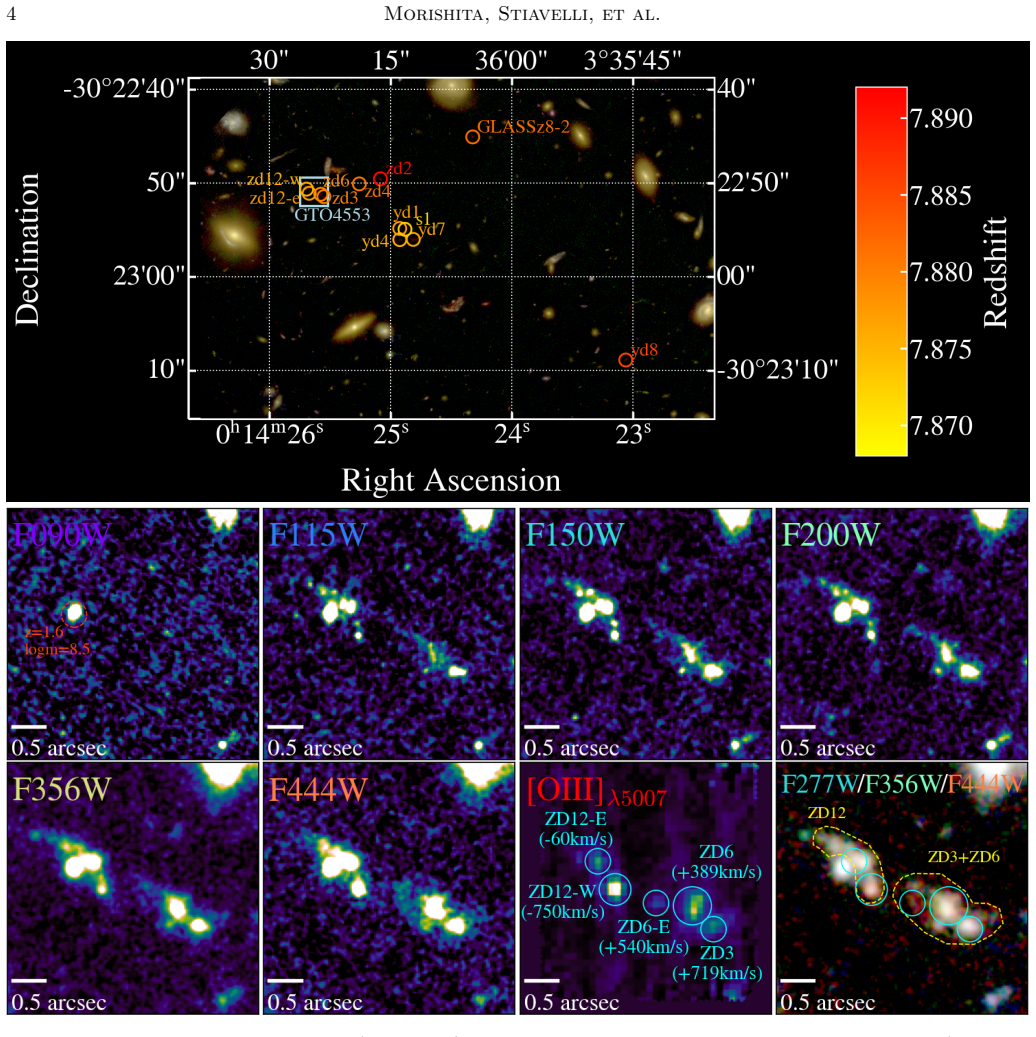
The analysis is carried by the [OIII]5007 emission-line map extracted from the NIRSpec IFU cube, which defines five regions (ZD3, ZD6, ZD6-E, ZD12-W, ZD12-E); the auroral [OIII]4363 detection in ZD12-W enables a direct electron-temperature metallicity, while R3 and R23 strong-line calibrations cover the rest. The load-bearing mechanism is luminosity weighting: because more massive regions outshine less enriched ones, the integrated spectrum is dominated by the enriched components, which is the effect the paper identifies as biasing MSA slit measurements.
What would settle it
Measure Balmer decrements (H-gamma/H-beta or, with longer-wavelength coverage, H-alpha/H-beta) for each of the five [OIII] regions in this system. If dust-corrected fluxes yield metallicities within ~0.3 dex of each other across ZD3, ZD6, ZD12-W, and ZD12-E, the claimed ~1 dex internal scatter would disappear; conversely, confirming the decrements would verify the dust-correction step.
Extended reading notes
Core claim
The central claim is that the ~1 dex metallicity scatter previously inferred for high-redshift galaxies is physically real and spatially resolved in this system: separate [OIII]-emitting regions within one z=7.88 merging galaxy differ by about an order of magnitude in oxygen abundance. A direct electron-temperature measurement in ZD12-W gives log(O/H)+12=7.41, while strong-line calibrations put ZD6 near 8 and ZD12-E below 7. The integrated (aperture) spectra trace the more enriched components, confirming that luminosity-weighted measurements are biased against low-metallicity star formation. The paper connects this scatter to four unresolved UV-bright clumps with star-formation surface densities above 30 solar masses per year per $kpc^{2}$, which provide an environment for rapid enrichment and dilution cycles.
Load-bearing premise
The metallicities of all but one region rely on dust-correcting [OIII] and Hbeta fluxes with an SED-based extinction rescaled by a fixed factor, and on the R3/R23 strong-line calibration being valid for these dense, high-redshift clumps; if either is off by ~0.3 dex, part of the claimed ~1 dex scatter would shrink, though the direct-T measurement of ZD12-W anchors the low-metallicity end.
Editorial extensions
If this is right
- Slit-based NIRSpec MSA metallicity measurements of early galaxies are systematically biased toward enriched regions, so reported metallicities may overestimate the true ISM abundance.
- The unresolved, intensely star-forming clumps in ZD12 are plausible sites of rapid metal enrichment and may be the environments where metal-poor star formation survives.
- Merger-driven assembly, not smooth accretion, can produce large internal metallicity variations in early galaxies, adding to the scatter around the mass-metallicity relation.
- The direct-T metallicity at z=7.88 in ZD12-W provides a benchmark for calibrating strong-line methods in the early universe.
- Updated protocluster properties (overdensity delta=44, total halo mass ~5.8e11 Msun, velocity dispersion 1100 km/s) place A2744-z7p9 among the densest structures known at z~8.
Reading between the lines
- If luminosity weighting is as strong as this system suggests, current JWST surveys that place MSA slits on galaxy photocenters may systematically miss the most pristine, lowest-metallicity star formation, and the true high-redshift mass-metallicity relation could be shallower than reported.
- The same bias should apply to other element abundance ratios (e.g., N/O) measured from integrated light; spatially resolved IFU follow-up of lensed systems could test whether N-enriched and O-poor regions are mixed.
- A testable prediction is that higher-resolution IFU observations of other z>7 merging systems will find similar 0.5-1 dex internal scatter, concentrated in compact clumps with high surface star-formation density.
- The unresolved clumps in ZD12 could be young massive clusters or proto-globular clusters; deep spectroscopy of nitrogen and argon lines would distinguish these and connect the scatter to cluster formation.
Editorial analysis
A structured set of objections, weighed in public.
Referee Report
Summary. This paper presents JWST/NIRSpec IFU G395H/F290LP observations of the merging galaxy system A2744-z7p9 at z=7.88. The authors identify five [O III]5007-emitting regions, including the newly confirmed galaxy ZD12, and detect the auroral [O III]4363 line in one region (ZD12-W), from which they derive a direct electron-temperature oxygen abundance of 12+log(O/H)=7.41+0.19-0.17. For the remaining regions they use the R3 and R23 strong-line calibrations of Sanders et al. (2024), reporting a ~1 dex metallicity spread, with ZD6 at 12+log(O/H)=7.92 and ZD12-E at 6.91. They then argue that integrated spectra are biased toward the more enriched components, so that slit-based MSA observations can miss metal-poor star formation. In addition, NIRCam F150W imaging reveals 10 UV-bright clumps in ZD12, four of which are unresolved with high star-formation surface densities, and the paper updates the overdensity, halo mass, and velocity dispersion of the protocluster.
Significance. If the measured ~1 dex metallicity scatter is real, this is an important result: it would be one of the first spatially resolved demonstrations at z~8 that chemical enrichment varies on sub-kiloparsec scales, with a direct-T measurement anchoring the low-metallicity end. The paper combines a clean IFU detection, a credible direct-T analysis, and a careful clump decomposition, and it makes a concrete, falsifiable prediction about the biases of slit-based spectroscopy. The main caveat is that the headline scatter rests on strong-line metallicities whose branch assignment and error budget are not yet fully demonstrated; the direct-T anchor alone does not remove that caveat.
major comments (3)
- [Sec. 3.2.2 and Table 2] The reported strong-line metallicities for ZD6 and ZD3+ZD6 carry uncertainties of ±0.01 dex, which is not consistent with the line-flux errors in Table 1. For ZD6, Hβ is measured at 22.8 ± 7.7 (34% error) and [O III]5007 at 382.8 ± 32.6 (8.5% error); propagating these in quadrature for the R3 index gives a random error of ~0.15 dex in log(O/H), not 0.01 dex. The quoted value therefore appears to omit the dominant random errors and any covariance between the line fluxes. Since ZD6 defines the high-metallicity end of the claimed ~1 dex scatter, the error budget for these values must be presented transparently; as written, the table overstates the precision of the strongest constraint on the scatter.
- [Sec. 3.2.2] The paper does not break the known double-valued degeneracy of R3 and R23 for ZD6 and ZD12-E. ZD12-E has R3 = log(26.1/6.9) ≈ 0.578, which can be reproduced either on the low-metallicity branch (12+log(O/H)=6.91, as quoted) or on the high-metallicity branch near 12+log(O/H)~8 where R3 turns over. Agreement between R3 and R23 does not resolve this degeneracy because both indices share the same branch structure and are drawn from the same calibration library. The direct-T measurement for ZD12-W (Sec. 3.2.1) anchors the R3–Z relation at one point only, not at the extremes represented by ZD6 and ZD12-E. The authors should demonstrate the branch choice, for example using [O II]/[O III] ratios or a photoionization model grid, or at minimum quote the high-branch alternative. Without this, the ~1 dex scatter in Fig. 4 could be a calibration artifact rather than an astrophysical result.
- [Sec. 3.1] The dust correction for the emission lines rests on rescaling SED-derived A_V by a fixed factor of 2.27 from Calzetti et al. (2000), with no Balmer-decrement verification except in ZD12-W. This is an external assumption applied to all five regions, and the paper does not report how the metallicities, especially the direct-T value in ZD12-W, change if the factor is varied or if no dust correction is applied. The auroral-to-Balmer ratio [O III]4363/Hβ used for ZD12-W spans a wider wavelength baseline than R3, so the direct-T anchor is not immune to this assumption. A short sensitivity test (e.g., adopting A_V directly, or halving/doubling the 2.27 factor) should be added so the reader can judge whether the ~1 dex scatter and the absolute metallicity scale are robust.
minor comments (4)
- [Fig. 4] The direct-T value for ZD12-W is discussed in the text but does not appear to be shown in Fig. 4; adding it with its asymmetric error bars would help the reader judge the consistency of the strong-line scale.
- [Sec. 4.1] The sentence describing the redshift evolution of the scatter ('from ~0.1 at z~0 ... to ~0.2 at ~0.2 dex at 3<z<5 and ~0.3 dex at z>5') is awkwardly phrased and should be rewritten for clarity.
- [Table 2] The footnote for ZD12-W gives the direct-T metallicity, but the table itself lists R3 and R23 values for the same region; a column header or note clarifying which values are used in Fig. 4 would avoid confusion.
- [Sec. 3.2.1] The phrase 'estimate the O+ temperature from the O++ temperature to 1.5e4 K' should read '... to be 1.5e4 K' for grammatical clarity.
Circularity Check
No significant circularity: the metallicity scatter is derived from external calibrations and a direct-T measurement, and the outshining interpretation is a flux-weighted consequence of independent line fluxes, not a fitted prediction.
full rationale
The paper's central claim, a ~1 dex metallicity scatter among sub-kiloparsec regions at z=7.88, is not manufactured from the paper's own inputs. The direct-T abundance for ZD12-W follows from the detected [OIII]4363 auroral line, with Te and ne solved via standard Izotov/Osterbrock relations and the density dependence checked against ne=1 and 10000 cm^-3. The other metallicities use the R3 and R23 strong-line calibrations of Sanders et al. (2024), an externally published calibration built on z=2-9 direct-T galaxies, with the paper explicitly noting that an independent Chakraborty et al. (2024) calibration gives similar values within ~0.1 dex. No parameter is fitted to the target scatter and then renamed a prediction. The statement that integrated spectra are 'more represented by enriched components' is an inference from the measured line fluxes: the integrated ZD3+ZD6 system has log(O/H)+12~7.9, ZD3 alone is ~7.3, and ZD6 alone is ~7.9, so the integrated value naturally tracks the brighter, more enriched region. This is a weighted-sum consequence of the observations, not a self-consistent fit. The paper does use self-citations (Morishita et al. 2024d for the dust-rescaling validation and for the z>5 mass-metallicity reference, and the gsf SED code), but these are contextual tools and comparisons rather than load-bearing steps in deriving the metallicity scatter; no uniqueness theorem or ansatz is imported from the authors' prior work. The dual-branch R3/R23 degeneracy raised by a skeptical reader is a legitimate external-calibration systematic, not a circular reduction: it concerns whether the external calibrations are accurate at the extremes, not whether the paper's result is equivalent to its inputs. The conclusion is therefore self-contained against external benchmarks, with only minor contextual self-citations, so no circularity is identified.
Assumptions & free parameters
free parameters (3)
- Per-region dust attenuation A_V from SED fitting =
Not tabulated; derived with gsf from photometry
- Per-clump stellar masses and mass-to-light ratios from SED fitting and galfit =
log M*/M_sun ~ 7.6 to 8.9 for UV clumps
- galfit Sersic parameters (half-light radius and index) for the 10 UV clumps =
Four clumps unresolved with Re upper limits; n=0.5-4.0 for resolved clumps
assumptions (5)
- domain assumption The electron temperature and abundance relations of Izotov et al. (2006) and Osterbrock (1989) apply to the z=7.88 gas.
- domain assumption The Sanders et al. (2024) R3 and R23 strong-line calibrations, built from z=2-9 direct-T galaxies, are valid for the five [OIII] regions here.
- ad hoc to paper The Calzetti et al. (2000) factor of 2.27, applied to SED-derived A_V, accurately corrects emission-line fluxes.
- domain assumption The lens model of Bergamini et al. (2023a,b) accurately predicts magnification at these positions.
- domain assumption The five [OIII] regions are physically associated members of a merging system rather than chance projections along the line of sight.
Cite this review
Pith. "Pith review of Metallicity Scatter Originating from Sub-kiloparsec Starbursting Clumps in the Core of a Protocluster at z=7.88." pith.science (2026). https://pith.science/paper/YUN4XLSJ
@misc{pith2026250111879,
  author       = {Pith},
  title        = {Pith review of: Metallicity Scatter Originating from Sub-kiloparsec Starbursting Clumps in the Core of a Protocluster at z=7.88},
  year         = {2026},
  howpublished = {\url{https://pith.science/paper/YUN4XLSJ}},
  note         = {Machine review of arXiv:2501.11879}
}
abstract
We present new JWST NIRSpec integral field unit (IFU) G395H/F290LP observations of a merging galaxy system at $z=7.88$, part of A2744-z7p9, the most distant protocluster to date. The IFU cube reveals [OIII] emissions in two previously known galaxies (ZD3 and ZD6) and a newly identified galaxy, ZD12, at $z_{\rm spec}=7.8762$. One of the detected \oiii-emitting regions has a detection of the auroral [OIII]4363, line, allowing us to derive a direct metallicity of $\log$(O/H)$+12=7.4\pm0.2$, while metallicities in other regions are measured using strong line calibration methods. We find large deviations within the measured metallicity ($\Delta \log {\rm (O/H)}\sim1$), which suggests a fast chemical enrichment from intense star formation and merger-driven growth, as expected in early galaxies. Our analysis shows that metal-poor regions could easily be outshone by more enriched regions, posing a challenge for spectroscopic analysis based on integrated light (i.e., NIRSpec MSA) against identifying metal-free star formation in the early universe. NIRCam imaging reveals seven UV-bright clumps in ZD12, in the range of stellar mass $\log M_*/M_\odot\sim7.6$--8.9. Four of them are unresolved ($< 100$pc) and intensely star-forming ($>30 M_\odot {\rm yr^{-1} kpc^{-2}}$), likely contributing to the scatter in metallicity by producing an ideal environment for rapid chemical cycles. Lastly, we revisit the nature of the host protocluster by including new member galaxies identified here and in the literature, and obtain local overdensity factor $\delta=44_{-31}^{+89}$, total halo mass $M_{\rm h} = 5.8_{-0.3}^{+0.2}\times10^{11}\,M_\odot$, and a formal velocity dispersion of $1100\pm500$ km s$^{-1}$.
Figures


Figures from the paper (4 more)


Reference graph
Works this paper leans on
-
[1]
Abdurro’uf, Larson, R. L., Coe, D., et al. 2024, ApJ, 973, 47, doi: 10.3847/1538-4357/ad6001
-
[2]
Adamo, A., Bradley, L. D., Vanzella, E., et al. 2024, arXiv e-prints, arXiv:2401.03224, doi: 10.48550/arXiv.2401.03224 Metallicity Scatter in the Core of a Protocluster atz = 7.88 13
-
[3]
Andrews, B. H., & Martini, P. 2013, ApJ, 765, 140, doi: 10.1088/0004-637X/765/2/140 Astropy Collaboration, Robitaille, T. P., Tollerud, E. J., et al. 2013, A&A, 558, A33, doi: 10.1051/0004-6361/201322068 Astropy Collaboration, Price-Whelan, A. M., Sip˝ ocz, B. M., et al. 2018, AJ, 156, 123, doi: 10.3847/1538-3881/aabc4f Astropy Collaboration, Price-Whelan...
-
[4]
Beers, T. C., Flynn, K., & Gebhardt, K. 1990, AJ, 100, 32, doi: 10.1086/115487
doi:10.1086/115487 1990
-
[5]
2017, MNRAS, 469, 151, doi: 10.1093/mnras/stx789
Belfiore, F., Maiolino, R., Tremonti, C., et al. 2017, MNRAS, 469, 151, doi: 10.1093/mnras/stx789
-
[6]
2023a, A&A, 670, A60, doi: 10.1051/0004-6361/202244575 —
Bergamini, P., Acebron, A., Grillo, C., et al. 2023a, A&A, 670, A60, doi: 10.1051/0004-6361/202244575 —. 2023b, ApJ, 952, 84, doi: 10.3847/1538-4357/acd643
-
[7]
1996, A&AS, 117, 393
Bertin, E., & Arnouts, S. 1996, A&AS, 117, 393
1996
- [8]
Show all 93 references
-
[9]
J., Oesch, P
Bouwens, R. J., Oesch, P. A., Stefanon, M., et al. 2021, AJ, 162, 47, doi: 10.3847/1538-3881/abf83e
2021 doi
-
[10]
2024, Nature Astronomy, doi: 10.1038/s41550-024-02218-7
Boyett, K., Trenti, M., Leethochawalit, N., et al. 2024, Nature Astronomy, doi: 10.1038/s41550-024-02218-7
2024 doi
-
[11]
2023, larrybradley/lacosmic: 1.1.0, 1.1.0, Zenodo, doi: 10.5281/zenodo.10145563
Bradley, L. 2023, larrybradley/lacosmic: 1.1.0, 1.1.0, Zenodo, doi: 10.5281/zenodo.10145563
2023 doi
-
[12]
2023, JWST Calibration Pipeline, 1.10.0, Zenodo, doi: 10.5281/zenodo.7795697
Bushouse, H., Eisenhamer, J., Dencheva, N., et al. 2023, JWST Calibration Pipeline, 1.10.0, Zenodo, doi: 10.5281/zenodo.7795697
2023 doi
-
[13]
C., et al
Calzetti, D., Armus, L., Bohlin, R. C., et al. 2000, ApJ, 533, 682, doi: 10.1086/308692
2000 doi
-
[14]
2003, MNRAS, 342, 345, doi: 10.1046/j.1365-8711.2003.06541.x
Cappellari, M., & Copin, Y. 2003, MNRAS, 342, 345, doi: 10.1046/j.1365-8711.2003.06541.x
2003
-
[15]
2003, PASP, 115, 763, doi: 10.1086/376392
Chabrier, G. 2003, PASP, 115, 763, doi: 10.1086/376392
2003 doi
-
[16]
2024, arXiv e-prints, arXiv:2412.15435, doi: 10.48550/arXiv.2412.15435
Chakraborty, P., Sarkar, A., Smith, R., et al. 2024, arXiv e-prints, arXiv:2412.15435, doi: 10.48550/arXiv.2412.15435
2024 doi
-
[17]
2024, ApJL, 976, L15, doi: 10.3847/2041-8213/ad8dc910.1134/ S1063772908080040
Chemerynska, I., Atek, H., Dayal, P., et al. 2024, ApJL, 976, L15, doi: 10.3847/2041-8213/ad8dc910.1134/ S1063772908080040
2024 doi
-
[18]
2022, Transient Name Server AstroNote, 166, 1
Chen, W., Kelly, P., Morishita, T., et al. 2022, Transient Name Server AstroNote, 166, 1
2022
-
[19]
P., Mason, C., et al
Chen, Z., Stark, D. P., Mason, C., et al. 2024, MNRAS, 528, 7052, doi: 10.1093/mnras/stae455
2024 doi
-
[20]
2018, MNRAS, 481, 1690, doi: 10.1093/mnras/sty2380
Chisholm, J., Tremonti, C., & Leitherer, C. 2018, MNRAS, 481, 1690, doi: 10.1093/mnras/sty2380
2018 doi
-
[21]
2020, MNRAS, 491, 944, doi: 10.1093/mnras/stz2910
Curti, M., Mannucci, F., Cresci, G., & Maiolino, R. 2020, MNRAS, 491, 944, doi: 10.1093/mnras/stz2910
2020 doi
- [22]
-
[23]
2024, arXiv e-prints, arXiv:2403.11428, doi: 10.48550/arXiv.2403.11428
Dalmasso, N., Calabr` o, A., Leethochawalit, N., et al. 2024, arXiv e-prints, arXiv:2403.11428, doi: 10.48550/arXiv.2403.11428
2024 doi
-
[24]
2008, MNRAS, 386, 577, doi: 10.1111/j.1365-2966.2008.13075.x
Fakhouri, O., & Ma, C.-P. 2008, MNRAS, 386, 577, doi: 10.1111/j.1365-2966.2008.13075.x
2008
-
[25]
2014, doi: 10.5281/zenodo.12157
Foreman-Mackey, D., Sick, J., & Johnson, B. 2014, doi: 10.5281/zenodo.12157
2014 doi
- [26]
-
[27]
E., et al
Fukugita, M., Ichikawa, T., Gunn, J. E., et al. 1996, AJ, 111, 1748, doi: 10.1086/117915
1996 doi
-
[28]
Gallazzi, A., Charlot, S., Brinchmann, J., White, S. D. M., & Tremonti, C. A. 2005, MNRAS, 362, 41, doi: 10.1111/j.1365-2966.2005.09321.x
2005
-
[29]
D., Clayton, G
Gordon, K. D., Clayton, G. C., Misselt, K. A., Landolt, A. U., & Wolff, M. J. 2003, ApJ, 594, 279, doi: 10.1086/376774
2003 doi
-
[30]
R., Millman, K
Harris, C. R., Millman, K. J., van der Walt, S. J., et al. 2020, Nature, 585, 357, doi: 10.1038/s41586-020-2649-2
2020 doi
-
[31]
2023, ApJL, 955, L2, doi: 10.3847/2041-8213/acf57c
Hashimoto, T., ´Alvarez-M´ arquez, J., Fudamoto, Y., et al. 2023, ApJL, 955, L2, doi: 10.3847/2041-8213/acf57c
2023 doi
-
[32]
E., Brammer, G
Heintz, K. E., Brammer, G. B., Gim´ enez-Arteaga, C., et al. 2023, Nature Astronomy, 7, 1517, doi: 10.1038/s41550-023-02078-7
2023 doi
-
[33]
Y.-Y., Coe, D., Abdurro’uf, et al
Hsiao, T. Y.-Y., Coe, D., Abdurro’uf, et al. 2023, ApJL, 949, L34, doi: 10.3847/2041-8213/acc94b
2023 doi
-
[34]
2016, ApJ, 822, 5, doi: 10.3847/0004-637X/822/1/5
Ishigaki, M., Ouchi, M., & Harikane, Y. 2016, ApJ, 822, 5, doi: 10.3847/0004-637X/822/1/5
2016 doi
-
[35]
2023, ApJ, 956, 139, doi: 10.3847/1538-4357/acf376
Isobe, Y., Ouchi, M., Nakajima, K., et al. 2023, ApJ, 956, 139, doi: 10.3847/1538-4357/acf376
2023 doi
-
[36]
Thuan, T. X. 2006, A&A, 448, 955, doi: 10.1051/0004-6361:20053763
2006 doi
-
[37]
C., Bowler, R., Bunker, A
Jones, G. C., Bowler, R., Bunker, A. J., et al. 2024, arXiv e-prints, arXiv:2412.15027, doi: 10.48550/arXiv.2412.15027
2024 doi
-
[38]
L., Diego, J
Kelly, P. L., Diego, J. M., Rodney, S., et al. 2018, Nature Astronomy, 2, 334, doi: 10.1038/s41550-018-0430-3
2018 doi
-
[39]
1998, ApJ, 498, 541, doi: 10.1086/305588
Kennicutt, Robert C., J. 1998, ApJ, 498, 541, doi: 10.1086/305588
1998 doi
-
[40]
N., Cohen, J
Kirby, E. N., Cohen, J. G., Guhathakurta, P., et al. 2013, ApJ, 779, 102, doi: 10.1088/0004-637X/779/2/102
2013 doi
-
[41]
2014, A&A, 562, L8, doi: 10.1051/0004-6361/201323179
Laporte, N., Streblyanska, A., Clement, B., et al. 2014, A&A, 562, L8, doi: 10.1051/0004-6361/201323179
2014 doi
-
[42]
H., Maseda, M
Laseter, I. H., Maseda, M. V., Curti, M., et al. 2024, A&A, 681, A70, doi: 10.1051/0004-6361/202347133 14 Morishita, Stiavelli, et al
2024 doi
- [43]
-
[44]
M., Koekemoer, A., Coe, D., et al
Lotz, J. M., Koekemoer, A., Coe, D., et al. 2017, ApJ, 837, 97, doi: 10.3847/1538-4357/837/1/97
2017 doi
-
[45]
F., Faucher-Gigu` ere, C.-A., et al
Ma, X., Hopkins, P. F., Faucher-Gigu` ere, C.-A., et al. 2016, MNRAS, 456, 2140, doi: 10.1093/mnras/stv2659
2016 doi
-
[46]
2010, MNRAS, 408, 2115, doi: 10.1111/j.1365-2966.2010.17291.x
Gnerucci, A. 2010, MNRAS, 408, 2115, doi: 10.1111/j.1365-2966.2010.17291.x
2010
- [47]
-
[48]
A., Trenti, M., & Treu, T
Mason, C. A., Trenti, M., & Treu, T. 2023, MNRAS, 521, 497, doi: 10.1093/mnras/stad035
2023 doi
-
[49]
2022, ApJL, 938, L14, doi: 10.3847/2041-8213/ac8f93
Merlin, E., Bonchi, A., Paris, D., et al. 2022, ApJL, 938, L14, doi: 10.3847/2041-8213/ac8f93
2022 doi
-
[50]
2024a, MNRAS, 529, 2162, doi: 10.1093/mnras/stae565
Messa, M., Dessauges-Zavadsky, M., Adamo, A., Richard, J., & Claeyssens, A. 2024a, MNRAS, 529, 2162, doi: 10.1093/mnras/stae565
-
[51]
2024b, arXiv e-prints, arXiv:2407.20331, doi: 10.48550/arXiv.2407.20331 Meˇ stri´ c, U., Vanzella, E., Zanella, A., et al
Messa, M., Vanzella, E., Loiacono, F., et al. 2024b, arXiv e-prints, arXiv:2407.20331, doi: 10.48550/arXiv.2407.20331 Meˇ stri´ c, U., Vanzella, E., Zanella, A., et al. 2022, MNRAS, 516, 3532, doi: 10.1093/mnras/stac2309
-
[52]
Mirocha, J., & Furlanetto, S. R. 2023, MNRAS, 519, 843, doi: 10.1093/mnras/stac3578
2023 doi
-
[53]
2023, ApJL, 946, L35, doi: 10.3847/2041-8213/acbf50
Morishita, T., & Stiavelli, M. 2023, ApJL, 946, L35, doi: 10.3847/2041-8213/acbf50
2023 doi
-
[54]
E., Treu, T., et al
Morishita, T., Abramson, L. E., Treu, T., et al. 2019, ApJ, 877, 141, doi: 10.3847/1538-4357/ab1d53
2019 doi
-
[55]
2023, ApJL, 947, L24, doi: 10.3847/2041-8213/acb99e
Morishita, T., Roberts-Borsani, G., Treu, T., et al. 2023, ApJL, 947, L24, doi: 10.3847/2041-8213/acb99e
2023 doi
-
[56]
2024a, ApJ, 963, 9, doi: 10.3847/1538-4357/ad1404
Morishita, T., Stiavelli, M., Chary, R.-R., et al. 2024a, ApJ, 963, 9, doi: 10.3847/1538-4357/ad1404
- [57]
- [58]
-
[59]
2024d, ApJ, 971, 43, doi: 10.3847/1538-4357/ad5290 Mu˜ noz, J
Morishita, T., Stiavelli, M., Grillo, C., et al. 2024d, ApJ, 971, 43, doi: 10.3847/1538-4357/ad5290 Mu˜ noz, J. B., Mirocha, J., Chisholm, J., Furlanetto, S. R., & Mason, C. 2024, MNRAS, 535, L37, doi: 10.1093/mnrasl/slae086
2024 doi
- [60]
- [61]
-
[62]
2024, ApJ, 975, 238, doi: 10.3847/1538-4357/ad7d0b
Nakazato, Y., Ceverino, D., & Yoshida, N. 2024, ApJ, 975, 238, doi: 10.3847/1538-4357/ad7d0b
2024 doi
-
[63]
A., Kannappan, S
Norris, M. A., Kannappan, S. J., Forbes, D. A., et al. 2014, MNRAS, 443, 1151, doi: 10.1093/mnras/stu1186
2014 doi
- [64]
-
[65]
D., & Dav´ e, R
Oppenheimer, B. D., & Dav´ e, R. 2006, MNRAS, 373, 1265, doi: 10.1111/j.1365-2966.2006.10989.x
2006
-
[66]
Osterbrock, D. E. 1989, Astrophysics of gaseous nebulae and active galactic nuclei
1989
- [67]
-
[68]
Y., Ho, L
Peng, C. Y., Ho, L. C., Impey, C. D., & Rix, H.-W. 2002, AJ, 124, 266, doi: 10.1086/340952 —. 2010, AJ, 139, 2097, doi: 10.1088/0004-6256/139/6/2097
2002 doi
-
[69]
2012, ApJS, 199, 25, doi: 10.1088/0067-0049/199/2/25
Postman, M., Coe, D., Ben ´ ıtez, N., et al. 2012, ApJS, 199, 25, doi: 10.1088/0067-0049/199/2/25
2012 doi
-
[70]
A., et al
Prieto-Lyon, G., Strait, V., Mason, C. A., et al. 2023, A&A, 672, A186, doi: 10.1051/0004-6361/202245532
2023 doi
- [71]
-
[72]
2022, ApJL, 938, L13, doi: 10.3847/2041-8213/ac8e6e
Roberts-Borsani, G., Morishita, T., Treu, T., et al. 2022, ApJL, 938, L13, doi: 10.3847/2041-8213/ac8e6e
2022 doi
-
[73]
2015, MNRAS, 449, 49, doi: 10.1093/mnras/stv264
Rodriguez-Gomez, V., Genel, S., Vogelsberger, M., et al. 2015, MNRAS, 449, 49, doi: 10.1093/mnras/stv264
2015 doi
- [74]
-
[75]
I., Verhamme, A., et al
Schaerer, D., Izotov, Y. I., Verhamme, A., et al. 2016, A&A, 591, L8, doi: 10.1051/0004-6361/201628943
2016 doi
- [76]
- [77]
- [78]
-
[79]
J., Labb´ e, I., et al
Smit, R., Bouwens, R. J., Labb´ e, I., et al. 2016, ApJ, 833, 254, doi: 10.3847/1538-4357/833/2/254
2016 doi
-
[80]
L., Jauzac, M., Acebron, A., et al
Steinhardt, C. L., Jauzac, M., Acebron, A., et al. 2020, ApJS, 247, 64, doi: 10.3847/1538-4365/ab75ed Metallicity Scatter in the Core of a Protocluster atz = 7.88 15
2020 doi
- [81]
- [82]
- [83]
-
[84]
2024, ApJ, 970, 14, doi: 10.3847/1538-4357/ad499a
Yajima, H. 2024, ApJ, 970, 14, doi: 10.3847/1538-4357/ad499a
2024 doi
-
[85]
W., Stark, D
Topping, M. W., Stark, D. P., Senchyna, P., et al. 2024, MNRAS, 529, 3301, doi: 10.1093/mnras/stae682
2024 doi
-
[86]
A., Heckman, T
Tremonti, C. A., Heckman, T. M., Kauffmann, G., et al. 2004, ApJ, 613, 898, doi: 10.1086/423264
2004 doi
-
[87]
2022, ApJ, 935, 110, doi: 10.3847/1538-4357/ac8158
Treu, T., Roberts-Borsani, G., Bradac, M., et al. 2022, ApJ, 935, 110, doi: 10.3847/1538-4357/ac8158
2022 doi
-
[88]
S., & Werk, J
Tumlinson, J., Peeples, M. S., & Werk, J. K. 2017, ARA&A, 55, 389, doi: 10.1146/annurev-astro-091916-055240 van Dokkum, P. G. 2001, PASP, 113, 1420, doi: 10.1086/323894
2017 doi
-
[89]
2022, ApJL, 940, L53, doi: 10.3847/2041-8213/ac8c2d
Vanzella, E., Castellano, M., Bergamini, P., et al. 2022, ApJL, 940, L53, doi: 10.3847/2041-8213/ac8c2d
2022 doi
-
[90]
2023a, ApJ, 945, 53, doi: 10.3847/1538-4357/acb59a
Vanzella, E., Claeyssens, A., Welch, B., et al. 2023a, ApJ, 945, 53, doi: 10.3847/1538-4357/acb59a
-
[91]
2023b, A&A, 678, A173, doi: 10.1051/0004-6361/202346981
Vanzella, E., Loiacono, F., Bergamini, P., et al. 2023b, A&A, 678, A173, doi: 10.1051/0004-6361/202346981
-
[92]
2024, A&A, 691, A251, doi: 10.1051/0004-6361/202451696
Vanzella, E., Loiacono, F., Messa, M., et al. 2024, A&A, 691, A251, doi: 10.1051/0004-6361/202451696
2024 doi
-
[93]
2014, ApJ, 795, 93, doi: 10.1088/0004-637X/795/1/93
Zheng, W., Shu, X., Moustakas, J., et al. 2014, ApJ, 795, 93, doi: 10.1088/0004-637X/795/1/93
2014 doi
Reviewed August 10, 2026 · model on record in the stance chip above.
Discussion (0). Continue with ORCID to comment.