REVIEW 2 major objections 6 minor 13 references
ESSnuSB status
T0 review · 2 major / 6 minor · reviewed 2026-08-10 · deepseek-v4-flash
Pith's one-line read This paper reports that the proposed ESSnuSB experiment would, after ten years of running, cover about 72% of possible CP-violating phase values at 5σ significance and measure the CP-violating phase δ_CP to better than 8 degrees.
desk verdict Status report with one new toy simulation; the headline sensitivity numbers are CDR restatements resting on an undefended 5% normalization systematic. read the letter →
The pith
A machine-rendered reading of the paper's core claim, the machinery that carries it, and where it could break.
The reading
What carries the argument
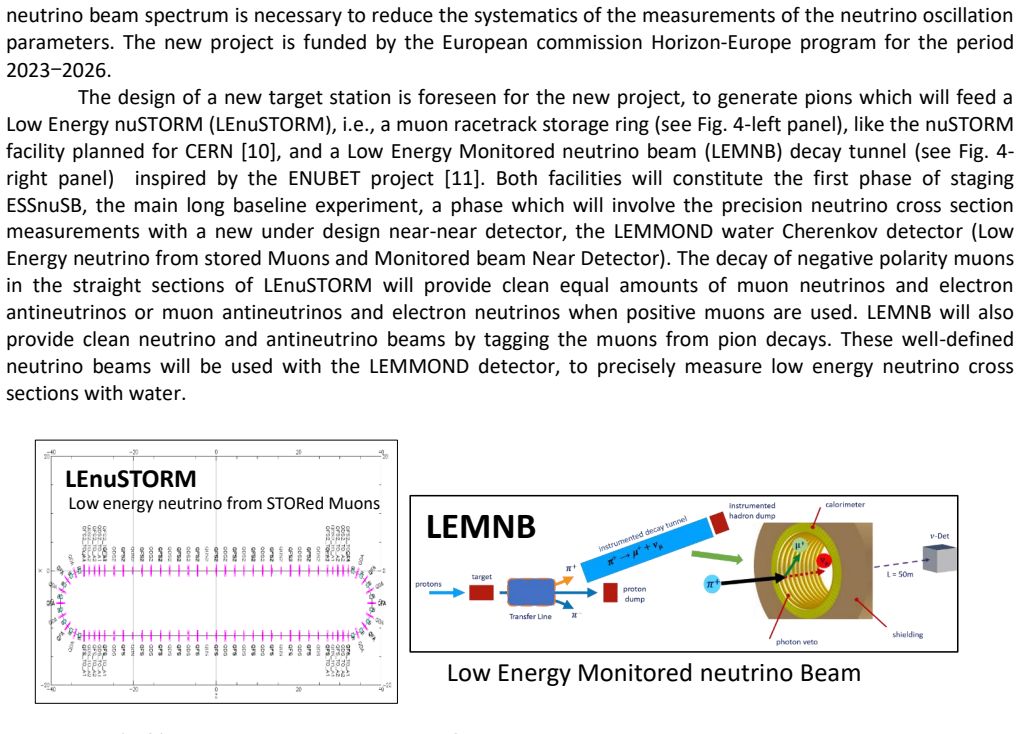
The mechanism that carries the argument is the second oscillation maximum: at ESSnuSB's beam energies and 360 km baseline, the $\nu_\mu\to\nu_e$ oscillation probability has its second peak in the relevant part of the spectrum. At that peak the CP-violating interference term is enhanced relative to the CP-conserving terms, making the neutrino–antineutrino asymmetry roughly 2.5 times larger and reducing matter-induced fake CP violation. This is the design choice that turns a single accelerator and a distant water tank into a sub-8° measurement of $\delta_\mathrm{CP}$. The beam and detector infrastructure (the accumulator ring that shortens the proton pulses, the four-target horn station, the water Cherenkov near and far detectors, and the monitored low-energy beams of ESSnuSB+) is what makes the physics reach realistic.
What would settle it
The decisive check is the normalization systematic and the reconstructed phase distribution: if the near/far detector cross-calibration yields a flux uncertainty above 5%, or if a full 10-year simulation gives a $\delta_\mathrm{CP}$ uncertainty larger than $8^\circ$ for any input value, the Fig. 3 projections fail; after real running, the fraction of injected true phase values excluded at $\geq5\sigma$ would need to reach 72% for the central claim to hold.
Extended reading notes
Core claim
On the paper's own terms, the quantity to pin down is $\delta_\mathrm{CP}$, the phase in the lepton mixing matrix that controls CP violation. ESSnuSB is arranged so that most of its flux arrives at the second oscillation maximum, where the asymmetry between $\nu_\mu\to\nu_e$ and $\bar\nu_\mu\to\bar\nu_e$ is about 2.5 times larger than at the first maximum and matter effects that can mimic CP violation are much smaller. Using a 360 km baseline, a 540 kt water Cherenkov far detector, five years of neutrinos and five years of antineutrinos, and assuming a 5% normalization systematic, the conceptual design report predicts that the no-CPV hypothesis is excluded at 5σ for 72% of possible $\delta_\mathrm{CP}$ values, that maximal values near $\pm90^\circ$ would be seen at about 12σ, and that the reconstructed phase is accurate to better than 8° for every true value.
Load-bearing premise
The sensitivity projections assume a 5% normalization uncertainty on the neutrino flux and detector efficiency, with exactly five years of neutrino running and five years of antineutrino running; if the near/far calibration cannot hold the systematic at 5%, the claimed 72% coverage and sub-8° precision are not reached.
Editorial extensions
If this is right
- After 5 years of neutrinos and 5 years of antineutrinos, ESSnuSB would reject the no-CP-violation hypothesis at 5$\sigma$ significance for about 72% of possible true $\delta_\mathrm{CP}$ values.
- The experiment would measure $\delta_\mathrm{CP}$ with an uncertainty below $8^\circ$ for every true value in its full range.
- Because most of the neutrino spectrum sits at the second oscillation maximum, the CP-violation signal is less affected by matter effects and by systematic uncertainties than a first-maximum experiment at the same baseline.
- ESSnuSB+ would provide clean neutrino and antineutrino beams in the 0.2–0.6 GeV range to measure neutrino–water cross sections, and its short-baseline configuration could search for sterile neutrinos with mass-splittings near 1–10 eV².
- Atmospheric neutrinos in the far detector alone could determine the neutrino mass ordering and the $\theta_{23}$ octant at 3$\sigma$ within a few years of running.
Reading between the lines
- If the sub-8° precision materializes, a measured $\delta_\mathrm{CP}$ would become a discriminator between flavour-symmetry models that predict specific phase values, not just a test of whether CP is violated at all.
- The neutrino–water cross-section data from LEnuSTORM and LEMNB in the 0.2–0.6 GeV range would likely be relevant to any future water Cherenkov detector, because the same interaction channels enter atmospheric-neutrino and supernova-neutrino physics.
- The monitored-beam technique could in principle lower the normalization systematic below the assumed 5%, which would push the CP-violation coverage beyond the 72% projected in Fig. 3.
- A sterile-neutrino signal in the short-baseline setup would change how the long-baseline oscillation data are interpreted, so the two phases of the program are not fully independent even though they are staged.
Editorial analysis
A structured set of objections, weighed in public.
Referee Report
Summary. This paper is a status report of the ESSnuSB and ESSnuSB+ projects. It summarizes the proposed accelerator upgrades, the long-baseline neutrino oscillation setup with a far detector at Zinkgruvan, and the physics reach from the collaboration's Conceptual Design Report: about 72% coverage of the δ_CP range at 5σ discovery significance after 10 years and a precision better than 8° on δ_CP. It then describes the ESSnuSB+ extension, which adds a Low Energy nuSTORM, a monitored neutrino beam, and a new water Cherenkov near-near detector (LEMMOND), with a preliminary simulation of LEMMOND's angular and vertex resolution. The paper also mentions studies of atmospheric neutrinos, non-standard interactions, quantum decoherence, and sterile neutrinos.
Significance. The main strength of the paper is that it gives a compact, authoritative status of a large design study and clearly attributes the headline sensitivity numbers to the published CDR (ref. [6]). The new LEMMOND simulation results, although preliminary, are a useful first step toward quantifying the performance of the proposed detector. If the quoted sensitivity figures hold, ESSnuSB would provide complementary and in some respects superior CPV precision to DUNE and Hyper-K. However, the paper is explicitly a status report: it contains no new physics results and the quantitative CPV claims are not derived within this manuscript. Its value lies in providing an up-to-date overview and in proposing a staged program for cross-section measurements and sterile-neutrino searches.
major comments (2)
- [Section 'The ESSnuSB project', paragraph introducing Fig. 3] The quoted CPV sensitivity (12σ at maximal violation, 72% coverage at 5σ, precision better than 8°) is stated to assume a 5% normalization uncertainty, but the manuscript provides no systematic uncertainty budget and no justification for this value. Since the sensitivity at maximal violation is about 12σ, the result is likely systematic-limited; a doubling of the normalization uncertainty to 10% would roughly halve the significance and could reduce the 5σ coverage to well below 50%. The authors should either justify the 5% assumption, present a scan over the normalization uncertainty, or explicitly state that these figures are taken from the CDR and refer to the relevant systematic studies in [6].
- [Section 'The ESSnuSB+ project', LEMMOND paragraph, and Fig. 5] There is an internal inconsistency in the reported z-resolution: the text states a precision of "about 6 cm" for the 1.5 ns sensor time resolution, while the Figure 5 caption reports "<3 cm" and the right panel shows σ_Z ≈ 2.9 cm for the same timing resolution. This discrepancy must be resolved and the quoted values harmonized.
minor comments (6)
- [Figure 5 caption] The caption contains a garbled sentence: "A less than 1 o θ resolution (left) was obtained for a toy detector consisted of a single sensor plane and a <3 cm (<1 cm) resolution for the z position of the muon verted was obtained (right)". This should be corrected to read, for example, "A less than 1° θ resolution (left) was obtained for a toy detector consisting of a single sensor plane, and a <3 cm (<1 cm) resolution for the z position of the muon vertex was obtained (right)."
- [Equation (1)] The text has "PΜΝS" instead of "PMNS" and the summation index "I<j" should be "i<j".
- [Section 'The ESSnuSB project', paragraph on matter effects] The statement "The matter effects are not important for ESSnuSB because the neutrino energy spectrum is partly on the second oscillation maximum" is qualitative; a quantitative estimate or a reference to the CDR would make this more convincing.
- [Reference [9]] Reference [9] is incomplete: "LHEP-517, 202." lacks page numbers or a DOI; reference [11] has a typo "{11}" instead of "[11]".
- [Abstract] The claim that ESSnuSB is "the most precise proposed experiment in the field" should be supported by a direct comparison of the δ_CP precision with DUNE and Hyper-K, or be rephrased to "one of the most precise".
- [Section 'The ESSnuSB+ project', LEMMOND simulation] The meaning of "25% coverage" in the LEMMOND simulation should be clarified (e.g., fraction of the detector plane covered by photosensor active area).
Circularity Check
No circularity: the sensitivity figures are transparently attributed to the collaboration's own CDR and are Monte Carlo projections, not derivations that reduce to their inputs.
full rationale
The paper is a status report rather than a derivation. Its central quantitative claims, the 72% CPV coverage at 5 sigma and the better-than-8-degree precision on delta_CP, are explicitly presented as results already obtained elsewhere: the abstract says 'The ESSnuSB CDR showed that after 10 years, about 72% of the possible CP violating phase range will be covered with 5 sigma C.L.,' and Section 2 says 'The main physics results obtained from this study are shown in Fig. 3.' These numbers come from Monte Carlo simulations under the stated assumptions of 5% normalization uncertainty and 5 years each of neutrino and antineutrino running; they are not obtained by fitting the target result, nor is any defining equation equivalent to the conclusion. The physics inputs, Eqs. (1) and (2), are standard oscillation formulae and a definition of the matter-antimatter asymmetry, and they are not used to derive the sensitivity figures within the paper. The cited CDR and follow-up papers are prior work by the collaboration, but this is normal self-citation and not load-bearing in a circular sense, since the cited reports contain independent simulations. Concerns about the realism of the 5% normalization assumption or the robustness of the 72% coverage to larger systematics are legitimate experimental-robustness criticisms, but they do not constitute circularity. No step in the paper reduces, by construction, to its own input. Therefore the appropriate circularity score is 0.
Assumptions & free parameters
free parameters (4)
- Normalization uncertainty =
5%
- Run time per polarity =
5 years nu + 5 years nu-bar
- Far detector mass =
2 x 270 kt water
- LEMMOND sensor parameters =
25% QE, 25% coverage, 1.5 ns or 120 ps timing
assumptions (4)
- standard math The PMNS three-neutrino oscillation framework with standard matter effects is valid; sterile neutrinos are neglected in the CPV analysis.
- domain assumption The ESS proton linac can be upgraded to accelerate H- at 2.5 GeV and 5 MW and compressed to microsecond pulses via an accumulator ring without compromising the neutron program.
- domain assumption The systematic uncertainty on the neutrino flux and detector response can be controlled at the level of 5% normalization.
- domain assumption The far detector can reconstruct neutrino energy and flavor with the assumed efficiency and resolution in the 0.2-0.6 GeV range.
Cite this review
Pith. "Pith review of ESSnuSB status." pith.science (2026). https://pith.science/paper/UKDFS7ZX
@misc{pith2026250112297,
  author       = {Pith},
  title        = {Pith review of: ESSnuSB status},
  year         = {2026},
  howpublished = {\url{https://pith.science/paper/UKDFS7ZX}},
  note         = {Machine review of arXiv:2501.12297}
}
read the original abstract
ESSnuSB (the European Spallation neutrino Super Beam) is a design study for a long-baseline neutrino experiment to precisely measure the CP violation in the leptonic sector, at the second neutrino oscillation maximum, using a beam driven by the uniquely powerful ESS linear accelerator. The ESSnuSB CDR showed that after 10 years, about 72% of the possible CP violating phase range will be covered with 5 sigma C.L. to reject the no CP violation hypothesis. The expected precision for the CP violating phase is better than 8 degrees for all allowed values, making it the most precise proposed experiment in the field. The extension project, ESSnuSB+, aims in designing two new facilities, a Low Energy nuSTORM and a Low Energy Monitored Neutrino Beam to use them to precisely measure the neutrino-nucleus cross-section in the energy range of 0.2 to 0.6 GeV. A new water Cherenkov detector will also be designed to measure cross sections and serve to explore the sterile neutrino case.
Figures


Figures from the paper (1 more)

Reference graph
Works this paper leans on
-
[6]
Alekou et al., The European Spallation Source neutrino super-beam conceptual design report
A. Alekou et al., The European Spallation Source neutrino super-beam conceptual design report. Eur. Phys. J. ST 2022, 231, 3779–3955, [arXiv:hep-ex/2206.01208]. https://doi.org/10.1140/epjs/s11734-022-00664-w
arXiv 2022
-
[1]
K. Abe et al. [ Hyper-K Collaboration]. Hyper -Kamiokande Design Report. arXiv 2018, arXiv:physics.ins -det/1805.04163.; B. Abi et al. [DUNE Collaboration]. Deep Underground Neutrino Experiment (DUNE), Far Detector Technical Design Report, Volume II: DUNE Physics. arXiv 2020, arXiv:hep-ex/2002.03005; JUNO collaboration. JUNO Physics and Detector. Progress...
arXiv 2022
- [2]
-
[3]
P. Ballett et al. Testing solar lepton mixing sum rules in neutrino oscillation experiments. JHEP12 (2014) 122; I. Girardi et al. CPV Predictions from Flavour Symmetries. PoS (NOW2016) 027 , DOI: https://doi.org/10.22323/1.283.0027
-
[4]
S. Navas et al. (Particle Data Group), Phys. Rev. D 110, 030001 (2024) , section 14: Neutrino masses, mixing and oscillations, revised by M.C. Gonzalez-Garcia et al
work page 2024
-
[5]
B. Pontecorvo. Mesonium and anti -mesonium. Sov. Phys. J. Exp. Theor. Phys. 1957, 6, 429; B. Pontecorvo. Inverse beta processes and nonconservation of lepton charge. Sov. Phys. J. Exp. Theor. Phys. 1958, 7, 172–173; Z Maki, M. Nakagawa, Y. Ohnuki, S. Sakata. A unified model for elementary particles. Prog. Theor. Phys. 1960, 23, 1174–1180; Z. Maki, M. Naka...
work page 1957
-
[7]
Neutrinos: Theory and Phenomenology
Stephen Parke, Neutrinos: Theory and Phenomenology. https://arxiv.org/pdf/1310.5992
-
[8]
Alekou et al., The ESSnuSB design study: overview and future prospects
A. Alekou et al., The ESSnuSB design study: overview and future prospects. Universe 9, 347 (2023)
work page 2023
Show all 13 references
-
[9]
Tolba et al
T. Tolba et al. Search for Leptonic CP Violation with the ESSnuSBplus Project. LHEP-517, 202
-
[10]
L. A. Ruso et al., Neutrinos from Stored Muons (nuSTORM). arXiv:2203.07545, in Proc. of the Snowmass 2021 (2022). [11} A. Longhin and F. Terranova, Enhanced NeUtrino BEams from kaon Tagging (ENUBET). arXiv:2203.08319, in Proc. Of the Snowmass 2021 (2022)
2022 arXiv
-
[12]
Aguilar et al
J. Aguilar et al. Exploring atmospheric neutrino oscillations at ESSnuSB. http://arxiv.org/abs/2407.21663
-
[13]
Aguilar et al
J. Aguilar et al. Study of nonstandard interactions mediated by a scalar field at the ESSnuSB experiment . Phys. Rev. D 109, (2024) 115010
2024
-
[14]
Ghosh et al
M. Ghosh et al. Quantum Decoherence at ESSnuSB Experiment . arXiv:2404.17559 [hep-ex] accepted for publication in JHEP
Reviewed August 10, 2026 · model on record in the stance chip above.
Discussion (0). Continue with ORCID to comment.